Stay Ahead, Stay ONMINE

GPT-6 models demonstrate intrinsic protein-design capabilities

Key findings:Our GPT‑6 family of models can design new protein shapes and the sequence of their chemical building blocks using only reasoning and code, without calling specialized biology models to generate those designs.An internal research model matched or outperformed specialized models on many protein design tasks. Researchers could also guide designs by prompting the model on where a protein should attach and what shape it should take.In lab tests with Onava, proteins based on GPT‑6.2’s designs showed evidence of binding, or attachment, across five targets. Redesigned antibodies also retained binding. Specialized models helped supply sequences and select candidates for testing.The models’ written reasoning and code suggest they draw on math, physics, chemistry, and biological knowledge to reason about protein shapes and interactions with other molecules.In a preprint titled GPT‑6 as a Universal Foundation Model for Protein Biology: Beyond Specialized Models, we show that our GPT‑6 family of models has intrinsic capabilities for designing new proteins: the models can design new protein structures and sequences without relying on specialized biology models, using only reasoning and general-purpose coding tools.Proteins do much of the work in living cells. They drive the chemical reactions that sustain life, carry oxygen through the blood, and defend the body against infection. Incorrectly shaped proteins can also cause disease and dysfunction. Proteins are made from chains of chemical building blocks called amino acids. The order, or sequence, of these amino acids helps determine how a protein folds into a three-dimensional shape, which in turn influences what it does.Scientists often start with a clear idea of what they want a protein to do. They might want it to block a signal that helps cancer cells evade the immune system or to help capture carbon dioxide from the air. The challenge is to work out what three-dimensional structure would enable the protein to do its job and which amino acid sequence would give it that structure. Specialized biology models capable of generating three-dimensional protein structures and sequences have made this work more practical.Using and coordinating these specialized models requires substantial expertise. Each accepts particular kinds of inputs and constraints, and these models cannot easily accept new kinds of information without changes to their software or additional training. In contrast, a general-purpose model capable of performing the work of multiple specialized models can easily adapt to new instructions and requirements.Our research illustrates the potential power of pairing natural language with intrinsic protein capabilities. We could guide our models at scales ranging from a single bond between two atoms to the overall shape of a protein. For example, we asked GPT‑6.2 to predict where and how a small molecule would bind to a protein. When we already knew which two atoms formed a bond, we could give the model that information and ask how the rest of the molecule would fit. We could switch between these tasks simply by changing the prompt, without retraining the model. We also asked our models to design small proteins called minibinders and marked where each should attach to its target, and further specified how many coils or strands each minibinder should contain. An internal model followed that instruction with near-perfect fidelity in its three-dimensional designs.Points farther from the center indicate better performance. Newer generations of models improved on many of the 14 protein tasks tested.A closer look at our models’ protein designsWe ran computational tests of whether the GPT‑6 models series could design small proteins to bind given targets, build proteins around specified structural features, predict protein structures and molecular interactions, and rank how sequence changes affect properties such as stability and binding. Our latest models performed comparably to or better than specialized models on most tasks, although predicting a complete protein structure remained a clear weakness.The models’ written reasoning and code offer clues to how they approach these tasks. They draw on mathematics, physics, chemistry, and coding alongside knowledge of recurring patterns in protein sequences and structures. For example, when designing a small protein intended to bind to IL-7Rα, the model proposed how the two proteins might interact, then wrote and executed code to explore different protein shapes and amino acid choices that could support that interaction.The model’s written reasoning and code show it drawing on math, physics, chemistry and biology to design a protein intended to attach to IL-7Rα. It examines the target’s surface, arranges five coiled sections into a protein shape, and checks how the two proteins could fit together.With our research partner, Onava⁠(opens in a new window), we also tested the models’ structure and sequence designs in the lab. First, Onava made small proteins based on three-dimensional structures designed by a pre-released version of GPT‑6.2. Specialized models supplied amino acid sequences and helped select candidates for testing. For each of the five targets we chose, at least one protein showed evidence of binding in the lab. In separate experiments, GPT‑6.2 designed new amino acid sequences for existing minibinders and antibodies. Following candidate selection with specialized models, many of the redesigned proteins also showed evidence of binding to the same targets as the originals.Laboratory Experiment 1: Designing small proteins that bind to a targetOur first laboratory experiment tested whether GPT‑6.2 could design small proteins that would bind to their intended targets. We compared computational measurements of quality against RFdiffusion, a specialized model for protein design, and found that GPT‑6.2’s three-dimensional designs scored slightly lower while our latest internal models scored higher. For the lab experiment, we made proteins based on GPT‑6.2’s designs and measured how strongly they bound to their targets.We gave GPT‑6.2 the three-dimensional structures of five target proteins and marked where we wanted a minibinder to attach. It then wrote code to create three-dimensional designs for potential minibinders, without using specialized protein AI models.To turn GPT‑6.2’s three-dimensional designs into proteins we could test in the lab, we needed amino acid sequences that would fold into the proposed structures. We used a specialized AI model called SolubleMPNN to suggest sequences for each design. Other specialized protein models helped us select candidates predicted to fold as designed and bind at the intended site on the target.GPT‑6.2 designed shapes for small proteins intended to attach to chosen targets. Specialized models then proposed amino acid sequences—the order of the proteins’ chemical building blocks—and helped select designs for our research partner Onava to make and test in the lab.We tested 322 minibinders against 5 targets in the lab. Of those, 35 (10.9%) tested positive for binding to their intended target. We found 5 hits for PD-L1 (a protein some cancers use to evade the immune system), 3 for IL-7Rα, 1 for TrkA, 8 for VEGF-A and 18 for IL-17A. The original RFdiffusion study⁠(opens in a new window) reported higher hit rates, but rates depend heavily on how strictly researchers filter designs before lab validation and their definition of binding. Nevertheless, our results provide early evidence that we can turn GPT‑6.2’s three-dimensional designs into proteins that bind to their intended targets in the lab.An internal research model designed shapes for small proteins intended to attach to the target proteins shown in gray. The colored shapes compare each design with a computational prediction of how the protein would fold and fit against its target.Laboratory Experiment 2: Designing new sequences for 3D protein structuresWe tested whether GPT‑6.2 could design the sequences itself. We gave it three-dimensional models of how existing minibinders fit against their targets, withheld the original amino acid sequences, and asked it to propose new ones. Specialized models helped us choose which proteins to make and test in the lab.For three targets, we started with computationally predicted structures of confirmed minibinders whose sequences Onava had collected from earlier studies. In our initial lab screens, we saw binding in 75 of 88 designs for MDM2 (85%), 26 of 42 for VEGF-A (62%), and 8 of 59 for PD-1 (14%). The amino acid sequences proposed by GPT‑6.2 also often differed significantly from the original minibinder sequences, with a median of 50% for VEGF-A, 43% for MDM2, and 15% for PD-1.We also asked GPT‑6.2 to design new sequences for three unpublished minibinder shapes it had generated earlier: two targeting PD-L1 and one targeting IL-7Rα. A specialized model, ProteinMPNN, had already supplied one sequence for each shape, and proteins made from those sequences had shown binding in the lab. Of the 107 proteins made from GPT‑6.2’s new sequences, 14 (13.1%) showed binding.Given an unpublished structure, GPT‑6.2 had come up with two substantially different sequences that both showed signs of binding to the same target. For the same PD-L1 minibinder structure, GPT‑6.2 designed two sequences different from the original in 52 and 58 out of 90 total amino acids. The two also differed from each other at 44 positions, nearly half the sequence.The unpublished structures and substantial differences in sequence give us strong evidence that GPT‑6.2’s capabilities extend beyond memorization. The results also suggest we could use GPT‑6.2 to intrinsically design both a minibinder’s structure and its sequence.Redesigning the parts of an antibody that bind to a targetResearchers often redesign an antibody’s binding loops to help it grip its target more tightly, a process called affinity maturation. They may also want it to bind more selectively, so it’s less likely to attach to similar proteins. We tested a first step toward those goals by asking our models to design new loop sequences that preserved binding to the original target.We started with six small antibodies (VHHs) that bind to the same protein, IL-4Rα. For each antibody, we gave GPT‑6.2 its predicted three-dimensional structure and most of its amino acid sequence, leaving out the three loops that help the antibody grip its target. We asked the model to design new sequences for them. Of the 182 designs we tested, 128 (70%) showed signs of binding to IL-4Rα.We then tested how precisely we could guide the model’s changes to existing therapeutic antibodies. This time, we gave the model the original sequences and asked it to change about half the amino acids in each of three binding loops while keeping the rest of the sequence intact. We tested the redesigned portions of the antibodies as fragments in the lab. Of 272 fragments based on five therapeutic antibodies, 179 (66%) showed binding to the original target, PD-1 or PD-L1.What else can our models design and predict?Precise control over minibinder structures for programmable structure designA long-term goal of programmable structure-based design is to let researchers specify structural constraints in natural language. In our computational evaluations, our models consistently designed minibinders that contacted the required locations on the target. We could also specify the minibinder’s structural class (all helices, all strands, or a combination) and control the number of coils and strands with near-perfect fidelity. The same approach lets us express more detailed requirements for the binding interface, such as which target amino acids should be buried upon binding or whether the minibinder and target should interact through specific interactions such as “β-sheet–β-sheet”. As our model’s reasoning capabilities improve, we envision researchers guiding protein structure generation much as they guide image generation today, by describing the features they want.Our model was asked to design small proteins with specified shapes: mainly coils (orange), mainly strands (blue), or a mix. Some instructions also specified how many coils or strands to include. The designs are intended to attach to PD-L1 or PD-1, shown in gray.Building a protein around a specified structural featureMost enzymes are proteins that speed up chemical reactions. When designing a new enzyme, researchers may know how a few key amino acids need to be arranged at the site where the reaction happens. Those amino acids can lie far apart along the protein chain. The challenge is to design the rest of the protein so that, as the chain folds, it brings them together and holds them in place.We tested our models on 30 challenges from MotifBench⁠(opens in a new window), including examples drawn from enzymes and from sites where proteins bind to one another. We gave the models a specific three-dimensional arrangement of amino acids, called a motif, and asked them to use coding tools to design the rest of the protein around it. This task is called motif scaffolding.For each design, we used ProteinMPNN to propose eight possible amino acid sequences, and ESMFold⁠(opens in a new window) to predict how each would fold. We counted the design as a success if at least one predicted structure both preserved the motif and closely matched the overall structure the model had designed.In a preliminary analysis, 43.7% of the designs we evaluated from our latest internal model met both criteria, compared with 27.8% for RFdiffusion. While laboratory experiments are needed to find out whether these proteins could carry out the intended function, such as speeding up a particular reaction, this provides strong computational evidence of our models’ intrinsic protein capabilities.An internal research model designed protein structures around a small region whose shape had to stay fixed, shown in gold. The colored shapes compare the model’s designs with computer predictions of how the proteins would fold. Panels showing only gold had no design that passed the computer checks.Designing a protein with a specified foldIn motif scaffolding, we specified how a few amino acids should sit relative to one another. We then determined whether we could also guide the design of an entire protein by specifying its overall fold. We gave our models a chain length and a code from CATH⁠(opens in a new window), a system scientists use to classify protein structures. The models then had to work out where each amino acid should go in three-dimensional space.Many designs captured the broad layout we asked for. The harder part was getting the chain to follow the right path through it. Two proteins can have several coiled stretches packed together in a similar bundle, for example, yet differ in the order in which the chain connects them.We counted a design as a success if at least one amino acid sequence was predicted to adopt the requested fold and closely match the model’s three-dimensional design. Across 200 challenges, 18.9% of the designs we evaluated from our latest internal model passed, compared with 17.1% for Proteina, a specialized protein design model.An internal research model was asked to design proteins with specified overall shapes, such as bundles of coils or layers of strands. The colored shapes compare selected designs with computer predictions of how they would fold, showing examples where the two closely match.Predicting how chemicals and proteins fit togetherMany medicines, including aspirin, are small molecules, chemical compounds much smaller than the proteins they act on. Predicting where a small molecule binds to a protein and how it fits there is called docking. These predictions can help researchers decide how to modify a drug candidate so it binds more tightly to its target. To test our models, we started with experimentally determined structures of small molecules bound to proteins. We digitally removed each small molecule and gave the models the protein structure along with a text description of how the molecule’s atoms were connected (a sequence of characters called SMILES). We then asked the models to predict where the molecule had been bound and how it was oriented.For our first docking test, we used the PoseBusters dataset⁠(opens in a new window), a collection of three-dimensional structures that show how small molecules bind to proteins. Researchers determined these structures experimentally, giving us a way to check the models’ predictions. Without being told where on the protein each molecule had bound, the models had to predict both where the molecule fit and which way it faced. GPT‑6.2 closely matched the molecule’s observed position and orientation in 93% of scored predictions, compared with 96% for our latest internal model and 50% for DiffDock-L, a specialized docking model.In practice, researchers may already know something about how a molecule binds. One major advantage of a GPT model is that we can give additional information directly in the prompt. We tested this on 179 structures from the Scarpino dataset⁠(opens in a new window), where each protein structure forms a chemical bond with a small molecule, tethering the two together. We told our models which two atoms formed the bond and asked them to predict how the rest of the molecule fit against the protein. GPT‑6.2 closely matched the experimental structure in 92% of scored predictions⁠(opens in a new window), and our latest internal model did so in 97%, while DiffDock⁠(opens in a new window) reached 60%.An internal research model predicted where and how small molecules would fit against proteins, shown in gray. Purple shows the model’s predictions, and teal shows the molecules’ positions determined in earlier experiments. In these examples, the predictions closely match the experimental structures.Predicting how antibodies bind to proteinsWhere an antibody binds can help explain whether it blocks another protein from attaching to the same site. We tested how accurately successive generations of GPT could predict where an antibody binds and which way it faces. For hundreds of pairs of antibodies and targets, we showed the models the two proteins separately and hid some of the atomic detail (all side chains) on their surfaces.With the side-chain details hidden, the mean DockQ score (a commonly used metric in which higher values indicate a closer match to the experimentally observed arrangement) increased from approximately 0.05 for GPT‑5.6 to 0.28 for GPT‑6, 0.57 for GPT‑6.2, and 0.81 for our latest internal model, at each model’s highest evaluated compute setting.Because these structures were public, the models may have seen the same antibody-target pairs or similar ones during training. Even so, each generation of our models predicted more accurately how the two proteins fit together, even with all side-chain positions hidden. That progress gives us reason to be optimistic about harder docking problems.Each row compares four models’ predictions of how an antibody attaches to its target protein. Colored shapes show the model’s prediction; dark gray shows the position observed in experiments. Results improved with each successive generation of model.Predicting the effects of mutationsWe can design far more proteins on a computer than we can make and test in the lab. Even after we settle on a promising structure, we may have many amino acid sequences to choose from. We tested whether our models could help researchers decide which versions to make first by predicting how changes to a protein’s sequence would affect its stability, activity, or ability to bind to a target.We drew on four public datasets from experiments in which scientists had replaced one or more amino acids in a protein and measured the effects. For each test, we gave our models the sequence of the protein the scientists started with and the sequences of 50 modified versions. We told the models what the scientists had measured, withheld the results, and asked them to rank the 50 versions without using coding tools, by reasoning only.In one study of protein stability, we asked the models to rank 50 versions of a protein by how likely each was to be folded at room temperature. We compared the predicted order with the order observed in the lab using a measure called rank correlation. A value of 1 means the rankings match perfectly, 0 means there’s no consistent relationship, and −1 means the order is exactly reversed. Across 265 sets from the stability study, each model generation improved, from 0.41 for GPT‑5.6 to 0.52 for GPT‑6, 0.57 for GPT‑6.2, and 0.66 for our latest internal model.In each of the four datasets, GPT‑6.2 and our latest internal model produced more accurate rankings on average than ESM2-650M, a specialized protein model.Early signals from our model’s protein structure predictionsEarlier, we relied on specialized models to predict whether an amino acid sequence would fold into the structure our models had designed. We wanted to see how close our models are to making that prediction themselves. We gave our models the amino acid sequences of proteins with known three-dimensional structures. Using only basic coding tools, the models predicted how each chain would fold in three dimensions. We evaluated their predictions using a measure called TM-score. A score of 1 means a perfect match to the real structure, and scores above 0.5 generally indicate that the prediction captures the overall fold.The biggest gains are visible in individual examples. For some proteins, our latest internal model closely reproduced folds that earlier models missed. Across the full test, the average score rose from 0.16 for GPT‑5.6 to 0.26 for GPT‑6.2 and 0.38 for our latest internal model. The specialized model ESMFold2 averaged 0.93, so there’s still a substantial gap in how reliably our models can predict a whole protein’s structure from its sequence alone.What if researchers already know most of the structure and want to fill in a missing piece? We tested this on 100 antibody fragments. For each one, we gave our models the amino acid sequences and the surrounding three-dimension structure, hiding the six loops that help the antibody recognize its target. Our latest internal model often predicted both the shape and position of those loops quite accurately. ESMFold2 was still more accurate overall, even working from the sequences alone.Each model was given the same protein sequence—the order of its chemical building blocks—and asked to predict its 3D shape. The colored shapes show the predictions, and dark gray shows the structure measured in experiments.Each model was given a partial structure and tasked with predicting the missing regions corresponding to the antibody CDRs. The colored regions show predictions from the internal model and ESMFold2 compared with the experimentally determined structures.LimitationsIt is important to note that our protein design campaign relied on specialized structure prediction models such as Boltz-2, OpenDDE, and ESMFold2 to filter candidates. Our results show that GPT models have intrinsic capabilities comparable to specialized models at two stages of the workflow: backbone generation, where researchers commonly use RFdiffusion; and sequence redesign, where they commonly use ProteinMPNN. Our results therefore do not yet establish that our models can generate de novo minibinders end-to-end in a zero-shot setting without help from specialized models.Our work demonstrates yet again the jagged capability frontier. Predicting a complete protein structure from its amino acid sequence remains substantially harder for our models than several of the component tasks above. On that task, even our best internal models remained well behind specialized structure-prediction models.Some benchmark results also require careful interpretation. In tests that asked models to infer amino acid sequences from protein structures, unusually high accuracy may partly reflect memorization or patterns left by the process used to generate those structures. Those results alone do not establish reliable performance on unfamiliar proteins.The laboratory results provide a more direct test of whether proposed designs can work, but binding is only one step toward a useful research tool or medicine. Further work would need to establish properties such as specificity, stability, and biological activity, along with safety and efficacy for therapeutic applications.What’s nextThis work is an early step toward programmable molecular design at OpenAI. Our goal is to let scientists describe what they want a molecule to do in plain language and use our models to help design candidates to test in the lab. To make that approach useful for developing medicines, we want to make progress in three areas.Find minibinders for harder targets. We want to design molecules that bind to targets where our attempts so far have fallen short.Design for what happens after binding. We want to test whether the molecules we design can produce a specific biological effect, such as killing a cancer cell. We also want to design molecules that bind selectively to their intended targets and are practical to manufacture.Design a wider range of molecules. Our lab experiments focused on small protein minibinders and antibody fragments. We’d like to extend that work to molecules that bind to several targets at once, RNA, and small molecules, including a class called PROTACs that direct a cell to break down a particular protein.As we work to accelerate scientific progress safely and responsibly, we also seek to evaluate and reduce risks, particularly those related to biosecurity. The same capabilities that help scientists design proteins for new medicines could also be misused. Our Preparedness Framework⁠ guides how we assess these risks and test safeguards to reduce them.While lab testing remains a critical part of protein design, our goal is to provide powerful models that can shorten each round of design by giving scientists more control and flexibility, and reduce the total number of design-test cycles needed to find a functional protein. Ultimately, we envision enabling scientists to design proteins and molecules simply by prompting our models in natural language, massively accelerating the development of new biotechnologies and new medicines.

Key findings:

  • Our GPT‑6 family of models can design new protein shapes and the sequence of their chemical building blocks using only reasoning and code, without calling specialized biology models to generate those designs.

  • An internal research model matched or outperformed specialized models on many protein design tasks. Researchers could also guide designs by prompting the model on where a protein should attach and what shape it should take.

  • In lab tests with Onava, proteins based on GPT‑6.2’s designs showed evidence of binding, or attachment, across five targets. Redesigned antibodies also retained binding. Specialized models helped supply sequences and select candidates for testing.

  • The models’ written reasoning and code suggest they draw on math, physics, chemistry, and biological knowledge to reason about protein shapes and interactions with other molecules.

In a preprint titled GPT‑6 as a Universal Foundation Model for Protein Biology: Beyond Specialized Models, we show that our GPT‑6 family of models has intrinsic capabilities for designing new proteins: the models can design new protein structures and sequences without relying on specialized biology models, using only reasoning and general-purpose coding tools.

Proteins do much of the work in living cells. They drive the chemical reactions that sustain life, carry oxygen through the blood, and defend the body against infection. Incorrectly shaped proteins can also cause disease and dysfunction. Proteins are made from chains of chemical building blocks called amino acids. The order, or sequence, of these amino acids helps determine how a protein folds into a three-dimensional shape, which in turn influences what it does.

Scientists often start with a clear idea of what they want a protein to do. They might want it to block a signal that helps cancer cells evade the immune system or to help capture carbon dioxide from the air. The challenge is to work out what three-dimensional structure would enable the protein to do its job and which amino acid sequence would give it that structure. Specialized biology models capable of generating three-dimensional protein structures and sequences have made this work more practical.

Using and coordinating these specialized models requires substantial expertise. Each accepts particular kinds of inputs and constraints, and these models cannot easily accept new kinds of information without changes to their software or additional training. In contrast, a general-purpose model capable of performing the work of multiple specialized models can easily adapt to new instructions and requirements.
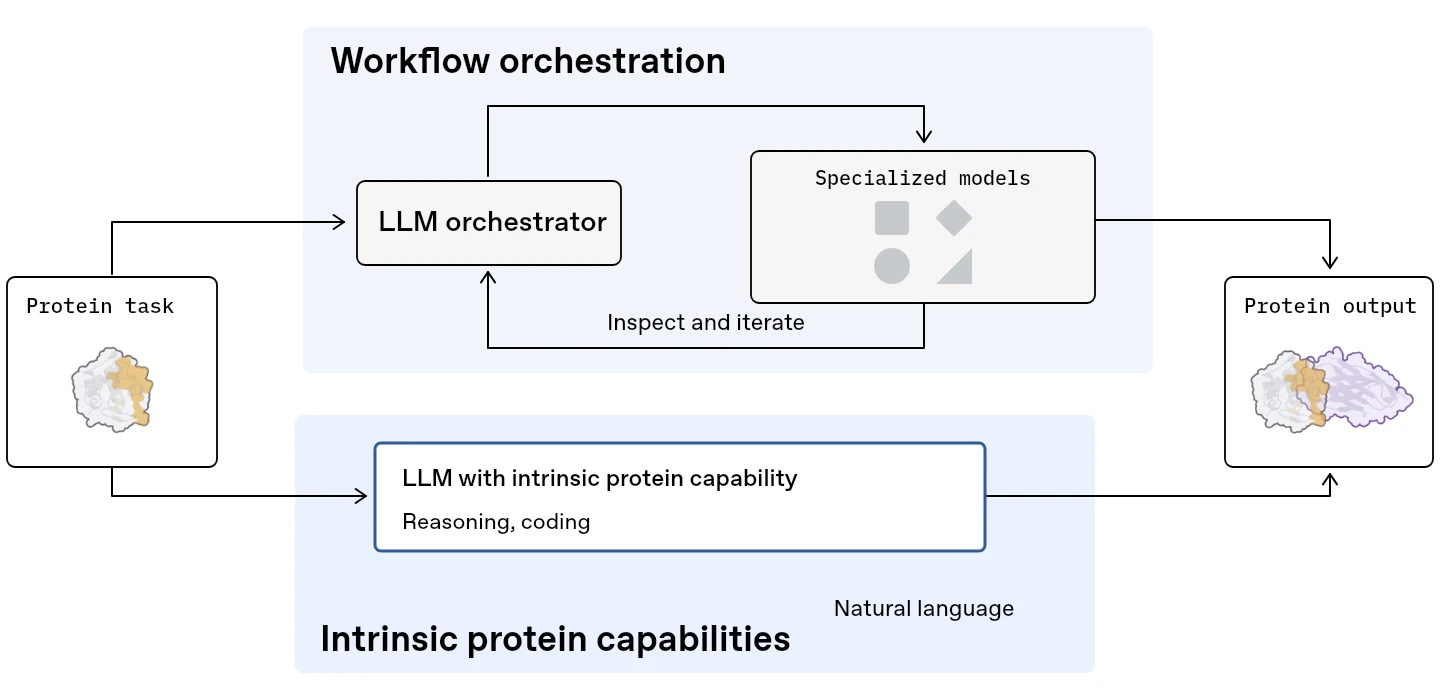
Diagram comparing a language model coordinating specialized tools with a single model handling protein tasks directly.

Our research illustrates the potential power of pairing natural language with intrinsic protein capabilities. We could guide our models at scales ranging from a single bond between two atoms to the overall shape of a protein. For example, we asked GPT‑6.2 to predict where and how a small molecule would bind to a protein. When we already knew which two atoms formed a bond, we could give the model that information and ask how the rest of the molecule would fit. We could switch between these tasks simply by changing the prompt, without retraining the model. We also asked our models to design small proteins called minibinders and marked where each should attach to its target, and further specified how many coils or strands each minibinder should contain. An internal model followed that instruction with near-perfect fidelity in its three-dimensional designs.

Points farther from the center indicate better performance. Newer generations of models improved on many of the 14 protein tasks tested.

A closer look at our models’ protein designs

We ran computational tests of whether the GPT‑6 models series could design small proteins to bind given targets, build proteins around specified structural features, predict protein structures and molecular interactions, and rank how sequence changes affect properties such as stability and binding. Our latest models performed comparably to or better than specialized models on most tasks, although predicting a complete protein structure remained a clear weakness.

The models’ written reasoning and code offer clues to how they approach these tasks. They draw on mathematics, physics, chemistry, and coding alongside knowledge of recurring patterns in protein sequences and structures. For example, when designing a small protein intended to bind to IL-7Rα, the model proposed how the two proteins might interact, then wrote and executed code to explore different protein shapes and amino acid choices that could support that interaction.
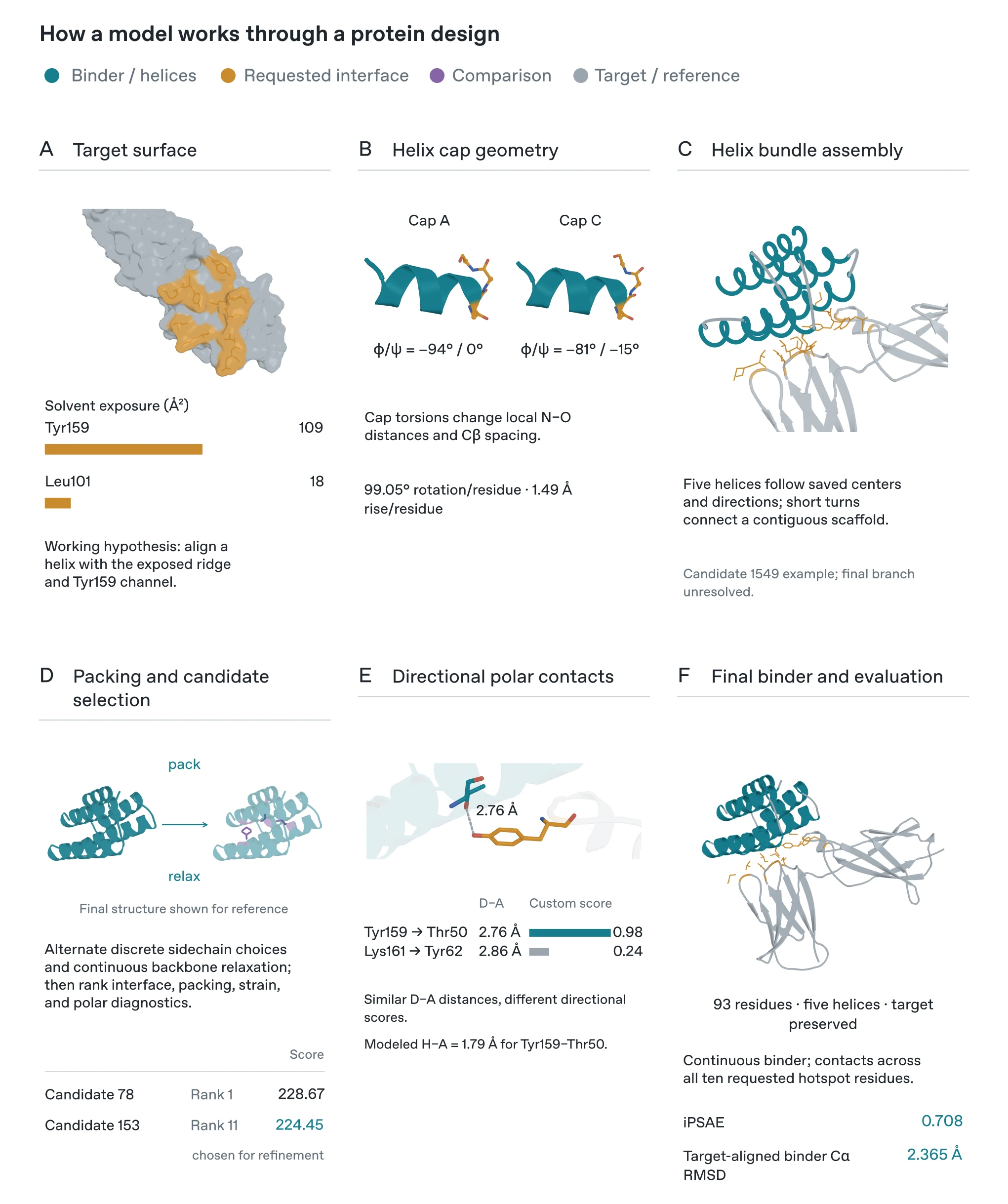
How a model works through a protein design

The model’s written reasoning and code show it drawing on math, physics, chemistry and biology to design a protein intended to attach to IL-7Rα. It examines the target’s surface, arranges five coiled sections into a protein shape, and checks how the two proteins could fit together.

With our research partner, Onava⁠(opens in a new window), we also tested the models’ structure and sequence designs in the lab. First, Onava made small proteins based on three-dimensional structures designed by a pre-released version of GPT‑6.2. Specialized models supplied amino acid sequences and helped select candidates for testing. For each of the five targets we chose, at least one protein showed evidence of binding in the lab. In separate experiments, GPT‑6.2 designed new amino acid sequences for existing minibinders and antibodies. Following candidate selection with specialized models, many of the redesigned proteins also showed evidence of binding to the same targets as the originals.

Laboratory Experiment 1: Designing small proteins that bind to a target

Our first laboratory experiment tested whether GPT‑6.2 could design small proteins that would bind to their intended targets. We compared computational measurements of quality against RFdiffusion, a specialized model for protein design, and found that GPT‑6.2’s three-dimensional designs scored slightly lower while our latest internal models scored higher. For the lab experiment, we made proteins based on GPT‑6.2’s designs and measured how strongly they bound to their targets.

We gave GPT‑6.2 the three-dimensional structures of five target proteins and marked where we wanted a minibinder to attach. It then wrote code to create three-dimensional designs for potential minibinders, without using specialized protein AI models.

To turn GPT‑6.2’s three-dimensional designs into proteins we could test in the lab, we needed amino acid sequences that would fold into the proposed structures. We used a specialized AI model called SolubleMPNN to suggest sequences for each design. Other specialized protein models helped us select candidates predicted to fold as designed and bind at the intended site on the target.
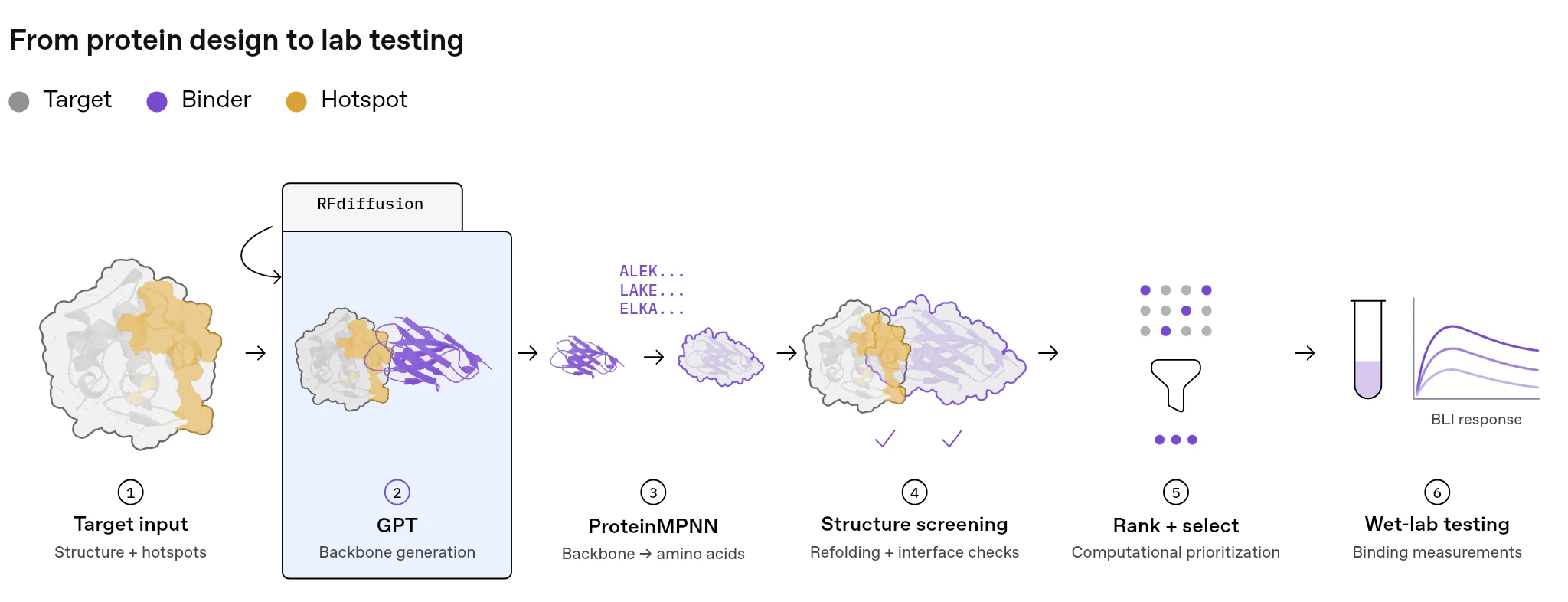
From protein design to lab testing. Workflow from target selection through backbone and sequence design, structure screening, ranking, and lab testing.

GPT‑6.2 designed shapes for small proteins intended to attach to chosen targets. Specialized models then proposed amino acid sequences—the order of the proteins’ chemical building blocks—and helped select designs for our research partner Onava to make and test in the lab.

We tested 322 minibinders against 5 targets in the lab. Of those, 35 (10.9%) tested positive for binding to their intended target. We found 5 hits for PD-L1 (a protein some cancers use to evade the immune system), 3 for IL-7Rα, 1 for TrkA, 8 for VEGF-A and 18 for IL-17A. The original RFdiffusion study⁠(opens in a new window) reported higher hit rates, but rates depend heavily on how strictly researchers filter designs before lab validation and their definition of binding. Nevertheless, our results provide early evidence that we can turn GPT‑6.2’s three-dimensional designs into proteins that bind to their intended targets in the lab.

Designing proteins to attach to specific targets · responsive legend poster

An internal research model designed shapes for small proteins intended to attach to the target proteins shown in gray. The colored shapes compare each design with a computational prediction of how the protein would fold and fit against its target.

Laboratory Experiment 2: Designing new sequences for 3D protein structures

We tested whether GPT‑6.2 could design the sequences itself. We gave it three-dimensional models of how existing minibinders fit against their targets, withheld the original amino acid sequences, and asked it to propose new ones. Specialized models helped us choose which proteins to make and test in the lab.

For three targets, we started with computationally predicted structures of confirmed minibinders whose sequences Onava had collected from earlier studies. In our initial lab screens, we saw binding in 75 of 88 designs for MDM2 (85%), 26 of 42 for VEGF-A (62%), and 8 of 59 for PD-1 (14%). The amino acid sequences proposed by GPT‑6.2 also often differed significantly from the original minibinder sequences, with a median of 50% for VEGF-A, 43% for MDM2, and 15% for PD-1.

We also asked GPT‑6.2 to design new sequences for three unpublished minibinder shapes it had generated earlier: two targeting PD-L1 and one targeting IL-7Rα. A specialized model, ProteinMPNN, had already supplied one sequence for each shape, and proteins made from those sequences had shown binding in the lab. Of the 107 proteins made from GPT‑6.2’s new sequences, 14 (13.1%) showed binding.

Given an unpublished structure, GPT‑6.2 had come up with two substantially different sequences that both showed signs of binding to the same target. For the same PD-L1 minibinder structure, GPT‑6.2 designed two sequences different from the original in 52 and 58 out of 90 total amino acids. The two also differed from each other at 44 positions, nearly half the sequence.

The unpublished structures and substantial differences in sequence give us strong evidence that GPT‑6.2’s capabilities extend beyond memorization. The results also suggest we could use GPT‑6.2 to intrinsically design both a minibinder’s structure and its sequence.

Redesigning the parts of an antibody that bind to a target

Researchers often redesign an antibody’s binding loops to help it grip its target more tightly, a process called affinity maturation. They may also want it to bind more selectively, so it’s less likely to attach to similar proteins. We tested a first step toward those goals by asking our models to design new loop sequences that preserved binding to the original target.

We started with six small antibodies (VHHs) that bind to the same protein, IL-4Rα. For each antibody, we gave GPT‑6.2 its predicted three-dimensional structure and most of its amino acid sequence, leaving out the three loops that help the antibody grip its target. We asked the model to design new sequences for them. Of the 182 designs we tested, 128 (70%) showed signs of binding to IL-4Rα.

We then tested how precisely we could guide the model’s changes to existing therapeutic antibodies. This time, we gave the model the original sequences and asked it to change about half the amino acids in each of three binding loops while keeping the rest of the sequence intact. We tested the redesigned portions of the antibodies as fragments in the lab. Of 272 fragments based on five therapeutic antibodies, 179 (66%) showed binding to the original target, PD-1 or PD-L1.

What else can our models design and predict?

Precise control over minibinder structures for programmable structure design

A long-term goal of programmable structure-based design is to let researchers specify structural constraints in natural language. In our computational evaluations, our models consistently designed minibinders that contacted the required locations on the target. We could also specify the minibinder’s structural class (all helices, all strands, or a combination) and control the number of coils and strands with near-perfect fidelity. The same approach lets us express more detailed requirements for the binding interface, such as which target amino acids should be buried upon binding or whether the minibinder and target should interact through specific interactions such as “β-sheet–β-sheet”. As our model’s reasoning capabilities improve, we envision researchers guiding protein structure generation much as they guide image generation today, by describing the features they want.

Guiding protein shapes with plain language · responsive legend poster

Our model was asked to design small proteins with specified shapes: mainly coils (orange), mainly strands (blue), or a mix. Some instructions also specified how many coils or strands to include. The designs are intended to attach to PD-L1 or PD-1, shown in gray.

Building a protein around a specified structural feature

Most enzymes are proteins that speed up chemical reactions. When designing a new enzyme, researchers may know how a few key amino acids need to be arranged at the site where the reaction happens. Those amino acids can lie far apart along the protein chain. The challenge is to design the rest of the protein so that, as the chain folds, it brings them together and holds them in place.

We tested our models on 30 challenges from MotifBench⁠(opens in a new window), including examples drawn from enzymes and from sites where proteins bind to one another. We gave the models a specific three-dimensional arrangement of amino acids, called a motif, and asked them to use coding tools to design the rest of the protein around it. This task is called motif scaffolding.

For each design, we used ProteinMPNN to propose eight possible amino acid sequences, and ESMFold⁠(opens in a new window) to predict how each would fold. We counted the design as a success if at least one predicted structure both preserved the motif and closely matched the overall structure the model had designed.

In a preliminary analysis, 43.7% of the designs we evaluated from our latest internal model met both criteria, compared with 27.8% for RFdiffusion. While laboratory experiments are needed to find out whether these proteins could carry out the intended function, such as speeding up a particular reaction, this provides strong computational evidence of our models’ intrinsic protein capabilities.

MotifBench · responsive legend poster

An internal research model designed protein structures around a small region whose shape had to stay fixed, shown in gold. The colored shapes compare the model’s designs with computer predictions of how the proteins would fold. Panels showing only gold had no design that passed the computer checks.

Designing a protein with a specified fold

In motif scaffolding, we specified how a few amino acids should sit relative to one another. We then determined whether we could also guide the design of an entire protein by specifying its overall fold. We gave our models a chain length and a code from CATH⁠(opens in a new window), a system scientists use to classify protein structures. The models then had to work out where each amino acid should go in three-dimensional space.

Many designs captured the broad layout we asked for. The harder part was getting the chain to follow the right path through it. Two proteins can have several coiled stretches packed together in a similar bundle, for example, yet differ in the order in which the chain connects them.

We counted a design as a success if at least one amino acid sequence was predicted to adopt the requested fold and closely match the model’s three-dimensional design. Across 200 challenges, 18.9% of the designs we evaluated from our latest internal model passed, compared with 17.1% for Proteina, a specialized protein design model.
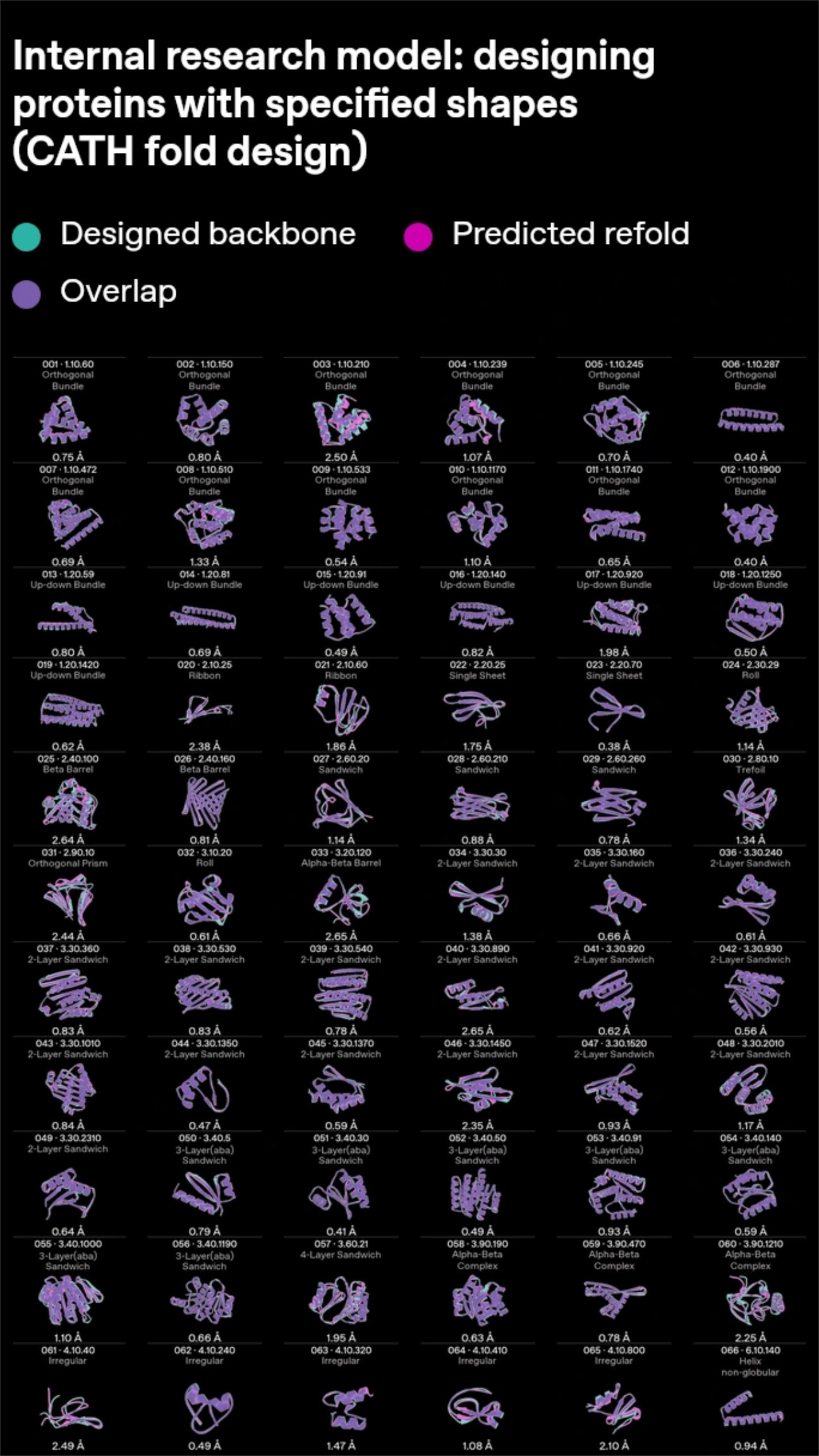
CATH fold design · responsive legend poster

An internal research model was asked to design proteins with specified overall shapes, such as bundles of coils or layers of strands. The colored shapes compare selected designs with computer predictions of how they would fold, showing examples where the two closely match.

Predicting how chemicals and proteins fit together

Many medicines, including aspirin, are small molecules, chemical compounds much smaller than the proteins they act on. Predicting where a small molecule binds to a protein and how it fits there is called docking. These predictions can help researchers decide how to modify a drug candidate so it binds more tightly to its target. To test our models, we started with experimentally determined structures of small molecules bound to proteins. We digitally removed each small molecule and gave the models the protein structure along with a text description of how the molecule’s atoms were connected (a sequence of characters called SMILES). We then asked the models to predict where the molecule had been bound and how it was oriented.

For our first docking test, we used the PoseBusters dataset⁠(opens in a new window), a collection of three-dimensional structures that show how small molecules bind to proteins. Researchers determined these structures experimentally, giving us a way to check the models’ predictions. Without being told where on the protein each molecule had bound, the models had to predict both where the molecule fit and which way it faced. GPT‑6.2 closely matched the molecule’s observed position and orientation in 93% of scored predictions, compared with 96% for our latest internal model and 50% for DiffDock-L, a specialized docking model.

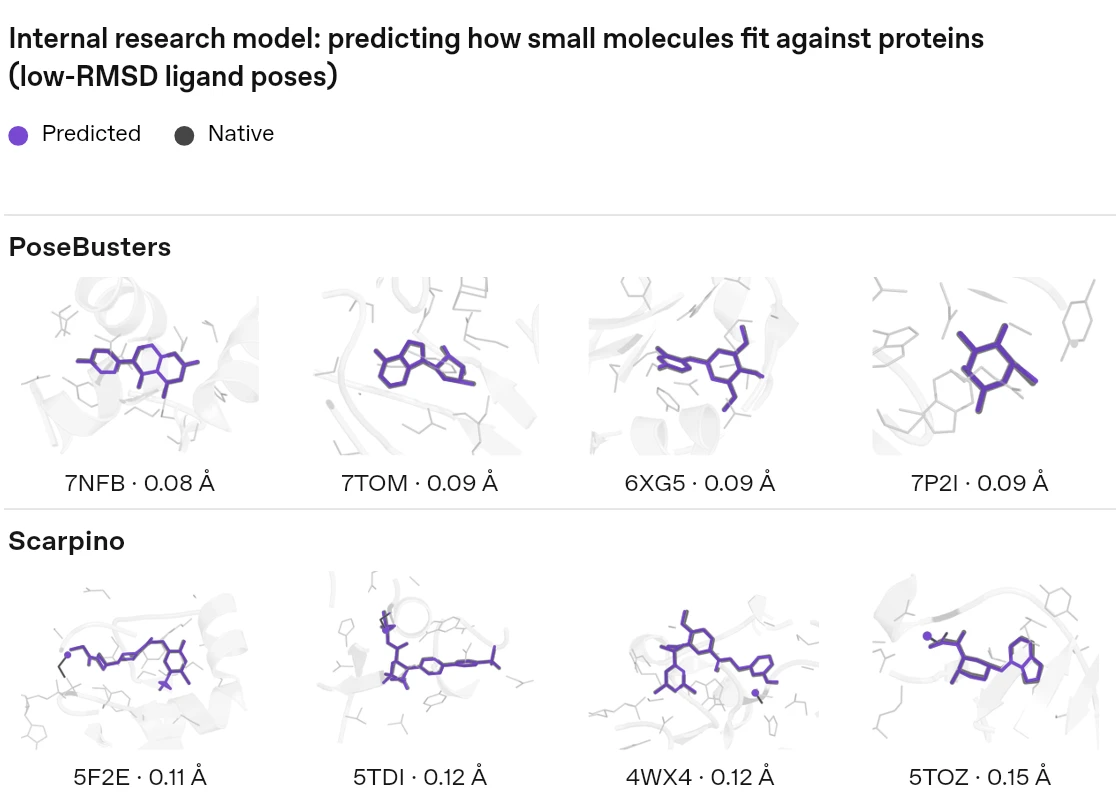
In practice, researchers may already know something about how a molecule binds. One major advantage of a GPT model is that we can give additional information directly in the prompt. We tested this on 179 structures from the Scarpino dataset⁠(opens in a new window), where each protein structure forms a chemical bond with a small molecule, tethering the two together. We told our models which two atoms formed the bond and asked them to predict how the rest of the molecule fit against the protein. GPT‑6.2 closely matched the experimental structure in 92% of scored predictions⁠(opens in a new window), and our latest internal model did so in 97%, while DiffDock⁠(opens in a new window) reached 60%.

Internal research model: predicting how small molecules fit against proteins (low-RMSD ligand poses). Predicted and experimental ligand positions overlaid for examples from the PoseBusters and Scarpino datasets.

An internal research model predicted where and how small molecules would fit against proteins, shown in gray. Purple shows the model’s predictions, and teal shows the molecules’ positions determined in earlier experiments. In these examples, the predictions closely match the experimental structures.

Predicting how antibodies bind to proteins

Where an antibody binds can help explain whether it blocks another protein from attaching to the same site. We tested how accurately successive generations of GPT could predict where an antibody binds and which way it faces. For hundreds of pairs of antibodies and targets, we showed the models the two proteins separately and hid some of the atomic detail (all side chains) on their surfaces.

With the side-chain details hidden, the mean DockQ score (a commonly used metric in which higher values indicate a closer match to the experimentally observed arrangement) increased from approximately 0.05 for GPT‑5.6 to 0.28 for GPT‑6, 0.57 for GPT‑6.2, and 0.81 for our latest internal model, at each model’s highest evaluated compute setting.

Because these structures were public, the models may have seen the same antibody-target pairs or similar ones during training. Even so, each generation of our models predicted more accurately how the two proteins fit together, even with all side-chain positions hidden. That progress gives us reason to be optimistic about harder docking problems.

Predicting antibody attachment · Video poster

Each row compares four models’ predictions of how an antibody attaches to its target protein. Colored shapes show the model’s prediction; dark gray shows the position observed in experiments. Results improved with each successive generation of model.

Predicting the effects of mutations

We can design far more proteins on a computer than we can make and test in the lab. Even after we settle on a promising structure, we may have many amino acid sequences to choose from. We tested whether our models could help researchers decide which versions to make first by predicting how changes to a protein’s sequence would affect its stability, activity, or ability to bind to a target.

We drew on four public datasets from experiments in which scientists had replaced one or more amino acids in a protein and measured the effects. For each test, we gave our models the sequence of the protein the scientists started with and the sequences of 50 modified versions. We told the models what the scientists had measured, withheld the results, and asked them to rank the 50 versions without using coding tools, by reasoning only.

In one study of protein stability, we asked the models to rank 50 versions of a protein by how likely each was to be folded at room temperature. We compared the predicted order with the order observed in the lab using a measure called rank correlation. A value of 1 means the rankings match perfectly, 0 means there’s no consistent relationship, and −1 means the order is exactly reversed. Across 265 sets from the stability study, each model generation improved, from 0.41 for GPT‑5.6 to 0.52 for GPT‑6, 0.57 for GPT‑6.2, and 0.66 for our latest internal model.

In each of the four datasets, GPT‑6.2 and our latest internal model produced more accurate rankings on average than ESM2-650M, a specialized protein model.

Early signals from our model’s protein structure predictions

Earlier, we relied on specialized models to predict whether an amino acid sequence would fold into the structure our models had designed. We wanted to see how close our models are to making that prediction themselves. We gave our models the amino acid sequences of proteins with known three-dimensional structures. Using only basic coding tools, the models predicted how each chain would fold in three dimensions. We evaluated their predictions using a measure called TM-score. A score of 1 means a perfect match to the real structure, and scores above 0.5 generally indicate that the prediction captures the overall fold.

The biggest gains are visible in individual examples. For some proteins, our latest internal model closely reproduced folds that earlier models missed. Across the full test, the average score rose from 0.16 for GPT‑5.6 to 0.26 for GPT‑6.2 and 0.38 for our latest internal model. The specialized model ESMFold2 averaged 0.93, so there’s still a substantial gap in how reliably our models can predict a whole protein’s structure from its sequence alone.

What if researchers already know most of the structure and want to fill in a missing piece? We tested this on 100 antibody fragments. For each one, we gave our models the amino acid sequences and the surrounding three-dimension structure, hiding the six loops that help the antibody recognize its target. Our latest internal model often predicted both the shape and position of those loops quite accurately. ESMFold2 was still more accurate overall, even working from the sequences alone.

Predicting how a protein folds · Video poster

Each model was given the same protein sequence—the order of its chemical building blocks—and asked to predict its 3D shape. The colored shapes show the predictions, and dark gray shows the structure measured in experiments.
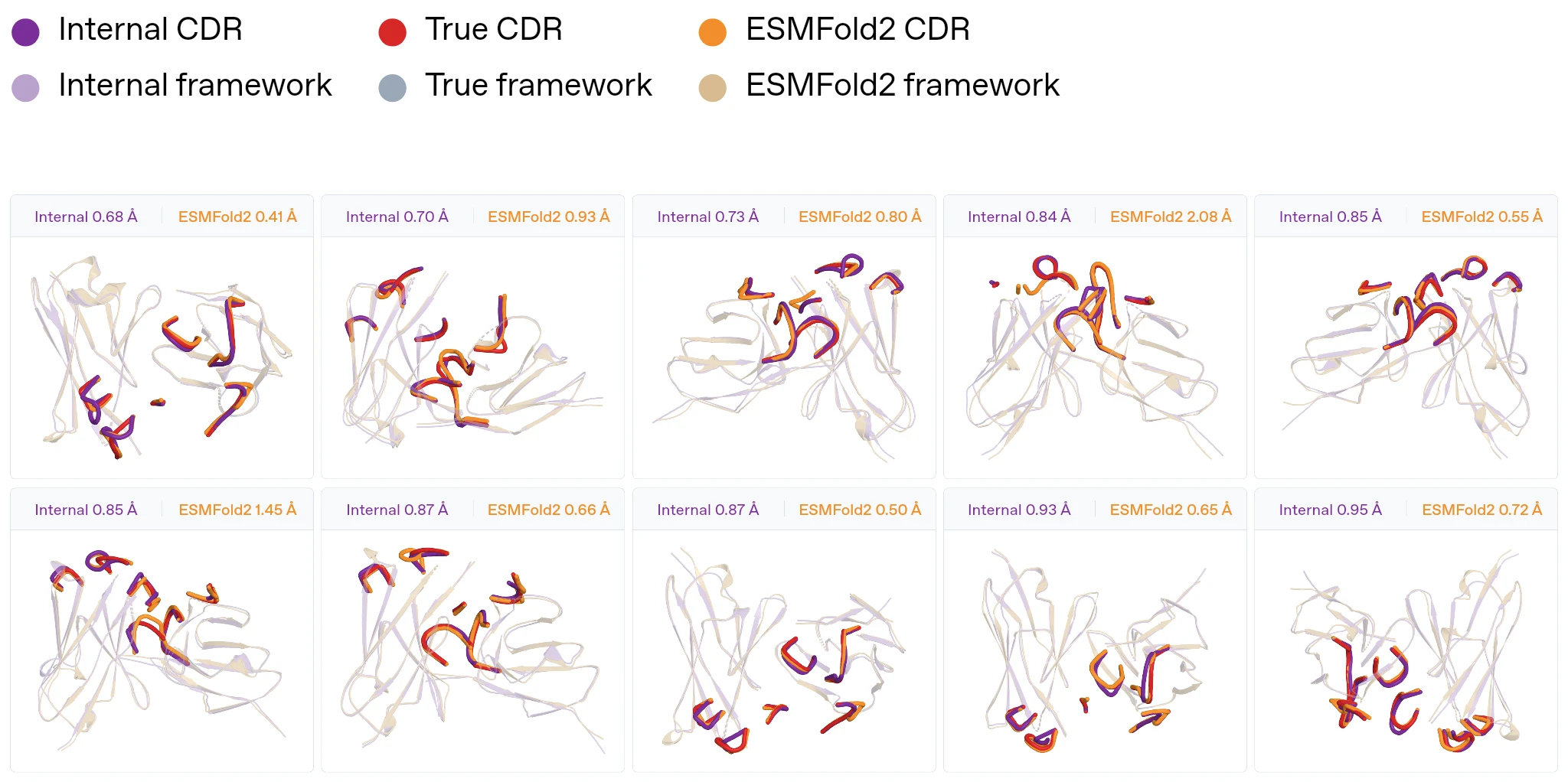
Ten antibody structures with missing loops predicted by the internal model in purple and ESMFold2 in orange. Red shows the experimental loops. Each example displays both prediction errors in ångströms.

Each model was given a partial structure and tasked with predicting the missing regions corresponding to the antibody CDRs. The colored regions show predictions from the internal model and ESMFold2 compared with the experimentally determined structures.

Limitations

It is important to note that our protein design campaign relied on specialized structure prediction models such as Boltz-2, OpenDDE, and ESMFold2 to filter candidates. Our results show that GPT models have intrinsic capabilities comparable to specialized models at two stages of the workflow: backbone generation, where researchers commonly use RFdiffusion; and sequence redesign, where they commonly use ProteinMPNN. Our results therefore do not yet establish that our models can generate de novo minibinders end-to-end in a zero-shot setting without help from specialized models.

Our work demonstrates yet again the jagged capability frontier. Predicting a complete protein structure from its amino acid sequence remains substantially harder for our models than several of the component tasks above. On that task, even our best internal models remained well behind specialized structure-prediction models.

Some benchmark results also require careful interpretation. In tests that asked models to infer amino acid sequences from protein structures, unusually high accuracy may partly reflect memorization or patterns left by the process used to generate those structures. Those results alone do not establish reliable performance on unfamiliar proteins.

The laboratory results provide a more direct test of whether proposed designs can work, but binding is only one step toward a useful research tool or medicine. Further work would need to establish properties such as specificity, stability, and biological activity, along with safety and efficacy for therapeutic applications.

What’s next

This work is an early step toward programmable molecular design at OpenAI. Our goal is to let scientists describe what they want a molecule to do in plain language and use our models to help design candidates to test in the lab. To make that approach useful for developing medicines, we want to make progress in three areas.

  • Find minibinders for harder targets. We want to design molecules that bind to targets where our attempts so far have fallen short.

  • Design for what happens after binding. We want to test whether the molecules we design can produce a specific biological effect, such as killing a cancer cell. We also want to design molecules that bind selectively to their intended targets and are practical to manufacture.

  • Design a wider range of molecules. Our lab experiments focused on small protein minibinders and antibody fragments. We’d like to extend that work to molecules that bind to several targets at once, RNA, and small molecules, including a class called PROTACs that direct a cell to break down a particular protein.

As we work to accelerate scientific progress safely and responsibly, we also seek to evaluate and reduce risks, particularly those related to biosecurity. The same capabilities that help scientists design proteins for new medicines could also be misused. Our Preparedness Framework⁠ guides how we assess these risks and test safeguards to reduce them.

While lab testing remains a critical part of protein design, our goal is to provide powerful models that can shorten each round of design by giving scientists more control and flexibility, and reduce the total number of design-test cycles needed to find a functional protein. Ultimately, we envision enabling scientists to design proteins and molecules simply by prompting our models in natural language, massively accelerating the development of new biotechnologies and new medicines.

Shape
Shape
Stay Ahead

Explore More Insights

Stay ahead with more perspectives on cutting-edge power, infrastructure, energy,  bitcoin and AI solutions. Explore these articles to uncover strategies and insights shaping the future of industries.

Shape

Pros and cons of running AI on consumer hardware

So, instead of going the cloud route, the company opted to do something else: to use three MacBook Pros at about $5,000 each. The hardware was also readily available, Patel says. “On the Apple side, there’s not many hardware restrictions at this time,” he says. Meanwhile, more robust and specialized

Read More »

Vår Energi to acquire ConocoPhillips’ Norway business, including Greater Ekofisk operatorship, in $4.4-billion deal

The acquisition gives Vår Energi operatorship of the Greater Ekofisk Area, including the Ekofisk, Eldfisk, Embla, Tor, and Tommeliten Alfa and Gamma fields.  “The transaction adds significant scale, reserves and operatorship, while creating the opportunity to unlock materially greater value from a high-quality asset base with substantial remaining resources and

Read More »

Masirah Oil reaches TD in Block 50 well

@import url(‘https://fonts.googleapis.com/css2?family=Inter:wght@100..900&display=swap’); .ebm-page__main h1, .ebm-page__main h2, .ebm-page__main h3, .ebm-page__main h4, .ebm-page__main h5, .ebm-page__main h6 { font-family: Inter; } body { line-height: 150%; letter-spacing: 0.025em; } button, .ebm-button-wrapper { font-family: Inter; } .label-style { text-transform: uppercase; color: var(–color-grey); font-weight: 600; font-size: 0.75rem; } .caption-style { font-size: 0.75rem; color: color-mix(in srgb, currentColor 60%, transparent); } Masirah Oil Ltd. (MOL) reached target depth in the first well in the current offshore Yumna field campaign in Block 50, offshore Oman. Drilling operations will now move forward to the second well in the campaign, MOL said. While first production will be delayed, MOL will continue to provide updates as the project progresses. MOL, an indirect 87.5% subsidiary of Jasmine Energy Ltd. (JEL), acts as operator for and holds 100% interest in Block 50.

Read More »

Petrobras targets refining, renewable fuels growth in new 2027-31 business plan

Petróleo Brasileiro SA (Petrobras) has outlined an ambitious downstream expansion strategy in its newly approved 2027-31 business plan, targeting higher refining capacity, increased low-sulfur diesel production, growth in renewable fuels, and new investments in petrochemicals, fertilizers, and gas infrastructure. The Brazilian state-controlled producer plans to invest $23 billion in its refining, transportation, marketing, petrochemicals, and fertilizers segment through 2031, with an additional $1 billion allocated to projects still under evaluation, the company said in separate releases Nov. 23. The investments are designed to expand production of higher-value, lower-carbon products, strengthen logistics infrastructure, and diversify revenue streams beyond crude oil production. A central objective of the operator’s 2027-31 plan is increasing its system-wide conventional processing capacity by 2031 to 2.173 million b/d from a current 1.813 million b/d capability. Rather than undertaking construction of a new refinery, Petrobras said it will achieve the additional 360,000 b/d in fresh capacity via upgrades to its existing refineries. Among the flagship projects are expansions at the Boaventura energy complex (BEC) in Itaborai, Rio de Janeiro, and the completion of a second 130,000-b/d Train 2 as part of the long-planned expansion and upgrade of the 130,000-b/d single-train Refinaria Abreu e Lima (RNEST) refinery in Ipojuca, Pernambuco, in northeast Brazil, both scheduled to start operations in 2029. Petrobras said the Boaventura project will enable increased yields of S-10 diesel and jet fuel while adding production of higher-value Group II base oils. At RNEST, startup of Train 2 will double existing capacity of the site as well as allow the refinery to maintain a high-diesel conversion rate, according to the operator. System-wide, Petrobras is also continuing to pursue expanded diesel output, targeting a 405,000-b/d increase in overall S-10 diesel production capacity by 2031. Of that total, 293,000 b/d will be added during the 2027-31 period via a

Read More »

Equinor signs 18-year natural gas supply contract with German VNG

Equinor ASA and VNG AG have signed a long-term agreement for the supply of natural gas to Germany. The 18-year contract is the longest gas sales agreement since the Troll agreements signed in 1986, the operator said in a release Nov. 24. Under the agreement, Equinor will deliver up to 1.4 billion cu m/year of natural gas to VNG. Deliveries will start on Jan. 1, 2027, and continue until yearend 2044, with gas delivered at Trading Hub Europe, the German gas market area. Equinor said pricing will reflect market terms, with other commercial details to remain confidential between the parties. The Leipzig-based gas trader VNG Handel & Vertrieb GmbH (VNG H&V), a 100% subsidiary of VNG AG, and the Norwegian energy company signed the deal in Oslo, Norway, at the Equinor Autumn Conference. Natural gas is expected to remain a key part of Europe’s energy mix as more renewable power and low carbon solutions are developed.

Read More »

TVA announces $1.7B data center deal under new large-load tariff

The Tennessee Valley Authority is set to receive $1.7 billion in aggregate payments from an unnamed data center customer under its new tariff for data centers above 5 MW, the federal utility said in a Nov. 12 U.S. Securities and Exchange Commission filing. “Capacity commitment charges under the agreement are based on a rate of approximately $1.5 million per MW of requested capacity above 5 MW,” the filing said. “This rate reflects TVA’s current cohort-based pricing methodology, which may be revised for future customer cohorts.” The new tariff took effect Oct. 1 and will be phased in through 2029, the filing said. That phase-in period will apply to existing customers to allow them to retain their existing rate structure for a period of time, the Nashville Scene reported in August. TVA CEO Mike Skaggs said during a Nov. 13 earnings call that the change to data center rates has supported the utility’s investments. Those investments include extending the lives of the utility’s existing nuclear units and “helping expand the nuclear fuel and supply hub in the East Tennessee area,” he said.  The utility recently received the first small modular reactor construction permit from the U.S. Nuclear Regulatory Commission for a BWRX-300 reactor at the Clinch River Site in Oak Ridge, “although TVA has not yet decided whether to construct a reactor at the site,” its filing said.  Skaggs came out of retirement to serve as interim CEO following the retirement of former CEO Don Moul and was instated as TVA’s permanent CEO following a Nov. 10 board meeting, TVA’s vice president of financial planning and investor relations Clifton Lowry said on the call. $1.5M The charge per MW of requested capacity above 5 MW for data center customers under TVA’s new tariff. $13B TVA’s planned capital investment over the next three

Read More »

$251M electric bus facility opens in Miami-Dade County

Dive Brief: The South Dade Transit Operations Center in Miami-Dade County began full operations on Monday, following a ribbon-cutting ceremony last week. The facility can accommodate up to 100 articulated battery-electric buses and is home base for the transit agency’s Metro Express bus rapid transit service that connects the Dadeland South Metrorail Station in Kendall and Florida City, Florida along a 20-mile route with 14 stations. A voter-approved half-cent transportation surtax in Miami-Dade County helped fund the $250.6 million project. Dive Insight: Construction on the 20-acre site began June 25, 2024. The facility includes areas for charging, storage, maintenance, bus wash stations, parts storage and space for cleaning and detailing vehicles. It also provides bus dispatching and driver training. “We’ve built a facility that gives our teams the technology to serve riders better today and the room to grow with Miami-Dade,” Department of Transportation and Public Works Director and CEO Stacy Miller said in a statement. “This is how we build a transit system worthy of the trust our riders place in us every day.” A battery-electric bus parked under an overhead charger at the South Dade Transit Operations Center. Courtesy of Miami-Dade County Department of Transportation and Public Works The facility includes rapid charging stations and rooftop charging platforms, according to Hypower, the station’s utility contractor. Because lithium-ion batteries pose a fire hazard, the structure will be heat-insulated to prevent damage should a fire erupt, WSP Senior Vice President and Alternative Delivery Project Director Angel André Chavarria told Smart Cities Dive in 2024. Sprinklers will activate in an area just around the fire location rather than the entire building, he said. WSP provided design and construction services for the project. The site includes a reclaimed water system for landscaping. The operations center can also serve as an emergency command

Read More »

FERC must take action to protect ratepayers from higher transmission costs in SPP

Listen to the article 5 min This audio is auto-generated. Please let us know if you have feedback. Paul Cicio is chairman of the Electricity Transmission Competition Coalition and president and CEO of the Industrial Energy Consumers of America. As electricity prices continue to surge, consumers cannot afford to pay more than necessary for the new transmission lines that deliver their power. Requiring utilities to compete with one another gives regulators a direct way to reduce those costs. Optional Caption Permission granted by Paul Cicio Earlier this year, the Southwest Power Pool decided to exempt four projects expected to cost $3.8 billion from competitive bidding by classifying them as short-term reliability projects under its 2025 Integrated Transmission Planning portfolio. SPP’s tariff specifies that unless a project is required to be in service in three years or less, it must face competition in building new large transmission lines, consistent with Federal Energy Regulatory Commission Order 1000. But the projects SPP has designated as short-term in its 2025 portfolio are not expected to enter service until 2029 or 2030. SPP violated its FERC-approved tariff by not requiring the transmission projects to face competition. It is misusing an exemption meant for urgent reliability needs to avoid competition in favor of incumbent utilities, contrary to the vital electricity affordability needs of ratepayers. As a result, ratepayers in the 17-state region could pay an estimated $750 million in higher electricity bills for these projects. We at the Electricity Transmission Competition Coalition and the Industrial Energy Consumers of America have filed a complaint asking FERC to hold SPP accountable for violating its tariff and require the four projects to be competitively bid. Time is of the essence. Ratepayers are concerned because SPP has relied on this exemption before and the projects have grown larger and more expensive over

Read More »

It’s the Roaring 2020’s for the HPC-AI Data Center Industry, But It Comes with Costs

It has been, and will very likely continue to be, the “Roaring 2020’s” for the HPC-AI data center industry. But similar to the generally healthy U.S. economy, affordability is a problem. Driven by demand for advanced computing technology, the HPC-AI data center infrastructure industry is generating tremendous growth, according to the latest market update figures released by industry analyst firm Hyperion Research. But with high demand come strains on supply chains that result in higher costs that restrain even higher growth. This is the picture presented this week by Hyperion at their annual breakfast at the SC26 Supercomputing Conference in Chicago. The customary large crowd turned out to hear Hyperion CEO Earl Joseph and colleagues discuss the state of the industry, some sectors of which are expanding at a clip Joseph said has never before been seen. “2025 was an extremely high growth year for the market…,” said Hyperion CEO Earl Joseph of on-premises servers for HPC, AI and data centers. “The first half of this year is growing at 20 percent… This is more than a doubling of historic growth. And then looking at the overall market in addition to servers, the storage, middleware, application services and spending for running HPC and AI for science workloads in the cloud…the market has just grown tremendously.” Among Hyperion’s key findings:         Overall HPC spending grew by just under 17 percent in 2025 reaching a total of more than $70 billion, including nearly 30 percent growth in cloud usage. Worldwide sales of on-prem for HPC and AI-for-science servers reached $29.4 billion, an increase of nearly 15 percent, with the EMEA region growing by roughly 10 percent. For the combination of HPC and AI-for-science on-prem servers plus cloud, the overall market is expected to double over the next five years,

Read More »

The Data Center Backlash Has a Playbook

The data center industry’s next development constraint may have less to do with megawatts than with the politics of where those megawatts are deployed. The warning became difficult to ignore on November 3, when American voters approved 33 local ballot measures restricting data center development or expressing opposition to it, according to Ballotpedia’s analysis of the 2026 midterm elections. The results included outright bans, partial prohibitions, temporary moratoriums, and new requirements for community oversight. Voters also rejected 13 measures that would have favored development or expressed support for it. For an industry accustomed to evaluating prospective sites through the availability of power, land, fiber, capital, and construction resources, the election results reinforced another increasingly consequential consideration: whether the communities hosting digital infrastructure are willing to accept its growing physical and economic footprint. As Data Center Frontier recently examined in its post-election assessment of the industry’s political future, the national push to accelerate AI infrastructure construction is colliding with a more complicated political reality at the state and local levels. Opposition crosses party lines, while questions surrounding utility rates, water, environmental impacts, and local economic benefits have moved from planning commission meetings into broader electoral debate. That changing environment was the subject of a conversation recorded at the DCF Trends Summit 2026 in Reston, Virginia, where DCF contributing editor Doug Black sat down with Adam Waitkunas, president of Milldam Public Relations, and Julia Chuang, founder of LocalQ Labs and an associate professor of sociology at the University of Maryland. Their discussion explored a fundamental shift in the development equation: community opposition is becoming more organized and politically consequential, but also more observable through data. The challenge for developers is to understand that risk early enough to influence site selection and project design, while recognizing that public trust cannot be manufactured through

Read More »

Oak Ridge’s AI Factory Moment: Lux, Nuclear Power, and the Next Data Center Frontier

For much of its history, Oak Ridge has been associated with the Manhattan Project and the subsequent development of America’s nuclear research and production capabilities. Established during World War II, the community became home to major facilities for uranium enrichment, nuclear materials processing, scientific research, and ultimately high-performance computing. Today, that legacy is being repurposed for a new generation of industrial development. The former K-25 uranium enrichment complex, once a critical part of the nation’s atomic weapons program, has been transformed into the East Tennessee Technology Park (ETTP), where extensive environmental cleanup and redevelopment have made former federal property available for commercial use. At an October 27 gathering in Oak Ridge, federal officials and nuclear industry representatives highlighted more than $15 billion in announced nuclear-related projects across the region, an investment wave subsequently documented in a November 17 DOE report on Oak Ridge’s emerging energy hub. The investment figure largely represents planned private-sector development rather than completed capital spending. Regional officials also anticipate demand for thousands of construction workers over the next five years, with additional permanent manufacturing and operating positions potentially following as projects advance. In March, DOE completed its largest Oak Ridge land transfer to date, conveying more than 700 acres for economic reuse. The transfer included a 624-acre parcel designated for Orano USA’s planned uranium enrichment complex and a 77-acre parcel associated with Oklo’s proposed nuclear fuel recycling development. Overall, more than 2,500 acres have been transferred from federal ownership for redevelopment, following decades of cleanup and the demolition of hundreds of former industrial structures. For nuclear developers, the appeal is straightforward: large industrial sites, existing utility and transportation infrastructure, proximity to federal laboratories, and an established community of nuclear engineers, technicians, researchers, and specialized manufacturers. For data center developers, the implications are somewhat different but no

Read More »

Dell and Microsoft drive private AI as enterprises seek greater data control

Dell Technologies and Microsoft are expanding their private cloud partnership with a new set of infrastructure offerings designed to let enterprises run AI models closer to their data, reduce reliance on public cloud services and maintain control over sensitive information. The announcement, made during Microsoft’s Ignite conference, extends Dell’s AI Factory with Nvidia initiative to Dell Private Cloud environments. It also reflects a growing industry push toward internally deployed AI inferencing, particularly among organizations dealing with sensitive corporate information, regulatory requirements and data residency restrictions, Dell stated. The expanded offering combines Dell Private Cloud, Microsoft Azure Local, Microsoft Foundry Local and Nvidia acceleration. The objective is to provide organizations with an integrated infrastructure for deploying heavy AI workloads inside their own data centers and firewalls, the companies said.

Read More »

StarlingX 13.0 updates the network stack for distributed edge deployments

Edge sites do not always come with the network gear that a data center takes for granted. That’s a challenge the open-source StarlingX project from the OpenInfra Foundation is now tackling in its 13.0 update. StarlingX is an open-source distributed cloud platform that combines Linux, Kubernetes, OpenStack, and Ceph. The OpenInfra Foundation hosts the project, and operators including Verizon, Vodafone, T-Systems and KDDI use it for 5G and Open Radio Access Network (O-RAN) infrastructure. Earlier this year, the StarlingX 12.0 update added precision timing capabilities to help networking stay on time. The 13.0 update tackles a different set of issues. Key features include: Gateway API support. Calico-based support is available to hosted applications, while platform services still use Ingress NGINX Optional certificate authority. The Enterprise Java Beans Certificate Authority (EJBCA) runs on the platform and serves certificates to hosted applications. Subcloud restore. A backup restores directly onto a factory-installed node at a subcloud, a remote edge site, with no operating system reinstall. Direct upgrades. Operators can upgrade from two releases back with a single reboot per host. Layer 2 switching. A new Open vSwitch application lets servers at sites with no router next to them bridge traffic and connect directly to aggregation routers. “The OpenvSwitch application adds Layer 2 switching to the K8S platform,” Greg Waines, a senior member of technical staff at Wind River and a StarlingX Technical Steering Committee member, told Network World. “A server can bridge traffic between its SR-IOV network interfaces and other servers, and it can forward traffic to the site routers.”

Read More »

Sovereign AI is about control, not just location

Guetari was open about the term itself being fuzzy. “Sovereignty is very vague and not always clear,” he told me. “It’s about control, auditability, observability.” He drew a line between data locality, meaning the data stays in-country, and sovereignty, which he described as being “more about control, control of what happens to your data and your workload.” He then made the case for why F5 belongs in that conversation: “This is what we have been doing for two decades.” F5 has always sat in the data path, deciding what an application can communicate with, enforcing security rules, and logging what happened. For a regulated bank or government agency, the ability to reconstruct exactly what happened after an incident is worth more than a press release about a data center’s location. The token is the new unit of economics The most interesting part of my conversation with Guetari wasn’t about security. It was about business models. He argued that every successful technology business has found the right unit to monetize. “The cloud is selling the unit of the cloud, which is the CPU core, very well. SaaS is the seat,” he said. “Telcos have been very successful early on using the voice minute, and then they moved to the gigabyte. Sooner or later, that unit will be the token, and most telcos will have to move to the token. And the ones who will not go to token, unfortunately, will be just pipes.”

Read More »

Microsoft will invest $80B in AI data centers in fiscal 2025

And Microsoft isn’t the only one that is ramping up its investments into AI-enabled data centers. Rival cloud service providers are all investing in either upgrading or opening new data centers to capture a larger chunk of business from developers and users of large language models (LLMs).  In a report published in October 2024, Bloomberg Intelligence estimated that demand for generative AI would push Microsoft, AWS, Google, Oracle, Meta, and Apple would between them devote $200 billion to capex in 2025, up from $110 billion in 2023. Microsoft is one of the biggest spenders, followed closely by Google and AWS, Bloomberg Intelligence said. Its estimate of Microsoft’s capital spending on AI, at $62.4 billion for calendar 2025, is lower than Smith’s claim that the company will invest $80 billion in the fiscal year to June 30, 2025. Both figures, though, are way higher than Microsoft’s 2020 capital expenditure of “just” $17.6 billion. The majority of the increased spending is tied to cloud services and the expansion of AI infrastructure needed to provide compute capacity for OpenAI workloads. Separately, last October Amazon CEO Andy Jassy said his company planned total capex spend of $75 billion in 2024 and even more in 2025, with much of it going to AWS, its cloud computing division.

Read More »

John Deere unveils more autonomous farm machines to address skill labor shortage

Join our daily and weekly newsletters for the latest updates and exclusive content on industry-leading AI coverage. Learn More Self-driving tractors might be the path to self-driving cars. John Deere has revealed a new line of autonomous machines and tech across agriculture, construction and commercial landscaping. The Moline, Illinois-based John Deere has been in business for 187 years, yet it’s been a regular as a non-tech company showing off technology at the big tech trade show in Las Vegas and is back at CES 2025 with more autonomous tractors and other vehicles. This is not something we usually cover, but John Deere has a lot of data that is interesting in the big picture of tech. The message from the company is that there aren’t enough skilled farm laborers to do the work that its customers need. It’s been a challenge for most of the last two decades, said Jahmy Hindman, CTO at John Deere, in a briefing. Much of the tech will come this fall and after that. He noted that the average farmer in the U.S. is over 58 and works 12 to 18 hours a day to grow food for us. And he said the American Farm Bureau Federation estimates there are roughly 2.4 million farm jobs that need to be filled annually; and the agricultural work force continues to shrink. (This is my hint to the anti-immigration crowd). John Deere’s autonomous 9RX Tractor. Farmers can oversee it using an app. While each of these industries experiences their own set of challenges, a commonality across all is skilled labor availability. In construction, about 80% percent of contractors struggle to find skilled labor. And in commercial landscaping, 86% of landscaping business owners can’t find labor to fill open positions, he said. “They have to figure out how to do

Read More »

2025 playbook for enterprise AI success, from agents to evals

Join our daily and weekly newsletters for the latest updates and exclusive content on industry-leading AI coverage. Learn More 2025 is poised to be a pivotal year for enterprise AI. The past year has seen rapid innovation, and this year will see the same. This has made it more critical than ever to revisit your AI strategy to stay competitive and create value for your customers. From scaling AI agents to optimizing costs, here are the five critical areas enterprises should prioritize for their AI strategy this year. 1. Agents: the next generation of automation AI agents are no longer theoretical. In 2025, they’re indispensable tools for enterprises looking to streamline operations and enhance customer interactions. Unlike traditional software, agents powered by large language models (LLMs) can make nuanced decisions, navigate complex multi-step tasks, and integrate seamlessly with tools and APIs. At the start of 2024, agents were not ready for prime time, making frustrating mistakes like hallucinating URLs. They started getting better as frontier large language models themselves improved. “Let me put it this way,” said Sam Witteveen, cofounder of Red Dragon, a company that develops agents for companies, and that recently reviewed the 48 agents it built last year. “Interestingly, the ones that we built at the start of the year, a lot of those worked way better at the end of the year just because the models got better.” Witteveen shared this in the video podcast we filmed to discuss these five big trends in detail. Models are getting better and hallucinating less, and they’re also being trained to do agentic tasks. Another feature that the model providers are researching is a way to use the LLM as a judge, and as models get cheaper (something we’ll cover below), companies can use three or more models to

Read More »

OpenAI’s red teaming innovations define new essentials for security leaders in the AI era

Join our daily and weekly newsletters for the latest updates and exclusive content on industry-leading AI coverage. Learn More OpenAI has taken a more aggressive approach to red teaming than its AI competitors, demonstrating its security teams’ advanced capabilities in two areas: multi-step reinforcement and external red teaming. OpenAI recently released two papers that set a new competitive standard for improving the quality, reliability and safety of AI models in these two techniques and more. The first paper, “OpenAI’s Approach to External Red Teaming for AI Models and Systems,” reports that specialized teams outside the company have proven effective in uncovering vulnerabilities that might otherwise have made it into a released model because in-house testing techniques may have missed them. In the second paper, “Diverse and Effective Red Teaming with Auto-Generated Rewards and Multi-Step Reinforcement Learning,” OpenAI introduces an automated framework that relies on iterative reinforcement learning to generate a broad spectrum of novel, wide-ranging attacks. Going all-in on red teaming pays practical, competitive dividends It’s encouraging to see competitive intensity in red teaming growing among AI companies. When Anthropic released its AI red team guidelines in June of last year, it joined AI providers including Google, Microsoft, Nvidia, OpenAI, and even the U.S.’s National Institute of Standards and Technology (NIST), which all had released red teaming frameworks. Investing heavily in red teaming yields tangible benefits for security leaders in any organization. OpenAI’s paper on external red teaming provides a detailed analysis of how the company strives to create specialized external teams that include cybersecurity and subject matter experts. The goal is to see if knowledgeable external teams can defeat models’ security perimeters and find gaps in their security, biases and controls that prompt-based testing couldn’t find. What makes OpenAI’s recent papers noteworthy is how well they define using human-in-the-middle

Read More »