Stay Ahead, Stay ONMINE

Agentic AI boom expected to reshape CPU market

These activities include planning tasks, scheduling subtasks, calling external tools, managing interactions between multiple agents and evaluating results. Agents also rely on conventional computing resources to execute Python code, search databases, crawl websites and process information, according to TrendForce. As a result, the CPU is enjoying a new lease on life and becoming a more […]

These activities include planning tasks, scheduling subtasks, calling external tools, managing interactions between multiple agents and evaluating results. Agents also rely on conventional computing resources to execute Python code, search databases, crawl websites and process information, according to TrendForce.

As a result, the CPU is enjoying a new lease on life and becoming a more significant component of AI infrastructure rather than simply serving as a supporting processor for GPUs, according to TrendForce.

TrendForce notes that traditional AI data centers have typically deployed approximately one CPU for every four to eight GPUs, reflecting the industry’s emphasis on accelerating computationally intensive AI workloads.

Shape
Shape
Stay Ahead

Explore More Insights

Stay ahead with more perspectives on cutting-edge power, infrastructure, energy,  bitcoin and AI solutions. Explore these articles to uncover strategies and insights shaping the future of industries.

Shape

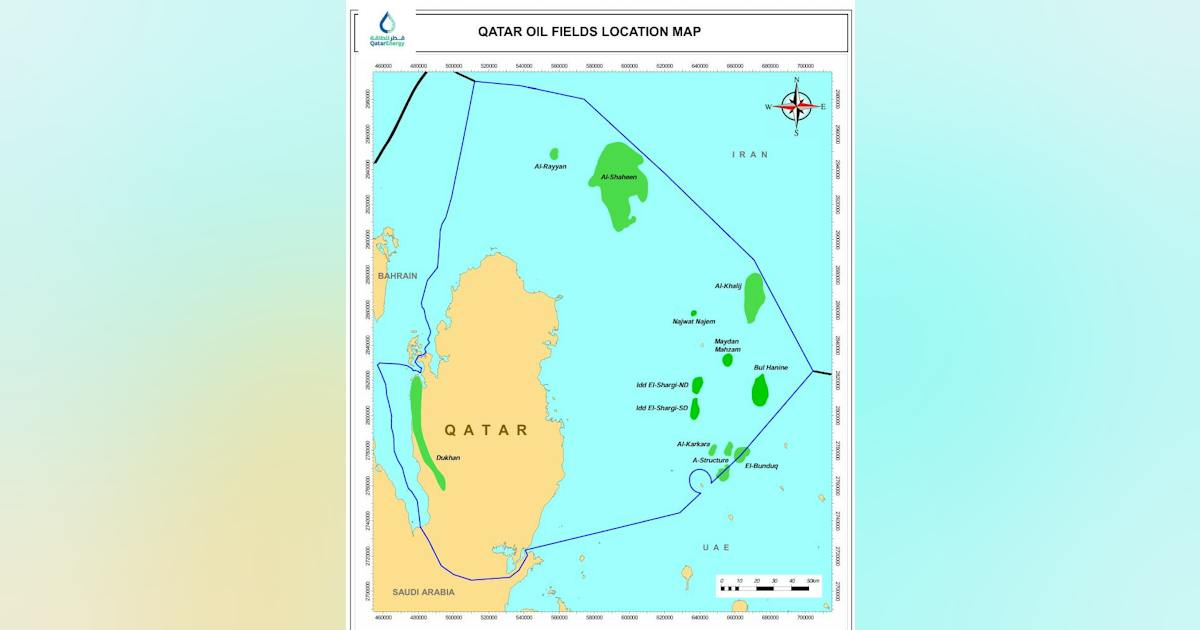
QatarEnergy continues Maydan Mahzam field redevelopment

@import url(‘https://fonts.googleapis.com/css2?family=Inter:wght@100..900&display=swap’); .ebm-page__main h1, .ebm-page__main h2, .ebm-page__main h3, .ebm-page__main h4, .ebm-page__main h5, .ebm-page__main h6 { font-family: Inter; } body { line-height: 150%; letter-spacing: 0.025em; } button, .ebm-button-wrapper { font-family: Inter; } .label-style { text-transform: uppercase; color: var(–color-grey); font-weight: 600; font-size: 0.75rem; } .caption-style { font-size: 0.75rem; color: color-mix(in srgb, currentColor 60%, transparent); } QatarEnergy contractor PTSC Mechanical and Construction Ltd. Co. (PTSC M&C) has let a letter of award (LOA) to Aker Solutions for design work related to the redevelopment of Maydan Mahzam oil field offshore Qatar. The field lies, which started production in November 1965, lies about 100 km northeast of the Qatari coastline and 28 km southeast of Halul Island in water depths of about 40 m. QatarEnergy has been redeveloping the field to extend its operational life.  Aker Solutions will provide detailed design services for several offshore installations under PTSC M&C’s project scope, including three major topsides, four jackets, and brownfield tie-in. The work will be executed by Aker Solutions’ engineering teams in Kuala Lumpur, Malaysia, and Mumbai, India.

Read More »

US sanctions network supporting Iranian oil shipments

The US Department of the Treasury imposed new sanctions on Nov. 4 against an India-based maritime network accused of facilitating Iranian oil shipments through fraudulent vessel registrations and certifications, as Washington continued efforts to restrict Tehran’s petroleum revenues. The sanctions target Suniel Kumar Sharma, his wife Jaspreet Preeti Shahid, two other Indian nationals, and nine associated entities. According to the  Treasury, the network established unauthorized ship registries and maritime classification services that enabled sanctioned tankers transporting Iranian petroleum to operate under false flags. Treasury said some of the vessels supported by the network operated on behalf of Iran’s military and its proxies. Among the designated companies are India-based Oceaniek Technologies India and Singapore-based Eswatini Maritime Affairs and International Ship Registry Pte. Ltd. Treasury said the network provided false vessel registrations to several sanctioned tankers, including LATTAFA, BINARY STAR, and VERA. The action, taken under Executive Order 13902 as part of the administration’s Operation Economic Outcast campaign, also included a new Office of Foreign Assets Control (OFAC) advisory warning maritime operators about sanctions risks associated with falsely flagged vessels. The designations block assets of the sanctioned parties held in the US or under the control of US persons and generally prohibit US persons from conducting transactions involving their property. The measures could further complicate transportation and compliance arrangements for Iranian oil shipments, although their immediate impact on export volumes remains uncertain.

Read More »

Matador eyes 5%+ production growth next year

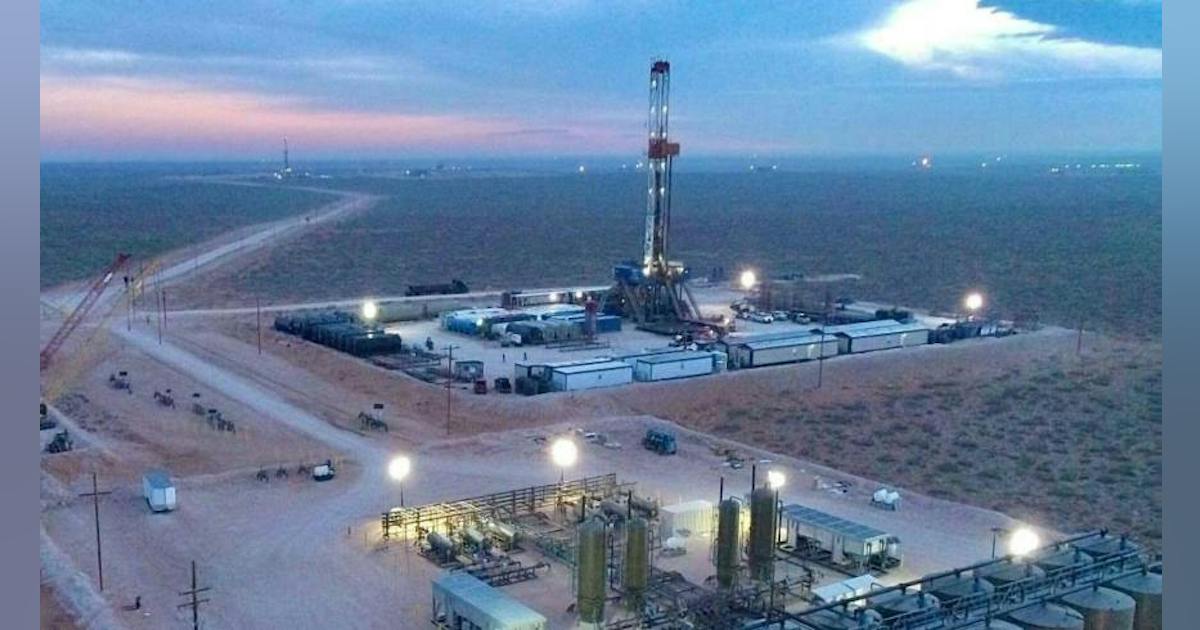
Tom Elsener, one of Matador’s executive vice-presidents, said wells near the property recently leased from the Bureau of Land Management were key contributors to the company’s topping its third-quarter expectations. That has executives eager to expand their work and 2 of the net 21-23 wells they expect to turn to sales this quarter are on federal land. Looking into 2027, chief financial officer Chris Calvert told analysts that the Matador team has positioned itself to be capital-efficient—its 2026 guidance for total capex is now around $1.7 billion, up from a midpoint of $1.675 billion 3 months ago—by having the option to invest either in its newly acquired assets or in its legacy properties. “We do see ourselves as being a potential relative grower. And we think we could prosecute a plan that not only allows us to be a relative grower but we could still achieve debt repayments,” Calvert said. “We could still grow our reserve base and then we could still potentially grow our acreage position through our brick-by-brick program.” Matador’s third-quarter activities brought in $1.16 billion in revenue and generated $195 million in net income. The latter figure was down slightly from the same period in 2025 primarily due to more than $227 million of losses from derivatives. Operating profits rose to $354 million from $306 million. Shares of Matador (Ticker: MTDR) fell about 7% to $50.37 on Nov. 4, when oil prices fell just as steeply on the heels of the midterm election results. Over the past 6 months, the stock is down about 20%, which has cut the company’s market capitalization to about $6.2 billion.

Read More »

Ovintiv shuffles some fourth-quarter spending to Permian basin

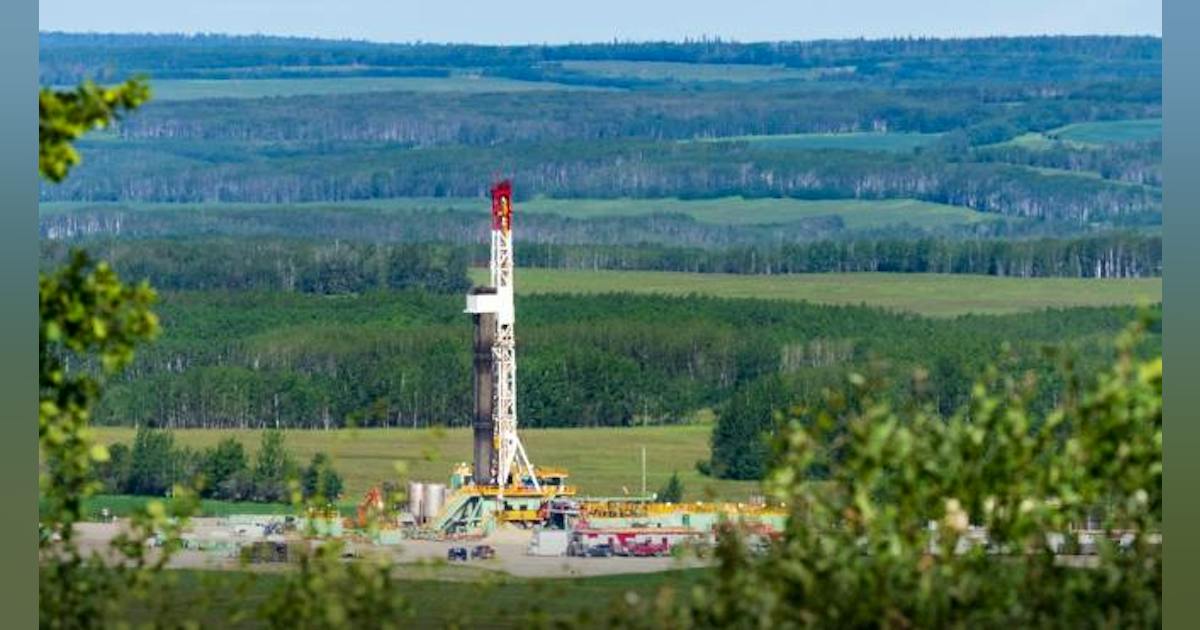
The leaders of Ovintiv Inc., Denver, are diverting $50 million in fourth-quarter capital spending to the operator’s Permian basin operations from the Montney to account for an Alberta gas plant being offline. President and chief executive officer Brendan McCracken and his team told analysts and investors on Nov. 4 that the adjustment to fourth-quarter spending plans should help oil and condensate production in the Permian basin average 125,000 and 130,000 b/d this quarter, in line with the third-quarter’s 127,000 b/d. The $50 million amounts to about 9% of Ovintiv’s planned capex this quarter and will let the company further manage the unplanned outage of CSV Midstream Solutions’ Albright sour gas plant in northern Alberta, which went offline in late July. Greg Givens, Ovintiv’s chief operating officer, said the CSV team has told Ovintiv that Albright should be up and running again before yearend and that Ovintiv has been able to manage the plant’s outage so that the company is only losing out on 3,000 boe/d. “If we think about that [capex] shift, that is really just us leaning into the flexibility of our portfolio,” Givens said on a conference call discussing Ovintiv’s third-quarter results. “The team has been doing a great job operating year to date. Our drilling performance was a little ahead of schedule so it just allowed us to accelerate some completion activity there.”

Read More »

EIA: US crude oil inventories down 900,000 bbl

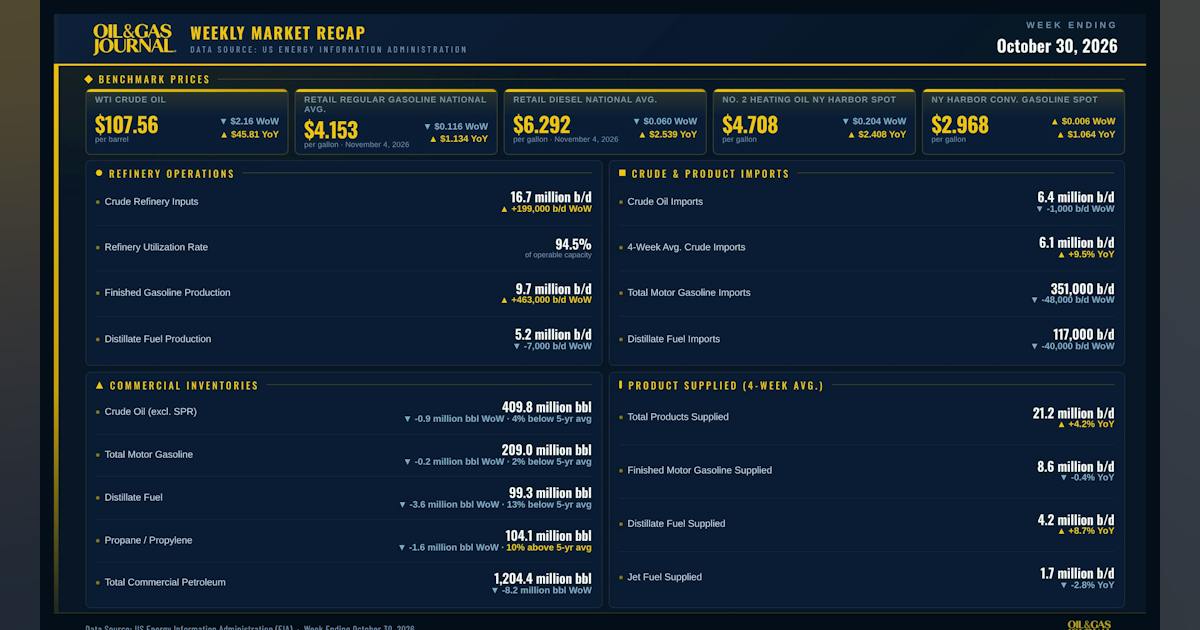
US crude oil inventories for the week ended Oct. 30, excluding the Strategic Petroleum Reserve, decreased by 900,000 bbl from the previous week, according to data from the US Energy Information Administration (EIA). At 409.8 million bbl, US crude oil inventories are 4% below the 5-year average for this time of year, the EIA report indicated. Gasoline inventories decreased 200,000 bbl, 2% below the 5-year average. Propane-propylene inventories decreased 1.6 million bbl, 10% above the 5-year average. Total commercial petroleum inventories decreased by 8.2 million bbl for the week. Distillate inventories decreased 3.6 million bbl, 13% below the 5-year average. US crude oil refinery inputs averaged 16.7 million b/d for the week ended Oct. 30, which was 199,000 b/d more than the previous week’s average. Refineries operated at 94.5% of capacity. Gasoline output averaged 9.7 million b/d, and distillate production decreased to 5.2 million b/d. Crude oil imports decreased 1,000 b/d to 6.4 million b/d. The 4-week average of 6.1 million b/d is 9.5% above the year-ago level. Gasoline imports averaged 351,000 b/d; distillate imports averaged 117,000 b/d. Over the past four weeks, total product supplied averaged 21.2 million b/d, up 4.2% year over year. The 4-week average for gasoline product supplied decreased 0.4% year over year to 8.6 million b/d, while the 4-week average for distillate product supplied increased 8.7% to 4.2 million b/d. The 4-week average for jet fuel product supplied decreased 2.8% year over year.  

Read More »

Vedanta to explore off India’s east coast

@import url(‘https://fonts.googleapis.com/css2?family=Inter:wght@100..900&display=swap’); .ebm-page__main h1, .ebm-page__main h2, .ebm-page__main h3, .ebm-page__main h4, .ebm-page__main h5, .ebm-page__main h6 { font-family: Inter; } body { line-height: 150%; letter-spacing: 0.025em; } button, .ebm-button-wrapper { font-family: Inter; } .label-style { text-transform: uppercase; color: var(–color-grey); font-weight: 600; font-size: 0.75rem; } .caption-style { font-size: 0.75rem; color: color-mix(in srgb, currentColor 60%, transparent); } Vedanta Oil & Gas Ltd. (VOGL) entered a strategic partnership with Exceed to explore the KG-DWHP-2017/1 deepwater block in Krishna-Godavari (KG) basin off India’s east coast. The block, which lies in 600-2,000 m of water, contains four existing gas discoveries spanning 4,616.85 sq m. Under the agreement, Exceed will provide integrated support across the campaign, including subsurface evaluation, well planning, drilling readiness, and operational management. Vedanta expects a multi-well exploration drilling campaign to begin early next year. The plan follows a phased approach covering project planning, engineering, operational readiness, and well execution. The company is evaluating the Vermilion prospect as a distinct new play with potential. Recently, Vedanta secured two offshore blocks including deepwater block KG/DWDSF/GD10/2025 in the KG basin. Vedanta is operator at DWHP-2017/1 with 100% interest.

Read More »

Agentic AI boom expected to reshape CPU market

These activities include planning tasks, scheduling subtasks, calling external tools, managing interactions between multiple agents and evaluating results. Agents also rely on conventional computing resources to execute Python code, search databases, crawl websites and process information, according to TrendForce. As a result, the CPU is enjoying a new lease on life and becoming a more significant component of AI infrastructure rather than simply serving as a supporting processor for GPUs, according to TrendForce. TrendForce notes that traditional AI data centers have typically deployed approximately one CPU for every four to eight GPUs, reflecting the industry’s emphasis on accelerating computationally intensive AI workloads.

Read More »

DCF Poll: Does the Data Center Industry Need a Political Reset?

Matt Vincent is Editor in Chief of Data Center Frontier, where he leads editorial strategy and coverage focused on the infrastructure powering cloud computing, artificial intelligence, and the digital economy. A veteran B2B technology journalist with more than two decades of experience, Vincent specializes in the intersection of data centers, power, cooling, and emerging AI-era infrastructure. Since assuming the EIC role in 2023, he has helped guide Data Center Frontier’s coverage of the industry’s transition into the gigawatt-scale AI era, with a focus on hyperscale development, behind-the-meter power strategies, liquid cooling architectures, and the evolving energy demands of high-density compute, while working closely with the Digital Infrastructure Group at Endeavor Business Media to expand the brand’s analytical and multimedia footprint. Vincent also hosts The Data Center Frontier Show podcast, where he interviews industry leaders across hyperscale, colocation, utilities, and the data center supply chain to examine the technologies and business models reshaping digital infrastructure. Since its inception he serves as Head of Content for the Data Center Frontier Trends Summit. Before becoming Editor in Chief, he served in multiple senior editorial roles across Endeavor Business Media’s digital infrastructure portfolio, with coverage spanning data centers and hyperscale infrastructure, structured cabling and networking, telecom and datacom, IP physical security, and wireless and Pro AV markets. He began his career in 2005 within PennWell’s Advanced Technology Division and later held senior editorial positions supporting brands such as Cabling Installation & Maintenance, Lightwave Online, Broadband Technology Report, and Smart Buildings Technology. Vincent is a frequent moderator, interviewer, and keynote speaker at industry events including the HPC Forum, where he delivers forward-looking analysis on how AI and high-performance computing are reshaping digital infrastructure. He graduated with honors from Indiana University Bloomington with a B.A. in English Literature and Creative Writing and lives in southern New Hampshire with

Read More »

Arista posts record growth as AI networking supercycle accelerates

One of the core answers to that threat is the company’s Autonomous Virtual Assistant (AVA), which lets administrators ask it questions about network conditions and receive explanations, recommendations, and assistance diagnosing problems. “AVA is incredibly powerful. It seamlessly navigates networking and security infrastructure from campus to WAN, to data center, to cloud, continuously monitoring and troubleshooting, isolating root causes without manual labor-intensive tasks,” said Ken Duda, Arista co-founder, president, CTO & director. “The bad news, of course, is the massive challenge AI poses for us and our customers by discovering and exploiting security vulnerabilities. This threat landscape demands secure and robust networking. Over the past few months, we’ve been collaborating with Anthropic, Google, OpenAI, and many others to integrate new AI-enabled security capabilities from frontier models into our existing software security pipeline,” Duda said.

Read More »

AEP, Google Advance $4 Billion Fuel-Cell Project to Power Cheyenne Data Centers

A Power Commitment That Began Two Years Earlier Although Google’s participation was publicly identified in October 2026, the procurement strategy underlying the Cheyenne project dates to November 2024, when Bloom Energy announced an agreement with AEP covering up to 1 gigawatt of solid oxide fuel-cell equipment. As Data Center Frontier reported at the time, the agreement included an initial commitment to purchase 100 MW, with options for an additional 900 MW. The arrangement was intended to help AEP serve large commercial and industrial customers facing growing electricity requirements without waiting for the completion of conventional grid infrastructure upgrades. The relationship advanced in January 2026, when AEP disclosed in a regulatory filing that an unregulated subsidiary had committed approximately $2.65 billion to purchase a substantial portion of the fuel-cell capacity covered by its earlier option. The company also reported a 20-year agreement to sell the planned facility’s entire electricity output to an unidentified investment-grade customer, now confirmed as Google. The equipment purchase formed part of the project’s development history, rather than representing a separate $2.65 billion investment in addition to the $4 billion project announced in October. The scale of the investment is significant, but so is the transaction structure. Rather than requiring Google to own and operate the generation equipment directly, the arrangement places development and ownership responsibilities with an established energy company while providing the hyperscaler long-term access to the facility’s electricity output. For AEP, it also represents an opportunity to deploy capital in support of large-load customers beyond its traditional regulated utility territory. At approximately $4 billion for 702 MW, the project represents roughly $5.7 million per megawatt of planned generating capacity. That figure offers a measure of the investment’s capital intensity, although it is not directly comparable with the construction cost of a conventional gas-fired power plant

Read More »

DCF Show: Can AI Unlock Data Centers’ Stranded Megawatts?

The data center industry’s race for power has become a contest against time. Developers are pursuing new generating capacity, transmission upgrades, utility interconnections, and increasingly elaborate behind-the-meter strategies to satisfy an AI infrastructure market whose demand keeps outrunning delivery schedules. Yet another possibility is emerging alongside the construction boom: Some of the power needed to expand AI computing may already be available inside operational facilities, committed to customers but not consistently consumed. That is the proposition behind Hammerhead AI, a Redwood City, California-based company developing software to coordinate electrical infrastructure, cooling systems, and computing workloads. Rather than treating a data center’s power allocation as a fixed ceiling that can only be raised through construction, Hammerhead argues that more compute can be accommodated by managing existing resources dynamically. In a new episode of the Data Center Frontier Show, Hammerhead AI founder and CEO Rahul Kar discussed the company’s approach with DCF Editor-in-Chief Matt Vincent, examining how reinforcement learning and workload orchestration could convert otherwise idle electrical capacity into revenue-producing AI infrastructure. The idea arrives at a consequential moment for the colocation market. DCF’s analysis of CBRE’s first-half 2026 data center market report found North American primary-market vacancy at just 1.4%, even as new construction reached record levels. Power commitments, delivery timelines, and access to ready infrastructure continue to determine where and when additional compute can be deployed. Hammerhead’s central argument is that the industry should examine how much of its already allocated capacity can be made productive before assuming that every increment of computing demand requires another increment of physical infrastructure. The commercial opportunity is substantial. Whether it can be realized without undermining the reliability expectations of mission-critical facilities is the harder question. A Power Shortage, or a Utilization Problem? Kar begins with a distinction between the electricity infrastructure available to

Read More »

Data Center Jobs: Engineering, Construction, Commissioning, Sales, Field Service and Facility Tech Jobs Available in Major Data Center Hotspots

Each month Data Center Frontier, in partnership with Pkaza, posts some of the hottest data center career opportunities in the market. Here’s a look at some of the latest data center jobs posted on the Data Center Frontier jobs board, powered by Pkaza Critical Facilities Recruiting. Looking for Data Center Candidates? Check out Pkaza’s Active Candidate / Featured Candidate Hotlist  Lead Mechanical Engineer – Data Center Design Dallas, TX / Remote This position is also available in: Denver, CO; Indianapolis, IN; Cedar Rapids, IA; Austin, TX; White Plains, NY; New York, NY; Richmond, VA; Ashburn, VA; Charlotte, NC; Atlanta, GA; Phoenix, AZ; Salt Lake City, UT; Kansas City, MO; Chicago, IL; Los Angeles, CA; Seattle, WA or San Jose, CA. Our client is a leading engineering design and commissioning company that is a subject matter expert in the data center space. They will provide design coordination and construction administration, consulting and management support for the data center / mission critical facilities space with the mindset to provide reliability, energy efficiency, and sustainable design expertise when providing these consulting services for enterprise, colocation and hyperscale companies. This career-growth minded opportunity offers exciting projects with leading-edge technology and innovation as well as competitive salaries and benefits. Electrical Commissioning Agent – Data Centers Phoenix, AZ (limited travel) Non-traveling CxA positions available in: Indianapolis, IN; Cedar Rapids, IA; Atlanta, GA and Columbus, OH. Traveling CxA based near any major airport, otherwise traveling to: New York, NY; White Plains, NY; Montvale, NJ; Richmond, VA; Boydton, VA; York, SC; Charlotte, NC; Salt Lake City, UT; Kansas City, MO; Chesterton, IN or Chicago, IL. *** Also looking for a lead EE and ME CxA agents and CxA PMs *** This opportunity is with a leading EPC company of data center design / build / commissioning solutions. This company provides a


Read More »

Microsoft will invest $80B in AI data centers in fiscal 2025

And Microsoft isn’t the only one that is ramping up its investments into AI-enabled data centers. Rival cloud service providers are all investing in either upgrading or opening new data centers to capture a larger chunk of business from developers and users of large language models (LLMs).  In a report published in October 2024, Bloomberg Intelligence estimated that demand for generative AI would push Microsoft, AWS, Google, Oracle, Meta, and Apple would between them devote $200 billion to capex in 2025, up from $110 billion in 2023. Microsoft is one of the biggest spenders, followed closely by Google and AWS, Bloomberg Intelligence said. Its estimate of Microsoft’s capital spending on AI, at $62.4 billion for calendar 2025, is lower than Smith’s claim that the company will invest $80 billion in the fiscal year to June 30, 2025. Both figures, though, are way higher than Microsoft’s 2020 capital expenditure of “just” $17.6 billion. The majority of the increased spending is tied to cloud services and the expansion of AI infrastructure needed to provide compute capacity for OpenAI workloads. Separately, last October Amazon CEO Andy Jassy said his company planned total capex spend of $75 billion in 2024 and even more in 2025, with much of it going to AWS, its cloud computing division.

Read More »

John Deere unveils more autonomous farm machines to address skill labor shortage

Join our daily and weekly newsletters for the latest updates and exclusive content on industry-leading AI coverage. Learn More Self-driving tractors might be the path to self-driving cars. John Deere has revealed a new line of autonomous machines and tech across agriculture, construction and commercial landscaping. The Moline, Illinois-based John Deere has been in business for 187 years, yet it’s been a regular as a non-tech company showing off technology at the big tech trade show in Las Vegas and is back at CES 2025 with more autonomous tractors and other vehicles. This is not something we usually cover, but John Deere has a lot of data that is interesting in the big picture of tech. The message from the company is that there aren’t enough skilled farm laborers to do the work that its customers need. It’s been a challenge for most of the last two decades, said Jahmy Hindman, CTO at John Deere, in a briefing. Much of the tech will come this fall and after that. He noted that the average farmer in the U.S. is over 58 and works 12 to 18 hours a day to grow food for us. And he said the American Farm Bureau Federation estimates there are roughly 2.4 million farm jobs that need to be filled annually; and the agricultural work force continues to shrink. (This is my hint to the anti-immigration crowd). John Deere’s autonomous 9RX Tractor. Farmers can oversee it using an app. While each of these industries experiences their own set of challenges, a commonality across all is skilled labor availability. In construction, about 80% percent of contractors struggle to find skilled labor. And in commercial landscaping, 86% of landscaping business owners can’t find labor to fill open positions, he said. “They have to figure out how to do

Read More »

2025 playbook for enterprise AI success, from agents to evals

Join our daily and weekly newsletters for the latest updates and exclusive content on industry-leading AI coverage. Learn More 2025 is poised to be a pivotal year for enterprise AI. The past year has seen rapid innovation, and this year will see the same. This has made it more critical than ever to revisit your AI strategy to stay competitive and create value for your customers. From scaling AI agents to optimizing costs, here are the five critical areas enterprises should prioritize for their AI strategy this year. 1. Agents: the next generation of automation AI agents are no longer theoretical. In 2025, they’re indispensable tools for enterprises looking to streamline operations and enhance customer interactions. Unlike traditional software, agents powered by large language models (LLMs) can make nuanced decisions, navigate complex multi-step tasks, and integrate seamlessly with tools and APIs. At the start of 2024, agents were not ready for prime time, making frustrating mistakes like hallucinating URLs. They started getting better as frontier large language models themselves improved. “Let me put it this way,” said Sam Witteveen, cofounder of Red Dragon, a company that develops agents for companies, and that recently reviewed the 48 agents it built last year. “Interestingly, the ones that we built at the start of the year, a lot of those worked way better at the end of the year just because the models got better.” Witteveen shared this in the video podcast we filmed to discuss these five big trends in detail. Models are getting better and hallucinating less, and they’re also being trained to do agentic tasks. Another feature that the model providers are researching is a way to use the LLM as a judge, and as models get cheaper (something we’ll cover below), companies can use three or more models to

Read More »

OpenAI’s red teaming innovations define new essentials for security leaders in the AI era

Join our daily and weekly newsletters for the latest updates and exclusive content on industry-leading AI coverage. Learn More OpenAI has taken a more aggressive approach to red teaming than its AI competitors, demonstrating its security teams’ advanced capabilities in two areas: multi-step reinforcement and external red teaming. OpenAI recently released two papers that set a new competitive standard for improving the quality, reliability and safety of AI models in these two techniques and more. The first paper, “OpenAI’s Approach to External Red Teaming for AI Models and Systems,” reports that specialized teams outside the company have proven effective in uncovering vulnerabilities that might otherwise have made it into a released model because in-house testing techniques may have missed them. In the second paper, “Diverse and Effective Red Teaming with Auto-Generated Rewards and Multi-Step Reinforcement Learning,” OpenAI introduces an automated framework that relies on iterative reinforcement learning to generate a broad spectrum of novel, wide-ranging attacks. Going all-in on red teaming pays practical, competitive dividends It’s encouraging to see competitive intensity in red teaming growing among AI companies. When Anthropic released its AI red team guidelines in June of last year, it joined AI providers including Google, Microsoft, Nvidia, OpenAI, and even the U.S.’s National Institute of Standards and Technology (NIST), which all had released red teaming frameworks. Investing heavily in red teaming yields tangible benefits for security leaders in any organization. OpenAI’s paper on external red teaming provides a detailed analysis of how the company strives to create specialized external teams that include cybersecurity and subject matter experts. The goal is to see if knowledgeable external teams can defeat models’ security perimeters and find gaps in their security, biases and controls that prompt-based testing couldn’t find. What makes OpenAI’s recent papers noteworthy is how well they define using human-in-the-middle

Read More »