Stay Ahead, Stay ONMINE

AI breakthroughs in robotics won’t change your life any time soon

The story is a collaboration between MIT Technology Review and Aventine, a non-profit research foundation that creates and supports content about how technology and science are changing the way we live. A robot shaped like a human—white with a black head and torso—has been popping up on video feeds. Perhaps you’ve seen it dance or pass popcorn, put trash in a bin, vacuum, or press the button of a microwave. Or maybe you’ve watched it fall backward while handing out water bottles or struggle to iron a shirt.  This would be Tesla’s Optimus, an AI-powered humanoid robot that Elon Musk, the company’s CEO, believes will be “not just Tesla’s biggest product ever, but probably the biggest product ever,” headed to work on factory floors and, later, in our homes. Eventually it “will have human and then superhuman dexterity,” he told shareholders in July. Optimus robots could automate almost all human labor—from hauling sheet metal to folding laundry—for as little as $20,000 each, Musk argues. Speaking at the World Economic Forum’s annual meeting in Davos, Switzerland, in January, he predicted they could be on sale to the public by the end of 2027. Musk is not alone in his evangelism. Marc Andreessen, cofounder and general partner of the Silicon Valley venture capital firm Andreessen Horowitz, has said that robotics could become the “biggest industry in the history of the planet.” In January, Jensen Huang, CEO of Nvidia, said that humanoid robots would match human-level ability this year. According to Morgan Stanley, the number of robots that “resemble and act like humans” is likely to reach nearly 1 billion by 2050, creating a market worth over $5 trillion.  Elon Musk predicts that Tesla’s Optimus humanoid could be one the world’s best-selling products. For now, it’s most often seen handing out food and drinks at Tesla events.SIPA VIA AP IMAGES Such proclamations are in large part fueled by the idea that the same AI advances behind tools like OpenAI’s ChatGPT and Anthropic’s Claude will enable a new generation of robots to imitate human movement the way chatbots imitate human language. But many robotics researchers are skeptical, arguing that such assumptions minimize the challenges of using an intelligence built on language and images to master the infinite variability of the physical world. “None of those companies [building humanoid robots]—absolutely none of them—has any idea how to make those robots smart enough to be useful,” Yann LeCun, often referred to as one of the godfathers of AI, said at another event during the January Davos conference.   Researchers also point out that the tendency to conflate humanoid robots made to resemble people with so-called generalist machines able to learn and perform multiple tasks is misleading. ”It’s very easy to make a robot that looks like a person,” explains Jonathan Hurst, cofounder and chief robot officer of Agility Robotics and professor of robotics at Oregon State University. “It is dramatically more difficult to make a machine that moves or behaves dynamically or physically like a person.”   These tensions—over whether all-purpose humanoid robots are just around the corner or nowhere in sight, and whether current forms of AI are all that’s needed to perfect them—are playing out in robotics labs across the country, where the hype over timelines is obscuring painstaking but meaningful progress. A decade or so ago, a series of breakthroughs led to a generative AI revolution that turned the long-imagined possibility of artificial intelligence into reality. Roboticists—though they disagree on exactly when this will happen—believe that an equally transformative revolution is possible in robotics, one that will endow machines with physical intuition and fluidity that has long been out of reach. As progress in robotics inches forward, the question is whether the same methods and tools that fueled advances in AI are enough to get there, or if an entirely new path is required. Robots meet advanced AI To see one of the smartest robot brains working today, it’s worth looking at what Google DeepMind can do with a piece of equipment called ALOHA 2, short for “A Low-cost Open-source Hardware System for Bimanual Teleoperation.”  Roboticists have long clashed over whether a humanlike form is necessary for generalist robots, with proponents arguing that it will help them slot into the world as it exists and detractors saying it’s not worth the trouble. ALOHA 2 reflects this second way of thinking. Not much to look at, it’s just a pair of arms, some grippers, and a couple of cameras. But despite its seeming simplicity, it is a workhorse for researchers at Google DeepMind, who use it to test their most advanced AI for robotics system, Gemini Robotics, in their various labs. When controlled by Gemini Robotics, ALOHA 2 becomes more of a generalist robot, in the sense that it can perform any number of tasks based on examples it’s been trained on. Ask it to pack a lunchbox and, as evidenced by a video of this exercise, it can use two pincer grippers to delicately place a piece of white bread into a Ziploc bag, close it, place a bunch of grapes in a Tupperware container, secure the lid, and then carefully move the items into a lunchbox before zipping it up.  It’s not a great lunch. But the fact that the robot can put it together represents an objective step forward from what was possible even, say, three years ago.  This is in large part due to AI and its impact on what are known as robot policies, which controls how a general-purpose robot will need to assess and understand its surroundings, plan how to move within them, and then perform its task correctly. The ALOHA 2 robot isn’t much more than two mechanical arms on a bench top, but it serves as a testbed for cutting-edge AI robotics models. These animations are based on human teleoperation of the robot arms, data that is used to train Google DeepMind’s models. (Video: Google DeepMind / Stanford University / Hoku Labs) Historically, these policies were based on rules developed by engineers who hard-coded them into the robot’s software—thousands of lines of code that would determine each millimeter of a robot’s movements in hundreds of tasks. What’s been happening for the last few years—and what is largely responsible for the optimism about generalist robots—is that robot policies are being handed over to advanced AI systems instead of being coded into the robot’s software. This first happened with VLMs, or vision-language models. These are similar to large language models, but they’re trained on images as well as words. Show a VLM a picture of a coffee spill and ask it to find a tool to clean up the mess, and it can identify a nearby cloth. This sort of immediate contextual understanding didn’t exist a couple of years ago when robot policies were hard-coded.  Next came vision-language-action models, which enable robots to assess their environment and take action within it. The models do this by adding yet another component: motion commands. VLAs are trained on a series of images or videos related to performing a given task along with associated data about how a robot arm moves to perform it. That movement data is typically collected through teleoperation, in which a human uses remote controls to lead a robot through an action. This sort of training allows the AI to learn how to command the robot to move and operate during a given task. Place a VLA-powered robot in front of a desk and tell it to “close a laptop” or “wrap up the headphone wire,” and it will survey the scene, identify the relevant object, plan a way to execute the request, and then swing its arms into action—at least if it has seen this task accomplished before.  The Gemini Robotics model is a VLA, trained on many hours of human demonstrations depicting a vast array of different actions. As a result, it can perform relatively complex tasks like picking up snow peas with kitchen tongs, doing origami, or putting together a simple lunch. It’s impressive, but there’s a glaring limitation: For now, if a robot controlled by a VLA is asked to perform a task that falls outside its training set, it’s highly likely to fail.  “Thinking about the space of all tasks, a real generalist policy would be able to do everything along that spectrum,” says Edward Johns, a robotics professor at Imperial College London. Today, though, a Gemini Robotics model can do only “a few things here and a few things there.” The search for true generality So how do we get robots to be able to do more things? The usual answer is probably not surprising: Train them on more data.   More data, the thinking goes, equals more examples, and more examples equals more generality. Google DeepMind, for instance, wants to pull together “as much data as possible,” says Pannag Sanketi, a former tech lead in robotics at the company who’s currently working on his own AI robotics project. But where to get it? Large language models had the benefit of oceans of existing text for training. There is no corresponding pool of high-quality physical demonstrations on which to train robots. Researchers have a few ways to make up for this, but all have flaws. One is to employ large numbers of people to create and collect teleoperation data (costly and time-consuming). Another is to train VLAs on videos of people performing activities (the resulting data quality is poor). Yet another is to deploy robots in the real world and use data collected from those experiences to further refine AI models (robots aren’t safe or reliable outside labs). Sanketi thinks a “multi-prong” approach that uses data collected from all these sources is the most likely path forward. But the belief that training data alone is the answer is far from universal. Agility’s Hurst describes it as “a fundamentally flawed premise.”  The issue is that tasks in the real world quickly explode in complexity. If you’re trying to, say, make coffee, there are myriad variables: No two kitchens are identical; coffee machines work in different ways; different cups require different grips; coffee grounds, hot water, and milk all need to be handled differently. Even this simple task requires understanding an ever-changing menu of possibilities. Achieving generality through VLAs, Hurst argues, would require “complete data coverage of all of the things that [a robot] could ever do.” Or, in other words, an almost infinite pool of training data.  LeCun is dismissive of the whole approach. “The [AI] approaches that have been successful for language do not work for high-dimensional, continuous, noisy data”—the kind of data that is commonplace in robotics, he said in Davos. “You have to use something else.” The leading contender for “something else” is the so-called world model—a form of AI trained less on text than on a combination of video, three-dimensional scans, and sensor data and built to predict the outcomes of actions in the real world. The aim is to build models that possess an internal representation of reality precise enough to capture how the physical world actually operates—how objects move, collide, fall, and deform. If roboticists could train machines in simulations faithful enough to real-world physics, development would become faster, cheaper, and safer, reducing the need for real-world testing. Even more transformative, robots equipped with world models could reason about their surroundings rather than merely reacting to them, helping them anticipate the consequences of an action before taking it. [embedded content] Google DeepMind’s latest AI models for robots are increasingly dextrous, if rather slow and erratic Companies like Nvidia and Google are working on the technology, and investor cash is pouring into high-profile startups. World Labs, cofounded by the Stanford AI researcher Fei-Fei Li, raised $1 billion in funding in February and was acquired by AMD at the end of September for $8.2 billion. AMI Labs, cofounded by LeCun (formerly Meta’s chief AI scientist), also raised $1 billion in March. Yet by their own admission, it is still early days. Late last year Li described the field as “nascent,” adding that “foundational approaches are still being established.” In a June Substack she described daunting challenges. For now, world models are a promising area of research rather than an immediate route to general-purpose robotics, but we are beginning to see glimmers of what they could achieve. One such glimpse came with a small but potentially significant leap forward that took place in a San Francisco robotics lab last April.  A breakthrough? In the heart of San Francisco’s Mission District, the startup Physical Intelligence—or PI (as in π), as it likes to be known—is focused on developing a universal brain that could, theoretically, turn any robot into a generalist. Using an everything-including-the-kitchen sink approach to training AI models for robots, the company recently observed a hint of what a robotic brain equipped with a world model could be capable of.  In 2024, PI published details of its first generalist robotics system, called π0, a VLA it claimed was the “most capable and dexterous generalist robot policy to date.” The model was initially trained on a 10,000-hour proprietary collection of human demonstrations gathered through teleoperation as well as several open-source robot datasets. A version released in spring 2025, π0.5, was trained on a wider variety of datasets, including labeled images from the web, lending it more versatility. A fall 2025 update, π0.6, added reinforcement learning to the model.   Each update yielded important improvements to the model’s performance, increasing its menu of abilities from slowly folding laundry to putting things away in new environments to completing tasks like folding boxes with a higher success rate. Then, in April 2026, π0.7 seemed to catapult PI into new territory. This version makes use of a less powerful world model that generates images of steps necessary to perform a task. As the robot undertakes the job, this “lightweight” model feeds it snapshots of what to do next.  How do you teach a robot to use a knife? At the startup Physical Intelligence, it begins with designing the right AI architecture, which includes components dedicated to language, vision and motion. This will help it relate commands — “hey robot, chop my vegetables!” — to appropriate actions.WINNI WINTERMEYER Data to train the AI can come from many sources, but one of the most important is human demonstrations. An employee at the startup controls a robot arm through teleoperation, exposing the AI to the task of slicing a zucchini.WINNI WINTERMEYER Researchers train the AI model on hundred of examples of human demonstrations, as well images from the web and first-person video. WINNI WINTERMEYER Once the AI is trained, the team presents it a task it has not seen before, such as chopping this summer squash. When a robot hasn’t seen the exact task before — it may wonder if that’s a yellow zucchini, or an unusual banana — it can mess up. But any failures can be used to help refine the model.WINNI WINTERMEYER The company claims that the model exhibits the first signs of compositional generalization, a term for AI systems’ ability to perform skills they’ve never been exposed to by recombining ones learned in their training data. One test involved asking a model to “load a sweet potato into the air fryer”—a task it had never previously encountered. In a demonstration video, the machine futzes around a little, makes a few false starts, and eventually manages a reasonable effort, though it doesn’t finish the task completely. Sergey Levine, a professor at the University of California, Berkeley, and a cofounder of PI, is excited by the potential: “It’s actually the first time that we’ve convincingly seen that kind of compositional generalization, where we can basically ask the model to do tasks that we did not specifically collect data for and train it to do, and it’ll actually make a passable attempt.”  The success led the team to wonder how the model was able to achieve such a feat. After some digging, they found snippets of relevant labeled teleoperation data lurking in the training material, including two examples of a human controller using the robot to push an air fryer basket into the fryer. Those shreds of data might have been enough to enable π0.7 to almost air-fry a sweet potato. For now, it remains unclear just how impressive π0.7’s abilities to generalize are. Still, given how fleeting the model’s exposure to air fryers had been, it offers a glimpse into how far cutting-edge research can currently take robots.  “70% success is like it doesn’t work” You might be sensing a disconnect between the halting baby steps robots are making in labs—“Look! It put a sweet potato into an air fryer!”—and the dazzling, lifelike nimbleness on view during many demonstrations and videos, where robots are seen doing everything from dancing on a stage to courteously serving drinks. Such demos often don’t clearly reveal a key fact: In many instances, humans are controlling the robot or have carefully scripted its actions. (The robot that appeared onstage with Nvidia CEO Jensen Huang in March 2025, for example, seemingly responding to his instructions and following him around, was remote-controlled by what its makers called “a puppeteer behind the scenes.”)  For now, fully autonomous motion planning so that a robot knows where it should go—especially in new, chaotic environments like a construction site or a unfamiliar home—remains a largely unsolved challenge. A bigger challenge still—albeit one that is often related—lies in getting robots to tackle larger, more ambiguous jobs that include multiple tasks and require decisions about how and in what order they’re done. This would be the difference between a robot that can put a plate into a microwave and one that can successfully respond to the prompt “Make dinner” by exploring the refrigerator, chopping ingredients, and firing up the stove. Google DeepMind’s best attempts at something like this—which involved asking its robot to survey a kitchen and pack all the ingredients for a mushroom risotto into a basket—have so far resulted in failure. Adding to the challenge, a practical robot must essentially get it right every time. With VLAs, “people are very excited when their result goes from 50% success to 70% success,” says Marc Raibert, founder of Boston Dynamics. “But 70% success is like it doesn’t work, right?” Demonstrations often make robots look useful, but the machines still mess up far too often to be used reliably in homes and factories.AP IMAGES, SHUTTERSTOCK, 1X, AGILITY ROBOTICS, GOOGLE DEEPMIND The few humanoids that are being tested in real-life settings are undertaking extremely limited tasks in tightly controlled environments. They’re far from generalists. Agility has hundreds of robots deployed across trials in facilities owned by GXO Logistics, Amazon, and Schaeffler, according to the company. But for now, Hurst says, the robots are targeting simple tasks such as moving bins and totes around. Even then, he adds, it took years to develop robots safe enough for logistics firms to even contemplate using them. For his part, Elon Musk claimed in May 2025 that “thousands” of his Optimus robots would be working at Tesla factories by the end of the year, but in January of this year he said that the company had only “some of the Tesla Optimus robots doing simple tasks in the factory.” While humanoids are starting to venture onto the factory floor, making the jump to households will be even more difficult. Right now, should you so desire, you can preorder the 1X Neo home robot, expected to be ready for delivery sometime later this year. Yours for $20,000, it promises to take on “the boring and mundane tasks around the house”—putting away dishes, answering the door, tidying the living room—“so you can focus on what matters to you.” The idea is for this five-foot-six-inch robot to one day perform all those tasks autonomously, but for now a remote human operator is needed for it to do most things. (Yes, a person would need permission to peer into your home through the robot’s cameras.) Asked how long it will be until fully autonomous robots are ready for domestic work, Hurst said, “If I had to pick a number, I’d say it’s 10 years before robots are … actually doing useful things in people’s homes.” When that happens, the robots might well be Chinese, as China is well ahead of the West in terms of production. Nearly 90% of the roughly 15,000 humanoid robots shipped in 2025 were made by Chinese companies, according to the market intelligence company Omdia and the Chinese robotics firm Unitree. One model produced by Unitree, which shipped more humanoid robots than any other company last year, costs less than $6,000. Such an affordable price could go a long way toward making robots more attractive to consumers, though the company expects its machines to be used in industrial applications first. (If you’re wondering who is buying all these Chinese robots, by the way, the AP recently reported that orders come predominantly from corporate and academic labs and state-owned enterprises.) We’ve been here before  The dream of building a humanoid robot runs deep: As far back as 1495, Leonardo da Vinci sketched out designs for a mechanical knight, controlled by cables and pulleys. Through the 20th century, machines of sci-fi fever dreams have come and gone.  Westinghouse’s Elektro was a sensation at the 1939 World Fair. GETTY IMAGES Westinghouse’s seven-foot-tall box on legs, Elektro, hit the New York World’s Fair in 1939, smoking a cigarette. WABOT-1, built by Waseda University in Japan in 1973, was the first full-scale, programmable humanoid robot. Honda’s ASIMO, unveiled in 2000, was probably the first such machine to prove at all competent—it could, at least to some degree, climb steps, recognize faces, and autonomously move through spaces. But the robot was discontinued in 2018, unable to advance far enough beyond what it could do in demonstrations to be useful.  All, at the time, were impressive—even jaw-dropping—feats of engineering. But none were ready to navigate the real world. Today’s robots, even with the transformative power of advanced AI, still face the same existential challenge.
The story is a collaboration between MIT Technology Review and Aventine, a non-profit research foundation that creates and supports content about how technology and science are changing the way we live.

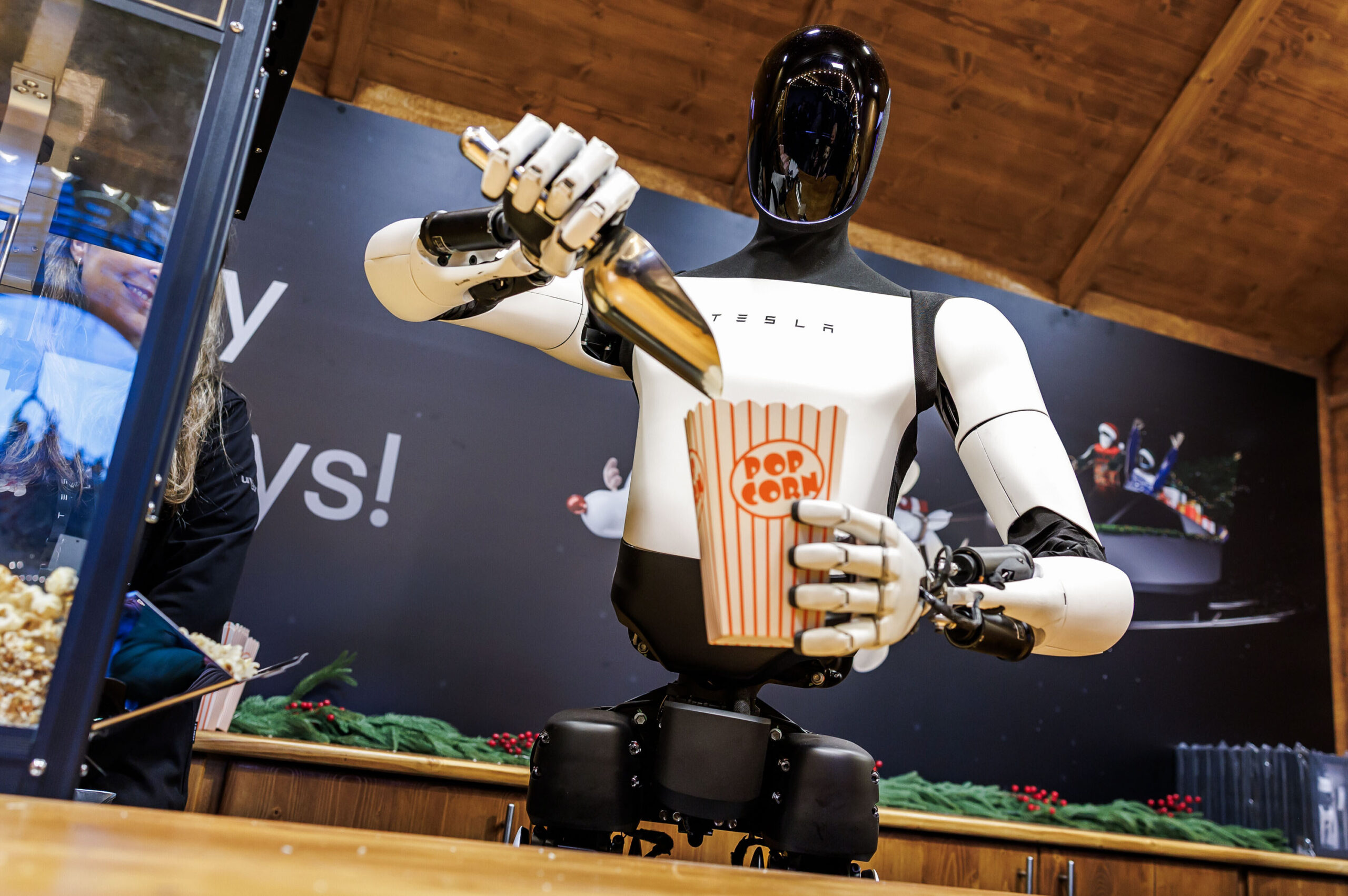
A robot shaped like a human—white with a black head and torso—has been popping up on video feeds. Perhaps you’ve seen it dance or pass popcorn, put trash in a bin, vacuum, or press the button of a microwave. Or maybe you’ve watched it fall backward while handing out water bottles or struggle to iron a shirt. 

This would be Tesla’s Optimus, an AI-powered humanoid robot that Elon Musk, the company’s CEO, believes will be “not just Tesla’s biggest product ever, but probably the biggest product ever,” headed to work on factory floors and, later, in our homes. Eventually it “will have human and then superhuman dexterity,” he told shareholders in July. Optimus robots could automate almost all human labor—from hauling sheet metal to folding laundry—for as little as $20,000 each, Musk argues. Speaking at the World Economic Forum’s annual meeting in Davos, Switzerland, in January, he predicted they could be on sale to the public by the end of 2027.

Musk is not alone in his evangelism. Marc Andreessen, cofounder and general partner of the Silicon Valley venture capital firm Andreessen Horowitz, has said that robotics could become the “biggest industry in the history of the planet.” In January, Jensen Huang, CEO of Nvidia, said that humanoid robots would match human-level ability this year. According to Morgan Stanley, the number of robots that “resemble and act like humans” is likely to reach nearly 1 billion by 2050, creating a market worth over $5 trillion. 

Elon Musk predicts that Tesla’s Optimus humanoid could be one the world’s best-selling products. For now, it’s most often seen handing out food and drinks at Tesla events.
SIPA VIA AP IMAGES

Such proclamations are in large part fueled by the idea that the same AI advances behind tools like OpenAI’s ChatGPT and Anthropic’s Claude will enable a new generation of robots to imitate human movement the way chatbots imitate human language. But many robotics researchers are skeptical, arguing that such assumptions minimize the challenges of using an intelligence built on language and images to master the infinite variability of the physical world. “None of those companies [building humanoid robots]—absolutely none of them—has any idea how to make those robots smart enough to be useful,” Yann LeCun, often referred to as one of the godfathers of AI, said at another event during the January Davos conference.  

Researchers also point out that the tendency to conflate humanoid robots made to resemble people with so-called generalist machines able to learn and perform multiple tasks is misleading. ”It’s very easy to make a robot that looks like a person,” explains Jonathan Hurst, cofounder and chief robot officer of Agility Robotics and professor of robotics at Oregon State University. “It is dramatically more difficult to make a machine that moves or behaves dynamically or physically like a person.”  

These tensions—over whether all-purpose humanoid robots are just around the corner or nowhere in sight, and whether current forms of AI are all that’s needed to perfect them—are playing out in robotics labs across the country, where the hype over timelines is obscuring painstaking but meaningful progress.

A decade or so ago, a series of breakthroughs led to a generative AI revolution that turned the long-imagined possibility of artificial intelligence into reality. Roboticists—though they disagree on exactly when this will happen—believe that an equally transformative revolution is possible in robotics, one that will endow machines with physical intuition and fluidity that has long been out of reach. As progress in robotics inches forward, the question is whether the same methods and tools that fueled advances in AI are enough to get there, or if an entirely new path is required.

Robots meet advanced AI

To see one of the smartest robot brains working today, it’s worth looking at what Google DeepMind can do with a piece of equipment called ALOHA 2, short for “A Low-cost Open-source Hardware System for Bimanual Teleoperation.” 

Roboticists have long clashed over whether a humanlike form is necessary for generalist robots, with proponents arguing that it will help them slot into the world as it exists and detractors saying it’s not worth the trouble. ALOHA 2 reflects this second way of thinking. Not much to look at, it’s just a pair of arms, some grippers, and a couple of cameras. But despite its seeming simplicity, it is a workhorse for researchers at Google DeepMind, who use it to test their most advanced AI for robotics system, Gemini Robotics, in their various labs.

When controlled by Gemini Robotics, ALOHA 2 becomes more of a generalist robot, in the sense that it can perform any number of tasks based on examples it’s been trained on. Ask it to pack a lunchbox and, as evidenced by a video of this exercise, it can use two pincer grippers to delicately place a piece of white bread into a Ziploc bag, close it, place a bunch of grapes in a Tupperware container, secure the lid, and then carefully move the items into a lunchbox before zipping it up. 

It’s not a great lunch. But the fact that the robot can put it together represents an objective step forward from what was possible even, say, three years ago. 

This is in large part due to AI and its impact on what are known as robot policies, which controls how a general-purpose robot will need to assess and understand its surroundings, plan how to move within them, and then perform its task correctly.

The ALOHA 2 robot isn’t much more than two mechanical arms on a bench top, but it serves as a testbed for cutting-edge AI robotics models. These animations are based on human teleoperation of the robot arms, data that is used to train Google DeepMind’s models. (Video: Google DeepMind / Stanford University / Hoku Labs)

Historically, these policies were based on rules developed by engineers who hard-coded them into the robot’s software—thousands of lines of code that would determine each millimeter of a robot’s movements in hundreds of tasks. What’s been happening for the last few years—and what is largely responsible for the optimism about generalist robots—is that robot policies are being handed over to advanced AI systems instead of being coded into the robot’s software. This first happened with VLMs, or vision-language models. These are similar to large language models, but they’re trained on images as well as words. Show a VLM a picture of a coffee spill and ask it to find a tool to clean up the mess, and it can identify a nearby cloth. This sort of immediate contextual understanding didn’t exist a couple of years ago when robot policies were hard-coded. 

Next came vision-language-action models, which enable robots to assess their environment and take action within it. The models do this by adding yet another component: motion commands. VLAs are trained on a series of images or videos related to performing a given task along with associated data about how a robot arm moves to perform it. That movement data is typically collected through teleoperation, in which a human uses remote controls to lead a robot through an action. This sort of training allows the AI to learn how to command the robot to move and operate during a given task. Place a VLA-powered robot in front of a desk and tell it to “close a laptop” or “wrap up the headphone wire,” and it will survey the scene, identify the relevant object, plan a way to execute the request, and then swing its arms into action—at least if it has seen this task accomplished before. 

The Gemini Robotics model is a VLA, trained on many hours of human demonstrations depicting a vast array of different actions. As a result, it can perform relatively complex tasks like picking up snow peas with kitchen tongs, doing origami, or putting together a simple lunch. It’s impressive, but there’s a glaring limitation: For now, if a robot controlled by a VLA is asked to perform a task that falls outside its training set, it’s highly likely to fail. 

“Thinking about the space of all tasks, a real generalist policy would be able to do everything along that spectrum,” says Edward Johns, a robotics professor at Imperial College London. Today, though, a Gemini Robotics model can do only “a few things here and a few things there.”

The search for true generality

So how do we get robots to be able to do more things? The usual answer is probably not surprising: Train them on more data.  

More data, the thinking goes, equals more examples, and more examples equals more generality. Google DeepMind, for instance, wants to pull together “as much data as possible,” says Pannag Sanketi, a former tech lead in robotics at the company who’s currently working on his own AI robotics project. But where to get it? Large language models had the benefit of oceans of existing text for training. There is no corresponding pool of high-quality physical demonstrations on which to train robots. Researchers have a few ways to make up for this, but all have flaws. One is to employ large numbers of people to create and collect teleoperation data (costly and time-consuming). Another is to train VLAs on videos of people performing activities (the resulting data quality is poor). Yet another is to deploy robots in the real world and use data collected from those experiences to further refine AI models (robots aren’t safe or reliable outside labs). Sanketi thinks a “multi-prong” approach that uses data collected from all these sources is the most likely path forward.

But the belief that training data alone is the answer is far from universal. Agility’s Hurst describes it as “a fundamentally flawed premise.” 

The issue is that tasks in the real world quickly explode in complexity. If you’re trying to, say, make coffee, there are myriad variables: No two kitchens are identical; coffee machines work in different ways; different cups require different grips; coffee grounds, hot water, and milk all need to be handled differently. Even this simple task requires understanding an ever-changing menu of possibilities. Achieving generality through VLAs, Hurst argues, would require “complete data coverage of all of the things that [a robot] could ever do.” Or, in other words, an almost infinite pool of training data. 

LeCun is dismissive of the whole approach. “The [AI] approaches that have been successful for language do not work for high-dimensional, continuous, noisy data”—the kind of data that is commonplace in robotics, he said in Davos. “You have to use something else.”

The leading contender for “something else” is the so-called world model—a form of AI trained less on text than on a combination of video, three-dimensional scans, and sensor data and built to predict the outcomes of actions in the real world. The aim is to build models that possess an internal representation of reality precise enough to capture how the physical world actually operates—how objects move, collide, fall, and deform. If roboticists could train machines in simulations faithful enough to real-world physics, development would become faster, cheaper, and safer, reducing the need for real-world testing. Even more transformative, robots equipped with world models could reason about their surroundings rather than merely reacting to them, helping them anticipate the consequences of an action before taking it.

Google DeepMind’s latest AI models for robots are increasingly dextrous, if rather slow and erratic

Companies like Nvidia and Google are working on the technology, and investor cash is pouring into high-profile startups. World Labs, cofounded by the Stanford AI researcher Fei-Fei Li, raised $1 billion in funding in February and was acquired by AMD at the end of September for $8.2 billion. AMI Labs, cofounded by LeCun (formerly Meta’s chief AI scientist), also raised $1 billion in March. Yet by their own admission, it is still early days. Late last year Li described the field as “nascent,” adding that “foundational approaches are still being established.” In a June Substack she described daunting challenges. For now, world models are a promising area of research rather than an immediate route to general-purpose robotics, but we are beginning to see glimmers of what they could achieve.

One such glimpse came with a small but potentially significant leap forward that took place in a San Francisco robotics lab last April. 

A breakthrough?

In the heart of San Francisco’s Mission District, the startup Physical Intelligence—or PI (as in π), as it likes to be known—is focused on developing a universal brain that could, theoretically, turn any robot into a generalist. Using an everything-including-the-kitchen sink approach to training AI models for robots, the company recently observed a hint of what a robotic brain equipped with a world model could be capable of. 

In 2024, PI published details of its first generalist robotics system, called π0, a VLA it claimed was the “most capable and dexterous generalist robot policy to date.” The model was initially trained on a 10,000-hour proprietary collection of human demonstrations gathered through teleoperation as well as several open-source robot datasets. A version released in spring 2025, π0.5, was trained on a wider variety of datasets, including labeled images from the web, lending it more versatility. A fall 2025 update, π0.6, added reinforcement learning to the model.  

Each update yielded important improvements to the model’s performance, increasing its menu of abilities from slowly folding laundry to putting things away in new environments to completing tasks like folding boxes with a higher success rate. Then, in April 2026, π0.7 seemed to catapult PI into new territory. This version makes use of a less powerful world model that generates images of steps necessary to perform a task. As the robot undertakes the job, this “lightweight” model feeds it snapshots of what to do next. 
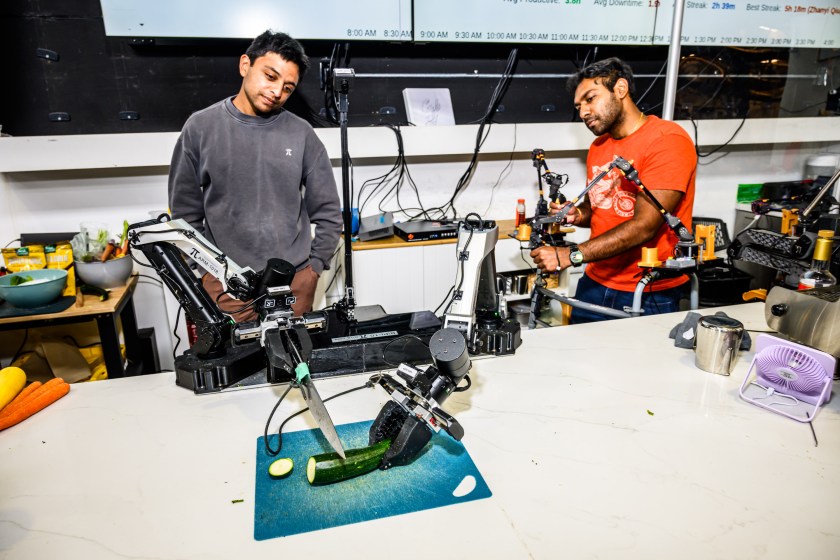
How do you teach a robot to use a knife? At the startup Physical Intelligence, it begins with designing the right AI architecture, which includes components dedicated to language, vision and motion. This will help it relate commands — “hey robot, chop my vegetables!” — to appropriate actions.
WINNI WINTERMEYER
Data to train the AI can come from many sources, but one of the most important is human demonstrations. An employee at the startup controls a robot arm through teleoperation, exposing the AI to the task of slicing a zucchini.
WINNI WINTERMEYER
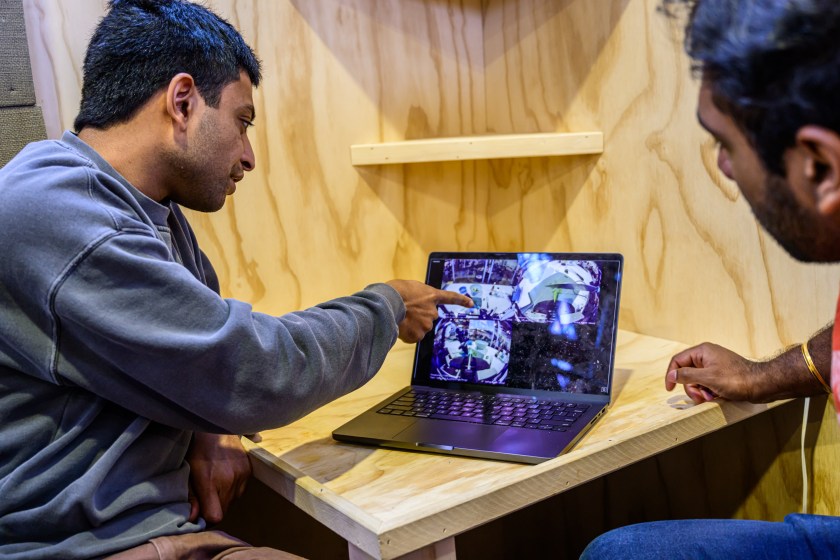
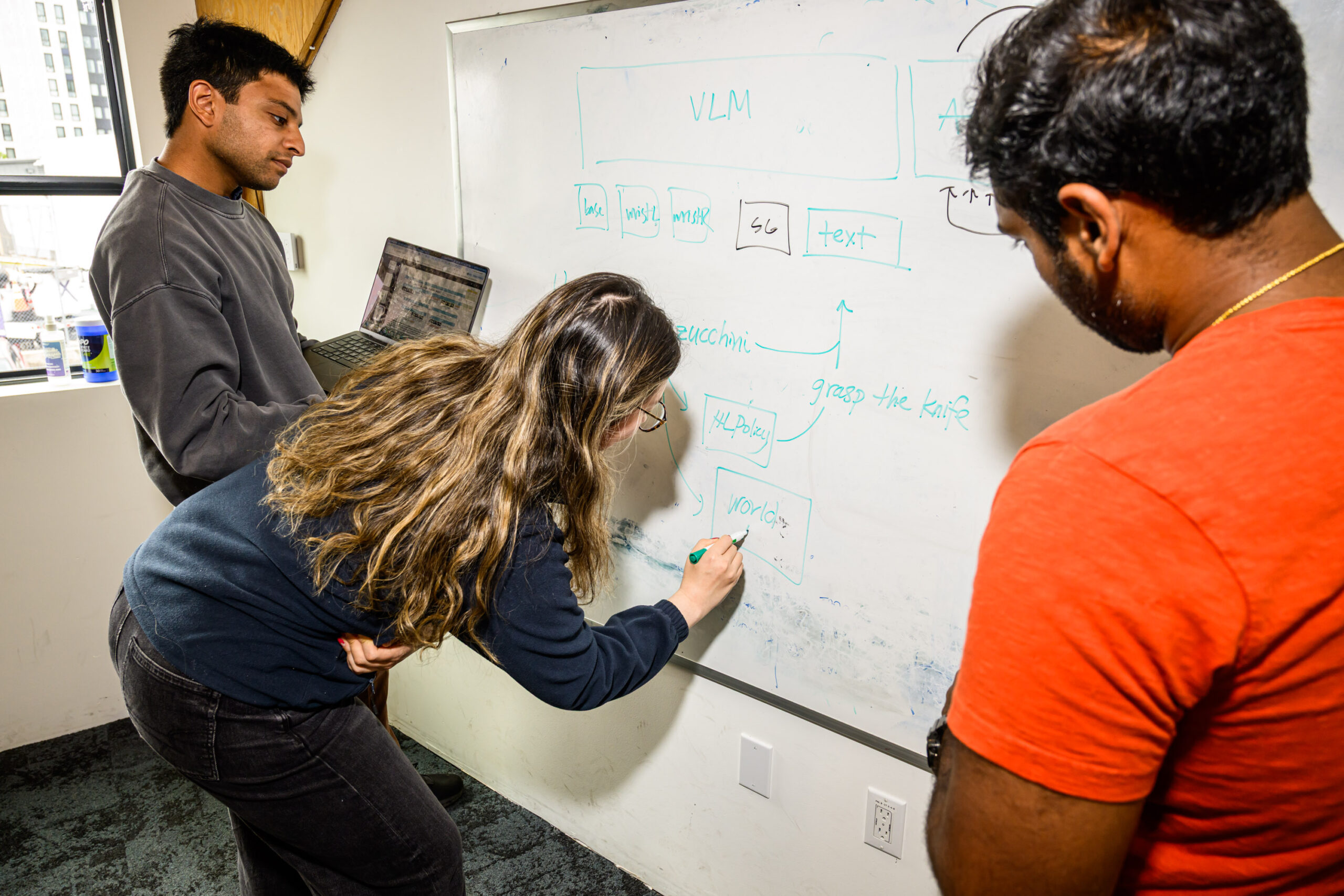
A researcher points out a detail from a training video to his colleague on a laptop screen
Researchers train the AI model on hundred of examples of human demonstrations, as well images from the web and first-person video.
WINNI WINTERMEYER
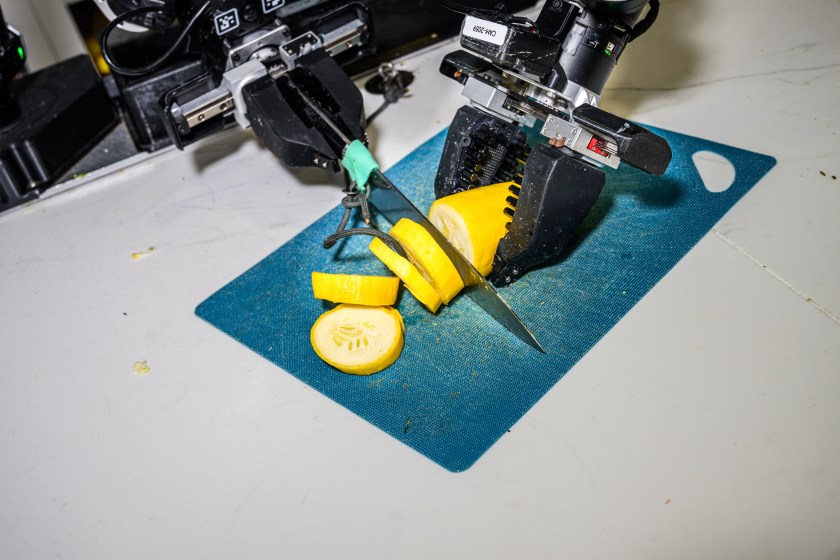
Robot grippers cutting a yellow squash with a kitchen knife
Once the AI is trained, the team presents it a task it has not seen before, such as chopping this summer squash. When a robot hasn’t seen the exact task before — it may wonder if that’s a yellow zucchini, or an unusual banana — it can mess up. But any failures can be used to help refine the model.
WINNI WINTERMEYER

The company claims that the model exhibits the first signs of compositional generalization, a term for AI systems’ ability to perform skills they’ve never been exposed to by recombining ones learned in their training data. One test involved asking a model to “load a sweet potato into the air fryer”—a task it had never previously encountered. In a demonstration video, the machine futzes around a little, makes a few false starts, and eventually manages a reasonable effort, though it doesn’t finish the task completely.

Sergey Levine, a professor at the University of California, Berkeley, and a cofounder of PI, is excited by the potential: “It’s actually the first time that we’ve convincingly seen that kind of compositional generalization, where we can basically ask the model to do tasks that we did not specifically collect data for and train it to do, and it’ll actually make a passable attempt.” 

The success led the team to wonder how the model was able to achieve such a feat. After some digging, they found snippets of relevant labeled teleoperation data lurking in the training material, including two examples of a human controller using the robot to push an air fryer basket into the fryer. Those shreds of data might have been enough to enable π0.7 to almost air-fry a sweet potato.

For now, it remains unclear just how impressive π0.7’s abilities to generalize are. Still, given how fleeting the model’s exposure to air fryers had been, it offers a glimpse into how far cutting-edge research can currently take robots. 

“70% success is like it doesn’t work”

You might be sensing a disconnect between the halting baby steps robots are making in labs—“Look! It put a sweet potato into an air fryer!”—and the dazzling, lifelike nimbleness on view during many demonstrations and videos, where robots are seen doing everything from dancing on a stage to courteously serving drinks. Such demos often don’t clearly reveal a key fact: In many instances, humans are controlling the robot or have carefully scripted its actions. (The robot that appeared onstage with Nvidia CEO Jensen Huang in March 2025, for example, seemingly responding to his instructions and following him around, was remote-controlled by what its makers called “a puppeteer behind the scenes.”) 

For now, fully autonomous motion planning so that a robot knows where it should go—especially in new, chaotic environments like a construction site or a unfamiliar home—remains a largely unsolved challenge. A bigger challenge still—albeit one that is often related—lies in getting robots to tackle larger, more ambiguous jobs that include multiple tasks and require decisions about how and in what order they’re done. This would be the difference between a robot that can put a plate into a microwave and one that can successfully respond to the prompt “Make dinner” by exploring the refrigerator, chopping ingredients, and firing up the stove. Google DeepMind’s best attempts at something like this—which involved asking its robot to survey a kitchen and pack all the ingredients for a mushroom risotto into a basket—have so far resulted in failure.

Adding to the challenge, a practical robot must essentially get it right every time. With VLAs, “people are very excited when their result goes from 50% success to 70% success,” says Marc Raibert, founder of Boston Dynamics. “But 70% success is like it doesn’t work, right?”
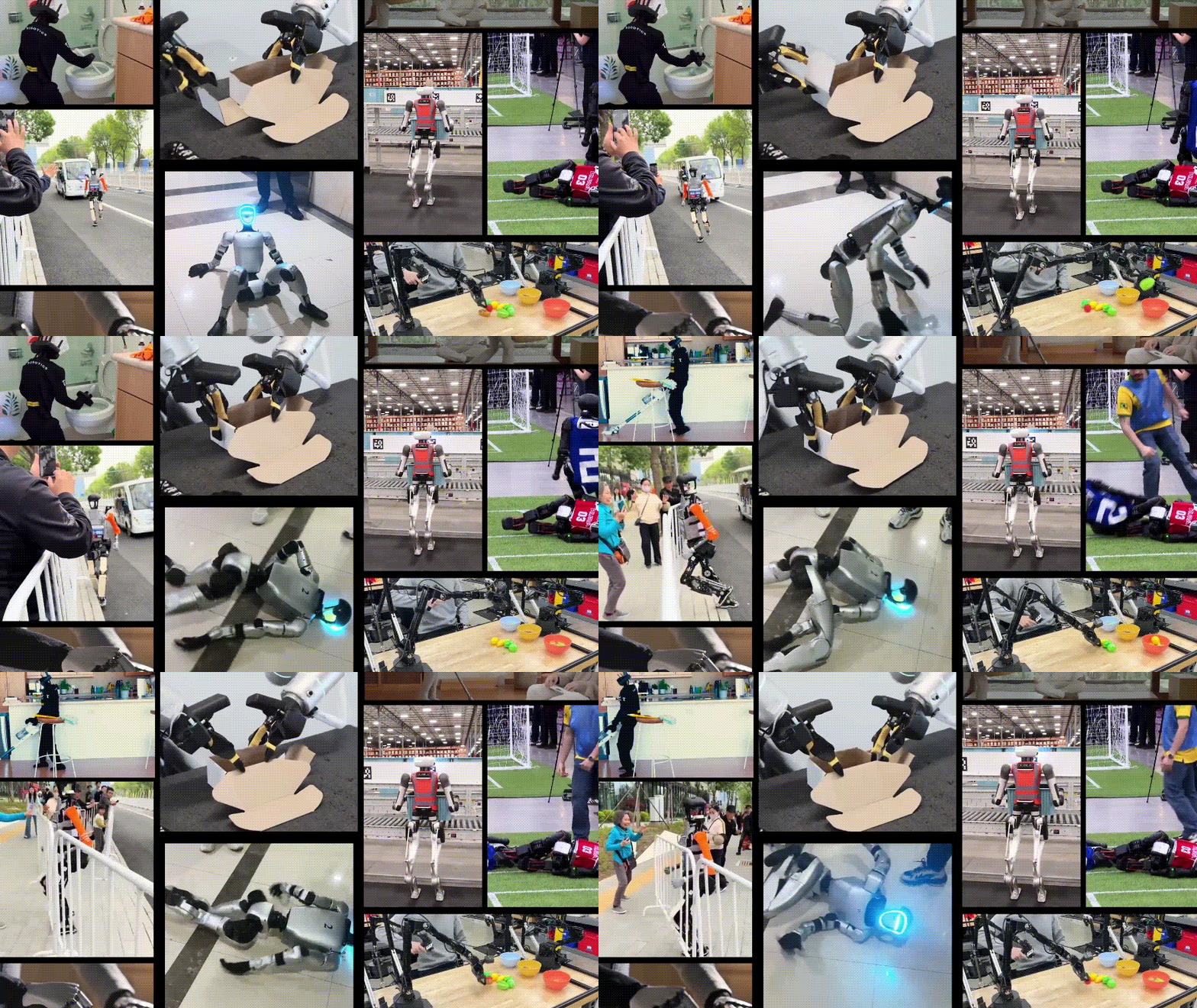
split screen of nine clips with different robots attempting tasks; some are teleoperated and a few have collided with objects or fallen.
Demonstrations often make robots look useful, but the machines still mess up far too often to be used reliably in homes and factories.
AP IMAGES, SHUTTERSTOCK, 1X, AGILITY ROBOTICS, GOOGLE DEEPMIND

The few humanoids that are being tested in real-life settings are undertaking extremely limited tasks in tightly controlled environments. They’re far from generalists. Agility has hundreds of robots deployed across trials in facilities owned by GXO Logistics, Amazon, and Schaeffler, according to the company. But for now, Hurst says, the robots are targeting simple tasks such as moving bins and totes around. Even then, he adds, it took years to develop robots safe enough for logistics firms to even contemplate using them. For his part, Elon Musk claimed in May 2025 that “thousands” of his Optimus robots would be working at Tesla factories by the end of the year, but in January of this year he said that the company had only “some of the Tesla Optimus robots doing simple tasks in the factory.”

While humanoids are starting to venture onto the factory floor, making the jump to households will be even more difficult. Right now, should you so desire, you can preorder the 1X Neo home robot, expected to be ready for delivery sometime later this year. Yours for $20,000, it promises to take on “the boring and mundane tasks around the house”—putting away dishes, answering the door, tidying the living room—“so you can focus on what matters to you.” The idea is for this five-foot-six-inch robot to one day perform all those tasks autonomously, but for now a remote human operator is needed for it to do most things. (Yes, a person would need permission to peer into your home through the robot’s cameras.) Asked how long it will be until fully autonomous robots are ready for domestic work, Hurst said, “If I had to pick a number, I’d say it’s 10 years before robots are … actually doing useful things in people’s homes.”

When that happens, the robots might well be Chinese, as China is well ahead of the West in terms of production. Nearly 90% of the roughly 15,000 humanoid robots shipped in 2025 were made by Chinese companies, according to the market intelligence company Omdia and the Chinese robotics firm Unitree. One model produced by Unitree, which shipped more humanoid robots than any other company last year, costs less than $6,000. Such an affordable price could go a long way toward making robots more attractive to consumers, though the company expects its machines to be used in industrial applications first. (If you’re wondering who is buying all these Chinese robots, by the way, the AP recently reported that orders come predominantly from corporate and academic labs and state-owned enterprises.)

We’ve been here before 

The dream of building a humanoid robot runs deep: As far back as 1495, Leonardo da Vinci sketched out designs for a mechanical knight, controlled by cables and pulleys. Through the 20th century, machines of sci-fi fever dreams have come and gone. 

Jeanne Dowling reaches up to light a cigarette for Elektro, a seven foot robot built by Westinghouse.
Westinghouse’s Elektro was a sensation at the 1939 World Fair.
GETTY IMAGES

Westinghouse’s seven-foot-tall box on legs, Elektro, hit the New York World’s Fair in 1939, smoking a cigarette. WABOT-1, built by Waseda University in Japan in 1973, was the first full-scale, programmable humanoid robot. Honda’s ASIMO, unveiled in 2000, was probably the first such machine to prove at all competent—it could, at least to some degree, climb steps, recognize faces, and autonomously move through spaces. But the robot was discontinued in 2018, unable to advance far enough beyond what it could do in demonstrations to be useful. 

All, at the time, were impressive—even jaw-dropping—feats of engineering. But none were ready to navigate the real world. Today’s robots, even with the transformative power of advanced AI, still face the same existential challenge.

Shape
Shape
Stay Ahead

Explore More Insights

Stay ahead with more perspectives on cutting-edge power, infrastructure, energy,  bitcoin and AI solutions. Explore these articles to uncover strategies and insights shaping the future of industries.

Shape

AMD takes on Intel and Nvidia with new 256-core EPYC server CPUs

AMD EPYC, Intel Xeon, and Nvidia Vera represent three different approaches to the evolving data-centre CPU market, added Rawat. “AMD competes through high core density, memory capabilities and power efficiency, while Intel leverages its established enterprise ecosystem, platform compatibility and customer relationships. Nvidia is taking a different approach with Vera,

Read More »

EIA: US crude oil inventories up 4.7 million bbl

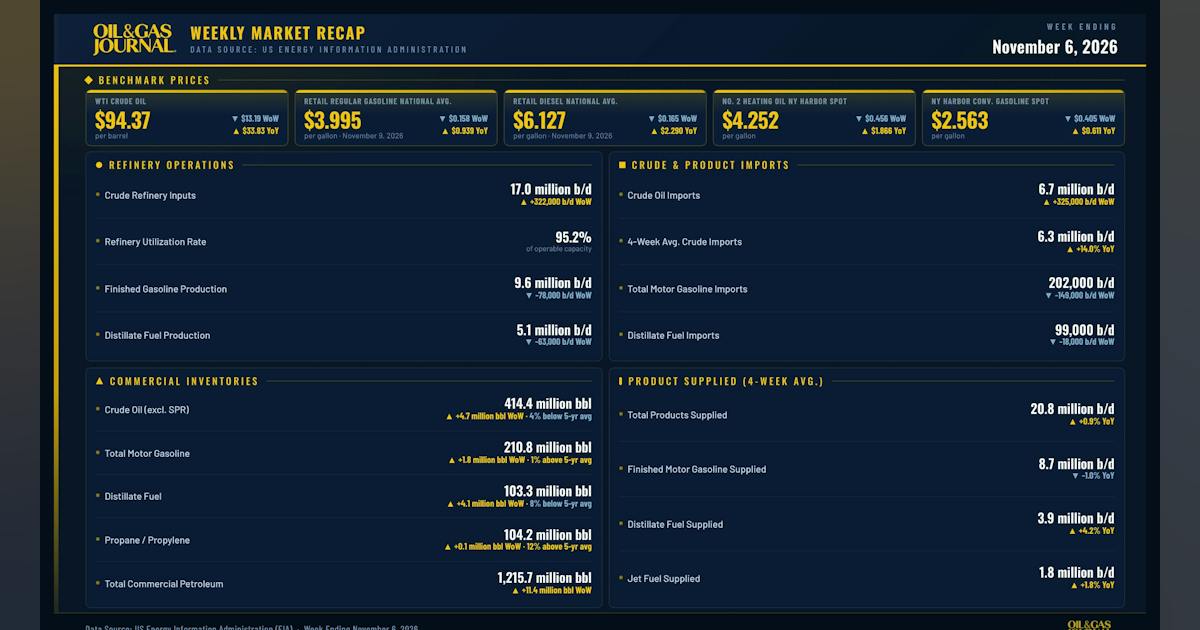
US crude oil inventories for the week ended Nov. 6, excluding the Strategic Petroleum Reserve, increased by 4.7 million bbl from the previous week, according to data from the US Energy Information Administration (EIA). The report was released a day later than usual due to the due to the closure of the Federal government on Wednesday, Nov. 11. At 414.4 million bbl, US crude oil inventories are 4% below the 5-year average for this time of year, the EIA report indicated. Gasoline inventories increased 1.8 million bbl, 1% above the 5-year average. Propane-propylene inventories increased 100,000 bbl, 12% above the 5-year average. Total commercial petroleum inventories increased by 11.4 million bbl for the week. Distillate inventories increased 4.1 million bbl, 8% below the 5-year average. US crude oil refinery inputs averaged 17.0 million b/d for the week ended Nov. 6, which was 322,000 b/d more than the previous week’s average. Refineries operated at 95.2% of capacity. Gasoline output averaged 9.6 million b/d, and distillate production decreased to 5.1 million b/d. Crude oil imports increased 325,000 b/d to 6.7 million b/d. The 4-week average of 6.3 million b/d is 14% above the year-ago level. Gasoline imports averaged 202,000 b/d; distillate imports averaged 99,000 b/d. Over the past four weeks, total product supplied averaged 20.8 million b/d, up 0.9% year over year. The 4-week average for gasoline product supplied decreased 1.0% year over year to 8.7 million b/d, while the 4-week average for distillate product supplied increased 4.2% to 3.9 million b/d. The 4-week average for jet fuel product supplied increased 1.8% year over year.

Read More »

Morningstar holds 2027 Brent forecast at $71/bbl as Persian Gulf supply recovers

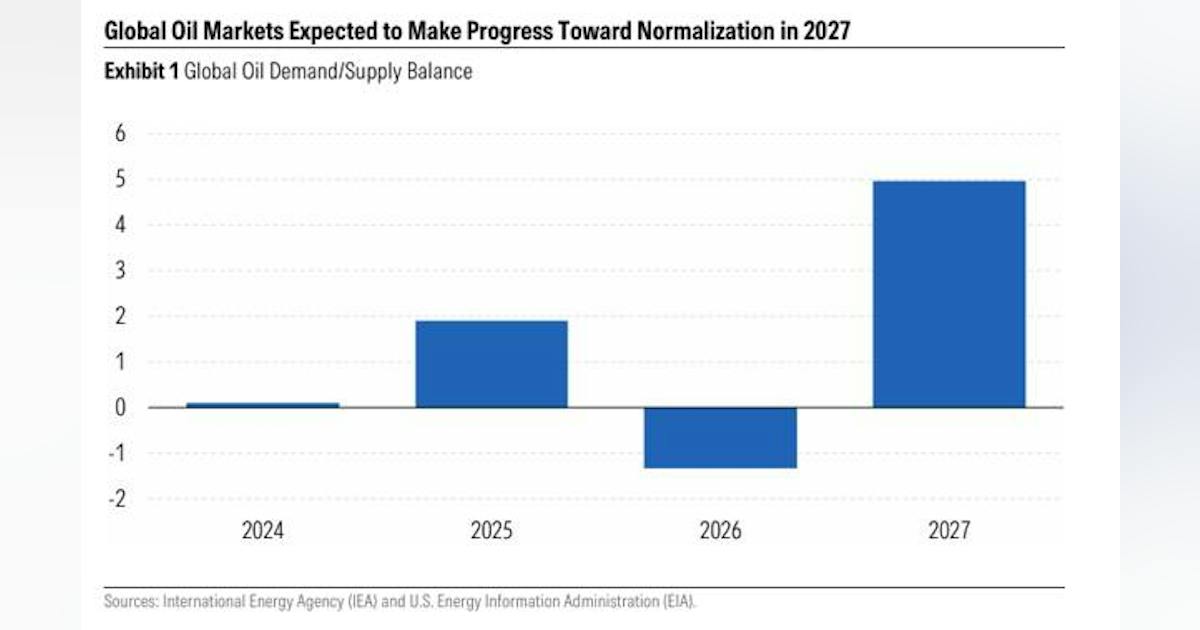
North American natural gas Morningstar DBRS kept its 2027 NYMEX natural gas price forecast at $3.50/Mcf. Growing LNG exports and electricity demand are expected to support prices, while rising production and relatively ample storage should limit sustained increases. EIA expects US dry gas production to reach about 116 bcfd in 2027 and LNG exports to rise to about 19 bcfd. US LNG export capacity is nearly fully utilized, limiting how much additional gas producers can send overseas when European or Asian LNG prices rise. In Western Canada, production growth from the Montney, Duvernay, and other liquids-rich formations is expected to outpace additional LNG demand in 2027. LNG Canada has added a source of demand, and the expected startup of Woodfibre LNG during 2027 should provide further price support. Canadian crude Canadian crude oil production is expected to rise modestly in 2027, particularly at oil sands projects where producers can add volumes through optimization and brownfield expansions. The Trans Mountain Expansion Project has improved access to Pacific markets. Morningstar expects a $14/bbl differential between WTI and Western Canadian Select (WCS) in 2027. Morningstar expects the credit profiles of most rated North American oil and gas producers to remain broadly stable under its 2027 price assumptions. For oil-weighted producers, $68/bbl WTI should generally provide enough cash flow to fund maintenance capital spending, support moderate production growth, and maintain shareholder distributions. Lower oil prices than in 2026 are expected to reduce excess free cash flow.

Read More »

Citgo refineries set quarterly throughput, distillate records

Citgo Petroleum Corp., Houston, achieved record quarterly crude runs and distillate production rates across its three US refineries in third-quarter 2026, the company said Nov. 12. Total refinery throughput averaged 904,000 b/d, up 10% from the second quarter, while average crude utilization reached 103%. Combined crude runs set a system-wide quarterly record of 855,000 b/d, with the operator’s 167,000-b/d refinery in Corpus Christi, Tex., setting a site-specific average quarterly throughput rate of 176,000 b/d. Combined distillate production also reached a quarterly record of 365,000 b/d, led by Citgo’s 479,000-b/d deep-conversion refinery along the Calcasieu Ship Channel in Lake Charles, La., which set a site production record of 208,000 b/d, according to the operator. Citgo reported third-quarter net income of $2.2 billion, compared with $936 million in the second quarter. Earnings before interest, taxes, depreciation, and amortization (EBITDA) were $3.008 billion, while adjusted EBITDA was $2.958 billion for the quarter. Citgo said year-to-date adjusted EBITDA at the end of third-quarter 2026 was $4.713 billion, exceeding the operator’s previous full-year earnings record set in 2022. Refining, commercial developments Citgo said its third-quarter capital spending included $50 million for turnaround and catalyst work and $128 million for capital projects. The operator’s crude fractionation and yield improvement project at Corpus Christi, was expected to be mechanically complete in December, with startup planned for early January 2027. The company’s reported throughput compares with 820,000 b/d in the second quarter, when turnaround work and unplanned outages affected runs. Average crude utilization rose from 97% in the previous quarter. Commercial developments during the third quarter included increased US Gulf Coast distillate exports to Europe, Brazil, and the Caribbean. Citgo also said it became the first shipper to move gasoline from the Chicago area to New York over the bi-directional Laurel Pipeline. Gasoline loading on the pipeline began

Read More »

Data centers could lower your electricity bill. Will utilities let them?

Listen to the article 6 min This audio is auto-generated. Please let us know if you have feedback. Edward Burgess is a partner at Current Energy Group. The debate over the impacts of new data centers on customers’ electricity bills is only intensifying. On the one hand, many people blame data center companies for triggering new grid costs that others will pay. On the other, data centers hold great promise to lower customer bills. For the latter, the theory is that, as high-utilization infrastructure users, data centers can absorb a large share of fixed costs that would otherwise be charged to existing customers. To their credit, nearly 200 data center companies have signed the Ratepayer Protection Pledge, committing to pay their fair share of costs. However, achieving this commitment depends on cooperative action by local utilities to update their rates accordingly. This raises an important question: Are investor-owned utilities willing to share the benefits of large-load growth with existing customers? Recent evidence suggests otherwise in some cases. Edward Burgess To fully understand this problem, let’s revisit the fundamentals of electricity ratemaking. New rates are typically proposed by utilities but ultimately approved by state utility regulators. When utilities propose new rates, the core calculation is based on two key inputs: 1) utility costs in the numerator, and 2) utility sales in the denominator. If the denominator increases more than the numerator (i.e., sales increase more than costs), then customer rates should decline on average. But in the era of hyperscale load growth, the specifics of these inputs — how they are defined and when relative changes occur — matter a great deal. In several recent cases, utilities have simply neglected to increase kWh sales from new data center load in their rate proposals, while still including related cost increases. For example,

Read More »

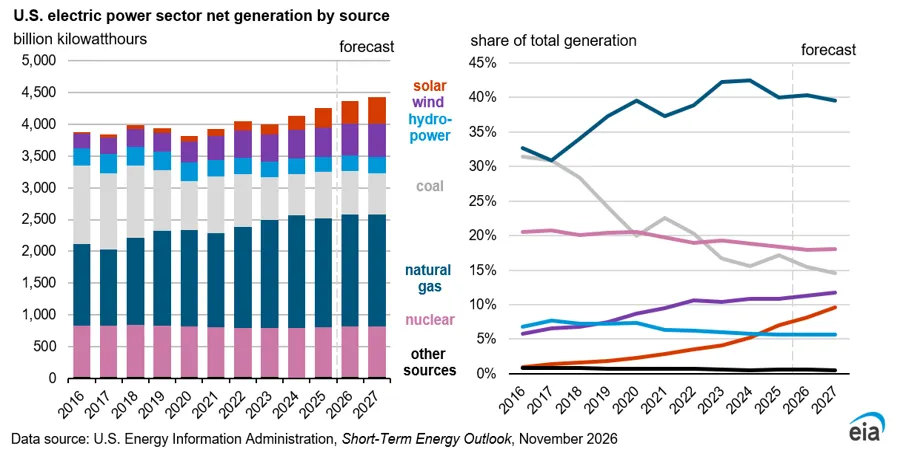
As coal burn declines, rising power demand will be primarily met by renewables: EIA

Listen to the article 3 min This audio is auto-generated. Please let us know if you have feedback. Dive Brief: The U.S. electric power sector will generate almost 4,390 billion kWh this year, up 2.7% from 2025 — a new production record driven by “rising demand from the commercial sector and increased cooling needs from warmer-than-average summer temperatures,” the U.S. Energy Information Administration said in its November Short-Term Energy Outlook published Tuesday. Rising electricity demand “is met primarily by increasing generation from renewable energy sources,” EIA said. Although the rate of generation growth is expected to slow next year, the share of total U.S. generation supplied by utility-scale solar plants will rise from 7% in 2025 to 8% in 2026, reaching nearly 10% in 2027, according to the report. Wind generation’s share is expected to rise from 11% in 2025 to 12% by 2027. EIA also expects the utility sector will install more than 25 GW of battery storage next year, reaching 91.7 GW of installed capacity by the end of 2027 — an increase of nearly 40% over expected 2026 totals. Dive Insight: Solar and wind generation are expected to add new capacity of about 72 GW and 20 GW, respectively, this year and next, EIA said. “Generation from other energy sources is likely to remain relatively flat or decrease,” it added. While commercial and industrial sector demand will continue to see robust growth next year, that could be “offset somewhat by lower residential electricity demand resulting from forecast milder summer weather next year,” EIA said. The federal government’s energy data arm is forecasting U.S. gas generation’s share of the electric power generation mix to hold relatively steady at an average of about 40% in 2026 and 2027, and nuclear’s share to average 18%. Coal’s share of generation will likely decline from 17% in

Read More »

Vår Energi selects SLB for integrated drilling services offshore Norway

@import url(‘https://fonts.googleapis.com/css2?family=Inter:wght@100..900&display=swap’); .ebm-page__main h1, .ebm-page__main h2, .ebm-page__main h3, .ebm-page__main h4, .ebm-page__main h5, .ebm-page__main h6 { font-family: Inter; } body { line-height: 150%; letter-spacing: 0.025em; } button, .ebm-button-wrapper { font-family: Inter; } .label-style { text-transform: uppercase; color: var(–color-grey); font-weight: 600; font-size: 0.75rem; } .caption-style { font-size: 0.75rem; color: color-mix(in srgb, currentColor 60%, transparent); } <!–> Vår Energi has selected SLB as its main integrated drilling services supplier for the Transocean Barents and Deepsea Bergen rigs on the Norwegian Continental Shelf. ]–> <!–> –> June 18, 2026 <!–> The energy technology company said the selection covers an initial 4-year period, with 4 additional 1-year extension options that could extend the scope through 2034. Two harsh-environment semisubmersibles will continuously drill exploration and development wells during this period. The selection expands SLB’s relationship with Vår Energi across drilling, digital well and field development planning, and subsea production systems.   ]–>

Read More »

Jensen Huang Resigns as NVIDIA CEO, Sending Shockwaves Through AI Data Center Industry

NVIDIA co-founder Jensen Huang resigned Thursday morning (November 12) as president, CEO and board member of the world’s dominant AI chipmaker, a stunning leadership change that introduces new uncertainty into the global artificial intelligence infrastructure boom. In an official announcement, NVIDIA confirmed that Chief Financial Officer Colette Kress will serve as interim CEO while the board conducts a search for Huang’s permanent successor. The company also appointed longtime director Harvey C. Jones as its first board chairman. The departure ends Huang’s 33-year leadership of the company he co-founded in 1993 and comes amid a rapidly escalating controversy involving his reported personal relationships, potential Chinese intelligence activity and questions about corporate governance. According to Reuters, NVIDIA shares fell more than 10% in premarket trading Thursday as investors weighed the implications for the approximately $4 trillion company and the wider AI technology sector. The company’s announcement did not specify a reason for Huang’s resignation. National Security Investigation Precedes Leadership Change The leadership shakeup follows several days of increasing scrutiny over Huang’s reported relationship with a businesswoman whom U.S. authorities suspect of connections to Chinese intelligence, alongside separate reporting concerning a relationship with a senior NVIDIA executive. On November 8, NVIDIA’s board announced an independent investigation into whether Huang had been targeted by a foreign intelligence operation. At the time, directors stated that they had no reason to believe company secrets or national security had been compromised. The controversy subsequently attracted congressional attention, including calls for Huang’s resignation and questions about semiconductor export controls and the security of advanced AI technology. The espionage allegations remain contested, and no compromise of NVIDIA technology has been publicly established. For the data center industry, however, the immediate question extends beyond the circumstances of Huang’s departure. It concerns the potential disruption of an infrastructure ecosystem increasingly organized

Read More »

Google’s Utah Deal Puts Geothermal Power on the Data Center Map

In Taiwan, the Work Begins With Access to Land Google’s first geothermal procurement agreements in Asia call for an initial 10 MW of new generation on Taiwan’s grid to support local data centers and offices. When Google and developer Baseload Capital announced the agreements in April 2025, a Google energy executive told Taiwan Public Television Service that the companies expected operations to begin in 2029. The original timetable allowed roughly four years between signing a customer and delivering electricity. Baseload’s development work in Hualien County illustrates one reason such projects take time. In November 2025, the company reported that members of the Hongye Tribe had voted to approve a public-land lease for geothermal exploration. Baseload opened a local office, reached an agreement with the community, and secured an exploration permit for a two-year program of drilling in stages. The company has described Hongye separately from Google’s contracted supply. What the Hualien project documents is an early milestone rarely visible in a power purchase announcement: the developer secured community consent before drilling could establish what the field might produce. Kenya Has the Generating Field. The Campus Remains Unresolved. In Kenya’s Rift Valley, the appeal of Olkaria was evident when Microsoft and G42 announced their digital investment initiative in 2024. Kenya already had a fleet of geothermal generating stations at Olkaria. G42 and local partners proposed building a campus there, powered by geothermal electricity and hosting Microsoft Azure services for a new East Africa cloud region. Two difficulties emerged. In May 2026, Semafor reported that President William Ruto had cited insufficient available power as an obstacle to the project. Separately, Reuters, citing Bloomberg, reported disagreements over payment guarantees. Microsoft and G42 had sought a commitment from the Kenyan government to buy a certain amount of computing capacity annually. Kenya’s principal secretary for

Read More »

Alberta’s Gigawatt Play: Why Building Data Centers Means Building an Industry

For Alberta’s emerging data center industry, the difference between a roadmap and an excavator has become increasingly consequential. A few years ago, Western Canada’s data center conversation revolved around the possibilities: abundant energy resources, available land, a favorable climate and the prospect of attracting hyperscale investment to a region better known for oil, gas and other industrial development. Today, earthmoving equipment is preparing the ground for what is expected to become Canada’s largest data center, and the questions facing the province have changed accordingly. The shift was on display at Data Centre West 2026, held in Calgary in September, where some 500 industry and government leaders gathered to examine the infrastructure and policy requirements of Alberta’s rapidly expanding digital economy. But for conference founder Vlad Oujegov, the most revealing development wasn’t simply the appearance of projects measured in gigawatts. It was the growing recognition that building those projects will require Alberta to develop an entire supporting industry, while confronting the environmental, political and community questions that increasingly accompany large-scale AI infrastructure. “The theme last year was the data center roadmap,” Oujegov told Data Center Frontier Editor in Chief Matt Vincent during a new episode of the Data Center Frontier Show podcast. “This year’s theme really to me was about execution and actually getting things done, actually seeing projects materialize and construction beginning.” Oujegov is president and founder of the Western Canada Data Centre Alliance, which organizes Data Centre West, and serves as National Data Center Power Systems Lead at Schneider Electric. His perspective draws on both Alberta’s emerging development pipeline and the wider industrial ecosystem now being assembled around it. In DCF’s earlier reporting from Data Centre West 2026, the central question was how quickly Alberta could convert growing hyperscale demand into deliverable capacity. The latest podcast conversation takes that

Read More »

Data center champions lose badly as ballot initiatives target AI infrastructure

In other locales, data centers lost badly. In Joliet Township, Illinois, a restriction on new data centers passed with 80% of the vote. In Hubbard, Ohio, more than three-quarters of voters gave data centers a thumbs down. Ohio emerged as the main battleground, accounting for 21 of the 50 measures tracked by Ballotpedia. The votes covered several different approaches to controlling development: outright bans, power-consumption thresholds, temporary permitting moratoriums, mandatory public votes and requirements for developers seeking tax incentives. California and Florida saw outright bans. California voters in the cities of Alhambra and Monterey Park, where voters approved a measure prohibiting data centers. In Florida, Edgewater voters approved a charter amendment opposing new data centers and expansions of existing facilities.

Read More »

Land & Expand: Texas’ AI Boom Meets a New Political Reality

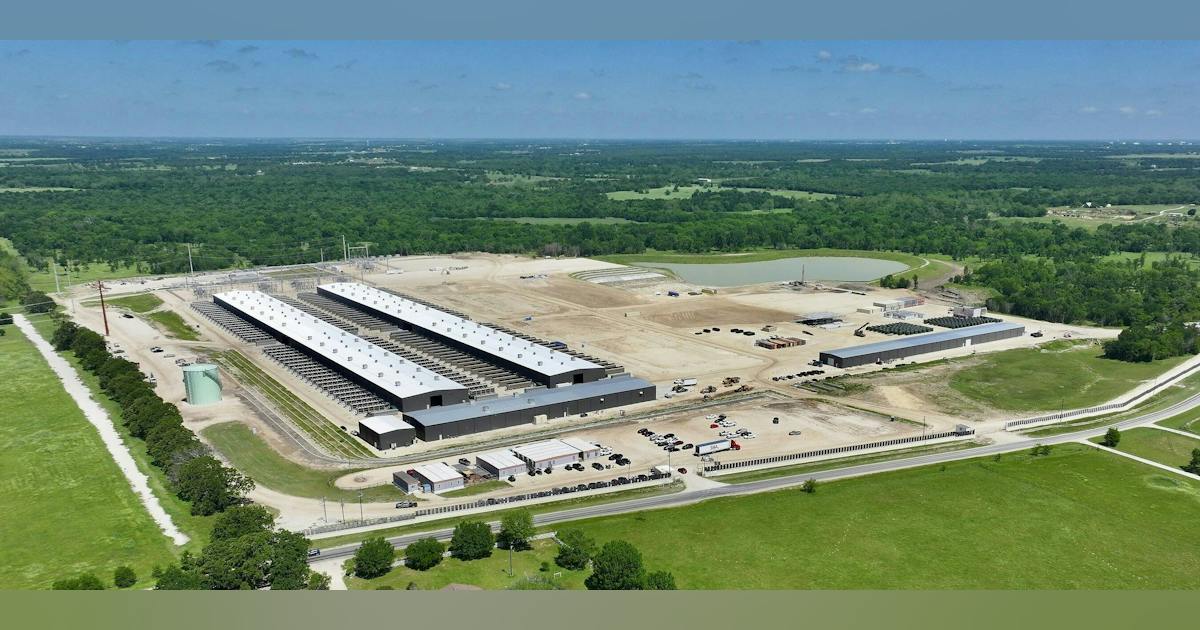
Hut 8 Advances a Gigawatt-Scale Campus Near Corpus Christi Another significant development came November 4, when Hut 8 reported continued progress on its Beacon Point AI data center campus in the Corpus Christi region. The company said that its previously announced second 352 MW IT-capacity lease had fully commercialized the campus, bringing the total contracted IT capacity associated with the two phases to 704 MW. The campus is designed around approximately 1 GW of utility capacity, a separate measure from the critical IT load under lease. Hut 8 estimates approximately $19.6 billion in base-term contract value across the two phases. In its third-quarter results, the company said construction of the campus substation had begun, alongside foundation and underground utility work for the first phase. Initial data hall delivery is targeted for the third quarter of 2027, with the second phase targeted for the second quarter of 2028. The company also disclosed agreements to acquire two energized sites in West Texas, with up to 230 MW of utility capacity at full energization, subject to outstanding approvals and infrastructure development. Those acquisitions point to another important trend: the increasing value of existing electrical infrastructure and sites that can potentially be adapted to serve advanced computing. As new greenfield projects face lengthy power studies and regulatory requirements, already energized locations may offer an alternative route to capacity. The distinction is especially important in markets such as Dallas-Fort Worth, where DCF’s analysis of CBRE’s first-half 2026 data found that approximately 95% of the region’s 765 MW under construction had already been preleased. PowerHouse and Big Watt Win Approval for Taylor Technology Campus Not every large new project is meeting resistance at the municipal level. On October 8, the City of Taylor approved a development agreement with PowerHouse Data Centers and Big Watt Digital for

Read More »

Google targets AI’s next infrastructure bottlenecks with two new TPUs

“It’s like adding more lanes to the highway,” he observed. “We’re not necessarily making each car travel faster, we’re creating more capacity so more traffic can move through the system at the same time.” Handling bursts, idling However, an agentic workload doesn’t behave exactly like a traditional inference workload. “It is bursty, long running, but often idle,” Lohmeyer noted. While it might generate outputs and call tools, it still has to wait for a response, maybe from a human, “literally for days.” During that time, it doesn’t need to do anything; it just needs to preserve context. But if resources are tied up for that entire multi-day period, they’re being wasted “90% plus of the time,” he said. Google Cloud’s open source TPU Sync is designed to address these issues by unifying memory, storage, and networking in software. The model-state layer for TPUs turns chip high bandwidth memory (HBM), host DRAM, shared storage, and the data center network into a “single, co-designed memory hierarchy,” the company said. It automatically tiers KV caches off the chip in milliseconds, streams context across nodes, and synchronizes RL weights to cut transfer latency and Time to First Token (TTFT) by more than 90%.

Read More »

Microsoft will invest $80B in AI data centers in fiscal 2025

And Microsoft isn’t the only one that is ramping up its investments into AI-enabled data centers. Rival cloud service providers are all investing in either upgrading or opening new data centers to capture a larger chunk of business from developers and users of large language models (LLMs).  In a report published in October 2024, Bloomberg Intelligence estimated that demand for generative AI would push Microsoft, AWS, Google, Oracle, Meta, and Apple would between them devote $200 billion to capex in 2025, up from $110 billion in 2023. Microsoft is one of the biggest spenders, followed closely by Google and AWS, Bloomberg Intelligence said. Its estimate of Microsoft’s capital spending on AI, at $62.4 billion for calendar 2025, is lower than Smith’s claim that the company will invest $80 billion in the fiscal year to June 30, 2025. Both figures, though, are way higher than Microsoft’s 2020 capital expenditure of “just” $17.6 billion. The majority of the increased spending is tied to cloud services and the expansion of AI infrastructure needed to provide compute capacity for OpenAI workloads. Separately, last October Amazon CEO Andy Jassy said his company planned total capex spend of $75 billion in 2024 and even more in 2025, with much of it going to AWS, its cloud computing division.

Read More »

John Deere unveils more autonomous farm machines to address skill labor shortage

Join our daily and weekly newsletters for the latest updates and exclusive content on industry-leading AI coverage. Learn More Self-driving tractors might be the path to self-driving cars. John Deere has revealed a new line of autonomous machines and tech across agriculture, construction and commercial landscaping. The Moline, Illinois-based John Deere has been in business for 187 years, yet it’s been a regular as a non-tech company showing off technology at the big tech trade show in Las Vegas and is back at CES 2025 with more autonomous tractors and other vehicles. This is not something we usually cover, but John Deere has a lot of data that is interesting in the big picture of tech. The message from the company is that there aren’t enough skilled farm laborers to do the work that its customers need. It’s been a challenge for most of the last two decades, said Jahmy Hindman, CTO at John Deere, in a briefing. Much of the tech will come this fall and after that. He noted that the average farmer in the U.S. is over 58 and works 12 to 18 hours a day to grow food for us. And he said the American Farm Bureau Federation estimates there are roughly 2.4 million farm jobs that need to be filled annually; and the agricultural work force continues to shrink. (This is my hint to the anti-immigration crowd). John Deere’s autonomous 9RX Tractor. Farmers can oversee it using an app. While each of these industries experiences their own set of challenges, a commonality across all is skilled labor availability. In construction, about 80% percent of contractors struggle to find skilled labor. And in commercial landscaping, 86% of landscaping business owners can’t find labor to fill open positions, he said. “They have to figure out how to do

Read More »

2025 playbook for enterprise AI success, from agents to evals

Join our daily and weekly newsletters for the latest updates and exclusive content on industry-leading AI coverage. Learn More 2025 is poised to be a pivotal year for enterprise AI. The past year has seen rapid innovation, and this year will see the same. This has made it more critical than ever to revisit your AI strategy to stay competitive and create value for your customers. From scaling AI agents to optimizing costs, here are the five critical areas enterprises should prioritize for their AI strategy this year. 1. Agents: the next generation of automation AI agents are no longer theoretical. In 2025, they’re indispensable tools for enterprises looking to streamline operations and enhance customer interactions. Unlike traditional software, agents powered by large language models (LLMs) can make nuanced decisions, navigate complex multi-step tasks, and integrate seamlessly with tools and APIs. At the start of 2024, agents were not ready for prime time, making frustrating mistakes like hallucinating URLs. They started getting better as frontier large language models themselves improved. “Let me put it this way,” said Sam Witteveen, cofounder of Red Dragon, a company that develops agents for companies, and that recently reviewed the 48 agents it built last year. “Interestingly, the ones that we built at the start of the year, a lot of those worked way better at the end of the year just because the models got better.” Witteveen shared this in the video podcast we filmed to discuss these five big trends in detail. Models are getting better and hallucinating less, and they’re also being trained to do agentic tasks. Another feature that the model providers are researching is a way to use the LLM as a judge, and as models get cheaper (something we’ll cover below), companies can use three or more models to

Read More »

OpenAI’s red teaming innovations define new essentials for security leaders in the AI era

Join our daily and weekly newsletters for the latest updates and exclusive content on industry-leading AI coverage. Learn More OpenAI has taken a more aggressive approach to red teaming than its AI competitors, demonstrating its security teams’ advanced capabilities in two areas: multi-step reinforcement and external red teaming. OpenAI recently released two papers that set a new competitive standard for improving the quality, reliability and safety of AI models in these two techniques and more. The first paper, “OpenAI’s Approach to External Red Teaming for AI Models and Systems,” reports that specialized teams outside the company have proven effective in uncovering vulnerabilities that might otherwise have made it into a released model because in-house testing techniques may have missed them. In the second paper, “Diverse and Effective Red Teaming with Auto-Generated Rewards and Multi-Step Reinforcement Learning,” OpenAI introduces an automated framework that relies on iterative reinforcement learning to generate a broad spectrum of novel, wide-ranging attacks. Going all-in on red teaming pays practical, competitive dividends It’s encouraging to see competitive intensity in red teaming growing among AI companies. When Anthropic released its AI red team guidelines in June of last year, it joined AI providers including Google, Microsoft, Nvidia, OpenAI, and even the U.S.’s National Institute of Standards and Technology (NIST), which all had released red teaming frameworks. Investing heavily in red teaming yields tangible benefits for security leaders in any organization. OpenAI’s paper on external red teaming provides a detailed analysis of how the company strives to create specialized external teams that include cybersecurity and subject matter experts. The goal is to see if knowledgeable external teams can defeat models’ security perimeters and find gaps in their security, biases and controls that prompt-based testing couldn’t find. What makes OpenAI’s recent papers noteworthy is how well they define using human-in-the-middle

Read More »

Introducing Gemini 4 Hydrogen

Unlocking efficiencies in multi-model workloadsIn real-world software development, while teams rely on frontier models like Carbon and Argon for deep architectural judgment when designing systems

Read More »