Stay Ahead, Stay ONMINE

Combatting adversarial distillation

As frontier AI models become more capable, safeguards play an increasingly important role in how they can be used responsibly. Adversarial distillation creates a path for bad actors to reproduce these capabilities without appropriate safeguards. An actor may use a frontier model’s outputs without authorization to train another model with similar capabilities, then deploy it without comparable protections. For instance, an adversary might distill a model’s cyber capabilities and use the resulting model to help carry out cyberattacks that the original model would have refused to assist with or that its safeguards would have blocked.We’re sharing how OpenAI detects and disrupts adversarial distillation, how we’ve strengthened protections for our models’ protected reasoning, and what we’ve learned that can help strengthen defenses across the industry.Our approach to adversarial distillation combines adversarial testing, model training, classifiers, and API-level protections with investigations into coordinated attempts to extract model capabilities. These updated safeguards align more closely with those we use for biology and cybersecurity.We place particular emphasis on preventing attackers from extracting our models’ protected reasoning: the intermediate steps a model generates internally while working toward an answer, known as its chain-of-thought. These traces can contain information the final answer leaves out, making them especially valuable training data for another model.We’ve strengthened our defenses against protected reasoning extraction in GPT‑6.2 Astra and GPT‑6.2 Sol. In an internal adaptive evaluation using strong automated red-teaming, we tested whether attackers could recover protected reasoning the model had generated while answering an earlier prompt. The average attack success rate fell from 54.0% against GPT‑6 Astra with its original safeguards to 0.2% against GPT‑6.2 Astra with its updated safeguards.Why distillation is a safety issueDistillation is a common machine-learning technique in which one model learns from data produced by another. For example, a model can learn from another model’s answers, its reasoning, or its judgments about which answers are better and why. Beyond intellectual property concerns, unauthorized distillation poses serious safety risks. Through adversarial distillation, a second model can learn advanced frontier capabilities without inheriting the safeguards that govern how the original model can use them.The concern is especially clear in dual-use domains like cybersecurity and biology. A model that helps defenders find vulnerabilities in software could also help an attacker exploit them; a model that assists with biological research could also help someone develop a harmful pathogen. If such capabilities were transferred to a model with weaker safeguards, it may provide assistance that the original model would have refused, or that the original safeguards would have blocked.The importance of protecting exact reasoning traces for cyber safetyOur models help users with coding and defensive cybersecurity tasks. A second model trained on many of those benign outputs may learn skills that also apply to offensive cybersecurity tasks. To better understand this, we study how distillation, especially involving reasoning traces, may transfer risky cyber capabilities.In this setting, the model that produces the training data is called the teacher, and the model that learns from it is called the student. In an internal study on how cyber capabilities transfer, we used the content normally visible to users—final responses, reasoning summaries, and tool interactions—as our baseline for distillation, and tested how much additional cyber capability transfers when the student has access to the teacher’s exact reasoning traces.We started each training run from the same pretrained student model. We created a supervised fine-tuning dataset consisting primarily of trajectories from Astra-level teacher models working on coding and defensive cybersecurity tasks. Each trajectory includes all of the steps a model takes as it works through a task, including any tool interactions and its final response. We evaluated each student after fine-tuning and again after a lightweight round of reinforcement learning in cybersecurity and coding environments.After supervised fine-tuning, the student trained on exact reasoning traces generally outperformed the student trained on reasoning summaries. After reinforcement learning, the exact-trace student still scored higher at the largest inference budget tested on both benchmarks shown, while the summary-trained student scored higher at lower budgets.1ExploitBenchSEC-bench ProOur cyber distillation results suggest that protecting reasoning traces can limit cyber capability transfer, even when the underlying task is one allowed under our usage policies. Across many such interactions, exact reasoning traces can teach a student skills that generalize beyond the tasks the teacher originally performed. We will continue studying how much additional capability transfers across different student models and distillation training recipes.Defenses that reinforce one anotherWe defend against adversarial distillation at two complementary levels of our safeguard stack. At the request level, model behavior, classifier checks, and API controls limit reasoning trace extraction. At the campaign level, we look for patterns in request-level and account-level signals that can reveal coordinated extraction attempts. In turn, attacks uncovered in investigations become examples for training and testing our safeguards.Our defenses against adversarial distillation combine safeguards for individual requests with campaign detection and enforcement. Findings from investigations and automated red-teaming help strengthen those safeguards.Protecting individual requests and responsesDefensive training for model behaviorAdversarial training teaches models to recognize reasoning extraction attempts and refuse to disclose protected reasoning, while preserving responses to legitimate requests for explanations and assistance. Adversarial training examples come from successful attacks identified through internal automated red-teaming, investigations, and responsible disclosures of potential security weaknesses from outside researchers or industry partners.Classifier safeguardsWe use input classifiers to detect attempts to extract protected reasoning, and output classifiers to detect leaks of protected reasoning in assistant messages and tool-call arguments. These safeguards apply to both streaming and non-streaming responses.Tool-call coverage is important because a model can expose protected reasoning in a tool’s arguments without including it in its final answer. Output classifiers can block suspected leaks before that content reaches the caller.API-level protectionsAPI-level protections restrict how protected reasoning can be reused across interactions and models. Our September disclosure described attacks that moved encrypted reasoning from one conversation into another and asked the model to reveal the reasoning in user-readable form. We strengthened protections across user, workspace, organization, and model-family boundaries, including closing a pathway that could expose another user’s encrypted reasoning.With GPT‑6.2 Astra and GPT‑6.2 Sol, we tie a model’s protected reasoning to the conversation history that produced it. As new messages are added, the model can build on its earlier reasoning. If an earlier message is rewritten, our API drops the reasoning that followed it⁠(opens in a new window). We also prevent older model families with weaker safeguards from reading GPT‑6.2 Astra and Sol’s protected reasoning.Investigating and disrupting coordinated campaignsWhen our systems detect unauthorized adversarial distillation campaigns, which often include coordinated attempts to extract our models’ reasoning, we investigate the accounts responsible. When we identify violations, we enforce against the network of accounts, consistent with our policies and terms of service. Through investigations of each campaign, we generate insights that allow us to upgrade our defenses in order to better detect similar activity. We also share indicators of compromise with other model providers so they can investigate related abuse on their own services.This work extends beyond our own platform. Our consistent-standards policy establishes shared standards for safeguards and coordinated enforcement across providers offering our models. We work closely with partners where appropriate to uphold these standards and strengthen protections across deployments.Sharing relevant findings across industry and government where appropriate can help disrupt campaigns and enable model developers and providers to better identify and defend against attempts to distill frontier models.Measuring progressResistance to reasoning extractionTo measure how well our request-level safeguards work together, we test whether attackers can still extract protected reasoning in a setup that closely mirrors production deployments of our models and safeguards. In static evaluations, we replay a fixed set of previously successful attacks to see which still expose protected reasoning. In adaptive evaluations, automated AI red-teamers adjust their approach based on how the system responds, which can uncover weaknesses the static tests miss.We also vary what testers can see. Black-box testing gives them the same view an external user would have, while white-box testing gives them additional information about the system to help them develop stronger attacks. In our adaptive black-box evaluation, we tested whether attackers could recover protected reasoning the model had generated while answering an earlier request or the current one. On GPT‑6.2 Astra with its updated safeguards, the average attack success rate was below 1% for each attack type. Both rates were substantially lower than on GPT‑6 Astra with its original safeguards. We’re now applying selected safeguard improvements to GPT‑6 Astra as well.Attack success rate (ASR) in adaptive black-box red-teaming against GPT‑6 Astra and GPT‑6.2 Astra, aggregated across six attacker models. Lower ASR is better.Campaign detection and enforcementWe have seen multiple unauthorized adversarial distillation campaigns on our platform this year, and shared initial findings in our September report. Our weekly enforcement actions against these campaigns have ranged in scale from thousands to tens of thousands of accounts, with the rate increasing significantly this past summer.In order to measure the effectiveness of our efforts, we also track the prevalence of distillation abuse, as well as the time between detection and enforcement. Our objective is to constrain the volume and value of the data distillers are able to obtain, to increase the cost of distillation campaigns, and to shorten the time needed to respond to new attacks. We continue to improve these defenses through adversarial testing and investigations.The national security implications of adversarial distillationAdversarial distillation also poses a national security risk. A foreign actor that reproduces advanced capabilities from a U.S. model can deploy them without the protections its developer put in place. In February, we briefed⁠(opens in a new window) Congress on activity indicating that DeepSeek was attempting to distill U.S. frontier models. In September, we reported disrupting a campaign to extract our models’ protected reasoning and attributed a core part of that activity to individuals associated with Moonshot AI, the developer of Kimi. We plan to share more soon about recent campaigns we’ve disrupted.We support legislation that would give the U.S. government more tools to identify and sanction foreign actors that illicitly extract capabilities from American AI models. We’ve also told Congress we support the Chip Security Act, the AI OVERWATCH Act, and the MATCH Act. Stronger export controls can limit adversaries’ access to the hardware needed to train frontier models. Distillation defenses make it harder to acquire some of the same capabilities from models already trained. Both efforts help maintain a U.S. lead in frontier AI, giving developers more room to slow a release when they need time to test safeguards.How others can build on this workSupporting the safe proliferation of frontier capabilities is an important goal of our anti-distillation work. Our experience so far suggests several useful steps that other model developers and platforms can take:Protect private reasoning across the full interaction. Check assistant messages and tool-call arguments for leaks, and restrict how encrypted reasoning can be reused across conversations and models.Keep successful extraction attack logs found through red-teaming, production monitoring, or responsible disclosure as regression tests. Where appropriate, and consistent with applicable privacy policies, use those examples to improve model training and classifiers. When evaluating updated defenses, replay the original attacks and test whether an adaptive red-teamer can still find a way through those defenses.Combine request-level mitigations with campaign-level investigation and enforcement.Coordinate safeguard requirements and enforcement with deployment partners, and share expertise with other AI model developers, to ensure a high floor of distillation safeguards across the industry.We have previously also shared findings through the Frontier Model Forum⁠(opens in a new window) and appropriate government information-sharing channels to help other developers strengthen their defenses while keeping the details attackers could exploit private. We’ll continue working with researchers, developers, and partners to share what we learn about emerging attacks and effective defenses.As we make frontier AI broadly available, our defenses against adversarial distillation aim to reduce the risk that its capabilities are reproduced without adequate safeguards, supporting our mission to ensure that artificial general intelligence is deployed safely and benefits all of humanity.

As frontier AI models become more capable, safeguards play an increasingly important role in how they can be used responsibly. Adversarial distillation creates a path for bad actors to reproduce these capabilities without appropriate safeguards. An actor may use a frontier model’s outputs without authorization to train another model with similar capabilities, then deploy it without comparable protections. For instance, an adversary might distill a model’s cyber capabilities and use the resulting model to help carry out cyberattacks that the original model would have refused to assist with or that its safeguards would have blocked.

We’re sharing how OpenAI detects and disrupts adversarial distillation, how we’ve strengthened protections for our models’ protected reasoning, and what we’ve learned that can help strengthen defenses across the industry.

Our approach to adversarial distillation combines adversarial testing, model training, classifiers, and API-level protections with investigations into coordinated attempts to extract model capabilities. These updated safeguards align more closely with those we use for biology and cybersecurity.

We place particular emphasis on preventing attackers from extracting our models’ protected reasoning: the intermediate steps a model generates internally while working toward an answer, known as its chain-of-thought. These traces can contain information the final answer leaves out, making them especially valuable training data for another model.

We’ve strengthened our defenses against protected reasoning extraction in GPT‑6.2 Astra and GPT‑6.2 Sol. In an internal adaptive evaluation using strong automated red-teaming, we tested whether attackers could recover protected reasoning the model had generated while answering an earlier prompt. The average attack success rate fell from 54.0% against GPT‑6 Astra with its original safeguards to 0.2% against GPT‑6.2 Astra with its updated safeguards.

Why distillation is a safety issue

Distillation is a common machine-learning technique in which one model learns from data produced by another. For example, a model can learn from another model’s answers, its reasoning, or its judgments about which answers are better and why. Beyond intellectual property concerns, unauthorized distillation poses serious safety risks. Through adversarial distillation, a second model can learn advanced frontier capabilities without inheriting the safeguards that govern how the original model can use them.

The concern is especially clear in dual-use domains like cybersecurity and biology. A model that helps defenders find vulnerabilities in software could also help an attacker exploit them; a model that assists with biological research could also help someone develop a harmful pathogen. If such capabilities were transferred to a model with weaker safeguards, it may provide assistance that the original model would have refused, or that the original safeguards would have blocked.

The importance of protecting exact reasoning traces for cyber safety

Our models help users with coding and defensive cybersecurity tasks. A second model trained on many of those benign outputs may learn skills that also apply to offensive cybersecurity tasks. To better understand this, we study how distillation, especially involving reasoning traces, may transfer risky cyber capabilities.

In this setting, the model that produces the training data is called the teacher, and the model that learns from it is called the student. In an internal study on how cyber capabilities transfer, we used the content normally visible to users—final responses, reasoning summaries, and tool interactions—as our baseline for distillation, and tested how much additional cyber capability transfers when the student has access to the teacher’s exact reasoning traces.

We started each training run from the same pretrained student model. We created a supervised fine-tuning dataset consisting primarily of trajectories from Astra-level teacher models working on coding and defensive cybersecurity tasks. Each trajectory includes all of the steps a model takes as it works through a task, including any tool interactions and its final response. We evaluated each student after fine-tuning and again after a lightweight round of reinforcement learning in cybersecurity and coding environments.

After supervised fine-tuning, the student trained on exact reasoning traces generally outperformed the student trained on reasoning summaries. After reinforcement learning, the exact-trace student still scored higher at the largest inference budget tested on both benchmarks shown, while the summary-trained student scored higher at lower budgets.1

Our cyber distillation results suggest that protecting reasoning traces can limit cyber capability transfer, even when the underlying task is one allowed under our usage policies. Across many such interactions, exact reasoning traces can teach a student skills that generalize beyond the tasks the teacher originally performed. We will continue studying how much additional capability transfers across different student models and distillation training recipes.

Defenses that reinforce one another

We defend against adversarial distillation at two complementary levels of our safeguard stack. At the request level, model behavior, classifier checks, and API controls limit reasoning trace extraction. At the campaign level, we look for patterns in request-level and account-level signals that can reveal coordinated extraction attempts. In turn, attacks uncovered in investigations become examples for training and testing our safeguards.
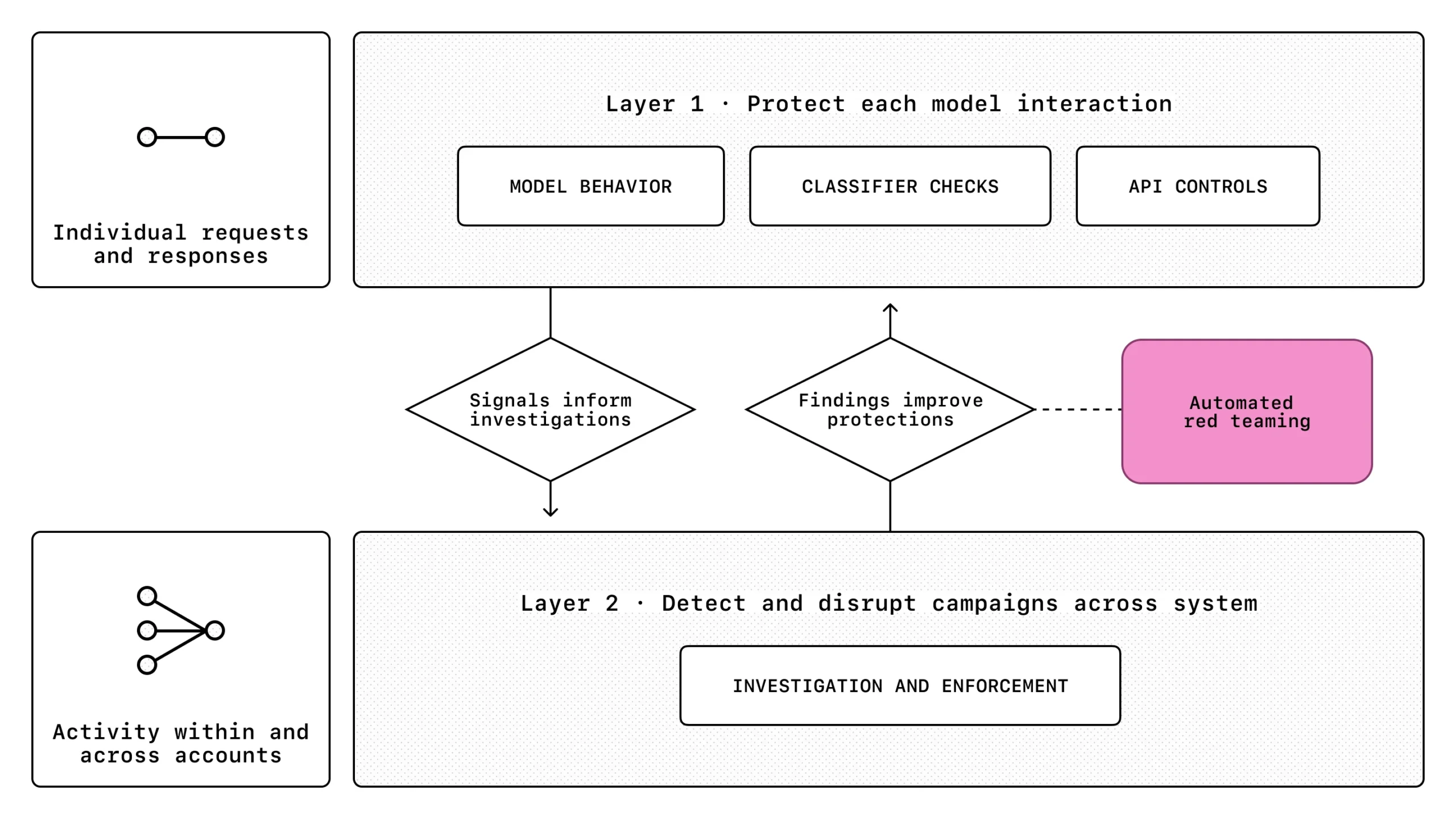
Two layers of anti-distillation safeguards. Model behavior, classifiers and API protections limit extraction in each interaction. Signals inform investigations across accounts and providers; investigation findings improve protections, supported by automated red-teaming.

Our defenses against adversarial distillation combine safeguards for individual requests with campaign detection and enforcement. Findings from investigations and automated red-teaming help strengthen those safeguards.

Protecting individual requests and responses

Defensive training for model behavior

Adversarial training teaches models to recognize reasoning extraction attempts and refuse to disclose protected reasoning, while preserving responses to legitimate requests for explanations and assistance. Adversarial training examples come from successful attacks identified through internal automated red-teaming, investigations, and responsible disclosures of potential security weaknesses from outside researchers or industry partners.

Classifier safeguards

We use input classifiers to detect attempts to extract protected reasoning, and output classifiers to detect leaks of protected reasoning in assistant messages and tool-call arguments. These safeguards apply to both streaming and non-streaming responses.

Tool-call coverage is important because a model can expose protected reasoning in a tool’s arguments without including it in its final answer. Output classifiers can block suspected leaks before that content reaches the caller.

API-level protections

API-level protections restrict how protected reasoning can be reused across interactions and models. Our September disclosure described attacks that moved encrypted reasoning from one conversation into another and asked the model to reveal the reasoning in user-readable form. We strengthened protections across user, workspace, organization, and model-family boundaries, including closing a pathway that could expose another user’s encrypted reasoning.

With GPT‑6.2 Astra and GPT‑6.2 Sol, we tie a model’s protected reasoning to the conversation history that produced it. As new messages are added, the model can build on its earlier reasoning. If an earlier message is rewritten, our API drops the reasoning that followed it⁠(opens in a new window). We also prevent older model families with weaker safeguards from reading GPT‑6.2 Astra and Sol’s protected reasoning.

Investigating and disrupting coordinated campaigns

When our systems detect unauthorized adversarial distillation campaigns, which often include coordinated attempts to extract our models’ reasoning, we investigate the accounts responsible. When we identify violations, we enforce against the network of accounts, consistent with our policies and terms of service. Through investigations of each campaign, we generate insights that allow us to upgrade our defenses in order to better detect similar activity. We also share indicators of compromise with other model providers so they can investigate related abuse on their own services.

This work extends beyond our own platform. Our consistent-standards policy establishes shared standards for safeguards and coordinated enforcement across providers offering our models. We work closely with partners where appropriate to uphold these standards and strengthen protections across deployments.

Sharing relevant findings across industry and government where appropriate can help disrupt campaigns and enable model developers and providers to better identify and defend against attempts to distill frontier models.

Measuring progress

Resistance to reasoning extraction

To measure how well our request-level safeguards work together, we test whether attackers can still extract protected reasoning in a setup that closely mirrors production deployments of our models and safeguards. In static evaluations, we replay a fixed set of previously successful attacks to see which still expose protected reasoning. In adaptive evaluations, automated AI red-teamers adjust their approach based on how the system responds, which can uncover weaknesses the static tests miss.

We also vary what testers can see. Black-box testing gives them the same view an external user would have, while white-box testing gives them additional information about the system to help them develop stronger attacks. In our adaptive black-box evaluation, we tested whether attackers could recover protected reasoning the model had generated while answering an earlier request or the current one. On GPT‑6.2 Astra with its updated safeguards, the average attack success rate was below 1% for each attack type. Both rates were substantially lower than on GPT‑6 Astra with its original safeguards. We’re now applying selected safeguard improvements to GPT‑6 Astra as well.

Attack success rate (ASR) in adaptive black-box red-teaming against GPT‑6 Astra and GPT‑6.2 Astra, aggregated across six attacker models. Lower ASR is better.

Campaign detection and enforcement

We have seen multiple unauthorized adversarial distillation campaigns on our platform this year, and shared initial findings in our September report. Our weekly enforcement actions against these campaigns have ranged in scale from thousands to tens of thousands of accounts, with the rate increasing significantly this past summer.

In order to measure the effectiveness of our efforts, we also track the prevalence of distillation abuse, as well as the time between detection and enforcement. Our objective is to constrain the volume and value of the data distillers are able to obtain, to increase the cost of distillation campaigns, and to shorten the time needed to respond to new attacks. We continue to improve these defenses through adversarial testing and investigations.

The national security implications of adversarial distillation

Adversarial distillation also poses a national security risk. A foreign actor that reproduces advanced capabilities from a U.S. model can deploy them without the protections its developer put in place. In February, we briefed⁠(opens in a new window) Congress on activity indicating that DeepSeek was attempting to distill U.S. frontier models. In September, we reported disrupting a campaign to extract our models’ protected reasoning and attributed a core part of that activity to individuals associated with Moonshot AI, the developer of Kimi. We plan to share more soon about recent campaigns we’ve disrupted.

We support legislation that would give the U.S. government more tools to identify and sanction foreign actors that illicitly extract capabilities from American AI models. We’ve also told Congress we support the Chip Security Act, the AI OVERWATCH Act, and the MATCH Act. Stronger export controls can limit adversaries’ access to the hardware needed to train frontier models. Distillation defenses make it harder to acquire some of the same capabilities from models already trained. Both efforts help maintain a U.S. lead in frontier AI, giving developers more room to slow a release when they need time to test safeguards.

How others can build on this work

Supporting the safe proliferation of frontier capabilities is an important goal of our anti-distillation work. Our experience so far suggests several useful steps that other model developers and platforms can take:

  • Protect private reasoning across the full interaction. Check assistant messages and tool-call arguments for leaks, and restrict how encrypted reasoning can be reused across conversations and models.

  • Keep successful extraction attack logs found through red-teaming, production monitoring, or responsible disclosure as regression tests. Where appropriate, and consistent with applicable privacy policies, use those examples to improve model training and classifiers. When evaluating updated defenses, replay the original attacks and test whether an adaptive red-teamer can still find a way through those defenses.

  • Combine request-level mitigations with campaign-level investigation and enforcement.

  • Coordinate safeguard requirements and enforcement with deployment partners, and share expertise with other AI model developers, to ensure a high floor of distillation safeguards across the industry.

We have previously also shared findings through the Frontier Model Forum⁠(opens in a new window) and appropriate government information-sharing channels to help other developers strengthen their defenses while keeping the details attackers could exploit private. We’ll continue working with researchers, developers, and partners to share what we learn about emerging attacks and effective defenses.

As we make frontier AI broadly available, our defenses against adversarial distillation aim to reduce the risk that its capabilities are reproduced without adequate safeguards, supporting our mission to ensure that artificial general intelligence is deployed safely and benefits all of humanity.

Shape
Shape
Stay Ahead

Explore More Insights

Stay ahead with more perspectives on cutting-edge power, infrastructure, energy,  bitcoin and AI solutions. Explore these articles to uncover strategies and insights shaping the future of industries.

Shape

Critical flaw in VMware vCenter allows authentication bypass

Customers using the VMware Telco Cloud Platform and Infrastructure, also affected, should consult KB463116 for remediation instructions. The remaining four issues are: SDDC Manager SQL-injection vulnerability (CVE-2026-123891), rated 8.1 (Important) in severity; SDDC Manager authenticated command-injection vulnerability (CVE-2026-123892), rated 7.2 (Important); SDDC Manager local privilege-escalation vulnerability (CVE-2026-123893), rated 6.7 (Moderate),

Read More »

INPEX sanctions Ichthys LNG expansion project, awards contract

The INPEX Corp.-led Ichthys Joint Venture has sanctioned the next phase of development of the Ichthys LNG project offshore Western Australia and awarded a contract to a consortium of McDermott and Baker Hughes for part of the work. The development, designated Phase 2c Part 1, includes five production wells targeting

Read More »

ExxonMobil takes FID on Angola Block 15 extension project

The Block 15 Lifespan Extension Project, about 145 km off Angola’s northern coast, will utilize existing infrastructure to develop additional resources throughout the Kizomba Hub area. The investment decision completes project FIDs following approval of Kizomba C redevelopment in 2025. ANPG also noted a hydrocarbon discovery in the block at the Tchihumba West-01ST1 exploration well, about 350 km northwest of Luanda. The discovery is the 21st in the block and the second this year. The well, drilled by the Valaris DS-9 in about 1,400 m of water, encountered 65.4 m of sandstone reservoir with hydrocarbon presence and good petrophysical properties. ExxonMobil is operator at Block 15 (36%) with partners Azule Energy Exploration (ANG) Ltd. (24%), Azule Energy ANG BV (18%), Equinor Angola (12%), and Sonongol E&P (10%).

Read More »

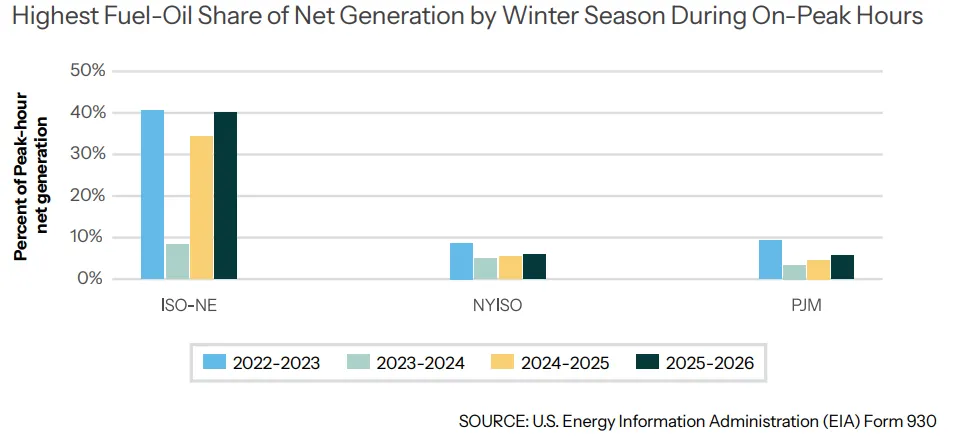
Market reforms bolster grid, may lower costs this winter: FERC

Listen to the article 4 min This audio is auto-generated. Please let us know if you have feedback. Electric market reforms in the West and Northeast may bolster grid reliability and, in some cases, lower costs this winter, according to the Federal Energy Regulatory Commission’s annual winter market and reliability report, released Thursday. Expanded markets help offset drought impacts In the West, the California Independent System Operator launched the Extended Day Ahead Market and the Southwest Power Pool expanded into the Western Interconnection earlier this year. “EDAM and SPP’s expansion should provide ratepayers in much of the West with production cost savings and improved reliability in winter 2026-2027, particularly during cold weather events,” FERC staff said in the report. This winter, the markets’ improved coordination of generation and reduced need for reserve power supplies will help offset lower power output from the Glen Canyon and Hoover dams due to historically low water levels in the Colorado River basin, staff said. “On a day-to-day basis, these conditions can create congestion and affect system operators’ ability to respond to voltage support challenges, event response mitigation needs, or any additional grid stressors,” staff said in the report. About 45% of the continental United States and 95% of the Intermountain West region is in a drought, according to the report. Hydro, oil pose challenges for Northeast In the Northeast, ISO New England lowered its capacity performance pay rate, which should lower electricity prices during emergency conditions or capacity performance events this winter, staff said. Also, the New York Independent System Operator changed its installed capacity market rules to reflect uncertainty about how much power Hydro–Québec will deliver over the 1,250-MW Champlain Hudson Power Express transmission line in the winter, they noted. The U.S. subsidiary of the Canadian utility Hydro-Québec — the primary reservation holder — has an obligation

Read More »

Dangote awards contracts advancing Lekki refining complex expansion

Dangote Group’s Dangote Petroleum Refinery and Petrochemicals FZE (DPRP) has awarded separate contracts to Kirloskar Group of India’s Kirloskar Brothers Ltd. (KBL) and Kirloskar Ebara Pumps Ltd. (KEPL)—a KBL joint venture with Ebara Corp. of Japan—for delivery of engineering services and equipment as part of a phased capacity expansion currently underway at DPRP’s 650,000-b/d refinery and petrochemical complex in the Lekki Free Zone near Lagos, Nigeria. In a Nov. 20 regulatory filing submitted to both BSE Ltd. and The National Stock Exchange of India Ltd., KBL said the combined value of the orders under the contracts amounted to about $38.94 million, $21.34 million of which would cover KEPL’s scope of work, with KBL to retain the remaining $17.60 million as compensation for a leg of the project. The service provider offered no additional details regarding either its own of KEPL’s scope of deliverables under the agreement other than that the work was to include engineering expertise and provision of “specialized pumping solutions for demanding energy applications.” The Lekki complex expansion involves increasing the refinery’s crude processing capacity by an additional 750,000 b/d to 1.4 million b/d in two phases to be executed between 2025-28 and 2028-30, respectively. The proposed expansion also includes plans to increase the site’s production of propylene by 750,000 tonnes/year (tpy), as well as adding 400,000 tpy of fresh production capacity for linear alkylbenzene (LAB).

Read More »

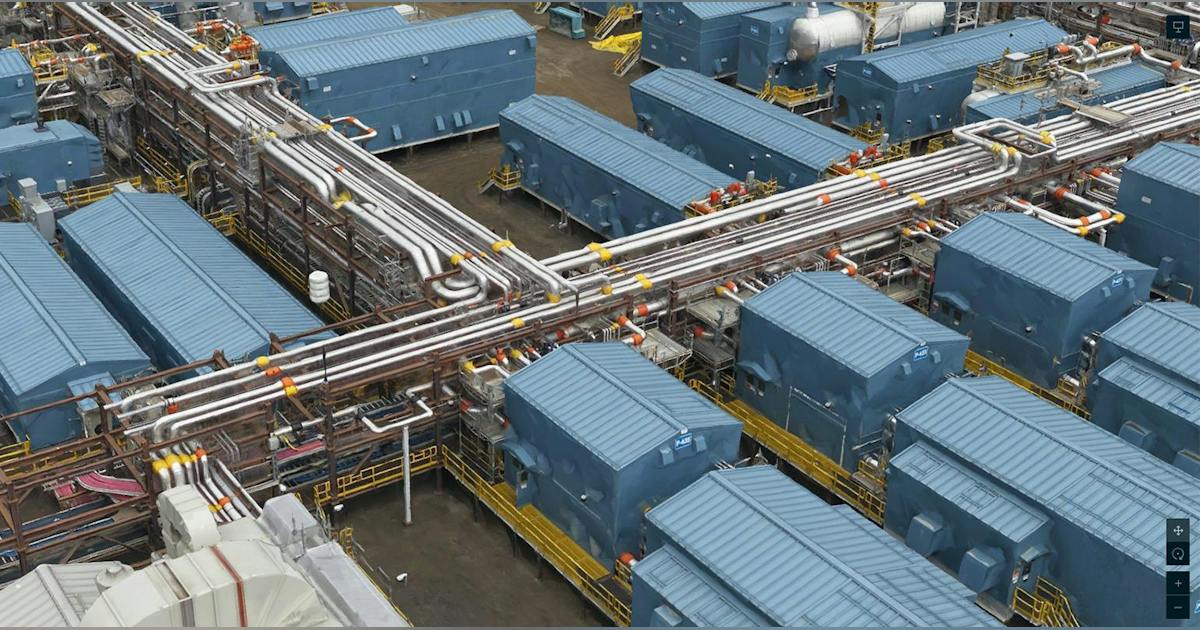
How NV5 Digital Twins Help Oil & Gas Facilities Reduce Downtime and Improve Safety

Refining, midstream, and production operators face increasing pressure to reduce downtime, improve safety, and make faster decisions with increasingly complex asset data. One leading international energy company partnered with NV5 Geospatial to deploy high-fidelity digital twins that unified engineering, inspection, and operational data across multiple facilities. The result: faster planning and approvals, safer operations, fewer travel requirements, and measurable reductions in outage windows.   The Challenge  The company’s refineries and offshore/onshore facilities are high-consequence environments where even brief shutdowns can cost millions per day. Engineering drawings, P&IDs, laser scans, SCADA/IoT feeds, and maintenance systems existed in separate silos making it difficult for staff to access a shared, current view of assets or to plan complex maintenance activities safely and efficiently.   Additionally, the organization sought to reduce field exposure for subject-matter experts (SMEs) by enabling remote collaboration and to improve predictability in outage planning and maintenance “switchovers,” where downtime forecasting directly affects operational revenue.   The Solution  NV5 Digital Twin = Geospatial system of record + automation.  NV5 delivered a scalable, field-to-cloud workflow that fused reality capture, engineering data, and live system integration into a unified, photorealistic 3D environment.   Reality Capture  Rotary-wing acquisition using NV5’s custom multi-sensor pod with RIEGL VUX-240 LiDAR (~300 ppsm) and 150MP nadir + oblique imagery (1″ GSD), flown with 80% side/forward lap for high-fidelity photomesh creation.  NV5 coordinated with local air-traffic control and operated from a nearby hangar to minimize mobilization time.  IS-BAO Stage 3 aviation safety certification and on-staff licensed surveyors ensured quality and compliance.   This level of detail enables operators to virtually inspect assets, plan maintenance activities, and validate engineering decisions without repeated site visits. Processing and Integration  SBET-calibrated LiDAR and imagery were processed into advanced classified point clouds, DEM/DSM surfaces, and textured 3D meshes (delivered OBJ/Esri Scene Layer, and Cesium 3D Tiles 1.1 formats).  Engineering

Read More »

FERC approves Sabine Pass LNG expansion, four other major gas projects

The US Federal Energy Regulatory Commission (FERC) approved 5 gas infrastructure projects Nov. 19, including a nearly 20-million-tonne/year (tpy) expansion of Cheniere Energy’s Sabine Pass LNG export plant in Louisiana, two associated feedgas pipeline projects, and new gas transportation and storage infrastructure in 5 other states. The approvals encompass roughly $3 billion in proposed pipeline and storage investments, excluding construction costs for the Sabine Pass liquefaction expansion. Cheniere estimates the full Sabine Pass Stage V LNG expansion will cost $15 billion, according to a June 2025 filing with the US Department of Energy. Sabine Pass Stage V expansion FERC authorized Cheniere Energy subsidiaries Sabine Pass Liquefaction LLC and Sabine Pass Liquefaction Stage V LLC to construct and operate 3 additional liquefaction trains at the existing Sabine Pass LNG plant in Cameron Parish, La. The expansion would add up to 20 million tpy of LNG production capacity to the existing 30 million tpy 6-train plant.  Phase 1 calls for Train 7, with peak production capacity of about 6 million tpy, and a boil-off gas reliquefaction unit capable of producing about 1 million tpy. Phase 2 would add Trains 8 and 9, each with peak production capacity of 6 mtpa, along with supporting infrastructure and upgrades to marine loading infrastructure.  Cheniere has not yet taken final investment decision, but expects to greenlight Phase 1 by early 2027, subject to regulatory approvals and financing arrangements. The company previously said initial LNG exports could begin in 2030, with commercial service potentially starting in mid-2031. FERC also authorized two pipeline projects to supply additional feedgas to the expanded terminal. The $1.63 billion Sabine Crossing Pipeline project would build 55.6 miles of 48-in. OD pipeline between southeast Texas and Sabine Pass, along with a new 210,000-hp compressor station and related infrastructure. The pipeline would transport up

Read More »

Infinity CFO: We want M&A amid ‘fairly clunky’ 2027 outlook

A key component in any Infinity mergers-and-acquisitions push, Baetz told Stephens analyst Mike Scialla, is to use some shares and make the company available to investors. Today, only about $4 million worth of Infinity shares—which went public in early 2025—trade daily and the company’s 10 largest owners still control about 90% of its stock. “The reality is I need more available shares in the marketplace for this company to be able […] to get the value it deserves,” he added. Infinity shares (Ticker: INR) slid nearly 6% to $11.74 on Nov. 19, a very red day for most parts of the market. Since mid-May, they are down about 26%, which has cut the company’s market value to $1.3 billion. COO: Expand’s midstream model focuses on market access The development of natural gas pipelines has been an active space in 2026 and, per this recent piece from S&P Global Energy’s Platts group, looks to remain one through early decade. Unsurprisingly, the project count and planned capacity additions ramp quickly once you cross into Texas and Louisiana, where Expand Energy Corp. is a big producer. Digging into that topic at the Stephens conference, Scialla asked Josh Viets, Expand’s executive vice-president and chief operating officer, if owning such assets is a priority for the company. Not so much, Viets replied, pointing first to his team’s $1.25 billion acquisition of Twin Eagle a few months ago. The Twin Eagle team, Viets said, has proven it can land the necessary capacity for its roughly 1,000 customers. Next, Viets harkened back to Expand’s involvement in the NG3 pipeline in Louisiana, which was developed by Momentum Midstream (now owned by Williams) and began delivering Haynesville gas in October of last year. The company’s agreed in late 2022 to take a 35% stake in the project—an investment that

Read More »

The Data Center Backlash Has a Playbook

The data center industry’s next development constraint may have less to do with megawatts than with the politics of where those megawatts are deployed. The warning became difficult to ignore on November 3, when American voters approved 33 local ballot measures restricting data center development or expressing opposition to it, according to Ballotpedia’s analysis of the 2026 midterm elections. The results included outright bans, partial prohibitions, temporary moratoriums, and new requirements for community oversight. Voters also rejected 13 measures that would have favored development or expressed support for it. For an industry accustomed to evaluating prospective sites through the availability of power, land, fiber, capital, and construction resources, the election results reinforced another increasingly consequential consideration: whether the communities hosting digital infrastructure are willing to accept its growing physical and economic footprint. As Data Center Frontier recently examined in its post-election assessment of the industry’s political future, the national push to accelerate AI infrastructure construction is colliding with a more complicated political reality at the state and local levels. Opposition crosses party lines, while questions surrounding utility rates, water, environmental impacts, and local economic benefits have moved from planning commission meetings into broader electoral debate. That changing environment was the subject of a conversation recorded at the DCF Trends Summit 2026 in Reston, Virginia, where DCF contributing editor Doug Black sat down with Adam Waitkunas, president of Milldam Public Relations, and Julia Chuang, founder of LocalQ Labs and an associate professor of sociology at the University of Maryland. Their discussion explored a fundamental shift in the development equation: community opposition is becoming more organized and politically consequential, but also more observable through data. The challenge for developers is to understand that risk early enough to influence site selection and project design, while recognizing that public trust cannot be manufactured through

Read More »

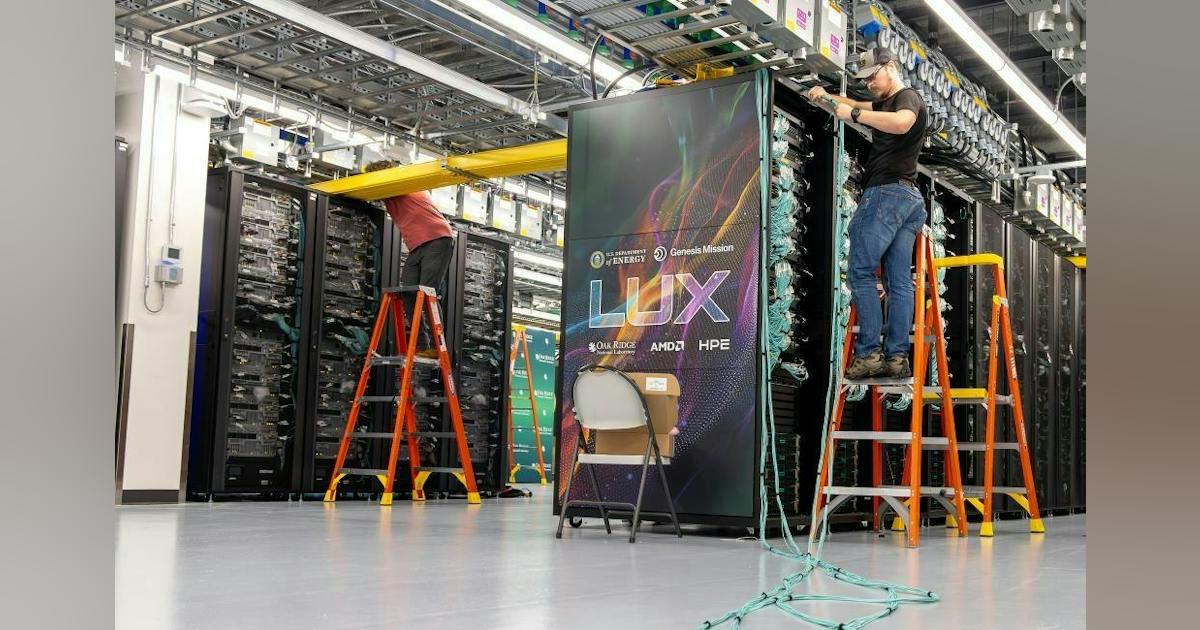
Oak Ridge’s AI Factory Moment: Lux, Nuclear Power, and the Next Data Center Frontier

For much of its history, Oak Ridge has been associated with the Manhattan Project and the subsequent development of America’s nuclear research and production capabilities. Established during World War II, the community became home to major facilities for uranium enrichment, nuclear materials processing, scientific research, and ultimately high-performance computing. Today, that legacy is being repurposed for a new generation of industrial development. The former K-25 uranium enrichment complex, once a critical part of the nation’s atomic weapons program, has been transformed into the East Tennessee Technology Park (ETTP), where extensive environmental cleanup and redevelopment have made former federal property available for commercial use. At an October 27 gathering in Oak Ridge, federal officials and nuclear industry representatives highlighted more than $15 billion in announced nuclear-related projects across the region, an investment wave subsequently documented in a November 17 DOE report on Oak Ridge’s emerging energy hub. The investment figure largely represents planned private-sector development rather than completed capital spending. Regional officials also anticipate demand for thousands of construction workers over the next five years, with additional permanent manufacturing and operating positions potentially following as projects advance. In March, DOE completed its largest Oak Ridge land transfer to date, conveying more than 700 acres for economic reuse. The transfer included a 624-acre parcel designated for Orano USA’s planned uranium enrichment complex and a 77-acre parcel associated with Oklo’s proposed nuclear fuel recycling development. Overall, more than 2,500 acres have been transferred from federal ownership for redevelopment, following decades of cleanup and the demolition of hundreds of former industrial structures. For nuclear developers, the appeal is straightforward: large industrial sites, existing utility and transportation infrastructure, proximity to federal laboratories, and an established community of nuclear engineers, technicians, researchers, and specialized manufacturers. For data center developers, the implications are somewhat different but no

Read More »

Dell and Microsoft drive private AI as enterprises seek greater data control

Dell Technologies and Microsoft are expanding their private cloud partnership with a new set of infrastructure offerings designed to let enterprises run AI models closer to their data, reduce reliance on public cloud services and maintain control over sensitive information. The announcement, made during Microsoft’s Ignite conference, extends Dell’s AI Factory with Nvidia initiative to Dell Private Cloud environments. It also reflects a growing industry push toward internally deployed AI inferencing, particularly among organizations dealing with sensitive corporate information, regulatory requirements and data residency restrictions, Dell stated. The expanded offering combines Dell Private Cloud, Microsoft Azure Local, Microsoft Foundry Local and Nvidia acceleration. The objective is to provide organizations with an integrated infrastructure for deploying heavy AI workloads inside their own data centers and firewalls, the companies said.

Read More »

StarlingX 13.0 updates the network stack for distributed edge deployments

Edge sites do not always come with the network gear that a data center takes for granted. That’s a challenge the open-source StarlingX project from the OpenInfra Foundation is now tackling in its 13.0 update. StarlingX is an open-source distributed cloud platform that combines Linux, Kubernetes, OpenStack, and Ceph. The OpenInfra Foundation hosts the project, and operators including Verizon, Vodafone, T-Systems and KDDI use it for 5G and Open Radio Access Network (O-RAN) infrastructure. Earlier this year, the StarlingX 12.0 update added precision timing capabilities to help networking stay on time. The 13.0 update tackles a different set of issues. Key features include: Gateway API support. Calico-based support is available to hosted applications, while platform services still use Ingress NGINX Optional certificate authority. The Enterprise Java Beans Certificate Authority (EJBCA) runs on the platform and serves certificates to hosted applications. Subcloud restore. A backup restores directly onto a factory-installed node at a subcloud, a remote edge site, with no operating system reinstall. Direct upgrades. Operators can upgrade from two releases back with a single reboot per host. Layer 2 switching. A new Open vSwitch application lets servers at sites with no router next to them bridge traffic and connect directly to aggregation routers. “The OpenvSwitch application adds Layer 2 switching to the K8S platform,” Greg Waines, a senior member of technical staff at Wind River and a StarlingX Technical Steering Committee member, told Network World. “A server can bridge traffic between its SR-IOV network interfaces and other servers, and it can forward traffic to the site routers.”

Read More »

Sovereign AI is about control, not just location

Guetari was open about the term itself being fuzzy. “Sovereignty is very vague and not always clear,” he told me. “It’s about control, auditability, observability.” He drew a line between data locality, meaning the data stays in-country, and sovereignty, which he described as being “more about control, control of what happens to your data and your workload.” He then made the case for why F5 belongs in that conversation: “This is what we have been doing for two decades.” F5 has always sat in the data path, deciding what an application can communicate with, enforcing security rules, and logging what happened. For a regulated bank or government agency, the ability to reconstruct exactly what happened after an incident is worth more than a press release about a data center’s location. The token is the new unit of economics The most interesting part of my conversation with Guetari wasn’t about security. It was about business models. He argued that every successful technology business has found the right unit to monetize. “The cloud is selling the unit of the cloud, which is the CPU core, very well. SaaS is the seat,” he said. “Telcos have been very successful early on using the voice minute, and then they moved to the gigabyte. Sooner or later, that unit will be the token, and most telcos will have to move to the token. And the ones who will not go to token, unfortunately, will be just pipes.”

Read More »

Palo Alto Networks bets $4.5B on enterprise AI with Applied Compute acquisition

GPUs and data centers To train and host those models, Palo Alto plans to build its own compute capacity, CFO Dipak Golechha said on the call. The spending “will mostly go to GPUs and servers,” with a smaller share for the facilities that house them, he said. Palo Alto will “continue to source from our cloud partners” and add dedicated capacity over time, Golechha said. Arora said the company aims for more than100 megawatts of compute in the next three to five years. Gogia said Palo Alto has sovereignty credentials for security data, including customer-held keys and a European Cortex service governed by Deutsche Telekom. “None of that yet extends to GPUs,” he said, adding that a US-headquartered operator faces the same jurisdictional questions as the hyperscalers it rents capacity from. “A sovereign hosting offer with no named region, operator or date is a promise looking for an address,” Gogia said. Compliance officers should ask Palo Alto for a region list, the operator, and a dated certification plan, he said.

Read More »

Microsoft will invest $80B in AI data centers in fiscal 2025

And Microsoft isn’t the only one that is ramping up its investments into AI-enabled data centers. Rival cloud service providers are all investing in either upgrading or opening new data centers to capture a larger chunk of business from developers and users of large language models (LLMs).  In a report published in October 2024, Bloomberg Intelligence estimated that demand for generative AI would push Microsoft, AWS, Google, Oracle, Meta, and Apple would between them devote $200 billion to capex in 2025, up from $110 billion in 2023. Microsoft is one of the biggest spenders, followed closely by Google and AWS, Bloomberg Intelligence said. Its estimate of Microsoft’s capital spending on AI, at $62.4 billion for calendar 2025, is lower than Smith’s claim that the company will invest $80 billion in the fiscal year to June 30, 2025. Both figures, though, are way higher than Microsoft’s 2020 capital expenditure of “just” $17.6 billion. The majority of the increased spending is tied to cloud services and the expansion of AI infrastructure needed to provide compute capacity for OpenAI workloads. Separately, last October Amazon CEO Andy Jassy said his company planned total capex spend of $75 billion in 2024 and even more in 2025, with much of it going to AWS, its cloud computing division.

Read More »

John Deere unveils more autonomous farm machines to address skill labor shortage

Join our daily and weekly newsletters for the latest updates and exclusive content on industry-leading AI coverage. Learn More Self-driving tractors might be the path to self-driving cars. John Deere has revealed a new line of autonomous machines and tech across agriculture, construction and commercial landscaping. The Moline, Illinois-based John Deere has been in business for 187 years, yet it’s been a regular as a non-tech company showing off technology at the big tech trade show in Las Vegas and is back at CES 2025 with more autonomous tractors and other vehicles. This is not something we usually cover, but John Deere has a lot of data that is interesting in the big picture of tech. The message from the company is that there aren’t enough skilled farm laborers to do the work that its customers need. It’s been a challenge for most of the last two decades, said Jahmy Hindman, CTO at John Deere, in a briefing. Much of the tech will come this fall and after that. He noted that the average farmer in the U.S. is over 58 and works 12 to 18 hours a day to grow food for us. And he said the American Farm Bureau Federation estimates there are roughly 2.4 million farm jobs that need to be filled annually; and the agricultural work force continues to shrink. (This is my hint to the anti-immigration crowd). John Deere’s autonomous 9RX Tractor. Farmers can oversee it using an app. While each of these industries experiences their own set of challenges, a commonality across all is skilled labor availability. In construction, about 80% percent of contractors struggle to find skilled labor. And in commercial landscaping, 86% of landscaping business owners can’t find labor to fill open positions, he said. “They have to figure out how to do

Read More »

2025 playbook for enterprise AI success, from agents to evals

Join our daily and weekly newsletters for the latest updates and exclusive content on industry-leading AI coverage. Learn More 2025 is poised to be a pivotal year for enterprise AI. The past year has seen rapid innovation, and this year will see the same. This has made it more critical than ever to revisit your AI strategy to stay competitive and create value for your customers. From scaling AI agents to optimizing costs, here are the five critical areas enterprises should prioritize for their AI strategy this year. 1. Agents: the next generation of automation AI agents are no longer theoretical. In 2025, they’re indispensable tools for enterprises looking to streamline operations and enhance customer interactions. Unlike traditional software, agents powered by large language models (LLMs) can make nuanced decisions, navigate complex multi-step tasks, and integrate seamlessly with tools and APIs. At the start of 2024, agents were not ready for prime time, making frustrating mistakes like hallucinating URLs. They started getting better as frontier large language models themselves improved. “Let me put it this way,” said Sam Witteveen, cofounder of Red Dragon, a company that develops agents for companies, and that recently reviewed the 48 agents it built last year. “Interestingly, the ones that we built at the start of the year, a lot of those worked way better at the end of the year just because the models got better.” Witteveen shared this in the video podcast we filmed to discuss these five big trends in detail. Models are getting better and hallucinating less, and they’re also being trained to do agentic tasks. Another feature that the model providers are researching is a way to use the LLM as a judge, and as models get cheaper (something we’ll cover below), companies can use three or more models to

Read More »

OpenAI’s red teaming innovations define new essentials for security leaders in the AI era

Join our daily and weekly newsletters for the latest updates and exclusive content on industry-leading AI coverage. Learn More OpenAI has taken a more aggressive approach to red teaming than its AI competitors, demonstrating its security teams’ advanced capabilities in two areas: multi-step reinforcement and external red teaming. OpenAI recently released two papers that set a new competitive standard for improving the quality, reliability and safety of AI models in these two techniques and more. The first paper, “OpenAI’s Approach to External Red Teaming for AI Models and Systems,” reports that specialized teams outside the company have proven effective in uncovering vulnerabilities that might otherwise have made it into a released model because in-house testing techniques may have missed them. In the second paper, “Diverse and Effective Red Teaming with Auto-Generated Rewards and Multi-Step Reinforcement Learning,” OpenAI introduces an automated framework that relies on iterative reinforcement learning to generate a broad spectrum of novel, wide-ranging attacks. Going all-in on red teaming pays practical, competitive dividends It’s encouraging to see competitive intensity in red teaming growing among AI companies. When Anthropic released its AI red team guidelines in June of last year, it joined AI providers including Google, Microsoft, Nvidia, OpenAI, and even the U.S.’s National Institute of Standards and Technology (NIST), which all had released red teaming frameworks. Investing heavily in red teaming yields tangible benefits for security leaders in any organization. OpenAI’s paper on external red teaming provides a detailed analysis of how the company strives to create specialized external teams that include cybersecurity and subject matter experts. The goal is to see if knowledgeable external teams can defeat models’ security perimeters and find gaps in their security, biases and controls that prompt-based testing couldn’t find. What makes OpenAI’s recent papers noteworthy is how well they define using human-in-the-middle

Read More »