Stay Ahead, Stay ONMINE

Don’t sleep on Google Gemini’s Deep Research mode: 8 examples of informative reports

Join our daily and weekly newsletters for the latest updates and exclusive content on industry-leading AI coverage. Learn More Many of us in the AI and business worlds are focused — anecdotally and in terms of the number of articles and messages being written/posted — on OpenAI and DeepSeek, especially OpenAI’s o3-powered Deep Research mode, […]

Join our daily and weekly newsletters for the latest updates and exclusive content on industry-leading AI coverage. Learn More


Many of us in the AI and business worlds are focused — anecdotally and in terms of the number of articles and messages being written/posted — on OpenAI and DeepSeek, especially OpenAI’s o3-powered Deep Research mode, a new reasoning AI agent that performs extensive web research on behalf of the user and compiles it into neat and tidy, well-cited reports.

This is natural since it’s a relatively new product (announced earlier this month) and OpenAI remains among the most highly-regarded and widely used AI model providers. Plus, CEO Sam Altman recently shared plans to make this product available outside of the current $200-per-month ChatGPT Pro subscription, at least on a limited trial basis.

Yet for those seeking to use AI to perform Deep Research and have it write reports for you, there’s another model worth checking out without waiting for OpenAI’s Deep Research to make its way to more affordable subscription tiers or shelling out the $200-per-month for the ChatGPT Pro plan.

Search giant Google’s own Deep Research mode, powered by its prior generation Gemini 1.5 Pro model, is available now on Google’s Gemini chatbot online through the Google One AI Premium plan (~$20 USD per month), and performs many of the same functionality as OpenAI’s Deep Research at 1/10th the monthly cost. Google actually offers the first month free, currently.

It also allows you to export the resulting reports directly to Google Docs with one click. For those that use Google Workspace apps like Docs, this is an incredibly helpful and natural integration.

How to use Google Deep Research to generate reports in minutes

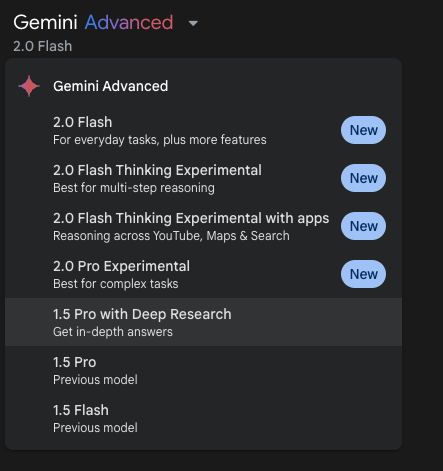
To access it, subscribe to the Google One AI Premium plan using the link above, then navigate to gemini.google.com, click the drop down menu labeled “Gemini Advanced” in the upper left corner, and select “1.5 Pro with Deep Research.” Every query you type into the entry bar at the bottom after this will now engage Deep Research mode.
After the user enters the prompt, the Deep Research agent will draft a research plan for the user’s approval that looks something like this:
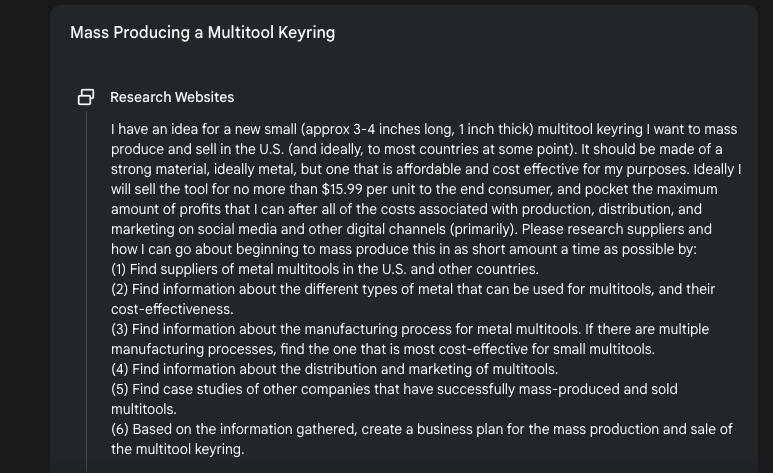
The user can click to edit parts of the plan by prompting with new adjustments, or go ahead and click the “Start Research” button to begin the process.

The Deep Research agent will compile a list of websites to perform the research on, and finally, a report in the form of a response that the user can quickly export to Google Docs with the “Open in Docs” button at the top right of the response box.
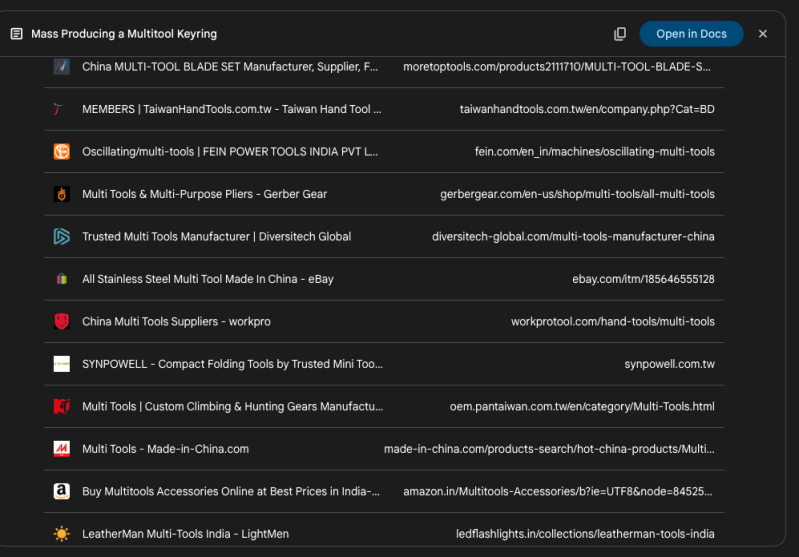
Whether it’s researching scholarly topics such as conflict throughout history, or the science of new materials like graphene, or market fluctuations, or coming up with concrete business plans for mass producing a new physical small consumer goods product, my own extensive hands-on usage of Google’s Deep Research over the last few days has produced informative reports on a wide range of subjects, complete with citations and well-constructed explanations of the topics discussed.

Even such controversial subjects that other AI models often refuse to engage with whatsoever — such as the recent Israeli military campaign in Gaza and whether or not it qualifies as a genocide, or the treatment of transgender people throughout history and in recent times — Google’s Deep Research will attempt to address using evidence from a variety of reputable sources, albeit with a bit of prompt engineering to get around initial resistance.

I would strongly encourage all and any business leaders, especially those in “knowledge work” or manufacturing fields, to try Google Deep Research: have it produce reports on subjects related to your industry, and ask it to identify new opportunities or helpful insights to grow your business and gain efficiencies, which you might have missed.

Basically treat it like a new helpful researcher on your team, give it some instructions in the form of a paragraph (or a few), and let it compile the report for you — mine took anywhere from seconds to less than 10 minutes. I strongly believe you will be impressed with the results, and may find it changes your workflow and approach for the better.

Take a look at examples of 8 reports I generated with Google Deep Research below, complete with initial prompt, and try it for yourself. These are all unedited, raw reports produced directly by Google’s Deep Research powered by Gemini 1.5 Pro.

I should hasten to add I’m not being paid by Google for this post or any other work, and am simply a tech journalist/geek by constitution who enjoys testing out new products and services and seeing how, if at all, they can be useful to me and my own personal knowledge repository.

1. Sleep research

Prompt: “Compile me a report cross referencing various and any recent applicable studies and other scientific information about sleep length per night, and why some people may need less or more sleep than others, any genetic basis for this, and health effects of low sleep as well as whether low sleepers tend to suffer these or have genetics that protect them from the effects of low sleep.”

Result: Sleep Duration, Individual Variability, and Health Consequences: A Comprehensive Review

2. Economic boom and bust research

Prompt:Markets globally and for individual countries and commodities are known for having peaks and valleys, with sudden “black swan” events that often drive economic activity down. Research these throughout history, from the Tulip Craze of Amsterdam to the Great Depression and Global Financial Crisis and subsequent Global Recession, plus any other notable examples you can find, and discuss any overlapping commonalities in causes for market decline and resurgence, and also which markets continued to grow and thrive in depression and recessionary environments.

Result:Peaks, Valleys, and Black Swans: An Analysis of Market Crashes and Thriving Sectors in Economic Downturns

3. Making a new mass produced consumer product

Prompt:I have an idea for a new small (approx 3-4 inches long, 1 inch thick) multitool keyring I want to mass produce and sell in the U.S. (and ideally, to most countries at some point). It should be made of a strong material, ideally metal, but one that is affordable and cost effective for my purposes. Ideally I will sell the tool for no more than $15.99 per unit to the end consumer, and pocket the maximum amount of profits that I can after all of the costs associated with production, distribution, and marketing on social media and other digital channels (primarily). Please research suppliers and how I can go about beginning to mass produce this in as short amount a time as possible.

Result:Multitool Keyring Mass Production Business Plan

4. New materials research

Prompt: There have been breakthroughs in new materials such as graphene and other metamaterials or piezoelectric materials in recent years. Research the most promising for commercial application and societal transformation — particularly unlocking new capabilities — and explain their current status of commercialization or more widespread usage and any impediments preventing them, such as high cost or difficulty synthesizing, and proposed ideas to overcome them.

Result:Breakthrough Materials: Graphene and Piezoelectric Materials Poised to Transform Society

5. Unintended consequences of technologies and how they apply to AI

Prompt:One of the most interesting yet often least discussed recurring problems throughout human history concerns the “unintended consequences” of new technologies. For example, the Industrial Revolution brought about the use of coal to power engines and factories, and this and subsequent fossil fuels such as oil and gasoline continue to be used today to power many vital processes in society, yet it is now scientifically and widely understood that the emissions are contributing to global warming which threatens humanity’s survival and that of many lifeforms on Earth. Another unintended consequence concerns plastic — petroleum products that can be formed into many different shapes with differing qualities such as flexibility and strength and color, with high pliability and malleability and low cost — which has been adopted widely in packaging and other consumer and industrial products and building materials, but which now produces so much waste around the globe it threatens human health in the form of microplastics in the body and brain. Also worth examining are the use of the pesticide DDT and its ultimate ban by the U.S. government after writings from environmentalist Rachel Carson. On the flip side, errant worries and fearmongering about new technologies such as nuclear power in the 1970s led to discontinuation or suspension of projects that could have resulted in a cleaner electrical grid and saved thousands or millions due to the effects of pollution and global warming. Taking all this into account and any other relevant historical examples of the unintended consequences of technology, explain how societies should approach new advances such as AI, what level of caution and mechanisms are appropriate, the risks of overregulation or adversaries weaponizing new technology or using it prosper at the expense of the originating society, and to what extent new tech should be embraced by people or should be viewed more cautiously.

Result: The Unintended Consequences of Technology: A Historical Perspective and the Path Forward with AI

6. Gender expression throughout history and today

Prompt:Gender and sexuality studies have seen numerous developments throughout human history even in the face of repressive government regimes and moralizing politicians and opponents. It is a field with many different theories that encompasses and touches upon numerous other disciplines such as biology, sociology, culture, neurology, genetics, and more. Investigate this field to discuss the evolving understanding of transgenderism, its possible causes or cooccurrences with other human attributes, using firsthand accounts of transgender patients, and discuss the outsized role transgender issues has taken in recent years and the reasons for this — is the community a political scapegoat? And furthermore, research and discuss the emergence of nonbinary and other alternate gender expressions and identities throughout history, even going back to Virginia Woolf’s Orlando and the Two Spirit identity of Native American tribes and other indigenous forms of gender expression, summarizing this phenomena and recording its prevalence across time.”

Result:Gender and Sexuality Studies: Transgenderism and Alternate Gender Identities

7. Genocide throughout history and whether or not Israel’s recent actions in Gaza qualify

Prompt: One of the most tragic recurrences throughout human recorded history is of genocides, in which a powerful and usually armed group seeks to oppress, subjugate, and ultimately eliminate one less powerful and less armed. The Holocaust perpetrated by Nazi Germany against its and the larger population of European Jews is one example taught today in many (most?) Western schools. There are also less well known yet still critically important and tragic incidents such as the Rwandan Genocide and the Armenian Genocide. Discuss the commonalities in these horrific incidents throughout history — in the social climate leading up to them in their respective locations — and examine current sources of information in the news and scholarly articles to identify whether or not Israel’s recent military actions in Gaza qualify as genocide, and why.

Result: Genocides: Commonalities Between the Holocaust, Rwandan, and Armenian Genocides and Whether the Gaza Conflict Qualifies

8. UAP research

Prompt: Research every verifiable source you can about UFOs and UAPs and prepare me a report of some of the theories that explain them with the most evidence or that you believe are best supported by available evidence

Result: Unidentified Anomalous Phenomena (UAP): An Examination of Leading Theories and Evidence

Shape
Shape
Stay Ahead

Explore More Insights

Stay ahead with more perspectives on cutting-edge power, infrastructure, energy,  bitcoin and AI solutions. Explore these articles to uncover strategies and insights shaping the future of industries.

Shape

How Jeetu Patel made Cisco unrecognizable

From dashboard sprawl to Cloud Control The most visible proof point of the new Cisco is Cloud Control, the unified management plane that now spans networking, security, compute, observability, collaboration, and an expanding ecosystem of third-party tools. Cisco is careful to note that this is not just another single pane

Read More »

IBM, ServiceNow team to bring AI to legacy enterprise systems

Decades of deeply interconnected legacy systems are the biggest barrier to moving fast on AI, the companies stated. Their pairings will take advantage of Big Blue’s expertise in working with large systems, such as its mainframe environment, and extensive legacy applications, along with ServiceNow’s workflow and agent management platforms. “Most

Read More »

Energy Secretary Keeps Coal-Fired Power Generation Alive in the Northwest

WASHINGTON—U.S. Secretary of Energy Chris Wright today issued an emergency order to keep affordable, reliable, and secure coal generation online and address critical grid reliability issues facing the Northwestern region of the United States. The emergency order directs TransAlta Centralia Generation LLC (TransAlta) to ensure that Unit 2 of the Centralia Generating Station in Centralia, Washington, a coal-fired power plant, remains available to operate. Centralia Unit 2 was scheduled to shut down at the end of 2025. The order minimizes the risk and cost of unnecessary blackouts. “Taking reliable generation off the grid compromises energy reliability and needlessly raises energy costs for Americans,” said Energy Secretary Wright. “During peak summer demand, Northwesterners deserve continued access to affordable, reliable, and secure energy to power and cool their homes.” Thanks to President Trump’s leadership, coal plants across the country are being saved from premature retirement and reversing plans to shut down. In 2025, more than 17 gigawatts of coal-power electricity generation were saved from going offline. As outlined in DOE’s Resource Adequacy Report, power outages could increase by 100 times by 2030 if the U.S. continues to take reliable power offline. The availability of Centralia to operate will continue to be an asset to maintain reliability in the Western Electricity Coordinating Council (WECC) Northwest region. The North American Electric Reliability Corporation’s (NERC) 2025 Long-Term Reliability Assessment assessed that the WECC Northwest region is at high risk of energy shortfalls over the next five years, noting that “rapid forecasted demand growth is driving the need for more resources” and that “periods of unserved energy are projected for both summer and winter.” This order is in effect beginning on June 15, 2026, through September 12, 2026. Background: According to the U.S. Environmental Protection Agency’s data, in 2025, Centralia generated an average of approximately 340,000 MWh per month, providing vital generation capacity to the region.  ###

Read More »

United States, Cyprus, Greece, Israel and Rice University To Establish Eastern Mediterranean Energy Center in Houston

HOUSTON, TEXAS—U.S. Secretary of Energy Chris Wright today signed a Declaration of Intent (DOI) with the Minister of Energy, Commerce, and Industry of the Republic of Cyprus Michael Damianos, Minister of Environment and Energy for Greece Stavros Papastavrou, Israeli Ambassador to the United States Dr. Yechiel Leiter, and President of Rice University Reginald DesRoches to establish the Eastern Mediterranean Energy Center (EMEC). The agreement establishes a framework to strengthen cooperation between the respective nations through the Eastern Mediterranean Energy Center (EMEC). It also advances a key initiative envisioned under Secretary Rubio’s Eastern Mediterranean Security and Energy Partnership Act of 2019. The agreement advances President Trump’s commitment to strengthening America’s partnerships with key allies while expanding opportunities for U.S. energy development, innovation, and investment. As global energy demand continues to grow, the United States, Cyprus, Greece, and Israel will work together to promote energy security, strengthen critical infrastructure, support emerging technologies, and advance long-term economic growth throughout the Eastern Mediterranean. “The Eastern Mediterranean Energy Center will help fulfill President Trump’s vision of prosperity and energy security at home and abroad,” said Secretary Wright. “The Eastern Mediterranean is an increasingly important region for global energy development, and this agreement strengthens cooperation among key allies while advancing our shared goals of energy abundance, economic prosperity, and regional stability. By establishing the Eastern Mediterranean Energy Center at Rice University in Houston, we are ensuring all member nations of this agreement will benefit from a lasting partnership bound together by the brightest minds and industry leaders in hydrocarbon development.” The partnership will support collaboration on shared priorities including natural gas development, U.S. LNG infrastructure, energy transportation networks, grid reliability, critical infrastructure resilience, and emerging technologies. It will also facilitate scientific and technical exchanges, research partnerships, workforce development initiatives, and engagement with industry stakeholders. The Trump

Read More »

Energy Secretary Secures Carolinas’ Grid Ahead of Period of Hot Weather

WASHINGTON—The U.S. Department of Energy (DOE) today issued an emergency order to mitigate blackouts in the Carolinas’ ahead of a period of hot weather. Issued pursuant to Section 202(c) of the Federal Power Act, the order authorizes Duke Energy Carolinas, LLC (“DEC”) and Duke Energy Progress, LLC (“DEP”) (collectively, “Duke Energy”) to operate specified units located within Duke Energy’s service territory to operate up to their maximum generation output levels, notwithstanding air quality or other permit limitations arising under federal, state, or local law or regulation, or other applicable source of law. The order was issued subsequent to Duke Energy’s application. The order will mitigate the risk of unnecessary blackouts brought on by unusually high load forecasts and high temperatures across the region. “Maintaining affordable, reliable, and secure power in the Duke Energy service territory is non-negotiable,” said U.S. Secretary of Energy Chris Wright. “The previous administration’s energy subtraction policies weakened the grid, leaving Americans more vulnerable during events like this. Thanks to President Trump’s leadership, we are reversing those failures and using every available tool ensuring Americans in the Carolinas’ have continued access to affordable, reliable, and secure energy to power and cool their homes.” On day one, President Trump declared a national energy emergency after the Biden administration’s energy subtraction agenda left behind a grid increasingly vulnerable to blackouts. The order is in effect beginning at 4:00 PM ET on June 11, 2026, and shall expire at 10:00 PM ET on June 12, 2026. Background: Duke Energy stated that some generating units are limited in providing needed generation because of conditions and limitations in their environmental permits. As a result, the system “may not have sufficient generation available to meet this unusually high demand and [Duke Energy] may be forced to curtail load in order to maintain security

Read More »

Energy Department Issues RFP to Advance President Trump’s 172-Million-Barrel Strategic Petroleum Reserve Exchange

WASHINGTON—The U.S. Department of Energy (DOE) today issued a Request for Proposal (RFP) for an exchange of up to 40 million barrels of crude oil from the Strategic Petroleum Reserve (SPR). Today’s solicitation opens competitive bidding, continuing DOE’s execution of President Trump’s 172-million-barrel release as part of a coordinated 400-million-barrel action by International Energy Agency (IEA) member nations’ strategic reserves. Under President Trump’s leadership, DOE has advanced an unprecedented series of large-scale SPR exchange solicitations at record speed. These actions have moved critical crude oil supplies into the market to address short term supply disruptions and bolster energy security for the United States and its allies. The crude oil will originate from the SPR’s Big Hill and Bryan Mound sites. This action builds on the Department’s four previous solicitations that collectively awarded more than 133 million barrels across three completed exchanges. DOE’s earlier exchanges demonstrated the SPR’s ability to rapidly deliver crude under emergency authorities while achieving a 26 percent premium in returned barrels—expanding the reserve at no additional cost to American taxpayers. “With today’s announcement, we are accelerating the President’s commitment to a coordinated and strategic release that stabilizes global oil markets,” said DOE Acting Assistant Secretary for the Hydrocarbons and Geothermal Energy Office Curt Coccodrilli. “This exchange will help move oil swiftly to refiners, ease short-term supply pressures, and ensure the Strategic Petroleum Reserve continues to grow stronger through the return of premium barrels.” Under DOE’s exchange authority, participating companies will return the 40 million borrowed barrels with additional premium barrels, ensuring immediate market supply while increasing the SPR’s long-term inventory. Bids for this solicitation are due no later than 11:00 A.M. Central Time on Monday, June 15, 2026. For more information on the SPR, please visit DOE’s website. 

Read More »

DOE’s Hydrocarbons and Geothermal Energy Office Invests $3.6 Million to Modernize America’s Coal-Fired Power Plants

WASHINGTON—The U.S. Department of Energy’s (DOE) Hydrocarbons and Geothermal Energy Office (HGEO) today announced $3.6 million for nine design and engineering projects that will support the refurbishment or retrofit of existing coal power plants with transformational technologies that address wastewater systems and improve the efficiency, reliability, flexibility, and performance of coal and natural gas use. By upgrading our nation’s existing coal facilities, these initiatives will help strengthen the backbone of America’s power grid and ensure all American’s have access to affordable, reliable, and secure energy when they need it most. These efforts help to advance President Trump’s Executive Orders Reinvigorating America’s Beautiful Clean Coal Industry and Strengthening the Reliability and Security of the United States Electric Grid to restore common-sense energy policies that prioritize dependable power, affordability, and American workers. “America’s coal fleet is an undeniable pillar of our energy dominance and economic strength, but for too long, policies have undermined this vital industry and the dedicated workforce behind it, threatening our grid’s stability and driving up costs for everyday Americans,” said DOE Acting Assistant Secretary of the Hydrocarbons and Geothermal Energy Office Curt Coccodrilli. “With the project investments announced today, we are decisively moving to champion our existing coal plants, ensuring they continue to deliver affordable, reliable power, keep the lights on, and fuel America’s progress for generations to come.” Projects have been selected under three topic areas to provide a path forward to rapidly and cost-effectively restore the stability of the nation’s bulk power system while also finding beneficial uses for wastes generated by coal-based energy production. The projects will be executed in three phases, with design and engineering completed in Phase I, final engineering and detailed design completed in Phase II, and technology implementation and validation completed in Phase III. Selectees to receive Phase I funding include: Baker Hughes Energy Transition LLC (Houston, Texas),

Read More »

Energy Department Releases Finalized Fusion Science and Technology Roadmap to Accelerate Commercial Fusion Power

WASHINGTON—The U.S. Department of Energy (DOE) today released the finalized Fusion Science and Technology (FS&T) Roadmap, a national strategy to accelerate the development and commercialization of fusion energy on the most rapid, responsible timeline in history. Building on earlier roadmap efforts, the finalized roadmap brings together fusion science, technology, infrastructure, workforce development, and commercialization priorities into a single national strategy to support fusion pilot plants and commercial fusion power in the mid-2030s. Fusion is the process that powers the sun and stars. For decades, scientists and engineers have worked to bring that same process to Earth as a source of abundant, reliable energy. The finalized roadmap outlines how DOE, industry, universities, and national laboratories will work together to accelerate the path toward commercial fusion energy in the United States. This effort advances President Trump’s energy dominance agenda and reinforces the Administration’s commitment to expanding reliable American energy production, strengthening domestic supply chains, and maintaining U.S. leadership in critical technologies. By accelerating progress toward commercial fusion power, DOE is helping secure a future of abundant and reliable energy. “Fusion energy has entered a new era defined by extraordinary scientific progress and public-private momentum,” said DOE Under Secretary for Science Dr. Darío Gil. “With this roadmap, we now have the clarity, coordination, and sustained commitment needed to turn the promise of fusion into a reality for the American people.” Developed with input from more than 800 scientists and engineers across the public and private sectors, the finalized FS&T Roadmap reflects contributions from more than 15 private companies, over 10 National Laboratories, and more than 70 universities. The roadmap identifies the critical science and technology gaps that must be closed to realize fusion pilot plants and strengthen U.S. leadership in the global fusion industry. The FS&T Roadmap establishes a unified strategy for the U.S.

Read More »

Amazon claims its data centers are 7x more water-efficient than the industry average

“Amazon is on the leading edge, but it’s not a secret recipe,” he said. What sets the company apart is scale, execution, facility design, geographic mix, and its aggressive pursuit of energy goals. Others are doing the similar things, if through different avenues: Microsoft is investing in closed-loop cooling systems that dramatically reduce evaporative water loss. Google is heavily focused on reclaimed water and using AI to optimize data centers. Meta has long relied on outside-air cooling. And overall, the industry is moving toward liquid cooling for dense AI deployments, “which changes the water equation again,” said Kimball. One of the big variables is location: Climate influences water efficiency, so where a company builds its infrastructure is as important as its cooling methods. Further, power-consumptive AI changes the discussion, he emphasized; traditional enterprise workloads and dense AI training clusters create very different thermal profiles.

Read More »

Marvell announces 102.4 Tbps switch silicon built for AI

Data movement has become an important concern in modern AI data centers. In the past, a cluster of a few servers could adequately handle back-office applications and databases. But with AI’s gigantic models, all sections of the data center need to move and receive data at high speeds. That requires a lot more power use than in the past. GPU- and XPU-based systems are approaching 120KW per rack, and switching and networking components consume approximately 15-25% of total rack power, making low-power switch silicon a strategic requirement. The Teralynx T100 delivers up to 25% lower power consumption than competitive solutions at a higher data rate. This enables AI infrastructures to deploy more accelerators within existing power envelopes without requiring additional power infrastructure. “As AI workloads evolve and scale exponentially, hyperscalers require network architectures that optimize latency, power and scalability simultaneously,” said Rishi Chugh, vice president and general manager of the data center switch business unit at Marvell, in a statement.

Read More »

From the data center to the edge: How to build secure, effective enterprise AI infrastructure

While hyperscalers and neo-cloud providers may get the lion’s share of attention for providing AI infrastructure, many enterprises are taking a build-it-themselves approach to meet their specific AI requirements. The success of such projects is crucial to achieving business objectives, yet companies face significant challenges as they try to scale pilots to production. Organizations must keep up with the dynamic, ever-changing demands that AI applications place on compute and network infrastructure, from the data center to the edge. That means architecting systems to grow as demand warrants and to avoid performance bottlenecks. The architecture must also account for AI-driven security vulnerabilities and ensure appropriate defenses are in place. Yes, it’s a tall order. But here, in simplified form, is a three-step plan for meeting those objectives. Step one: Go modular Integrating all the required components in piecemeal fashion for an AI factory is complex, costly, and fraught with integration risk. Start with a modular design, based on proven NVIDIA reference architectures. A modular approach combines pre-validated accelerated computing hardware, AI software, and orchestration platforms, as well as networking and storage capabilities. A modular strategy speeds implementation and creates a faster time to value for your AI infrastructure. Using modules that combine compute, networking, and storage makes it easier to scale capacity as needed, whether in the data center or at edge facilities. In addition, the modular approach simplifies the job of addressing varying requirements, from inferencing engines at the edge to massive-scale model training in the data center, while staying within the same solution family. The same applies to easing integration processes, as modular platforms offer pre-validated software. The Cisco Secure AI Factory with NVIDIA approach, for example, includes hardware (Cisco AI PODS) that is pre-validated to work with NVIDIA AI Enterprise software; Cisco Security and Splunk Observability software; orchestration

Read More »

OpenAI weighs Nvidia-backed lease for 10 GW Ohio data center campus

OpenAI would control the computing equipment under a 20-year lease and begin payments once the site starts operating, with the first phase expected in 2028. Nvidia is expected to supply the hardware and guarantee both OpenAI’s lease obligations and the developer’s financing, the report added. The reported structure highlights a broader shift in AI infrastructure strategy, where model developers, chip suppliers, and energy providers are forging increasingly long-term partnerships to secure compute capacity amid surging demand. “These types of symbiotic deals are becoming the norm as AI infrastructure rolls out,” said Neil Shah, vice president for research and partner at Counterpoint Research. “If a CIO picks OpenAI to be the base layer, they shouldn’t just accept whatever infrastructure comes with it. CIOs need to negotiate and demand that OpenAI uses a mix of capacity so all your eggs are not in one premium basket like Nvidia.” OpenAI and Nvidia did not immediately respond to requests for comment.

Read More »

Arista unveils 1.6T rack-scale switch family for AI infrastructure

The new Arista family joins a growing ecosystem of vendors looking to tap into the 1.6T Ethernet world, which includes Cisco, Nvidia, Celestica and others. “Arista Network’s new 7060XE7 Series is a strong signal of where large-scale AI fabrics are heading: higher bandwidth, better power efficiency, and tighter integration between compute, optics, silicon, cooling, and network operating software,” wrote Sameh Boujelbene, vice president, data center switch and AI networks market research for Dell Oro, in a LinkedIn post. Among the features that stand out to her are “strong customer and ecosystem validation from Microsoft Azure, Oracle Cloud Infrastructure, Meta, AMD, and Broadcom.”

Read More »

Water Emerges as a Critical Constraint for AI Data Centers

“There really has been a major shift within the last couple of years,” Bajpayee said. “I would even say within the last 12 months is where we have seen suddenly a rapid increase in the data center operators’ desire to control their water destiny.” For Gradiant, the MIT-born water technology company that built its reputation serving semiconductor manufacturers, pharmaceutical companies, and industrial customers worldwide, that shift has translated into a rapidly expanding pipeline of data center opportunities. More importantly, Bajpayee believes it signals a fundamental change in how the industry thinks about water itself. The conversation is no longer centered primarily on sustainability metrics or corporate environmental goals. Instead, operators increasingly view water as a business continuity issue. “We’re seeing operators themselves come to us and tell us that these are issues they are facing,” Bajpayee said. “They want to make sure they don’t get stalled, their permits don’t get pulled, their business doesn’t get stopped, and communities don’t push them out because they didn’t figure out a way to control their water.” From Water Treatment to Water Strategy That shift is occurring as Gradiant expands deployments of its recently announced HyperSolved platform, an end-to-end cooling water management system purpose-built for AI data centers. The company says HyperSolved is now being deployed with several of the world’s largest hyperscale operators across North America, Europe, and Asia, reflecting growing industry demand for integrated approaches to water infrastructure. While compute, networking, and power systems have evolved rapidly during the AI era, water management often remains fragmented, requiring operators to coordinate multiple vendors responsible for sourcing, treatment, cooling, wastewater management, reuse, discharge, and regulatory compliance. Gradiant’s approach seeks to consolidate those functions into a single integrated platform and operating model. The timing reflects the growing scale of the challenge. New AI data center

Read More »

Microsoft will invest $80B in AI data centers in fiscal 2025

And Microsoft isn’t the only one that is ramping up its investments into AI-enabled data centers. Rival cloud service providers are all investing in either upgrading or opening new data centers to capture a larger chunk of business from developers and users of large language models (LLMs).  In a report published in October 2024, Bloomberg Intelligence estimated that demand for generative AI would push Microsoft, AWS, Google, Oracle, Meta, and Apple would between them devote $200 billion to capex in 2025, up from $110 billion in 2023. Microsoft is one of the biggest spenders, followed closely by Google and AWS, Bloomberg Intelligence said. Its estimate of Microsoft’s capital spending on AI, at $62.4 billion for calendar 2025, is lower than Smith’s claim that the company will invest $80 billion in the fiscal year to June 30, 2025. Both figures, though, are way higher than Microsoft’s 2020 capital expenditure of “just” $17.6 billion. The majority of the increased spending is tied to cloud services and the expansion of AI infrastructure needed to provide compute capacity for OpenAI workloads. Separately, last October Amazon CEO Andy Jassy said his company planned total capex spend of $75 billion in 2024 and even more in 2025, with much of it going to AWS, its cloud computing division.

Read More »

John Deere unveils more autonomous farm machines to address skill labor shortage

Join our daily and weekly newsletters for the latest updates and exclusive content on industry-leading AI coverage. Learn More Self-driving tractors might be the path to self-driving cars. John Deere has revealed a new line of autonomous machines and tech across agriculture, construction and commercial landscaping. The Moline, Illinois-based John Deere has been in business for 187 years, yet it’s been a regular as a non-tech company showing off technology at the big tech trade show in Las Vegas and is back at CES 2025 with more autonomous tractors and other vehicles. This is not something we usually cover, but John Deere has a lot of data that is interesting in the big picture of tech. The message from the company is that there aren’t enough skilled farm laborers to do the work that its customers need. It’s been a challenge for most of the last two decades, said Jahmy Hindman, CTO at John Deere, in a briefing. Much of the tech will come this fall and after that. He noted that the average farmer in the U.S. is over 58 and works 12 to 18 hours a day to grow food for us. And he said the American Farm Bureau Federation estimates there are roughly 2.4 million farm jobs that need to be filled annually; and the agricultural work force continues to shrink. (This is my hint to the anti-immigration crowd). John Deere’s autonomous 9RX Tractor. Farmers can oversee it using an app. While each of these industries experiences their own set of challenges, a commonality across all is skilled labor availability. In construction, about 80% percent of contractors struggle to find skilled labor. And in commercial landscaping, 86% of landscaping business owners can’t find labor to fill open positions, he said. “They have to figure out how to do

Read More »

2025 playbook for enterprise AI success, from agents to evals

Join our daily and weekly newsletters for the latest updates and exclusive content on industry-leading AI coverage. Learn More 2025 is poised to be a pivotal year for enterprise AI. The past year has seen rapid innovation, and this year will see the same. This has made it more critical than ever to revisit your AI strategy to stay competitive and create value for your customers. From scaling AI agents to optimizing costs, here are the five critical areas enterprises should prioritize for their AI strategy this year. 1. Agents: the next generation of automation AI agents are no longer theoretical. In 2025, they’re indispensable tools for enterprises looking to streamline operations and enhance customer interactions. Unlike traditional software, agents powered by large language models (LLMs) can make nuanced decisions, navigate complex multi-step tasks, and integrate seamlessly with tools and APIs. At the start of 2024, agents were not ready for prime time, making frustrating mistakes like hallucinating URLs. They started getting better as frontier large language models themselves improved. “Let me put it this way,” said Sam Witteveen, cofounder of Red Dragon, a company that develops agents for companies, and that recently reviewed the 48 agents it built last year. “Interestingly, the ones that we built at the start of the year, a lot of those worked way better at the end of the year just because the models got better.” Witteveen shared this in the video podcast we filmed to discuss these five big trends in detail. Models are getting better and hallucinating less, and they’re also being trained to do agentic tasks. Another feature that the model providers are researching is a way to use the LLM as a judge, and as models get cheaper (something we’ll cover below), companies can use three or more models to

Read More »

OpenAI’s red teaming innovations define new essentials for security leaders in the AI era

Join our daily and weekly newsletters for the latest updates and exclusive content on industry-leading AI coverage. Learn More OpenAI has taken a more aggressive approach to red teaming than its AI competitors, demonstrating its security teams’ advanced capabilities in two areas: multi-step reinforcement and external red teaming. OpenAI recently released two papers that set a new competitive standard for improving the quality, reliability and safety of AI models in these two techniques and more. The first paper, “OpenAI’s Approach to External Red Teaming for AI Models and Systems,” reports that specialized teams outside the company have proven effective in uncovering vulnerabilities that might otherwise have made it into a released model because in-house testing techniques may have missed them. In the second paper, “Diverse and Effective Red Teaming with Auto-Generated Rewards and Multi-Step Reinforcement Learning,” OpenAI introduces an automated framework that relies on iterative reinforcement learning to generate a broad spectrum of novel, wide-ranging attacks. Going all-in on red teaming pays practical, competitive dividends It’s encouraging to see competitive intensity in red teaming growing among AI companies. When Anthropic released its AI red team guidelines in June of last year, it joined AI providers including Google, Microsoft, Nvidia, OpenAI, and even the U.S.’s National Institute of Standards and Technology (NIST), which all had released red teaming frameworks. Investing heavily in red teaming yields tangible benefits for security leaders in any organization. OpenAI’s paper on external red teaming provides a detailed analysis of how the company strives to create specialized external teams that include cybersecurity and subject matter experts. The goal is to see if knowledgeable external teams can defeat models’ security perimeters and find gaps in their security, biases and controls that prompt-based testing couldn’t find. What makes OpenAI’s recent papers noteworthy is how well they define using human-in-the-middle

Read More »