
Stay Ahead, Stay ONMINE

Gemini 4 Argon for Robotics

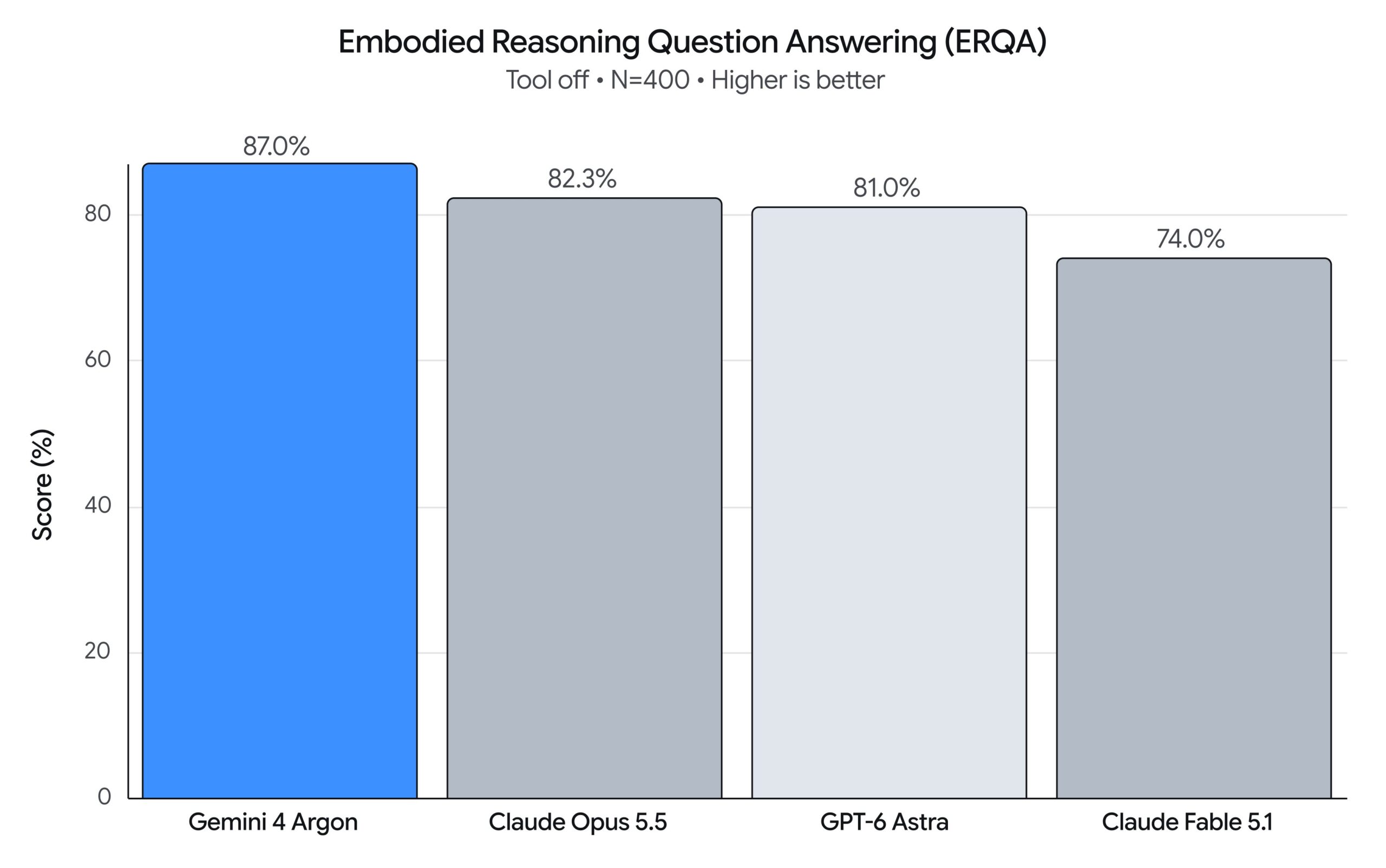
Gemini 4 Argon marks a step change in physical understanding, code generation, and visual-semantic reasoning—unlocking new workflows across the robotics stack and accelerating progress toward physical AGI.You can see this leap in capability on the Embodied Reasoning (ERQA) benchmark, which tests a model’s ability to understand and solve physical, spatial problems in 3D environments. Using pure reasoning, Argon scores 87%, outperforming every other frontier model. As a general-purpose physical reasoning model, Argon can be applied across the entire robotics lifecycle. In this post, we share representative prompts for Argon across four key areas:Robot control → Mobile manipulation with MuJoCo practice, zero-shot robot control, and closed-loop steering of video world models.Real2Sim → Reconstructing physically calibrated simulation twins from robot camera feeds, egocentric human video, or hand-drawn paper sketches.Physical understanding → Agentic multimodal hindsight labeling including detailed understanding of dexterity, dense value functions and progress estimation.Research and self-improvement → Action improvement via simulation and iterative self-improvement on hardware.Unlocking robot control with Argon1. Spot mobile manipulation: Putting in the trash bin with MuJoCo practiceArgon controls a Boston Dynamics Spot® quadruped (12-DoF legs + 6-DoF arm) to learn a new skill: stepping on a foot-pedal trash bin to throw away soda cans. Argon creates an articulated MuJoCo digital twin of a foot-pedal trash bin to practice its moves before stepping on the physical pedal and dropping soda cans into the open bin. Sorry, your browser doesn’t support playback for this video Spot Mobile Manipulation — Real-to-Sim-to-Real foot-pedal trash bin disposal: Spot picking up the soda can, checking its wrist camera, practicing 3-leg tripod balance in MuJoCo, stepping on the foot pedal, verifying hand centering in the open bin, and dropping the can inside. There’s a Diet Coke can behind you and another on the black table on your left. Use the spot-mobile-manipulation skill to pick them up and trash them in the black foot-pedal bin. Before stepping down on the pedal, verify in the front cameras that your front-right foot target is centered on the pedal, and use a 2-agent verification swarm (foot-verifier and hand-verifier) to verify both the foot-pedal step and the 3D hand-in-bin alignment before releasing. Plain text 2. Zero-shot controlArgon controls a simple robotic arm to place a fallen mug upright and put the crumpled napkin inside. Argon reasons with a visual coordinate harness and action primitives to perform this task over several turns. Sorry, your browser doesn’t support playback for this video Left: 3rd-person real robot view; Right: calibrated wrist camera with projected 2 cm world coordinates and jaw-closing reticle. [Attached: wrist_cam.png, obs.json] Task: Get the robot arm to reorient the mug upright and put the napkin inside the mug. ## Execution Discipline – Simply output 1 sentence observation followed immediately by your `curl` command (with `# Plan:` on Turn 1 and `# Thought:` on every turn). Everything needed is in `obs.json` and the calibrated reticle/grid drawn on `wrist_cam.png`. ## Visual Coordinate Reference (Annotated on wrist_cam.png) – `+X` (UP in image): Away from robot base | `-X` (DOWN): Towards robot base – `+Y` (LEFT in image): World left | `-Y` (RIGHT): World right – `+Z`: Height above table | `Yellow numbers`: World (X, Y) in centimetres (2 cm grid at `grid_z`) – `Cyan + crosshair`: Current 3D pinch center – `Cyan [ + ] brackets`: Current jaw opening and closing line – `Green line`: Current object long-axis orientation (`yaw_deg`: 0° = vertical along +X, 90° = horizontal along +Y) – `pitch_deg = 90°`: Straight down (-Z) top-down grasp/place; `pitch_deg `grasp` – > `place` – > `done` – Pre-Grasp Hover Verify (4–7 calls): `look_at` – > `goto(z=0.04)` (verify cyan `[ + ]` brackets straddle target) – > `grasp` – > `place_until_contact` – > `done` – Fine Visual Servoing (8–20 calls): `look_at` – > `grasp` – > pre-pose `goto` – > closed-loop `move_by` / `move_until_contact` – > `done` 3. Send motion primitives (`POST /plan`) and verify visually after every turn in the updated `wrist_cam.png`. If `status == “grasp_failed”`, call `robot.look_at(…)` to re-observe and recover closed-loop. ## Code-as-Policies Primitives (`POST http://127.0.0.1:8081/plan`) robot.look_at(x=0.35, y=0.13, z=0.14, grid_z=0.015) x, y = robot.deproject(u=0.52, v=0.48, z_plane=0.015) robot.grasp(x=x, y=y, z=0.015, yaw_deg=-35, pitch_deg=90) robot.place(x=0.24, y=0.06, z=0.075) robot.place_until_contact(x=0.24, y=0.06, z=0.015, max_lag=0.012, relief=0.002) robot.goto(x=0.28, y=0.05, z=0.04, arc_z=0.14, pitch_deg=25, azimuth_deg=90, roll_deg=0, speed=0.10) robot.move_by(forward=0.025, dz=-0.002, dpitch_deg=-3, droll_deg=5, speed=0.04) robot.move_until_contact(dz=-0.06, speed=0.03, max_lag=0.012, relief=0.002) robot.open_gripper() / robot.close_gripper() / robot.home() / robot.done() Plain text 3. Omni controlArgon steers robots in the Gemini Omni World Model to rearrange five scattered Scrabble tiles (G, R, A, N, O) into a clean row spelling A – R – G – O – N. Instead of specifying one static prompt, Argon steers in a closed visual loop. It writes timestamped action prompts, inspecting intermediate rollout keyframes, and refining its prompts. Sorry, your browser doesn’t support playback for this video Iterative Video World Model Steering Dexterous Hands: 33-Step Steered Video Rollout Spelling A-R-G-O-N. Goal: {task_goal} You are steering a video world model (Gemini Omni) in an iterative visual feedback loop. Inspect the attached frames from the latest rollout and write the next timestamped action prompt for the video world model: – Break complex motions into one simple, single-direction action at a time. – Keep inactive hands retracted and avoid blocking the camera’s view of objects in the workspace. – Explicitly state which areas of the workspace become empty after an object moves. – Use [MM:SS.mmm] timestamps for each action beat and wrap your output in tags. Example format (sample timestamps only, not the full prompt): [00:00.000] Character A’s left hand rests at the side while the right hand reaches toward the target object. [00:02.500] Character A’s right fingertips push the object smoothly into the center of the table, leaving its starting area empty. [00:05.000] Character A’s right hand opens and retracts to the side so all placed objects remain in clear view of the camera. Plain text Unlocking Real2Sim with Argon1. Robot view to simulationArgon views a real robot teleoperation episode and develops a digital twin; it obtains or creates simulation assets that look and behave like the real objects upon contact with the dexterous hands. Argon tunes the assets and scenes to match sim visuals and contact events with those in the real recorded data in an iterative visual-reasoning loop. Sorry, your browser doesn’t support playback for this video Left (Real View): synchronized real robot camera feeds; Right (Simulated): 3D MuJoCo scene reconstructed and calibrated by Argon. [Attached: robot_rollout_episode] Build a MuJoCo scene of the robot and reconstructed task objects. When each episode is replayed frame by frame, by driving the robot joints toward the logged observation.state with joint-space PD. Iterate using two verification objectives: (1) Visual match: MuJoCo renders from the head_left, left_wrist, and right_wrist cameras line up with, and look like, those real observations. (2) Physical match: the simulated contact force/torque on each Sharpa fingertip, in the sensor frame, matches the logged tactile_force in timing, magnitude and direction. What you can tune happens before simulation starts: (1) Static object assets: realistic geometry, collision shapes, mass, inertia, friction and joints, with appearance close to the real objects, plus the initial object poses at t = 0. (2) Offline-planned robot commands, changed only in frames where the real fingertips are near an object. Each command must stay within 0.55 rad (arm joints) and 0.65 rad (hand joints) of the logged teleop trajectory. Everywhere else, replay the logged trajectory unchanged. No sim cheating: task objects may move only through real MuJoCo contact with the robot hands and the environment (mj_step). Not allowed after t = 0: changing MjModel parameters; applying external forces or torques to objects; welds or equality constraints; feedforward torques beyond joint-space PD; setting or rolling back object qpos/qvel; disabling or excluding collisions; reporting contact forces that don’t come from the MuJoCo solver (for example, copying the logged tactile readings). Immediately present the reconstructed scene and rollout results as an interactive HTML session viewer with one page per episode, showing: – At the bottom: A synced timeline (play, scrub, speed control) that drives every panel. – On the left panel: An interactive 3D Blender scene showing the simulated robot and objects, showing contact points and force arrows as replay progresses. – On the right panel: Real vs. sim camera views side by side for all 3 cameras. Real vs. sim finger force visualizations. Plain text 2. Human view to simulationGiven an egocentric human video of a manipulation task, Argon identifies the task-relevant objects, replaces crude bounding boxes with compound convex-decomposed meshes for concave containers, and retargets the human hand trajectory onto a 76-DoF bimanual humanoid with 22-DoF five-fingered hands in MuJoCo contact physics. Sorry, your browser doesn’t support playback for this video Human View to Simulation — Egocentric Human Video to Dexterous Humanoid Twin: Left shows the input egocentric human RGB video; Right shows the synchronized 500 Hz MuJoCo + Blender Cycles multi-view simulation rollout. [Attached: egocentric_human_video.mp4, candidate_sim_views.png, hand_3d_keypoints.json] You are building a physically solvable 500 Hz MuJoCo manipulation environment (`scene.xml`) and studio Blender render that faithfully reproduces the tabletop task shown in `egocentric_human_video.mp4` on a bimanual humanoid robot with 22-DoF dexterous five-fingered hands: 1. Scene Reconstruction & Camera Calibration: – Identify only the manipulation-relevant objects (the grasped target object and the receiving container or landmark) and triangulate their 3D tabletop coordinates from the egocentric camera intrinsics/extrinsics. – Replace crude bounding boxes with compound convex-decomposed 3D meshes so concave containers (nested bowls, recessed wooden trays, open bins) support physical interior placement. 2. 500 Hz Dexterous Motion-Fitting Stress Test: – Retarget the 3D human wrist and finger keypoints to the humanoid’s 7-DoF arm and 22-DoF hand joints, and step the trajectory in MuJoCo at 500 Hz (dt = 0.002s) with zero kinematic weld constraints. – Verify opposing thumb-and-finger force closure, clean object lift ( > 2 cm), and stable final placement inside or beside the target landmark. Plain text 3. Sketch to simulationWith Argon, a developer can snap a photo of a rough pen-and-paper sketch—showing an Apollo 2 humanoid throwing a ball along a parabolic arc to topple a 3-2-1 stack of boxes on a table—and have Argon automatically construct the GPU-accelerated mujoco_warp scene, synthesize a balanced 76-DoF whole-body and five-finger throw trajectory, verify 6/6 target knockdown in closed-loop physics, and export a Blender 4.5 Cycles render. Sorry, your browser doesn’t support playback for this video Sketch to Simulation — Hand-Drawn Sketch to Dexterous Humanoid Trajectory & Cycles Render. [Attached: hand_drawn_throw_sketch.jpg] Translate this hand-drawn sketch into a physically verified humanoid simulation in `mujoco_warp` and a raytraced Blender Cycles video: 1. Scene & Kinematic Setup from Sketch: – Parse the spatial layout from `hand_drawn_throw_sketch.jpg`: place the 76-DoF humanoid (32-DoF body equipped with two 22-DoF five-finger dexterous hands) at the origin facing a table holding a 3-2-1 pyramid of 6 rigid target boxes, with a projectile sphere grasped in the right five-finger hand. 2. Whole-Body Balance & Dexterous Throw Synthesis: – Synthesize a 50 Hz whole-body throwing trajectory (140 steps, 2.80 s) across four phases: (1) stable stance & 5-finger power grasp closure, (2) torso/shoulder wind-up with ankle-hip Center-of-Mass compensation, (3) forward whipping acceleration, and (4) synchronized 22-DoF five-finger opening at peak hand velocity so the ball launches on a ballistic arc into the pyramid’s second-tier center of mass. – Verify in `mujoco_warp` contact physics that the humanoid maintains upright balance (< 3 cm pelvis drift) and knocks down all 6 target boxes. Plain text Unlocking physical understanding with Argon1. Hindsight labeling and data qualityArgon has precise physical understanding of dexterous manipulation and can provide detailed segmentation and text labeling from video. Argon is able to identify poor manipulation segments such as pauses, unstable grasps and fumbles. Given an overhead video of a bimanual ALOHA 2 robot folding a square sheet of paper into an origami fox over 136 seconds, Argon produces a time-aligned 4-level hindsight annotation hierarchy: Episode Goal (G1), 6 contiguous Semantic Subtasks (G2), 17 contact-level Atomic Primitives (G3), and automated Quality Control (QC) reweighting that holds task progress flat during fumbles and retries. Sorry, your browser doesn't support playback for this video Argon Multi-Granularity Hindsight & Telemetry HUD. [Attached: Aloha2_Origami_20250309.mp4] Produce a time-aligned multi-granularity hindsight annotation JSON with four levels: 1. G1_episode_instruction: Concise imperative sentence describing the overall manipulation goal. 2. G2_subtasks: Contiguous semantic subtask phases specifying which arm(s) anchor vs. fold/rotate the object. 3. G3_atomic_primitives: Fine-grained contact-level primitives (3–15s) aligned with grasp closure, crease sweeps, release, or retry attempts. 4. quality_control_and_reweighting: Hold task_progress_pct flat during non-progressing slip/delamination retry loops and downweight them (0.15x–0.25x) for Behavior Cloning. Plain text 2. Find the odd ballTo recreate the classic 12-ball balance scale puzzle with robots, Argon builds a bimanual Franka FR3 MuJoCo environment with 12 visually identical pool balls (one secretly heavier or lighter) and an articulated Roberval two-pan balance scale. It then writes a vision-only closed-loop solver that triangulates the balls from stereo RGB cameras, visually reads the scale tilt after each weighing, and isolates the odd ball into the Heavy (Red) or Light (Blue) tray within 3 weighings. Sorry, your browser doesn't support playback for this video Find the Odd Ball (Vision-Only Closed-Loop Solver): Dual-arm Franka FR3 weighing candidate balls on the Gold/Teal pans, reading stereo scale tilt , and isolating the confirmed Heavy odd ball into the Red tray in 3 weighings. # Prompt 1 — Physics-Accurate MuJoCo Environment & Benchmark Generation Make a MuJoCo environment where a dual-arm robot (two 7-DoF Franka FR3 arms with parallel-jaw grippers on a shared tabletop) is tasked to solve the classic 12-ball balance scale weight puzzle from https://www.mathsisfun.com/pool_balls_solution.html. 1. Create 12 visually indistinguishable pool balls in a 2×6 starting rack (11 standard 150 g, 1 odd ball either 270 g or 30 g). 2. Build a functional two-pan Roberval balance scale at the center of the table with parallelogram equality constraints (`mjEQ_JOINT`) so the Left (Gold) and Right (Teal) pans stay horizontal, plus Red (Heavy) and Blue (Light) submission trays. 3. Track distinct settled weighings (`weighing_count`) and reward `1.00` for isolating the true odd ball in the correct Heavy/Light tray within

Gemini 4 Argon marks a step change in physical understanding, code generation, and visual-semantic reasoning—unlocking new workflows across the robotics stack and accelerating progress toward physical AGI.

You can see this leap in capability on the Embodied Reasoning (ERQA) benchmark, which tests a model’s ability to understand and solve physical, spatial problems in 3D environments. Using pure reasoning, Argon scores 87%, outperforming every other frontier model.
gemini-4-argon__benchmark__robotics

As a general-purpose physical reasoning model, Argon can be applied across the entire robotics lifecycle. In this post, we share representative prompts for Argon across four key areas:

  • Robot control → Mobile manipulation with MuJoCo practice, zero-shot robot control, and closed-loop steering of video world models.
  • Real2Sim → Reconstructing physically calibrated simulation twins from robot camera feeds, egocentric human video, or hand-drawn paper sketches.
  • Physical understanding → Agentic multimodal hindsight labeling including detailed understanding of dexterity, dense value functions and progress estimation.
  • Research and self-improvement → Action improvement via simulation and iterative self-improvement on hardware.

Unlocking robot control with Argon

1. Spot mobile manipulation: Putting in the trash bin with MuJoCo practice

Argon controls a Boston Dynamics Spot® quadruped (12-DoF legs + 6-DoF arm) to learn a new skill: stepping on a foot-pedal trash bin to throw away soda cans. Argon creates an articulated MuJoCo digital twin of a foot-pedal trash bin to practice its moves before stepping on the physical pedal and dropping soda cans into the open bin.

Sorry, your browser doesn’t support playback for this video

Spot Mobile Manipulation — Real-to-Sim-to-Real foot-pedal trash bin disposal: Spot picking up the soda can, checking its wrist camera, practicing 3-leg tripod balance in MuJoCo, stepping on the foot pedal, verifying hand centering in the open bin, and dropping the can inside.

There's a Diet Coke can behind you and another on the black table on your left.
Use the spot-mobile-manipulation skill to pick them up and trash them in the black foot-pedal bin.
Before stepping down on the pedal, verify in the front cameras that your front-right foot target is centered on the pedal, and use a 2-agent verification swarm (foot-verifier and hand-verifier) to verify both the foot-pedal step and the 3D hand-in-bin alignment before releasing.

Plain text

2. Zero-shot control

Argon controls a simple robotic arm to place a fallen mug upright and put the crumpled napkin inside. Argon reasons with a visual coordinate harness and action primitives to perform this task over several turns.

Sorry, your browser doesn’t support playback for this video

Left: 3rd-person real robot view; Right: calibrated wrist camera with projected 2 cm world coordinates and jaw-closing reticle.

[Attached: wrist_cam.png, obs.json]

Task: Get the robot arm to reorient the mug upright and put the napkin inside the mug.

## Execution Discipline
- Simply output 1 sentence observation followed immediately by your `curl` command (with `# Plan:` on Turn 1 and `# Thought:` on every turn). Everything needed is in `obs.json` and the calibrated reticle/grid drawn on `wrist_cam.png`.

## Visual Coordinate Reference (Annotated on wrist_cam.png)
- `+X` (UP in image): Away from robot base | `-X` (DOWN): Towards robot base
- `+Y` (LEFT in image): World left         | `-Y` (RIGHT): World right
- `+Z`: Height above table                | `Yellow numbers`: World (X, Y) in centimetres (2 cm grid at `grid_z`)
- `Cyan + crosshair`: Current 3D pinch center
- `Cyan [ + ] brackets`: Current jaw opening and closing line
- `Green line`: Current object long-axis orientation (`yaw_deg`: 0° = vertical along +X, 90° = horizontal along +Y)
- `pitch_deg = 90°`: Straight down (-Z) top-down grasp/place; `pitch_deg  `grasp` -> `place` -> `done`
   - Pre-Grasp Hover Verify (4–7 calls): `look_at` -> `goto(z=0.04)` (verify cyan `[ + ]` brackets straddle target) -> `grasp` -> `place_until_contact` -> `done`
   - Fine Visual Servoing (8–20 calls): `look_at` -> `grasp` -> pre-pose `goto` -> closed-loop `move_by` / `move_until_contact` -> `done`
3. Send motion primitives (`POST /plan`) and verify visually after every turn in the updated `wrist_cam.png`. If `status == "grasp_failed"`, call `robot.look_at(...)` to re-observe and recover closed-loop.

## Code-as-Policies Primitives (`POST http://127.0.0.1:8081/plan`)
robot.look_at(x=0.35, y=0.13, z=0.14, grid_z=0.015)
x, y = robot.deproject(u=0.52, v=0.48, z_plane=0.015)
robot.grasp(x=x, y=y, z=0.015, yaw_deg=-35, pitch_deg=90)
robot.place(x=0.24, y=0.06, z=0.075)
robot.place_until_contact(x=0.24, y=0.06, z=0.015, max_lag=0.012, relief=0.002)
robot.goto(x=0.28, y=0.05, z=0.04, arc_z=0.14, pitch_deg=25, azimuth_deg=90, roll_deg=0, speed=0.10)
robot.move_by(forward=0.025, dz=-0.002, dpitch_deg=-3, droll_deg=5, speed=0.04)
robot.move_until_contact(dz=-0.06, speed=0.03, max_lag=0.012, relief=0.002)
robot.open_gripper() / robot.close_gripper() / robot.home() / robot.done()

Plain text

3. Omni control

Argon steers robots in the Gemini Omni World Model to rearrange five scattered Scrabble tiles (G, R, A, N, O) into a clean row spelling A - R - G - O - N. Instead of specifying one static prompt, Argon steers in a closed visual loop. It writes timestamped action prompts, inspecting intermediate rollout keyframes, and refining its prompts.

Sorry, your browser doesn’t support playback for this video

Iterative Video World Model Steering Dexterous Hands: 33-Step Steered Video Rollout Spelling A-R-G-O-N.

Goal: {task_goal}

You are steering a video world model (Gemini Omni) in an iterative visual feedback loop. Inspect the attached frames from the latest rollout and write the next timestamped action prompt for the video world model:
- Break complex motions into one simple, single-direction action at a time.
- Keep inactive hands retracted and avoid blocking the camera's view of objects in the workspace.
- Explicitly state which areas of the workspace become empty after an object moves.
- Use [MM:SS.mmm] timestamps for each action beat and wrap your output in  tags.

Example format (sample timestamps only, not the full prompt):

[00:00.000] Character A's left hand rests at the side while the right hand reaches toward the target object.
[00:02.500] Character A's right fingertips push the object smoothly into the center of the table, leaving its starting area empty.
[00:05.000] Character A's right hand opens and retracts to the side so all placed objects remain in clear view of the camera.

Plain text

Unlocking Real2Sim with Argon

1. Robot view to simulation

Argon views a real robot teleoperation episode and develops a digital twin; it obtains or creates simulation assets that look and behave like the real objects upon contact with the dexterous hands. Argon tunes the assets and scenes to match sim visuals and contact events with those in the real recorded data in an iterative visual-reasoning loop.

Sorry, your browser doesn’t support playback for this video

Left (Real View): synchronized real robot camera feeds; Right (Simulated): 3D MuJoCo scene reconstructed and calibrated by Argon.

[Attached: robot_rollout_episode]

Build a MuJoCo scene of the robot and reconstructed task objects. When each episode is replayed frame by frame, by driving the robot joints toward the logged observation.state with joint-space PD.

Iterate using two verification objectives:
(1) Visual match: MuJoCo renders from the head_left, left_wrist, and right_wrist cameras line up with, and look like, those real observations.
(2) Physical match: the simulated contact force/torque on each Sharpa fingertip, in the sensor frame, matches the logged tactile_force in timing, magnitude and direction.

What you can tune happens before simulation starts:
(1) Static object assets: realistic geometry, collision shapes, mass, inertia, friction and joints, with appearance close to the real objects, plus the initial object poses at t = 0.
(2) Offline-planned robot commands, changed only in frames where the real fingertips are near an object. Each command must stay within 0.55 rad (arm joints) and 0.65 rad (hand joints) of the logged teleop trajectory. Everywhere else, replay the logged trajectory unchanged.

No sim cheating: task objects may move only through real MuJoCo contact with the robot hands and the environment (mj_step).
Not allowed after t = 0: changing MjModel parameters; applying external forces or torques to objects; welds or equality constraints; feedforward torques beyond joint-space PD; setting or rolling back object qpos/qvel; disabling or excluding collisions; reporting contact forces that don't come from the MuJoCo solver (for example, copying the logged tactile readings).

Immediately present the reconstructed scene and rollout results as an interactive HTML session viewer with one page per episode, showing:
- At the bottom: A synced timeline (play, scrub, speed control) that drives every panel.
- On the left panel: An interactive 3D Blender scene showing the simulated robot and objects, showing contact points and force arrows as replay progresses.
- On the right panel: Real vs. sim camera views side by side for all 3 cameras. Real vs. sim finger force visualizations.

Plain text

2. Human view to simulation

Given an egocentric human video of a manipulation task, Argon identifies the task-relevant objects, replaces crude bounding boxes with compound convex-decomposed meshes for concave containers, and retargets the human hand trajectory onto a 76-DoF bimanual humanoid with 22-DoF five-fingered hands in MuJoCo contact physics.

Sorry, your browser doesn’t support playback for this video

Human View to Simulation — Egocentric Human Video to Dexterous Humanoid Twin: Left shows the input egocentric human RGB video; Right shows the synchronized 500 Hz MuJoCo + Blender Cycles multi-view simulation rollout.

[Attached: egocentric_human_video.mp4, candidate_sim_views.png, hand_3d_keypoints.json]

You are building a physically solvable 500 Hz MuJoCo manipulation environment (`scene.xml`) and studio Blender render that faithfully reproduces the tabletop task shown in `egocentric_human_video.mp4` on a bimanual humanoid robot with 22-DoF dexterous five-fingered hands:

1. Scene Reconstruction & Camera Calibration:
   - Identify only the manipulation-relevant objects (the grasped target object and the receiving container or landmark) and triangulate their 3D tabletop coordinates from the egocentric camera intrinsics/extrinsics.
   - Replace crude bounding boxes with compound convex-decomposed 3D meshes so concave containers (nested bowls, recessed wooden trays, open bins) support physical interior placement.

2. 500 Hz Dexterous Motion-Fitting Stress Test:
   - Retarget the 3D human wrist and finger keypoints to the humanoid's 7-DoF arm and 22-DoF hand joints, and step the trajectory in MuJoCo at 500 Hz (dt = 0.002s) with zero kinematic weld constraints.
   - Verify opposing thumb-and-finger force closure, clean object lift (> 2 cm), and stable final placement inside or beside the target landmark.

Plain text

3. Sketch to simulation

With Argon, a developer can snap a photo of a rough pen-and-paper sketch—showing an Apollo 2 humanoid throwing a ball along a parabolic arc to topple a 3-2-1 stack of boxes on a table—and have Argon automatically construct the GPU-accelerated mujoco_warp scene, synthesize a balanced 76-DoF whole-body and five-finger throw trajectory, verify 6/6 target knockdown in closed-loop physics, and export a Blender 4.5 Cycles render.

Sorry, your browser doesn’t support playback for this video

Sketch to Simulation — Hand-Drawn Sketch to Dexterous Humanoid Trajectory & Cycles Render.

[Attached: hand_drawn_throw_sketch.jpg]

Translate this hand-drawn sketch into a physically verified humanoid simulation in `mujoco_warp` and a raytraced Blender Cycles video:

1. Scene & Kinematic Setup from Sketch:
   - Parse the spatial layout from `hand_drawn_throw_sketch.jpg`: place the 76-DoF humanoid (32-DoF body equipped with two 22-DoF five-finger dexterous hands) at the origin facing a table holding a 3-2-1 pyramid of 6 rigid target boxes, with a projectile sphere grasped in the right five-finger hand.

2. Whole-Body Balance & Dexterous Throw Synthesis:
   - Synthesize a 50 Hz whole-body throwing trajectory (140 steps, 2.80 s) across four phases: (1) stable stance & 5-finger power grasp closure, (2) torso/shoulder wind-up with ankle-hip Center-of-Mass compensation, (3) forward whipping acceleration, and (4) synchronized 22-DoF five-finger opening at peak hand velocity so the ball launches on a ballistic arc into the pyramid's second-tier center of mass.
   - Verify in `mujoco_warp` contact physics that the humanoid maintains upright balance (< 3 cm pelvis drift) and knocks down all 6 target boxes.

Plain text

Unlocking physical understanding with Argon

1. Hindsight labeling and data quality

Argon has precise physical understanding of dexterous manipulation and can provide detailed segmentation and text labeling from video. Argon is able to identify poor manipulation segments such as pauses, unstable grasps and fumbles. Given an overhead video of a bimanual ALOHA 2 robot folding a square sheet of paper into an origami fox over 136 seconds, Argon produces a time-aligned 4-level hindsight annotation hierarchy: Episode Goal (G1), 6 contiguous Semantic Subtasks (G2), 17 contact-level Atomic Primitives (G3), and automated Quality Control (QC) reweighting that holds task progress flat during fumbles and retries.

Sorry, your browser doesn’t support playback for this video

Argon Multi-Granularity Hindsight & Telemetry HUD.

[Attached: Aloha2_Origami_20250309.mp4]

Produce a time-aligned multi-granularity hindsight annotation JSON with four levels:
1. G1_episode_instruction: Concise imperative sentence describing the overall manipulation goal.
2. G2_subtasks: Contiguous semantic subtask phases specifying which arm(s) anchor vs. fold/rotate the object.
3. G3_atomic_primitives: Fine-grained contact-level primitives (3–15s) aligned with grasp closure, crease sweeps, release, or retry attempts.
4. quality_control_and_reweighting: Hold task_progress_pct flat during non-progressing slip/delamination retry loops and downweight them (0.15x–0.25x) for Behavior Cloning.

Plain text

2. Find the odd ball

To recreate the classic 12-ball balance scale puzzle with robots, Argon builds a bimanual Franka FR3 MuJoCo environment with 12 visually identical pool balls (one secretly heavier or lighter) and an articulated Roberval two-pan balance scale. It then writes a vision-only closed-loop solver that triangulates the balls from stereo RGB cameras, visually reads the scale tilt after each weighing, and isolates the odd ball into the Heavy (Red) or Light (Blue) tray within 3 weighings.

Sorry, your browser doesn’t support playback for this video

Find the Odd Ball (Vision-Only Closed-Loop Solver): Dual-arm Franka FR3 weighing candidate balls on the Gold/Teal pans, reading stereo scale tilt , and isolating the confirmed Heavy odd ball into the Red tray in 3 weighings.

# Prompt 1 — Physics-Accurate MuJoCo Environment & Benchmark Generation
Make a MuJoCo environment where a dual-arm robot (two 7-DoF Franka FR3 arms with parallel-jaw grippers on a shared tabletop) is tasked to solve the classic 12-ball balance scale weight puzzle from https://www.mathsisfun.com/pool_balls_solution.html.
1. Create 12 visually indistinguishable pool balls in a 2x6 starting rack (11 standard 150 g, 1 odd ball either 270 g or 30 g).
2. Build a functional two-pan Roberval balance scale at the center of the table with parallelogram equality constraints (`mjEQ_JOINT`) so the Left (Gold) and Right (Teal) pans stay horizontal, plus Red (Heavy) and Blue (Light) submission trays.
3. Track distinct settled weighings (`weighing_count`) and reward `1.00` for isolating the true odd ball in the correct Heavy/Light tray within <= 3 weighings.

# Prompt 2 — Closed-Loop Vision-Only Solver
Implement an independent closed-loop policy relying strictly on stereo RGB camera inputs (`head_camera_left_rgb_image`, `head_camera_right_rgb_image`) and robot proprioception (`add_privileged_task_observations=False`):
1. Segment the 12 balls, Gold/Teal pans, and Red/Blue trays in both stereo views and triangulate their 3D coordinates.
2. Visually read the balance scale tilt after each weighing from stereo vertical pixel disparity (+1 = left heavier, -1 = right heavier, 0 = balanced).
3. Rotate the gripper wrist yaw by 90 degrees when grasping/placing inside the narrow scale pans to clear the raised rims, and isolate the odd ball into the Red or Blue tray within <= 3 weighings.

Plain text

3. Value function

Argon is a general value function for robotics tasks. Evaluated on a 60-second bimanual ring-sorting episode from a human UMI dataset, Argon iteratively inspects synchronized head, left-gripper, and right-gripper camera feeds around contact transitions to generate dense value function / task progress predictions and decompose the trajectory into 28 segments with positive, neutral, and negative progress slopes.

Sorry, your browser doesn’t support playback for this video

Value Function: Synchronized 3-camera UMI playback (head, left gripper, right gripper) locked to animated task progress curve and bimanual segment annotations.

[Attached: umi_head.mp4, umi_left_gripper.mp4, umi_right_gripper.mp4]

Look at 3 videos of human wearing a gripper performing activities from head, left, right gripper views. Look at the videos thoroughly and give a detailed plot of progress at the task (with positive, neutral, negative slope), identifying important segments in the video and labeling the activities. Look at individual frames or subsegments of the video if necessary to get a better understanding.

Plain text

Unlocking research and self-improvement with Argon

1. Action improvement via simulation

Argon can generate new data in simulation to improve performance of generalist vision-language-action (VLA) models. Starting from a single RGB photo of the real tabletop, Argon autonomously builds a calibrated MuJoCo simulation twin, defines new tasks, and synthesizes a closed-loop motion generator to collect 4,500+ domain-randomized episodes in simulation—boosting real-world physical robot Success Rate from 56% to 75% and reducing completion time from 35s to 24s.

Sorry, your browser doesn’t support playback for this video

Action Improvement via Simulation: improves the real-world evaluation benchmark (56% → 75% Success Rate and 35s → 24s Completion Time).

[Attached: real_tabletop_photo.jpg]

You are given a single overhead RGB camera photo (`real_tabletop_photo.jpg`) of a bimanual robot workspace (two 7-DoF Franka FR3 arms with parallel-jaw grippers and 4 RGB cameras) facing a table arranged with photobooth party props.
1. Reconstruct procedural 3D meshes and compound MuJoCo collision primitives for all 9 party props matching their real-world dimensions, colors, and resting poses, including spring-hinged deformable crown panels for the soft plush cap.
2. Define a 77-task single-arm and bimanual curriculum (pick-and-place, uprighting, directional pushing, mid-air handovers, bimanual scoop-and-push, and pipelined table clearing).
3. Synthesize a closed-loop IK trajectory generator across ±10 cm pose randomization, verify `reward == 1.0` in MuJoCo physics, and export 4,500+ episodes for VLA fine-tuning.

Plain text

2. Self-Improvement for visual pick and place

On a simple 6-DoF arm, Argon iteratively self-improves both execution speed and placement accuracy on a pick and place task via trial and self-reflection.

Sorry, your browser doesn’t support playback for this video

SO-101 Vision-Guided Pick-and-Place — Iterative Hardware Self-Improvement Across Iterations 1 → 2 → 3: Iteration 1 (58.9s), Iteration 2 (22.9s, grazed box rim on drop), and Iteration 3 (17.4s, dead-center drop).

# Stage 1 — Measure Objects & Dry-Run Plan (No Hardware Motion)
Stage 1: measure objects — find the objects and plan the whole motion. The arm does not move in this stage.

A. I put a LEGO brick and a box on the table in front of the arm, and the wooden box to one side. Find the brick and the wooden box in the image. And also in the real world. Show this in an annotated image.

B. A dry-run plan (no hardware). Write the planner to pick and place the lego block. Print the plan table, draw all poses onto the overhead image, and stop. Do not move the robot.
Report with evidence.

# Stage 2 — Pre-Pick Hover & Wrist-Camera Verification
Stage 2: Put the gripper above the brick without touching it, and verify with the wrist camera that the arm and the vision agree. Please record executions with both cameras (compressed video is OK).

# Stage 3 (Autonomous Pick-and-Place → Self-Improvement → Optimization):
1. Execute autonomously: Turn the Stage 1 dry run into a real grasp, lift, and place into the wooden box. Run it yourself subject to safety rules from AGENTS.md.

2. Self-improve: When an attempt fails, diagnose it yourself. Review your own logs and wrist/overhead footage, find the root cause, check the fix in a dry run, and retry.

3. Optimize on feedback: Once it succeeds, make it at least 2× faster within safety limits (rule R5) unless I authorize more, or give feedback.

Plain text

3. One-prompt robotics paper reproductions in MuJoCo WebAssembly

With a single prompt per paper, Argon reads a robotics control manuscript and any released checkpoints, ports the physics model and closed-loop controller (from 7-network hierarchical locomotion in DeepLoco and 50 Hz PPO actors in HUSKY to Web Worker iLQR in Whole-Body MPC) into self-contained MuJoCo WebAssembly browser labs, and verifies them in headless Chromium.

Sorry, your browser doesn’t support playback for this video

Five Landmark Legged & Humanoid Papers Running Live in Browser (MuJoCo WASM): Robotic Soccer OP3 1v1, DeepLoco, Massively Parallel Deep RL ANYmal C, Whole-Body MPC Go2, and HUSKY G1 Skateboarding (from 68 interactive browser sandboxes reproduced by Argon).

[Attached: paper.pdf, optional author_checkpoints/ or urdf_assets/]

Reproduce the paper "" from scratch in MuJoCo WebAssembly and deploy a self-contained browser lab + visual essay:
1. Match the paper's exact physics timestep, actuator gains (kp/kv), torque limits, and kinematic constraints in MuJoCo XML, and run real neural inference or Web Worker iLQR in JavaScript at the paper's exact control rates.
2. Build `index.html` (Spatial UI simulator with camera presets, live telemetry plots, and disturbance injection) and `scrollytelling.html` (interactive visual essay).
3. Run a headless Chromium (Playwright) verification loop asserting 0 console errors and non-zero task progress over 300+ frames.

Plain text

Advancing embodied intelligence with Argon

Argon bridges coding, visual perception, physics simulation, and embodied robot control. By reasoning natively over multi-view video, 3D geometry, contact mechanics, and proprioceptive telemetry, Argon understands not just what objects are in a scene, but how they physically interact with agents to accomplish whole-body dexterous tasks. Gemini 4 Argon marks an important milestone accelerating the path toward physical AGI. By building this core intelligence, our goal is to enable robotics that can work alongside humans to solve complex challenges.

Getting started

You can start building with Gemini 4 Argon today across Google’s developer platforms:

  • Google AI Studio: Available to Google AI Ultra subscribers.
  • Gemini API: Available with the paid tier of the Gemini API in AI Studio. Use gemini-4-argon in the Interactions API with day-one support across the google-genai SDKs.
  • Google Antigravity: Available for Google AI Ultra subscribers. To start building, select Gemini 4 Argon (gemini-4-argon) as your active model in Google Antigravity for complex planning, /goal runs, and multi-agent orchestration.
Shape
Shape
Stay Ahead

Explore More Insights

Stay ahead with more perspectives on cutting-edge power, infrastructure, energy,  bitcoin and AI solutions. Explore these articles to uncover strategies and insights shaping the future of industries.

Shape

F5 scrambles to fix more critical BIG-IP security flaws

CVE-2026-121805: When an iRule that processes client traffic using the PEM:subscriber command is configured on a virtual server, undisclosed requests can cause the Traffic Management Microkernel (TMM) to terminate and may lead to remote code execution (RCE); CVE-2026-120292: When an HTTP profile and an iRule using the MR:message route command

Read More »

Energy Secretary Keeps Critical Generation Available in Mid-Atlantic

WASHINGTON—U.S. Secretary of Energy Chris Wright today issued an emergency order to address critical grid reliability issues facing the mid-Atlantic region of the United States. The order directs PJM Interconnection L.L.C. (PJM), in coordination with Constellation Energy Corporation (Constellation Energy), to ensure Units 3 and 4 of the Eddystone Generating Station in Pennsylvania remain available to operate and to employ economic dispatch to minimize costs for the American people. The units were originally slated to shut down on May 31, 2025.   “The energy sources that perform when you need them most are the most valuable,” said U.S. Secretary of Energy Chris Wright. “President Trump and the Energy Department are committed to keeping critical generation available when demand is highest, reducing the risk of blackouts and ensuring Americans have affordable, reliable, and secure power—regardless of whether the wind is blowing or the sun is shining.”  Secretary Wright first ordered that the two Eddystone Generating Station units remain online past their planned retirement date in a May 30, 2025 emergency order. Subsequent orders were issued later in 2025 and 2026. Keeping these units operational has strengthened energy security in the PJM region, ensuring reliable electricity for American families and businesses. This order is in effect beginning on November 21, 2026, through February 18, 2027. 

Read More »

ExxonMobil takes FID on Angola Block 15 extension project

The Block 15 Lifespan Extension Project, about 145 km off Angola’s northern coast, will utilize existing infrastructure to develop additional resources throughout the Kizomba Hub area. The investment decision completes project FIDs following approval of Kizomba C redevelopment in 2025. ANPG also noted a hydrocarbon discovery in the block at the Tchihumba West-01ST1 exploration well, about 350 km northwest of Luanda. The discovery is the 21st in the block and the second this year. The well, drilled by the Valaris DS-9 in about 1,400 m of water, encountered 65.4 m of sandstone reservoir with hydrocarbon presence and good petrophysical properties. ExxonMobil is operator at Block 15 (36%) with partners Azule Energy Exploration (ANG) Ltd. (24%), Azule Energy ANG BV (18%), Equinor Angola (12%), and Sonongol E&P (10%).

Read More »

Market reforms bolster grid, may lower costs this winter: FERC

Listen to the article 4 min This audio is auto-generated. Please let us know if you have feedback. Electric market reforms in the West and Northeast may bolster grid reliability and, in some cases, lower costs this winter, according to the Federal Energy Regulatory Commission’s annual winter market and reliability report, released Thursday. Expanded markets help offset drought impacts In the West, the California Independent System Operator launched the Extended Day Ahead Market and the Southwest Power Pool expanded into the Western Interconnection earlier this year. “EDAM and SPP’s expansion should provide ratepayers in much of the West with production cost savings and improved reliability in winter 2026-2027, particularly during cold weather events,” FERC staff said in the report. This winter, the markets’ improved coordination of generation and reduced need for reserve power supplies will help offset lower power output from the Glen Canyon and Hoover dams due to historically low water levels in the Colorado River basin, staff said. “On a day-to-day basis, these conditions can create congestion and affect system operators’ ability to respond to voltage support challenges, event response mitigation needs, or any additional grid stressors,” staff said in the report. About 45% of the continental United States and 95% of the Intermountain West region is in a drought, according to the report. Hydro, oil pose challenges for Northeast In the Northeast, ISO New England lowered its capacity performance pay rate, which should lower electricity prices during emergency conditions or capacity performance events this winter, staff said. Also, the New York Independent System Operator changed its installed capacity market rules to reflect uncertainty about how much power Hydro–Québec will deliver over the 1,250-MW Champlain Hudson Power Express transmission line in the winter, they noted. The U.S. subsidiary of the Canadian utility Hydro-Québec — the primary reservation holder — has an obligation

Read More »

Dangote awards contracts advancing Lekki refining complex expansion

Dangote Group’s Dangote Petroleum Refinery and Petrochemicals FZE (DPRP) has awarded separate contracts to Kirloskar Group of India’s Kirloskar Brothers Ltd. (KBL) and Kirloskar Ebara Pumps Ltd. (KEPL)—a KBL joint venture with Ebara Corp. of Japan—for delivery of engineering services and equipment as part of a phased capacity expansion currently underway at DPRP’s 650,000-b/d refinery and petrochemical complex in the Lekki Free Zone near Lagos, Nigeria. In a Nov. 20 regulatory filing submitted to both BSE Ltd. and The National Stock Exchange of India Ltd., KBL said the combined value of the orders under the contracts amounted to about $38.94 million, $21.34 million of which would cover KEPL’s scope of work, with KBL to retain the remaining $17.60 million as compensation for a leg of the project. The service provider offered no additional details regarding either its own of KEPL’s scope of deliverables under the agreement other than that the work was to include engineering expertise and provision of “specialized pumping solutions for demanding energy applications.” The Lekki complex expansion involves increasing the refinery’s crude processing capacity by an additional 750,000 b/d to 1.4 million b/d in two phases to be executed between 2025-28 and 2028-30, respectively. The proposed expansion also includes plans to increase the site’s production of propylene by 750,000 tonnes/year (tpy), as well as adding 400,000 tpy of fresh production capacity for linear alkylbenzene (LAB).

Read More »

How NV5 Digital Twins Help Oil & Gas Facilities Reduce Downtime and Improve Safety

Refining, midstream, and production operators face increasing pressure to reduce downtime, improve safety, and make faster decisions with increasingly complex asset data. One leading international energy company partnered with NV5 Geospatial to deploy high-fidelity digital twins that unified engineering, inspection, and operational data across multiple facilities. The result: faster planning and approvals, safer operations, fewer travel requirements, and measurable reductions in outage windows.   The Challenge  The company’s refineries and offshore/onshore facilities are high-consequence environments where even brief shutdowns can cost millions per day. Engineering drawings, P&IDs, laser scans, SCADA/IoT feeds, and maintenance systems existed in separate silos making it difficult for staff to access a shared, current view of assets or to plan complex maintenance activities safely and efficiently.   Additionally, the organization sought to reduce field exposure for subject-matter experts (SMEs) by enabling remote collaboration and to improve predictability in outage planning and maintenance “switchovers,” where downtime forecasting directly affects operational revenue.   The Solution  NV5 Digital Twin = Geospatial system of record + automation.  NV5 delivered a scalable, field-to-cloud workflow that fused reality capture, engineering data, and live system integration into a unified, photorealistic 3D environment.   Reality Capture  Rotary-wing acquisition using NV5’s custom multi-sensor pod with RIEGL VUX-240 LiDAR (~300 ppsm) and 150MP nadir + oblique imagery (1″ GSD), flown with 80% side/forward lap for high-fidelity photomesh creation.  NV5 coordinated with local air-traffic control and operated from a nearby hangar to minimize mobilization time.  IS-BAO Stage 3 aviation safety certification and on-staff licensed surveyors ensured quality and compliance.   This level of detail enables operators to virtually inspect assets, plan maintenance activities, and validate engineering decisions without repeated site visits. Processing and Integration  SBET-calibrated LiDAR and imagery were processed into advanced classified point clouds, DEM/DSM surfaces, and textured 3D meshes (delivered OBJ/Esri Scene Layer, and Cesium 3D Tiles 1.1 formats).  Engineering

Read More »

FERC approves Sabine Pass LNG expansion, four other major gas projects

The US Federal Energy Regulatory Commission (FERC) approved 5 gas infrastructure projects Nov. 19, including a nearly 20-million-tonne/year (tpy) expansion of Cheniere Energy’s Sabine Pass LNG export plant in Louisiana, two associated feedgas pipeline projects, and new gas transportation and storage infrastructure in 5 other states. The approvals encompass roughly $3 billion in proposed pipeline and storage investments, excluding construction costs for the Sabine Pass liquefaction expansion. Cheniere estimates the full Sabine Pass Stage V LNG expansion will cost $15 billion, according to a June 2025 filing with the US Department of Energy. Sabine Pass Stage V expansion FERC authorized Cheniere Energy subsidiaries Sabine Pass Liquefaction LLC and Sabine Pass Liquefaction Stage V LLC to construct and operate 3 additional liquefaction trains at the existing Sabine Pass LNG plant in Cameron Parish, La. The expansion would add up to 20 million tpy of LNG production capacity to the existing 30 million tpy 6-train plant.  Phase 1 calls for Train 7, with peak production capacity of about 6 million tpy, and a boil-off gas reliquefaction unit capable of producing about 1 million tpy. Phase 2 would add Trains 8 and 9, each with peak production capacity of 6 mtpa, along with supporting infrastructure and upgrades to marine loading infrastructure.  Cheniere has not yet taken final investment decision, but expects to greenlight Phase 1 by early 2027, subject to regulatory approvals and financing arrangements. The company previously said initial LNG exports could begin in 2030, with commercial service potentially starting in mid-2031. FERC also authorized two pipeline projects to supply additional feedgas to the expanded terminal. The $1.63 billion Sabine Crossing Pipeline project would build 55.6 miles of 48-in. OD pipeline between southeast Texas and Sabine Pass, along with a new 210,000-hp compressor station and related infrastructure. The pipeline would transport up

Read More »

The Data Center Backlash Has a Playbook

The data center industry’s next development constraint may have less to do with megawatts than with the politics of where those megawatts are deployed. The warning became difficult to ignore on November 3, when American voters approved 33 local ballot measures restricting data center development or expressing opposition to it, according to Ballotpedia’s analysis of the 2026 midterm elections. The results included outright bans, partial prohibitions, temporary moratoriums, and new requirements for community oversight. Voters also rejected 13 measures that would have favored development or expressed support for it. For an industry accustomed to evaluating prospective sites through the availability of power, land, fiber, capital, and construction resources, the election results reinforced another increasingly consequential consideration: whether the communities hosting digital infrastructure are willing to accept its growing physical and economic footprint. As Data Center Frontier recently examined in its post-election assessment of the industry’s political future, the national push to accelerate AI infrastructure construction is colliding with a more complicated political reality at the state and local levels. Opposition crosses party lines, while questions surrounding utility rates, water, environmental impacts, and local economic benefits have moved from planning commission meetings into broader electoral debate. That changing environment was the subject of a conversation recorded at the DCF Trends Summit 2026 in Reston, Virginia, where DCF contributing editor Doug Black sat down with Adam Waitkunas, president of Milldam Public Relations, and Julia Chuang, founder of LocalQ Labs and an associate professor of sociology at the University of Maryland. Their discussion explored a fundamental shift in the development equation: community opposition is becoming more organized and politically consequential, but also more observable through data. The challenge for developers is to understand that risk early enough to influence site selection and project design, while recognizing that public trust cannot be manufactured through

Read More »

Oak Ridge’s AI Factory Moment: Lux, Nuclear Power, and the Next Data Center Frontier

For much of its history, Oak Ridge has been associated with the Manhattan Project and the subsequent development of America’s nuclear research and production capabilities. Established during World War II, the community became home to major facilities for uranium enrichment, nuclear materials processing, scientific research, and ultimately high-performance computing. Today, that legacy is being repurposed for a new generation of industrial development. The former K-25 uranium enrichment complex, once a critical part of the nation’s atomic weapons program, has been transformed into the East Tennessee Technology Park (ETTP), where extensive environmental cleanup and redevelopment have made former federal property available for commercial use. At an October 27 gathering in Oak Ridge, federal officials and nuclear industry representatives highlighted more than $15 billion in announced nuclear-related projects across the region, an investment wave subsequently documented in a November 17 DOE report on Oak Ridge’s emerging energy hub. The investment figure largely represents planned private-sector development rather than completed capital spending. Regional officials also anticipate demand for thousands of construction workers over the next five years, with additional permanent manufacturing and operating positions potentially following as projects advance. In March, DOE completed its largest Oak Ridge land transfer to date, conveying more than 700 acres for economic reuse. The transfer included a 624-acre parcel designated for Orano USA’s planned uranium enrichment complex and a 77-acre parcel associated with Oklo’s proposed nuclear fuel recycling development. Overall, more than 2,500 acres have been transferred from federal ownership for redevelopment, following decades of cleanup and the demolition of hundreds of former industrial structures. For nuclear developers, the appeal is straightforward: large industrial sites, existing utility and transportation infrastructure, proximity to federal laboratories, and an established community of nuclear engineers, technicians, researchers, and specialized manufacturers. For data center developers, the implications are somewhat different but no

Read More »

Dell and Microsoft drive private AI as enterprises seek greater data control

Dell Technologies and Microsoft are expanding their private cloud partnership with a new set of infrastructure offerings designed to let enterprises run AI models closer to their data, reduce reliance on public cloud services and maintain control over sensitive information. The announcement, made during Microsoft’s Ignite conference, extends Dell’s AI Factory with Nvidia initiative to Dell Private Cloud environments. It also reflects a growing industry push toward internally deployed AI inferencing, particularly among organizations dealing with sensitive corporate information, regulatory requirements and data residency restrictions, Dell stated. The expanded offering combines Dell Private Cloud, Microsoft Azure Local, Microsoft Foundry Local and Nvidia acceleration. The objective is to provide organizations with an integrated infrastructure for deploying heavy AI workloads inside their own data centers and firewalls, the companies said.

Read More »

StarlingX 13.0 updates the network stack for distributed edge deployments

Edge sites do not always come with the network gear that a data center takes for granted. That’s a challenge the open-source StarlingX project from the OpenInfra Foundation is now tackling in its 13.0 update. StarlingX is an open-source distributed cloud platform that combines Linux, Kubernetes, OpenStack, and Ceph. The OpenInfra Foundation hosts the project, and operators including Verizon, Vodafone, T-Systems and KDDI use it for 5G and Open Radio Access Network (O-RAN) infrastructure. Earlier this year, the StarlingX 12.0 update added precision timing capabilities to help networking stay on time. The 13.0 update tackles a different set of issues. Key features include: Gateway API support. Calico-based support is available to hosted applications, while platform services still use Ingress NGINX Optional certificate authority. The Enterprise Java Beans Certificate Authority (EJBCA) runs on the platform and serves certificates to hosted applications. Subcloud restore. A backup restores directly onto a factory-installed node at a subcloud, a remote edge site, with no operating system reinstall. Direct upgrades. Operators can upgrade from two releases back with a single reboot per host. Layer 2 switching. A new Open vSwitch application lets servers at sites with no router next to them bridge traffic and connect directly to aggregation routers. “The OpenvSwitch application adds Layer 2 switching to the K8S platform,” Greg Waines, a senior member of technical staff at Wind River and a StarlingX Technical Steering Committee member, told Network World. “A server can bridge traffic between its SR-IOV network interfaces and other servers, and it can forward traffic to the site routers.”

Read More »

Sovereign AI is about control, not just location

Guetari was open about the term itself being fuzzy. “Sovereignty is very vague and not always clear,” he told me. “It’s about control, auditability, observability.” He drew a line between data locality, meaning the data stays in-country, and sovereignty, which he described as being “more about control, control of what happens to your data and your workload.” He then made the case for why F5 belongs in that conversation: “This is what we have been doing for two decades.” F5 has always sat in the data path, deciding what an application can communicate with, enforcing security rules, and logging what happened. For a regulated bank or government agency, the ability to reconstruct exactly what happened after an incident is worth more than a press release about a data center’s location. The token is the new unit of economics The most interesting part of my conversation with Guetari wasn’t about security. It was about business models. He argued that every successful technology business has found the right unit to monetize. “The cloud is selling the unit of the cloud, which is the CPU core, very well. SaaS is the seat,” he said. “Telcos have been very successful early on using the voice minute, and then they moved to the gigabyte. Sooner or later, that unit will be the token, and most telcos will have to move to the token. And the ones who will not go to token, unfortunately, will be just pipes.”

Read More »

Palo Alto Networks bets $4.5B on enterprise AI with Applied Compute acquisition

GPUs and data centers To train and host those models, Palo Alto plans to build its own compute capacity, CFO Dipak Golechha said on the call. The spending “will mostly go to GPUs and servers,” with a smaller share for the facilities that house them, he said. Palo Alto will “continue to source from our cloud partners” and add dedicated capacity over time, Golechha said. Arora said the company aims for more than100 megawatts of compute in the next three to five years. Gogia said Palo Alto has sovereignty credentials for security data, including customer-held keys and a European Cortex service governed by Deutsche Telekom. “None of that yet extends to GPUs,” he said, adding that a US-headquartered operator faces the same jurisdictional questions as the hyperscalers it rents capacity from. “A sovereign hosting offer with no named region, operator or date is a promise looking for an address,” Gogia said. Compliance officers should ask Palo Alto for a region list, the operator, and a dated certification plan, he said.

Read More »

Microsoft will invest $80B in AI data centers in fiscal 2025

And Microsoft isn’t the only one that is ramping up its investments into AI-enabled data centers. Rival cloud service providers are all investing in either upgrading or opening new data centers to capture a larger chunk of business from developers and users of large language models (LLMs).  In a report published in October 2024, Bloomberg Intelligence estimated that demand for generative AI would push Microsoft, AWS, Google, Oracle, Meta, and Apple would between them devote $200 billion to capex in 2025, up from $110 billion in 2023. Microsoft is one of the biggest spenders, followed closely by Google and AWS, Bloomberg Intelligence said. Its estimate of Microsoft’s capital spending on AI, at $62.4 billion for calendar 2025, is lower than Smith’s claim that the company will invest $80 billion in the fiscal year to June 30, 2025. Both figures, though, are way higher than Microsoft’s 2020 capital expenditure of “just” $17.6 billion. The majority of the increased spending is tied to cloud services and the expansion of AI infrastructure needed to provide compute capacity for OpenAI workloads. Separately, last October Amazon CEO Andy Jassy said his company planned total capex spend of $75 billion in 2024 and even more in 2025, with much of it going to AWS, its cloud computing division.

Read More »

John Deere unveils more autonomous farm machines to address skill labor shortage

Join our daily and weekly newsletters for the latest updates and exclusive content on industry-leading AI coverage. Learn More Self-driving tractors might be the path to self-driving cars. John Deere has revealed a new line of autonomous machines and tech across agriculture, construction and commercial landscaping. The Moline, Illinois-based John Deere has been in business for 187 years, yet it’s been a regular as a non-tech company showing off technology at the big tech trade show in Las Vegas and is back at CES 2025 with more autonomous tractors and other vehicles. This is not something we usually cover, but John Deere has a lot of data that is interesting in the big picture of tech. The message from the company is that there aren’t enough skilled farm laborers to do the work that its customers need. It’s been a challenge for most of the last two decades, said Jahmy Hindman, CTO at John Deere, in a briefing. Much of the tech will come this fall and after that. He noted that the average farmer in the U.S. is over 58 and works 12 to 18 hours a day to grow food for us. And he said the American Farm Bureau Federation estimates there are roughly 2.4 million farm jobs that need to be filled annually; and the agricultural work force continues to shrink. (This is my hint to the anti-immigration crowd). John Deere’s autonomous 9RX Tractor. Farmers can oversee it using an app. While each of these industries experiences their own set of challenges, a commonality across all is skilled labor availability. In construction, about 80% percent of contractors struggle to find skilled labor. And in commercial landscaping, 86% of landscaping business owners can’t find labor to fill open positions, he said. “They have to figure out how to do

Read More »

2025 playbook for enterprise AI success, from agents to evals

Join our daily and weekly newsletters for the latest updates and exclusive content on industry-leading AI coverage. Learn More 2025 is poised to be a pivotal year for enterprise AI. The past year has seen rapid innovation, and this year will see the same. This has made it more critical than ever to revisit your AI strategy to stay competitive and create value for your customers. From scaling AI agents to optimizing costs, here are the five critical areas enterprises should prioritize for their AI strategy this year. 1. Agents: the next generation of automation AI agents are no longer theoretical. In 2025, they’re indispensable tools for enterprises looking to streamline operations and enhance customer interactions. Unlike traditional software, agents powered by large language models (LLMs) can make nuanced decisions, navigate complex multi-step tasks, and integrate seamlessly with tools and APIs. At the start of 2024, agents were not ready for prime time, making frustrating mistakes like hallucinating URLs. They started getting better as frontier large language models themselves improved. “Let me put it this way,” said Sam Witteveen, cofounder of Red Dragon, a company that develops agents for companies, and that recently reviewed the 48 agents it built last year. “Interestingly, the ones that we built at the start of the year, a lot of those worked way better at the end of the year just because the models got better.” Witteveen shared this in the video podcast we filmed to discuss these five big trends in detail. Models are getting better and hallucinating less, and they’re also being trained to do agentic tasks. Another feature that the model providers are researching is a way to use the LLM as a judge, and as models get cheaper (something we’ll cover below), companies can use three or more models to

Read More »

OpenAI’s red teaming innovations define new essentials for security leaders in the AI era

Join our daily and weekly newsletters for the latest updates and exclusive content on industry-leading AI coverage. Learn More OpenAI has taken a more aggressive approach to red teaming than its AI competitors, demonstrating its security teams’ advanced capabilities in two areas: multi-step reinforcement and external red teaming. OpenAI recently released two papers that set a new competitive standard for improving the quality, reliability and safety of AI models in these two techniques and more. The first paper, “OpenAI’s Approach to External Red Teaming for AI Models and Systems,” reports that specialized teams outside the company have proven effective in uncovering vulnerabilities that might otherwise have made it into a released model because in-house testing techniques may have missed them. In the second paper, “Diverse and Effective Red Teaming with Auto-Generated Rewards and Multi-Step Reinforcement Learning,” OpenAI introduces an automated framework that relies on iterative reinforcement learning to generate a broad spectrum of novel, wide-ranging attacks. Going all-in on red teaming pays practical, competitive dividends It’s encouraging to see competitive intensity in red teaming growing among AI companies. When Anthropic released its AI red team guidelines in June of last year, it joined AI providers including Google, Microsoft, Nvidia, OpenAI, and even the U.S.’s National Institute of Standards and Technology (NIST), which all had released red teaming frameworks. Investing heavily in red teaming yields tangible benefits for security leaders in any organization. OpenAI’s paper on external red teaming provides a detailed analysis of how the company strives to create specialized external teams that include cybersecurity and subject matter experts. The goal is to see if knowledgeable external teams can defeat models’ security perimeters and find gaps in their security, biases and controls that prompt-based testing couldn’t find. What makes OpenAI’s recent papers noteworthy is how well they define using human-in-the-middle

Read More »