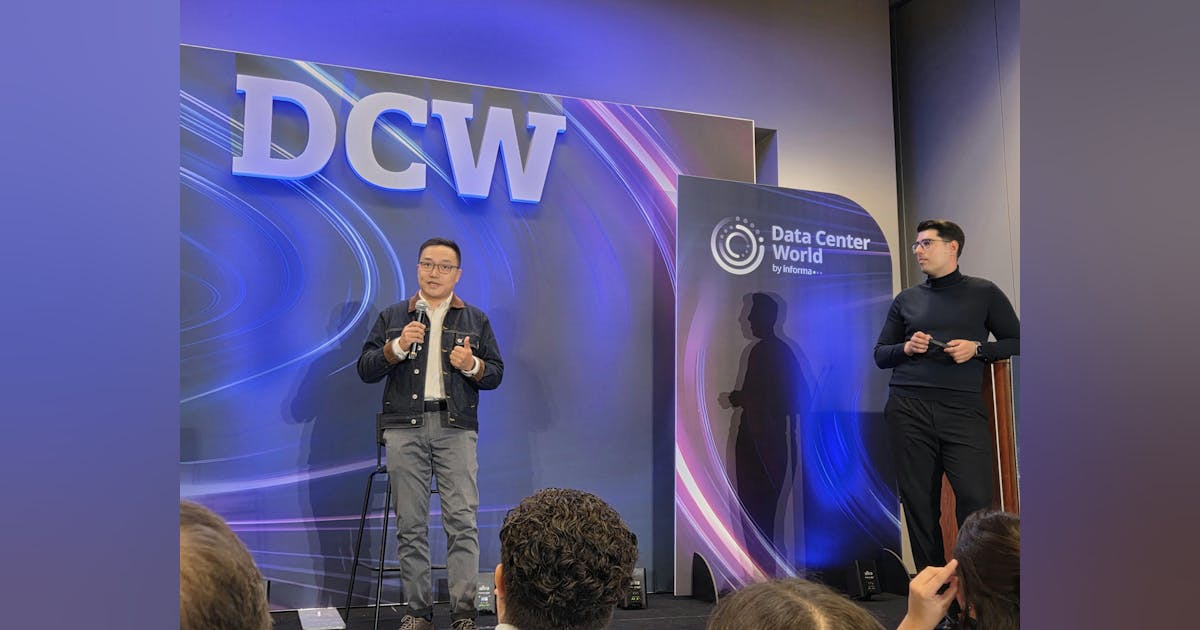
At Data Center World 2026, the industry didn’t need convincing that something fundamental has shifted.
“This feels different,” said Bill Kleyman as he opened a keynote fireside with Phill Lawson-Shanks and Amber Caramella. “In the past 24 months, we’ve seen more evolution… than in the two decades before.”
What followed was less a forecast than a field report from the front lines of the AI infrastructure buildout—where demand is immediate, power is decisive, and execution is everything.
A Different Kind of Growth Cycle
For Caramella, the shift starts with scale—and speed.
“What feels fundamentally different is just the sheer pace and breadth of the demand combined with a real shift in architecture,” she said.
Vacancy rates have collapsed even as capacity expands. AI workloads are not just additive—they are redefining absorption curves across the market.
But the deeper change is behavioral.
“Over 75% of people are using AI in their day-to-day business… and now the conversation is shifting to agentic AI,” Caramella noted.
That shift—from tools to delegated workflows—points to a second wave of infrastructure demand that has not yet fully materialized.
Lawson-Shanks framed the transformation in more structural terms. The industry, he said, has always followed a predictable chain: workload → software → hardware → facility → location.
That chain has broken.
“We had a very predictable industry… prior to Covid. And Covid changed everything,” he said, describing how hyperscale demand compressed deployment cycles overnight.
What followed was a surge that utilities—and supply chains—were not prepared to meet.
From Capacity to Constraint: Power Becomes Strategy
If AI has a gating factor, it is no longer compute.
It is power.
“Before it used to be an operational convenience,” Caramella said. “Now it’s a strategic advantage—or constraint if you don’t have it.”
That shift is reshaping executive decision-making. Power is no longer a downstream consideration—it is the first question.
At Aligned Data Centers, Lawson-Shanks described a structural response: integrating power procurement, site strategy, and community engagement into a single planning function.
“Is there land, is there power, and what is the community sentiment?” he said. “Bringing those three things together is critical.”
For Netrality Data Centers, the discipline is even sharper. Interconnection hubs cannot simply chase density—they must allocate power with precision.
“It’s not just about demand,” Caramella said. “It’s the right customer demand that will grow and scale.”
This is the capital discipline phase of the AI cycle—where underwriting risk, customer profile, and long-term utilization matter as much as megawatts.
Speed to Market Is Now the Product
If power is the constraint, time is the currency.
“The main difference I’m seeing is timing,” Caramella said. “It needs to be real time… speed of delivery is key.”
That urgency is reshaping customer expectations across hyperscale and enterprise segments alike.
Lawson-Shanks pointed to a recent project where a standard design had to be reconfigured mid-build to accommodate next-generation GPU requirements.
“This is no longer an eight-year cycle,” he said. “This is radically different.”
The implication is clear: adaptability is no longer a design feature—it is a survival requirement.
The industry is now bifurcating into two parallel tracks:
- Standardized cloud deployments
- Purpose-built AI infrastructure
Both are growing. But they operate on different timelines, densities, and economic assumptions.
The Enterprise Returns—and the Edge Emerges
One of the more underappreciated dynamics discussed on stage: the enterprise has been left behind.
“The enterprise market… hasn’t been very well served,” Lawson-Shanks said, noting that hyperscale demand has consumed available capacity.
That may be about to change.
A long-deferred enterprise refresh cycle is coming—likely at the edge, closer to users and latency-sensitive applications.
At the same time, the industry is entering what Kleyman framed as “the era of inference”—where AI workloads move from training clusters to distributed deployment.
The result: a new geography of infrastructure.
Edge inference. Modular builds. Retrofit facilities. Containerized deployments.
The AI factory is no longer a single place. It is a network.
The Industry’s Hardest Problem: Community Trust
If power is the constraint and speed is the mandate, community acceptance may be the industry’s most fragile variable.
“There is a massive disconnect right now,” Caramella said.
She pointed to rising opposition—from moratoriums to local backlash—as a growing risk to development timelines.
The takeaway: community friction is no longer anecdotal. It is systemic.
Lawson-Shanks was direct about the industry’s responsibility.
“There are bad actors… we have to acknowledge that we’re not all saints,” he said.
The solution, both executives argued, is earlier and deeper engagement:
- Before permitting
- Before zoning
- Before opposition forms
That includes outreach not just to officials, but to schools, civic groups, and local stakeholders.
“Just keep on being polite and countering with science,” Lawson-Shanks said.
It’s a long game. But increasingly, it’s a prerequisite for growth.
What Changes Next
Looking ahead, both executives pointed to a near-term future defined by clarity—and expansion.
Caramella expects:
- Broader AI adoption
- Widespread use of agentic systems
- Clearer segmentation of workloads
“I think we are all going to have our own agents,” she said.
Lawson-Shanks sees infrastructure following that shift:
- More inference at the edge
- More composable data centers
- Greater integration with grid stabilization strategies
“We can be much more impactful in stabilizing the power requirements,” he said.
Execution Is the New Differentiator
As the session closed, Kleyman offered a line that captured the tone of the conversation—and the moment.
“Vision without execution is just hallucination.”
It was a fitting end.
Because what emerged from this C-suite exchange was not speculation, but a recalibration.
The AI era is no longer about what can be built.
It is about what can be delivered—on time, with power, and with permission.
And that, increasingly, is the real infrastructure challenge.