Stay Ahead, Stay ONMINE

Mars may be a hellhole, but the moon is not far behind

Welcome to the second space race. You can be forgiven for experiencing déjà vu. Last time, it was the Soviet Union and the United States vying to be the first to plant some flags. Now it’s a sprint to the lunar surface between America and China—alongside a host of varyingly friendly and rival nations—plus a cornucopia of private spaceflight companies. And this time it looks like they’re getting ready to set up camp. There will be, the contenders say, bases on the moon, permanently inhabited castles under the stars. The notion of a moon base, fanciful as it might sound, isn’t new. But this year, under the leadership of Administrator Jared Isaacman, NASA has been flooding the zone with bold announcements. If all goes according to plan—a plan that will likely cost tens of billions of dollars to start—there will be drones, robotic landers, communication satellites, and a nuclear power plant; there will be plant terrariums and moonquake sensors; there will be mechanized scouts exploring craters for water. Initial astronaut missions to the lunar surface, which the US is currently planning to start in 2028, will be focused on exploration and technological experimentation. But the idea is that we will—some time in the 2030s—get to a point where there will be habitation quarters for long-term stays, surrounded by a network of scientific research stations, resource mining and processing plants, and landing pads for spaceships. “It’s going to be an expanse,” says Carlos García-Galán, NASA’s moon base program manager—one that will add up to “hundreds of square miles.” The effort is undoubtedly being fueled by nationalistic competition. China has near-identical plans to build its own base on the moon. And being first matters, because the “victor” gets to define the terms. What is the moon, exactly? Is it a militarized outpost? Is it a manufacturing hub? Is it a wilderness to be studied and preserved? But there are also other reasons to go. Earth’s companion contains primeval rocks that hold clues to the formation of the entire solar system. The lunar surface, with virtually no atmosphere in the way, is an ideal place to put telescopes that could examine the most ancient epochs of the cosmos. The far side of the moon would be “a fantastic place to explore the further universe,” says Josef Aschbacher, the European Space Agency’s director general. And it’s way more energy efficient to launch rockets from the low-gravity lunar surface than it is from Earth, meaning sending astronauts—or robotic spacecraft—farther into the solar system will become much less difficult. “The moon is critical. It will be a stepping stone for going further—that means to Mars and beyond,” says Aschbacher. SELMAN DESIGN But if these bold visions are to become reality, there’s a daunting amount of work to be done. A sprawling moon base must be safe for its astronaut inhabitants—protected from falling asteroids, endless cosmic radiation, razor-sharp lunar dust, and torturous temperature swings. It also must be somewhat self-sustaining, so that it can weather changing political fortunes and not cost ruinous amounts of money to maintain. For that, we’ll need to find a way to use the moon’s resources to keep the base operating—and ideally generating revenue. And we’ll need autonomous robots that can build, maintain, and expand the base even when their human masters aren’t present. “It’s almost like starting civilization from scratch,” says Simon Middleburgh, co-director of the Nuclear Futures Institute at Bangor University in Wales. Assuming we can overcome these starting challenges, decades from now—let’s say, by the year 2100—our initial moon bases could grow from barely visible structures into luminous cities, perhaps not too dissimilar from those dreamed up by authors and screenwriters the world over. “It’s like science fiction today that we really want to turn into a reality,” says García-Galán. Will anyone succeed? The moon is a tremendously hostile place to set up camp. In general, daytime temperatures can reach more than 250 °F; at night, they can plummet to less than –200 °F. Exposed to the vacuum of space, the surface is constantly showered in carcinogenic radiation and frequently hit by meteoroids. And its volcanic dust is sticky and corrosive, a destroyer of equipment and choker of lungs.  Sadly, the lunar south pole—the area NASA is targeting—is even harsher. NASA wants to build a base there because its permanently shadowed craters are thought to harbor caches of water ice, which would be more precious than gold. Purify it, and you can water crops and hydrate astronauts; split it into oxygen and hydrogen, and you have breathable air and rocket propellant. But the temperature in those craters can be lower than –410 °F, making them some of the coldest places in the known universe. On the surface outside those pits, astronauts would be bathed in the scorching sun for 14 days before experiencing an equally long frigid night. But there is only so much money we can spend on safety. “What it comes down to is acceptable risk of death,” Philip Metzger, a spaceflight engineering researcher at the Florida Space Institute, said while pondering some of the dangers. “What can we reasonably survive without breaking the bank?” Temperature is one of the easiest problems to handle. Materials science has come a long way, and there are myriad metals, ceramics, plastics, compounds, and alloys that can resist wild temperature swings. Radiators keep things cool; heaters keep batteries from dying prematurely. Astronauts survive just fine too, with their fancy spacesuits—but that technology has proved itself only during brief excursions. It’s not yet clear how long this equipment could operate under such tempestuous conditions. The temperature in the moon’s south pole craters can be lower than –410 °F, making them some of the coldest places in the known universe. Outside those pits, astronauts would be bathed in the scorching sun for 14 days before experiencing an equally long frigid night. Space radiation, which can wreak havoc on electronics and trigger a cancerous division of cells, is far more pernicious. And as Stuart George, a physicist at NASA’s Johnson Space Center in Houston, explains, it comes in two unpleasant forms.  The first is galactic cosmic rays, which rain down on the moon almost constantly. “They’re made by supernovas and neutron star mergers—all these kinds of things,” says George. And because the atomic nuclei, protons, and electrons that make them up are moving at significant fractions of the speed of light, these cosmic rays have oodles of kinetic energy, meaning they can punch through thin shielding (say, a metal wall) with ease. “They also have this habit where the heavier ions are fragmenting in that shielding and making secondary particles,” says George. That means if your shield is too thin, the astronauts behind it will be blasted with a surprisingly large dose of radiation.  Then you have the sun. It may sustain life on Earth, but without our planet’s thick atmosphere and magnetic bubble to get in its way, moonwalkers will occasionally be blasted by one of its paroxysms: a solar flare (a burst of diverse types of radiation) or a coronal mass ejection (volleys of magnetized plasma). “During Apollo, they knew that if a large solar flare occurred while the crew was on the moon, there would be no way to keep them alive,” says Metzger. The crew could have developed acute radiation sickness and perished in a matter of days. The way to survive a powerful solar flare or coronal mass ejection is straightforward: “Get back inside a habitat where there’s more shielding,” says George—preferably a dedicated, highly shielded “storm shelter,” essentially a thick-walled bunker. The issue is that astronauts might be outside the base, driving a rover many miles away. Coronal mass ejections take hours to days to reach the vicinity of the Earth-moon system, but solar flares can do so in under an hour. And scientists can’t yet model the sun well enough to give much advance notice. “All of the capability to forecast solar storms is kind of like where weather forecasting [was] … in the ’50s and ’60s,” says George. As for those punchy galactic cosmic rays, the only way to avoid them would be to put a lot of stuff—lunar rocks, possibly—between the astronauts and the sky. “Build habitat modules underground,” says Chris Dreyer, director of engineering at the Center for Space Resources at the Colorado School of Mines. One option: Burrow living quarters into lava tubes, the naturally hollowed-­out volcanic tunnels created by molten rock eons ago. At this point, NASA hasn’t mentioned any plans to make its moon base subterranean, but it may need to if it wants to end up with a small lunar city. Radiation limits the time astronauts can spend on the lunar surface over their entire life—it can total around two years max, experts estimate, before the health risk becomes too high. Unfortunately, that’s not all space will throw at them. When the Artemis II astronauts swung around the far side of the moon earlier this year, they saw curious flashes light up the silvery land below. These were the explosive deaths of small meteoroids punching into the lunar surface. Earth is naturally protected from smaller space rocks, up to around 50 feet in diameter: They burn up inconsequentially in the atmosphere. “You don’t have that option on the moon,” says Philip Lubin, a physicist and planetary defense researcher at the University of California, Santa Barbara. Since smaller rocks plunge toward planets and moons far more frequently than larger ones do, this means the moon is often peppered by what are effectively tiny space bullets. They could easily puncture a spacesuit or the engine of a moon rover. How do you protect astronauts from the onslaught? “The simplest answer is burial,” says Nicholas Schmerr, a planetary seismologist at the University of Maryland—conveniently, the same way you’d deal with radiation exposure. Pile up moon rocks onto your base walls or put habitable structures in lava tubes.  Inconveniently, there’s always a chance that a bigger asteroid will come along. Even buried habitation modules would have trouble surviving an assault from a 50-footer—about the length of a semi-trailer.  That doesn’t mean a moon base would be helpless against bigger asteroids. Planetary defense has come a long way in just a few decades. NASA’s DART mission demonstrated that it could deflect an asteroid by ramming into the rock with an uncrewed spacecraft, and cutting-­edge experiments at clandestine labs around the US suggest that a nuclear bomb could swat away or entirely vaporize errant space rocks. An array of both ground-based and space-based telescopes specifically designed to spy killers—such as the ATLAS quartet of largely automated telescopes, and the soon-to-be-launched NEO Surveyor infrared telescope—are also aiming to find 90% of the near-Earth asteroids potentially capable of wiping out entire cities (those 460 feet across) in the coming years. All these protections apply to the moon. But asteroids 50 feet across are so stealthy that even NASA’s best telescopes would struggle to see them years or even months in advance. Odds are that they would first be seen not long before they were due to hit the lunar surface. Then what? It’s not unreasonable to imagine several turret-like launch sites on the moon that, owing to the lower gravity and airless environment, could rapidly fire projectiles toward an incoming asteroid. Hit it hard enough and it would break into fragments. Just make sure you shoot when it is as far away as possible: “If you were to break something up into a thousand pieces, then you have a thousand impacts on the moon,” says Lubin. “That might be worse than letting it hit one place.”  Having your base destroyed by an asteroid would be awful. But a moon base is far more likely to be imperiled by dust—which, unlike asteroids, is everywhere, all the time. Volcanic lunar rocks, when broken down, turn into sharp, electrostatically charged, adhesive, acrid, abrasive particles. While on the moon, Apollo astronauts who inhaled some of this dust occasionally suffered from a strange “lunar hay fever,” which irritated their eyes and agitated their lungs. That same dust ate through all kinds of gear with disturbing ease. “It rips up seals, gears, motors, spacesuits, habitats—everything else it comes into contact with,” says Justin Cyrus, the CEO of Lunar Outpost, a spaceflight technology company that is providing NASA with one of the Artemis program’s moon rovers. NASA has already developed a defense against these dark shards: the electrodynamic dust shield, or EDS. The lightweight electrodes that make up this shield—which can be layered on machinery, walls, and perhaps even spacesuits—use opposing currents to blast away the electrically charged dust. The EDS worked wonders when tested in labs on Earth, and it also demonstrated its anti-dust magic when sent to the lunar surface in 2025 as part of a NASA-sponsored robotic mission.  Amy Fritz, a dust-mitigation researcher at Johnson Space Center, says that the EDS will likely be widely featured all over a lunar habitat. But other dust-fighting instruments are being developed too—including a lint-roller-type object inspired by gecko skin and a sci-fi-esque blaster that uses ionized nitrogen gas. Its first spray will neutralize the charge of the dust to remove its stickiness; then a second burst will clear it off the surface. Irritatingly, the busier a base gets, the dustier things will become. As it expands to the size of a small city, rocket ships will need to deliver cargo and crew to the lunar surface on a frequent cadence. Each takeoff and landing will launch a salvo of dust in every direction, inundating the base’s infrastructure. “You have to worry about essentially being sandblasted every time,” says Fritz.  Metzger calculates that even with landing pads more than 3,000 feet away from a base, just 10 to 20 liftoffs or landings would be sufficient to severely damage things like protective coatings on exterior walls and communications equipment. After a while, he says, “everything breaks.”  Even if the moon base of the future is buried partly below ground, barricaded against micrometeorites and space radiation, and well equipped with dust-repelling technologies, it’s still a risky gig for any astronaut. Skipping around in a preternaturally agile way at one-sixth of Earth’s gravity will be entertaining. But “microgravity is not good for the human body,” says Dreyer. Muscle wastage, cardiovascular troubles, respiratory problems, and immune deficiencies can arise.  Radiation, too, may always afflict lunar residents. And there’s also evidence that disease-causing microbes could stealthily sneak aboard spacecraft, even after stringent sterilization procedures. Those microbes may behave differently than they do on Earth; microgravity experiments (both real and simulated) have suggested that some become more aggressive and more likely to cause disease. “We call them the invisible crew,” says Lisa Carnell, the director of NASA’s Biological and Physical Sciences Division. The lunar south pole, which is thought to contain a sizable amount of water, is an attractive target for lunar exploration and, eventually, settlement. This map shows the topography of the region. The South Pole–Aitken basin (blue) is an immense crater studded with smaller craters. The vertical distance from the lowest-lying regions to the surrounding peaks can exceed 15 kilometers, almost twice the height of Mount Everest.NASA/GSFC/MIT Hoping to find a better way to protect astronauts, Carnell spearheaded an experiment called AVATAR (A Virtual Astronaut Tissue Analog Response), which launched aboard the Artemis II mission. It used thumb-drive-size chips, containing cells taken from the heart, lungs, or other parts of the body, that could be switched on to act like miniature organs. Scientists have previously used this organ-on-a-chip technology for purposes like testing out new pharmaceuticals in a highly controlled setting. For Artemis II, Carnell’s crew sent up chips containing bone marrow samples taken from the mission’s four astronauts. Bone marrow makes red and white blood cells, as well as platelets—the sort of stuff that affects almost the entire human body. So seeing how space radiation and microgravity affect it would give Carnell and her team vital insight into how astronauts’ biology might change on the moon. The advantage of organ chips is that you can make them for any astronaut and then send them into space ahead of time to see how that person’s organs will react to spaceflight. Researchers envision that data from such chips will be able to clue medics in to the specific preventive treatments or pharmaceuticals that will help moonbound astronauts on their journey. What is NASA likely to send up sooner rather than later? “Brain organoids,” says Carnell. Yes, she adds—that sounds super weird. But it would be good to know how a real brain might respond to being on the moon for several months before people start living there. Okay. Your vast moon base and its inhabitants are protected—as much as is possible—from the treacherous lunar environment. But astronauts’ time is extremely valuable, and humans are fragile creatures. You can’t make them do all the heavy lifting, which means that whether you’re trying to make a tiny lunar outpost or a small city, you’re going to need a lot of robots. “The buildup of the moon base, in the first years, will pretty much 99% be robotic,” says NASA’s García-Galán. Autonomy will be there right from the start. NASA’s new version of the moon buggy, its Lunar Terrain Vehicle, can be driven by the astronauts riding in it but can also be piloted remotely from Earth (or from elsewhere on the moon). There are visions, too, of adding modular robotic arms, towing vehicles, and cargo movers—all still in the preliminary stages of planning. Over the next few decades, though, we’ll likely want an army of robots to do our bidding: excavators to dig up lunar rocks that could be turned into concrete and bricks, plus other robots to flatten surfaces, dig trenches, create building foundations, pave landing pads, and build up dust-deflecting berms to keep the base from being sandblasted by launches and landings. Even solar panels and wiring can potentially be made from moon rocks—something that the spaceflight company Blue Origin demonstrated in labs on Earth in 2023 using a geologic simulant designed to match the composition of lunar regolith.  Powering this robot army will require considerable energy. Two-week-long nights make solar power an impractical solution. Aside from a cornucopia of high-­capacity, extreme-temperature-resistant batteries, nuclear power is probably the only viable option. A small, car-size nuclear reactor, filled with an almost literal handful of uranium, could power a small village for a decade without needing to be refueled. And although nobody’s yet tested a nuclear reactor on the moon, few doubt that NASA and the US Department of Energy can conjure up a working design—one that perhaps wouldn’t be too different from those aboard nuclear submarines. A moon base in 2100 would probably feature multiple small, autonomously or remotely operated nuclear reactors, which—conveniently—the base-expanding robots could simply plug themselves into to recharge.  But the biggest lunar question mark might be water, which planners want to support the astronauts—and to make fuel to launch things from the lunar surface. A process known as electrolysis, which uses electricity to snap apart molecular bonds, can be used to split water into oxygen and hydrogen, both of which could be used to make rocket fuel. Getting them this way could be far less expensive than sending either all the way from Earth. And as an added bonus, it would provide a source of breathable oxygen.  Orbital data has revealed that there is some amount of water preserved in patches on the lunar south pole, but little is known about how much there actually is, what form it takes, or how easy it will be to extract. Will there be solid sheets of ice here and there, ready for us to excavate? Or will there be scattered ice crystals intermingled among the rocky grains, requiring some more inventive form of extraction? A lot of the moon’s water is thought to be hiding in deep, dark craters on the south pole, where the environment is so extreme that robots may freeze up, tumble over, or lose contact with the base. “To me, that is the biggest hurdle,” says Paul van Susante, principal investigator of the Planetary Surface Technology Development Lab at Michigan Technological University. Van Susante’s lab has been putting various construction robots through their paces in moon-like vacuum chambers filled with moon-like rocks. His team was part of NASA’s recent Break the Ice challenge, which invited engineers to build robots to test different ways to excavate such rocks. Some teams used an electric jackhammer and a scoop, while others used scrapers to peel off layers of the ground. The teams simulated the moon’s weak gravity using a crane to lift and offset the weight of the robots. Progress in this regard is speeding along. “I won’t say that’s solved, but we’ve got a lot of the puzzle pieces,” says van Susante. Mining the water will be just one part of an extensive operation. “When you extract it, it’s not going to be clean. It needs to be purified,” says Jessica Atkin, a space botanist at Texas A&M. The technology to do this already exists and works fine on terra firma. But things in space never go the way you expect. “There’s a water purification system on the International Space Station (ISS), and it is known for getting contaminated with microbes,” she says. SELMAN DESIGN But if you purify the water sufficiently—something that can handily be achieved on Earth but may falter in microgravity, where fluids flow in stranger ways—then your moon base can hit its stride. With an effective water recycling system, an increasingly populous base will never go thirsty—and, just maybe, you’ll have a lunar greenhouse. Several edible plants have been successfully grown aboard the ISS, including lettuce, mustard greens, tomatoes, and peppers. Lunar dust unfortunately makes for a terrible garden: It’s filled with far too much aluminum—and it forms a resistant layer when watered. But Atkin has shown that with the help of fertilizing fungi, chickpeas can grow in soil much like the volcanic stuff found on the moon. Moon base inhabitants of 2100 would be supported largely by prepacked meals sent from Earth. But in time, they would start growing some of their own produce—probably with a good deal of automation for lighting, watering, and maintenance of humidity and other environmental conditions. Aside from chickpeas, there might also be plenty of lunar tomatoes. They’d be desirable not least because they’ve been bioengineered to produce higher levels of compounds called anthocyanins that, according to some studies, might help humans mitigate the cellular damage caused by space radiation. A garden on the moon would do more than just provide food, as recent experiences on the ISS suggest. Carnell says that NASA recently caught the astronauts aboard the space station doing something sneaky. All plants up there are supposed to be confined to their growth chambers. But “we learned that the crew were pirating our leftover soil and bringing their seeds and planting their own little gardens, if you will, and hiding them in their own cabins,” she says.  Conversations were had in the summer of 2026, after which NASA decided to let astronauts grow their own mini-gardens anywhere they wanted. “Some of the astronauts said they thrived better,” says Carnell. Nature, and gardening, has a hugely beneficial psychological effect on those kept in confined quarters hanging above Earth. That will be even truer for those living in lava tunnels under the lunar surface. “That human element is so important,” she says. Nobody is deluded into thinking there isn’t a mountain of technological challenges in the way. Mars may be a hellhole, as the writer Shannon Stirone put it in 2021 in The Atlantic, but the moon isn’t too far behind. It’s an almost comically menacing place to be. Much about it stands in the way of building a safe, self-sustaining, robotically managed base.  NASA wants to put the first nuclear reactor on the moon by 2030. China, partnering with Russia, wants to place its own nuclear power plant up there around 2035. Beyond the first basic habitation module, it will take decades of experimentation and iteration on the lunar surface to get to a working moon base spanning hundreds of square miles. But few doubt that with enough time and tinkering, humanity can prevail. “It’s not an unsolvable problem,” says the University of Maryland’s Schmerr. The chief obstacle, especially in the initial stages of building, may be one of political will. NASA is currently bringing every resource to bear on the project—something that the agency hopes could culminate in a small lunar city by the century’s end. But will that commitment continue over multiple US administrations? Will the international community also throw its weight behind the NASA-led effort? NASA has “a very ambitious plan,” says Yuqi Qian, a lunar geologist at the University of Hong Kong. “We need to keep an eye on it.” In fact, he says, “the current plan looks over-ambitious.” The agency, for example, wants to put the first nuclear reactor on the moon by 2030. (China, partnering with Russia, wants to place its own nuclear power plant up there around 2035.)  “These sorts of projects—although very exciting, and potentially transformative for humankind—are the first ones to be delayed or scrapped,” says Middleburgh of the Nuclear Futures Institute. NASA’s direction tends to change when a new administration comes into power—sometimes dramatically so. But several experts outside of NASA agree that, at least for now, there is definite momentum and political will behind the moon base. “NASA has very clearly expressed where they want to go, what their priorities [are], what their ambition is, and how they want to do it,” says ESA’s Aschbacher. “It was quite impressive to see.” Even if the political will behind the US-led endeavor is maintained over the coming decades, expanding anywhere beyond an initial, compact moon base will require more than government funding. “There has to be a lunar economy for this to be self-sustaining,” says Dreyer, the space resources expert. Perhaps that will come from the production of rocket fuel, or from the mining of valuable materials on the moon that can replace similar, polluting activities on Earth. But it’s not at all clear how valuable, or not, a lunar economy will be.  Even Isaacman, NASA’s chief, doesn’t think the moon will be a major moneymaker. “I don’t know of anything on the moon right now that’s going to be easier and more affordable to mine, manufacture, and then bring back to Earth than what we could make here on Earth,” he remarked back in February. (Instead, he suspects, mining metals from asteroids will be the path to prosperity.)  What if, instead, a moon base earns the right to exist because it’s a place for novel scientific research? Aschbacher imagines it will be like humanity’s outposts in Antarctica. Down there, in what truly feels like another world, scientist-explorers work in a land of gleaming and endless ice to learn more about our planet’s climate, its deep past, and its resilient life-forms. “We understand planet Earth by looking into those remote places,” he says. The moon offers a similar opportunity. What discoveries await astronauts in those primordial lava tubes? What will lunar astronomers see in the night sky—with effectively no atmosphere or light pollution in the way—that those on Earth can’t? As in all spaceflight programs, technologies developed up there will no doubt be tweaked to be used back on Earth. And a base on the moon will make exploring the rest of the solar system easier. Technologically, physiologically, and psychologically, the moon “is a proving ground for the technologies we need for Mars,” says NASA’s García-Galán. If we play the US-China race forward, perhaps the lunar south pole of 2100 will feature several sprawling bases operated by multiple geopolitical rivals. Perhaps it’ll be an off-world powder keg of militarized territorial ambitions and jingoism. But maybe it could instead become an international cathedral to science—and the ultimate adventure destination. “Even if countries on planet Earth have difficulty talking to each other,” says Aschbacher, they might behave differently when it comes to the moon. “I’m pretty sure they will get together and see what we can do together, and see what problems we can solve.” After all, he says, up there, far from home, “you’re so dependent on each other.”  Robin George Andrews is an award-winning science journalist and doctor of volcanoes based in London. He regularly writes about the Earth, space, and planetary sciences and is the author of two critically acclaimed books: Super Volcanoes (2021) and How to Kill an Asteroid (2024).

Welcome to the second space race. You can be forgiven for experiencing déjà vu. Last time, it was the Soviet Union and the United States vying to be the first to plant some flags. Now it’s a sprint to the lunar surface between America and China—alongside a host of varyingly friendly and rival nations—plus a cornucopia of private spaceflight companies. And this time it looks like they’re getting ready to set up camp. There will be, the contenders say, bases on the moon, permanently inhabited castles under the stars.

The notion of a moon base, fanciful as it might sound, isn’t new. But this year, under the leadership of Administrator Jared Isaacman, NASA has been flooding the zone with bold announcements. If all goes according to plan—a plan that will likely cost tens of billions of dollars to start—there will be drones, robotic landers, communication satellites, and a nuclear power plant; there will be plant terrariums and moonquake sensors; there will be mechanized scouts exploring craters for water.

Initial astronaut missions to the lunar surface, which the US is currently planning to start in 2028, will be focused on exploration and technological experimentation. But the idea is that we will—some time in the 2030s—get to a point where there will be habitation quarters for long-term stays, surrounded by a network of scientific research stations, resource mining and processing plants, and landing pads for spaceships. “It’s going to be an expanse,” says Carlos García-Galán, NASA’s moon base program manager—one that will add up to “hundreds of square miles.”

The effort is undoubtedly being fueled by nationalistic competition. China has near-identical plans to build its own base on the moon. And being first matters, because the “victor” gets to define the terms. What is the moon, exactly? Is it a militarized outpost? Is it a manufacturing hub? Is it a wilderness to be studied and preserved?

But there are also other reasons to go. Earth’s companion contains primeval rocks that hold clues to the formation of the entire solar system. The lunar surface, with virtually no atmosphere in the way, is an ideal place to put telescopes that could examine the most ancient epochs of the cosmos. The far side of the moon would be “a fantastic place to explore the further universe,” says Josef Aschbacher, the European Space Agency’s director general. And it’s way more energy efficient to launch rockets from the low-gravity lunar surface than it is from Earth, meaning sending astronauts—or robotic spacecraft—farther into the solar system will become much less difficult. “The moon is critical. It will be a stepping stone for going further—that means to Mars and beyond,” says Aschbacher.
SELMAN DESIGN

But if these bold visions are to become reality, there’s a daunting amount of work to be done. A sprawling moon base must be safe for its astronaut inhabitants—protected from falling asteroids, endless cosmic radiation, razor-sharp lunar dust, and torturous temperature swings. It also must be somewhat self-sustaining, so that it can weather changing political fortunes and not cost ruinous amounts of money to maintain. For that, we’ll need to find a way to use the moon’s resources to keep the base operating—and ideally generating revenue. And we’ll need autonomous robots that can build, maintain, and expand the base even when their human masters aren’t present. “It’s almost like starting civilization from scratch,” says Simon Middleburgh, co-director of the Nuclear Futures Institute at Bangor University in Wales.

Assuming we can overcome these starting challenges, decades from now—let’s say, by the year 2100—our initial moon bases could grow from barely visible structures into luminous cities, perhaps not too dissimilar from those dreamed up by authors and screenwriters the world over. “It’s like science fiction today that we really want to turn into a reality,” says García-Galán. Will anyone succeed?


The moon is a tremendously hostile place to set up camp. In general, daytime temperatures can reach more than 250 °F; at night, they can plummet to less than –200 °F. Exposed to the vacuum of space, the surface is constantly showered in carcinogenic radiation and frequently hit by meteoroids. And its volcanic dust is sticky and corrosive, a destroyer of equipment and choker of lungs. 

Sadly, the lunar south pole—the area NASA is targeting—is even harsher. NASA wants to build a base there because its permanently shadowed craters are thought to harbor caches of water ice, which would be more precious than gold. Purify it, and you can water crops and hydrate astronauts; split it into oxygen and hydrogen, and you have breathable air and rocket propellant. But the temperature in those craters can be lower than –410 °F, making them some of the coldest places in the known universe. On the surface outside those pits, astronauts would be bathed in the scorching sun for 14 days before experiencing an equally long frigid night.

But there is only so much money we can spend on safety. “What it comes down to is acceptable risk of death,” Philip Metzger, a spaceflight engineering researcher at the Florida Space Institute, said while pondering some of the dangers. “What can we reasonably survive without breaking the bank?”

Temperature is one of the easiest problems to handle. Materials science has come a long way, and there are myriad metals, ceramics, plastics, compounds, and alloys that can resist wild temperature swings. Radiators keep things cool; heaters keep batteries from dying prematurely. Astronauts survive just fine too, with their fancy spacesuits—but that technology has proved itself only during brief excursions. It’s not yet clear how long this equipment could operate under such tempestuous conditions.

The temperature in the moon’s south pole craters can be lower than –410 °F, making them some of the coldest places in the known universe.

Outside those pits, astronauts would be bathed in the scorching sun for 14 days before experiencing an equally long frigid night.

Space radiation, which can wreak havoc on electronics and trigger a cancerous division of cells, is far more pernicious. And as Stuart George, a physicist at NASA’s Johnson Space Center in Houston, explains, it comes in two unpleasant forms. 

The first is galactic cosmic rays, which rain down on the moon almost constantly. “They’re made by supernovas and neutron star mergers—all these kinds of things,” says George. And because the atomic nuclei, protons, and electrons that make them up are moving at significant fractions of the speed of light, these cosmic rays have oodles of kinetic energy, meaning they can punch through thin shielding (say, a metal wall) with ease. “They also have this habit where the heavier ions are fragmenting in that shielding and making secondary particles,” says George. That means if your shield is too thin, the astronauts behind it will be blasted with a surprisingly large dose of radiation. 

Then you have the sun. It may sustain life on Earth, but without our planet’s thick atmosphere and magnetic bubble to get in its way, moonwalkers will occasionally be blasted by one of its paroxysms: a solar flare (a burst of diverse types of radiation) or a coronal mass ejection (volleys of magnetized plasma). “During Apollo, they knew that if a large solar flare occurred while the crew was on the moon, there would be no way to keep them alive,” says Metzger. The crew could have developed acute radiation sickness and perished in a matter of days.

The way to survive a powerful solar flare or coronal mass ejection is straightforward: “Get back inside a habitat where there’s more shielding,” says George—preferably a dedicated, highly shielded “storm shelter,” essentially a thick-walled bunker. The issue is that astronauts might be outside the base, driving a rover many miles away. Coronal mass ejections take hours to days to reach the vicinity of the Earth-moon system, but solar flares can do so in under an hour. And scientists can’t yet model the sun well enough to give much advance notice. “All of the capability to forecast solar storms is kind of like where weather forecasting [was] … in the ’50s and ’60s,” says George.

As for those punchy galactic cosmic rays, the only way to avoid them would be to put a lot of stuff—lunar rocks, possibly—between the astronauts and the sky. “Build habitat modules underground,” says Chris Dreyer, director of engineering at the Center for Space Resources at the Colorado School of Mines. One option: Burrow living quarters into lava tubes, the naturally hollowed-­out volcanic tunnels created by molten rock eons ago. At this point, NASA hasn’t mentioned any plans to make its moon base subterranean, but it may need to if it wants to end up with a small lunar city.


Radiation limits the time astronauts can spend on the lunar surface over their entire life—it can total around two years max, experts estimate, before the health risk becomes too high. Unfortunately, that’s not all space will throw at them. When the Artemis II astronauts swung around the far side of the moon earlier this year, they saw curious flashes light up the silvery land below. These were the explosive deaths of small meteoroids punching into the lunar surface.

Earth is naturally protected from smaller space rocks, up to around 50 feet in diameter: They burn up inconsequentially in the atmosphere. “You don’t have that option on the moon,” says Philip Lubin, a physicist and planetary defense researcher at the University of California, Santa Barbara. Since smaller rocks plunge toward planets and moons far more frequently than larger ones do, this means the moon is often peppered by what are effectively tiny space bullets. They could easily puncture a spacesuit or the engine of a moon rover.

How do you protect astronauts from the onslaught? “The simplest answer is burial,” says Nicholas Schmerr, a planetary seismologist at the University of Maryland—conveniently, the same way you’d deal with radiation exposure. Pile up moon rocks onto your base walls or put habitable structures in lava tubes. 

Inconveniently, there’s always a chance that a bigger asteroid will come along. Even buried habitation modules would have trouble surviving an assault from a 50-footer—about the length of a semi-trailer. 

That doesn’t mean a moon base would be helpless against bigger asteroids. Planetary defense has come a long way in just a few decades. NASA’s DART mission demonstrated that it could deflect an asteroid by ramming into the rock with an uncrewed spacecraft, and cutting-­edge experiments at clandestine labs around the US suggest that a nuclear bomb could swat away or entirely vaporize errant space rocks. An array of both ground-based and space-based telescopes specifically designed to spy killers—such as the ATLAS quartet of largely automated telescopes, and the soon-to-be-launched NEO Surveyor infrared telescope—are also aiming to find 90% of the near-Earth asteroids potentially capable of wiping out entire cities (those 460 feet across) in the coming years.

All these protections apply to the moon. But asteroids 50 feet across are so stealthy that even NASA’s best telescopes would struggle to see them years or even months in advance. Odds are that they would first be seen not long before they were due to hit the lunar surface. Then what?

It’s not unreasonable to imagine several turret-like launch sites on the moon that, owing to the lower gravity and airless environment, could rapidly fire projectiles toward an incoming asteroid. Hit it hard enough and it would break into fragments. Just make sure you shoot when it is as far away as possible: “If you were to break something up into a thousand pieces, then you have a thousand impacts on the moon,” says Lubin. “That might be worse than letting it hit one place.” 


Having your base destroyed by an asteroid would be awful. But a moon base is far more likely to be imperiled by dust—which, unlike asteroids, is everywhere, all the time.

Volcanic lunar rocks, when broken down, turn into sharp, electrostatically charged, adhesive, acrid, abrasive particles. While on the moon, Apollo astronauts who inhaled some of this dust occasionally suffered from a strange “lunar hay fever,” which irritated their eyes and agitated their lungs. That same dust ate through all kinds of gear with disturbing ease. “It rips up seals, gears, motors, spacesuits, habitats—everything else it comes into contact with,” says Justin Cyrus, the CEO of Lunar Outpost, a spaceflight technology company that is providing NASA with one of the Artemis program’s moon rovers.

NASA has already developed a defense against these dark shards: the electrodynamic dust shield, or EDS. The lightweight electrodes that make up this shield—which can be layered on machinery, walls, and perhaps even spacesuits—use opposing currents to blast away the electrically charged dust. The EDS worked wonders when tested in labs on Earth, and it also demonstrated its anti-dust magic when sent to the lunar surface in 2025 as part of a NASA-sponsored robotic mission. 

Amy Fritz, a dust-mitigation researcher at Johnson Space Center, says that the EDS will likely be widely featured all over a lunar habitat. But other dust-fighting instruments are being developed too—including a lint-roller-type object inspired by gecko skin and a sci-fi-esque blaster that uses ionized nitrogen gas. Its first spray will neutralize the charge of the dust to remove its stickiness; then a second burst will clear it off the surface.

Irritatingly, the busier a base gets, the dustier things will become. As it expands to the size of a small city, rocket ships will need to deliver cargo and crew to the lunar surface on a frequent cadence. Each takeoff and landing will launch a salvo of dust in every direction, inundating the base’s infrastructure. “You have to worry about essentially being sandblasted every time,” says Fritz. 

Metzger calculates that even with landing pads more than 3,000 feet away from a base, just 10 to 20 liftoffs or landings would be sufficient to severely damage things like protective coatings on exterior walls and communications equipment. After a while, he says, “everything breaks.” 


Even if the moon base of the future is buried partly below ground, barricaded against micrometeorites and space radiation, and well equipped with dust-repelling technologies, it’s still a risky gig for any astronaut. Skipping around in a preternaturally agile way at one-sixth of Earth’s gravity will be entertaining. But “microgravity is not good for the human body,” says Dreyer. Muscle wastage, cardiovascular troubles, respiratory problems, and immune deficiencies can arise. 

Radiation, too, may always afflict lunar residents. And there’s also evidence that disease-causing microbes could stealthily sneak aboard spacecraft, even after stringent sterilization procedures. Those microbes may behave differently than they do on Earth; microgravity experiments (both real and simulated) have suggested that some become more aggressive and more likely to cause disease. “We call them the invisible crew,” says Lisa Carnell, the director of NASA’s Biological and Physical Sciences Division.
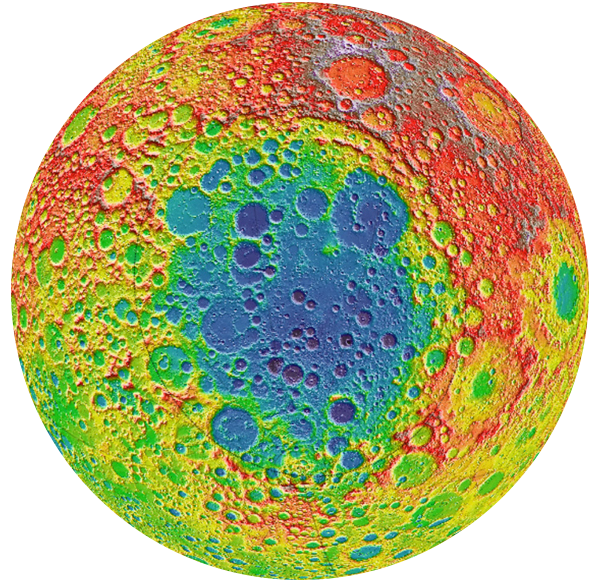
The lunar south pole, which is thought to contain a sizable amount of water, is an attractive target for lunar exploration and, eventually, settlement. This map shows the topography of the region. The South Pole–Aitken basin (blue) is an immense crater studded with smaller craters. The vertical distance from the lowest-lying regions to the surrounding peaks can exceed 15 kilometers, almost twice the height of Mount Everest.
NASA/GSFC/MIT

Hoping to find a better way to protect astronauts, Carnell spearheaded an experiment called AVATAR (A Virtual Astronaut Tissue Analog Response), which launched aboard the Artemis II mission. It used thumb-drive-size chips, containing cells taken from the heart, lungs, or other parts of the body, that could be switched on to act like miniature organs. Scientists have previously used this organ-on-a-chip technology for purposes like testing out new pharmaceuticals in a highly controlled setting. For Artemis II, Carnell’s crew sent up chips containing bone marrow samples taken from the mission’s four astronauts. Bone marrow makes red and white blood cells, as well as platelets—the sort of stuff that affects almost the entire human body. So seeing how space radiation and microgravity affect it would give Carnell and her team vital insight into how astronauts’ biology might change on the moon.

The advantage of organ chips is that you can make them for any astronaut and then send them into space ahead of time to see how that person’s organs will react to spaceflight. Researchers envision that data from such chips will be able to clue medics in to the specific preventive treatments or pharmaceuticals that will help moonbound astronauts on their journey.

What is NASA likely to send up sooner rather than later? “Brain organoids,” says Carnell. Yes, she adds—that sounds super weird. But it would be good to know how a real brain might respond to being on the moon for several months before people start living there.


Okay. Your vast moon base and its inhabitants are protected—as much as is possible—from the treacherous lunar environment. But astronauts’ time is extremely valuable, and humans are fragile creatures. You can’t make them do all the heavy lifting, which means that whether you’re trying to make a tiny lunar outpost or a small city, you’re going to need a lot of robots. “The buildup of the moon base, in the first years, will pretty much 99% be robotic,” says NASA’s García-Galán.

Autonomy will be there right from the start. NASA’s new version of the moon buggy, its Lunar Terrain Vehicle, can be driven by the astronauts riding in it but can also be piloted remotely from Earth (or from elsewhere on the moon). There are visions, too, of adding modular robotic arms, towing vehicles, and cargo movers—all still in the preliminary stages of planning.

Over the next few decades, though, we’ll likely want an army of robots to do our bidding: excavators to dig up lunar rocks that could be turned into concrete and bricks, plus other robots to flatten surfaces, dig trenches, create building foundations, pave landing pads, and build up dust-deflecting berms to keep the base from being sandblasted by launches and landings. Even solar panels and wiring can potentially be made from moon rocks—something that the spaceflight company Blue Origin demonstrated in labs on Earth in 2023 using a geologic simulant designed to match the composition of lunar regolith. 

Powering this robot army will require considerable energy. Two-week-long nights make solar power an impractical solution. Aside from a cornucopia of high-­capacity, extreme-temperature-resistant batteries, nuclear power is probably the only viable option. A small, car-size nuclear reactor, filled with an almost literal handful of uranium, could power a small village for a decade without needing to be refueled. And although nobody’s yet tested a nuclear reactor on the moon, few doubt that NASA and the US Department of Energy can conjure up a working design—one that perhaps wouldn’t be too different from those aboard nuclear submarines. A moon base in 2100 would probably feature multiple small, autonomously or remotely operated nuclear reactors, which—conveniently—the base-expanding robots could simply plug themselves into to recharge. 


But the biggest lunar question mark might be water, which planners want to support the astronauts—and to make fuel to launch things from the lunar surface. A process known as electrolysis, which uses electricity to snap apart molecular bonds, can be used to split water into oxygen and hydrogen, both of which could be used to make rocket fuel. Getting them this way could be far less expensive than sending either all the way from Earth. And as an added bonus, it would provide a source of breathable oxygen. 

Orbital data has revealed that there is some amount of water preserved in patches on the lunar south pole, but little is known about how much there actually is, what form it takes, or how easy it will be to extract. Will there be solid sheets of ice here and there, ready for us to excavate? Or will there be scattered ice crystals intermingled among the rocky grains, requiring some more inventive form of extraction?

A lot of the moon’s water is thought to be hiding in deep, dark craters on the south pole, where the environment is so extreme that robots may freeze up, tumble over, or lose contact with the base. “To me, that is the biggest hurdle,” says Paul van Susante, principal investigator of the Planetary Surface Technology Development Lab at Michigan Technological University.

Van Susante’s lab has been putting various construction robots through their paces in moon-like vacuum chambers filled with moon-like rocks. His team was part of NASA’s recent Break the Ice challenge, which invited engineers to build robots to test different ways to excavate such rocks. Some teams used an electric jackhammer and a scoop, while others used scrapers to peel off layers of the ground. The teams simulated the moon’s weak gravity using a crane to lift and offset the weight of the robots. Progress in this regard is speeding along. “I won’t say that’s solved, but we’ve got a lot of the puzzle pieces,” says van Susante.

Mining the water will be just one part of an extensive operation. “When you extract it, it’s not going to be clean. It needs to be purified,” says Jessica Atkin, a space botanist at Texas A&M. The technology to do this already exists and works fine on terra firma. But things in space never go the way you expect. “There’s a water purification system on the International Space Station (ISS), and it is known for getting contaminated with microbes,” she says.

SELMAN DESIGN

But if you purify the water sufficiently—something that can handily be achieved on Earth but may falter in microgravity, where fluids flow in stranger ways—then your moon base can hit its stride. With an effective water recycling system, an increasingly populous base will never go thirsty—and, just maybe, you’ll have a lunar greenhouse. Several edible plants have been successfully grown aboard the ISS, including lettuce, mustard greens, tomatoes, and peppers. Lunar dust unfortunately makes for a terrible garden: It’s filled with far too much aluminum—and it forms a resistant layer when watered. But Atkin has shown that with the help of fertilizing fungi, chickpeas can grow in soil much like the volcanic stuff found on the moon.

Moon base inhabitants of 2100 would be supported largely by prepacked meals sent from Earth. But in time, they would start growing some of their own produce—probably with a good deal of automation for lighting, watering, and maintenance of humidity and other environmental conditions. Aside from chickpeas, there might also be plenty of lunar tomatoes. They’d be desirable not least because they’ve been bioengineered to produce higher levels of compounds called anthocyanins that, according to some studies, might help humans mitigate the cellular damage caused by space radiation.

A garden on the moon would do more than just provide food, as recent experiences on the ISS suggest. Carnell says that NASA recently caught the astronauts aboard the space station doing something sneaky. All plants up there are supposed to be confined to their growth chambers. But “we learned that the crew were pirating our leftover soil and bringing their seeds and planting their own little gardens, if you will, and hiding them in their own cabins,” she says. 

Conversations were had in the summer of 2026, after which NASA decided to let astronauts grow their own mini-gardens anywhere they wanted. “Some of the astronauts said they thrived better,” says Carnell. Nature, and gardening, has a hugely beneficial psychological effect on those kept in confined quarters hanging above Earth. That will be even truer for those living in lava tunnels under the lunar surface. “That human element is so important,” she says.


Nobody is deluded into thinking there isn’t a mountain of technological challenges in the way. Mars may be a hellhole, as the writer Shannon Stirone put it in 2021 in The Atlantic, but the moon isn’t too far behind. It’s an almost comically menacing place to be. Much about it stands in the way of building a safe, self-sustaining, robotically managed base. 

NASA wants to put the first nuclear reactor on the moon by 2030. China, partnering with Russia, wants to place its own nuclear power plant up there around 2035.

Beyond the first basic habitation module, it will take decades of experimentation and iteration on the lunar surface to get to a working moon base spanning hundreds of square miles. But few doubt that with enough time and tinkering, humanity can prevail. “It’s not an unsolvable problem,” says the University of Maryland’s Schmerr.

The chief obstacle, especially in the initial stages of building, may be one of political will. NASA is currently bringing every resource to bear on the project—something that the agency hopes could culminate in a small lunar city by the century’s end. But will that commitment continue over multiple US administrations? Will the international community also throw its weight behind the NASA-led effort? NASA has “a very ambitious plan,” says Yuqi Qian, a lunar geologist at the University of Hong Kong. “We need to keep an eye on it.” In fact, he says, “the current plan looks over-ambitious.” The agency, for example, wants to put the first nuclear reactor on the moon by 2030. (China, partnering with Russia, wants to place its own nuclear power plant up there around 2035.) 

“These sorts of projects—although very exciting, and potentially transformative for humankind—are the first ones to be delayed or scrapped,” says Middleburgh of the Nuclear Futures Institute. NASA’s direction tends to change when a new administration comes into power—sometimes dramatically so.

But several experts outside of NASA agree that, at least for now, there is definite momentum and political will behind the moon base. “NASA has very clearly expressed where they want to go, what their priorities [are], what their ambition is, and how they want to do it,” says ESA’s Aschbacher. “It was quite impressive to see.”

Even if the political will behind the US-led endeavor is maintained over the coming decades, expanding anywhere beyond an initial, compact moon base will require more than government funding. “There has to be a lunar economy for this to be self-sustaining,” says Dreyer, the space resources expert. Perhaps that will come from the production of rocket fuel, or from the mining of valuable materials on the moon that can replace similar, polluting activities on Earth. But it’s not at all clear how valuable, or not, a lunar economy will be. 

Even Isaacman, NASA’s chief, doesn’t think the moon will be a major moneymaker. “I don’t know of anything on the moon right now that’s going to be easier and more affordable to mine, manufacture, and then bring back to Earth than what we could make here on Earth,” he remarked back in February. (Instead, he suspects, mining metals from asteroids will be the path to prosperity.) 

What if, instead, a moon base earns the right to exist because it’s a place for novel scientific research? Aschbacher imagines it will be like humanity’s outposts in Antarctica. Down there, in what truly feels like another world, scientist-explorers work in a land of gleaming and endless ice to learn more about our planet’s climate, its deep past, and its resilient life-forms. “We understand planet Earth by looking into those remote places,” he says. The moon offers a similar opportunity. What discoveries await astronauts in those primordial lava tubes? What will lunar astronomers see in the night sky—with effectively no atmosphere or light pollution in the way—that those on Earth can’t?

As in all spaceflight programs, technologies developed up there will no doubt be tweaked to be used back on Earth. And a base on the moon will make exploring the rest of the solar system easier. Technologically, physiologically, and psychologically, the moon “is a proving ground for the technologies we need for Mars,” says NASA’s García-Galán.

If we play the US-China race forward, perhaps the lunar south pole of 2100 will feature several sprawling bases operated by multiple geopolitical rivals. Perhaps it’ll be an off-world powder keg of militarized territorial ambitions and jingoism. But maybe it could instead become an international cathedral to science—and the ultimate adventure destination. “Even if countries on planet Earth have difficulty talking to each other,” says Aschbacher, they might behave differently when it comes to the moon. “I’m pretty sure they will get together and see what we can do together, and see what problems we can solve.” After all, he says, up there, far from home, “you’re so dependent on each other.” 

Robin George Andrews is an award-winning science journalist and doctor of volcanoes based in London. He regularly writes about the Earth, space, and planetary sciences and is the author of two critically acclaimed books: Super Volcanoes (2021) and How to Kill an Asteroid (2024).

Shape
Shape
Stay Ahead

Explore More Insights

Stay ahead with more perspectives on cutting-edge power, infrastructure, energy,  bitcoin and AI solutions. Explore these articles to uncover strategies and insights shaping the future of industries.

Shape

F5 scrambles to fix more critical BIG-IP security flaws

CVE-2026-121805: When an iRule that processes client traffic using the PEM:subscriber command is configured on a virtual server, undisclosed requests can cause the Traffic Management Microkernel (TMM) to terminate and may lead to remote code execution (RCE); CVE-2026-120292: When an HTTP profile and an iRule using the MR:message route command

Read More »

Energy Secretary Keeps Critical Generation Available in Mid-Atlantic

WASHINGTON—U.S. Secretary of Energy Chris Wright today issued an emergency order to address critical grid reliability issues facing the mid-Atlantic region of the United States. The order directs PJM Interconnection L.L.C. (PJM), in coordination with Constellation Energy Corporation (Constellation Energy), to ensure Units 3 and 4 of the Eddystone Generating Station in Pennsylvania remain available to operate and to employ economic dispatch to minimize costs for the American people. The units were originally slated to shut down on May 31, 2025.   “The energy sources that perform when you need them most are the most valuable,” said U.S. Secretary of Energy Chris Wright. “President Trump and the Energy Department are committed to keeping critical generation available when demand is highest, reducing the risk of blackouts and ensuring Americans have affordable, reliable, and secure power—regardless of whether the wind is blowing or the sun is shining.”  Secretary Wright first ordered that the two Eddystone Generating Station units remain online past their planned retirement date in a May 30, 2025 emergency order. Subsequent orders were issued later in 2025 and 2026. Keeping these units operational has strengthened energy security in the PJM region, ensuring reliable electricity for American families and businesses. This order is in effect beginning on November 21, 2026, through February 18, 2027. 

Read More »

ExxonMobil takes FID on Angola Block 15 extension project

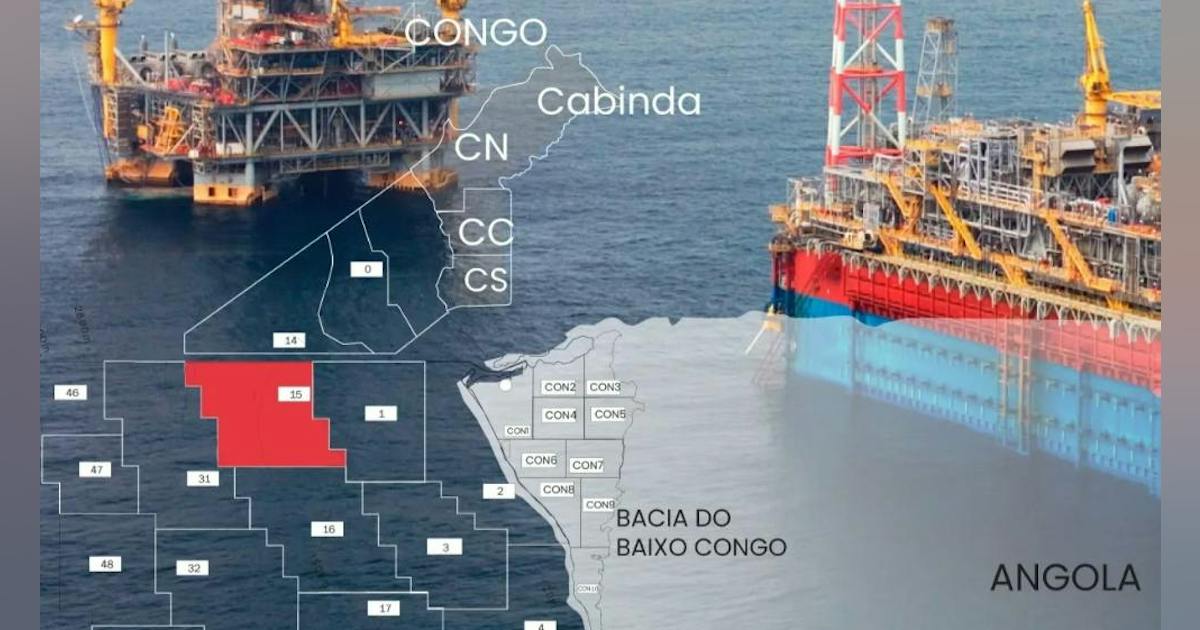
The Block 15 Lifespan Extension Project, about 145 km off Angola’s northern coast, will utilize existing infrastructure to develop additional resources throughout the Kizomba Hub area. The investment decision completes project FIDs following approval of Kizomba C redevelopment in 2025. ANPG also noted a hydrocarbon discovery in the block at the Tchihumba West-01ST1 exploration well, about 350 km northwest of Luanda. The discovery is the 21st in the block and the second this year. The well, drilled by the Valaris DS-9 in about 1,400 m of water, encountered 65.4 m of sandstone reservoir with hydrocarbon presence and good petrophysical properties. ExxonMobil is operator at Block 15 (36%) with partners Azule Energy Exploration (ANG) Ltd. (24%), Azule Energy ANG BV (18%), Equinor Angola (12%), and Sonongol E&P (10%).

Read More »

Market reforms bolster grid, may lower costs this winter: FERC

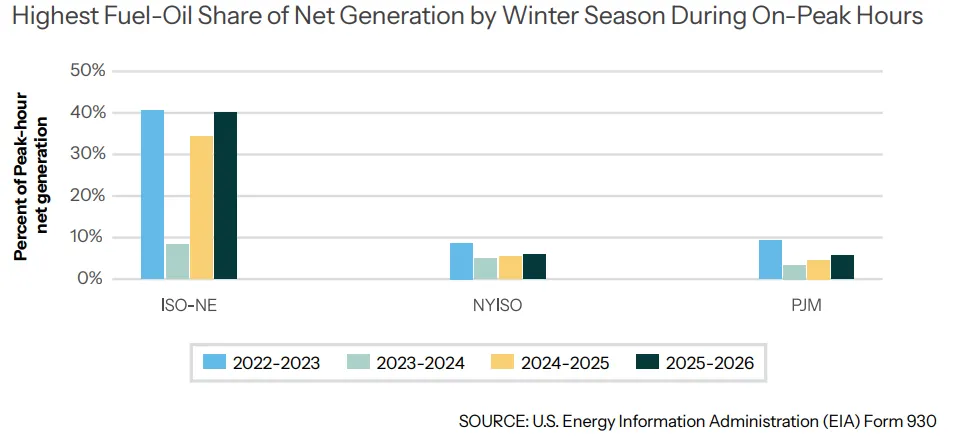
Listen to the article 4 min This audio is auto-generated. Please let us know if you have feedback. Electric market reforms in the West and Northeast may bolster grid reliability and, in some cases, lower costs this winter, according to the Federal Energy Regulatory Commission’s annual winter market and reliability report, released Thursday. Expanded markets help offset drought impacts In the West, the California Independent System Operator launched the Extended Day Ahead Market and the Southwest Power Pool expanded into the Western Interconnection earlier this year. “EDAM and SPP’s expansion should provide ratepayers in much of the West with production cost savings and improved reliability in winter 2026-2027, particularly during cold weather events,” FERC staff said in the report. This winter, the markets’ improved coordination of generation and reduced need for reserve power supplies will help offset lower power output from the Glen Canyon and Hoover dams due to historically low water levels in the Colorado River basin, staff said. “On a day-to-day basis, these conditions can create congestion and affect system operators’ ability to respond to voltage support challenges, event response mitigation needs, or any additional grid stressors,” staff said in the report. About 45% of the continental United States and 95% of the Intermountain West region is in a drought, according to the report. Hydro, oil pose challenges for Northeast In the Northeast, ISO New England lowered its capacity performance pay rate, which should lower electricity prices during emergency conditions or capacity performance events this winter, staff said. Also, the New York Independent System Operator changed its installed capacity market rules to reflect uncertainty about how much power Hydro–Québec will deliver over the 1,250-MW Champlain Hudson Power Express transmission line in the winter, they noted. The U.S. subsidiary of the Canadian utility Hydro-Québec — the primary reservation holder — has an obligation

Read More »

Dangote awards contracts advancing Lekki refining complex expansion

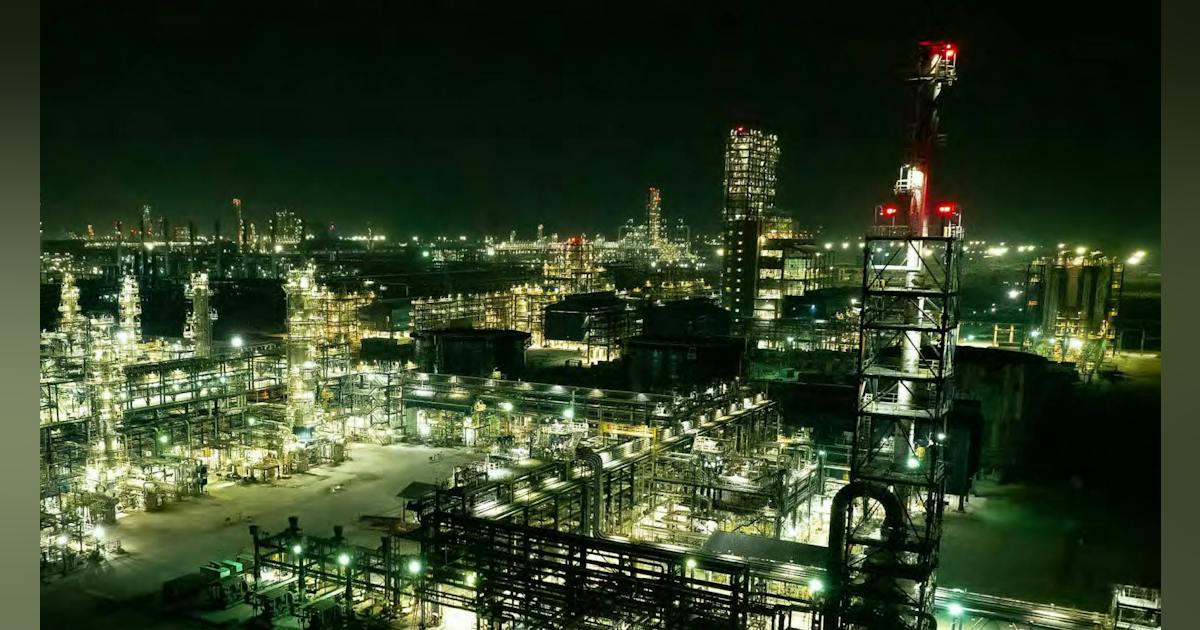
Dangote Group’s Dangote Petroleum Refinery and Petrochemicals FZE (DPRP) has awarded separate contracts to Kirloskar Group of India’s Kirloskar Brothers Ltd. (KBL) and Kirloskar Ebara Pumps Ltd. (KEPL)—a KBL joint venture with Ebara Corp. of Japan—for delivery of engineering services and equipment as part of a phased capacity expansion currently underway at DPRP’s 650,000-b/d refinery and petrochemical complex in the Lekki Free Zone near Lagos, Nigeria. In a Nov. 20 regulatory filing submitted to both BSE Ltd. and The National Stock Exchange of India Ltd., KBL said the combined value of the orders under the contracts amounted to about $38.94 million, $21.34 million of which would cover KEPL’s scope of work, with KBL to retain the remaining $17.60 million as compensation for a leg of the project. The service provider offered no additional details regarding either its own of KEPL’s scope of deliverables under the agreement other than that the work was to include engineering expertise and provision of “specialized pumping solutions for demanding energy applications.” The Lekki complex expansion involves increasing the refinery’s crude processing capacity by an additional 750,000 b/d to 1.4 million b/d in two phases to be executed between 2025-28 and 2028-30, respectively. The proposed expansion also includes plans to increase the site’s production of propylene by 750,000 tonnes/year (tpy), as well as adding 400,000 tpy of fresh production capacity for linear alkylbenzene (LAB).

Read More »

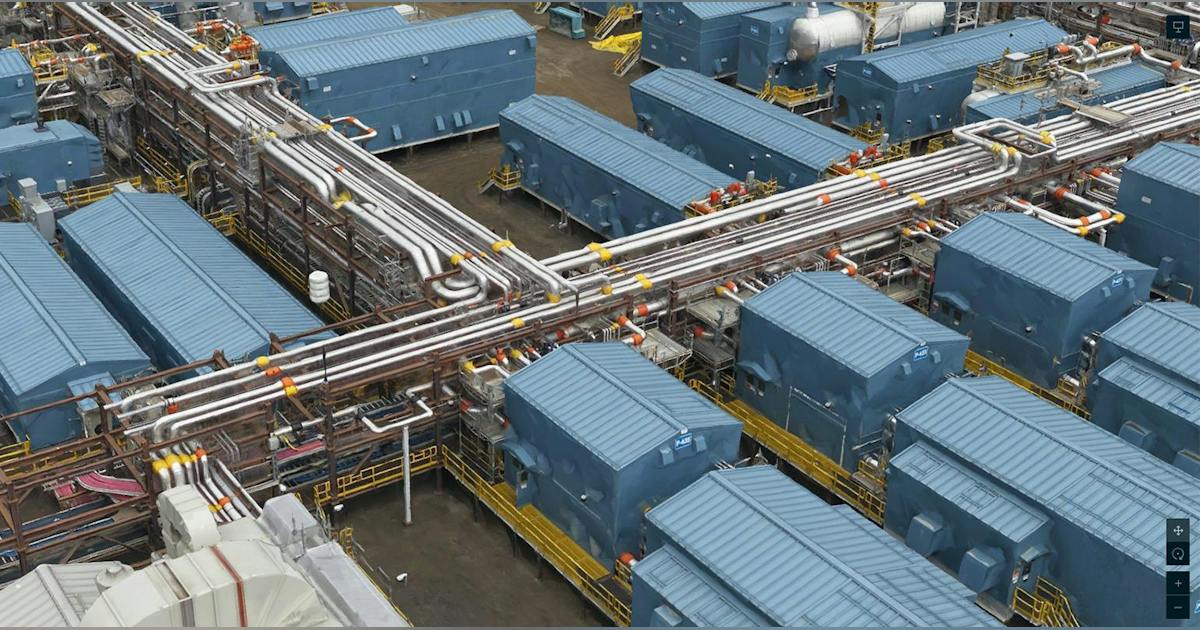
How NV5 Digital Twins Help Oil & Gas Facilities Reduce Downtime and Improve Safety

Refining, midstream, and production operators face increasing pressure to reduce downtime, improve safety, and make faster decisions with increasingly complex asset data. One leading international energy company partnered with NV5 Geospatial to deploy high-fidelity digital twins that unified engineering, inspection, and operational data across multiple facilities. The result: faster planning and approvals, safer operations, fewer travel requirements, and measurable reductions in outage windows.   The Challenge  The company’s refineries and offshore/onshore facilities are high-consequence environments where even brief shutdowns can cost millions per day. Engineering drawings, P&IDs, laser scans, SCADA/IoT feeds, and maintenance systems existed in separate silos making it difficult for staff to access a shared, current view of assets or to plan complex maintenance activities safely and efficiently.   Additionally, the organization sought to reduce field exposure for subject-matter experts (SMEs) by enabling remote collaboration and to improve predictability in outage planning and maintenance “switchovers,” where downtime forecasting directly affects operational revenue.   The Solution  NV5 Digital Twin = Geospatial system of record + automation.  NV5 delivered a scalable, field-to-cloud workflow that fused reality capture, engineering data, and live system integration into a unified, photorealistic 3D environment.   Reality Capture  Rotary-wing acquisition using NV5’s custom multi-sensor pod with RIEGL VUX-240 LiDAR (~300 ppsm) and 150MP nadir + oblique imagery (1″ GSD), flown with 80% side/forward lap for high-fidelity photomesh creation.  NV5 coordinated with local air-traffic control and operated from a nearby hangar to minimize mobilization time.  IS-BAO Stage 3 aviation safety certification and on-staff licensed surveyors ensured quality and compliance.   This level of detail enables operators to virtually inspect assets, plan maintenance activities, and validate engineering decisions without repeated site visits. Processing and Integration  SBET-calibrated LiDAR and imagery were processed into advanced classified point clouds, DEM/DSM surfaces, and textured 3D meshes (delivered OBJ/Esri Scene Layer, and Cesium 3D Tiles 1.1 formats).  Engineering

Read More »

FERC approves Sabine Pass LNG expansion, four other major gas projects

The US Federal Energy Regulatory Commission (FERC) approved 5 gas infrastructure projects Nov. 19, including a nearly 20-million-tonne/year (tpy) expansion of Cheniere Energy’s Sabine Pass LNG export plant in Louisiana, two associated feedgas pipeline projects, and new gas transportation and storage infrastructure in 5 other states. The approvals encompass roughly $3 billion in proposed pipeline and storage investments, excluding construction costs for the Sabine Pass liquefaction expansion. Cheniere estimates the full Sabine Pass Stage V LNG expansion will cost $15 billion, according to a June 2025 filing with the US Department of Energy. Sabine Pass Stage V expansion FERC authorized Cheniere Energy subsidiaries Sabine Pass Liquefaction LLC and Sabine Pass Liquefaction Stage V LLC to construct and operate 3 additional liquefaction trains at the existing Sabine Pass LNG plant in Cameron Parish, La. The expansion would add up to 20 million tpy of LNG production capacity to the existing 30 million tpy 6-train plant.  Phase 1 calls for Train 7, with peak production capacity of about 6 million tpy, and a boil-off gas reliquefaction unit capable of producing about 1 million tpy. Phase 2 would add Trains 8 and 9, each with peak production capacity of 6 mtpa, along with supporting infrastructure and upgrades to marine loading infrastructure.  Cheniere has not yet taken final investment decision, but expects to greenlight Phase 1 by early 2027, subject to regulatory approvals and financing arrangements. The company previously said initial LNG exports could begin in 2030, with commercial service potentially starting in mid-2031. FERC also authorized two pipeline projects to supply additional feedgas to the expanded terminal. The $1.63 billion Sabine Crossing Pipeline project would build 55.6 miles of 48-in. OD pipeline between southeast Texas and Sabine Pass, along with a new 210,000-hp compressor station and related infrastructure. The pipeline would transport up

Read More »

The Data Center Backlash Has a Playbook

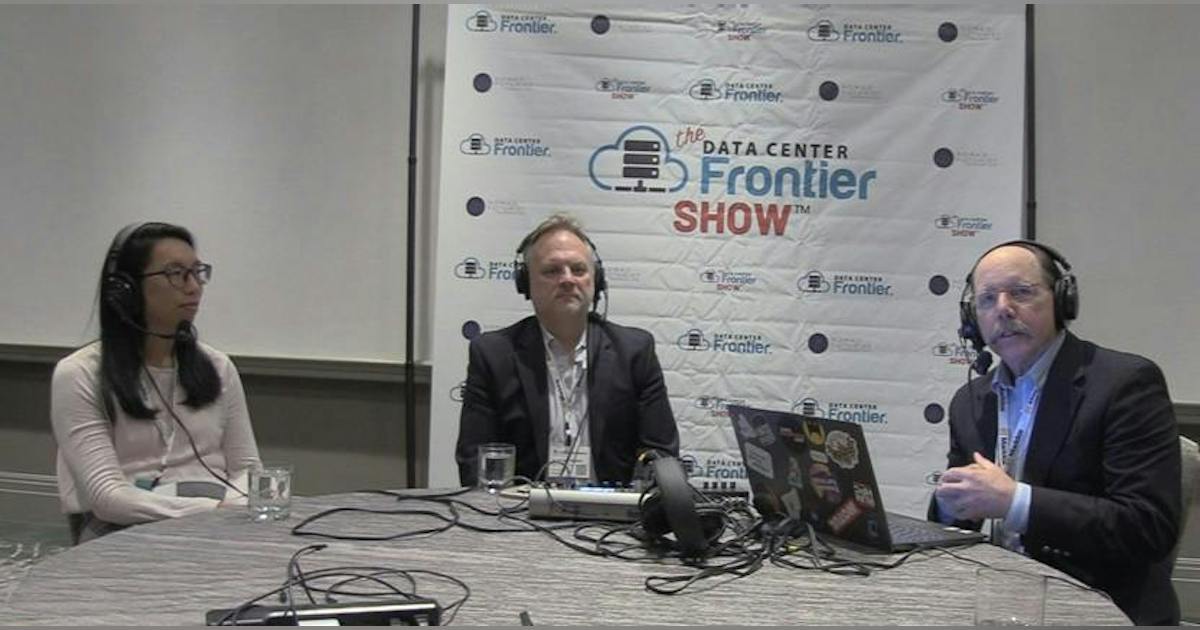
The data center industry’s next development constraint may have less to do with megawatts than with the politics of where those megawatts are deployed. The warning became difficult to ignore on November 3, when American voters approved 33 local ballot measures restricting data center development or expressing opposition to it, according to Ballotpedia’s analysis of the 2026 midterm elections. The results included outright bans, partial prohibitions, temporary moratoriums, and new requirements for community oversight. Voters also rejected 13 measures that would have favored development or expressed support for it. For an industry accustomed to evaluating prospective sites through the availability of power, land, fiber, capital, and construction resources, the election results reinforced another increasingly consequential consideration: whether the communities hosting digital infrastructure are willing to accept its growing physical and economic footprint. As Data Center Frontier recently examined in its post-election assessment of the industry’s political future, the national push to accelerate AI infrastructure construction is colliding with a more complicated political reality at the state and local levels. Opposition crosses party lines, while questions surrounding utility rates, water, environmental impacts, and local economic benefits have moved from planning commission meetings into broader electoral debate. That changing environment was the subject of a conversation recorded at the DCF Trends Summit 2026 in Reston, Virginia, where DCF contributing editor Doug Black sat down with Adam Waitkunas, president of Milldam Public Relations, and Julia Chuang, founder of LocalQ Labs and an associate professor of sociology at the University of Maryland. Their discussion explored a fundamental shift in the development equation: community opposition is becoming more organized and politically consequential, but also more observable through data. The challenge for developers is to understand that risk early enough to influence site selection and project design, while recognizing that public trust cannot be manufactured through

Read More »

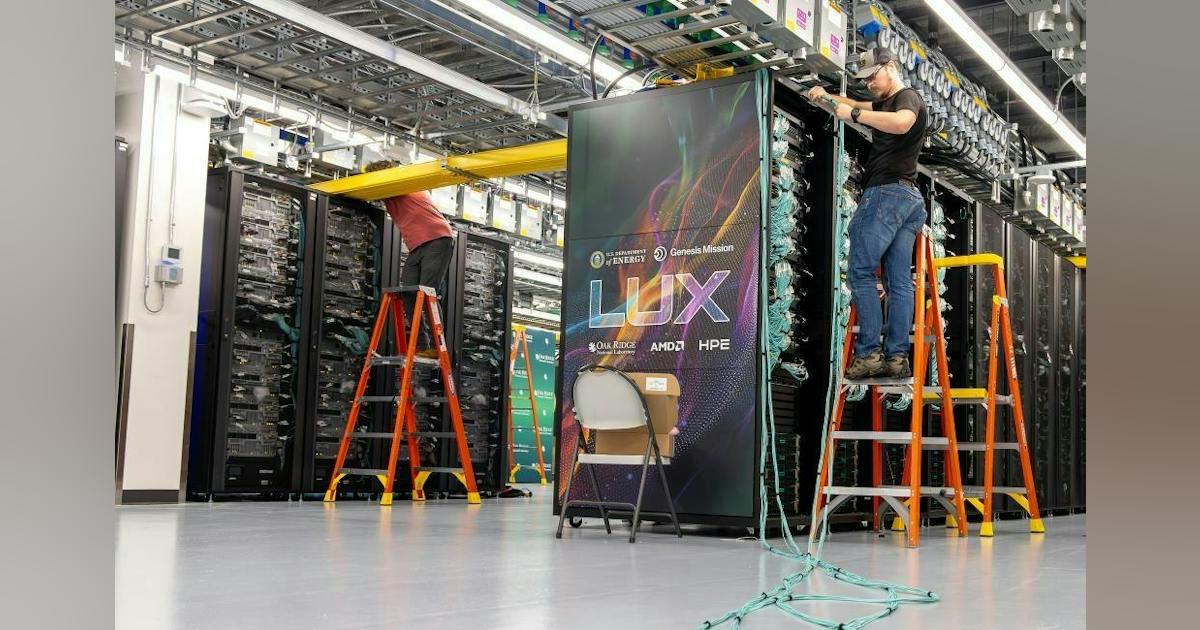
Oak Ridge’s AI Factory Moment: Lux, Nuclear Power, and the Next Data Center Frontier

For much of its history, Oak Ridge has been associated with the Manhattan Project and the subsequent development of America’s nuclear research and production capabilities. Established during World War II, the community became home to major facilities for uranium enrichment, nuclear materials processing, scientific research, and ultimately high-performance computing. Today, that legacy is being repurposed for a new generation of industrial development. The former K-25 uranium enrichment complex, once a critical part of the nation’s atomic weapons program, has been transformed into the East Tennessee Technology Park (ETTP), where extensive environmental cleanup and redevelopment have made former federal property available for commercial use. At an October 27 gathering in Oak Ridge, federal officials and nuclear industry representatives highlighted more than $15 billion in announced nuclear-related projects across the region, an investment wave subsequently documented in a November 17 DOE report on Oak Ridge’s emerging energy hub. The investment figure largely represents planned private-sector development rather than completed capital spending. Regional officials also anticipate demand for thousands of construction workers over the next five years, with additional permanent manufacturing and operating positions potentially following as projects advance. In March, DOE completed its largest Oak Ridge land transfer to date, conveying more than 700 acres for economic reuse. The transfer included a 624-acre parcel designated for Orano USA’s planned uranium enrichment complex and a 77-acre parcel associated with Oklo’s proposed nuclear fuel recycling development. Overall, more than 2,500 acres have been transferred from federal ownership for redevelopment, following decades of cleanup and the demolition of hundreds of former industrial structures. For nuclear developers, the appeal is straightforward: large industrial sites, existing utility and transportation infrastructure, proximity to federal laboratories, and an established community of nuclear engineers, technicians, researchers, and specialized manufacturers. For data center developers, the implications are somewhat different but no

Read More »

Dell and Microsoft drive private AI as enterprises seek greater data control

Dell Technologies and Microsoft are expanding their private cloud partnership with a new set of infrastructure offerings designed to let enterprises run AI models closer to their data, reduce reliance on public cloud services and maintain control over sensitive information. The announcement, made during Microsoft’s Ignite conference, extends Dell’s AI Factory with Nvidia initiative to Dell Private Cloud environments. It also reflects a growing industry push toward internally deployed AI inferencing, particularly among organizations dealing with sensitive corporate information, regulatory requirements and data residency restrictions, Dell stated. The expanded offering combines Dell Private Cloud, Microsoft Azure Local, Microsoft Foundry Local and Nvidia acceleration. The objective is to provide organizations with an integrated infrastructure for deploying heavy AI workloads inside their own data centers and firewalls, the companies said.

Read More »

StarlingX 13.0 updates the network stack for distributed edge deployments

Edge sites do not always come with the network gear that a data center takes for granted. That’s a challenge the open-source StarlingX project from the OpenInfra Foundation is now tackling in its 13.0 update. StarlingX is an open-source distributed cloud platform that combines Linux, Kubernetes, OpenStack, and Ceph. The OpenInfra Foundation hosts the project, and operators including Verizon, Vodafone, T-Systems and KDDI use it for 5G and Open Radio Access Network (O-RAN) infrastructure. Earlier this year, the StarlingX 12.0 update added precision timing capabilities to help networking stay on time. The 13.0 update tackles a different set of issues. Key features include: Gateway API support. Calico-based support is available to hosted applications, while platform services still use Ingress NGINX Optional certificate authority. The Enterprise Java Beans Certificate Authority (EJBCA) runs on the platform and serves certificates to hosted applications. Subcloud restore. A backup restores directly onto a factory-installed node at a subcloud, a remote edge site, with no operating system reinstall. Direct upgrades. Operators can upgrade from two releases back with a single reboot per host. Layer 2 switching. A new Open vSwitch application lets servers at sites with no router next to them bridge traffic and connect directly to aggregation routers. “The OpenvSwitch application adds Layer 2 switching to the K8S platform,” Greg Waines, a senior member of technical staff at Wind River and a StarlingX Technical Steering Committee member, told Network World. “A server can bridge traffic between its SR-IOV network interfaces and other servers, and it can forward traffic to the site routers.”

Read More »

Sovereign AI is about control, not just location

Guetari was open about the term itself being fuzzy. “Sovereignty is very vague and not always clear,” he told me. “It’s about control, auditability, observability.” He drew a line between data locality, meaning the data stays in-country, and sovereignty, which he described as being “more about control, control of what happens to your data and your workload.” He then made the case for why F5 belongs in that conversation: “This is what we have been doing for two decades.” F5 has always sat in the data path, deciding what an application can communicate with, enforcing security rules, and logging what happened. For a regulated bank or government agency, the ability to reconstruct exactly what happened after an incident is worth more than a press release about a data center’s location. The token is the new unit of economics The most interesting part of my conversation with Guetari wasn’t about security. It was about business models. He argued that every successful technology business has found the right unit to monetize. “The cloud is selling the unit of the cloud, which is the CPU core, very well. SaaS is the seat,” he said. “Telcos have been very successful early on using the voice minute, and then they moved to the gigabyte. Sooner or later, that unit will be the token, and most telcos will have to move to the token. And the ones who will not go to token, unfortunately, will be just pipes.”

Read More »

Palo Alto Networks bets $4.5B on enterprise AI with Applied Compute acquisition

GPUs and data centers To train and host those models, Palo Alto plans to build its own compute capacity, CFO Dipak Golechha said on the call. The spending “will mostly go to GPUs and servers,” with a smaller share for the facilities that house them, he said. Palo Alto will “continue to source from our cloud partners” and add dedicated capacity over time, Golechha said. Arora said the company aims for more than100 megawatts of compute in the next three to five years. Gogia said Palo Alto has sovereignty credentials for security data, including customer-held keys and a European Cortex service governed by Deutsche Telekom. “None of that yet extends to GPUs,” he said, adding that a US-headquartered operator faces the same jurisdictional questions as the hyperscalers it rents capacity from. “A sovereign hosting offer with no named region, operator or date is a promise looking for an address,” Gogia said. Compliance officers should ask Palo Alto for a region list, the operator, and a dated certification plan, he said.

Read More »

Microsoft will invest $80B in AI data centers in fiscal 2025

And Microsoft isn’t the only one that is ramping up its investments into AI-enabled data centers. Rival cloud service providers are all investing in either upgrading or opening new data centers to capture a larger chunk of business from developers and users of large language models (LLMs).  In a report published in October 2024, Bloomberg Intelligence estimated that demand for generative AI would push Microsoft, AWS, Google, Oracle, Meta, and Apple would between them devote $200 billion to capex in 2025, up from $110 billion in 2023. Microsoft is one of the biggest spenders, followed closely by Google and AWS, Bloomberg Intelligence said. Its estimate of Microsoft’s capital spending on AI, at $62.4 billion for calendar 2025, is lower than Smith’s claim that the company will invest $80 billion in the fiscal year to June 30, 2025. Both figures, though, are way higher than Microsoft’s 2020 capital expenditure of “just” $17.6 billion. The majority of the increased spending is tied to cloud services and the expansion of AI infrastructure needed to provide compute capacity for OpenAI workloads. Separately, last October Amazon CEO Andy Jassy said his company planned total capex spend of $75 billion in 2024 and even more in 2025, with much of it going to AWS, its cloud computing division.

Read More »

John Deere unveils more autonomous farm machines to address skill labor shortage

Join our daily and weekly newsletters for the latest updates and exclusive content on industry-leading AI coverage. Learn More Self-driving tractors might be the path to self-driving cars. John Deere has revealed a new line of autonomous machines and tech across agriculture, construction and commercial landscaping. The Moline, Illinois-based John Deere has been in business for 187 years, yet it’s been a regular as a non-tech company showing off technology at the big tech trade show in Las Vegas and is back at CES 2025 with more autonomous tractors and other vehicles. This is not something we usually cover, but John Deere has a lot of data that is interesting in the big picture of tech. The message from the company is that there aren’t enough skilled farm laborers to do the work that its customers need. It’s been a challenge for most of the last two decades, said Jahmy Hindman, CTO at John Deere, in a briefing. Much of the tech will come this fall and after that. He noted that the average farmer in the U.S. is over 58 and works 12 to 18 hours a day to grow food for us. And he said the American Farm Bureau Federation estimates there are roughly 2.4 million farm jobs that need to be filled annually; and the agricultural work force continues to shrink. (This is my hint to the anti-immigration crowd). John Deere’s autonomous 9RX Tractor. Farmers can oversee it using an app. While each of these industries experiences their own set of challenges, a commonality across all is skilled labor availability. In construction, about 80% percent of contractors struggle to find skilled labor. And in commercial landscaping, 86% of landscaping business owners can’t find labor to fill open positions, he said. “They have to figure out how to do

Read More »

2025 playbook for enterprise AI success, from agents to evals

Join our daily and weekly newsletters for the latest updates and exclusive content on industry-leading AI coverage. Learn More 2025 is poised to be a pivotal year for enterprise AI. The past year has seen rapid innovation, and this year will see the same. This has made it more critical than ever to revisit your AI strategy to stay competitive and create value for your customers. From scaling AI agents to optimizing costs, here are the five critical areas enterprises should prioritize for their AI strategy this year. 1. Agents: the next generation of automation AI agents are no longer theoretical. In 2025, they’re indispensable tools for enterprises looking to streamline operations and enhance customer interactions. Unlike traditional software, agents powered by large language models (LLMs) can make nuanced decisions, navigate complex multi-step tasks, and integrate seamlessly with tools and APIs. At the start of 2024, agents were not ready for prime time, making frustrating mistakes like hallucinating URLs. They started getting better as frontier large language models themselves improved. “Let me put it this way,” said Sam Witteveen, cofounder of Red Dragon, a company that develops agents for companies, and that recently reviewed the 48 agents it built last year. “Interestingly, the ones that we built at the start of the year, a lot of those worked way better at the end of the year just because the models got better.” Witteveen shared this in the video podcast we filmed to discuss these five big trends in detail. Models are getting better and hallucinating less, and they’re also being trained to do agentic tasks. Another feature that the model providers are researching is a way to use the LLM as a judge, and as models get cheaper (something we’ll cover below), companies can use three or more models to

Read More »

OpenAI’s red teaming innovations define new essentials for security leaders in the AI era

Join our daily and weekly newsletters for the latest updates and exclusive content on industry-leading AI coverage. Learn More OpenAI has taken a more aggressive approach to red teaming than its AI competitors, demonstrating its security teams’ advanced capabilities in two areas: multi-step reinforcement and external red teaming. OpenAI recently released two papers that set a new competitive standard for improving the quality, reliability and safety of AI models in these two techniques and more. The first paper, “OpenAI’s Approach to External Red Teaming for AI Models and Systems,” reports that specialized teams outside the company have proven effective in uncovering vulnerabilities that might otherwise have made it into a released model because in-house testing techniques may have missed them. In the second paper, “Diverse and Effective Red Teaming with Auto-Generated Rewards and Multi-Step Reinforcement Learning,” OpenAI introduces an automated framework that relies on iterative reinforcement learning to generate a broad spectrum of novel, wide-ranging attacks. Going all-in on red teaming pays practical, competitive dividends It’s encouraging to see competitive intensity in red teaming growing among AI companies. When Anthropic released its AI red team guidelines in June of last year, it joined AI providers including Google, Microsoft, Nvidia, OpenAI, and even the U.S.’s National Institute of Standards and Technology (NIST), which all had released red teaming frameworks. Investing heavily in red teaming yields tangible benefits for security leaders in any organization. OpenAI’s paper on external red teaming provides a detailed analysis of how the company strives to create specialized external teams that include cybersecurity and subject matter experts. The goal is to see if knowledgeable external teams can defeat models’ security perimeters and find gaps in their security, biases and controls that prompt-based testing couldn’t find. What makes OpenAI’s recent papers noteworthy is how well they define using human-in-the-middle

Read More »