The 100 kW rack figure places MSI’s offering squarely in the world of AI-era rack densities, where conventional air cooling becomes increasingly difficult or inefficient. The announcement also suggests that MSI is aligning with hyperscale and large cloud design principles, particularly through ORv3 and 48V power distribution. The company is moving from the “we have servers that can be liquid cooled” message, to “we can participate in rack-level AI infrastructure design.”
The EIA air-cooled architecture, by contrast, is designed for more conventional data center environments. MSI says its 19-inch, 48RU EIA air-cooled rack supports standard deployments and can be configured with 16 2U2N multi-node systems, with AMD EPYC 9005 and Intel Xeon 6 platform options.
That split matters because the AI infrastructure market is not moving in one uniform direction. Hyperscalers, neoclouds, and AI factories may move aggressively into ORv3, liquid cooling, busbar power, and rack-scale designs. Enterprise data centers, managed service providers, and colocation customers often need to work within existing 19-inch rack footprints and existing facility constraints. MSI wants to supply both markets.
The CG681-S6093: MSI’s Flagship Liquid-Cooled AI Server
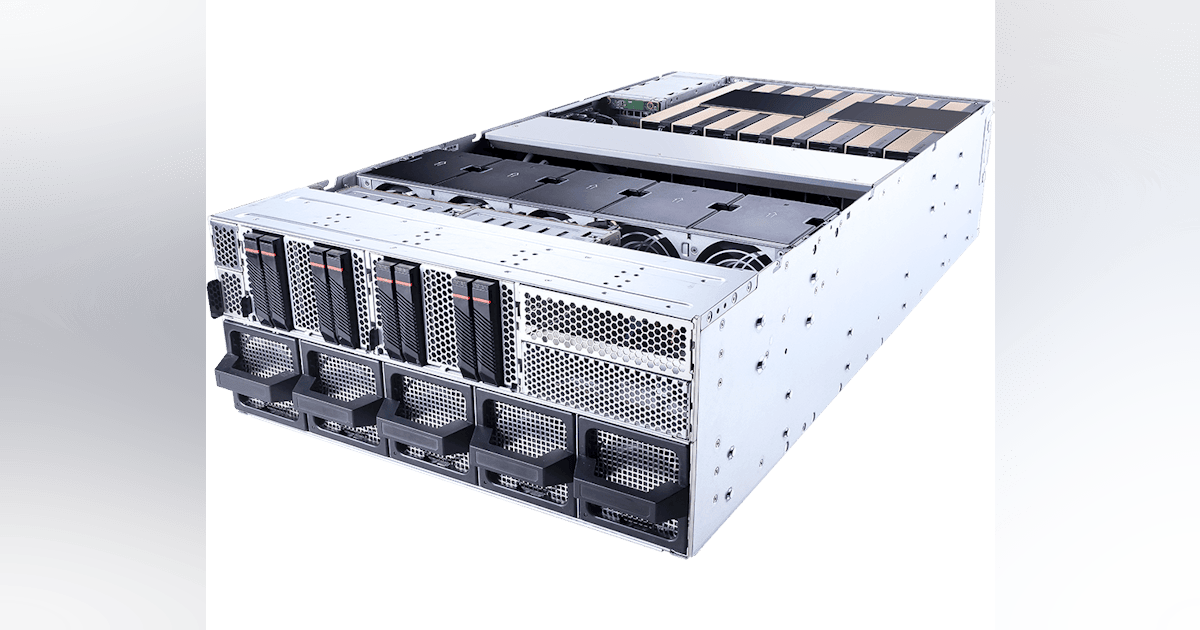
The centerpiece of MSI’s NVIDIA-based AI server announcement is the CG681-S6093, a 6U liquid-cooled AI server based on NVIDIA MGX architecture. MSI says the system supports dual AMD EPYC processors and up to eight NVIDIA RTX PRO 6000 Blackwell Server Edition Liquid Cooled GPUs. It also supports 32 DDR5 DIMMs and NVIDIA ConnectX-8 SuperNICs with up to 8×400Gbps networking.
This system is a direct entry into high-density AI inference, HPC, simulation, graphics, video, and physical AI workloads. The server is not positioned only for frontier model training. Instead, MSI appears to be aiming at the expanding middle of the AI infrastructure market: large inference clusters, visual computing, simulation, industrial AI, scientific computing, and agentic AI workloads.
The next phase of AI data center demand is not only about ever-larger training clusters. It is also about deploying trained models at scale, supporting long-running agents, handling multimodal workloads, and serving enterprise inference demand with acceptable latency and cost. The CG681-S6093’s combination of eight liquid-cooled GPUs and 400GbE networking is designed for distributed AI environments where server-to-server communication becomes a critical performance factor.
MSI also emphasized rack-scale scalability. In its cloud-to-edge announcement, the company said its liquid-cooled rack-scale architecture supports up to four CG681-S6093 GPU systems within a 48RU configuration, with networking anchored by NVIDIA Spectrum-4 SN5600 Ethernet switches and SN2201 out-of-band switches.
That gives the server a role beyond a single box. MSI is effectively packaging compute, thermal design, network fabric, and management infrastructure into a more deployment-ready rack-scale architecture. This aligns with the broader industry movement toward the AI factory: clusters are increasingly designed as integrated systems rather than collections of discrete servers.
NVIDIA frames AI factories as data centers designed to transform raw data into intelligence across the full AI lifecycle. MSI’s use of MGX places it inside that ecosystem and gives customers a path to modular, multi-generation AI server designs rather than one-off platforms.
The 4U and 2U MGX Portfolio: More Than One AI Server
While the 6U liquid-cooled CG681-S6093 is the headline system, MSI’s COMPUTEX 2026 MGX portfolio also included 4U and 2U GPU platforms. MSI says its MGX server portfolio supports NVIDIA H200 NVL, NVIDIA RTX PRO 6000, and NVIDIA RTX PRO 4500 Blackwell Server Edition GPUs across systems designed for AI training, inference, HPC, and data-intensive workloads. The company also says it is extending its collaboration within the NVIDIA MGX ecosystem toward next-generation Vera Rubin rack-scale platforms.
The 4U CG480-S5063 is a dual-socket Intel Xeon 6 platform supporting up to eight double-wide GPUs, 32 DDR5 DIMMs, 20 E1.S NVMe drives, and five additional PCIe 5.0 expansion slots. MSI positions it for storage-rich AI and HPC workloads.
That storage-heavy configuration speaks to a practical challenge in AI infrastructure: not every AI workload is GPU-bound in the same way. Data preprocessing, retrieval-augmented generation, simulation, video pipelines, analytics, and scientific workflows may need substantial local storage and I/O. By offering 20 E1.S NVMe (the Enterprise and Datacenter Standard Form Factor (EDSFF) “1U Short” NVMe drive) bays alongside eight GPUs, MSI is targeting data-intensive AI pipelines where storage architecture can become a limiting factor.
MSI’s AMD-based 4U systems, the CG481-S6053 and CG480-S6053, support AMD EPYC 9005 processors, up to eight double-wide GPUs, 24 DDR5 DIMMs, and eight U.2 NVMe drives. The CG481-S6053 adds up to 8×400G QSFP112 networking through NVIDIA ConnectX-8 SuperNICs, while the CG480-S6053 provides additional PCIe 5.0 expansion slots.
The 2U CG290-S3063 is a more compact single-socket Intel Xeon 6 platform supporting up to four double-wide GPUs, 16 DDR5 DIMMs, and four rear U.2 NVMe drives. MSI positions it for inference, edge AI, and space-constrained data center deployments.
Taken together, the 2U, 4U, and 6U MGX platforms show MSI trying to cover a range of AI deployment densities. The 6U liquid-cooled platform is the high-density flagship. The 4U systems serve multi-GPU AI and HPC workloads where air cooling or mixed configurations may still be viable. The 2U system offers a smaller footprint for inference and edge-adjacent data center use cases.
DC-MHS: MSI’s Bet on Modular Cloud Infrastructure
The announcements also highlight DC-MHS-based Open Compute and Core Compute multi-node platforms. Not losing site of what has been a core customer, MSI continues to develop for the cloud and cluster market by offering both 21-inch Open Compute and 19-inch Core Compute multi-node platforms for hyperscale and cloud data centers. Built on DC-MHS architecture, these systems are intended to support modular platform integration, scalable infrastructure deployment, and simplified platform transitions.
The 21-inch Open Compute portfolio includes air-cooled and liquid-cooled 1OU2N, 2OU2N, and 2OU4N platforms optimized for high-density AI and cloud infrastructure with 48Vdc busbar power distribution. The liquid-cooled CD281-S4051-X4 is a 2OU four-node platform supporting a single AMD EPYC 9005 processor, 12 DDR5 DIMMs, and four E1.S NVMe bays per node. MSI positions it for AI inference and cloud-native infrastructure.
The CD281-S4051-X2 is a 2OU two-node platform with a single AMD EPYC 9005 processor, 12 DDR5 DIMMs, 12 E3.S NVMe bays, and dual FHHL PCIe 5.0 expansion slots per node. MSI positions it for storage-rich cloud and scale-out deployments.
On the 19-inch Core Compute side, MSI lists 2U2N and 2U4N platforms for enterprise and cloud deployments within standard rack environments. These include Intel Xeon 6 and Xeon 6+ systems, with support for up to 288 E-cores in some configurations, as well as AMD EPYC 9005-based platforms.
The Open Compute Project describes the Modular Hardware System effort as including DC-MHS and DC-SCM workstreams, with the workstreams cooperating to advance modular hardware systems. DC -MHS is about moving away from custom, monolithic server designs toward modular, interoperable building blocks.
For cloud and hyperscale operators, modularity can simplify qualification, maintenance, lifecycle management, and platform transitions. For vendors like MSI, DC-MHS offers a way to compete in environments that increasingly value open hardware design, multi-vendor supply chains, and rack-level standardization.
Edge AI: Extending the Data Center Outward
MSI’s second major COMPUTEX 2026 announcement framed the company’s AI roadmap as a “cloud-to-edge ecosystem.” The company said its showcase spans liquid-cooled AI platforms and supercomputers built on NVIDIA MGX, NVIDIA DGX Station, and NVIDIA DGX Spark architectures.
The EdgeXpert AI Supercomputer, built on NVIDIA DGX Spark, is positioned for deploying AI agents and applications at the edge. MSI also highlighted AI agent frameworks, EU Cyber Resilience Act-compliant agentic AI with Galene Elettra, a legal AI suite, smart campus patrol, smart manufacturing and semiconductor inspection, voice AI, driver safety, transportation, and precision agriculture use cases.
For data center operators, the edge piece is relevant because it changes where inference happens. Not every AI workload will be centralized. Some will run in plants, vehicles, campuses, farms, stores, and field environments where latency, bandwidth, data sovereignty, or operational continuity require local execution. That does not eliminate data centers; it changes their role. Central clusters may train models, synchronize data, manage fleets, and run heavier inference, while edge systems handle real-time decision-making.
MSI’s edge portfolio extends the company’s data center narrative outward. The company is describing and building an architecture in which AI moves between centralized compute, deskside development, and real-world execution.
Can MSI meet the challenge?
MSI’s 2026 data center announcements show a company trying to move up the infrastructure value chain. The story is not one server, one GPU, or one rack. It is a portfolio story built around the demands of the AI infrastructure future.
The challenge for MSI is that this market is crowded. Supermicro, Dell, HPE, Lenovo, ASUS, Gigabyte, and others are all chasing AI infrastructure demand. Many of them are also building around NVIDIA platforms, liquid cooling, rack-scale integration, and open modular architectures. MSI will need to prove not only that it can announce competitive systems, but that it can deliver them at scale, support them globally, and integrate them into the complex power, cooling, networking, and software environments that AI data centers now require.
MSI is presenting itself as a supplier for the next phase of AI infrastructure: denser, more modular, more liquid-cooled, more distributed, and more closely tied to the operational edge. For data center buyers, the significance is that MSI is no longer just talking about servers. It is talking about the architecture of AI deployment from rack to desk to field.