Stay Ahead, Stay ONMINE

NVIDIA’s DSX Ready Brings Power and Cooling Into the AI Factory Blueprint

NVIDIA is extending its influence over AI infrastructure beyond the GPU, server rack and network, introducing qualification requirements for the power and cooling systems that increasingly determine the scale and performance of AI data centers. The company’s new NVIDIA DSX Ready program, announced September 21, establishes requirements for specific infrastructure products intended for use with […]

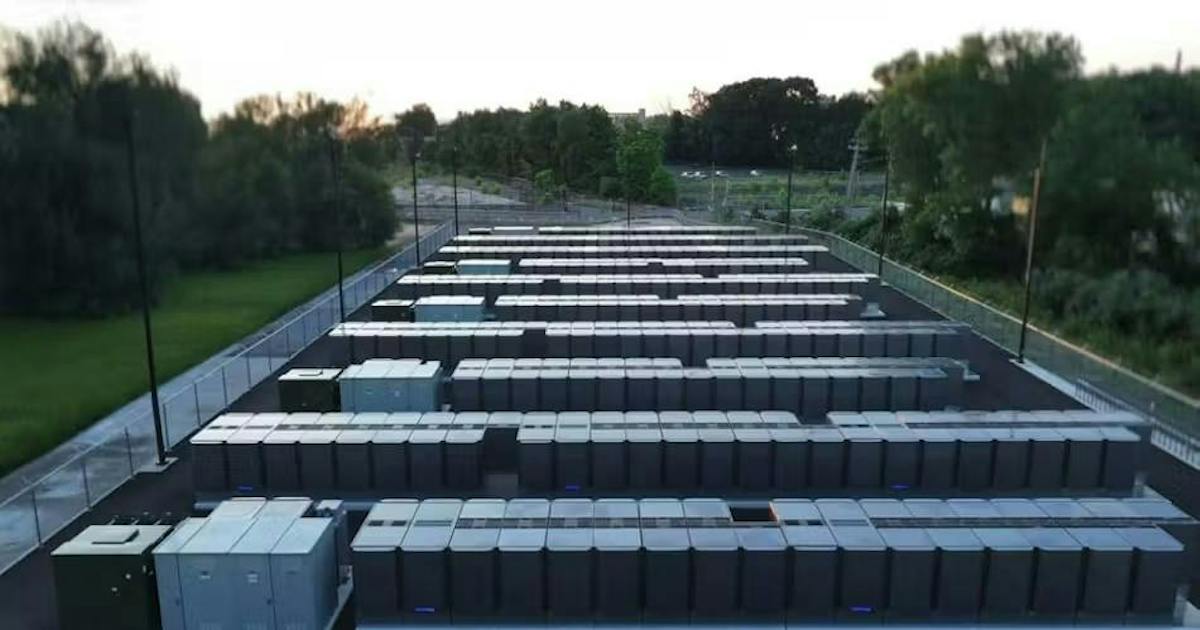
NVIDIA is extending its influence over AI infrastructure beyond the GPU, server rack and network, introducing qualification requirements for the power and cooling systems that increasingly determine the scale and performance of AI data centers.

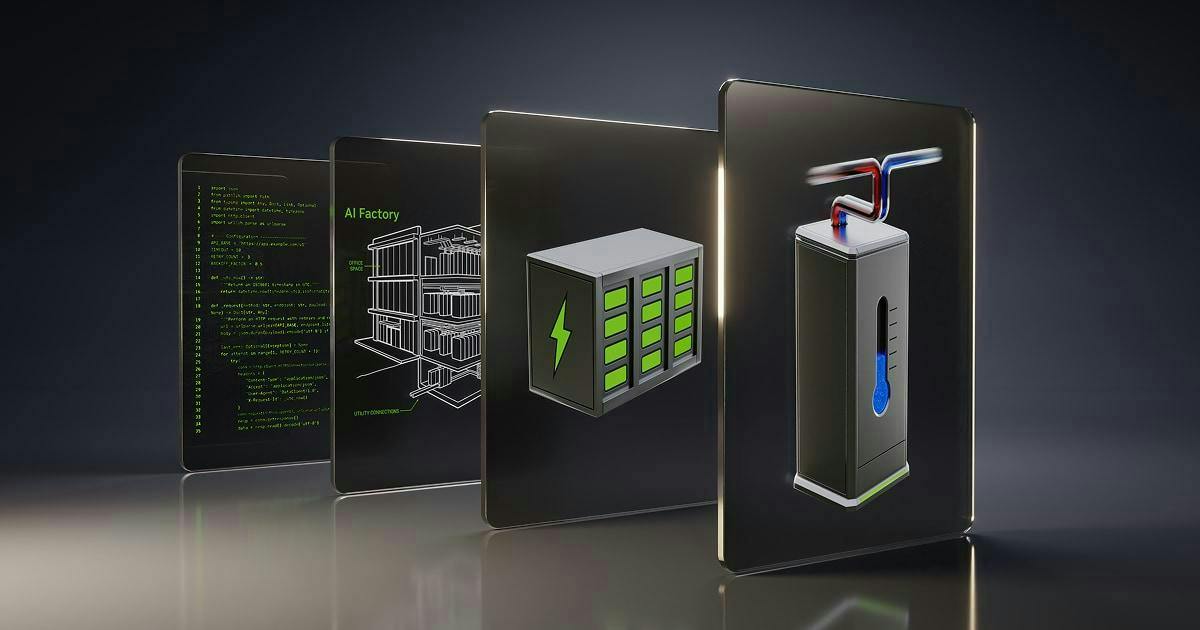
The company’s new NVIDIA DSX Ready program, announced September 21, establishes requirements for specific infrastructure products intended for use with NVIDIA’s DSX AI factory reference designs. Its first two categories—battery energy storage systems (BESS) and coolant distribution units (CDUs)—address two of the most pressing engineering challenges in AI infrastructure: managing rapidly changing electrical demand and removing heat from increasingly dense computing systems.

The initial qualified suppliers are Hitachi Energy, LG Energy Solution and Tesla for battery storage, and LG Electronics, LiquidStack and Vertiv for liquid cooling.

While the announcement might initially resemble another NVIDIA partner program, its technical details suggest something more consequential. The company is establishing performance criteria for the electrical and mechanical equipment supporting its computing platforms, connecting those requirements to an expanding ecosystem of qualified suppliers.

Subsequent partner announcements offer a clearer view of what that means in practice. They describe battery systems designed to respond to AI load fluctuations, coolant distribution equipment operating at multi-megawatt capacities, and integrated cooling architectures intended to make more of a data center’s available power usable for computing.

The initiative also coincides with the arrival of Chris Malone, formerly a data center infrastructure executive at OpenAI, Meta and Google, as NVIDIA’s vice president of the DSX Platform.

Together, the developments point toward a closer relationship between computing architecture and facility engineering, with NVIDIA seeking to influence not only the processors deployed in AI factories but the infrastructure requirements that support their operation.

From Reference Design to Infrastructure Qualification

DSX Ready is an extension of the broader NVIDIA DSX AI Factory Platform, introduced in May 2026.

As Data Center Frontier reported in September, NVIDIA had already been extending DSX into site development, electrical systems and thermal management through partnerships with Lancium, Cloverleaf, Eaton and Trane. DSX Ready adds a product-level qualification mechanism to that broader infrastructure strategy.

DSX combines reference designs, digital twins and operational software to help developers coordinate computing, networking, power, cooling and facility infrastructure. Using NVIDIA Omniverse technologies, the platform is intended to model interactions between physical and digital systems and support more integrated approaches to AI factory design and operation.

The emphasis reflects the changing economics of large-scale AI infrastructure. To wit: An AI factory’s productive capacity is constrained not simply by the number of GPUs installed, but by the power available to operate them, the ability to remove the heat they generate, and the reliability of the supporting infrastructure.

NVIDIA increasingly describes this relationship in terms of computing output per unit of power. Within a fixed electrical envelope, improvements in facility efficiency can potentially make additional capacity available for revenue-producing AI workloads.

DSX Ready connects that broader architecture to identifiable products. Rather than providing only reference designs that engineers must translate into equipment specifications, the program establishes category-specific requirements against which suppliers can qualify particular offerings.

This does not mean NVIDIA is certifying complete facilities. Qualification applies to defined products and technical boundaries, while developers remain responsible for site-level design, integration and commissioning.

Nevertheless, the program introduces a new consideration into infrastructure procurement: whether a battery system or CDU has demonstrated compliance with the performance requirements of an NVIDIA AI factory reference architecture.

For suppliers seeking business in large AI deployments, that qualification could become an increasingly relevant credential.

Why NVIDIA Is Looking Beyond Battery Capacity

Of the two initial categories, battery energy storage offers perhaps the clearest example of how AI computing requirements are changing facility infrastructure.

Data center power architectures have historically emphasized utility reliability, uninterruptible power supplies and standby generation. Large battery energy storage systems are now being considered for additional functions, including grid support, energy management and the management of dynamic electrical loads. AI computing makes those capabilities more relevant.

The shift was already evident in DCF’s reporting from Data Centre West 2026, where Tesla’s Sean Jones described AI training loads falling from full demand to approximately 30% in less than a second. Such abrupt changes illustrate why power quality and fast-response energy storage are becoming central to AI facility planning.

At sufficient scale, those fluctuations can affect power conversion equipment, onsite generation and the facility’s relationship with the utility grid. Battery storage can potentially absorb or supply power quickly enough to help manage those variations. But the ability to do so depends as much on power electronics and control behavior as on the amount of energy stored.

That distinction is central to NVIDIA’s BESS qualification guidelines. The company has established twelve tests covering electrical stability, dynamic response, operating transitions and control-system performance. The requirements go considerably beyond conventional measures of battery capacity and discharge duration.

They include telemetry verification, voltage and frequency regulation, current-limit behavior, AI workload buffering, demand-response dispatch, voltage ride-through, grid-to-island transitions, generator coordination, black-start capability, energy management and control-system transparency.

One of the more revealing requirements is the AI buffering test. NVIDIA specifies that a BESS must demonstrate its ability to follow representative AI workload power ramps under both strong-grid and weak-grid conditions. The test requires steady-state tracking error of no more than 2% of the commanded ramp magnitude, without sustained oscillations or unacceptable current-limiting behavior.

The qualification also requires electromagnetic transient modeling to evaluate control stability under particularly challenging grid conditions, including scenarios involving low short-circuit ratios, changing electrical impedance and disturbances associated with partially islanded systems.

Another test evaluates whether the system can manage competing demands over a simulated 24-hour operating period, balancing AI load buffering, demand response and reserves for electrical disturbances. The BESS must demonstrate that its state of charge remains controlled while performing those different functions. Simply increasing battery capacity is not sufficient to satisfy the requirement; the energy management system must show how it maintains reserves and prioritizes competing demands.

These are not simply tests of how much energy a battery can deliver. They address whether the power conversion system can behave predictably as part of a complex electrical network serving dynamic computing workloads. That engineering challenge was also explored in a recent Data Center Frontier Show interview with ON.energy’s Asser Elsamahy, who described using medium-voltage battery systems and dual-inverter architectures to decouple rapidly changing AI loads from the electrical profile presented to the grid.

ON.energy’s double-conversion architecture differs from the parallel BESS configurations addressed by NVIDIA’s qualification program. Nevertheless, both approaches reflect the growing importance of controlling the interaction between dynamic computing loads and the wider power system.

Importantly, NVIDIA defines the BESS qualification boundary at the AC terminals, including the power conversion system. Battery chemistry and sizing are outside the scope, as are campus transformers, switchgear, generators and other site-level integration elements.

NVIDIA characterizes its BESS requirements as addressing a gap in existing standards governing power conversion system behavior. The company is not attempting to replace established electrical safety, fire protection or interconnection requirements.

Instead, its qualification focuses on how battery power conversion systems respond to the particular operating conditions associated with large AI computing loads—an area in which conventional equipment specifications may not fully capture the demands of the application.

Passing qualification therefore does not demonstrate that an entire data center will operate stably under every electrical condition. What it does establish is a more rigorous basis for evaluating battery system behavior against the requirements NVIDIA considers important for AI factories.

Hitachi Energy, LG Energy Solution and Tesla Enter the Qualified BESS Ecosystem

The three initial BESS suppliers bring different capabilities and market positions to the program.

Hitachi Energy’s qualified offering emphasizes the integration of energy storage, power conversion, automation and controls. The company identifies dynamic load management, power stability and coordination with grid requirements as important capabilities for AI infrastructure. Its broader experience in utility systems and power quality is particularly relevant as data center developers seek larger utility connections and increasingly consider onsite energy resources.

Marco Berardi, head of Grid & Power Quality Solutions and Service at Hitachi Energy, said AI factory customers need electrical systems that can be deployed and expanded quickly while maintaining reliability and resilience. The company’s qualified solution incorporates Hitachi Energy power converters and power plant control capabilities, connecting the battery system’s electrical performance to the wider operational requirements of AI facilities.

LG Energy Solution’s qualified AC-coupled battery system uses modular 2.5 MW / 5.1 MWh storage blocks. The company identifies grid-forming capability, fast response, voltage ride-through and AI load smoothing among the system’s features.

LG also points to its expanding North American manufacturing footprint, including plans for more than 50 GWh of lithium iron phosphate battery cell production capacity by the end of 2026. The manufacturing capacity is not dedicated exclusively to data centers, but the announcement illustrates how suppliers are positioning established energy storage technologies for the growing AI infrastructure market.

Chang Beom Kang, head of LG Energy Solution’s ESS Battery Division, described the DSX Ready qualification as validation of the company’s BESS technology and its suitability for emerging AI power applications.

Tesla rounds out the inaugural group of qualified battery suppliers. Its participation places a major utility-scale energy storage provider alongside established electrical infrastructure manufacturers in NVIDIA’s qualification ecosystem.

Tesla’s Megapack technology is already associated with large-scale storage installations supporting utilities, renewable energy projects and commercial power applications. However, NVIDIA’s initial announcement does not identify the precise Tesla product configuration qualified under DSX Ready.

Even so, the inclusion of all three companies highlights a potentially significant market development: battery systems are being evaluated as active elements of AI factory electrical architecture, not merely as sources of stored energy. For developers considering hundreds of megawatts of computing capacity, that distinction could become increasingly important.

Liquid Cooling Becomes Part of the AI Factory Specification

On the thermal side, DSX Ready begins with coolant distribution units, the equipment that helps manage liquid coolant circulation and heat transfer between computing systems and facility cooling infrastructure.

CDUs have become increasingly important as high-density AI servers place greater demands on traditional air cooling. Direct-to-chip liquid cooling requires coordination among server hardware, coolant flow rates, temperature requirements, pumps, heat exchangers, piping and the facility’s broader heat rejection systems. As rack densities increase, an improperly matched cooling system can constrain computing performance regardless of the available electrical capacity.

NVIDIA’s CDU qualification program establishes functional requirements for products intended to support its reference designs. Unlike the BESS process, which requires suppliers to provide test evidence for NVIDIA review and approval, the CDU process uses a self-qualification suite to determine whether an offering meets the applicable requirements. The three initial suppliers illustrate the range of megawatt-scale liquid cooling equipment entering the market.

Vertiv announced that its 2.3 MW CoolChip CDU had qualified as NVIDIA DSX Ready, identifying the product as the first CDU qualified specifically under the program. Designed for high-density liquid cooling applications, the system can support deployment at the end of a row or around the perimeter of a data hall.

“The scale of AI deployment is forcing a more integrated approach to data center infrastructure,” said Scott Armul, Vertiv’s chief product and technology officer. Armul argued that computing, electrical power and cooling decisions can no longer be considered independently, because constraints in any one of those systems can limit an entire facility’s productive capacity.

LG Electronics qualified its 2.6 MW CDU, extending a liquid cooling portfolio that includes 600 kW and 1 MW systems with earlier NVIDIA infrastructure qualifications. The 2.6 MW system met the additional requirements for DSX Ready status. The company is pursuing a broader “Chip-to-Chiller” strategy connecting liquid cooling equipment with the chillers and other thermal infrastructure needed to support large data center environments.

A subsequent September 28 announcement identified LG Electronics as an NVIDIA Preferred Partner for Power and Cooling Solutions and outlined plans to pursue qualification for a 4 MW CDU by the end of 2026. The involvement of LG Electronics alongside LG Energy Solution also means separate companies within the LG group have qualified offerings in both of DSX Ready’s inaugural infrastructure categories.

LiquidStack, meanwhile, brings a different scale of cooling architecture through its GigaModular CDU platform.

The GigaModular system, which has also received DSX Ready qualification, supports scalable cooling capacity up to 14 MW. Its modular approach is intended to help operators expand centralized liquid cooling capacity as computing deployments grow.

The platform incorporates centralized controls and modular capacity expansion options designed for large AI factory and hyperscale environments.

The range of these qualified products is significant. Rather than prescribing a single cooling system size or deployment model, NVIDIA’s initial program encompasses equipment supporting different approaches to distributing cooling capacity across AI facilities.

Their qualification does not establish that the products are interchangeable, nor does it eliminate the need to match equipment to actual rack loads, facility systems and operating conditions. It does, however, create a common qualification framework connecting those products to NVIDIA’s AI factory requirements.

Trane Pushes DSX From Components Into 250 MW Cooling Architectures

A subsequent announcement from Trane Technologies provides a broader illustration of how NVIDIA’s reference design strategy is influencing facility-level engineering. On September 28, Trane introduced two 250 MW AI factory thermal management reference designs based on the DSX platform.

The designs incorporate technology from LiquidStack and Stellar Energy, two companies acquired by Trane, and are intended to provide high-efficiency cooling with zero operational water consumption for cooling, as described by the company.

Both include LiquidStack’s qualified GigaModular CDU platform, connecting a DSX Ready component to a larger cooling plant architecture.

The first design, Reference Design #506, combines direct-to-chip cooling with Trane Ascend ACR air-cooled chillers featuring integrated free cooling. Trane projects that the configuration could improve cooling efficiency by up to 25% and make as much as 22 MW of additional electrical capacity available for computing. The company also estimates an improvement in annualized partial power usage effectiveness from 1.201 to 1.083.

The second architecture, Reference Design #507, incorporates factory-built Stellar Energy modular cooling plants with water-cooled chillers, dry fluid coolers and separate temperature loops. Trane projects a reduction in chiller power requirements of up to 16%, potentially making another 8 MW available for AI workloads.

For a temperate climate such as Chicago, the company estimates that integrated waterside economizers could provide full free cooling during more than 98% of annual operating hours.

The second design uses closed-loop dry cooling for heat rejection, allowing Trane to characterize the architecture as achieving zero operational water usage effectiveness. That should not be confused with eliminating water requirements throughout the full construction, manufacturing or operating lifecycle of an AI data center.

These performance figures represent Trane’s design projections, not independently verified results from operating facilities. Actual performance would depend on climate, system configuration and the conditions under which the equipment operates.

Nevertheless, the announcements provide a concrete example of the larger objective behind DSX: coordinating computing and facility infrastructure to increase useful AI output within a limited power envelope.

The importance of reclaiming electrical capacity should not be underestimated. At a large AI campus, the energy consumed by chillers, pumps and other mechanical systems directly affects the power available for computing, particularly where utility service cannot be expanded quickly.

Reducing the electrical overhead of cooling can therefore be more than an operating-cost improvement. Under the right conditions, it can expand the productive computing capacity of a facility without requiring a corresponding increase in utility supply.

For developers confronting long interconnection timelines and significant power constraints, that possibility helps explain the emphasis on integrated thermal design.

What Qualification Means for Procurement—and What It Doesn’t

DSX Ready introduces a potentially important new consideration for data center equipment selection. Infrastructure manufacturers have long qualified products against industry standards, safety requirements and customer-specific engineering specifications. NVIDIA is adding another layer: qualification against the functional requirements of its own AI factory reference architecture.

If DSX-based designs become widely adopted, these qualifications could influence which products developers and engineering firms evaluate during procurement. Suppliers may increasingly use DSX Ready status to demonstrate that particular offerings have been tested against the operating requirements of NVIDIA-based computing environments.

But the program’s limitations are just as important as its potential influence. NVIDIA’s own documentation makes clear that BESS qualification does not establish site-level stability. A qualified battery system must still be integrated with the facility’s electrical distribution, utility interconnection, protection systems and onsite generation. Likewise, a qualified CDU must operate within a properly engineered cooling system, with appropriate capacity, temperature control, redundancy and heat rejection.

The qualifications do not replace established safety standards, professional engineering, commissioning or regulatory compliance. Nor is there evidence that DSX Ready has become a mandatory procurement requirement across the AI data center industry. Its commercial significance will ultimately depend on how widely NVIDIA’s reference designs are adopted and whether hyperscalers, developers and engineering firms begin incorporating the qualification into their equipment specifications.

For now, the program establishes something more specific: a defined means of demonstrating that selected infrastructure products meet NVIDIA’s stated requirements for AI factory applications.

That could be meaningful even without becoming an industry-wide standard. As AI infrastructure becomes more complex and capital-intensive, suppliers able to demonstrate tested compatibility with a widely used computing architecture may gain an advantage in engineering evaluations.

At the same time, operators will have to determine whether qualification actually reduces project risk, simplifies integration or shortens procurement and deployment timelines. Those questions are ultimately settled in the design process and the field, not by the qualification label alone.

NVIDIA Adds Hyperscale Experience to DSX Leadership

The program’s launch also comes amid changes in the leadership of NVIDIA’s infrastructure initiatives.

Chris Malone, formerly head of data centers at OpenAI, joined NVIDIA in September as vice president of the DSX Platform, according to reporting by The Information.

Malone previously worked on data center infrastructure at Meta and Google, bringing experience from several organizations responsible for some of the world’s largest computing environments.

His appointment adds significant hyperscale expertise to NVIDIA’s DSX initiative at a time when the company is working to translate AI factory reference architectures into deployable facilities.

That experience could prove significant as NVIDIA works with developers, operators and equipment suppliers to translate reference architectures into deployable facilities.

The company’s September announcement also stated that additional qualification categories across infrastructure and software would be introduced over time, suggesting that batteries and CDUs represent the beginning rather than the full extent of the initiative.

Who Defines the AI Factory?

The wider implications of DSX Ready extend beyond the six initial suppliers.

AI factories are increasingly being designed around the relationships among computing hardware, electrical infrastructure, thermal capacity and operational controls. Those relationships have become more consequential as individual accelerator platforms increase in density and large computing campuses encounter tighter limits on utility service, heat rejection and deployment schedules.

Historically, the requirements governing facility equipment have emerged through a combination of engineering practices, industry standards, equipment manufacturers and operator specifications. That convergence has been taking shape across the infrastructure industry. In an earlier DCF examination of Schneider Electric’s AI data center strategy, executives described the growing importance of digital twins, power quality, energy storage and integrated thermal systems in the next generation of facility architectures.

NVIDIA is now introducing another influential set of requirements, developed around the needs of its AI computing architecture. Whether those requirements become a widely adopted procurement reference remains to be seen. Developers retain responsibility for designing reliable, compliant facilities, and the broader infrastructure industry includes many technology platforms and engineering approaches beyond NVIDIA.

But DSX Ready demonstrates how the influence of AI computing vendors can extend into the physical systems supporting the data center. By qualifying battery storage and liquid cooling equipment, NVIDIA is beginning to connect the performance expectations of its computing platforms with the behavior of infrastructure products available for deployment.

For operators, the potential benefit is a clearer path from computing requirements to equipment selection and integration. For suppliers, it creates a new qualification framework that may become increasingly relevant to participation in large AI projects. And for the broader industry, it raises a fundamental question about the next phase of AI infrastructure development.

As data centers become increasingly specialized factories for AI computing, how much of the surrounding electrical and mechanical infrastructure will ultimately be shaped by the requirements of the computing platforms themselves? With DSX Ready, NVIDIA is taking another step toward answering that question.


Shape
Shape
Stay Ahead

Explore More Insights

Stay ahead with more perspectives on cutting-edge power, infrastructure, energy,  bitcoin and AI solutions. Explore these articles to uncover strategies and insights shaping the future of industries.

Shape

North America rig numbers dip

Total drilling activity in North America decreased slightly the week ended Nov. 6 with a total of 827 rigs working, reported Baker Hughes. A 1-rig increase in the US helped offset a 3-rig loss in Canada. The total North American rig count is down 2 units from this time last

Read More »

Energy Secretary Builds on Progress to Strengthen Puerto Rico’s Energy Reliability

WASHINGTON—The U.S. Department of Energy (DOE) renewed two emergency orders to support continued improvements to Puerto Rico’s electric grid as the island faces rising energy demand and energy reliability challenges. Building on previous actions in 2025 and 2026, the emergency orders authorize the Puerto Rico Electric Power Authority (PREPA) to dispatch generation units essential for maintaining critical generation capacity, while continuing vegetation management to reduce outages, strengthen long-term grid reliability, and minimize the risk of blackouts.  “The Department of Energy remains committed to modernizing Puerto Rico’s electric grid to provide American families and businesses with more affordable, reliable, and secure energy,” said U.S. Secretary of Energy Chris Wright. “These orders ensure critical work moves forward, pressing reliability challenges are addressed, and the island’s electric grid is equipped to meet growing energy demands. Thanks to President Trump, these efforts are driving meaningful and long-term improvements to Puerto Rico’s energy infrastructure.”  The emergency orders will help secure Puerto Rico’s electricity supply and ensure uninterrupted power service in the face of unforeseen conditions. The orders also address vegetation management issues near power lines. Falling tree limbs and brush can damage transmission lines, cause widespread outages, and potentially cause wildfires.  “I thank President Trump and Secretary Wright for once again demonstrating their commitment to strengthening Puerto Rico’s electric system,” Puerto Rico Governor Jenniffer González-Colón. “The Department of Energy’s Section 202(c) orders have provided essential flexibilities to increase generation capacity, strengthen grid stability, and advance critical maintenance activities. More work remains to be done, and these emergency authorities will be vital as we continue our joint efforts to deliver the reliable and affordable electric service that Puerto Rico’s families and businesses deserve.” The renewed orders are in effect beginning on November 8, 2026, through February 5, 2027. DOE will continue working closely with Governor González-Colón and local authorities to ensure Puerto Rico’s 3.2 million Americans have access to a reliable and secure electric grid. 

Read More »

Vista lets drilling contract for Vaca Muerta development

Vista Energy SAB de CV has let a 2-year drilling contract to Archer for work in the Vaca Muerta shale play in Argentina. Under the agreement, Archer will deploy its AC drilling rig DLS-156 to support Vista’s development program in the region. The total contract value is estimated at $35-40 million over the full contract term, including the optional extension year. Vista has an inventory of about 1,470 ready-to-drill locations in Vaca Muerta, and 486 net wells already drilled at the end of third quarter 2026. In July, Vista applied to include its Bandurria Norte shale oil development in Argentina’s Large Investment Incentive Regime (RIGI). Bandurria Norte spans 26,500 acres in Vaca Muerta’s oil window and currently has no producing wells. Vista plans to drill and complete 332 horizontal wells and build dedicated infrastructure, including a 40,000-b/d oil treatment plant, a gas compression plant, gathering systems, pipelines, and associated infrastructure. The project would be Vista’s first large-scale development outside its core Bajada del Palo hub, where existing roads, processing capacity, and gathering networks support lower-cost drilling.

Read More »

Devon takes more divestitures off the table

Devon Energy Corp., Houston, has concluded a strategic review of its portfolio after buying Coterra Energy and striking a deal to sell its Eagle Ford assets but president and chief executive officer Clay Gaspar said Nov. 6 that he and the company’s directors “will not hesitate” to strike other deals if they’re good for shareholders. On a conference call discussing Devon’s third-quarter results, Gaspar said the months since Devon bought Coterra and he said his team would take a fine-toothed comb through its holdings in six basins have been “taxing” for both employees and investors because of the uncertainty about the company’s strategy. Several investors have pushed Devon’s leaders to sell other assets and focus on the Permian basin or to put the entire company on the block. That’s not happening in the near future, Gaspar said on the third-quarter call while also saying his team remains open to talking to bidders for its assets. “We owe it to our investors to […] be thorough, very transparent and very open, but we also found it very important that we drew a line and said, ‘This is the close of this period, this chapter.’” he said. “This chapter being, ‘Everything’s on the table.’” Assuming the planned $4.2 billion divestiture of its Eagle Ford operations to Crescent Energy Co. goes through, Devon will control about 750,000 net acres in the Permian that produce about 900,000 boe/d as well as a group of what Gaspar called “complementary assets” in the Anadarko (177,000 boe/d), the Williston and Powder River (187,000 boe/d) and the Marcellus (about 2 bcfd).

Read More »

Co-located solar, storage jumps to 16% of all installations, up from 2% in 2017: EIA

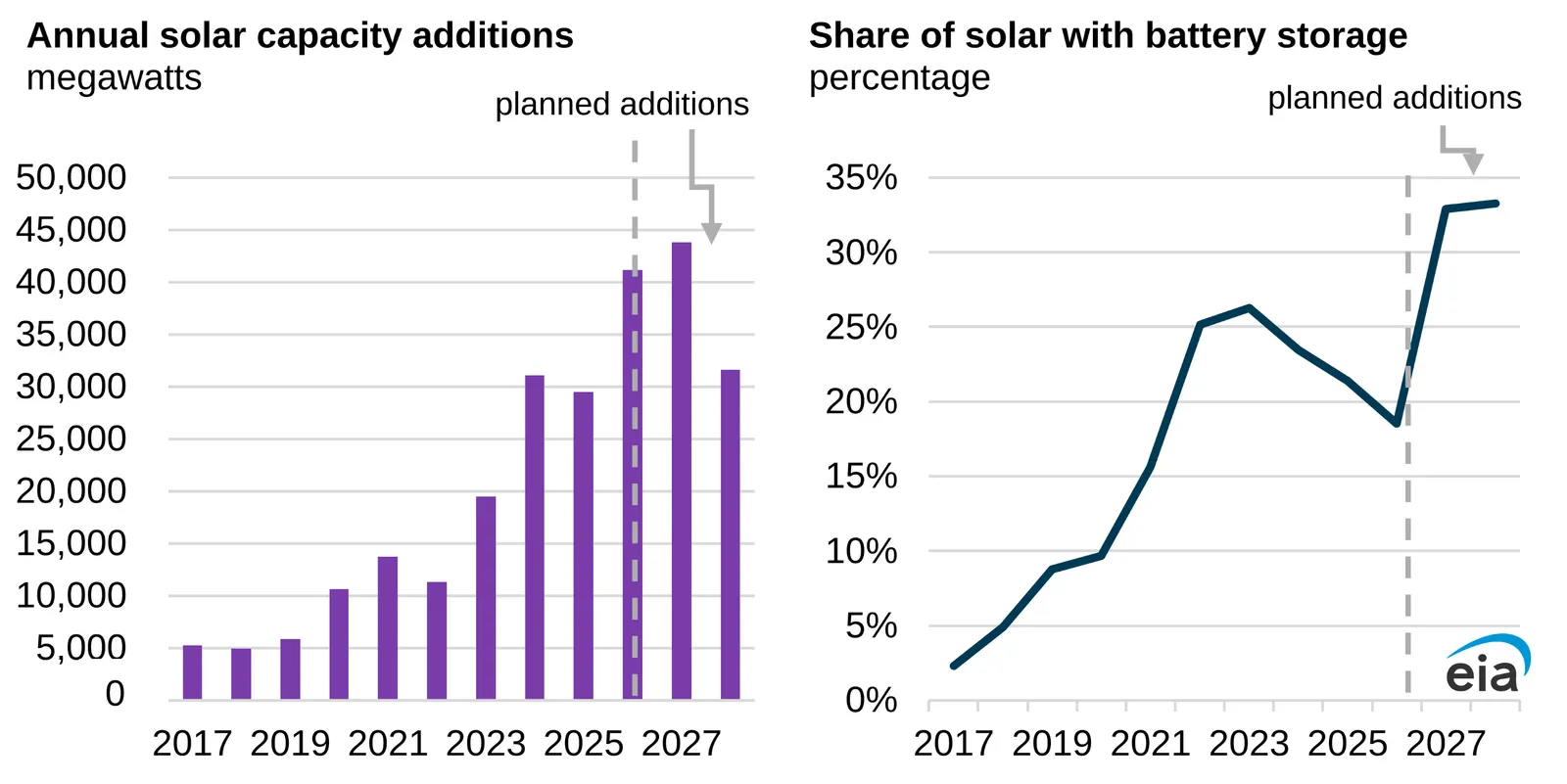
Listen to the article 3 min This audio is auto-generated. Please let us know if you have feedback. The share of new solar projects deployed with co-located battery storage this year is 16% — or about 41 GW — as of September, and may reach 19% by year’s end, said an Oct. 30 report from the U.S. Energy Information Administration. It is likely to pass 30% in the next two years, the agency estimated. The trend has increased significantly over the last decade, as only around 2% of projects, or 5 GW, of new solar capacity was co-located with storage in 2017. In 2023, co-location jumped to 25% of projects, then fell over 2024 and 2025, according to EIA’s data — but is projected to pass 30% over the next two years, based on planned additions. “When operators co-locate battery storage with solar, they can direct solar electricity output to the grid or to the battery, depending on the wholesale prices,” EIA’s report said. “Wholesale prices in regions with large solar participation tend to fall when solar contributions are high and rise as they decrease.” “Plants with both solar and battery storage can manage the combined output of their generating resources to maximize their value in a changing wholesale price environment,” EIA added. Courtesy of U.S. Energy Information Administration An Oct. 22 report from the Solar Energy Industries Association found that from 2021 to 2026, “solar generation increased 421% in Texas and 90% in California, while battery storage capacity grew more than 26-fold in Texas and nearly sevenfold in California.” When comparing the same June to August period, SEIA found that “CAISO used 2.5% more power than the same time in 2021 with an average wholesale electricity price 40% lower after accounting for inflation. ERCOT used 30.1% more power than the

Read More »

Data centers don’t need special treatment to get power faster

Listen to the article 7 min This audio is auto-generated. Please let us know if you have feedback. Seyed Madaeni is CEO and co-founder of Verse, an energy software company specializing in battery dispatch optimization for data centers. Even the best-funded project can’t operate without electricity, and the grid often can’t deliver hundreds of new megawatts as quickly as AI developers need them. Access to power has become a competitive advantage, and companies are searching for ways to get it faster. Seyed Madaeni Today, developers see two obvious options. They can wait years for traditional grid upgrades, or they can build private power plants onsite. The first can move too slowly. The second brings fuel-supply, equipment, permitting and community challenges of its own. A third path to data center interconnection is taking shape. Across the country, utilities and grid operators are creating clearer ways for large loads that can reduce the risks they bring to the system. Depending on the market, a data center might guarantee a minimum payment, agree to reduce its grid demand when the system is strained, provide better operating data or contract for new generation and storage. These policies differ, but they share one idea: If a data center wants faster or more certain access to power, it should give the grid greater certainty in return. That is a better approach than advancing projects mainly because they promise jobs or investment. Projects that make their demand more predictable, controllable and financially secure should have a clearer path to service. Ohio is asking data centers to pay for what they reserve Utilities often need to invest in substations, transmission equipment and other infrastructure years before a data center reaches full operation. They are building against forecasts that can change, and their queues may include projects that never get

Read More »

APA to beef up exploration spending in 2027

@import url(‘https://fonts.googleapis.com/css2?family=Inter:wght@100..900&display=swap’); .ebm-page__main h1, .ebm-page__main h2, .ebm-page__main h3, .ebm-page__main h4, .ebm-page__main h5, .ebm-page__main h6 { font-family: Inter; } body { line-height: 150%; letter-spacing: 0.025em; } button, .ebm-button-wrapper { font-family: Inter; } .label-style { text-transform: uppercase; color: var(–color-grey); font-weight: 600; font-size: 0.75rem; } .caption-style { font-size: 0.75rem; color: color-mix(in srgb, currentColor 60%, transparent); } Executives at APA Corp., Houston, plan to bump the company’s 2027 capital spending to $2.5 billion from an expected $2.1 billion and will dedicate the majority of that increase to exploration work and the development of the GranMorgu project in which it is a 40% partner. Speaking to analysts and investors after APA reported third-quarter profits of $698 million on revenues of more than $2.8 billion, chief executice officer John Christmann said the allocation of $250 million to exploration and another $250 million to developing GranMorgu will return APA to its targeted range of having 10-15% of annual upstream capital go to such work. The plans comprise: Two exploration wells in Suriname’s GranMorgu offshore development with TotalEnergies, which also owns 40% of that project and is the operator. Christmann said the wells will look to extend GranMorgu’s production plateau “or even support a second development.” A winter program in Alaska that includes an exploration well and an appraisal test of the company’s Sockeye discovery. The spudding of APA’s well in the OFF-6 block of which it owns 60%, with Eni holding the remainder. Tracey Henderson, APA’s executive vice-president of exploration, said the block reminds her team of conditions offshore Namibia and that its work with Eni will essentially be a “petroleum systems test.” Addressing the potential of GranMorgu—which APA and TotalEnergies teams have estimated has nearly 760 million bbl of reserves—and the goal of starting production in mid-2028, Christmann said 4 wells are being planned over the

Read More »

DCF Global: Britain’s New Bargain With the AI Data Center Industry

The Global Perspective: A New Bargain for the AI Economy? Britain’s new Data Centre Covenant may ultimately prove important well beyond the United Kingdom. Governments across the world are attempting to reconcile the economic promise of AI infrastructure with the extraordinary physical requirements of building it. Electricity networks must accommodate loads measured in hundreds of megawatts. Utilities must plan transmission and generation investments years in advance. Communities are being asked to host facilities whose construction costs can run into billions, but whose permanent employment footprints may be relatively modest. At the same time, national governments increasingly view domestic computing capacity as a strategic asset. Britain is attempting to connect those issues within a single policy framework. Its approach differs in important respects from the fragmented regulatory environment in the United States, where utility commissions, state governments, local authorities, and regional grid operators exercise separate—and sometimes competing—powers over development. Nevertheless, the underlying questions are increasingly similar. In DCF’s October examination of Virginia’s changing data center policies, the industry’s largest established market was confronting new expectations concerning infrastructure costs, utility commitments, community impacts, and the conditions under which large facilities should receive development approval. Britain’s Covenant addresses comparable pressures through a more coordinated national initiative. It effectively proposes that preferential treatment for strategically important data center development should be accompanied by demonstrable public value. That is a meaningful evolution in the relationship between government and the industry. For years, data center investment announcements have emphasized capital expenditure, construction employment, technological leadership, and economic development. Those considerations remain important. But Britain’s emerging framework asks a more demanding set of questions: Can the project obtain real electricity capacity? Will it pay its fair share of infrastructure costs? Does it contribute to domestic capability? What obligations does it have to its host community? And can

Read More »

Don’t mention the data center: OpenAI calls them ‘compute campuses’ instead

Data centers’ increasing power consumption is straining the grid, with AI servers accounting for an ever larger share of that consumption, with further increases forecast. These demands are leading to a growing number of protests against the development of data centers, which could lead to construction delays. OpenAI claims that its Grid Protectors Program will meet some of those issues head-on by taking into account future capacity needs and working to make power flexibility a key element in data center, sorry, compute campus, design. The company said that the approach would differ, region by region. It has yet to finalize all the details of the scheme, but it hopes to head off some of the protests. It remains to be seen whether it has this effect. Google recently took the opposite approach to the peak consumption problem, proposing to pay people to turn off their appliances at times of high demand so that it can continue to power its data centers.

Read More »

Agentic AI boom expected to reshape CPU market

These activities include planning tasks, scheduling subtasks, calling external tools, managing interactions between multiple agents and evaluating results. Agents also rely on conventional computing resources to execute Python code, search databases, crawl websites and process information, according to TrendForce. As a result, the CPU is enjoying a new lease on life and becoming a more significant component of AI infrastructure rather than simply serving as a supporting processor for GPUs, according to TrendForce. TrendForce notes that traditional AI data centers have typically deployed approximately one CPU for every four to eight GPUs, reflecting the industry’s emphasis on accelerating computationally intensive AI workloads.

Read More »

DCF Poll: Does the Data Center Industry Need a Political Reset?

Matt Vincent is Editor in Chief of Data Center Frontier, where he leads editorial strategy and coverage focused on the infrastructure powering cloud computing, artificial intelligence, and the digital economy. A veteran B2B technology journalist with more than two decades of experience, Vincent specializes in the intersection of data centers, power, cooling, and emerging AI-era infrastructure. Since assuming the EIC role in 2023, he has helped guide Data Center Frontier’s coverage of the industry’s transition into the gigawatt-scale AI era, with a focus on hyperscale development, behind-the-meter power strategies, liquid cooling architectures, and the evolving energy demands of high-density compute, while working closely with the Digital Infrastructure Group at Endeavor Business Media to expand the brand’s analytical and multimedia footprint. Vincent also hosts The Data Center Frontier Show podcast, where he interviews industry leaders across hyperscale, colocation, utilities, and the data center supply chain to examine the technologies and business models reshaping digital infrastructure. Since its inception he serves as Head of Content for the Data Center Frontier Trends Summit. Before becoming Editor in Chief, he served in multiple senior editorial roles across Endeavor Business Media’s digital infrastructure portfolio, with coverage spanning data centers and hyperscale infrastructure, structured cabling and networking, telecom and datacom, IP physical security, and wireless and Pro AV markets. He began his career in 2005 within PennWell’s Advanced Technology Division and later held senior editorial positions supporting brands such as Cabling Installation & Maintenance, Lightwave Online, Broadband Technology Report, and Smart Buildings Technology. Vincent is a frequent moderator, interviewer, and keynote speaker at industry events including the HPC Forum, where he delivers forward-looking analysis on how AI and high-performance computing are reshaping digital infrastructure. He graduated with honors from Indiana University Bloomington with a B.A. in English Literature and Creative Writing and lives in southern New Hampshire with

Read More »

Arista posts record growth as AI networking supercycle accelerates

One of the core answers to that threat is the company’s Autonomous Virtual Assistant (AVA), which lets administrators ask it questions about network conditions and receive explanations, recommendations, and assistance diagnosing problems. “AVA is incredibly powerful. It seamlessly navigates networking and security infrastructure from campus to WAN, to data center, to cloud, continuously monitoring and troubleshooting, isolating root causes without manual labor-intensive tasks,” said Ken Duda, Arista co-founder, president, CTO & director. “The bad news, of course, is the massive challenge AI poses for us and our customers by discovering and exploiting security vulnerabilities. This threat landscape demands secure and robust networking. Over the past few months, we’ve been collaborating with Anthropic, Google, OpenAI, and many others to integrate new AI-enabled security capabilities from frontier models into our existing software security pipeline,” Duda said.

Read More »

AEP, Google Advance $4 Billion Fuel-Cell Project to Power Cheyenne Data Centers

A Power Commitment That Began Two Years Earlier Although Google’s participation was publicly identified in October 2026, the procurement strategy underlying the Cheyenne project dates to November 2024, when Bloom Energy announced an agreement with AEP covering up to 1 gigawatt of solid oxide fuel-cell equipment. As Data Center Frontier reported at the time, the agreement included an initial commitment to purchase 100 MW, with options for an additional 900 MW. The arrangement was intended to help AEP serve large commercial and industrial customers facing growing electricity requirements without waiting for the completion of conventional grid infrastructure upgrades. The relationship advanced in January 2026, when AEP disclosed in a regulatory filing that an unregulated subsidiary had committed approximately $2.65 billion to purchase a substantial portion of the fuel-cell capacity covered by its earlier option. The company also reported a 20-year agreement to sell the planned facility’s entire electricity output to an unidentified investment-grade customer, now confirmed as Google. The equipment purchase formed part of the project’s development history, rather than representing a separate $2.65 billion investment in addition to the $4 billion project announced in October. The scale of the investment is significant, but so is the transaction structure. Rather than requiring Google to own and operate the generation equipment directly, the arrangement places development and ownership responsibilities with an established energy company while providing the hyperscaler long-term access to the facility’s electricity output. For AEP, it also represents an opportunity to deploy capital in support of large-load customers beyond its traditional regulated utility territory. At approximately $4 billion for 702 MW, the project represents roughly $5.7 million per megawatt of planned generating capacity. That figure offers a measure of the investment’s capital intensity, although it is not directly comparable with the construction cost of a conventional gas-fired power plant

Read More »

Microsoft will invest $80B in AI data centers in fiscal 2025

And Microsoft isn’t the only one that is ramping up its investments into AI-enabled data centers. Rival cloud service providers are all investing in either upgrading or opening new data centers to capture a larger chunk of business from developers and users of large language models (LLMs).  In a report published in October 2024, Bloomberg Intelligence estimated that demand for generative AI would push Microsoft, AWS, Google, Oracle, Meta, and Apple would between them devote $200 billion to capex in 2025, up from $110 billion in 2023. Microsoft is one of the biggest spenders, followed closely by Google and AWS, Bloomberg Intelligence said. Its estimate of Microsoft’s capital spending on AI, at $62.4 billion for calendar 2025, is lower than Smith’s claim that the company will invest $80 billion in the fiscal year to June 30, 2025. Both figures, though, are way higher than Microsoft’s 2020 capital expenditure of “just” $17.6 billion. The majority of the increased spending is tied to cloud services and the expansion of AI infrastructure needed to provide compute capacity for OpenAI workloads. Separately, last October Amazon CEO Andy Jassy said his company planned total capex spend of $75 billion in 2024 and even more in 2025, with much of it going to AWS, its cloud computing division.

Read More »

John Deere unveils more autonomous farm machines to address skill labor shortage

Join our daily and weekly newsletters for the latest updates and exclusive content on industry-leading AI coverage. Learn More Self-driving tractors might be the path to self-driving cars. John Deere has revealed a new line of autonomous machines and tech across agriculture, construction and commercial landscaping. The Moline, Illinois-based John Deere has been in business for 187 years, yet it’s been a regular as a non-tech company showing off technology at the big tech trade show in Las Vegas and is back at CES 2025 with more autonomous tractors and other vehicles. This is not something we usually cover, but John Deere has a lot of data that is interesting in the big picture of tech. The message from the company is that there aren’t enough skilled farm laborers to do the work that its customers need. It’s been a challenge for most of the last two decades, said Jahmy Hindman, CTO at John Deere, in a briefing. Much of the tech will come this fall and after that. He noted that the average farmer in the U.S. is over 58 and works 12 to 18 hours a day to grow food for us. And he said the American Farm Bureau Federation estimates there are roughly 2.4 million farm jobs that need to be filled annually; and the agricultural work force continues to shrink. (This is my hint to the anti-immigration crowd). John Deere’s autonomous 9RX Tractor. Farmers can oversee it using an app. While each of these industries experiences their own set of challenges, a commonality across all is skilled labor availability. In construction, about 80% percent of contractors struggle to find skilled labor. And in commercial landscaping, 86% of landscaping business owners can’t find labor to fill open positions, he said. “They have to figure out how to do

Read More »

2025 playbook for enterprise AI success, from agents to evals

Join our daily and weekly newsletters for the latest updates and exclusive content on industry-leading AI coverage. Learn More 2025 is poised to be a pivotal year for enterprise AI. The past year has seen rapid innovation, and this year will see the same. This has made it more critical than ever to revisit your AI strategy to stay competitive and create value for your customers. From scaling AI agents to optimizing costs, here are the five critical areas enterprises should prioritize for their AI strategy this year. 1. Agents: the next generation of automation AI agents are no longer theoretical. In 2025, they’re indispensable tools for enterprises looking to streamline operations and enhance customer interactions. Unlike traditional software, agents powered by large language models (LLMs) can make nuanced decisions, navigate complex multi-step tasks, and integrate seamlessly with tools and APIs. At the start of 2024, agents were not ready for prime time, making frustrating mistakes like hallucinating URLs. They started getting better as frontier large language models themselves improved. “Let me put it this way,” said Sam Witteveen, cofounder of Red Dragon, a company that develops agents for companies, and that recently reviewed the 48 agents it built last year. “Interestingly, the ones that we built at the start of the year, a lot of those worked way better at the end of the year just because the models got better.” Witteveen shared this in the video podcast we filmed to discuss these five big trends in detail. Models are getting better and hallucinating less, and they’re also being trained to do agentic tasks. Another feature that the model providers are researching is a way to use the LLM as a judge, and as models get cheaper (something we’ll cover below), companies can use three or more models to

Read More »

OpenAI’s red teaming innovations define new essentials for security leaders in the AI era

Join our daily and weekly newsletters for the latest updates and exclusive content on industry-leading AI coverage. Learn More OpenAI has taken a more aggressive approach to red teaming than its AI competitors, demonstrating its security teams’ advanced capabilities in two areas: multi-step reinforcement and external red teaming. OpenAI recently released two papers that set a new competitive standard for improving the quality, reliability and safety of AI models in these two techniques and more. The first paper, “OpenAI’s Approach to External Red Teaming for AI Models and Systems,” reports that specialized teams outside the company have proven effective in uncovering vulnerabilities that might otherwise have made it into a released model because in-house testing techniques may have missed them. In the second paper, “Diverse and Effective Red Teaming with Auto-Generated Rewards and Multi-Step Reinforcement Learning,” OpenAI introduces an automated framework that relies on iterative reinforcement learning to generate a broad spectrum of novel, wide-ranging attacks. Going all-in on red teaming pays practical, competitive dividends It’s encouraging to see competitive intensity in red teaming growing among AI companies. When Anthropic released its AI red team guidelines in June of last year, it joined AI providers including Google, Microsoft, Nvidia, OpenAI, and even the U.S.’s National Institute of Standards and Technology (NIST), which all had released red teaming frameworks. Investing heavily in red teaming yields tangible benefits for security leaders in any organization. OpenAI’s paper on external red teaming provides a detailed analysis of how the company strives to create specialized external teams that include cybersecurity and subject matter experts. The goal is to see if knowledgeable external teams can defeat models’ security perimeters and find gaps in their security, biases and controls that prompt-based testing couldn’t find. What makes OpenAI’s recent papers noteworthy is how well they define using human-in-the-middle

Read More »