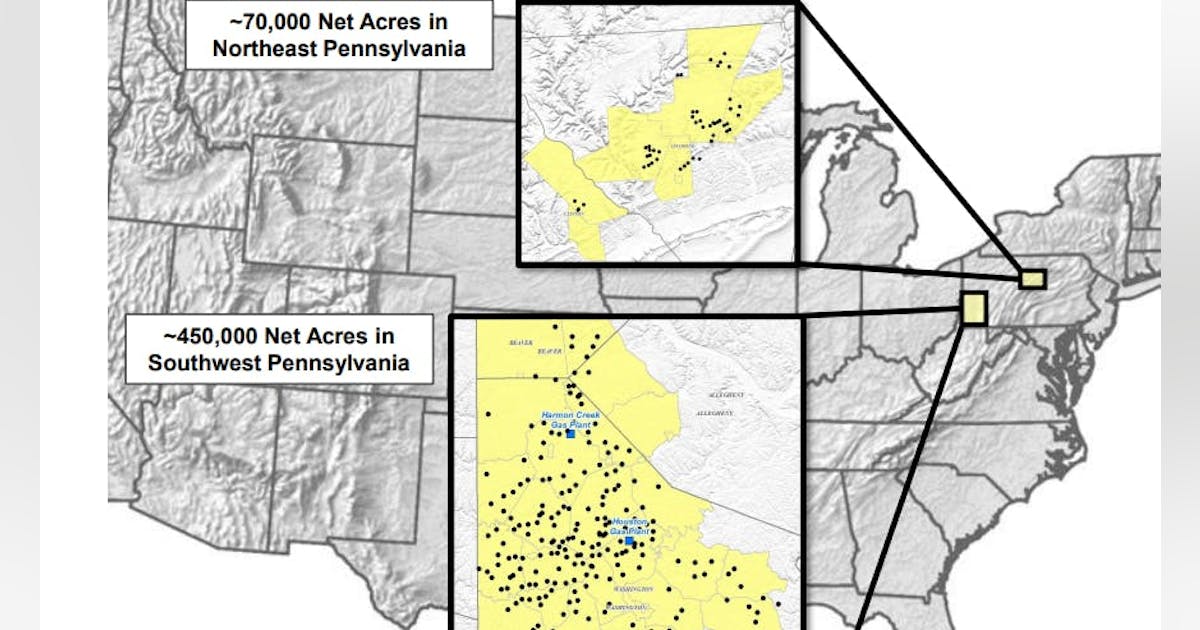
By year’s end, Degner told analysts on an Apr. 22 conference call, production from Range’s roughly 52,000 net acres in Pennsylvania should grow to 2.5 bcfed as unfinished wells start to be turned in line. Those additions, outlined by executives 2 months ago, will help Range’s output get to 2.6 bcfed in 2027 but near-term growth beyond that will need a strong market signal.
“When we think about what’s beyond 2027, […] it’s going to start with a conversation around what kind of demand and opportunity further materializes,” Degner said. “We think there’s a really strong opportunity for that to take shape. But it’s got to take shape.”
Degner and his team are sticking to their full-year production guidance of 2.35-2.40 bcfed and their capital spending forecast of $650-700 million. Should the Range team decide not to invest in more growth over the near term, Degner said the company’s capex budget could shrink to $570-600 million while maintaining production around 2.6 bcfed.
Degner said Range executives expect to be able to invest in “another thoughtful wedge of growth” late this decade, when commodity prices are expected to be consistently higher. The first quarter’s rise in prices, first from harsh winter weather and then from the Iran war, boosted Range’s average price per mcfe to $4.84 from $4.02 early last year.
Degner said the operator’s natural gas liquids premium over the benchmark Mont Belvieu Index was $4.41, the highest in Range’s history. That helped net income in the first 3 months of the year pop to $342 million from $97 million in first-quarter 2025 as revenues rose to $1.03 billion from $691 million.
Shares of Range (Ticker: RRC) were up more than 4% to $43.55 in afternoon trading on Apr. 22. They have now climbed more than 20% over the past 6 months, an increase that has grown Range’s market capitalization to about $10.2 billion.