Belden + OptiCool: Modular Cooling for the AI Middle Market
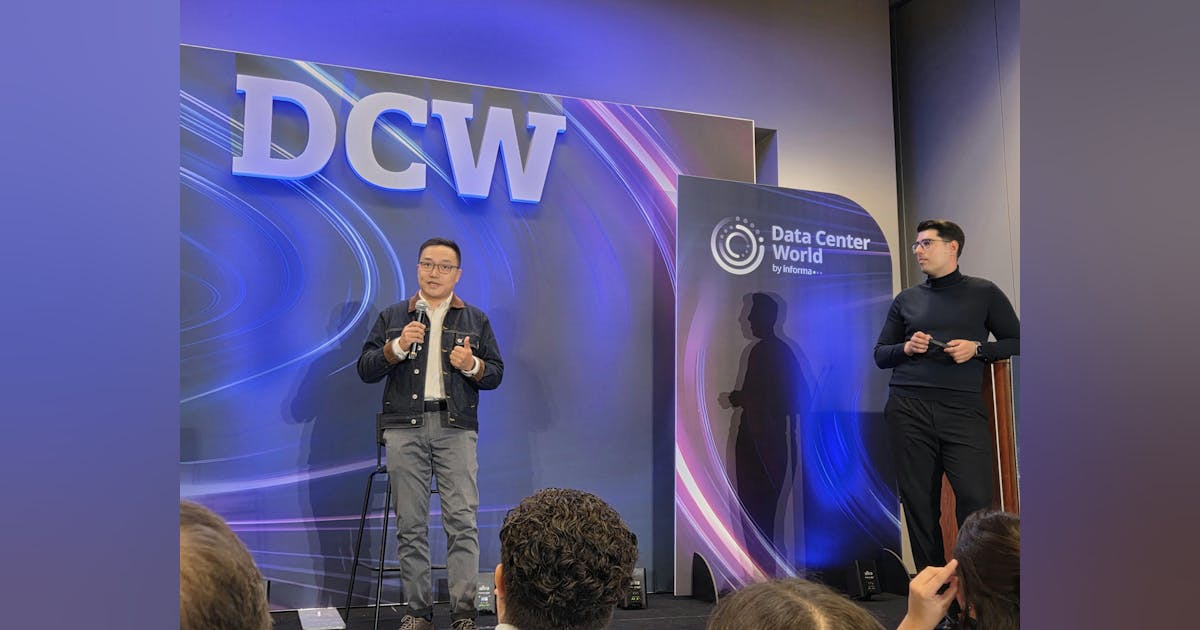
At Data Center World 2026, company representatives from Belden and OptiCool described a joint push into integrated rack-level infrastructure—pairing connectivity, power, and modular cooling into a single deployable system aimed squarely at enterprise and mid-market colocation providers.
The partnership reflects a shift already underway inside Belden itself. Long known as a manufacturer of wire, cable, and connectivity products, the company said it has spent the last several years evolving into a solutions provider—leveraging a broader portfolio that spans industrial networking, automation, and control systems.
That repositioning is now extending into AI infrastructure.
From Components to Fully Integrated Systems
Rather than selling discrete products into bid cycles, Belden is now packaging racks, PDUs, cable management, and cooling into a unified offering—delivered as a manufacturer-backed system rather than a third-party integration.
“We can bring a full solution to the table now,” a company representative said, emphasizing that the company is “standing behind the solution as a manufacturer, not as a system integrator.”
The cooling layer comes via OptiCool, whose rear-door heat exchanger (RDHx) technology is designed to scale alongside uncertain AI workloads.
Two-Phase Rear Door Cooling at Rack Scale
OptiCool’s approach centers on two-phase cooling applied at the rear door, combining the non-invasive characteristics of RDHx with the efficiency gains typically associated with direct-to-chip liquid cooling.
According to company representatives, the system:
- Supports up to 120 kW per rack (with 60 kW demonstrated on the show floor)
- Delivers up to 10x cooling capacity compared to traditional approaches
- Operates at roughly one-third the energy consumption of comparable single-phase systems
Instead of injecting cold air, the system extracts heat using refrigerant as the heat sink, reducing demand on CRAC units and broader facility cooling infrastructure.
Designing for Uncertainty: Modular, Swappable Capacity
The defining feature—and the clearest signal of target market—is modularity.
OptiCool’s units are designed to be swapped in and out in “five minutes or less,” allowing operators to scale cooling capacity from 10 kW to 60 kW within the same rack infrastructure.
That flexibility directly addresses a core problem for enterprise and colo operators: uncertainty.
Customers don’t know what their AI workloads will look like in three to five years—but traditional infrastructure forces them to size for peak demand upfront.
“You have to guess… and spend capex on the maximum capacity you might ever use,” a Belden representative said.
The modular model flips that dynamic, allowing incremental scaling without stranded capital.
Targeting the AI “Middle Market”
Both companies repeatedly pointed to the same opportunity: the gap between hyperscale AI deployments and enterprise reality.
While hyperscale systems are often delivered as fixed, highly standardized architectures, enterprise buyers are asking for something different—customizable, adaptable systems that align with their evolving needs.
“Their stuff is made for hyperscale… they’re not listening to our needs,” one representative said, recounting customer feedback.
That demand is being reinforced by the early stages of the AI inference buildout, which is expected to drive more distributed, enterprise-adjacent deployments.
Not every organization needs—or can support—the “Ferrari” of GPU infrastructure.
“There’s this entire mid-market… that doesn’t need that,” the company said.
Integration as the Product
The Belden–OptiCool partnership is notable less for any single component than for how it’s packaged.
The companies emphasized:
- Single-part-number procurement
- Design-to-deployment support
- End-to-end accountability from a unified vendor stack
For customers lacking in-house expertise, the pitch is straightforward: “We’ve already done the heavy lifting.”
Sustainability and Site Constraints
The solution also aligns with growing scrutiny around data center resource use.
Notably, the system requires no water, addressing one of the most visible points of public and regulatory concern.
At the same time, its efficiency gains reduce overall energy demand from supporting cooling infrastructure—a secondary but increasingly important lever in constrained power environments.
The DCF Take
This is a different kind of AI infrastructure play.
Belden and OptiCool aren’t chasing hyperscale megaclusters. They’re building for the long tail of AI adoption—enterprise and colo environments where:
- Workloads are uncertain
- Expertise is limited
- Capital must be staged, not front-loaded
The key innovation isn’t just two-phase cooling at the rack. It’s the combination of:
- Modular scaling
- Integrated delivery
- And a design philosophy built around uncertainty as a first principle
As AI moves beyond hyperscale into broader enterprise deployment, that combination may prove just as important as raw performance.