Stay Ahead, Stay ONMINE

Rebuilding the data stack for AI

In partnership withInfosys Topaz Artificial intelligence may be dominating boardroom agendas, but many enterprises are discovering that the biggest obstacle to meaningful adoption is the state of their data. While consumer-facing AI tools have dazzled users with speed and ease, enterprise leaders are discovering that deploying AI at scale requires something far less glamorous but far more consequential: data infrastructure that is unified, governed, and fit for purpose. That gap between AI ambition and enterprise readiness is becoming one of the defining challenges of this next phase of digital transformation. As Bavesh Patel, senior vice president of Databricks, puts it, “the quality of that AI and how effective that AI is, is really dependent on information in your organization.” Yet in many companies, that information remains fragmented across legacy systems, siloed applications, and disconnected formats, making it nearly impossible for AI systems to generate trustworthy, context-rich outputs. “Really, the big competitive differentiator for most organizations is their own data and then their third-party data that they can add to it,” says Patel. For enterprise AI to deliver value, data must be consolidated into open formats, governed with precision, and made accessible across functions. Without that foundation, businesses risk “terrible AI,” as Patel bluntly describes it. That means moving beyond siloed SaaS platforms and disconnected dashboards toward a unified, open data architecture capable of combining structured and unstructured data, preserving real-time context, and enforcing rigorous access controls. When the groundwork is laid correctly, organizations can move toward measurable outcomes, unlocking efficiencies, automating complex workflows, and even launching entirely new lines of business. That value focus is critical, says Rajan Padmanabhan, unit technology officer at Infosys, especially as enterprises seek precision in the outputs driving business decisions. Rather than treating AI initiatives as isolated innovation projects, leading companies are tying AI deployment directly to business metrics, using governance frameworks to determine what delivers results and what should be abandoned quickly. “We see this big opportunity just with AI literacy with business users, where they’re very eager to understand how they should be thinking about AI,” adds Patel. “What does AI mean when you peel the covers? What are the pieces and the building blocks that you need to put in place, both from a technology and a training and an enablement standpoint?” The possibilities ahead are substantial. As AI agents evolve from copilots into autonomous operators capable of managing workflows and transactions, the organizations that win will be those that build the right foundation now. “What we are seeing as a new way of thinking is moving from a system of execution or a system of engagement to a system of action,” notes  Padmanabhan. “That is the new way we see the road ahead.” The future of AI in the enterprise will be determined by whether businesses can turn fragmented information into a strategic asset capable of powering both smarter decisions and entirely new ways of operating. This episode of Business Lab is produced in partnership with Infosys Topaz. Full Transcript: Megan Tatum: From MIT Technology Review, I’m Megan Tatum, and this is Business Lab, the show that helps business leaders make sense of new technologies coming out of the lab and into the marketplace. This episode is produced in partnership with Infosys Topaz.Now, recent advancements in AI may have unlocked some compelling new industrial applications, but a reliance on inadequate data models means that many enterprises are hitting a brick wall. AI and agentic AI in particular place a whole new set of demands on data. The technology requires greater access, context, and guardrails to operate effectively. Existing data models often fall short. They’re too fragmented or siloed. Data itself often lacks quality. To bridge the gap, they require an AI-ready upgrade. Two words for you: data reconfigured.My guest today, are Bavesh Patel, senior vice president for Go-to-Market at Databricks, and Rajan Padmanabhan, unit technology officer for data analytics and AI at Infosys. Welcome, Bavesh and Rajan. Rajan Padmanabhan: Thank you. Thanks for having us. Bavesh Patel: Thanks for having us. Megan: Fantastic. Thank you both so much for joining us today. Bavesh, if I could come to you first, when we talk about AI-ready data, what exactly do we mean? What new demands does AI place on data, and how does this impact the way it needs to be structured and used? Bavesh: Yeah. Great question. Appreciate you hosting us today. I think that obviously the whole world is enamored with AI because of all of the power that we can all see as users. AI is now democratized across hundreds of millions of users. And when we think about enterprises and businesses using AI, the quality of that AI and how effective that AI is really dependent on information in your organization, and that’s data. And what we found is that most enterprises, their data is kind of locked away in these different applications and different systems. And it’s very difficult to get a good view of, what is all my data? How trustworthy is it? How recent and fresh is it? And all of that is being injected into the AI. Unless you have a proper understanding of your data, the ability to ensure that it’s data that’s accurate and that can be used so that the AI can take advantage of it, you’re actually going to end up having terrible AI. We see a lot of customers spend time on cleansing their data, organizing their data, making sure it’s access controlled correctly, and that tends to be the fuel of good AI. Megan: Yeah. It’s such a foundational thing, isn’t it? But it can be missed, I think, quite easily. Rajan, what difference can having AI-ready data really make for enterprises as they unlock that full potential of AI and its applications? Rajan: First and foremost, thanks for having us. It’s a pleasure. I think in continuation of what Bavesh talked about, see, data and AI is pretty synonymous. And similarly, the consumer AI and enterprise AI and enterprise agentic AI are different because first and foremost, the business needs to have the context. That context from your enterprise information, which is not only structured, both structured and unstructured and user-generated contents and all forms of data is going to be very, very critical to really get the context right, and really get any model that you pick. That’s where the platforms like Databricks really help with the plethora of models or whether you want to build your own models or whether you want to ground the model based on your data. That is going to be very, very critical. That is where getting the data for AI is going to be very, very critical. The third critical part, and this actually will be one of the roadblocks for adoption of AI. That’s why if you see the AI adoption on the consumer side is skyrocketing, but on the enterprise side, the enterprises are struggling is primarily around the precision of their output, because you are taking a business decisions where you are taking a buy decision, you are taking a sell decision, or you are trying to recommend something, recommend the content. It could be 20 different use cases. For that, the precision is going to be very critical. We are seeing our customers, the successful customers, definitely for the precision to be more than 92% is not aspiration, that is a must-have. If you have that, definitely being that AI data is going to be the entrepreneur right now for that. Megan: And I suppose if we’ve outlined there how critical this is, where should enterprises start then, professional perhaps, the level, what are the foundations when it comes to building an AI-ready data model? Bavesh: Yeah. And I think Rajan hit the nail on the head. I mean, enterprises are grappling with a different set of problems than consumer AI. The first thing is that you’ve got to get a handle on your data. As I mentioned, a lot of the data is locked in. Ensuring that you have ability to put your data in a place where you can understand the holistic view of as much of your data as possible. That kind of starts with putting your data in open formats. A lot of the valuable data today in an organization is locked away in some proprietary SaaS app or some system, and all the datasets aren’t connected together to form that context. The first step is to really do an analysis of what is your data estate? What are the critical pieces of data that need to be put into a place where you can start to understand them and how they’re connected to one another? Thinking about how do you set up your data catalog, thinking about how do the relationships between the data assets work, putting data governance around it, that seems to be the first step. And if you think about how ChatGPT was built, it took all the data on the internet and then aggregated it, synthesized it, and then built these transformer models, while enterprises, they don’t really have a handle of all their data within the organization. That’s the first foundation that you really want to think about. The second thing is that you don’t want to just go ad hoc, go and do random AI projects. You really need to be thinking about business value. A lot of our customers are looking at AI much more strategically in that they want to be able to get projects on the board with wins and then generate business value. Building an AI value roadmap, which is connected to how well your data is organized, those two things seem to be foundational to how do you launch AI successfully in your organization. Megan: That value piece is so important, isn’t it? And as I understand it, Infosys and Databricks have worked closely together to guide organizations through this transformation. I wondered, can you share some examples of the impact you’ve seen enterprises you’ve worked with, Rajan, what difference has it made to the ways in which they can integrate more sophisticated AI and agentic AI applications? Rajan: Well, that’s a very, very good question. What both Databricks and Infosys has done is we have come up with, a kind of a framework first. First and foremost, it all needs to start with the value. One of the largest food products company where we collaborated together, what we have done is we have applied this framework. The framework consists of six different things. First and foremost, very critical is the value management, which Bavesh touched upon. We have worked together to come up with a 3M measurement framework, what we call adaptability, business value, and then responsible. You can’t just go and do a garage project. It has to be measurable. It should be responsible, follow all those things. That is going to be very critical. And we helped this client to prioritize, which will give them the most value for money, the investments that they are making. The second critical part here is it is not like most of the enterprises today are not everybody’s AI-born companies. Most of them were born during analog days; most of them were born in digital days. There are companies which are applying AI for modernization, because a lot of your historical information, which is actually helping you to build that long-term context. And that is where we have worked closely with some of the native tools of Databricks, like Lakebridge or the AI assistants that are there, and then create composable services on top of it to help the clients unlock the value bringing into Databricks. And then the second part where we help the client is exactly to the point, the readying of data. Now you brought in the data, now you have to bring both the structured, unstructured, analytical and all these aspects. And that is where the third layer, we closely work with the Databricks, which is part of leveraging all the great capabilities within the Databricks, be it Unity Catalog, be it the open formats, or be it the gateways and other aspects. We were able to make the data available for this client. What has really helped our client, the third part, is Agent Bricks, which is one of the differentiatiors. It gives you the flavor for the enterprise. That is where we have closely worked, and we built some of our industry-specific agents, be it CPG, be it energy, be it FS. And for this client, what we have done is we have taken some of those CPG-specific use cases. Either it could be on the HR space or the procurement space or on the marketing space. And this has really helped our client be able to build a business capability surrounding this and unlock eight to nine use cases, we call it as a products, agentic AI products, which can really drive more value for them, solving the real business problems. And this kind of a comprehensive set of frameworks plus set of suites of services, plus our solution assets, Infosys solution assets, as well asunlocking the value from Databricks has really helped these clients. And we see similar patents for a lot of these successful engagements where we were able to continuously drive the value by applying this framework actually. Megan: Right. Sounds like it made a real material difference. Rajan mentioned a few of the tools in Databricks catalog there, Bavesh. I know you’ve recently worked to launch an operational database for AI agents and apps. I wonder how does a platform like that help organizations in this journey? What makes it different from some of the other platforms out there right now? Bavesh: Databricks has come to market with a new offering called Lakebase, which is really an OLTP database where you can build your AI apps. And if you think about it, there’s really two main types of data in an enterprise. There’s all the historical data, which is all the things that have happened, and that’s really what your analytics is based on. You have an old app system where you have put all your historical data and Databricks has come to market with what we call the Lakehouse, which is essentially a data warehouse with all of your data that is not operational in nature. It’s historical data. And I think that Lakehouse concept is really pushing forward with AI because a lot of our customers have thousands of users within their business and they need to get data. And what they’ve done is they’ve actually gone down the BI route, which is really building a dashboard or a report. Most organizations have had thousands of these dashboards and reports proliferate across the organization and then they need to be customized. It just takes a long time for users inside of the business to actually get access to the data. AI now is really making that a lot easier from just the analytics perspective where we can now democratize access to the data, which has really been the holy grail for most data teams. They really want to get out of the way and just give the right data to the right people inside of the business with the right access. With a product like Genie at Databricks, you can just use English language or whatever your language is to ask questions of the data. And it’ll give you back data that answers your questions in context. It’ll give you not just what ChatGPT will give you, which is information about a topic that’s on the internet, but it will actually tell you, “Well, why did my sales numbers not reflect what I expected in the month of April?” It’ll give you some root cause analysis based on your enterprise data. Genie is going to be one of these things that’s really important where it’s going to truly kind of democratize data inside of the business. That’s kind of this OLAP world, which is what the Lakehouse is. More recently, we’ve come to market with what we call the Lakebase, which is the OLTP world. What we’re finding is that agents are now being deployed in these organizations, and those agents need a place to keep all of their orchestration, all of the context of what’s happening in that particular workflow. On the one hand, you’ve got users just asking questions. On the other hand, the next chapter is going to be around automating an entire business process. If you’re taking a function like generating a campaign in marketing, right? There are a lot of tools you use and a lot of steps you use. An agent can come in and really automate a lot of that. But on the back end of that agent, you’re going to need to stand up a real-time database to keep track of all the things that the agent is doing. That’s what Databricks has brought to market, which is this OLTP Lakebase solution. The innovation that we have brought to market is that it’s a modern kind of Postgres database where we have separated the compute and storage, very much like what we did with the data Lakehouse with the data warehouse. But on the Lakebase, the data is on one copy inside of your cloud storage, and then the compute is separated and it’s serverless. You can do things like branching and you can start up the OLTP database really quickly. What we found is that agents are actually starting these Lakebases because they can very quickly go start one up, keep it running, put it down when it needs to, make a copy of it. Agents are doing this, then they need the velocity, they need a cost-effective solution. And the beauty of all this is when you take the OLTP, which is all around the Lakebase and the real time, and you take the OLAP, you now have one system for all your data. You don’t have to copy the data around, you don’t have to manage all the permissions, you can set the context against it. We see these AI apps being really the future of how businesses run, where they’re going to take away all of the bottlenecks that humans are having to do repetitive work and automate these using LLMs and all these new technologies. We want to be the default for powering all that because we believe that our Lakebase technology is going to be faster, cheaper, and more secure for an AI database. Megan: Sounds like a real game changer. And we’ve touched on this a couple of times already, I mean, this idea of value. We know that engaging the commercial value of investments into AI is really high on the priorities right now for senior leaders. How important is this value measure piece when it comes to creating AI-ready data systems, Rajan? How can organizations ensure they’re monitoring what is delivering and what isn’t? Rajan: This is the paramount importance and most of the successful AI implementations or agentic AI implementations really required this value measurement. I’ll just extend the client example that I talked about, the large food products company, the global products company, to explain this question. I just want to create a metaphor. When the initial digital world came, we have a lot of these analytics primarily around defining those performance management KPIs, fact-based decisioning and other things were evolving over a period of time. Typically, a lot of these metrics are going to be very critical for them to measure how a function, how a business is doing. On a similar line for the value measurement, if I take the same example of the client, what is very critical for an organization is actually to map your outcome that you are expecting. Iin this case, how do I optimize my spend on direct and indirect purchases? So by applying AI, I would like to identify the areas where I can optimize the spend. That means one of the critical measures that you have is, what is your indirect expense classification and what spends you have been classified and how much you are able to reduce by bringing in this. Establishing these measures and the metrics is going to be very, very critical. And once you establish these base metrics and the measurement, and the beauty of it is some of these metrics, to just extend what Bavesh was talking about, the capabilities that Databricks gives you, like metrics view, features, tools, and other things would actually help you to translate those AI telemetries, business telemetries that is coming from your applications into a measurable metrics in terms of an outcome, which you can actually measure using the Genie room for value management measurement. Then what happens is two things that you can take, the use case, the products that as I said for this client, the products that we build either on the procurement side or on the marketing research side, if you find there is a value either because of VAC, they identify that they’re able to optimize or it is able to reachability, what is the reach, you can either accelerate that use case and further fine tune that product to expand it. Or there are, if you find it is not really driving the value or I’m not able to see the value that it is going to deliver, you can very well do a fast failure method rather than trying to make it work, you can understand and then you can take a call to pivot it to something else different. There are three aspects here. What we see from our experience, not only with this client across some of our other clients from industrial manufacturing or FS or in the energy, is by setting up this metrics-driven valuation method upfront and then leveraging the capabilities to establish, transform these telemetries, signals into a measurement, what we call an AI compass room so that you really measure the business stakeholders, whether it is coming from a marketing office or whether it is coming from supply chain office or whether it is coming from a CFO office where they can say, “Hey, this is what it is intended to do, this is what the current measurement, and this is where it’s failing that can help them to pivot.” And this will actually drive and democratize AI, all the agent decay across the enterprise, and that really drives the value. This is going to be one of the critical part that enterprise needs to do it. And that is where the six part framework that I talked about, applying that framework like value office, applying the ready for AI, applying the transformation fabric. Then the third part is the governance, which is going to be the entrepreneur of this. Then running your operations, not based on SLA, based on the experience level agreements and business metrics for you to continually measure, bringing all these six layers is going to be very critical. That’s when we see the organizations are very successful, and some of our proven examples exactly do the same that this is going to be very critical for organizations from a measurement standpoint. Megan: Lots of tangible ways there that you can actually gauge value here. And you touched on governance and the impact of AI on governance is another huge talking point among senior leaders and interactions with data are a core part of that. To what extent is having the right governance and security protocols an integral part of having AI-ready data? To Bavesh, what scenarios do these systems need to handle? What does that mean for data models? Bavesh: This is becoming kind of the prerequisite to deploying a successful AI project. I think MIT produced a report that said 95% of these new AI projects fail to actually generate business value. A big reason for that is you can go and prototype and stand up and vibe code a pilot, but when you’re actually moving a workload into production, you realize that governance becomes so critical. So what do we really mean by governance? I think the first thing is getting your data in order, like I said, in open formats. Most companies realize now that the way they engage with their customers, the way they develop a drug, the way they approve a person for a credit limit increase, all of that enterprise information is actually their competitive advantage. Because you can go and use a frontier model like ChatGPT or Claude that everybody has access to. Really the big competitive differentiator for most organizations is their own data and then their third-party data that they can add to it. Getting your data into an open format so you can understand your data and understanding your data is where governance comes in. Because when you think about governance, you really want to be able to find the data. If I’m an end user or if I’m building an AI product, I want to know what data’s available to me. Can I trust the data? How fresh is the data? Is it coming from my analytics world or do I need a real-time system like a OLTP system? I need to find the data. I also need to make sure that access is controlled in a way that doesn’t cause any huge headaches from my organization. This becomes critical. If I have a whole bunch of PDFs that have purchase orders in them, who actually has access to all that data? In a clinical trial, for example, in healthcare, you really want to ensure that people across trials don’t have visibility to patient data. Maybe the model that was used to build that was running across trial. Who has access to all the data? Who has access to only parts of the data? You really have to think about this. We also look at semantics of the data. Rajan brought this up right at the beginning of this, which is what is the context? How do we think about the metrics and all the things that the business users know in their head? We need to start codifying that somewhere. We have a product at Databricks called Unity Catalog where you can do the discovery, the access and the business semantics. You also want to share the data. And in the world of agents, what we see is something called agent sprawl. In a very short order, just like how SaaS applications became very prevalent within any organization where they really solved a business problem. You go to a line of business and you say, “I need to be able to do credit underwriting” or “I am doing a prior authorization use case or pick thousands of use cases.” There’s a SaaS app for that. Much like that, there’s going to be this world in which agents are going to come into play, and most organizations are going to have lots of agents running all the time, but the reality of it is that how did that agent perform? What was the feedback loop from the user? What was the cost of running that workload and is it going up dramatically? And if you don’t have a way to monitor, to understand, and trace all the questions and answers and responses at scale, you’re going to find yourself in a big pickle. This actually could hurt your organization because users will be very confused about what to do. When you look at governance, most organizations are recognizing that they have to start to understand what is it that they have put in place from a systems, from a process, from a tooling standpoint, focus on one use case, build out the governance for that, but build it in a way that’s going to allow you to become repeatable. AI is not going to be about one use case or two use cases. It’s whoever builds the flywheel of building many use cases in a safe, secure way, in a cost-effective way that’s driving a business outcome. If you don’t apply governance, it’s going to be very hard. At Databricks, we made a big bet on governance four or five years ago. This is one of the main reasons our company’s growing right now because we can ensure that there’s quality data that’s going into all of your AI. You can use things like Genie and you can use things like Agent Bricks and you can build apps using Lakebase. None of that really works without governance. It’s really what we call the brain inside of Databricks. Most of our customers spend a lot of time inside of Unity Catalog. And the great news is that AI is helping governance get set up much more quickly. We have a customer that three years ago, they were trying to get all of the data assets across all their domains from the customer, from the loyalty app, from the e-commerce engine. They had to go and map out all this data assets. AI is now doing a lot of their work for them. The human in the loop is just checking things. We’ve made this much easier with AI. We always think about AI as a business use case and an outcome, which I think is going to be where the biggest value is. But at Databricks, we’re using AI inside of our platform to make it much easier to operate and to make it much easier to provide all the right things for your business. This is a super critical part of how we plan to innovate as AI takes fruition in the market. Megan: And Rajan, Bavesh touched on this a little bit there, but does the integration of Agentic AI add another layer of complexity here too? What new consideration around governance does that raise? Rajan: That’s a very, very valid question. I would like to take a metaphor to really explain. We are getting into the world of self-driving cars, robotaxis, and other things. While that takes us to the autonomous world, but still there are rules that you need to adhere to when you are driving on a road. The reason I’m bringing this metaphor is because what is actually required is actually adhering to the rules and different topographies, different things, depends upon where you are driving is going to be very, very critical. The complexity that agents are going to add is basically how you operate with those constraints. For example, as a UTO, I can do 10 things, but say if I cannot approve a discount for more than 70% or I cannot give something as a bonus for someone because that is a part of the CFO, which an agent should be aware of. That is one aspect, applying the constraints around it and making sure that the agents are adhering to the constraints. The second set of complexity that it builds is the tools to access. As a business, in today’s world, when you define a process, certain processes need a certain set of tools to really actionize it. There are certain entitlements, only people entitled to do certain things based on their identity, based on the need or the situation need, you need to govern. The third is information sharing. While MCP and other aspects are great, UCP and other aspects are great, but one critical thing is what you need to share, what you don’t need to share. And those are the critical considerations. The last part is learning and relearning. Sometimes when you learn good things, you should keep something. Sometimes it is better for you to completely remove it and reevaluate in a newer way, relearn it in a newer way. These are all the critical things that are required. On the similar line for agents, it is going to be paramount, because when you are operating agents for an enterprise, you need to know, learn, and adhere to certain compliance related rules, business related constraints, and then the entitlement identity, and then sharing whatever that apply to a physical human will also start applying to an agent. That is where this is going to be very critical. This requires a new set of operating systems. That doesn’t really mean now get out of a new thing. That is where I’m just interpreting how Bavesh touched upon the Unity Catalog. The best part that which we see and some of our clients that which are implementing is extending the Unity Catalog and the capabilities like now you can catalog the tools, catalog the MCP as well as catalog these agents, and then govern those agents based on the constraints, ground them based on the constraints. It’s going to be very, very critical. Doing it not later, but starting that as part of your strategy and enforcing this as one of the critical dimensions of when you measure the value is also going to be very critical for an organization. It is like making sure that not only building the autonomous car, but as well as making sure that the car drives as per the rules of the road, not going rogue. Megan: Lots to think about there. Fascinating stuff. Thank you. Just to close, with a quick look ahead, we all know the pace of development in AI and Agentic AI is so rapid. For those organizations that can prioritize AI-ready data now, what are the most compelling use cases for the technology that you can see coming to the fore in the next few years, Bavesh? Bavesh: I think the excitement level is at its peak. We’ve seen so much investment in AI. I think the reason why there’s a lot of excitement is because you can look at the early adopters and you can see massive amounts of gains that these organizations are seeing. The one thing I will tell you is that the companies that there’s really three categories and the companies that I think are doing well, a lot of them started out with just copilots and things that are just giving people quick answers. Think about it as making an individual productive. That is the first phase. And the ROI on that has been somewhat questionable. With something like Genie, it makes it a lot more effective because it’s actually on your data and your data is contextualized in your organization. I think that’s one level of area that we’re going to see a lot of innovation. We’ll see most organizations just start to get the right information to the right person at the right time. And that has been a dream for a lot of organizations. The second one is around automating entire business processes. We see functions within marketing, like I described earlier, or whether you’re going through a process of rebates for a company. There’s a whole bunch of steps involved where you have to go into three different apps and export data from Excel and put it over here. There’s thousands of people doing very laborious, monotonous, repeatable work. These agents are really going to help get an immense amount of not only productivity for the business process, but it’s just going to make things faster. Processes that took weeks are now going to take days. Processes that took days are going to take hours and minutes now. One trend we’ve seen is that the AI world is so dynamic. In a world where you got lots of different players, you want to think about first principles, what are the foundations? You want to think about owning your data, making sure you have a handle on your structured and unstructured data. You want to put governance on that. But the other thing that you want to make sure that you don’t do is lock yourself in. Today, if you think about it, Gemini is really good with multimodal. Anytime you have pictures or videos or things like that, Gemini just is super good. Whereas if you’re writing code, Claude is really good. If you’re just doing certain types of questions around introspection, ChatGPT is really good. What you really want is an open data platform where you can build your open AI on multiple clouds, which is what we built at Databricks. I think that’ll help with the second piece, which is you can pick and choose because when you build these agents, you don’t have to be locked into just one. You should be picking the best quality and the best security and the best ROI and cost for a particular workload. One workload may use multiple of these models, and they might be even specific industry models. You need a system and a platform that can really handle this complexity. I think the third category is business reimagination. A lot of people talk about this where, yes, you’re going to go and take the data and make it available and give everybody access to the data. You’re going to make existing processes much more efficient. But the third thing is there’s going to be brand new things that come out of it. We have a very large customer who’s a bank and they have built a product that they didn’t have a year ago. Essentially, it’s machine learning and LLMs helping treasury departments forecast what their balances are going to be because they have more data at their fingertips. Historically, it took a long time for the data to get to the bankers. They were not able to really predict what a balance would be for a treasury department. Think about this for a big enterprise company, they have now built a brand new data AI solution that they’re monetizing and it’s generated hundreds of millions of dollars in the first six months. We’re seeing brand new lines of business open up and that is going to be really exciting because that’s where a lot of the transformation is going to happen. There’s going to be productivity. There’s going to be kind of automation at the business process level. Then there’s going to be these big new things that we didn’t even imagine that people are going to come up with. We are actually seeing the early signals of this in every industry. We see retailers getting data at the hourly and the minute level so that they can integrate much more closely with their supply chains. We’re seeing much more targeted customer 360-degree use cases where as retailers or as consumers, we get annoyed by ads, but now it’s so contextualized and you have so much information about what really matters to your target customer, you’re giving them value added kind of information and that’s engaging them more. There’s a whole bunch of innovation happening with agentic commerce and things like concierge and virtualized shopping. You look at any industry, there’s definitely new ways of doing things. This is what’s really exciting about AI, but you really have to not get too far ahead without thinking about what are the foundational things. You mentioned this earlier, which is open data platform, making sure you have governance correctly, making sure you think about your historical analytical data and your application data that’s going to be real time, having a good foundation to build on, that’s going to allow you to scale and move more quickly and compete in this new world. We’re very excited about what we’re seeing with our customers and what they’re building. And honestly, that’s the best part about being in my role at Databricks, which is our teams really go to customers and say, “What are the outcomes you’re driving?” The early signals have been super positive. We’re seeing companies that get serious about all the foundational elements and really are methodical about building really outcome-based AI solutions, that 5% of projects that are being successful, those are wildly successful. That’s why we’re growing as a company because once you get a good project under your belt, that gets visibility within executives. The last thing is that historically, a lot of tech has been in the IT department. You get the business designing how they want to go to market and how they’re going to compete and what products and services they want to offer. IT was the enabler and in many cases became the cost center and was relegated to rationalizing the portfolio of spend and tools. But now we’re seeing the business kind of take the lead with AI where they want to understand, they want to know, “Hey, what can I be doing now that was not possible before?” We see this big opportunity just with AI literacy with business users where they’re very eager to understand how they should be thinking about AI. What does AI mean when you peel the covers? What are the pieces and the building blocks that you need to put in place, both from a technology and a training and an enablement standpoint? We’re spending a lot of time with executives helping them along this journey. We definitely see a lot of amazing opportunities ahead. Megan: Yeah. So much innovation going on. And finally, how about yourself, Rajan? What on the horizon is exciting you the most? Rajan: I think Bavesh covered quite a bit, but I think the way I’m seeing is today predominantly we are talking about labor shift. That means unlocking the potential of human or shifting the current way of working to the new way of working with the more efficiency game. It’s predominantly more of an efficiency game. I think that is what we are seeing now and the majority of the successful use cases around the labor shift. But what is pretty promising is the two kinds of shift, the business shifts. What we are seeing as a new way of thinking or the new thing that is coming up is moving from system of execution or a system of engagement to system of action. That is the new way we see the road ahead. That is where some of the points that I touched upon. The business wants to have access to it, but how does it really make the real difference for it? One classical example that I could clearly see which we have implemented for one of our customers primarily in the manufacturing space, is around the lifecycle of creation of a product and then publishing the content around the product in line with their different B2B marketplaces. Some of those, you are not just talking about recommending, creating, but actually you are able to reimagine this process, which used to involve five different departments, now can be done much faster, but at the same time gives you that veracity in terms of the decisioning that you are able to do and as far as how you’re able to actionize. That is the second thing which we are seeing. The third part I think is also going to be is the way how the commerce has evolved. There is also not beyond that agentic commerce, but I think what we are seeing is that agent to agent commerce, agent to human commerce and agent to agent payments, agent to human payments, and then the content monetization. These are the new set of business opportunities like building new business agentic products. It could be for family techs, it could be for on the consumer side, or it could be on the industrial technology side. These are going to be what I’m calling the economy shift, labor shift, business shift, because that is going to bring a new set of system of actions, moving them from the system of executions or the typical SaaS application with the bolt-on agentic, the so called agentic application. That is going to be a major transformation, and we are underway. But on the technology side, what is very critical for entrepreneuring is in today’s world you have data, analytical data, operational data, and then there is intelligence, there are different facets of it. I think both this analytical core and operational core is going to really come into one. That’s why we are so gung-ho about the releases of Lakebase and other things because that is the way the future is going to drive. When they are really thinking about being ready for AI technology use cases, they should really think, how do you really create this unified core for the newer world? The second part is people have to reimagine today, if I take SAP as an example, you do hundreds of edge applications, business applications needed to integrate another thing. Typically, we create sprawl of these integrations. One technology use case, people can say, “Hey, how do I really create a domain-based service mesh on top of this unified core and how do I make it more agentic integration ready?” That is one of the technology use cases that we are advising to the client. I think now with a lot of the new areas that are coming around SAP, BDC with the Databricks, and this zero-based integration, that makes them rethink the way they need to integrate, the way they need to do things. The third part, I think from a technology investment and technology, the use cases that most come for the technology that I would talk about is don’t just talk about now. This is the time that you have to, the way you own the people, the FTEs for your organizations. Agents are going to be your new FTEs. That means that some of the new technology paradigm is going to be you will end up creating these co-intellects within your organization. That means you need to invest on what we call this agentic grid, where it becomes like a unified agentic fabric where every other agents can really collaborate and integrate and building on top of the same, the unified operational analytical core, the unified agentic integration on top of it, which is going to create a new set of experiences, agentic experiences rather than the traditional experiences or conversational experiences. Then the new collaboration methods are going to be some of the critical aspects from a technology side that people have to really think from a technology standpoint. To start with, I would say you start looking at it from a data standpoint, building that unified core, building that unified integration and building that collaboration layer for both sharing and collaborating with intelligence as well as the agentic collaboration all governed under single umbrella. That is going to be the one critical use case which no one will feel bad about, and they are going to get really a 100X of their investments out of it. Megan: Certainly no shortage of exciting developments on the horizon. Thank you both so much for that conversation. That was Bavesh Patel, senior vice president for Go-to-Market at Databricks and Rajan Padmanabhan, unit technology officer for data analytics and AI at Infosys, whom I spoke with from Brighton, England.That’s it for this episode of Business Lab. I’m your host, Megan Tatum. I’m a contributing editor and host for Insights, the custom publishing division of MIT Technology Review. We were founded in 1899 at the Massachusetts Institute of Technology, and you can find us in print, on the web and at events each year around the world. For more information about us and the show, please check out our website at technologyreview.com.This show is available wherever you get your podcasts, and if you enjoyed this episode, we hope you’ll take a moment to rate and review us. Business Lab is a production of MIT Technology Review, and this episode was produced by Giro Studios. Thanks for listening. This content was produced by Insights, the custom content arm of MIT Technology Review. It was not written by MIT Technology Review’s editorial staff. It was researched, designed, and written by human writers, editors, analysts, and illustrators. This includes the writing of surveys and collection of data for surveys. AI tools that may have been used were limited to secondary production processes that passed thorough human review.

In partnership withInfosys Topaz

Artificial intelligence may be dominating boardroom agendas, but many enterprises are discovering that the biggest obstacle to meaningful adoption is the state of their data. While consumer-facing AI tools have dazzled users with speed and ease, enterprise leaders are discovering that deploying AI at scale requires something far less glamorous but far more consequential: data infrastructure that is unified, governed, and fit for purpose.

That gap between AI ambition and enterprise readiness is becoming one of the defining challenges of this next phase of digital transformation. As Bavesh Patel, senior vice president of Databricks, puts it, “the quality of that AI and how effective that AI is, is really dependent on information in your organization.” Yet in many companies, that information remains fragmented across legacy systems, siloed applications, and disconnected formats, making it nearly impossible for AI systems to generate trustworthy, context-rich outputs.

“Really, the big competitive differentiator for most organizations is their own data and then their third-party data that they can add to it,” says Patel.

For enterprise AI to deliver value, data must be consolidated into open formats, governed with precision, and made accessible across functions. Without that foundation, businesses risk “terrible AI,” as Patel bluntly describes it. That means moving beyond siloed SaaS platforms and disconnected dashboards toward a unified, open data architecture capable of combining structured and unstructured data, preserving real-time context, and enforcing rigorous access controls. When the groundwork is laid correctly, organizations can move toward measurable outcomes, unlocking efficiencies, automating complex workflows, and even launching entirely new lines of business.

That value focus is critical, says Rajan Padmanabhan, unit technology officer at Infosys, especially as enterprises seek precision in the outputs driving business decisions. Rather than treating AI initiatives as isolated innovation projects, leading companies are tying AI deployment directly to business metrics, using governance frameworks to determine what delivers results and what should be abandoned quickly.

“We see this big opportunity just with AI literacy with business users, where they’re very eager to understand how they should be thinking about AI,” adds Patel. “What does AI mean when you peel the covers? What are the pieces and the building blocks that you need to put in place, both from a technology and a training and an enablement standpoint?”

The possibilities ahead are substantial. As AI agents evolve from copilots into autonomous operators capable of managing workflows and transactions, the organizations that win will be those that build the right foundation now.

“What we are seeing as a new way of thinking is moving from a system of execution or a system of engagement to a system of action,” notes  Padmanabhan. “That is the new way we see the road ahead.”

The future of AI in the enterprise will be determined by whether businesses can turn fragmented information into a strategic asset capable of powering both smarter decisions and entirely new ways of operating.

This episode of Business Lab is produced in partnership with Infosys Topaz.

Full Transcript:

Megan Tatum: From MIT Technology Review, I’m Megan Tatum, and this is Business Lab, the show that helps business leaders make sense of new technologies coming out of the lab and into the marketplace.

This episode is produced in partnership with Infosys Topaz.

Now, recent advancements in AI may have unlocked some compelling new industrial applications, but a reliance on inadequate data models means that many enterprises are hitting a brick wall. AI and agentic AI in particular place a whole new set of demands on data. The technology requires greater access, context, and guardrails to operate effectively. Existing data models often fall short. They’re too fragmented or siloed. Data itself often lacks quality. To bridge the gap, they require an AI-ready upgrade.

Two words for you: data reconfigured.

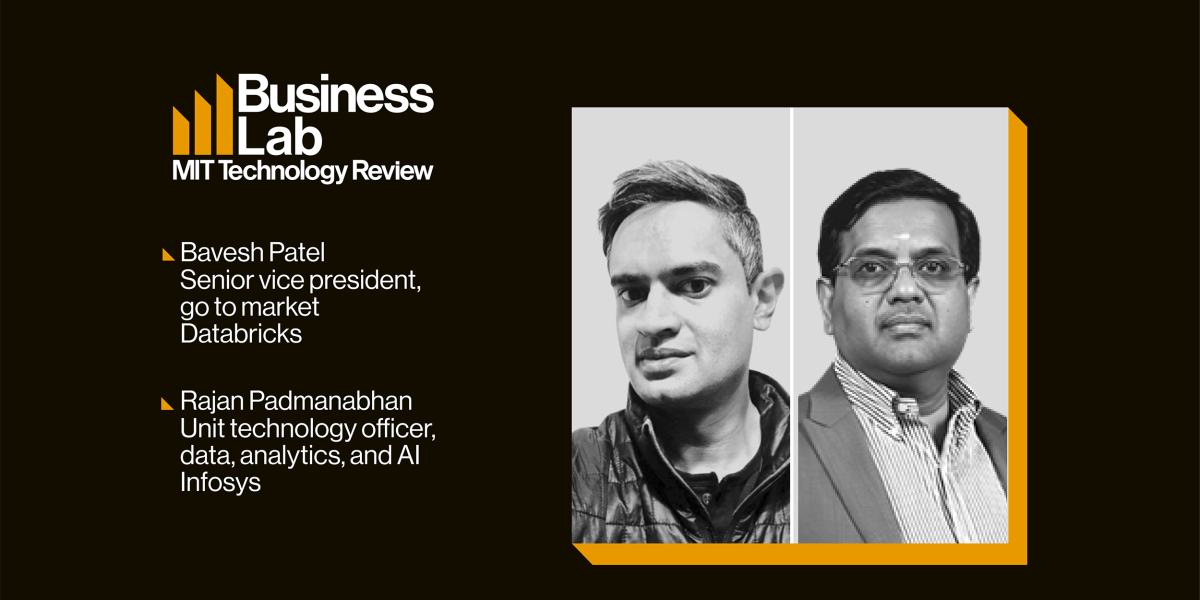
My guest today, are Bavesh Patel, senior vice president for Go-to-Market at Databricks, and Rajan Padmanabhan, unit technology officer for data analytics and AI at Infosys.

Welcome, Bavesh and Rajan.

Rajan Padmanabhan: Thank you. Thanks for having us.

Bavesh Patel: Thanks for having us.

Megan: Fantastic. Thank you both so much for joining us today. Bavesh, if I could come to you first, when we talk about AI-ready data, what exactly do we mean? What new demands does AI place on data, and how does this impact the way it needs to be structured and used?

Bavesh: Yeah. Great question. Appreciate you hosting us today. I think that obviously the whole world is enamored with AI because of all of the power that we can all see as users. AI is now democratized across hundreds of millions of users. And when we think about enterprises and businesses using AI, the quality of that AI and how effective that AI is really dependent on information in your organization, and that’s data. And what we found is that most enterprises, their data is kind of locked away in these different applications and different systems. And it’s very difficult to get a good view of, what is all my data? How trustworthy is it? How recent and fresh is it? And all of that is being injected into the AI. Unless you have a proper understanding of your data, the ability to ensure that it’s data that’s accurate and that can be used so that the AI can take advantage of it, you’re actually going to end up having terrible AI.

We see a lot of customers spend time on cleansing their data, organizing their data, making sure it’s access controlled correctly, and that tends to be the fuel of good AI.

Megan: Yeah. It’s such a foundational thing, isn’t it? But it can be missed, I think, quite easily. Rajan, what difference can having AI-ready data really make for enterprises as they unlock that full potential of AI and its applications?

Rajan: First and foremost, thanks for having us. It’s a pleasure. I think in continuation of what Bavesh talked about, see, data and AI is pretty synonymous. And similarly, the consumer AI and enterprise AI and enterprise agentic AI are different because first and foremost, the business needs to have the context. That context from your enterprise information, which is not only structured, both structured and unstructured and user-generated contents and all forms of data is going to be very, very critical to really get the context right, and really get any model that you pick. That’s where the platforms like Databricks really help with the plethora of models or whether you want to build your own models or whether you want to ground the model based on your data. That is going to be very, very critical. That is where getting the data for AI is going to be very, very critical.

The third critical part, and this actually will be one of the roadblocks for adoption of AI. That’s why if you see the AI adoption on the consumer side is skyrocketing, but on the enterprise side, the enterprises are struggling is primarily around the precision of their output, because you are taking a business decisions where you are taking a buy decision, you are taking a sell decision, or you are trying to recommend something, recommend the content. It could be 20 different use cases. For that, the precision is going to be very critical. We are seeing our customers, the successful customers, definitely for the precision to be more than 92% is not aspiration, that is a must-have. If you have that, definitely being that AI data is going to be the entrepreneur right now for that.

Megan: And I suppose if we’ve outlined there how critical this is, where should enterprises start then, professional perhaps, the level, what are the foundations when it comes to building an AI-ready data model?

Bavesh: Yeah. And I think Rajan hit the nail on the head. I mean, enterprises are grappling with a different set of problems than consumer AI. The first thing is that you’ve got to get a handle on your data. As I mentioned, a lot of the data is locked in. Ensuring that you have ability to put your data in a place where you can understand the holistic view of as much of your data as possible. That kind of starts with putting your data in open formats. A lot of the valuable data today in an organization is locked away in some proprietary SaaS app or some system, and all the datasets aren’t connected together to form that context. The first step is to really do an analysis of what is your data estate? What are the critical pieces of data that need to be put into a place where you can start to understand them and how they’re connected to one another?

Thinking about how do you set up your data catalog, thinking about how do the relationships between the data assets work, putting data governance around it, that seems to be the first step. And if you think about how ChatGPT was built, it took all the data on the internet and then aggregated it, synthesized it, and then built these transformer models, while enterprises, they don’t really have a handle of all their data within the organization. That’s the first foundation that you really want to think about. The second thing is that you don’t want to just go ad hoc, go and do random AI projects. You really need to be thinking about business value. A lot of our customers are looking at AI much more strategically in that they want to be able to get projects on the board with wins and then generate business value.

Building an AI value roadmap, which is connected to how well your data is organized, those two things seem to be foundational to how do you launch AI successfully in your organization.

Megan: That value piece is so important, isn’t it? And as I understand it, Infosys and Databricks have worked closely together to guide organizations through this transformation. I wondered, can you share some examples of the impact you’ve seen enterprises you’ve worked with, Rajan, what difference has it made to the ways in which they can integrate more sophisticated AI and agentic AI applications?

Rajan: Well, that’s a very, very good question. What both Databricks and Infosys has done is we have come up with, a kind of a framework first. First and foremost, it all needs to start with the value. One of the largest food products company where we collaborated together, what we have done is we have applied this framework. The framework consists of six different things. First and foremost, very critical is the value management, which Bavesh touched upon. We have worked together to come up with a 3M measurement framework, what we call adaptability, business value, and then responsible. You can’t just go and do a garage project. It has to be measurable. It should be responsible, follow all those things. That is going to be very critical. And we helped this client to prioritize, which will give them the most value for money, the investments that they are making.

The second critical part here is it is not like most of the enterprises today are not everybody’s AI-born companies. Most of them were born during analog days; most of them were born in digital days. There are companies which are applying AI for modernization, because a lot of your historical information, which is actually helping you to build that long-term context. And that is where we have worked closely with some of the native tools of Databricks, like Lakebridge or the AI assistants that are there, and then create composable services on top of it to help the clients unlock the value bringing into Databricks. And then the second part where we help the client is exactly to the point, the readying of data. Now you brought in the data, now you have to bring both the structured, unstructured, analytical and all these aspects.

And that is where the third layer, we closely work with the Databricks, which is part of leveraging all the great capabilities within the Databricks, be it Unity Catalog, be it the open formats, or be it the gateways and other aspects. We were able to make the data available for this client. What has really helped our client, the third part, is Agent Bricks, which is one of the differentiatiors. It gives you the flavor for the enterprise. That is where we have closely worked, and we built some of our industry-specific agents, be it CPG, be it energy, be it FS. And for this client, what we have done is we have taken some of those CPG-specific use cases. Either it could be on the HR space or the procurement space or on the marketing space. And this has really helped our client be able to build a business capability surrounding this and unlock eight to nine use cases, we call it as a products, agentic AI products, which can really drive more value for them, solving the real business problems.

And this kind of a comprehensive set of frameworks plus set of suites of services, plus our solution assets, Infosys solution assets, as well asunlocking the value from Databricks has really helped these clients. And we see similar patents for a lot of these successful engagements where we were able to continuously drive the value by applying this framework actually.

Megan: Right. Sounds like it made a real material difference. Rajan mentioned a few of the tools in Databricks catalog there, Bavesh. I know you’ve recently worked to launch an operational database for AI agents and apps. I wonder how does a platform like that help organizations in this journey? What makes it different from some of the other platforms out there right now?

Bavesh: Databricks has come to market with a new offering called Lakebase, which is really an OLTP database where you can build your AI apps. And if you think about it, there’s really two main types of data in an enterprise. There’s all the historical data, which is all the things that have happened, and that’s really what your analytics is based on. You have an old app system where you have put all your historical data and Databricks has come to market with what we call the Lakehouse, which is essentially a data warehouse with all of your data that is not operational in nature. It’s historical data. And I think that Lakehouse concept is really pushing forward with AI because a lot of our customers have thousands of users within their business and they need to get data. And what they’ve done is they’ve actually gone down the BI route, which is really building a dashboard or a report.

Most organizations have had thousands of these dashboards and reports proliferate across the organization and then they need to be customized. It just takes a long time for users inside of the business to actually get access to the data. AI now is really making that a lot easier from just the analytics perspective where we can now democratize access to the data, which has really been the holy grail for most data teams. They really want to get out of the way and just give the right data to the right people inside of the business with the right access.

With a product like Genie at Databricks, you can just use English language or whatever your language is to ask questions of the data. And it’ll give you back data that answers your questions in context. It’ll give you not just what ChatGPT will give you, which is information about a topic that’s on the internet, but it will actually tell you, “Well, why did my sales numbers not reflect what I expected in the month of April?”

It’ll give you some root cause analysis based on your enterprise data. Genie is going to be one of these things that’s really important where it’s going to truly kind of democratize data inside of the business. That’s kind of this OLAP world, which is what the Lakehouse is. More recently, we’ve come to market with what we call the Lakebase, which is the OLTP world. What we’re finding is that agents are now being deployed in these organizations, and those agents need a place to keep all of their orchestration, all of the context of what’s happening in that particular workflow. On the one hand, you’ve got users just asking questions. On the other hand, the next chapter is going to be around automating an entire business process. If you’re taking a function like generating a campaign in marketing, right? There are a lot of tools you use and a lot of steps you use.

An agent can come in and really automate a lot of that. But on the back end of that agent, you’re going to need to stand up a real-time database to keep track of all the things that the agent is doing. That’s what Databricks has brought to market, which is this OLTP Lakebase solution. The innovation that we have brought to market is that it’s a modern kind of Postgres database where we have separated the compute and storage, very much like what we did with the data Lakehouse with the data warehouse. But on the Lakebase, the data is on one copy inside of your cloud storage, and then the compute is separated and it’s serverless. You can do things like branching and you can start up the OLTP database really quickly. What we found is that agents are actually starting these Lakebases because they can very quickly go start one up, keep it running, put it down when it needs to, make a copy of it.

Agents are doing this, then they need the velocity, they need a cost-effective solution. And the beauty of all this is when you take the OLTP, which is all around the Lakebase and the real time, and you take the OLAP, you now have one system for all your data. You don’t have to copy the data around, you don’t have to manage all the permissions, you can set the context against it. We see these AI apps being really the future of how businesses run, where they’re going to take away all of the bottlenecks that humans are having to do repetitive work and automate these using LLMs and all these new technologies. We want to be the default for powering all that because we believe that our Lakebase technology is going to be faster, cheaper, and more secure for an AI database.

Megan: Sounds like a real game changer. And we’ve touched on this a couple of times already, I mean, this idea of value. We know that engaging the commercial value of investments into AI is really high on the priorities right now for senior leaders. How important is this value measure piece when it comes to creating AI-ready data systems, Rajan? How can organizations ensure they’re monitoring what is delivering and what isn’t?

Rajan: This is the paramount importance and most of the successful AI implementations or agentic AI implementations really required this value measurement. I’ll just extend the client example that I talked about, the large food products company, the global products company, to explain this question. I just want to create a metaphor. When the initial digital world came, we have a lot of these analytics primarily around defining those performance management KPIs, fact-based decisioning and other things were evolving over a period of time. Typically, a lot of these metrics are going to be very critical for them to measure how a function, how a business is doing. On a similar line for the value measurement, if I take the same example of the client, what is very critical for an organization is actually to map your outcome that you are expecting.

Iin this case, how do I optimize my spend on direct and indirect purchases? So by applying AI, I would like to identify the areas where I can optimize the spend. That means one of the critical measures that you have is, what is your indirect expense classification and what spends you have been classified and how much you are able to reduce by bringing in this. Establishing these measures and the metrics is going to be very, very critical. And once you establish these base metrics and the measurement, and the beauty of it is some of these metrics, to just extend what Bavesh was talking about, the capabilities that Databricks gives you, like metrics view, features, tools, and other things would actually help you to translate those AI telemetries, business telemetries that is coming from your applications into a measurable metrics in terms of an outcome, which you can actually measure using the Genie room for value management measurement.

Then what happens is two things that you can take, the use case, the products that as I said for this client, the products that we build either on the procurement side or on the marketing research side, if you find there is a value either because of VAC, they identify that they’re able to optimize or it is able to reachability, what is the reach, you can either accelerate that use case and further fine tune that product to expand it. Or there are, if you find it is not really driving the value or I’m not able to see the value that it is going to deliver, you can very well do a fast failure method rather than trying to make it work, you can understand and then you can take a call to pivot it to something else different.

There are three aspects here. What we see from our experience, not only with this client across some of our other clients from industrial manufacturing or FS or in the energy, is by setting up this metrics-driven valuation method upfront and then leveraging the capabilities to establish, transform these telemetries, signals into a measurement, what we call an AI compass room so that you really measure the business stakeholders, whether it is coming from a marketing office or whether it is coming from supply chain office or whether it is coming from a CFO office where they can say, “Hey, this is what it is intended to do, this is what the current measurement, and this is where it’s failing that can help them to pivot.” And this will actually drive and democratize AI, all the agent decay across the enterprise, and that really drives the value.

This is going to be one of the critical part that enterprise needs to do it. And that is where the six part framework that I talked about, applying that framework like value office, applying the ready for AI, applying the transformation fabric. Then the third part is the governance, which is going to be the entrepreneur of this. Then running your operations, not based on SLA, based on the experience level agreements and business metrics for you to continually measure, bringing all these six layers is going to be very critical. That’s when we see the organizations are very successful, and some of our proven examples exactly do the same that this is going to be very critical for organizations from a measurement standpoint.

Megan: Lots of tangible ways there that you can actually gauge value here. And you touched on governance and the impact of AI on governance is another huge talking point among senior leaders and interactions with data are a core part of that. To what extent is having the right governance and security protocols an integral part of having AI-ready data? To Bavesh, what scenarios do these systems need to handle? What does that mean for data models?

Bavesh: This is becoming kind of the prerequisite to deploying a successful AI project. I think MIT produced a report that said 95% of these new AI projects fail to actually generate business value. A big reason for that is you can go and prototype and stand up and vibe code a pilot, but when you’re actually moving a workload into production, you realize that governance becomes so critical.

So what do we really mean by governance? I think the first thing is getting your data in order, like I said, in open formats. Most companies realize now that the way they engage with their customers, the way they develop a drug, the way they approve a person for a credit limit increase, all of that enterprise information is actually their competitive advantage. Because you can go and use a frontier model like ChatGPT or Claude that everybody has access to.

Really the big competitive differentiator for most organizations is their own data and then their third-party data that they can add to it. Getting your data into an open format so you can understand your data and understanding your data is where governance comes in. Because when you think about governance, you really want to be able to find the data.

If I’m an end user or if I’m building an AI product, I want to know what data’s available to me. Can I trust the data? How fresh is the data? Is it coming from my analytics world or do I need a real-time system like a OLTP system? I need to find the data. I also need to make sure that access is controlled in a way that doesn’t cause any huge headaches from my organization. This becomes critical. If I have a whole bunch of PDFs that have purchase orders in them, who actually has access to all that data?

In a clinical trial, for example, in healthcare, you really want to ensure that people across trials don’t have visibility to patient data. Maybe the model that was used to build that was running across trial. Who has access to all the data? Who has access to only parts of the data? You really have to think about this. We also look at semantics of the data. Rajan brought this up right at the beginning of this, which is what is the context? How do we think about the metrics and all the things that the business users know in their head? We need to start codifying that somewhere. We have a product at Databricks called Unity Catalog where you can do the discovery, the access and the business semantics. You also want to share the data.

And in the world of agents, what we see is something called agent sprawl. In a very short order, just like how SaaS applications became very prevalent within any organization where they really solved a business problem. You go to a line of business and you say, “I need to be able to do credit underwriting” or “I am doing a prior authorization use case or pick thousands of use cases.” There’s a SaaS app for that. Much like that, there’s going to be this world in which agents are going to come into play, and most organizations are going to have lots of agents running all the time, but the reality of it is that how did that agent perform? What was the feedback loop from the user? What was the cost of running that workload and is it going up dramatically? And if you don’t have a way to monitor, to understand, and trace all the questions and answers and responses at scale, you’re going to find yourself in a big pickle. This actually could hurt your organization because users will be very confused about what to do.

When you look at governance, most organizations are recognizing that they have to start to understand what is it that they have put in place from a systems, from a process, from a tooling standpoint, focus on one use case, build out the governance for that, but build it in a way that’s going to allow you to become repeatable. AI is not going to be about one use case or two use cases. It’s whoever builds the flywheel of building many use cases in a safe, secure way, in a cost-effective way that’s driving a business outcome. If you don’t apply governance, it’s going to be very hard.

At Databricks, we made a big bet on governance four or five years ago. This is one of the main reasons our company’s growing right now because we can ensure that there’s quality data that’s going into all of your AI. You can use things like Genie and you can use things like Agent Bricks and you can build apps using Lakebase. None of that really works without governance. It’s really what we call the brain inside of Databricks.

Most of our customers spend a lot of time inside of Unity Catalog. And the great news is that AI is helping governance get set up much more quickly. We have a customer that three years ago, they were trying to get all of the data assets across all their domains from the customer, from the loyalty app, from the e-commerce engine. They had to go and map out all this data assets. AI is now doing a lot of their work for them. The human in the loop is just checking things.

We’ve made this much easier with AI. We always think about AI as a business use case and an outcome, which I think is going to be where the biggest value is. But at Databricks, we’re using AI inside of our platform to make it much easier to operate and to make it much easier to provide all the right things for your business. This is a super critical part of how we plan to innovate as AI takes fruition in the market.

Megan: And Rajan, Bavesh touched on this a little bit there, but does the integration of Agentic AI add another layer of complexity here too? What new consideration around governance does that raise?

Rajan: That’s a very, very valid question. I would like to take a metaphor to really explain. We are getting into the world of self-driving cars, robotaxis, and other things. While that takes us to the autonomous world, but still there are rules that you need to adhere to when you are driving on a road. The reason I’m bringing this metaphor is because what is actually required is actually adhering to the rules and different topographies, different things, depends upon where you are driving is going to be very, very critical. The complexity that agents are going to add is basically how you operate with those constraints.

For example, as a UTO, I can do 10 things, but say if I cannot approve a discount for more than 70% or I cannot give something as a bonus for someone because that is a part of the CFO, which an agent should be aware of.

That is one aspect, applying the constraints around it and making sure that the agents are adhering to the constraints. The second set of complexity that it builds is the tools to access. As a business, in today’s world, when you define a process, certain processes need a certain set of tools to really actionize it. There are certain entitlements, only people entitled to do certain things based on their identity, based on the need or the situation need, you need to govern. The third is information sharing. While MCP and other aspects are great, UCP and other aspects are great, but one critical thing is what you need to share, what you don’t need to share. And those are the critical considerations.

The last part is learning and relearning. Sometimes when you learn good things, you should keep something. Sometimes it is better for you to completely remove it and reevaluate in a newer way, relearn it in a newer way. These are all the critical things that are required. On the similar line for agents, it is going to be paramount, because when you are operating agents for an enterprise, you need to know, learn, and adhere to certain compliance related rules, business related constraints, and then the entitlement identity, and then sharing whatever that apply to a physical human will also start applying to an agent. That is where this is going to be very critical. This requires a new set of operating systems. That doesn’t really mean now get out of a new thing. That is where I’m just interpreting how Bavesh touched upon the Unity Catalog.

The best part that which we see and some of our clients that which are implementing is extending the Unity Catalog and the capabilities like now you can catalog the tools, catalog the MCP as well as catalog these agents, and then govern those agents based on the constraints, ground them based on the constraints.

It’s going to be very, very critical. Doing it not later, but starting that as part of your strategy and enforcing this as one of the critical dimensions of when you measure the value is also going to be very critical for an organization. It is like making sure that not only building the autonomous car, but as well as making sure that the car drives as per the rules of the road, not going rogue.

Megan: Lots to think about there. Fascinating stuff. Thank you. Just to close, with a quick look ahead, we all know the pace of development in AI and Agentic AI is so rapid. For those organizations that can prioritize AI-ready data now, what are the most compelling use cases for the technology that you can see coming to the fore in the next few years, Bavesh?

Bavesh: I think the excitement level is at its peak. We’ve seen so much investment in AI. I think the reason why there’s a lot of excitement is because you can look at the early adopters and you can see massive amounts of gains that these organizations are seeing. The one thing I will tell you is that the companies that there’s really three categories and the companies that I think are doing well, a lot of them started out with just copilots and things that are just giving people quick answers. Think about it as making an individual productive. That is the first phase. And the ROI on that has been somewhat questionable. With something like Genie, it makes it a lot more effective because it’s actually on your data and your data is contextualized in your organization. I think that’s one level of area that we’re going to see a lot of innovation. We’ll see most organizations just start to get the right information to the right person at the right time. And that has been a dream for a lot of organizations.

The second one is around automating entire business processes. We see functions within marketing, like I described earlier, or whether you’re going through a process of rebates for a company. There’s a whole bunch of steps involved where you have to go into three different apps and export data from Excel and put it over here. There’s thousands of people doing very laborious, monotonous, repeatable work. These agents are really going to help get an immense amount of not only productivity for the business process, but it’s just going to make things faster. Processes that took weeks are now going to take days. Processes that took days are going to take hours and minutes now.

One trend we’ve seen is that the AI world is so dynamic. In a world where you got lots of different players, you want to think about first principles, what are the foundations? You want to think about owning your data, making sure you have a handle on your structured and unstructured data. You want to put governance on that. But the other thing that you want to make sure that you don’t do is lock yourself in.

Today, if you think about it, Gemini is really good with multimodal. Anytime you have pictures or videos or things like that, Gemini just is super good. Whereas if you’re writing code, Claude is really good. If you’re just doing certain types of questions around introspection, ChatGPT is really good. What you really want is an open data platform where you can build your open AI on multiple clouds, which is what we built at Databricks.

I think that’ll help with the second piece, which is you can pick and choose because when you build these agents, you don’t have to be locked into just one. You should be picking the best quality and the best security and the best ROI and cost for a particular workload. One workload may use multiple of these models, and they might be even specific industry models. You need a system and a platform that can really handle this complexity.

I think the third category is business reimagination. A lot of people talk about this where, yes, you’re going to go and take the data and make it available and give everybody access to the data. You’re going to make existing processes much more efficient. But the third thing is there’s going to be brand new things that come out of it.

We have a very large customer who’s a bank and they have built a product that they didn’t have a year ago. Essentially, it’s machine learning and LLMs helping treasury departments forecast what their balances are going to be because they have more data at their fingertips. Historically, it took a long time for the data to get to the bankers. They were not able to really predict what a balance would be for a treasury department. Think about this for a big enterprise company, they have now built a brand new data AI solution that they’re monetizing and it’s generated hundreds of millions of dollars in the first six months. We’re seeing brand new lines of business open up and that is going to be really exciting because that’s where a lot of the transformation is going to happen. There’s going to be productivity. There’s going to be kind of automation at the business process level. Then there’s going to be these big new things that we didn’t even imagine that people are going to come up with.

We are actually seeing the early signals of this in every industry. We see retailers getting data at the hourly and the minute level so that they can integrate much more closely with their supply chains. We’re seeing much more targeted customer 360-degree use cases where as retailers or as consumers, we get annoyed by ads, but now it’s so contextualized and you have so much information about what really matters to your target customer, you’re giving them value added kind of information and that’s engaging them more. There’s a whole bunch of innovation happening with agentic commerce and things like concierge and virtualized shopping.

You look at any industry, there’s definitely new ways of doing things. This is what’s really exciting about AI, but you really have to not get too far ahead without thinking about what are the foundational things. You mentioned this earlier, which is open data platform, making sure you have governance correctly, making sure you think about your historical analytical data and your application data that’s going to be real time, having a good foundation to build on, that’s going to allow you to scale and move more quickly and compete in this new world.

We’re very excited about what we’re seeing with our customers and what they’re building. And honestly, that’s the best part about being in my role at Databricks, which is our teams really go to customers and say, “What are the outcomes you’re driving?” The early signals have been super positive. We’re seeing companies that get serious about all the foundational elements and really are methodical about building really outcome-based AI solutions, that 5% of projects that are being successful, those are wildly successful. That’s why we’re growing as a company because once you get a good project under your belt, that gets visibility within executives.

The last thing is that historically, a lot of tech has been in the IT department. You get the business designing how they want to go to market and how they’re going to compete and what products and services they want to offer. IT was the enabler and in many cases became the cost center and was relegated to rationalizing the portfolio of spend and tools.

But now we’re seeing the business kind of take the lead with AI where they want to understand, they want to know, “Hey, what can I be doing now that was not possible before?” We see this big opportunity just with AI literacy with business users where they’re very eager to understand how they should be thinking about AI. What does AI mean when you peel the covers? What are the pieces and the building blocks that you need to put in place, both from a technology and a training and an enablement standpoint? We’re spending a lot of time with executives helping them along this journey. We definitely see a lot of amazing opportunities ahead.

Megan: Yeah. So much innovation going on. And finally, how about yourself, Rajan? What on the horizon is exciting you the most?

Rajan: I think Bavesh covered quite a bit, but I think the way I’m seeing is today predominantly we are talking about labor shift. That means unlocking the potential of human or shifting the current way of working to the new way of working with the more efficiency game. It’s predominantly more of an efficiency game. I think that is what we are seeing now and the majority of the successful use cases around the labor shift. But what is pretty promising is the two kinds of shift, the business shifts.

What we are seeing as a new way of thinking or the new thing that is coming up is moving from system of execution or a system of engagement to system of action. That is the new way we see the road ahead. That is where some of the points that I touched upon. The business wants to have access to it, but how does it really make the real difference for it?

One classical example that I could clearly see which we have implemented for one of our customers primarily in the manufacturing space, is around the lifecycle of creation of a product and then publishing the content around the product in line with their different B2B marketplaces. Some of those, you are not just talking about recommending, creating, but actually you are able to reimagine this process, which used to involve five different departments, now can be done much faster, but at the same time gives you that veracity in terms of the decisioning that you are able to do and as far as how you’re able to actionize. That is the second thing which we are seeing.

The third part I think is also going to be is the way how the commerce has evolved. There is also not beyond that agentic commerce, but I think what we are seeing is that agent to agent commerce, agent to human commerce and agent to agent payments, agent to human payments, and then the content monetization.

These are the new set of business opportunities like building new business agentic products. It could be for family techs, it could be for on the consumer side, or it could be on the industrial technology side. These are going to be what I’m calling the economy shift, labor shift, business shift, because that is going to bring a new set of system of actions, moving them from the system of executions or the typical SaaS application with the bolt-on agentic, the so called agentic application. That is going to be a major transformation, and we are underway. But on the technology side, what is very critical for entrepreneuring is in today’s world you have data, analytical data, operational data, and then there is intelligence, there are different facets of it.

I think both this analytical core and operational core is going to really come into one. That’s why we are so gung-ho about the releases of Lakebase and other things because that is the way the future is going to drive. When they are really thinking about being ready for AI technology use cases, they should really think, how do you really create this unified core for the newer world?

The second part is people have to reimagine today, if I take SAP as an example, you do hundreds of edge applications, business applications needed to integrate another thing. Typically, we create sprawl of these integrations. One technology use case, people can say, “Hey, how do I really create a domain-based service mesh on top of this unified core and how do I make it more agentic integration ready?” That is one of the technology use cases that we are advising to the client.

I think now with a lot of the new areas that are coming around SAP, BDC with the Databricks, and this zero-based integration, that makes them rethink the way they need to integrate, the way they need to do things.

The third part, I think from a technology investment and technology, the use cases that most come for the technology that I would talk about is don’t just talk about now. This is the time that you have to, the way you own the people, the FTEs for your organizations. Agents are going to be your new FTEs.

That means that some of the new technology paradigm is going to be you will end up creating these co-intellects within your organization. That means you need to invest on what we call this agentic grid, where it becomes like a unified agentic fabric where every other agents can really collaborate and integrate and building on top of the same, the unified operational analytical core, the unified agentic integration on top of it, which is going to create a new set of experiences, agentic experiences rather than the traditional experiences or conversational experiences.

Then the new collaboration methods are going to be some of the critical aspects from a technology side that people have to really think from a technology standpoint. To start with, I would say you start looking at it from a data standpoint, building that unified core, building that unified integration and building that collaboration layer for both sharing and collaborating with intelligence as well as the agentic collaboration all governed under single umbrella. That is going to be the one critical use case which no one will feel bad about, and they are going to get really a 100X of their investments out of it.

Megan: Certainly no shortage of exciting developments on the horizon. Thank you both so much for that conversation. That was Bavesh Patel, senior vice president for Go-to-Market at Databricks and Rajan Padmanabhan, unit technology officer for data analytics and AI at Infosys, whom I spoke with from Brighton, England.

That’s it for this episode of Business Lab. I’m your host, Megan Tatum. I’m a contributing editor and host for Insights, the custom publishing division of MIT Technology Review. We were founded in 1899 at the Massachusetts Institute of Technology, and you can find us in print, on the web and at events each year around the world. For more information about us and the show, please check out our website at technologyreview.com.

This show is available wherever you get your podcasts, and if you enjoyed this episode, we hope you’ll take a moment to rate and review us. Business Lab is a production of MIT Technology Review, and this episode was produced by Giro Studios. Thanks for listening.

This content was produced by Insights, the custom content arm of MIT Technology Review. It was not written by MIT Technology Review’s editorial staff. It was researched, designed, and written by human writers, editors, analysts, and illustrators. This includes the writing of surveys and collection of data for surveys. AI tools that may have been used were limited to secondary production processes that passed thorough human review.

Shape
Shape
Stay Ahead

Explore More Insights

Stay ahead with more perspectives on cutting-edge power, infrastructure, energy,  bitcoin and AI solutions. Explore these articles to uncover strategies and insights shaping the future of industries.

Shape

Cirrascale to offer on-prem Google Gemini models

Google Distributed Cloud can be deployed in customer-controlled environments, including installations that are disconnected from the Internet, which is a key requirement for some government and critical-infrastructure users. One of the big challenges is that these models are incredibly valuable and they need to be delivered in a trusted, secure

Read More »

Cisco switch aimed at building practical quantum networks

Cisco today unveiled a prototype switch it says will significantly accelerate the timeline for practical, distributed, quantum-computing-based networks. Cisco’s Universal Quantum Switch is designed to connect quantum systems from different vendors, such as IBM, IonQ, Google and Rigetti, in all major qubit encoding technologies, at room temperature, and over standard

Read More »

US BLM to offer 400,000 acres for oil and gas leasing under ANWR’s coastal plain in June

The US Bureau of Land Management (BLM) will offer oil and gas leases on 400,000 acres under the Alaska National Wildlife Refuge (ANWR)’s coastal plain on June 5, the first in a series of at least four sales required under the One Big Beautiful Bill Act (OBBBA), which the Trump administration now calls the Working Families Tax Cut act. Recent attempts to lease land for oil and gas development in the 1.5-million-acre coastal plain (the “1002 Area”) of ANWR have generated little interest, with the most recent federal lease sale in January 2025 yielding zero bids and no revenue for federal or state taxpayers. This sale was the second auction mandated by another bill, the 2017 Tax Cuts and Jobs Act. The first sale under that law, held in January 2021, offered 1.1 million acres but yielded only $14.4 million in high bids, less than 1% of the roughly $1 billion originally estimated. BLM noted, however, that a recent federal lease sale in the National Petroleum Reserve in Alaska generated strong participation, which could portend a stronger showing for the upcoming ANWR sale. “The record-breaking success of last month’s lease sale in Alaska’s National Petroleum Reserve sent a clear signal: There is robust and continuing demand for Alaskan energy, underscoring the need for more opportunities like the Coastal Plain sale,” Acting BLM Director Bill Groffy said in a statement. “By expanding these opportunities, we strengthen our national energy security, support high-paying jobs for Alaskans, and help ensure Americans have access to affordable energy.” The Mar. 18 NPR-A sale resulted in 187 leases and $163.7 million in total receipts. Oil and gas development in ANWR remains contentious because of its ecologically sensitive environment and ongoing lawsuits from indigenous groups and environmental organizations. Majors, including ExxonMobil, ConocoPhillips, and bp have left the area

Read More »

Oil prices decline as Strait traffic resumes

Friday’s move has the May 2026 WTI NYMEX futures are trading below the 8-, 13-, and 21-day Moving Averages with a Low that breached the Lower-Bollinger Band limit. Volume is down to 80,000 as May expires next week and traders turn their attention to June. The Relative Strength Indicator (RSI), a momentum indicator, has fallen back into neutral territory at 42. Resistance is now pegged at $93.70 (8-day MA) while near-term Support is $82.45 (Bollinger Band). As has been the pattern for several weeks now, traders have to be cautious with their Friday positions as the market is closed until Sunday evening and the US/Iran talks continue on Saturday.   Looking ahead Questions now remain in terms of the duration of the Israeli ceasefire with Lebanon which Iran has tied to the opening of the Strait of Hormuz. Should Israel violate the ceasefire, it would put Iran’s IRGC back in direct conflict with US naval forces in the area should the former attempt to close the Strait again. US/Iran negotiations are scheduled to continue this weekend in Islamabad. Once again, markets will be closed until Sunday evening so the outcome of those talks will be key to market direction on the Open. Should peace hold, there will need to be a very detailed assessment of the long-term damage to all oil and gas infrastructure in the region. The tanker tracking map below indicates loaded oil vessels are exiting the Strait of Hormuz. Natural gas, fundamental analysis May NYMEX natural gas futures have now been on a 5-week downtrend on mild weather and a larger-than-expected storage injections despite healthy LNG export volumes. The week’s High was Monday’s $2.72/MMbtu while the Low was Tuesday’s $2.56, a tight range which indicates market direction uncertainty.   Natural gas demand this week has been estimated at about

Read More »

Phillips 66, Kinder Morgan move forward with Western Gateway pipeline with secured shipper interest

Phillips 66 Co. and Kinder Morgan Inc. have secured sufficient shipper interest to advance the proposed Western Gateway refined products pipeline project to supply fuel to ‌Arizona and California, the companies said in a joint release Apr. 20. Following a second open season to secure long-term shipper commitments, the companies will “move the project forward, subject to the execution of definitive transportation service agreements, joint venture agreements, and respective board approvals,” the companies said. “Customer response during the open season underscores the importance of Western Gateway in addressing long term refined products logistics needs in the region,” said Phillips 66 chairman and chief executive officer Mark Lashier. “By utilizing existing pipeline assets across multiple states along the route, we’re uniquely well-positioned to support a refined products transportation solution,” said Kim Dang, Kinder Morgan chief executive officer. Western Gateway pipeline specs The planned 200,000-b/d Western Gateway project is designed as a 1,300-mile refined products system with a new-build pipeline from Borger, Tex. to Phoenix, Ariz., combined with Kinder Morgan’s existing SFPP LP pipeline from Colton, Calif. to Phoenix, Ariz., which will be reversed to enable east-to-west product flows into California. It will be fed from supplies connected to Borger as well as supplies already connected to SFPP’s system in El Paso, Tex. The Gold Pipeline, operated by Phillips 66, which currently flows from Borger to St. Louis, will be reversed to enable refined products from midcontinent refineries to flow toward Borger and supply the Western Gateway pipeline. Western Gateway will also have connectivity to Las Vegas, Nev. via Kinder Morgan’s 566-mile CALNEV Pipeline. The Western Gateway Pipeline is targeting completion by 2029.  Phillips 66 will build the entirety of the new pipeline and will operate the line from Borger, Tex., to El Paso, Tex. Kinder Morgan will operate the line from El

Read More »

Viva Energy reports on Geelong refinery status following fire

Viva Energy Group Ltd. has stabilized operations at its 120,000-b/d Geelong refinery in Victoria, Australia, which continues operating at reduced rates following a mid-April fire in the site’s gasoline complex. In an Apr. 20 update to the market, Viva Energy confirmed the Apr. 15 fire specifically occurred in the complex’s alkylation unit and was not fully extinguished until the morning of Apr. 16. While the refinery’s crude distillation units and reformer continue operating, the site’s residue catalytic cracking unit (RCCU) remains temporarily offline as part of ongoing stabilization efforts, according to the company. In the near term, Viva Energy said it expects the refinery’s diesel and jet fuel production to average about 80% normal capacity, with gasoline output reduced to about 60% capacity. The company anticipates production constraints to ease in the coming weeks, subject to inspection and restart of the RCCU, which would allow the refinery’s combined output diesel, jet fuel, and gasoline to exceed 90% of nameplate capacity until all necessary repairs are completed. With sufficient fuel inventories already on hand, Viva Energy said it remains well-positioned to maintain normal fuel supplies to customers during the production shortfalls. “The whole Viva Energy team understands how important our refinery is to the energy security of the country, especially at the current time. We will progressively restore production once we are confident that it is safe to do so, and do not expect any disruptions to fuel availability or price increases for Viva Energy’s customers as a result of this incident,” Scott Wyatt, Viva Energy’s chief executive officer, said in a separate statement. While the company confirmed an assessment of damage to the alkylation unit and associated systems is under way, estimated timelines for full repairs and financial impacts resulting from the fire have yet to be determined. Alongside prioritizing

Read More »

Oil prices plunge following full reopening of the Strait of Hormuz to commercial vessels

Oil prices plunged on Apr. 17, as geopolitical tensions in the Middle East showed signs of easing, following the full reopening of the Strait of Hormuz to commercial vessels. Global crude markets reacted sharply after Iran confirmed that the Strait of Hormuz is now “completely open” to commercial shipping during an ongoing ceasefire tied to regional conflict negotiations. The announcement marked a major turning point after weeks of disruption that had severely constrained global oil flows. Stay updated on oil price volatility, shipping disruptions, LNG market analysis, and production output at OGJ’s Iran war content hub. Brent crude fell by more than 10%, dropping to around $88–89/bbl, while US West Texas Intermediate (WTI) declined to the low $80s—both benchmarks hitting their lowest levels in over a month. The sell-off reflects a rapid unwinding of the geopolitical risk premium that had built up during the conflict. The reopening follows a fragile, 10-day ceasefire involving Israel and Lebanon, alongside tentative progress in US–Iran negotiations. While the waterway is now open, the US has maintained a naval blockade on Iranian ports, signaling that broader geopolitical risks have not fully dissipated. The return of tanker traffic through the Gulf could gradually restore millions of barrels per day to global markets, easing the tight conditions that had driven recent price volatility. However, some uncertainty remains over how quickly shipping activity will normalize and whether the ceasefire will hold. Despite the sharp price decline, the oil market remains structurally fragile. Weeks of disruption have depleted inventories and altered trade flows, and it may take time for supply chains to fully recover. Additionally, any breakdown in ceasefire talks could quickly reverse the current trend. Beyond energy markets, the development rippled across global financial systems. Equity markets surged, with major US indices posting strong gains as lower oil

Read More »

EIA: US crude inventories up 1.9 million bbl

US crude oil inventories for the week ended Apr. 17, excluding the Strategic Petroleum Reserve, increased by 1.9 million bbl from the previous week, according to data from the US Energy Information Administration (EIA). At 465.7 million bbl, US crude oil inventories are about 3% above the 5-year average for this time of year, the EIA report indicated. EIA said total motor gasoline inventories decreased by 4.6 million bbl from last week and are about 0.5% below the 5-year average for this time of year. Finished gasoline inventories increased while blending components inventories decreased last week. Distillate fuel inventories decreased by 3.4 million bbl last week and are about 8% below the 5-year average for this time of year. Propane-propylene inventories increased by 2.1 million bbl from last week and are 69% above the 5-year average for this time of year, EIA said. US crude oil refinery inputs averaged 16.0 million b/d for the week, which was 55,000 b/d less than the previous week’s average. Refineries operated at 89.1% of capacity. Gasoline production increased, averaging 10.1 million b/d. Distillate fuel production increased, averaging 5.0 million b/d. US crude oil imports averaged 6.1 million b/d, up 787,000 b/d from the previous week. Over the last 4 weeks, crude oil imports averaged about 6.0 million b/d, 0.4% less than the same 4-week period last year. Total motor gasoline imports averaged 587,000 b/d. Distillate fuel imports averaged 190,000 b/d.

Read More »

BYOP Moves to the Center of Data Center Strategy

Self-Sufficiency Becomes a Feature, Not a Risk Consider Wyoming’s Project Jade, where county commissioners approved an AI campus tied to 2.7 GW of new natural gas-fired generation being developed by Tallgrass Energy. Reporting from POWER described the project as a “bring your own power” model designed for a high degree of self-sufficiency, with a mix of natural gas generation and Bloom fuel cells. The campus is expected to scale significantly over time. What stands out is not only the size, but the positioning. Self-sufficiency is becoming a selling point both for developers seeking to de-risk timelines, and for local stakeholders wary of overloading existing utility infrastructure. Fuel Cells and Nuclear: The Middle Ground and the Long Game Fuel cells occupy an important middle ground in this shift. Bloom Energy’s 2026 report positions fuel cells as a leading onsite option due to shorter lead times, modular deployment, and lower local emissions. Market activity suggests that interest is real. For developers, fuel cells can be easier to permit than large turbine installations and can be deployed incrementally. That makes them effective as bridge-to-grid solutions or as permanent components of hybrid architectures. Advanced nuclear remains the most strategically significant, but least immediate, BYOP pathway. Companies including Switch and other data center operators have explored partnerships with Oklo around its Aurora small modular reactor design. Nuclear holds long-term appeal because it offers firm, low-carbon power at scale. But for current AI buildouts, it remains a future option rather than a near-term construction solution. The immediate reality is that gas and modular onsite systems are closing the time-to-power gap, while nuclear is being positioned as a longer-duration successor as licensing and deployment timelines evolve. The model itself is also evolving. BYOP is beginning to blur the line between developer, energy provider, and compute customer. Reuters

Read More »

Microsoft Builds for Two Worlds: Sovereign Cloud and AI Factories

So far in 2026, across the United States and overseas, Microsoft is building an infrastructure portfolio at full hyperscale. The strategy runs on two tracks. The first is familiar: sovereign cloud expansion involving new regions, local data residency, and compliance-driven enterprise infrastructure. The second is larger and more consequential: purpose-built AI factory campuses designed for dense GPU clusters, liquid cooling, private fiber, and power acquisition at a scale that extends far beyond traditional cloud infrastructure. Despite reports last year that Microsoft was pulling back on data center development, the company is accelerating. It is not only advancing its own large-scale campuses, but also absorbing premium AI capacity originally aligned with OpenAI. In Texas and Norway, projects tied to OpenAI’s infrastructure plans have shifted back into Microsoft’s orbit. Even after contractual changes gave OpenAI greater flexibility to source compute elsewhere, Microsoft remains the market’s most reliable backstop buyer for top-tier AI infrastructure. It no longer needs to control every OpenAI build to maintain its position. In 2026, Microsoft is still the company best positioned to turn uncertain AI demand into deployed capacity, e.g. concrete, steel, power, and silicon at scale. Building at Industrial Scale The clearest indicator of Microsoft’s intent is its capital spending. In its January 2026 earnings cycle, Reuters reported that Microsoft’s quarterly capital expenditures reached a record $37.5 billion, up nearly 66% year over year. The company’s cloud backlog rose to $625 billion, with roughly 45% of remaining performance obligations tied to OpenAI. About two-thirds of that quarterly capex was directed toward compute chips. To be clear: this is no speculative buildout. Microsoft is deploying capital against a massive, committed demand pipeline, even as it maintains significant exposure to OpenAI-driven workloads. The company is solving two infrastructure problems at once: supporting broad Azure and Copilot growth, while ensuring

Read More »

AI’s Execution Era: Aligned and Netrality on Power, Speed, and the New Data Center Reality

At Data Center World 2026, the industry didn’t need convincing that something fundamental has shifted. “This feels different,” said Bill Kleyman as he opened a keynote fireside with Phill Lawson-Shanks and Amber Caramella. “In the past 24 months, we’ve seen more evolution… than in the two decades before.” What followed was less a forecast than a field report from the front lines of the AI infrastructure buildout—where demand is immediate, power is decisive, and execution is everything. A Different Kind of Growth Cycle For Caramella, the shift starts with scale—and speed. “What feels fundamentally different is just the sheer pace and breadth of the demand combined with a real shift in architecture,” she said. Vacancy rates have collapsed even as capacity expands. AI workloads are not just additive—they are redefining absorption curves across the market. But the deeper change is behavioral. “Over 75% of people are using AI in their day-to-day business… and now the conversation is shifting to agentic AI,” Caramella noted. That shift—from tools to delegated workflows—points to a second wave of infrastructure demand that has not yet fully materialized. Lawson-Shanks framed the transformation in more structural terms. The industry, he said, has always followed a predictable chain: workload → software → hardware → facility → location. That chain has broken. “We had a very predictable industry… prior to Covid. And Covid changed everything,” he said, describing how hyperscale demand compressed deployment cycles overnight. What followed was a surge that utilities—and supply chains—were not prepared to meet. From Capacity to Constraint: Power Becomes Strategy If AI has a gating factor, it is no longer compute. It is power. “Before it used to be an operational convenience,” Caramella said. “Now it’s a strategic advantage—or constraint if you don’t have it.” That shift is reshaping executive decision-making. Power is no

Read More »

The Trillion-Dollar AIDC Boom Gets Real: Omdia Maps the Path From Megaclusters to Microgrids

The AI data center buildout is getting bigger, denser, and more electrically complex than even many bullish observers expected. That was the core message from Omdia’s Data Center World analyst summit, where Senior Director Vlad Galabov and Practice Lead Shen Wang laid out a view of the market that has grown more expansive in just the past year. What had been a large-scale infrastructure story is now, in Omdia’s telling, something closer to a full-stack industrial transition: hyperscalers are still leading, but enterprises, second-tier cloud providers, and new AI use cases are beginning to add demand on top of demand. Omdia’s updated forecast reflects that shift. Galabov said the firm has now raised its 2030 projection for data center investment beyond the $1.6 trillion figure it showed a year ago, arguing that surging AI usage, expanding buyer classes, and the emergence of new power infrastructure categories have all forced a rethink. “One of the reasons why we raised it is that people keep using more AI,” Galabov said. “And that just means more money, because we need to buy more GPUs to run the AI.” That is the simple version. The more consequential one is that AI is no longer behaving like a contained technology cycle. It is spilling outward into adjacent infrastructure markets, including batteries, gas-fired onsite generation, and high-voltage DC power architectures that until recently sat well outside the mainstream data center conversation. A Market Moving Faster Than the Forecasts Galabov opened by revisiting the predictions Omdia made last year for 2030. On several fronts, he said, the market is already validating them faster than expected. AI applications are becoming commonplace. AI has become the dominant driver of data center investment. Self-generation is no longer a fringe strategy. Even some of the rack-scale architecture concepts that once looked

Read More »

Data Center World 2026: Innovation Spotlight

Belden + OptiCool: Modular Cooling for the AI Middle Market At Data Center World 2026, company representatives from Belden and OptiCool described a joint push into integrated rack-level infrastructure—pairing connectivity, power, and modular cooling into a single deployable system aimed squarely at enterprise and mid-market colocation providers. The partnership reflects a shift already underway inside Belden itself. Long known as a manufacturer of wire, cable, and connectivity products, the company said it has spent the last several years evolving into a solutions provider—leveraging a broader portfolio that spans industrial networking, automation, and control systems. That repositioning is now extending into AI infrastructure. From Components to Fully Integrated Systems Rather than selling discrete products into bid cycles, Belden is now packaging racks, PDUs, cable management, and cooling into a unified offering—delivered as a manufacturer-backed system rather than a third-party integration. “We can bring a full solution to the table now,” a company representative said, emphasizing that the company is “standing behind the solution as a manufacturer, not as a system integrator.” The cooling layer comes via OptiCool, whose rear-door heat exchanger (RDHx) technology is designed to scale alongside uncertain AI workloads. Two-Phase Rear Door Cooling at Rack Scale OptiCool’s approach centers on two-phase cooling applied at the rear door, combining the non-invasive characteristics of RDHx with the efficiency gains typically associated with direct-to-chip liquid cooling. According to company representatives, the system: Supports up to 120 kW per rack (with 60 kW demonstrated on the show floor) Delivers up to 10x cooling capacity compared to traditional approaches Operates at roughly one-third the energy consumption of comparable single-phase systems Instead of injecting cold air, the system extracts heat using refrigerant as the heat sink, reducing demand on CRAC units and broader facility cooling infrastructure. Designing for Uncertainty: Modular, Swappable Capacity The defining feature—and

Read More »

Space data-center news: Roundup of extraterrestrial AI endeavors

Orbital is betting that distributed inference can scale as a constellation, with each satellite handling workloads in parallel. The company is also filing with the FCC for a larger constellation. Lonestar announces first commercial space data storage service April 2026: Lonestar Data Holdings announced StarVault, which it’s calling “the world’s first commercially operational space-based sovereign data storage platform.” The service launches in October 2026 aboard Sidus Space’s LizzieSat-4 mission. StarVault isn’t a full data center — it’s data storage with “advanced cryptographic key escrow capabilities,” according to the announcement. But it’s the first commercial space data service that enterprises can actually buy. Lonestar says demand from governments, financial institutions, and critical infrastructure operators has already exceeded expectations, and the company has ordered a second payload for launch next year. Lonestar has already flown four proof-of-concept data centers to space, including two to the Moon, according to the announcement. This is different because it’s the first one designed for paying customers. Atomic-6 launches a marketplace for buying orbital capacity April 2026: Atomic-6, a space systems company in Marietta, Georgia, has launched ODC.space — basically, a marketplace where you spec, price, and order orbital data center capacity the way you’d order a rack from a colo provider. You can buy either a sovereign satellite, where you get the whole thing, or colocated, where you rent space on someone else’s capacity, according to the announcement. Atomic-6 handles spacecraft build, launch, licensing, and operations through a partner network. You just supply the processors and the workload. Delivery runs two to three years, which Atomic-6 is carefully positioning against terrestrial data center timelines that now routinely run five-plus. Base configurations start with 1U nodes on satellites rated up to 100 kW. Connectivity starts at 1 Gbps. A sovereign rack runs $3.5 million a month, Atomic-6

Read More »

Microsoft will invest $80B in AI data centers in fiscal 2025

And Microsoft isn’t the only one that is ramping up its investments into AI-enabled data centers. Rival cloud service providers are all investing in either upgrading or opening new data centers to capture a larger chunk of business from developers and users of large language models (LLMs).  In a report published in October 2024, Bloomberg Intelligence estimated that demand for generative AI would push Microsoft, AWS, Google, Oracle, Meta, and Apple would between them devote $200 billion to capex in 2025, up from $110 billion in 2023. Microsoft is one of the biggest spenders, followed closely by Google and AWS, Bloomberg Intelligence said. Its estimate of Microsoft’s capital spending on AI, at $62.4 billion for calendar 2025, is lower than Smith’s claim that the company will invest $80 billion in the fiscal year to June 30, 2025. Both figures, though, are way higher than Microsoft’s 2020 capital expenditure of “just” $17.6 billion. The majority of the increased spending is tied to cloud services and the expansion of AI infrastructure needed to provide compute capacity for OpenAI workloads. Separately, last October Amazon CEO Andy Jassy said his company planned total capex spend of $75 billion in 2024 and even more in 2025, with much of it going to AWS, its cloud computing division.

Read More »

John Deere unveils more autonomous farm machines to address skill labor shortage

Join our daily and weekly newsletters for the latest updates and exclusive content on industry-leading AI coverage. Learn More Self-driving tractors might be the path to self-driving cars. John Deere has revealed a new line of autonomous machines and tech across agriculture, construction and commercial landscaping. The Moline, Illinois-based John Deere has been in business for 187 years, yet it’s been a regular as a non-tech company showing off technology at the big tech trade show in Las Vegas and is back at CES 2025 with more autonomous tractors and other vehicles. This is not something we usually cover, but John Deere has a lot of data that is interesting in the big picture of tech. The message from the company is that there aren’t enough skilled farm laborers to do the work that its customers need. It’s been a challenge for most of the last two decades, said Jahmy Hindman, CTO at John Deere, in a briefing. Much of the tech will come this fall and after that. He noted that the average farmer in the U.S. is over 58 and works 12 to 18 hours a day to grow food for us. And he said the American Farm Bureau Federation estimates there are roughly 2.4 million farm jobs that need to be filled annually; and the agricultural work force continues to shrink. (This is my hint to the anti-immigration crowd). John Deere’s autonomous 9RX Tractor. Farmers can oversee it using an app. While each of these industries experiences their own set of challenges, a commonality across all is skilled labor availability. In construction, about 80% percent of contractors struggle to find skilled labor. And in commercial landscaping, 86% of landscaping business owners can’t find labor to fill open positions, he said. “They have to figure out how to do

Read More »

2025 playbook for enterprise AI success, from agents to evals

Join our daily and weekly newsletters for the latest updates and exclusive content on industry-leading AI coverage. Learn More 2025 is poised to be a pivotal year for enterprise AI. The past year has seen rapid innovation, and this year will see the same. This has made it more critical than ever to revisit your AI strategy to stay competitive and create value for your customers. From scaling AI agents to optimizing costs, here are the five critical areas enterprises should prioritize for their AI strategy this year. 1. Agents: the next generation of automation AI agents are no longer theoretical. In 2025, they’re indispensable tools for enterprises looking to streamline operations and enhance customer interactions. Unlike traditional software, agents powered by large language models (LLMs) can make nuanced decisions, navigate complex multi-step tasks, and integrate seamlessly with tools and APIs. At the start of 2024, agents were not ready for prime time, making frustrating mistakes like hallucinating URLs. They started getting better as frontier large language models themselves improved. “Let me put it this way,” said Sam Witteveen, cofounder of Red Dragon, a company that develops agents for companies, and that recently reviewed the 48 agents it built last year. “Interestingly, the ones that we built at the start of the year, a lot of those worked way better at the end of the year just because the models got better.” Witteveen shared this in the video podcast we filmed to discuss these five big trends in detail. Models are getting better and hallucinating less, and they’re also being trained to do agentic tasks. Another feature that the model providers are researching is a way to use the LLM as a judge, and as models get cheaper (something we’ll cover below), companies can use three or more models to

Read More »

OpenAI’s red teaming innovations define new essentials for security leaders in the AI era

Join our daily and weekly newsletters for the latest updates and exclusive content on industry-leading AI coverage. Learn More OpenAI has taken a more aggressive approach to red teaming than its AI competitors, demonstrating its security teams’ advanced capabilities in two areas: multi-step reinforcement and external red teaming. OpenAI recently released two papers that set a new competitive standard for improving the quality, reliability and safety of AI models in these two techniques and more. The first paper, “OpenAI’s Approach to External Red Teaming for AI Models and Systems,” reports that specialized teams outside the company have proven effective in uncovering vulnerabilities that might otherwise have made it into a released model because in-house testing techniques may have missed them. In the second paper, “Diverse and Effective Red Teaming with Auto-Generated Rewards and Multi-Step Reinforcement Learning,” OpenAI introduces an automated framework that relies on iterative reinforcement learning to generate a broad spectrum of novel, wide-ranging attacks. Going all-in on red teaming pays practical, competitive dividends It’s encouraging to see competitive intensity in red teaming growing among AI companies. When Anthropic released its AI red team guidelines in June of last year, it joined AI providers including Google, Microsoft, Nvidia, OpenAI, and even the U.S.’s National Institute of Standards and Technology (NIST), which all had released red teaming frameworks. Investing heavily in red teaming yields tangible benefits for security leaders in any organization. OpenAI’s paper on external red teaming provides a detailed analysis of how the company strives to create specialized external teams that include cybersecurity and subject matter experts. The goal is to see if knowledgeable external teams can defeat models’ security perimeters and find gaps in their security, biases and controls that prompt-based testing couldn’t find. What makes OpenAI’s recent papers noteworthy is how well they define using human-in-the-middle

Read More »