Stay Ahead, Stay ONMINE

Hacking the atmosphere: Geoengineering gets a reality check

Jim Franke pulls away the cover page of a presentation on the wraparound desk in his office, revealing an illustration of an odd-­looking aircraft with massive wings stretching out from a stubby fuselage. .cst-large, .cst-default { width: 100%; } @media (max-width: 767px) { .cst-block { overflow-x: hidden; } } @media (min-width: 630px) { .cst-large { margin-left: -25%; width: 150%; } @media (min-width: 960px) { .cst-large { margin-left: -16.666666666666664%; width: 140.26%; } } @media (min-width: 1312px) { .cst-large { width: 145.13%; } } } @media (min-width: 60rem) { .flourish-embed { width: 60vw; transform: translateX(-50%); left: 50%; position: relative; } } The uncrewed plane is soaring thousands of meters higher than commercial jets fly—so high you can see the curvature of the Earth. It’s precisely the type of aircraft one would need to begin artificially cooling the planet. Those outsize wings would keep the plane and its payload aloft in the stratosphere, about a dozen miles (or 20 kilometers) above the surface, where the air is much thinner—as little as 5% the density near the ground. Once at altitude, the plane would release materials that could, after a few steps of chemistry, reflect sunlight back into space. “If you want to get to 20 kilometers in the near term, this is probably the best bet,” says Franke, a research assistant professor at the University of Chicago. Franke is one of a small but growing cohort of scientists focused on the engineering challenges associated with solar geoengineering, the controversial idea that we could deliberately intervene in the climate system to counteract global warming. The concept came from volcanoes. Massive eruptions in the past have reduced temperatures worldwide by blasting sulfur dioxide and other compounds into the stratosphere, where they convert into sunlight-scattering particles. Hundreds of studies in recent decades have suggested that a human attempt to mimic this mechanism would work quickly and efficiently—at least within the confines of climate models. But these computer simulations are approximations of how the real world works. They gloss over numerous challenges. Like the fact that aircraft capable of carrying the necessary loads to the necessary altitudes don’t exist. Or that we don’t know for sure how to release material so that most of it turns into tiny reflective aerosols instead of, say, clumping together and falling out of the sky. Or even what specific substance we would want to load onto an aircraft, given open questions about safety, cost, and effectiveness.  Amid these compounding unknowns, more and more research on solar geoengineering is moving beyond computer simulations, delving into the detailed design and practical engineering work that would be needed before we could carry out a campaign to dial down temperatures. The tasks required range from inventing high-altitude aircraft to mastering the precise chemistry and delivery mechanisms for dispersing materials to building out the monitoring infrastructure that we’ll need in order to know if any of it actually works. The question of whether we should geoengineer the planet has no clear-cut answer. It might save millions of lives by reducing the dangers of catastrophic heat waves, floods, droughts, and famines. But many fear it’s too dangerous to even consider, much less seriously study, arguing that we can’t possibly predict the spiraling consequences of manipulating such large, complex, interconnected planetary systems.  Critics argue that the building momentum in this phase of research will make it ever more likely that someone, somewhere in the world, will eventually pull the trigger on geoengineering, no matter the remaining unknowns or the dangers for certain parts of the world.   “I do think it’s very dangerous because of what we know about science and technology,” says Jennie Stephens, a professor of climate justice at Maynooth University in Ireland. “The more investment that’s made, the further the advances, the more likely it is that it will be deployed.” But proponents of this practical research argue that playing out how we’d mount a solar geoengineering program will improve our understanding of the potential benefits and risks, helping to ensure that if anyone does try to tweak the climate, they might at least do so in an informed and potentially safer way. The Climate Systems Engineering Initiative (CSEi) at the University of Chicago formally launched in 2024 under the leadership of the prominent geoengineering researcher David Keith.MIT TECHNOLOGY REVIEW | JUSTIN SAGLIO It’s still very much a niche field. Much of the work now underway is happening at the Climate Systems Engineering Initiative (CSEi) at the University of Chicago, which formally launched in 2024 under the leadership of the prominent geoengineering researcher David Keith.  Franke, a professional engineer before earning his doctorate in geosciences, is overseeing a series of overlapping research projects and collaborations aimed at resolving many of the engineering uncertainties. That includes working out the designs now on his desk—renderings of the type of aircraft that could be used in the initial phase of a geoengineering program.  Franke argues that more computer simulations are simply not going to answer the big remaining questions in the field, including the most compelling one: the “boogeyman” of what could go wrong.  “I’m kind of personally skeptical that additional model development or more simulations are going to satisfactorily resolve those things,” he says. “And so I’m not really that interested in turning the crank on more models.” For Franke, it’s time for the next step: “We’re interested in seeing how you’d actually do this thing if you wanted to do it.” What we don’t know Solar geoengineering is often portrayed as a relatively cheap and easy fix for climate change. But as researchers take a harder look at the nuts and bolts, they’re finding considerable uncertainties, missing tools, and unbuilt infrastructure. None of that may be a showstopper, but we’ll need time and money to develop the components necessary to implement even the early stages of a solar geoengineering program. What this research is about, at its core, is not actually launching something, but figuring out what it would take to do so.  A young San Francisco nonprofit, Reflective, recently worked with scientists in the field to figure out just how much we still don’t know. The process began by outlining what the organization, which pools money from donors to fund geoengineering studies, describes as a “well-managed, moderate” scenario: In 2035, some nation or group of nations begins a small-scale geoengineering deployment, spraying an equal amount of sulfur dioxide or hydrogen sulfide—gases that should convert into reflective aerosols in the stratosphere—near both the North and South Poles. The initial program would release enough material to reduce temperatures by about 0.1 °C, shaving off a fraction of the roughly 1.4 °C of worldwide warming that’s occurred since the start of the industrial era. The poles figure prominently in this and other early-stage geoengineering scenarios, for a simple reason: The stratosphere starts as low as seven kilometers there—as opposed to around 18 to 20 kilometers at the equator. That makes it easier to reach, enabling existing aircraft, with some modifications, to carry sizable payloads up there.  The wrinkle is that the cooling effect would be more pronounced in the northernmost and southernmost latitudes. That’s because, among other complicated mechanisms, higher temperatures in the tropical stratosphere would mostly prevent aerosols released around the poles from drifting toward the equator. So deploying geoengineering in those areas would likely have milder effects on the hotter and poorer nations around the tropics, which are also some of the areas most vulnerable to climate change. To cool the world evenly—and fairly—you’d eventually want to add flights closer to the equator. Over the following decade or so, under Reflective’s scenario, the program would scale up, shift to novel aircraft flying above the subtropics, and release enough material to achieve global cooling of 0.5 °C.  The question the researchers then examined was: If we wanted to carry out such a scenario, what would we still need to do to pull it off?  Quite a bit, it turns out. Earlier this year, Reflective published its SAI Uncertainty Database (SAI stands for “stratospheric aerosol injection”), highlighting a variety of scientific unknowns and six engineering obstacles. Among them: sorting out how hard or expensive it would be to retrofit existing aircraft to carry out the early stages of the project. Deploying at the poles could also require constructing new airports, establishing new shipping lanes or railways to transport supplies, and building facilities that could process raw materials—by, for example, combusting elemental sulfur to produce sulfur dioxide. We would also need to build more instruments and send them up to the stratosphere aboard balloons, drones, or other aircraft to observe the baseline chemistry, reflectivity, and distribution of compounds there—and to track what changed once new materials were released. Finally, the main satellites that observe the stratosphere from space are set to go out of commission in the coming years, creating the risk of an “imminent data desert,” as a 2025 paper in the Bulletin of the American Meteorological Society warned. Several new instruments are in development or available for launch, but there could be a gap in observations at a point where we’d want to have a clear picture of the baseline conditions, Reflective notes. Dakota Gruener, the chief executive officer of the nonprofit, stresses that the organization isn’t advocating the use of solar geoengineering. But she says it’s important for the field to begin addressing engineering uncertainties now because it stress-tests the assumptions in climate models. It helps us determine whether the scenarios explored in silico are feasible in the real world. It’s also important to do this, she says, because it may take a long time to resolve all these unknowns while the climate grows steadily warmer. “If we aren’t putting adequate attention to them now, we might be caught flat-footed,” Gruener told MIT Technology Review. A 2024 analysis in the journal Earth’s Future highlighted just how expensive and time-consuming it might be to develop the aircraft and infrastructure required for an initial deployment. The study explored what it would take for a geoengineering program around the poles, capable of reducing temperatures by 2 °C in the northernmost and southernmost parts of the planet, to be up and running by 2040. The conclusion: It could require at least a decade of work and a $35 billion investment.  Wake Smith, a research fellow at Harvard and lead author of the study, also says that researchers need to move forward with engineering studies now, because the urge to use the technology will likely grow stronger as climate change becomes increasingly catastrophic. “The risk I worry about is needing it before we understand it and therefore doing it badly,” he says, later adding: “The sooner we get going with it, the better decisions we’ll be able to make a few decades hence in terms of whether to do it, how to do it, when to do it.” A novel aircraft The aircraft pictured on Franke’s desk, which is still just a concept, could reach just beyond the threshold of the stratosphere above the tropics when fully loaded. A fleet of 270 of them could disperse about a million metric tons of material per year, enough to ease global surface temperatures by about 0.26 °C.  The CSEi outsourced the work of designing it to John Langford, a well-known aeronautical engineer and entrepreneur. Langford’s company, Electra.aero, had previously collaborated with the MIT Department of Aeronautics and Astronautics to develop autonomous, solar-powered aircraft that could carry out extended scientific missions in the stratosphere. He is now spinning out a new business, Iris Aero, to produce those planes, which are assembled from a single, continuous wing covered in solar panels and suspended above a tiny fuselage. Langford expects the solar plane to find its main initial commercial applications in wildfire monitoring and forecasting. But by swapping in a different set of instruments, it could be used to monitor how materials dispersed in the stratosphere might alter conditions there, he says. The novel aircraft is a variation on the observational plane, with the added space and thrust necessary to carry these materials to the stratosphere and release them. It has a wider wingspan and swaps out those solar panels for a pair of Rolls-Royce AE 3007 engines. The aircraft would also include a detachable tank that would function something like a trailer on a semi. This would make it possible to load materials between flights and prevent any damage to the plane itself from those materials, some of which are corrosive, Langford says.  He says he and his team have completed the initial designs and are now doing more detailed engineering and cost analyses. They intend to publish the findings when the effort is complete.  “We’d love to build a prototype of such an airplane and feel we could do so relatively quickly,” Langford says. “But that all depends on what David’s group wants to do.” The program David Keith’s group, CSEi, is still coming together. The University of Chicago unveiled the research initiative in 2024 and has committed to hiring 10 additional faculty members to advance scientific understanding of various forms of geoengineering and explore the thorny questions related to policy, ethics, and governance. It had hired two of them as of press time. The university saw an opportunity to step up as a leader in a field that wasn’t getting adequate academic attention despite its potential to address the dangers of climate change, says Michael Greenstone, a climate economist and the founding director of the university’s Institute for Climate and Sustainable Growth. “Universities, as a whole, were committing academic malpractice by not investigating the technical, the social, the political, and the even kind of humanist elements of geoengineering,” Greenstone says. He helped recruit Keith to lead the initiative.  Keith, 62, previously spent nearly 13 years as a professor of applied physics and public policy at Harvard, where he led the establishment of the university’s Solar Geoengineering Research Program. More famously, he strove to carry out what could have been the first solar geoengineering experiment to release material in the stratosphere, known as SCoPEx. But after years of work and multiple delays, the research team finally scrapped the project in early 2024, following mounting criticism from environmental and Indigenous groups and the eventual intervention of the Swedish government. Keith has long argued that researchers should seriously study geoengineering because it might substantially reduce the dangers of climate change, alleviating death, destruction, and suffering on massive scales. He says that the overarching goal of the Chicago initiative is to expand the field by bringing together “enough independent professors and other research professionals” to “build a community around climate engineering as a broad field of inquiry.” “Solar geoengineering certainly has complex and potentially dangerous political consequences, but so do a host of other emerging ideas and technologies.” David Keith, geoengineering researcher “The University of Chicago was the first big university to try and build this as a field in a serious way, to make it not about one person,” he tells me. “It’s a giant commitment.” Keith himself has become a divisive figure, the face of geoengineering to some. He says he now wants to help build a larger, sustainable research program that will outlive his involvement. He told the administrators that he shouldn’t run the program for more than five years. “It’s important to have a generational handover,” he says, adding: “I think it’s really important that this not be ‘the David Keith Show.’” The CSEi researchers are now exploring nearly every engineering challenge that Reflective highlighted in its analysis. In addition to the work on novel aircraft and in situ observations, the group is designing small “cube” satellites with optical sensors optimized for observing the stratosphere. It is also studying which materials might prove most practical to ship to the stratosphere and how best to release them. The goal is “producing public information which can be independently assessed, critically assessed, so policymakers can understand more about what’s possible and not,” Keith says. Normalizing a dangerous idea The debate around solar geoengineering is quickly moving beyond the academic and theoretical realm. A handful of startups, some more serious than others, have begun testing technologies that could one day be used to cool the planet.  Yet to critics, solar geoengineering is the peak of techno-solutionism, affixing a high-tech Band-Aid to a global crisis caused by earlier technologies instead of addressing the root cause. Further, they argue that there’s no way to deploy or govern it in a globally equitable way, because any use of it will prove more advantageous to some regions than others.  Even if solar geoengineering succeeded in reducing the average global temperature by 1 °C or so, that would mean very different things in different regions. It could keep farmers prosperous and cities safe across, say, much of the US and the world’s temperate zones. But the lower temperature might be too cool for Russia to boost its agricultural productivity, while it might still be too hot for subsistence farming in northern Africa.  Some studies also suggest that high levels of solar geoengineering could create new dangers in some regions, potentially altering monsoon rains, decreasing agricultural output, shifting the range of infectious diseases, and more.  These complications raise a long list of thorny and divisive ethical questions. Even if solar geoengineering produced better conditions across most of the planet relative to a world with unchecked climate change, would it still be acceptable if it unleashed deadly famines or floods in a few regions? What kind of global consensus should be required to decide it’s okay to deploy it? And how should we determine where to set the planet’s temperature—and when, if ever, to shut the technology off? Stephens argues that the answers, like so much else in the world, will come down to wealth and power. Countries, corporations, or even wealthy individuals with the resources to deploy such a system would have every incentive to tune it for their optimal benefit, no matter what it might mean for others.  “It will be certain people who have a lot of wealth and power deciding when and how, and who should benefit and who will get screwed,” she says. “That’s the fundamental reason I think any advance in this technology is so dangerous.” Duncan McLaren, an environmental researcher and political scientist, argues that the shift into practical engineering studies demands more oversight of the research field.   For many critics of outdoor experiments like SCoPEx, he explains, the major concern wasn’t the environmental or safety risks, which were minimal; the issue was the normalization of a concept that could reduce pressures to cut greenhouse-­gas emissions.  He says that any advance in research—whether it’s on paper, in the lab, or in the stratosphere—raises a similar risk: undermining progress on climate action by allowing the fossil-fuel sector and other business interests to say there’s an easier solution in development that doesn’t require overhauling our energy systems. A policy paper that the Texas Conservative Coalition Research Institute released in March advanced this very argument, citing the far lower costs of solar geoengineering relative to the “staggering costs” of a “forced transition.”  Given this so-called moral hazard risk, design and engineering work should demand the same level of scientific supervision that outdoor experiments do, including ethical review, risk assessments, and public engagement, McLaren says. “It ought to be more onerous,” he says. “There ought to be more barriers to researchers saying they want to do this.” “The next ethical step” Keith pushes back forcefully on that assertion, condemning as “profoundly illiberal” the idea that we should regulate open academic research posing no physical risks.  “Solar geoengineering certainly has complex and potentially dangerous political consequences, but so do a host of other emerging ideas and technologies,” he said in an email. “The best chance to manage these challenges is to debate them openly and freely.” Keith is all for keeping solar geoengineering technology in the public domain, and he agrees that the first line of climate defense must be rapid and deep reduction of greenhouse-gas emissions. But the world has made little progress in cutting climate pollution, carbon dioxide can persist for thousands of years in the atmosphere, and the planet is heating up fast. So, he argues, we may need to pursue other measures to temper the growing threats. The bar for restricting research in this field should be “very high,” he says, given the potential promise of the technology.  After visiting flood-devastated villages in Bangladesh, Keith underscored this point in an interview with the director of Plan C for Civilization, a recent documentary that profiles his work. “I think people have to take the next ethical step,” he said. “Because if you are really going to withhold access to and knowledge of a technology that could potentially save enormous numbers of lives—real lives, people we’ve met in the last few days—you’ve got to be very confident that that technology is going to be misused.” The particles Mingyi Wang, an assistant professor at the University of Chicago, leads me down the hall to a square, white lab room in the Henry Hinds Laboratory for Geophysical Sciences. He pulls open the doors to a gray Haier biomedical freezer just inside the entrance, revealing a transparent flow tube hanging vertically and tapering at the bottom. It’s a miniature stratosphere, chilled below −50 °C and filled with the same mix  of oxygen, nitrogen, and other air molecules you’d find 20 or so kilometers above us. A series of Teflon and stainless-­steel tubes run into the vessel, allowing Wang and his team to add various gases or particles and observe how they react. Wang is an atmospheric scientist who studies how aerosols form, and he is now exploring what materials might be the most effective for reducing temperatures.  This rendering illustrates the type of high-altitude aircraft that could one day be used to deliver Earth-cooling material into the stratosphere.COURTESY OF IRIS AERO CORP. Most modeling experiments focusing on solar geoengineering explore the impact of adding sulfuric acid to the stratosphere, because that’s what ultimately ends up there after a volcanic blast.  But it would be costly and complicated to simply haul sulfuric acid up there and release it, because it’s heavy and sticky. So Wang and his team are conducting experiments in that chilly flow tube to determine what substances, including precursors to the acid, might do the best job of producing aerosols of the ideal size for reflecting away sunlight—and how best to prevent the materials from simply clumping together with existing particles and falling out of the stratosphere. Wang, whom Keith refers to as a “young star,” has arrived at a novel solution to this problem, though he’s not ready to share the full details yet. He and his team are feeding the findings from their experiments into computer simulations of stratospheric plumes that they’ve developed. These, in turn, can be plugged into large-scale climate models to improve their simulation of smaller-scale effects—and thus enhance our understanding of stratospheric chemistry. Wang says that it’s important to do this detailed research because until now, climate models simply assumed you’d wind up with the right aerosols of the right size.  “Scientifically, we may understand it reasonably well, but on the engineering perspective—do we really know how to do it right?” he asks. “That’s a big question.”  What’s next As I began reporting on CSEi, I assumed that some of the engineering and design work would lead to new proposals for stratospheric experiments, picking up from where SCoPEx left off.  Keith, though, insists he has no interest in reliving that experience, given the weight the experiment took on as the focal point for a broader societal debate over solar geoengineering. He doesn’t see any of the other “practical engineering” work at the initiative leading toward field experiments either, at least at this stage. Much of the work, in fact, is focused on a step beyond that: exploring what it would take to start a geoengineering campaign, if a nation or group of them eventually decides to. Franke notes that we already have balloons and other aircraft that could get to the lower bounds of the stratosphere to release an experimental amount of, say, sulfur dioxide.  “We’re thinking of it right now as: We’re trying to develop, we think, the tools should someone want to start doing SAI,” he says.  He and Keith are quick to stress that the research group does not intend to actually build the physical hardware that would be needed to deploy solar geoengineering—not even the aircraft that Langford’s company is designing.  Indeed, most of the researchers at the University of Chicago stress that they are not advocating for use of geoengineering; they’re doing the research to inform the public and policymakers about its benefits and risks. But after decades closely studying the topic, Keith, at least, has evolved in his thinking on this point, and his public comments reflect that.  “As a scientist, I think the evidence [indicates] that early deployment—careful, hemispherically balanced, slow, monitored early deployment—would have benefits that are higher than the risks,” he says. “I think that evidence is very strong.” Keith adds that if there were somehow a global referendum on whether to start, he would vote yes.  “I think that this field needs to stop being so ashamed of using the ‘deployment’ word,” he says. 

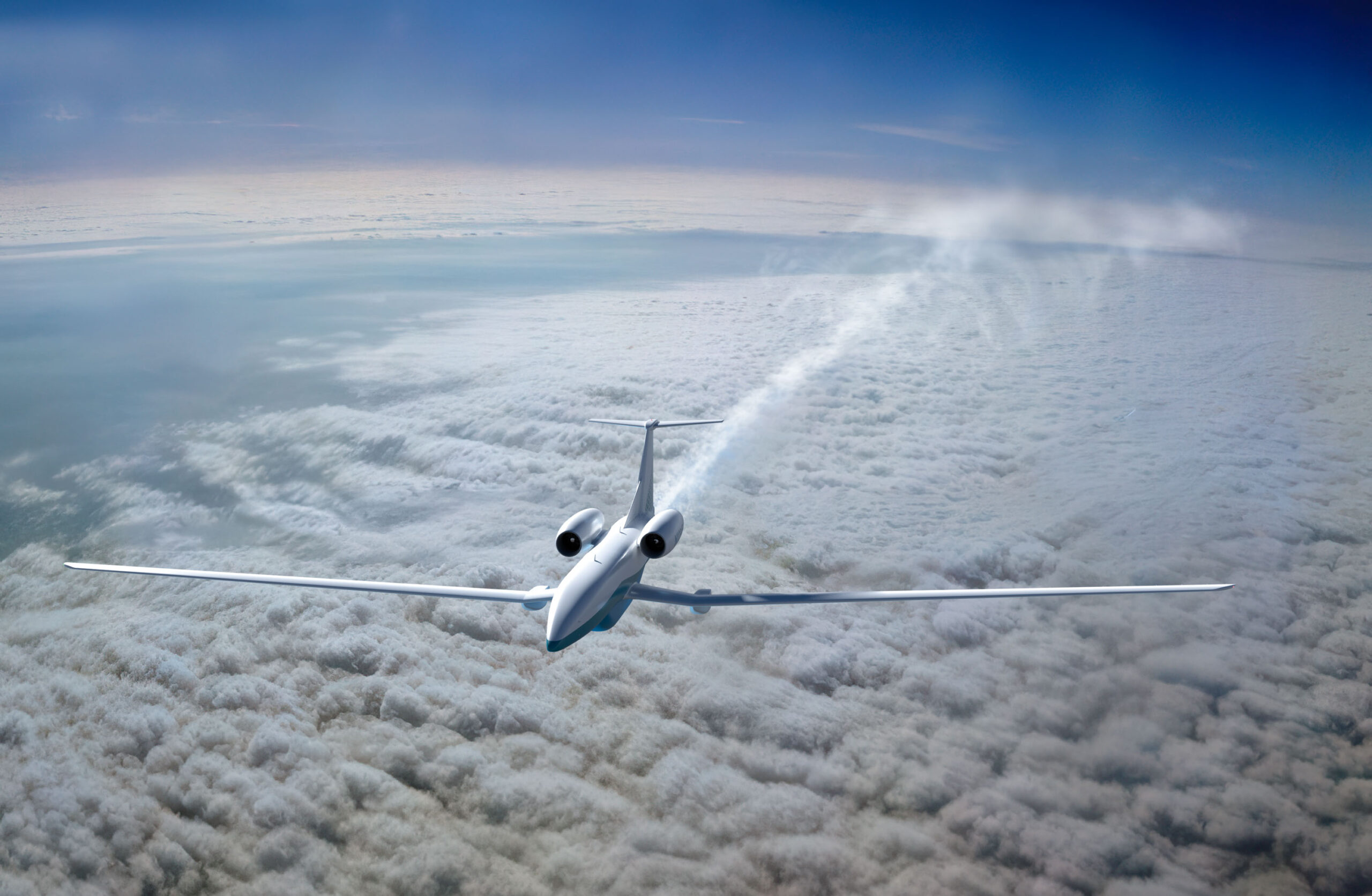
Jim Franke pulls away the cover page of a presentation on the wraparound desk in his office, revealing an illustration of an odd-­looking aircraft with massive wings stretching out from a stubby fuselage.

.cst-large,
.cst-default {
width: 100%;
}

@media (max-width: 767px) {
.cst-block {
overflow-x: hidden;
}
}

@media (min-width: 630px) {
.cst-large {
margin-left: -25%;
width: 150%;
}

@media (min-width: 960px) {
.cst-large {
margin-left: -16.666666666666664%;
width: 140.26%;
}
}

@media (min-width: 1312px) {
.cst-large {
width: 145.13%;
}
}
}

@media (min-width: 60rem) { .flourish-embed { width: 60vw; transform: translateX(-50%); left: 50%; position: relative; } }

The uncrewed plane is soaring thousands of meters higher than commercial jets fly—so high you can see the curvature of the Earth. It’s precisely the type of aircraft one would need to begin artificially cooling the planet. Those outsize wings would keep the plane and its payload aloft in the stratosphere, about a dozen miles (or 20 kilometers) above the surface, where the air is much thinner—as little as 5% the density near the ground. Once at altitude, the plane would release materials that could, after a few steps of chemistry, reflect sunlight back into space.

“If you want to get to 20 kilometers in the near term, this is probably the best bet,” says Franke, a research assistant professor at the University of Chicago.

Franke is one of a small but growing cohort of scientists focused on the engineering challenges associated with solar geoengineering, the controversial idea that we could deliberately intervene in the climate system to counteract global warming.

The concept came from volcanoes. Massive eruptions in the past have reduced temperatures worldwide by blasting sulfur dioxide and other compounds into the stratosphere, where they convert into sunlight-scattering particles. Hundreds of studies in recent decades have suggested that a human attempt to mimic this mechanism would work quickly and efficiently—at least within the confines of climate models.

But these computer simulations are approximations of how the real world works. They gloss over numerous challenges. Like the fact that aircraft capable of carrying the necessary loads to the necessary altitudes don’t exist. Or that we don’t know for sure how to release material so that most of it turns into tiny reflective aerosols instead of, say, clumping together and falling out of the sky. Or even what specific substance we would want to load onto an aircraft, given open questions about safety, cost, and effectiveness. 

Amid these compounding unknowns, more and more research on solar geoengineering is moving beyond computer simulations, delving into the detailed design and practical engineering work that would be needed before we could carry out a campaign to dial down temperatures. The tasks required range from inventing high-altitude aircraft to mastering the precise chemistry and delivery mechanisms for dispersing materials to building out the monitoring infrastructure that we’ll need in order to know if any of it actually works.

The question of whether we should geoengineer the planet has no clear-cut answer. It might save millions of lives by reducing the dangers of catastrophic heat waves, floods, droughts, and famines. But many fear it’s too dangerous to even consider, much less seriously study, arguing that we can’t possibly predict the spiraling consequences of manipulating such large, complex, interconnected planetary systems. 

Critics argue that the building momentum in this phase of research will make it ever more likely that someone, somewhere in the world, will eventually pull the trigger on geoengineering, no matter the remaining unknowns or the dangers for certain parts of the world.  

“I do think it’s very dangerous because of what we know about science and technology,” says Jennie Stephens, a professor of climate justice at Maynooth University in Ireland. “The more investment that’s made, the further the advances, the more likely it is that it will be deployed.”

But proponents of this practical research argue that playing out how we’d mount a solar geoengineering program will improve our understanding of the potential benefits and risks, helping to ensure that if anyone does try to tweak the climate, they might at least do so in an informed and potentially safer way.
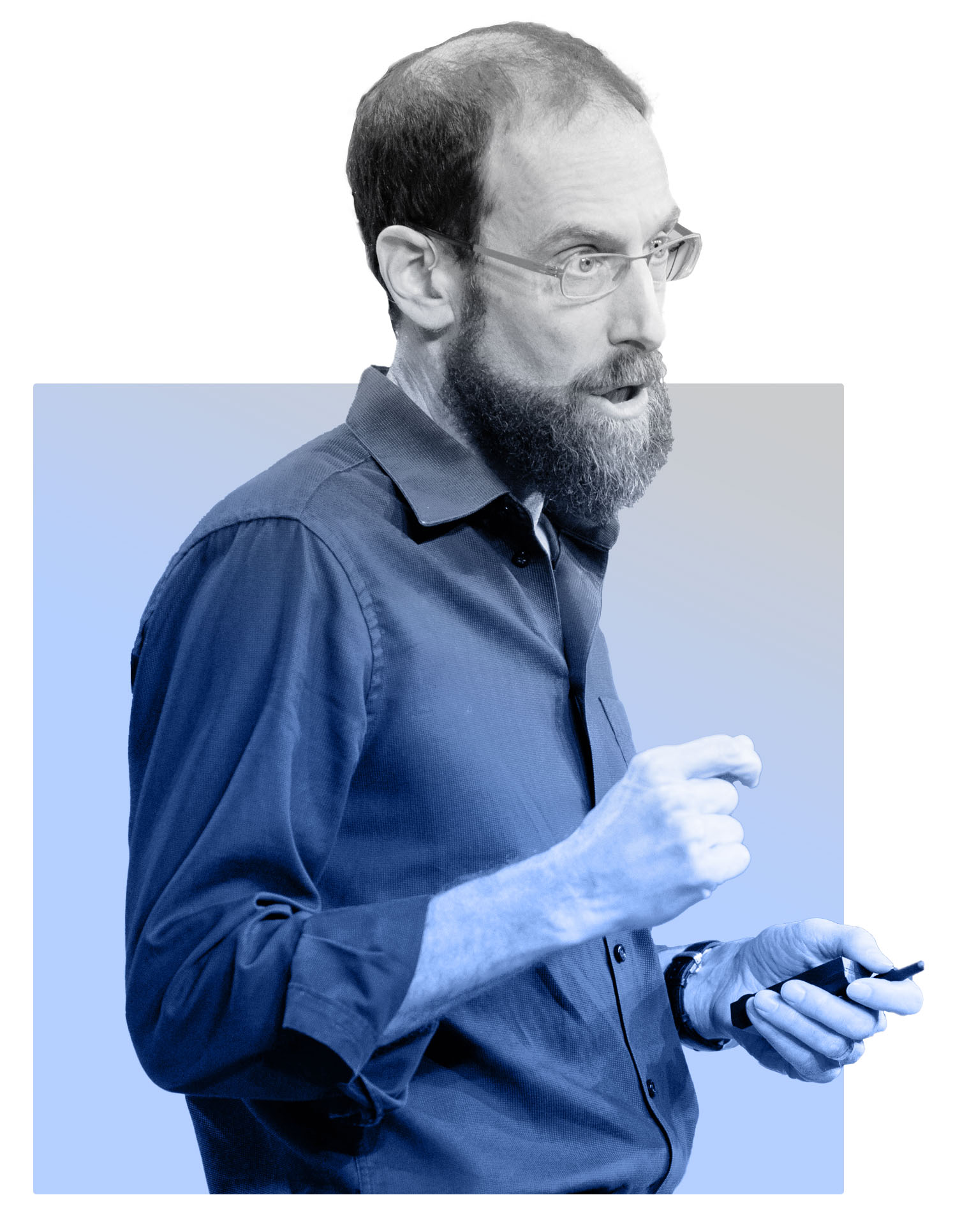
David Keith
The Climate Systems Engineering Initiative (CSEi) at the University of Chicago formally launched in 2024 under the leadership of the prominent geoengineering researcher David Keith.
MIT TECHNOLOGY REVIEW | JUSTIN SAGLIO

It’s still very much a niche field. Much of the work now underway is happening at the Climate Systems Engineering Initiative (CSEi) at the University of Chicago, which formally launched in 2024 under the leadership of the prominent geoengineering researcher David Keith. 

Franke, a professional engineer before earning his doctorate in geosciences, is overseeing a series of overlapping research projects and collaborations aimed at resolving many of the engineering uncertainties. That includes working out the designs now on his desk—renderings of the type of aircraft that could be used in the initial phase of a geoengineering program. 

Franke argues that more computer simulations are simply not going to answer the big remaining questions in the field, including the most compelling one: the “boogeyman” of what could go wrong. 

“I’m kind of personally skeptical that additional model development or more simulations are going to satisfactorily resolve those things,” he says. “And so I’m not really that interested in turning the crank on more models.”

For Franke, it’s time for the next step: “We’re interested in seeing how you’d actually do this thing if you wanted to do it.”

What we don’t know

Solar geoengineering is often portrayed as a relatively cheap and easy fix for climate change. But as researchers take a harder look at the nuts and bolts, they’re finding considerable uncertainties, missing tools, and unbuilt infrastructure.

None of that may be a showstopper, but we’ll need time and money to develop the components necessary to implement even the early stages of a solar geoengineering program. What this research is about, at its core, is not actually launching something, but figuring out what it would take to do so. 

A young San Francisco nonprofit, Reflective, recently worked with scientists in the field to figure out just how much we still don’t know.

The process began by outlining what the organization, which pools money from donors to fund geoengineering studies, describes as a “well-managed, moderate” scenario: In 2035, some nation or group of nations begins a small-scale geoengineering deployment, spraying an equal amount of sulfur dioxide or hydrogen sulfide—gases that should convert into reflective aerosols in the stratosphere—near both the North and South Poles. The initial program would release enough material to reduce temperatures by about 0.1 °C, shaving off a fraction of the roughly 1.4 °C of worldwide warming that’s occurred since the start of the industrial era.

The poles figure prominently in this and other early-stage geoengineering scenarios, for a simple reason: The stratosphere starts as low as seven kilometers there—as opposed to around 18 to 20 kilometers at the equator. That makes it easier to reach, enabling existing aircraft, with some modifications, to carry sizable payloads up there. 

The wrinkle is that the cooling effect would be more pronounced in the northernmost and southernmost latitudes. That’s because, among other complicated mechanisms, higher temperatures in the tropical stratosphere would mostly prevent aerosols released around the poles from drifting toward the equator. So deploying geoengineering in those areas would likely have milder effects on the hotter and poorer nations around the tropics, which are also some of the areas most vulnerable to climate change.

To cool the world evenly—and fairly—you’d eventually want to add flights closer to the equator. Over the following decade or so, under Reflective’s scenario, the program would scale up, shift to novel aircraft flying above the subtropics, and release enough material to achieve global cooling of 0.5 °C. 

The question the researchers then examined was: If we wanted to carry out such a scenario, what would we still need to do to pull it off? 

Quite a bit, it turns out. Earlier this year, Reflective published its SAI Uncertainty Database (SAI stands for “stratospheric aerosol injection”), highlighting a variety of scientific unknowns and six engineering obstacles.

Among them: sorting out how hard or expensive it would be to retrofit existing aircraft to carry out the early stages of the project. Deploying at the poles could also require constructing new airports, establishing new shipping lanes or railways to transport supplies, and building facilities that could process raw materials—by, for example, combusting elemental sulfur to produce sulfur dioxide.

We would also need to build more instruments and send them up to the stratosphere aboard balloons, drones, or other aircraft to observe the baseline chemistry, reflectivity, and distribution of compounds there—and to track what changed once new materials were released.

Finally, the main satellites that observe the stratosphere from space are set to go out of commission in the coming years, creating the risk of an “imminent data desert,” as a 2025 paper in the Bulletin of the American Meteorological Society warned. Several new instruments are in development or available for launch, but there could be a gap in observations at a point where we’d want to have a clear picture of the baseline conditions, Reflective notes.

Dakota Gruener, the chief executive officer of the nonprofit, stresses that the organization isn’t advocating the use of solar geoengineering. But she says it’s important for the field to begin addressing engineering uncertainties now because it stress-tests the assumptions in climate models. It helps us determine whether the scenarios explored in silico are feasible in the real world.

It’s also important to do this, she says, because it may take a long time to resolve all these unknowns while the climate grows steadily warmer. “If we aren’t putting adequate attention to them now, we might be caught flat-footed,” Gruener told MIT Technology Review.

A 2024 analysis in the journal Earth’s Future highlighted just how expensive and time-consuming it might be to develop the aircraft and infrastructure required for an initial deployment. The study explored what it would take for a geoengineering program around the poles, capable of reducing temperatures by 2 °C in the northernmost and southernmost parts of the planet, to be up and running by 2040. The conclusion: It could require at least a decade of work and a $35 billion investment. 

Wake Smith, a research fellow at Harvard and lead author of the study, also says that researchers need to move forward with engineering studies now, because the urge to use the technology will likely grow stronger as climate change becomes increasingly catastrophic.

“The risk I worry about is needing it before we understand it and therefore doing it badly,” he says, later adding: “The sooner we get going with it, the better decisions we’ll be able to make a few decades hence in terms of whether to do it, how to do it, when to do it.”

A novel aircraft

The aircraft pictured on Franke’s desk, which is still just a concept, could reach just beyond the threshold of the stratosphere above the tropics when fully loaded. A fleet of 270 of them could disperse about a million metric tons of material per year, enough to ease global surface temperatures by about 0.26 °C. 

The CSEi outsourced the work of designing it to John Langford, a well-known aeronautical engineer and entrepreneur. Langford’s company, Electra.aero, had previously collaborated with the MIT Department of Aeronautics and Astronautics to develop autonomous, solar-powered aircraft that could carry out extended scientific missions in the stratosphere. He is now spinning out a new business, Iris Aero, to produce those planes, which are assembled from a single, continuous wing covered in solar panels and suspended above a tiny fuselage.

Langford expects the solar plane to find its main initial commercial applications in wildfire monitoring and forecasting. But by swapping in a different set of instruments, it could be used to monitor how materials dispersed in the stratosphere might alter conditions there, he says.

The novel aircraft is a variation on the observational plane, with the added space and thrust necessary to carry these materials to the stratosphere and release them. It has a wider wingspan and swaps out those solar panels for a pair of Rolls-Royce AE 3007 engines.

The aircraft would also include a detachable tank that would function something like a trailer on a semi. This would make it possible to load materials between flights and prevent any damage to the plane itself from those materials, some of which are corrosive, Langford says. 

He says he and his team have completed the initial designs and are now doing more detailed engineering and cost analyses. They intend to publish the findings when the effort is complete. 

“We’d love to build a prototype of such an airplane and feel we could do so relatively quickly,” Langford says. “But that all depends on what David’s group wants to do.”

The program

David Keith’s group, CSEi, is still coming together.

The University of Chicago unveiled the research initiative in 2024 and has committed to hiring 10 additional faculty members to advance scientific understanding of various forms of geoengineering and explore the thorny questions related to policy, ethics, and governance. It had hired two of them as of press time.

The university saw an opportunity to step up as a leader in a field that wasn’t getting adequate academic attention despite its potential to address the dangers of climate change, says Michael Greenstone, a climate economist and the founding director of the university’s Institute for Climate and Sustainable Growth.

“Universities, as a whole, were committing academic malpractice by not investigating the technical, the social, the political, and the even kind of humanist elements of geoengineering,” Greenstone says.

He helped recruit Keith to lead the initiative. 

Keith, 62, previously spent nearly 13 years as a professor of applied physics and public policy at Harvard, where he led the establishment of the university’s Solar Geoengineering Research Program. More famously, he strove to carry out what could have been the first solar geoengineering experiment to release material in the stratosphere, known as SCoPEx. But after years of work and multiple delays, the research team finally scrapped the project in early 2024, following mounting criticism from environmental and Indigenous groups and the eventual intervention of the Swedish government.

Keith has long argued that researchers should seriously study geoengineering because it might substantially reduce the dangers of climate change, alleviating death, destruction, and suffering on massive scales.

He says that the overarching goal of the Chicago initiative is to expand the field by bringing together “enough independent professors and other research professionals” to “build a community around climate engineering as a broad field of inquiry.”

“Solar geoengineering certainly has complex and potentially dangerous political consequences, but so do a host of other emerging ideas and technologies.”

David Keith, geoengineering researcher

“The University of Chicago was the first big university to try and build this as a field in a serious way, to make it not about one person,” he tells me. “It’s a giant commitment.”

Keith himself has become a divisive figure, the face of geoengineering to some. He says he now wants to help build a larger, sustainable research program that will outlive his involvement. He told the administrators that he shouldn’t run the program for more than five years.

“It’s important to have a generational handover,” he says, adding: “I think it’s really important that this not be ‘the David Keith Show.’”

The CSEi researchers are now exploring nearly every engineering challenge that Reflective highlighted in its analysis. In addition to the work on novel aircraft and in situ observations, the group is designing small “cube” satellites with optical sensors optimized for observing the stratosphere. It is also studying which materials might prove most practical to ship to the stratosphere and how best to release them.

The goal is “producing public information which can be independently assessed, critically assessed, so policymakers can understand more about what’s possible and not,” Keith says.

Normalizing a dangerous idea

The debate around solar geoengineering is quickly moving beyond the academic and theoretical realm. A handful of startups, some more serious than others, have begun testing technologies that could one day be used to cool the planet. 

Yet to critics, solar geoengineering is the peak of techno-solutionism, affixing a high-tech Band-Aid to a global crisis caused by earlier technologies instead of addressing the root cause. Further, they argue that there’s no way to deploy or govern it in a globally equitable way, because any use of it will prove more advantageous to some regions than others. 

Even if solar geoengineering succeeded in reducing the average global temperature by 1 °C or so, that would mean very different things in different regions.

It could keep farmers prosperous and cities safe across, say, much of the US and the world’s temperate zones. But the lower temperature might be too cool for Russia to boost its agricultural productivity, while it might still be too hot for subsistence farming in northern Africa. 

Some studies also suggest that high levels of solar geoengineering could create new dangers in some regions, potentially altering monsoon rains, decreasing agricultural output, shifting the range of infectious diseases, and more. 

These complications raise a long list of thorny and divisive ethical questions. Even if solar geoengineering produced better conditions across most of the planet relative to a world with unchecked climate change, would it still be acceptable if it unleashed deadly famines or floods in a few regions? What kind of global consensus should be required to decide it’s okay to deploy it? And how should we determine where to set the planet’s temperature—and when, if ever, to shut the technology off?

Stephens argues that the answers, like so much else in the world, will come down to wealth and power. Countries, corporations, or even wealthy individuals with the resources to deploy such a system would have every incentive to tune it for their optimal benefit, no matter what it might mean for others. 

“It will be certain people who have a lot of wealth and power deciding when and how, and who should benefit and who will get screwed,” she says. “That’s the fundamental reason I think any advance in this technology is so dangerous.”

Duncan McLaren, an environmental researcher and political scientist, argues that the shift into practical engineering studies demands more oversight of the research field.  

For many critics of outdoor experiments like SCoPEx, he explains, the major concern wasn’t the environmental or safety risks, which were minimal; the issue was the normalization of a concept that could reduce pressures to cut greenhouse-­gas emissions. 

He says that any advance in research—whether it’s on paper, in the lab, or in the stratosphere—raises a similar risk: undermining progress on climate action by allowing the fossil-fuel sector and other business interests to say there’s an easier solution in development that doesn’t require overhauling our energy systems. A policy paper that the Texas Conservative Coalition Research Institute released in March advanced this very argument, citing the far lower costs of solar geoengineering relative to the “staggering costs” of a “forced transition.” 

Given this so-called moral hazard risk, design and engineering work should demand the same level of scientific supervision that outdoor experiments do, including ethical review, risk assessments, and public engagement, McLaren says.

“It ought to be more onerous,” he says. “There ought to be more barriers to researchers saying they want to do this.”

“The next ethical step”

Keith pushes back forcefully on that assertion, condemning as “profoundly illiberal” the idea that we should regulate open academic research posing no physical risks. 

“Solar geoengineering certainly has complex and potentially dangerous political consequences, but so do a host of other emerging ideas and technologies,” he said in an email. “The best chance to manage these challenges is to debate them openly and freely.”

Keith is all for keeping solar geoengineering technology in the public domain, and he agrees that the first line of climate defense must be rapid and deep reduction of greenhouse-gas emissions. But the world has made little progress in cutting climate pollution, carbon dioxide can persist for thousands of years in the atmosphere, and the planet is heating up fast. So, he argues, we may need to pursue other measures to temper the growing threats.

The bar for restricting research in this field should be “very high,” he says, given the potential promise of the technology. 

After visiting flood-devastated villages in Bangladesh, Keith underscored this point in an interview with the director of Plan C for Civilization, a recent documentary that profiles his work. “I think people have to take the next ethical step,” he said. “Because if you are really going to withhold access to and knowledge of a technology that could potentially save enormous numbers of lives—real lives, people we’ve met in the last few days—you’ve got to be very confident that that technology is going to be misused.”

The particles

Mingyi Wang, an assistant professor at the University of Chicago, leads me down the hall to a square, white lab room in the Henry Hinds Laboratory for Geophysical Sciences.

He pulls open the doors to a gray Haier biomedical freezer just inside the entrance, revealing a transparent flow tube hanging vertically and tapering at the bottom.

It’s a miniature stratosphere, chilled below −50 °C and filled with the same mix  of oxygen, nitrogen, and other air molecules you’d find 20 or so kilometers above us. A series of Teflon and stainless-­steel tubes run into the vessel, allowing Wang and his team to add various gases or particles and observe how they react.

Wang is an atmospheric scientist who studies how aerosols form, and he is now exploring what materials might be the most effective for reducing temperatures. 
an aircraft shown from above flying over the clouds
This rendering illustrates the type of high-altitude aircraft that could one day be used to deliver Earth-cooling material into the stratosphere.
COURTESY OF IRIS AERO CORP.

Most modeling experiments focusing on solar geoengineering explore the impact of adding sulfuric acid to the stratosphere, because that’s what ultimately ends up there after a volcanic blast. 

But it would be costly and complicated to simply haul sulfuric acid up there and release it, because it’s heavy and sticky. So Wang and his team are conducting experiments in that chilly flow tube to determine what substances, including precursors to the acid, might do the best job of producing aerosols of the ideal size for reflecting away sunlight—and how best to prevent the materials from simply clumping together with existing particles and falling out of the stratosphere.

Wang, whom Keith refers to as a “young star,” has arrived at a novel solution to this problem, though he’s not ready to share the full details yet. He and his team are feeding the findings from their experiments into computer simulations of stratospheric plumes that they’ve developed. These, in turn, can be plugged into large-scale climate models to improve their simulation of smaller-scale effects—and thus enhance our understanding of stratospheric chemistry.

Wang says that it’s important to do this detailed research because until now, climate models simply assumed you’d wind up with the right aerosols of the right size. 

“Scientifically, we may understand it reasonably well, but on the engineering perspective—do we really know how to do it right?” he asks. “That’s a big question.” 

What’s next

As I began reporting on CSEi, I assumed that some of the engineering and design work would lead to new proposals for stratospheric experiments, picking up from where SCoPEx left off. 

Keith, though, insists he has no interest in reliving that experience, given the weight the experiment took on as the focal point for a broader societal debate over solar geoengineering. He doesn’t see any of the other “practical engineering” work at the initiative leading toward field experiments either, at least at this stage.

Much of the work, in fact, is focused on a step beyond that: exploring what it would take to start a geoengineering campaign, if a nation or group of them eventually decides to. Franke notes that we already have balloons and other aircraft that could get to the lower bounds of the stratosphere to release an experimental amount of, say, sulfur dioxide. 

“We’re thinking of it right now as: We’re trying to develop, we think, the tools should someone want to start doing SAI,” he says. 

He and Keith are quick to stress that the research group does not intend to actually build the physical hardware that would be needed to deploy solar geoengineering—not even the aircraft that Langford’s company is designing. 

Indeed, most of the researchers at the University of Chicago stress that they are not advocating for use of geoengineering; they’re doing the research to inform the public and policymakers about its benefits and risks.

But after decades closely studying the topic, Keith, at least, has evolved in his thinking on this point, and his public comments reflect that. 

“As a scientist, I think the evidence [indicates] that early deployment—careful, hemispherically balanced, slow, monitored early deployment—would have benefits that are higher than the risks,” he says. “I think that evidence is very strong.”

Keith adds that if there were somehow a global referendum on whether to start, he would vote yes. 

“I think that this field needs to stop being so ashamed of using the ‘deployment’ word,” he says. 

Shape
Shape
Stay Ahead

Explore More Insights

Stay ahead with more perspectives on cutting-edge power, infrastructure, energy,  bitcoin and AI solutions. Explore these articles to uncover strategies and insights shaping the future of industries.

Shape

AMD acquires MEXT to add predictive memory optimization to its AI stack

Gogia said predictive memory tiering addresses inefficiencies that often leave expensive DRAM underutilized, but cautioned that optimization should complement, rather than replace, sound infrastructure design. “Predictive tiering attacks the waste inside that reflex,” he said, referring to the tendency to address performance challenges by purchasing more memory instead of improving

Read More »

HPE product barrage targets AI networks, agents, management

HPE Mist integration Continuing that integration theme, HPE said it will integrate Juniper’s natural language Mist AI into HPE Aruba Central and vice versa, all fed by its core AIOps Marvis AI engine. Marvis collects telemetry and user state data from Juniper’s routers, switches, access points, firewalls, and applications to detect and

Read More »

MRV lets EPCIC contract for Coral North FLNG project

Mozambique Rovuma Venture (MRV) SpA  has let an engineering, procurement, construction, installation, and commissioning (EPCIC) contract to Technip Energies, in partnership with JGC and Samsung Heavy Industries, for the Coral North FLNG project offshore Mozambique. Under the contract, JGC France and Technip Energies, through their joint venture, will be primarily responsible for the engineering and procurement of the FLNG topside infrastructure as well as overall project management. Samsung Heavy Industries will undertake the engineering, procurement, and construction of the FLNG hull and the fabrication of the topside modules. The Coral North project includes construction of a new FLNG vessel with a production capacity of about 3.6 million tonnes/year (tpy). The vessel will be installed in Coral gas field, about 50 km offshore northern Mozambique. Coral North is designed as an enhanced replica of Coral Sul, the first development in Mozambique’s Area 4 offshore gas block, and is expected to double Coral hub’s capacity to 7 million tpy.  Coral FLNG SA is a special-purpose entity incorporated by Area 4 partners Eni SPA (operator), China National Petroleum Corp. (CNPC), Empresa Nacional de Hidrocarbonetos (ENH), Galp Energia SGPS SA, and Korea Gas Corp. (KOGAS).

Read More »

EIA forecasts prolonged oil market tightening amid Hormuz shipping disruptions

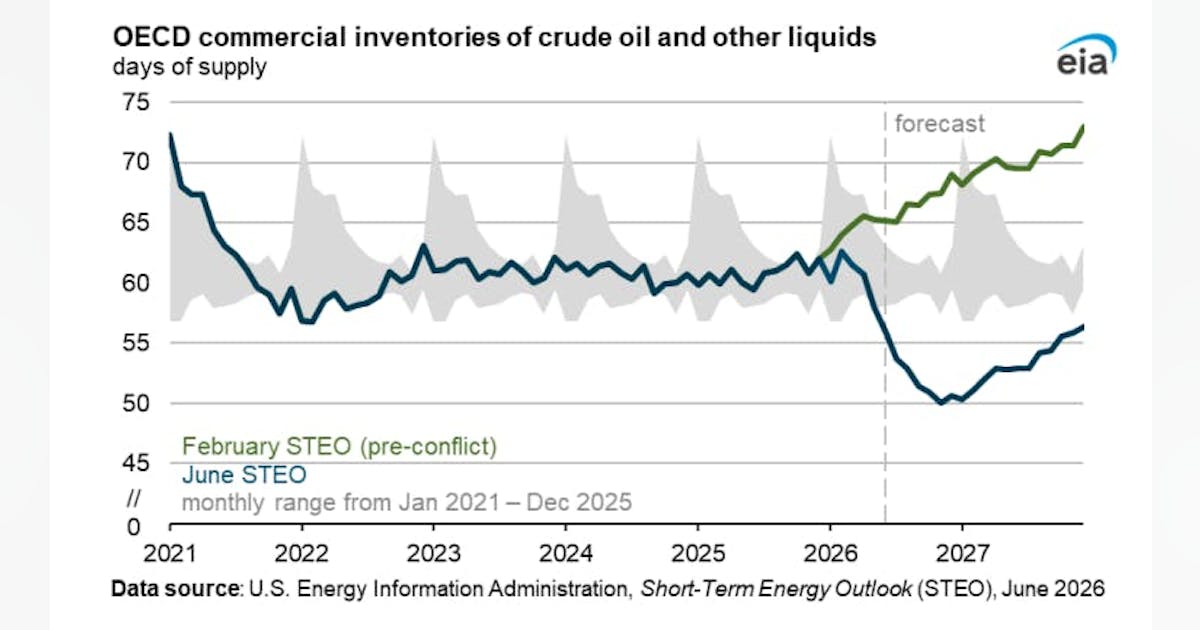
In its June 2026 Short-Term Energy Outlook (STEO), the US Energy Information Administration (EIA) assumes the Strait of Hormuz will remain effectively closed in the near term, with oil shipments resuming in third–quarter 2026. The agency expects it will take until early 2027 for traffic through the waterway to return to pre-conflict levels. Some Middle East oil production is expected to remain disrupted beyond the forecast period. Global oil producers in the Middle East reduced crude oil production by more than 11 million b/d in May compared with pre-conflict levels because of limited shipping traffic through the strait. EIA estimates production shut-ins averaged 11.3 million b/d in May and forecasts disruptions of 11.34 million b/d in June before easing to 10.11 million b/d in the third quarter and 5.70 million b/d in the fourth quarter. Stay updated on oil price volatility, shipping disruptions, LNG market analysis, and production output at OGJ’s Iran war content hub. As a result, EIA expects global oil inventories to fall by an average of 6.3 million b/d in second-quarter 2026 and 7.6 million b/d in third-quarter 2026. OECD commercial inventories are forecast to fall to just under 2.3 billion bbl by December 2026, the lowest level since 2003. On a days-of-supply basis, OECD inventories are expected to fall to 50 days by yearend 2026. Brent crude oil averaged $107/bbl in May, down $10/bbl from April. EIA forecasts Brent prices will average about $105/bbl in June and July before declining to an average of $89/bbl in fourth-quarter 2026 as oil flows gradually resume. Brent is forecast to average $95/bbl in 2026 and $79/bbl in 2027. High fuel prices, reduced fuel availability, and government initiatives have lowered oil demand, EIA said. The agency now forecasts global oil demand will decline by 1.1 million b/d in 2026 compared

Read More »

EnQuest looks to boost production by over 130% with Malaysian asset deals

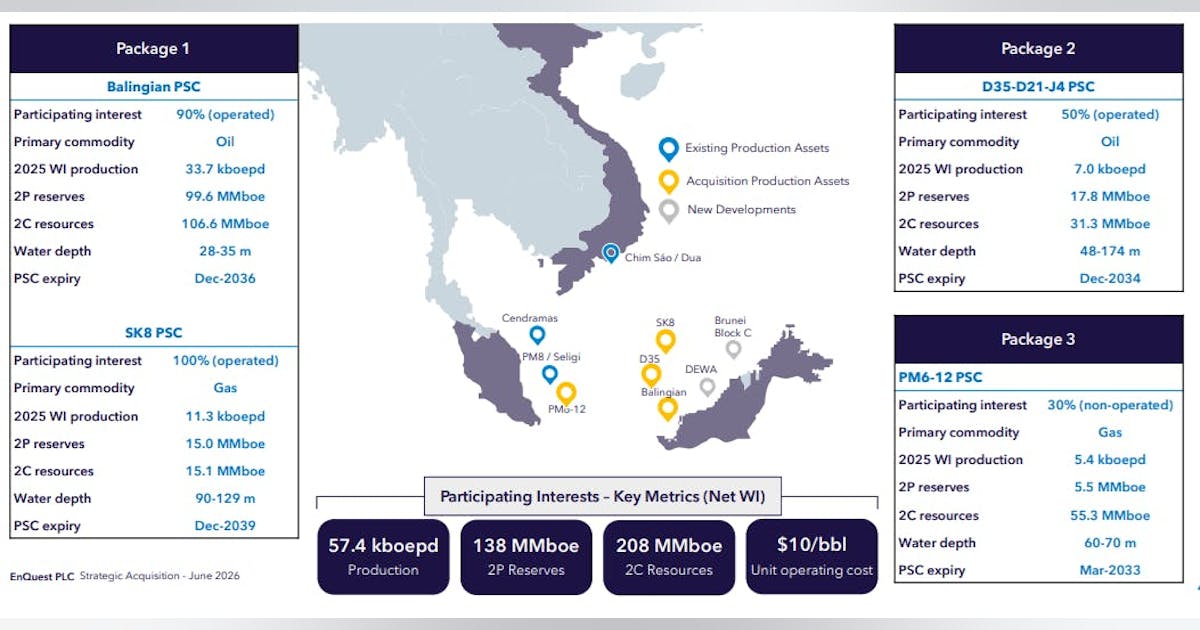
EnQuest PLC subsidiary EnQuest Petroleum Production Malaysia Ltd. has agreed to acquire interests in producing upstream assets in Peninsular Malaysia and Sarawak. The company expects to leverage its integrated technical capabilities and experience in managing brownfield and late-life assets to support continued operations and redevelopment. Under three separate transaction packages with Petronas Carigali Sdn. Bhd. and E&P Malaysia Venture Sdn. Bhd., EnQuest will acquire interests in four offshore production sharing contracts (PSCs) for a maximum total consideration of up to $833 million. As part of the agreements, EnQuest Petroleum Production Malaysia will assume operatorship and participating interests in the Balingian PSC (Package 1, 90% participating interest), SK8 PSC (Package 1, 100% interest), and D35 PSC (Package 2, 50% interest), and will hold a nonoperated participating interest in the PM6/12 PSC (Package 3, 30% interest). The transaction also includes participation by Terengganu-based TI Exploration & Production Sdn. Bhd. (TI EP), which will hold a nonoperated interest in the PM6/12 PSC. TI EP is a joint venture between TI Petroleum Sdn. Bhd., a subsidiary of state-owned Terengganu Inc., and Ping Petroleum Ltd., an independent upstream company. On a 2025 net participating interest basis, the acquired interests are expected to add about 57,400 boe/d of production (47% liquids, 53% gas). This would increase EnQuest’s group production to more than 100,000 boe/d, representing a 134% increase compared with its 2025 production. The assets are expected to support production at around 100,000 boe/d through the end of the decade, the company said. EnQuest would also add 138 MMboe of 2P reserves and 208 MMboe of 2C resources (net WI). The acquisitions are expected to close by yearend, subject to customary conditions, including the waiver or expiry of applicable pre-emption rights associated with Package 2.  Package 1, Package 2, and Package 3 are subject to separate acquisition

Read More »

EIA: US crude inventories down 7.2 million bbl

US crude oil inventories for the week ended June 5, excluding the Strategic Petroleum Reserve, decreased by 7.2 million bbl from the previous week, according to data from the US Energy Information Administration (EIA). At 426.5 million bbl, US crude oil inventories are about 5% below the 5-year average for this time of year, the EIA report indicated. EIA said total motor gasoline inventories increased by 200,000 bbl from last week and are about 6% below the 5-year average for this time of year. Finished gasoline inventories increased while blending components inventories decreased last week. Distillate fuel inventories decreased by 200,000 bbl last week and are about 13% below the 5-year average for this time of year. Propane-propylene inventories increased by 1.1 million bbl from last week and are about 35% above the 5-year average for this time of year, EIA said. US crude oil refinery inputs averaged 17.0 million b/d for the week ended June 5, which was 80,000 b/d more than the previous week’s average. Refineries operated at 95.3% of capacity. Gasoline production increased, averaging 9.7 million b/d. Distillate fuel production increased, averaging 5.2 million b/d. US crude oil imports averaged 5.9 million b/d, down 500,000 b/d from the previous week. Over the last 4 weeks, crude oil imports averaged about 5.9 million b/d, 5.8% less than the same 4-week period last year. Total motor gasoline imports averaged 714,000 b/d. Distillate fuel imports averaged 130,000 b/d.

Read More »

Shell discovers oil in Namibia’s Orange basin

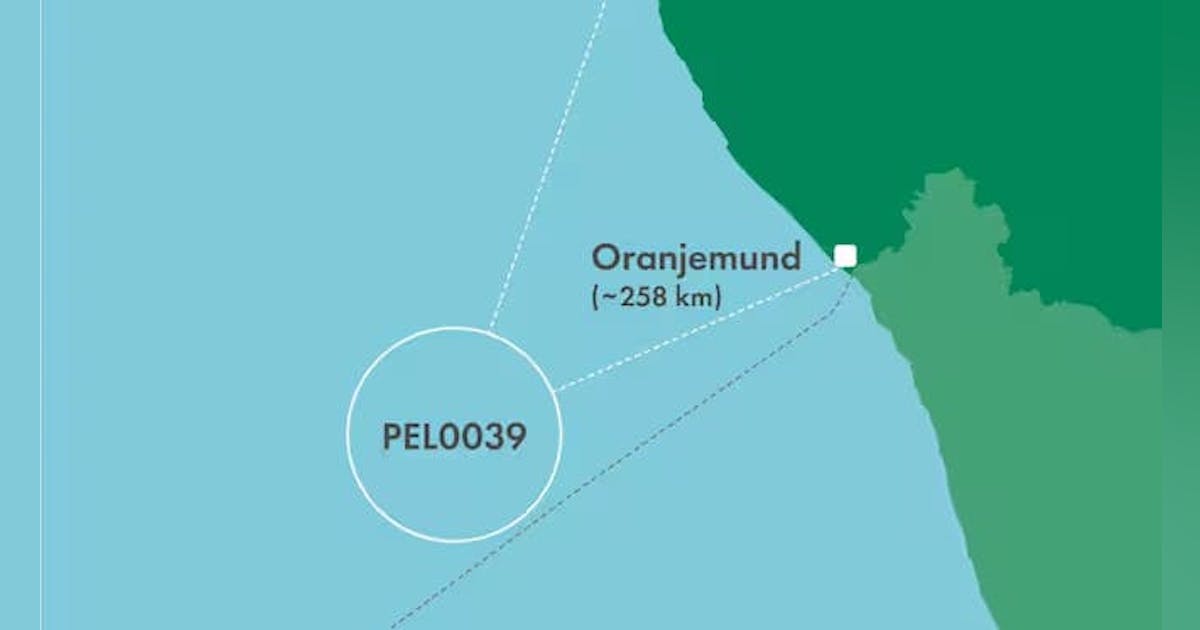
Shell discovered oil at the Merlin-1X exploration well in Orange basin 250 km off the southern coast of Namibia. Merlin-1X, spudded on Apr. 8, 2026, is the tenth well drilled in Petroleum Exploration License 39 (PEL 0039). The well penetrated the Coniacian play and has delivered the most promising subsurface results to date in PEL 0039, indicating good reservoir quality with light oil and limited associated gas, the operator said in a release June 9. Shell said additional drilling late this year is under consideration as part of a broader exploratory appraisal program. PEL 0039 covers 12,000 sq km. Over the last 4 years, 10 wells have been drilled in the license: Graff-1X, La Rona-1X, Jonker-1X, Graff-1A, Lesedi-1X, Cullinan-1X, Jonker-1A, Jonker-2A, Enigma-1X, and Merlin-1X. Shell is operator of PEL 0039 with 45% working interest. Partners are QatarEnergy (45%) and the National Petroleum Corp. of Namibia (NAMCOR) (10%).

Read More »

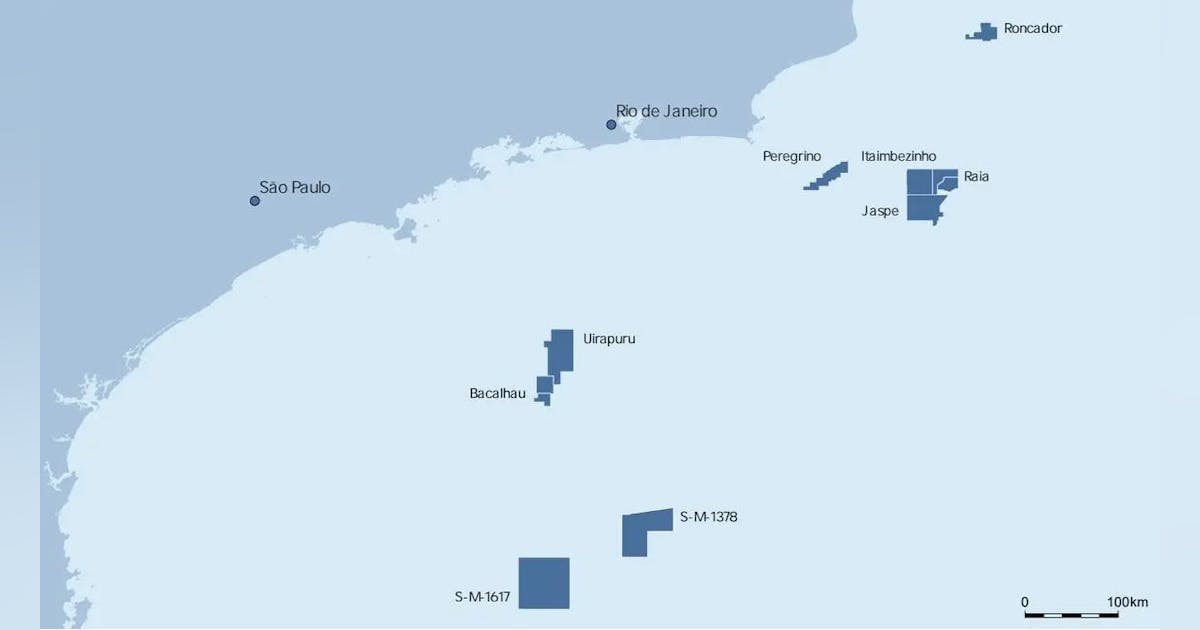
Equinor to farm out 50% stake in Itaimbezinho block offshore Brazil

@import url(‘https://fonts.googleapis.com/css2?family=Inter:[email protected]&display=swap’); .ebm-page__main h1, .ebm-page__main h2, .ebm-page__main h3, .ebm-page__main h4, .ebm-page__main h5, .ebm-page__main h6 { font-family: Inter; } body { line-height: 150%; letter-spacing: 0.025em; } button, .ebm-button-wrapper { font-family: Inter; } .label-style { text-transform: uppercase; color: var(–color-grey); font-weight: 600; font-size: 0.75rem; } .caption-style { font-size: 0.75rem; opacity: .6; } #onetrust-pc-sdk [id*=btn-handler], #onetrust-pc-sdk [class*=btn-handler] { background-color: #c19a06 !important; border-color: #c19a06 !important; } #onetrust-policy a, #onetrust-pc-sdk a, #ot-pc-content a { color: #c19a06 !important; } #onetrust-consent-sdk #onetrust-pc-sdk .ot-active-menu { border-color: #c19a06 !important; } #onetrust-consent-sdk #onetrust-accept-btn-handler, #onetrust-banner-sdk #onetrust-reject-all-handler, #onetrust-consent-sdk #onetrust-pc-btn-handler.cookie-setting-link { background-color: #c19a06 !important; border-color: #c19a06 !important; } #onetrust-consent-sdk .onetrust-pc-btn-handler { color: #c19a06 !important; border-color: #c19a06 !important; } Equinor Brasil Energia Ltda. has agreed to farm out a 50% interest in the Itaimbezinho exploration block in Brazil’s offshore Campos basin to Petróleo Brasileiro SA (Petrobras). Equinor was awarded a 100% stake in the block during Brazil’s National Agency of Petroleum, Natural Gas and Biofuels (ANP) 3rd Cycle pre-salt bidding round in 2025. Upon completion of the deal with Petrobras, Equinor will retain a 50% interest and remain operator, while Pré-Sal Petróleo SA (PPSA) will continue as manager of the production-sharing contract. The agreement builds on Equinor and Petrobras’ broader partnership in the basin. The companies jointly acquired the Jaspe exploration block in the same bidding round, with Petrobras as operator (60%) and Equinor holding 40%. The companies also partner on the Raia natural gas project, where Equinor, as operator, began a 6-well drilling campaign in March.   Completion of the transaction remains subject to customary regulatory and governmental approvals.

Read More »

MSI’s Strategic Shift: From Server Vendor to Full-Spectrum AI Infrastructure Provider

The 100 kW rack figure places MSI’s offering squarely in the world of AI-era rack densities, where conventional air cooling becomes increasingly difficult or inefficient. The announcement also suggests that MSI is aligning with hyperscale and large cloud design principles, particularly through ORv3 and 48V power distribution. The company is moving from the “we have servers that can be liquid cooled” message, to “we can participate in rack-level AI infrastructure design.” The EIA air-cooled architecture, by contrast, is designed for more conventional data center environments. MSI says its 19-inch, 48RU EIA air-cooled rack supports standard deployments and can be configured with 16 2U2N multi-node systems, with AMD EPYC 9005 and Intel Xeon 6 platform options. That split matters because the AI infrastructure market is not moving in one uniform direction. Hyperscalers, neoclouds, and AI factories may move aggressively into ORv3, liquid cooling, busbar power, and rack-scale designs. Enterprise data centers, managed service providers, and colocation customers often need to work within existing 19-inch rack footprints and existing facility constraints. MSI wants to supply both markets. The CG681-S6093: MSI’s Flagship Liquid-Cooled AI Server The centerpiece of MSI’s NVIDIA-based AI server announcement is the CG681-S6093, a 6U liquid-cooled AI server based on NVIDIA MGX architecture. MSI says the system supports dual AMD EPYC processors and up to eight NVIDIA RTX PRO 6000 Blackwell Server Edition Liquid Cooled GPUs. It also supports 32 DDR5 DIMMs and NVIDIA ConnectX-8 SuperNICs with up to 8×400Gbps networking. This system is a direct entry into high-density AI inference, HPC, simulation, graphics, video, and physical AI workloads. The server is not positioned only for frontier model training. Instead, MSI appears to be aiming at the expanding middle of the AI infrastructure market: large inference clusters, visual computing, simulation, industrial AI, scientific computing, and agentic AI workloads. The next

Read More »

Cooling at AI Scale: Inside Motivair’s Blueprint for the Liquid-Cooled Data Center

BUFFALO, N.Y. — In the race to build AI infrastructure, the industry often focuses on GPUs, power availability, and the massive capital investments reshaping the digital infrastructure landscape. But a walk through Motivair’s manufacturing facility in Buffalo, as provided on the eve of the Motivair-Schneider Electric Global Press Event’s tour of the nearby Terawulf Lake Mariner AI campus, offers a reminder that another critical component of the AI boom is being built one coolant distribution unit at a time. During a recent Data Center Frontier Show podcast recorded at Motivair’s Buffalo headquarters, CEO Rich Whitmore described a reality that is becoming bedrock across the industry: Liquid cooling is now very far from being an emerging technology. It is now a prerequisite for deploying the most advanced AI systems. “You cannot deploy AI servers—at least the cutting-edge AI servers—without liquid cooling,” Whitmore said. That observation may be obvious to infrastructure veterans. Yet it points to a larger shift now underway across the data center ecosystem. As AI workloads drive rack densities beyond the practical limits of air cooling, thermal infrastructure has moved from a supporting role to a primary design consideration. For Whitmore and Motivair, that transition did not begin with ChatGPT. From Supercomputing to Commercial AI Long before AI became the defining growth story of the data center sector, Motivair was developing liquid cooling systems for high-performance computing and supercomputing environments. Whitmore describes today’s AI market as less of a technological revolution than a commercialization of capabilities that have existed for years inside elite computing environments. “We cut our teeth in high-performance computing and supercomputing,” Whitmore explained. “What we’re seeing today as we go into the AI era is really a commercialization of traditional supercomputing.” That experience has positioned Motivair differently than many newer entrants rushing into the liquid cooling

Read More »

From Components to AI Factories: Peter Panfil Says the Future of Data Centers Is All About Integration at Scale

ORLANDO, Fla. — For years, the data center industry optimized individual systems: power distribution, cooling, racks, UPS equipment, and mechanical infrastructure. In the AI era, according to Vertiv Distinguished Engineer and Vice President of Technical Business Development Peter Panfil, that approach is no longer sufficient. Speaking during Wednesday morning’s keynote at the 2026 7×24 Exchange Spring Conference, Panfil presented a vision in which the data center itself becomes a single, tightly orchestrated computing appliance—truly an “AI factory” whose success depends less on standalone components than on the seamless interaction between them. Throughout his presentation, titled “Scale at Speed: How Massively Parallel Compute GPUs Are Revolutionizing Data Center Design,” Panfil repeatedly returned to a single imperative: the AI infrastructure race is increasingly defined by execution velocity. “If you think you’re going big enough, go bigger,” he told attendees. “If you think you’re going fast enough, you’re going to have to go faster.” For an industry gathered under the conference’s overarching theme of future-proofing AI infrastructure, Panfil’s message suggested something subtly different. Rather than trying to predict the future, operators should build systems capable of adapting to it. “I would much rather be future ready,” he said, “than future proof.” Speed Becomes the New Competitive Metric One of the keynote’s recurring themes was that deployment speed has become an economic variable in its own right. Panfil argued that hyperscalers and AI providers increasingly view time-to-capacity as directly tied to business value, making delays in construction or commissioning far more expensive than traditional infrastructure inefficiencies. “The cost of speeding up has real benefits right now,” he observed. That urgency is changing the way facilities are assembled. Rather than coordinating numerous independent contractors and subsystem vendors on-site, Panfil described an emerging model built around highly standardized, factory-produced HAC [hot aisle containment] modules—or “hacks”—that arrive

Read More »

Beyond the GPU: Cisco Says AI’s Biggest Challenge May Be the Network That Connects It All

For much of the AI boom, the industry’s attention has centered on GPUs, power availability, and liquid cooling. But according to Cisco Senior Business Development Manager Robin Olds, another critical constraint is rapidly moving to the forefront: the network itself. Speaking with Data Center Frontier on the show floor at Fiber Connect 2026, Olds argued that AI represents a once-in-a-generation shift comparable to the birth of the commercial internet, fundamentally changing traffic patterns and forcing service providers, data center operators, hyperscalers, and emerging neoclouds to rethink infrastructure design. “It’s really like the internet when it was created,” Olds said. “We’re at another intersection in time where we could really see things happening.” AI Is Rewriting the Bandwidth Equation The most significant change may not be compute density alone but the sustained demand AI places on transport networks. According to Olds, service providers are already seeing AI traffic account for roughly 30% of utilization on backbone infrastructure; a dramatic increase from less than 1% only two years ago. As AI workloads continue to proliferate, those utilization levels are expected to rise further. The next wave of agentic AI could amplify that trend. Unlike consumer chatbots, which generate bursty request patterns, autonomous AI agents continuously interact with applications and external services, creating more persistent traffic flows. “Everything’s about chatbots,” Olds observed. “It’s very spiky—up, down. Agentic AI is going to maintain utilization because now I have agents working on my behalf.” For data center developers, network operators, and cloud providers alike, that implies planning not just for peak demand but for elevated baseline utilization across metro and long-haul infrastructure. Compressing the Network Stack Cisco’s response centers on architectural simplification. Olds highlighted the company’s Agile Services Networking framework, which combines router and optical networking technologies with coherent optics to converge functions that historically

Read More »

Emerging Power Strategies Transforming AI Data Center Development

This deal follows the industry trend shown in the Flex/EP² acquisition. One transaction targets engineered control and protection systems; the other targets high-power conductive components and value-added services around them. The clarity here is that data center growth is creating investable demand not just for chips and campuses, but for the industrial companies that make the electrical buildout possible. AZIO AI and EVTV: EV maker to AI infrastructure After multiple announcements of deals between the two companies, and the end of May, they decided a corporate merger was in order. The AZIO AI–EVTV merger turns Envirotech Vehicles Inc., from an electric-vehicle company into a prospective power-backed AI infrastructure and data center platform. The core impact is not just an increase in AI servers; it is the combination of compute hardware, controlled land, behind-the-meter power, fiber, modular deployment, and cooling validation building on the AI data center growth story. AZIO describes the deal as part of EVTV’s strategic transformation into an AI infrastructure and compute platform focused on domestic AI deployment, data center operations, and long-term compute capacity expansion. For data center ambitions, the most important element is power access. AZIO and EVTV say about 11 MW of power capacity has been identified at EVTV’s existing site, with hardware orders placed for an initial 6 MW deployment. They are also discussing long-term rights tied to as much as 500 MW of additional same-site capacity. That matters because AI data center development is increasingly constrained by power availability rather than just real estate or server supply. And with the modular infrastructure the company develops, having that power availability is the key to future site growth. EVTV later said it had expanded its controlled development footprint to more than 548 acres, secured dedicated fiber for current and future operations, and was advancing natural

Read More »

Amazon claims its data centers are 7x more water-efficient than the industry average

“Amazon is on the leading edge, but it’s not a secret recipe,” he said. What sets the company apart is scale, execution, facility design, geographic mix, and its aggressive pursuit of energy goals. Others are doing the similar things, if through different avenues: Microsoft is investing in closed-loop cooling systems that dramatically reduce evaporative water loss. Google is heavily focused on reclaimed water and using AI to optimize data centers. Meta has long relied on outside-air cooling. And overall, the industry is moving toward liquid cooling for dense AI deployments, “which changes the water equation again,” said Kimball. One of the big variables is location: Climate influences water efficiency, so where a company builds its infrastructure is as important as its cooling methods. Further, power-consumptive AI changes the discussion, he emphasized; traditional enterprise workloads and dense AI training clusters create very different thermal profiles.

Read More »

Microsoft will invest $80B in AI data centers in fiscal 2025

And Microsoft isn’t the only one that is ramping up its investments into AI-enabled data centers. Rival cloud service providers are all investing in either upgrading or opening new data centers to capture a larger chunk of business from developers and users of large language models (LLMs).  In a report published in October 2024, Bloomberg Intelligence estimated that demand for generative AI would push Microsoft, AWS, Google, Oracle, Meta, and Apple would between them devote $200 billion to capex in 2025, up from $110 billion in 2023. Microsoft is one of the biggest spenders, followed closely by Google and AWS, Bloomberg Intelligence said. Its estimate of Microsoft’s capital spending on AI, at $62.4 billion for calendar 2025, is lower than Smith’s claim that the company will invest $80 billion in the fiscal year to June 30, 2025. Both figures, though, are way higher than Microsoft’s 2020 capital expenditure of “just” $17.6 billion. The majority of the increased spending is tied to cloud services and the expansion of AI infrastructure needed to provide compute capacity for OpenAI workloads. Separately, last October Amazon CEO Andy Jassy said his company planned total capex spend of $75 billion in 2024 and even more in 2025, with much of it going to AWS, its cloud computing division.

Read More »

John Deere unveils more autonomous farm machines to address skill labor shortage

Join our daily and weekly newsletters for the latest updates and exclusive content on industry-leading AI coverage. Learn More Self-driving tractors might be the path to self-driving cars. John Deere has revealed a new line of autonomous machines and tech across agriculture, construction and commercial landscaping. The Moline, Illinois-based John Deere has been in business for 187 years, yet it’s been a regular as a non-tech company showing off technology at the big tech trade show in Las Vegas and is back at CES 2025 with more autonomous tractors and other vehicles. This is not something we usually cover, but John Deere has a lot of data that is interesting in the big picture of tech. The message from the company is that there aren’t enough skilled farm laborers to do the work that its customers need. It’s been a challenge for most of the last two decades, said Jahmy Hindman, CTO at John Deere, in a briefing. Much of the tech will come this fall and after that. He noted that the average farmer in the U.S. is over 58 and works 12 to 18 hours a day to grow food for us. And he said the American Farm Bureau Federation estimates there are roughly 2.4 million farm jobs that need to be filled annually; and the agricultural work force continues to shrink. (This is my hint to the anti-immigration crowd). John Deere’s autonomous 9RX Tractor. Farmers can oversee it using an app. While each of these industries experiences their own set of challenges, a commonality across all is skilled labor availability. In construction, about 80% percent of contractors struggle to find skilled labor. And in commercial landscaping, 86% of landscaping business owners can’t find labor to fill open positions, he said. “They have to figure out how to do

Read More »

2025 playbook for enterprise AI success, from agents to evals

Join our daily and weekly newsletters for the latest updates and exclusive content on industry-leading AI coverage. Learn More 2025 is poised to be a pivotal year for enterprise AI. The past year has seen rapid innovation, and this year will see the same. This has made it more critical than ever to revisit your AI strategy to stay competitive and create value for your customers. From scaling AI agents to optimizing costs, here are the five critical areas enterprises should prioritize for their AI strategy this year. 1. Agents: the next generation of automation AI agents are no longer theoretical. In 2025, they’re indispensable tools for enterprises looking to streamline operations and enhance customer interactions. Unlike traditional software, agents powered by large language models (LLMs) can make nuanced decisions, navigate complex multi-step tasks, and integrate seamlessly with tools and APIs. At the start of 2024, agents were not ready for prime time, making frustrating mistakes like hallucinating URLs. They started getting better as frontier large language models themselves improved. “Let me put it this way,” said Sam Witteveen, cofounder of Red Dragon, a company that develops agents for companies, and that recently reviewed the 48 agents it built last year. “Interestingly, the ones that we built at the start of the year, a lot of those worked way better at the end of the year just because the models got better.” Witteveen shared this in the video podcast we filmed to discuss these five big trends in detail. Models are getting better and hallucinating less, and they’re also being trained to do agentic tasks. Another feature that the model providers are researching is a way to use the LLM as a judge, and as models get cheaper (something we’ll cover below), companies can use three or more models to

Read More »

OpenAI’s red teaming innovations define new essentials for security leaders in the AI era

Join our daily and weekly newsletters for the latest updates and exclusive content on industry-leading AI coverage. Learn More OpenAI has taken a more aggressive approach to red teaming than its AI competitors, demonstrating its security teams’ advanced capabilities in two areas: multi-step reinforcement and external red teaming. OpenAI recently released two papers that set a new competitive standard for improving the quality, reliability and safety of AI models in these two techniques and more. The first paper, “OpenAI’s Approach to External Red Teaming for AI Models and Systems,” reports that specialized teams outside the company have proven effective in uncovering vulnerabilities that might otherwise have made it into a released model because in-house testing techniques may have missed them. In the second paper, “Diverse and Effective Red Teaming with Auto-Generated Rewards and Multi-Step Reinforcement Learning,” OpenAI introduces an automated framework that relies on iterative reinforcement learning to generate a broad spectrum of novel, wide-ranging attacks. Going all-in on red teaming pays practical, competitive dividends It’s encouraging to see competitive intensity in red teaming growing among AI companies. When Anthropic released its AI red team guidelines in June of last year, it joined AI providers including Google, Microsoft, Nvidia, OpenAI, and even the U.S.’s National Institute of Standards and Technology (NIST), which all had released red teaming frameworks. Investing heavily in red teaming yields tangible benefits for security leaders in any organization. OpenAI’s paper on external red teaming provides a detailed analysis of how the company strives to create specialized external teams that include cybersecurity and subject matter experts. The goal is to see if knowledgeable external teams can defeat models’ security perimeters and find gaps in their security, biases and controls that prompt-based testing couldn’t find. What makes OpenAI’s recent papers noteworthy is how well they define using human-in-the-middle

Read More »