Stay Ahead, Stay ONMINE

From Announcements to Delivery: What Separates Real AI Data Center Projects From the Rest

The AI infrastructure market has become very good at announcing gigawatts. Delivering them is another matter. That distinction framed one of the closing sessions of Day 1 at the Data Center Frontier Trends Summit 2026 (Aug. 4-6), where Sean Farney, vice president of data center strategy at JLL and a member of the Data Center […]

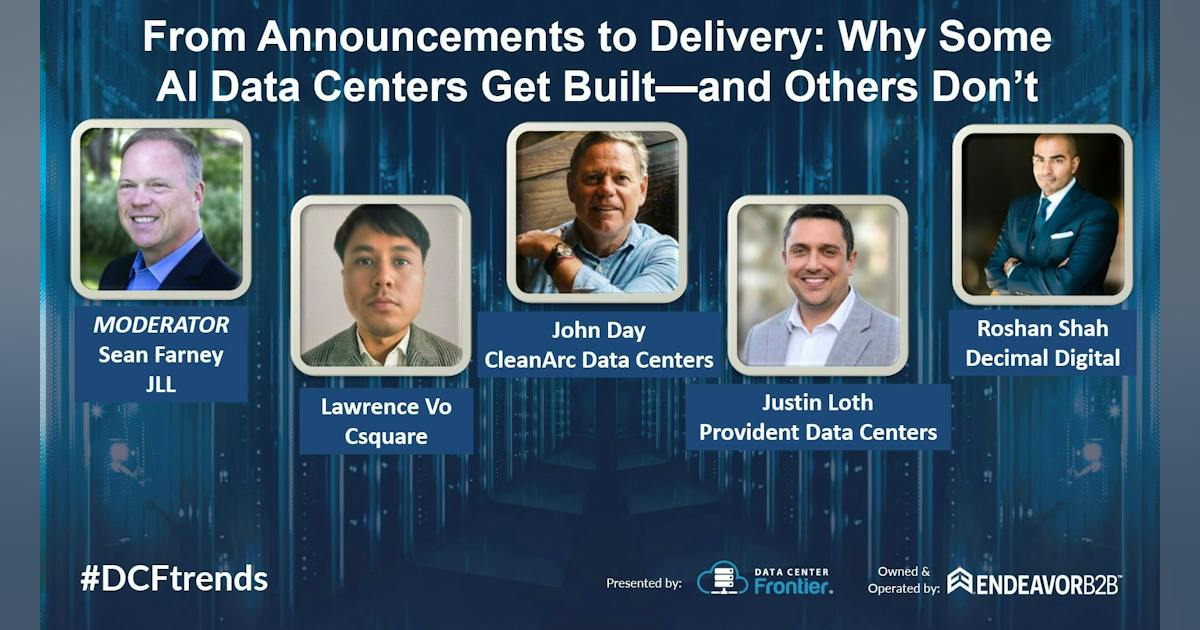
The AI infrastructure market has become very good at announcing gigawatts. Delivering them is another matter. That distinction framed one of the closing sessions of Day 1 at the Data Center Frontier Trends Summit 2026 (Aug. 4-6), where Sean Farney, vice president of data center strategy at JLL and a member of the Data Center Frontier Editorial Advisory Board, moderated a discussion on why some AI data center projects advance from concept to construction while others remain little more than ambitious site plans.

Farney was joined by Lawrence Vo, vice president of M&A and capex at Csquare; John Day, chief commercial officer at CleanArc Data Centers; Justin Loth, executive director of power development at Provident Data Centers; and Roshan Shah, co-founder and CEO of Decimal Digital.

The question Farney put before the group was straightforward: amid a market moving at what he called “the speed of light,” what separates the developers that actually get projects done from those that do not?

The answers repeatedly came back to the same point. In the current market, land, capital and an announcement are no longer enough. Developers have to prove that power is deliverable, infrastructure is ready, regulatory processes are moving, communities are receptive, talent is available and the commercial model can withstand changing conditions.

A Gigawatt on Paper Is Not a Gigawatt of Capacity

For Loth, who spent roughly 15 years on the utility side before joining Provident, the scale of current data center proposals alone should force the industry to think differently about what constitutes a credible project.

Before the hyperscale and AI expansion, he noted, gigawatts were a measure more commonly associated with cities than individual loads. “A 3.5 gigawatt campus,” Loth said, is roughly equivalent to the native load of Austin or San Antonio.

That scale makes the distinction between announced power and deliverable power critical. “You can have a CBRE or some kind of flyer that says a gigawatt of power available,” Loth said. “When is it available is my point.”

The due diligence goes considerably deeper than a headline capacity number. Developers and customers need to understand when power will arrive, what the load ramp looks like, whether an electric service agreement has been signed, whether long-lead equipment has been secured and whether sufficient generation exists behind the transmission capacity serving the site.

“When it really comes to closing breakers and making these operational,” Loth said, those details become decisive.

Transmission and generation also have to be considered together. A site may appear to have access to the transmission system, but that does not necessarily mean the generation required to support a new gigawatt-scale load is available on the timeline the customer expects.

For developers pitching enormous campuses, Loth’s message was essentially a familiar one applied to an unfamiliar scale: trust, but verify.

Finding the Contenders

Day described another way of separating projects that are advancing from projects that are mostly being marketed.

After CleanArc acquired its roughly 860-acre site south of Fredericksburg, Virginia, the company examined other large developments being promoted in the region. In many cases, bringing significant new transmission to a site requires a Certificate of Public Convenience and Necessity, or CPCN, filed with the Virginia State Corporation Commission.

The process is public. CleanArc used those filings as one measure of how far competing projects had actually progressed. “Out of like 30-some developments, there were seven,” Day said.

He was careful to note that not every development requires a CPCN. A project located near existing transmission or a substation with sufficient excess capacity could follow a different path.

But the exercise illustrated a broader point: regulatory filings, infrastructure commitments and actual investment provide a clearer picture of project maturity than announcements alone.

“There’s a lot of pretenders, not as many contenders,” Day said. Experience, the panel argued, is becoming another separator.

CleanArc itself is a relatively new platform, but Day said its top seven leaders collectively have about 137 years of direct data center experience. That matters because, despite unprecedented demand, he said developing campuses has arguably become harder.

There are labor constraints, equipment shortages, permitting issues, capital considerations and growing local opposition. Meanwhile, the influx of new developers attracted by AI demand has created another layer of friction.

Day compared the moment to a gold rush. Some new entrants will succeed. Others may learn quickly. But inexperienced developers can also consume utility, customer and local-government resources while advancing projects they do not yet have the ability to execute.

Hyperscalers still have to assess those sites because they cannot afford to overlook a viable opportunity. Planning commissions and boards of supervisors still have to process applications. Problems arise when applicants show up unable to answer fundamental questions about how a data center works or how their project will affect the community.

“There’s no replacement for having been there and done it at a smaller scale when you decide to dive in and do it at a massive scale,” Day said.

Community Support Becomes Part of Site Due Diligence

If power has traditionally dominated data center site selection, the panel made clear that local acceptance now belongs much earlier in the diligence process.

Shah offered the clearest example. Decimal Digital had secured an electric service agreement for a project in Ohio through what Shah described as a public and unanimously approved process. The company then acquired land in an industrial park already zoned for heavy industrial use.

From a conventional development standpoint, the project appeared well positioned. Then the municipality enacted a one-year moratorium. Shah said he did not learn how serious the opposition had become until the mayor summoned him to a meeting.

“I thought the mayor called me in to talk about kickstarting this project,” Shah said. Instead, the mayor suggested that Decimal leave.

Residents had raised concerns about electricity rates, water consumption, drought and what Shah characterized as fears about “toxic sludge,” among other issues. Rather than walk away, the company changed its approach. It began with listening.

Decimal representatives met residents at the American Legion, took people to breakfast and coffee, held town halls and collected the questions residents were asking. The company then produced a more than 20-page FAQ addressing those concerns, launched a project website where residents could review information and submit questions, and created a social media presence for the project.

Shah said some of the opposition appeared to come less from data centers specifically than from uncertainty about an unfamiliar kind of development.

Once the company understood the concerns, he said, the next step was education using engineering information, data and evidence. “If somebody came to me and said, hey, we’re going to be building a data center in your backyard, I’m going to have questions as well,” Shah said.

Day described a similar experience around CleanArc’s Virginia development. The company began by approaching the local economic development organization and asking where county officials actually wanted to see a data center. The resulting site had previously hosted a large flea market and had sat largely unused.

CleanArc later held a community event at a local elementary school, mailed invitations to nearby residents and stayed to answer questions directly.

Some attendees arrived visibly skeptical, Day recalled. By the end, he said, some of the people who had appeared most upset on arrival were among the most courteous and appreciative when they left.

The lesson was not that every resident had become a supporter. It was that many concerns were unanswered questions. “Listening is really powerful,” Day said.

Developers also have to distinguish between misunderstandings and legitimate impacts. If a project uses large amounts of water, for example, Day said the developer should acknowledge that rather than bury the answer in technical language. Where concerns are based on misconceptions, the response should remain simple and respectful.

His communications rule was borrowed from politics: “If you’re explaining, you’re losing.” The goal, he said, should be the shortest clear answer possible without dismissing the person asking the question.

Building With the Community, Not Around It

The panel pushed the community discussion beyond public meetings. Shah said developers should identify trusted local figures early, including economic development officials, fire and police leadership, school representatives and other community members who can evaluate the project independently.

Loth added that even vendor and engineering decisions can matter. Using a smaller local civil engineering firm familiar with the terrain, schools and people in a community can create a different relationship than bringing every resource in from outside the region.

“If folks from my community are bought into this and there’s people from my community that are working, maybe it’s not gonna be so bad,” Loth said.

Farney pointed to organized labor as another potentially important constituency. Data centers produce substantial construction demand for electricians, operating engineers and other trades whose members already live in the communities where projects are being proposed.

Day supplied perhaps the most tangible workforce example. During a fight over a proposed data center elsewhere in Virginia, he recalled a technician who said she was driving roughly 90 minutes each way to Ashburn for work. If the proposed project had moved forward closer to her home, her commute could have fallen to about 10 minutes.

The data center industry should be accurate about employment, Day said. Large campuses generate significant construction employment but are not necessarily massive sources of permanent operating jobs.

The other side of that equation, however, is significant local tax revenue without the same demands on schools, roads and other services associated with many forms of residential development.

For Shah, the larger lesson from Ohio was that community and political risk now belongs beside power, land and permitting in site selection.

He said Decimal subsequently evaluated a project in New York and detected what he described as political headwinds during due diligence. The company decided not to proceed at that point.

“Engaging early and factoring in whether you have community buy-in is an essential part of the due diligence process,” Shah said.

Not Every AI Opportunity Is a Gigawatt Campus

Vo brought a different dimension to the discussion: knowing which portion of the rapidly expanding market to pursue.

He divides the current business broadly into three areas: hyperscale infrastructure serving large training workloads; colocation supporting enterprise and inference requirements; and NeoCloud or GPU-as-a-service platforms.

Each comes with a different capital profile. Vo cited one 5 MW GPU deployment that required roughly $150 million of GPU investment. He said operators in that category can pursue returns around 25% unlevered, reflecting the higher capital and technology risk.

Colocation, he said, can target approximately 15% to 20% unlevered returns, while large hyperscale leases with major credit tenants generally operate at lower return expectations because of the security of those contracts.

Vo’s interest has shifted back toward the colocation segment partly because so much capital and attention have moved toward hyperscale development. He said some operators are selling sub-50 MW enterprise facilities to recycle capital into larger hyperscale projects, creating opportunity in parts of the middle market that may now be receiving less attention.

At the same time, AI demand is reaching directly into those facilities. CSquare operates roughly 500 MW of colocation capacity serving about 2,000 customers, according to Vo. During the past 12 months, he said, roughly 20% of its new leases have come from NeoCloud companies. That demand appeared “out of nowhere,” he said, and could continue growing.

The result is a market where the biggest campus announcement is not necessarily the only—or even the most attractive—opportunity. Developers and operators also need the agility to understand where customer demand is moving and which business model matches it.

AI Can Scale Productivity. It Still Can’t Turn a Wrench.

Talent represents another constraint that cannot be solved simply by announcing more projects.

Vo said Csquare is already using AI tools to increase employee productivity rather than simply adding people as the company grows. He estimated that his own productivity in some tasks had increased substantially through AI-assisted research and workflows.

But software has limits when the product being built is physical infrastructure. “AI can’t turn a wrench,” Day said. It cannot lay duct banks or perform the skilled electrical and mechanical work needed to build and operate campuses.

Loth also cautioned against confusing AI assistance with experienced infrastructure judgment. A billion-dollar investment still requires people capable of recognizing when engineering, utility or due-diligence work is going wrong.

Provident is trying to expand that pipeline through universities, internships and co-op programs, Loth said. For a company with fewer than 200 employees, he characterized its intern and co-op population as comparatively large.

CleanArc is taking a similar approach in Virginia. Day said the company has already been in discussions with Germanna Community College and local high schools about developing pathways for technicians, HVAC workers and electrical apprentices.

Farney added that JLL is testing robots for overnight facility rounds and readings, including systems equipped with thermal cameras that could identify developing heat problems and potentially reduce exposure to hazards such as arc flash.

That may automate pieces of facility operations. It does not eliminate the need for skilled people.

The Premium Moves From Megawatts Announced to Megawatts Executed

The discussion eventually returned to where it began: power.

Loth argued that the next competitive distinction in AI infrastructure will not come from announcing ever-larger numbers.

“The premium is not gonna be on the announcement of megawatts,” he said. “It’s probably gonna be in the execution of megawatts.”

That execution may increasingly require data centers to behave differently as grid loads.

Loth pointed to flexible computing loads and demand response as an important part of that future. He cited an ERCOT queue that he said exceeds 400 GW as an illustration of the scale of demand now confronting grid planners.

Rather than treating every data center load as fixed at a single location and operating level, he sees potential for hyperscale operators to move some machine-learning workloads among campuses or curtail them ahead of periods of tight power supply.

If that can be demonstrated reliably at scale, flexibility could become both a grid resource and a competitive advantage for operators seeking capacity.

Other power options remain more complicated.

Day questioned whether some of the intense recent attention around behind-the-meter natural gas and small modular reactors had begun to cool. Fully islanded gas generation can carry significant redundancy requirements, he noted, while fuel contracts may not align neatly with a short-term bridge-to-grid strategy.

Those issues do not eliminate behind-the-meter generation. They illustrate the same problem that ran through the rest of the panel: every apparent shortcut eventually runs into execution details.

Even the most futuristic concept raised during the session carried that qualification.

Vo said he was preparing to meet with a company staffed in part by former NASA engineers that is developing small orbital data centers, with an initial launch targeted for around 2031. The concept, as he described it, would perform computing in orbit while relying on terrestrial data centers for storage.

It was an appropriately futuristic note for a conference focused heavily on AI infrastructure. But the more immediate challenge remains firmly on the ground.

Projects still need generation. They need transmission. They need equipment, permits, customers, financing, experienced teams, skilled labor and communities willing to host them.

AI infrastructure may be entering an era measured in gigawatts. The harder metric is how many of those gigawatts ultimately make it to the breaker.


Shape
Shape
Stay Ahead

Explore More Insights

Stay ahead with more perspectives on cutting-edge power, infrastructure, energy,  bitcoin and AI solutions. Explore these articles to uncover strategies and insights shaping the future of industries.

Shape

California Resources unloads Uinta assets

The leaders of California Resources Corp., Long Beach, have sold the company’s Uinta basin assets for about $90 million to an undisclosed buyer. The deal has an effective date of July 1 and is expected to close by yearend. “Today’s transaction strengthens our business,” said Francisco Leon, CRC president and chief executive officer. “This transaction enhances our capital allocation flexibility, allowing us to invest in higher-return opportunities within the Golden State, and supports our shareholder return strategy.” CRC had come to own the Uinta assets, which span about 100,000 net acres, after it acquired Berry Corp. in December of last year for $709 million. But the operation accounts for a small part of CRC’s business–2.5% of oil production and 8% of natural gas production in the second quarter–and Leon last month told analysts “it’s hard to see allocating a lot of dollars back into the Uinta” as his team focuses on building out its California network of assets. “It requires a pretty significant amount of capital to develop the scale that we need for a second asset,” Leon said Aug. 10 after CRC reported its second-quarter results. “So as we do a side-by-side and we compare the Uinta assets with California, Uinta has higher capital intensity, higher break-evens, lower crude quality [and] higher transportation and operating costs and steeper declines.” In the deal announcement, Leon said the Uinta sale also offsets the price CRC will pay for a set of midstream assets in California it plans to buy from CorEnergy Infrastructure Trust. The purchase of those pipelines and other operations is expected to close later this month. Shares of CRC (Ticker: CRC) were down slightly to $54.24 in late-morning trading Sept. 17. They have lost about 15% of their value over the past 6 months, trimming the company’s market capitalization

Read More »

Vitesse acquires interest in Chevron-operated DJ basin assets

Vitesse Energy Inc. has acquired non-operated oil and gas assets in the Denver-Julesburg (DJ) Basin in Colorado from an undisclosed seller for an initial unadjusted purchase price of $26 million. The acquired assets (average working interest: 4.1%), which lie primarily in Weld County, Colorado, are entirely operated by Chevron, and add “a high-quality, predominantly proved developed producing asset base,” said Jamie Benard, Vitesse’s chief executive officer and president, in a release Sept. 16. Vitesse said the deal adds to the company’s existing DJ basin position under a top-tier operator and adds 819 gross wells to its database, strengthening underwriting of future opportunities in the basin. Over the next 12 months following the effective date (June 1, 2026), the acquired assets are expected to produce about 900 boe/d on a two-stream basis (28% oil), the company said. In connection with the acquisition, the company has entered into commodity derivative contracts covering a significant portion of the acquired production through 2030 to support the underwritten returns. Prior to the deal closing Sept. 15, 2026, the company noted in an August 2026 investor presentation that it holds fractional, non-operated working interests in productive wells and new drills across the Williston, Powder River, and DJ basins with an average 3.6% average working interest.

Read More »

Continental Resources, PDVSA sign MoU for potential Venezuela oil development

Continental Resources Inc., Oklahoma City, Okla., has signed a Memorandum of Understanding (MOU) with Petróleos de Venezuela SA (PDVSA) to operate and develop the Ayacucho 2 Block in Venezuela’s Orinoco Oil Belt. In a release Sept. 15, Continental said it has the opportunity “to bring significant private capital, technology, technical expertise, and large-scale operating capability to the redevelopment of Venezuela’s oil industry.” The Ayacucho 2 Block lies north of the Orinoco River in Anzoátegui state. The 126,000-acre block contains an estimated 30 billion bbl of resource in place, Continental said. Upon signing a long-term Contrato de Participación Productiva (CPP) agreement—expected in the coming weeks—Continental would operate the block with a 100% working interest, it said in a release Sept. 16. Continental Resources has been building its international presence in recent years, including in Türkiye’s Diyarbakır Basin and Argentina’s Vaca Muerta formation.

Read More »

EIA: US crude inventories down 600,000 bbl

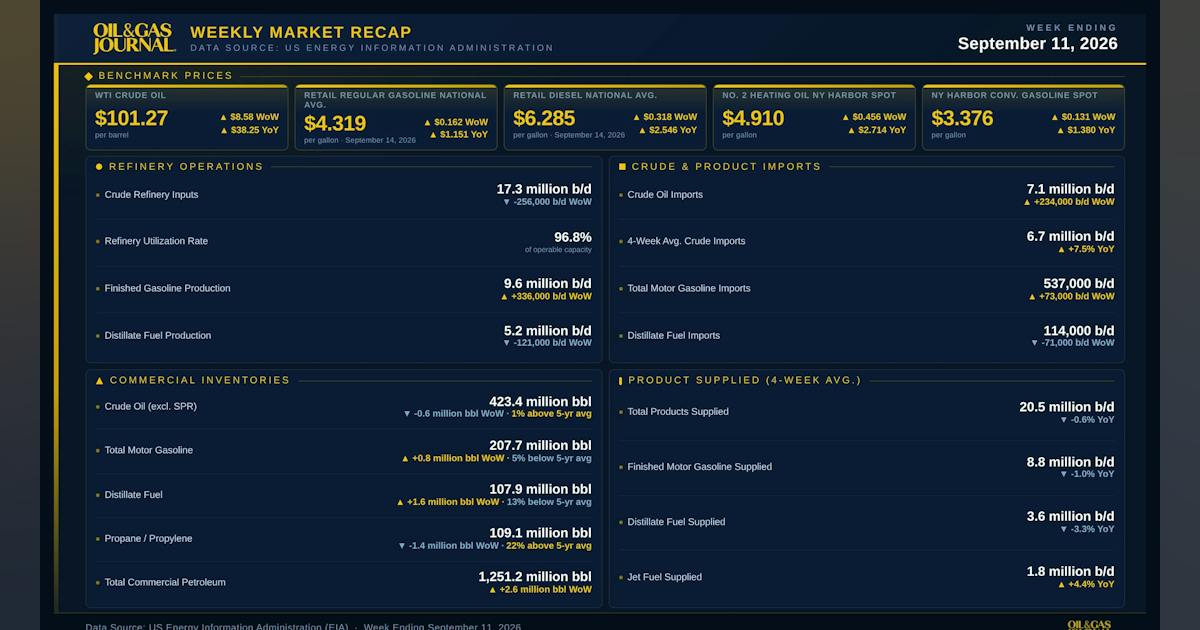
US crude oil inventories for the week ended Sept. 11, excluding the Strategic Petroleum Reserve, decreased by 600,000 bbl from the previous week, according to data from the US Energy Information Administration (EIA). At 423.4 million bbl, US crude oil inventories are 1% above the 5-year average for this time of year, the EIA report indicated. EIA said total motor gasoline inventories increased by 800,000 bbl from last week and are 5% below the 5-year average for this time of year. Distillate inventories increased by 1.6 million bbl last week and are about 13% below the 5-year average for this time of year. Propane-propylene inventories decreased 1.4 million bbl, 22% above the 5-year average. Total commercial petroleum inventories increased by 2.6 million bbl for the week. US refineries processed 17.3 million b/d for the week ended Sept. 11, which was 256,000 b/d less than the previous week’s average. Refineries operated at 96.8% of capacity. Gasoline output averaged 9.6 million b/d, and distillate production decreased to 5.2 million b/d. US crude oil imports averaged 7.1 million b/d, up 234,000 b/d from the previous week. Over the last 4 weeks, crude oil imports averaged about 6.7 million b/d, 7.5% more than the same 4-week period last year. Total motor gasoline imports averaged 537,000 b/d. Distillate fuel imports averaged 114,000 b/d.

Read More »

POSCO to acquire Chord’s Marcellus gas assets for $550 million

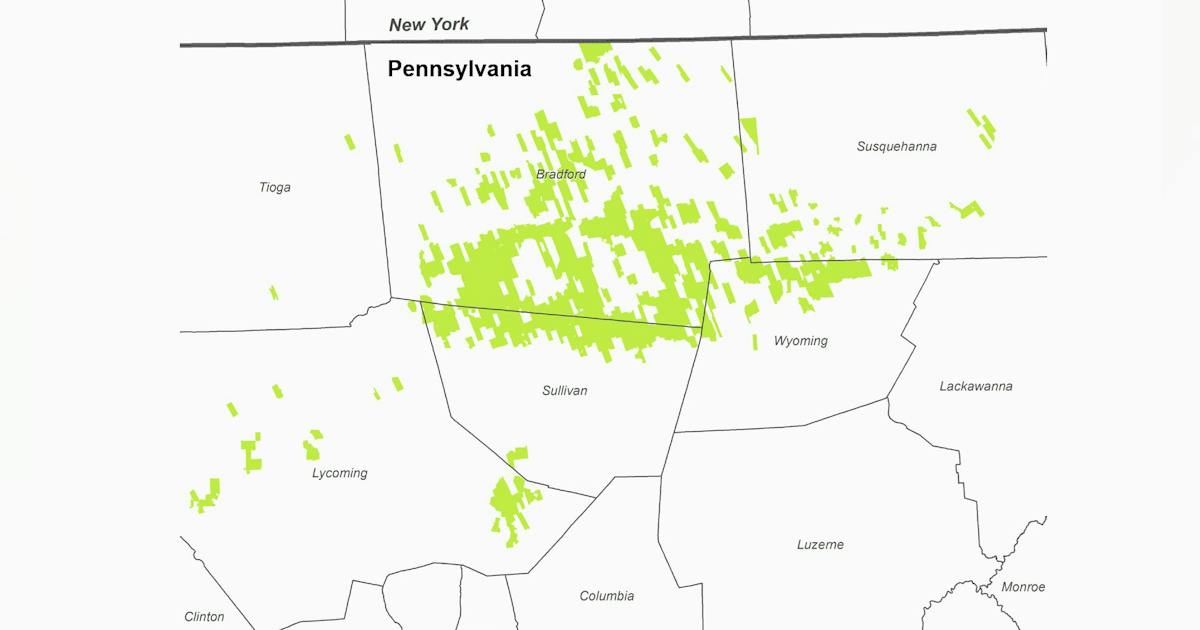
South Korea-based POSCO International Corp. has agreed to acquire the non-operated Marcellus position of a Chord Energy Corp. subsidiary for $550 million, gaining a producing US shale gas asset that it plans to use to generate immediate cash flow while expanding its LNG value chain. The acquisition includes about 32,000 net acres in the core of the Marcellus play in Pennsylvania, trailing 12-month production of about 121 MMcfd, and 1.3 tcf of reserves, including 220 bcf of discovered potential, POSCO said in a briefing Sept. 16. The asset produces 100% residue gas with no NGLs and includes 2,006 wells, consisting of 1,305 producing wells and 701 development wells. POSCO said first-half 2026 production averaged about 124 MMscfd. Field activities, including production, drilling, and permitting, will continue to be managed by an established local operator, POSCO said. The company plans to focus on gas marketing and downstream integration. “This investment goes beyond the simple acquisition of a producing gas field,” said Dong-il Kim, head of POSCO International’s E&P Business Division. “It is an investment to expand the value chain by securing immediate returns through proven US upstream assets and connecting gas sales, liquefaction, LNG trading, and group demand.” POSCO said that, under the current sales portfolio, about half of production is sold near production sites, with roughly 30% marketed into northeastern US and Ohio and another 20% supplied to Gulf Coast markets. Beginning in 2029, the company plans to direct a portion of production to LNG liquefaction plants and market the resulting LNG through its trading subsidiary. 

Read More »

Plains to acquire Powder River Basin assets from Silver Creek for $585 million

Plains All American Pipeline LP and Plains GP Holdings, through a subsidiary, have agreed to acquire SCM PR II LLC (Silver Creek) from subsidiaries of Tailwater Capital and The Energy and Minerals Group for about $585 million in cash. The transaction will expand Plains’ Powder River Basin footprint, increase connectivity to producer supply and strengthen its Rockies crude oil gathering and transportation network, the company said in a release Sept. 16. “This is a highly strategic addition to Plains’ Rockies platform,” said Willie Chiang, chairman, chief executive officer, and president of Plains. “It expands our footprint in the Powder River Basin, a region supported by substantial remaining drilling inventory and an attractive outlook for continued producer development over the coming years.” Silver Creek owns and operates a large integrated crude oil gathering system in the Powder River Basin across Converse, Campbell, Johnson, and Natrona counties, Wyoming, providing producers access to Plains’ existing Rockies infrastructure through the Guernsey and Fort Laramie hubs. The acquired assets include about 600 miles of crude oil gathering and transmission pipelines, more than 350,000 b/d of operating capacity, about 1.2 million bbl of operational storage capacity, and Silver Creek’s 49% non-operated interest in the Tallgrass Energy-led Powder River Gateway Joint Venture, which owns and operates both the Iron Horse and Powder River Express pipelines. Plains said the acquisition will enhance producer access to its integrated transportation network, including gathering and transmission systems in the Powder River Basin and long-haul pipelines delivering crude oil to Cushing. The company also said the assets are supported by a diversified customer base, 915,000 dedicated acres under long-term acreage dedications and minimum volume commitments, and contracts with a weighted-average remaining term of more than eight years. Current throughput averages about 125,000 b/d. The transaction is expected to close in this year’s

Read More »

From Announcements to Delivery: What Separates Real AI Data Center Projects From the Rest

The AI infrastructure market has become very good at announcing gigawatts. Delivering them is another matter. That distinction framed one of the closing sessions of Day 1 at the Data Center Frontier Trends Summit 2026 (Aug. 4-6), where Sean Farney, vice president of data center strategy at JLL and a member of the Data Center Frontier Editorial Advisory Board, moderated a discussion on why some AI data center projects advance from concept to construction while others remain little more than ambitious site plans. Farney was joined by Lawrence Vo, vice president of M&A and capex at Csquare; John Day, chief commercial officer at CleanArc Data Centers; Justin Loth, executive director of power development at Provident Data Centers; and Roshan Shah, co-founder and CEO of Decimal Digital. The question Farney put before the group was straightforward: amid a market moving at what he called “the speed of light,” what separates the developers that actually get projects done from those that do not? The answers repeatedly came back to the same point. In the current market, land, capital and an announcement are no longer enough. Developers have to prove that power is deliverable, infrastructure is ready, regulatory processes are moving, communities are receptive, talent is available and the commercial model can withstand changing conditions. A Gigawatt on Paper Is Not a Gigawatt of Capacity For Loth, who spent roughly 15 years on the utility side before joining Provident, the scale of current data center proposals alone should force the industry to think differently about what constitutes a credible project. Before the hyperscale and AI expansion, he noted, gigawatts were a measure more commonly associated with cities than individual loads. “A 3.5 gigawatt campus,” Loth said, is roughly equivalent to the native load of Austin or San Antonio. That scale makes the distinction

Read More »

The Future of Data Centers: Biomimicry and Community-Centric Design

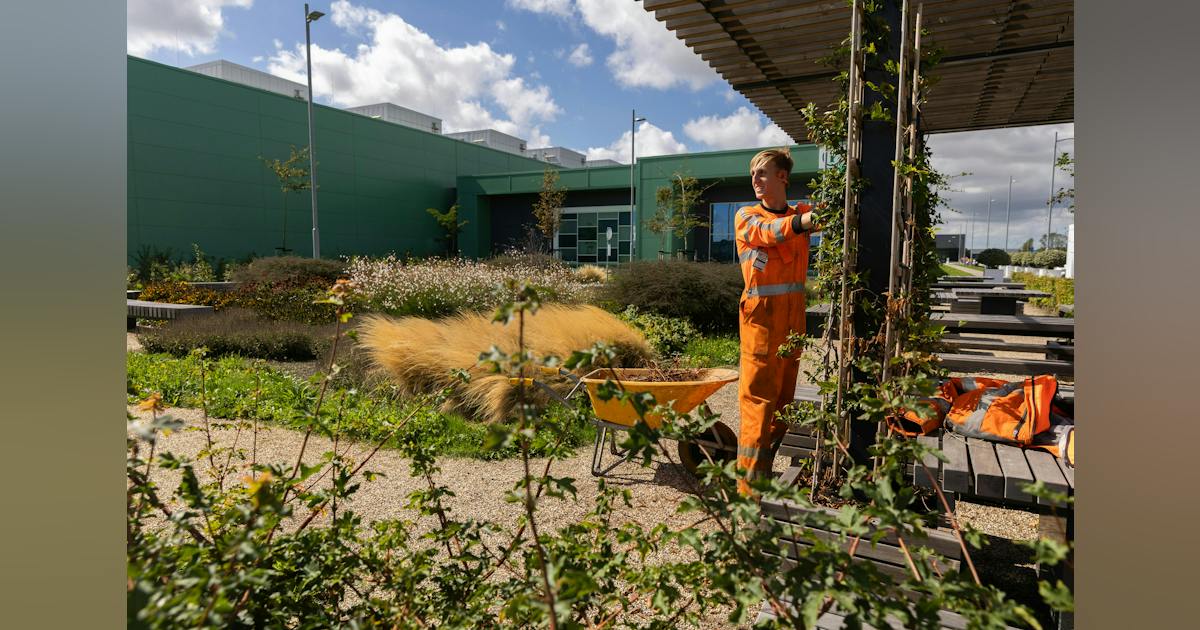
As a result, Microsoft has said six additional data centers planned in the region are being designed around biomimicry principles rather than treating landscaping as something added after the engineering work is finished. The change, from landscaping as decoration to ecology as a design input, is now being applied elsewhere. There is already a significant US example, set in Mecklenburg County, Virginia, where Microsoft originally announced the Chase City Conservancy in 2022, as part of a data center development south of Chase City. The completed project, which opened in April 2025, protects more than 230 acres from development. It includes more than eight acres of wetlands, over 16,300 linear feet of restored streams, 185 acres of native pollinator habitat, more than 25,000 planted trees and over three miles of publicly accessible walking trails. Local environmental organizations helped shift the design away from what the company describes as a more conventional recreational area toward biodiversity and habitat conservation illustrating the community-engagement side of Microsoft’s model, which, given the current temperature of such relationships, can’t be understated. For data center developers, that may be as important as the ecological results. Community impact is no longer being evaluated on just tax revenue and jobs. Turning portions of a site into protected wetlands, forests, trails or habitat potentially creates a visible local benefit in ways that renewable-energy contracts hundreds of miles away cannot. Microsoft’s commitment to the local community has been led by their Community First AI Infrastructure Plan announced in January 2026. Wetlands in Wisconsin, Screening in Georgia At Microsoft’s massive Mount Pleasant, Wisconsin, AI data center development, the company is working with the Root-Pike Watershed Initiative Network on restoration projects involving wetlands, native prairie and forested riparian buffers. One element involves returning previously straightened streams to more natural, winding channels, improving aquatic

Read More »

Axelera Europa targets enterprise data centers with far more efficient AI

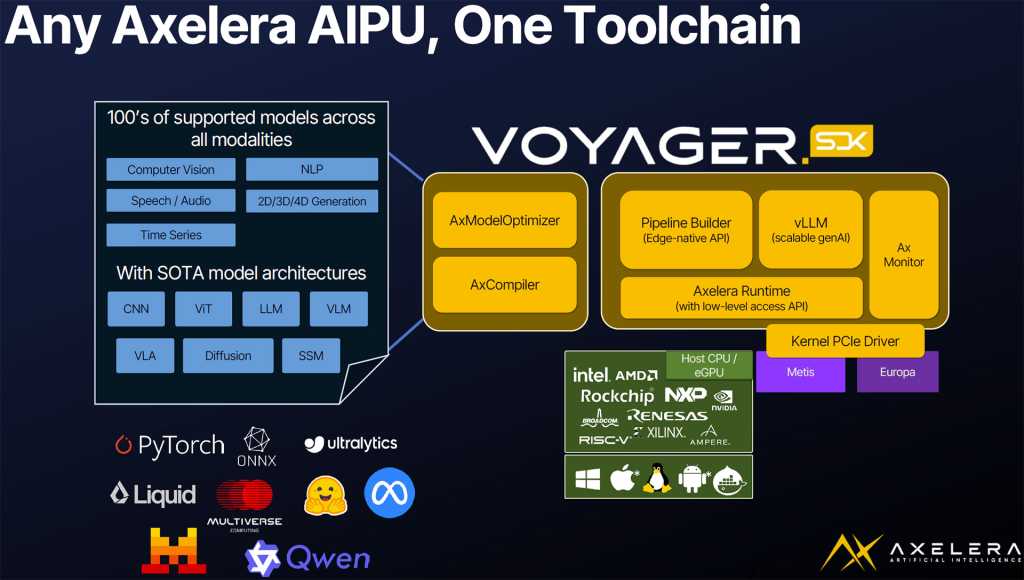
Software is still the gatekeeper Axelera In terms of software enablement, Axelera’s Voyager SDK spans its existing Metis products and the new Europa architecture, providing a common environment across embedded, edge and server deployments, with support for a multitude of computer vision models, LLMs, VLMs, diffusion models, speech and other AI workloads. To automate setup, Axelera’s Voyager Wingman uses natural-language prompts to help developers create or port inference pipelines, while AxeleraScript, or AxScript, provides a Python-enabled domain-specific language with lower-level AIPU control for custom operators and transformer models. This could prove every bit as important as Europa’s performance and efficiency. Enterprises already have models, development environments and application stacks. Extensive rewriting or specialized expertise adds development and operational costs that can quickly undermine savings on hardware and power.

Read More »

Scott Bergs, CEO of Kirkwood IG: Fiber and the AI Data Center Buildout

For years, fiber was one of the more forgiving elements of data center site selection. Developers could secure land, line up power, begin planning the facility and then work with carriers to establish the connectivity required by tenants. In a traditional multi-tenant data center, that model generally worked. At AI scale, Scott Bergs says it increasingly does not. “The architecture of those original communications service provider networks just don’t meet the latency and/or capacity needs” of today’s high-density compute environments, said Bergs, CEO of Kirkwood Infrastructure Group, during a recent episode of the Data Center Frontier Show. The result is a significant change in the data center development stack: network infrastructure can no longer be treated as something that gets solved after the site is chosen. For hyperscalers and neo-cloud providers, fiber route diversity, latency, physical security and future capacity increasingly need to enter the conversation alongside power and land. And as data center campuses follow available power farther from established digital infrastructure hubs, the scale of the network challenge is expanding with them. A connection between data center campuses that might once have extended two or 30 miles can now stretch 250 miles or more, Bergs said. What would traditionally have been considered a long-haul fiber route is increasingly becoming another piece of inter-campus infrastructure. That change is helping drive Kirkwood’s own expansion. From DF&I to Kirkwood Bergs previously led DF&I, a dark-fiber infrastructure platform concentrated in Northern Virginia and Maryland. Kirkwood Infrastructure Group is not simply DF&I under a new name, he said. Rather, it represents what Bergs described as a second phase in a broader infrastructure investment strategy developed originally through IPI Partners. IPI, an investment platform focused on digital infrastructure, backed DF&I after identifying communications infrastructure serving dense compute environments as an area requiring greater direct

Read More »

Cisco brings Splunk AI on premises, expands agent observability, monitors token costs

Cisco executives said during a press briefing that AI agents are operating across data centers, campuses, and branches, and interacting with enterprise resources and other agents. For example, if an agent deletes thousands of files, IT teams need to determine whether it malfunctioned or was compromised. On-premises option: Cisco AI POD for Splunk Aimed at enterprises that need to keep sensitive machine data within their own environments, Cisco AI POD for Splunk “brings Splunk AI to on-premises customers with new AI runtime software, Cisco infrastructure, Nvidia accelerated computing, and Kubernetes-based architecture, pre-validated and optimized for Splunk AI workloads,” according to Cisco. “One of the biggest roadblocks to enterprise AI today is that it’s too hard to deploy,” said Jeetu Patel, Cisco’s president and chief product officer, in a statement. “Customers want to know: Can I trust it to do the job? Can I afford it? And, most importantly, can I secure it? By running Splunk AI on the infrastructure customers already trust, they can move faster to put AI to work in their business with confidence and control.”

Read More »

Nuclear’s Next AI Test: Building at Scale

For data center developers facing multiyear utility interconnection queues and tightening power markets, nuclear energy is entering a different phase of its AI infrastructure story. The near-term opportunity still rests largely with the existing reactor fleet. Holtec International has moved the Palisades Nuclear Plant in Michigan into fuel loading, one of the final major stages before reactor startup activities. Constellation Energy, meanwhile, continues to work toward a 2027 restart of the former Three Mile Island Unit 1, now the Christopher M. Crane Clean Energy Center, under its long-term power agreement with Microsoft. Together, Palisades and Crane represent roughly 1.64 GW of existing nuclear capacity that could return to service without waiting for entirely new plants to be licensed, financed and constructed. That makes reactor restarts one of the few ways nuclear generation can materially intersect with data center power demand before the end of the decade. But the more consequential change may be taking place further upstream. A burst of activity from advanced nuclear developers at the end of August pointed increasingly toward the industrial systems required to move new reactor designs from demonstrations to repeatable infrastructure. X-energy, TerraPower, GE Vernova Hitachi, Oklo, Westinghouse, Kairos Power and others reported progress involving fuel supply, reactor testing, manufacturing, licensing and commercial deployment. None of these advanced reactor projects will solve the industry’s 2027 or 2028 power shortage. That is no longer the most useful test. The more important question is whether advanced nuclear can begin acquiring the characteristics of an industrial supply chain: dependable fuel, standardized manufacturing, repeatable construction, tested reactor systems and enough commercial certainty for large power customers to plan around deployment schedules measured in years rather than speculation. For data center infrastructure, that is the transition worth watching. Palisades Moves From Restoration to Startup The clearest near-term proof point

Read More »

Microsoft will invest $80B in AI data centers in fiscal 2025

And Microsoft isn’t the only one that is ramping up its investments into AI-enabled data centers. Rival cloud service providers are all investing in either upgrading or opening new data centers to capture a larger chunk of business from developers and users of large language models (LLMs).  In a report published in October 2024, Bloomberg Intelligence estimated that demand for generative AI would push Microsoft, AWS, Google, Oracle, Meta, and Apple would between them devote $200 billion to capex in 2025, up from $110 billion in 2023. Microsoft is one of the biggest spenders, followed closely by Google and AWS, Bloomberg Intelligence said. Its estimate of Microsoft’s capital spending on AI, at $62.4 billion for calendar 2025, is lower than Smith’s claim that the company will invest $80 billion in the fiscal year to June 30, 2025. Both figures, though, are way higher than Microsoft’s 2020 capital expenditure of “just” $17.6 billion. The majority of the increased spending is tied to cloud services and the expansion of AI infrastructure needed to provide compute capacity for OpenAI workloads. Separately, last October Amazon CEO Andy Jassy said his company planned total capex spend of $75 billion in 2024 and even more in 2025, with much of it going to AWS, its cloud computing division.

Read More »

John Deere unveils more autonomous farm machines to address skill labor shortage

Join our daily and weekly newsletters for the latest updates and exclusive content on industry-leading AI coverage. Learn More Self-driving tractors might be the path to self-driving cars. John Deere has revealed a new line of autonomous machines and tech across agriculture, construction and commercial landscaping. The Moline, Illinois-based John Deere has been in business for 187 years, yet it’s been a regular as a non-tech company showing off technology at the big tech trade show in Las Vegas and is back at CES 2025 with more autonomous tractors and other vehicles. This is not something we usually cover, but John Deere has a lot of data that is interesting in the big picture of tech. The message from the company is that there aren’t enough skilled farm laborers to do the work that its customers need. It’s been a challenge for most of the last two decades, said Jahmy Hindman, CTO at John Deere, in a briefing. Much of the tech will come this fall and after that. He noted that the average farmer in the U.S. is over 58 and works 12 to 18 hours a day to grow food for us. And he said the American Farm Bureau Federation estimates there are roughly 2.4 million farm jobs that need to be filled annually; and the agricultural work force continues to shrink. (This is my hint to the anti-immigration crowd). John Deere’s autonomous 9RX Tractor. Farmers can oversee it using an app. While each of these industries experiences their own set of challenges, a commonality across all is skilled labor availability. In construction, about 80% percent of contractors struggle to find skilled labor. And in commercial landscaping, 86% of landscaping business owners can’t find labor to fill open positions, he said. “They have to figure out how to do

Read More »

2025 playbook for enterprise AI success, from agents to evals

Join our daily and weekly newsletters for the latest updates and exclusive content on industry-leading AI coverage. Learn More 2025 is poised to be a pivotal year for enterprise AI. The past year has seen rapid innovation, and this year will see the same. This has made it more critical than ever to revisit your AI strategy to stay competitive and create value for your customers. From scaling AI agents to optimizing costs, here are the five critical areas enterprises should prioritize for their AI strategy this year. 1. Agents: the next generation of automation AI agents are no longer theoretical. In 2025, they’re indispensable tools for enterprises looking to streamline operations and enhance customer interactions. Unlike traditional software, agents powered by large language models (LLMs) can make nuanced decisions, navigate complex multi-step tasks, and integrate seamlessly with tools and APIs. At the start of 2024, agents were not ready for prime time, making frustrating mistakes like hallucinating URLs. They started getting better as frontier large language models themselves improved. “Let me put it this way,” said Sam Witteveen, cofounder of Red Dragon, a company that develops agents for companies, and that recently reviewed the 48 agents it built last year. “Interestingly, the ones that we built at the start of the year, a lot of those worked way better at the end of the year just because the models got better.” Witteveen shared this in the video podcast we filmed to discuss these five big trends in detail. Models are getting better and hallucinating less, and they’re also being trained to do agentic tasks. Another feature that the model providers are researching is a way to use the LLM as a judge, and as models get cheaper (something we’ll cover below), companies can use three or more models to

Read More »

OpenAI’s red teaming innovations define new essentials for security leaders in the AI era

Join our daily and weekly newsletters for the latest updates and exclusive content on industry-leading AI coverage. Learn More OpenAI has taken a more aggressive approach to red teaming than its AI competitors, demonstrating its security teams’ advanced capabilities in two areas: multi-step reinforcement and external red teaming. OpenAI recently released two papers that set a new competitive standard for improving the quality, reliability and safety of AI models in these two techniques and more. The first paper, “OpenAI’s Approach to External Red Teaming for AI Models and Systems,” reports that specialized teams outside the company have proven effective in uncovering vulnerabilities that might otherwise have made it into a released model because in-house testing techniques may have missed them. In the second paper, “Diverse and Effective Red Teaming with Auto-Generated Rewards and Multi-Step Reinforcement Learning,” OpenAI introduces an automated framework that relies on iterative reinforcement learning to generate a broad spectrum of novel, wide-ranging attacks. Going all-in on red teaming pays practical, competitive dividends It’s encouraging to see competitive intensity in red teaming growing among AI companies. When Anthropic released its AI red team guidelines in June of last year, it joined AI providers including Google, Microsoft, Nvidia, OpenAI, and even the U.S.’s National Institute of Standards and Technology (NIST), which all had released red teaming frameworks. Investing heavily in red teaming yields tangible benefits for security leaders in any organization. OpenAI’s paper on external red teaming provides a detailed analysis of how the company strives to create specialized external teams that include cybersecurity and subject matter experts. The goal is to see if knowledgeable external teams can defeat models’ security perimeters and find gaps in their security, biases and controls that prompt-based testing couldn’t find. What makes OpenAI’s recent papers noteworthy is how well they define using human-in-the-middle

Read More »