The race to industrialize AI data center construction is moving beyond prefabricated electrical rooms and modular building components. Increasingly, major infrastructure suppliers are attempting to standardize the power, cooling, controls, and engineering systems surrounding the computing equipment itself, with the goal of delivering highly integrated infrastructure through repeatable manufacturing processes rather than site-specific construction.
Schneider Electric’s recent activities provide a revealing example of that transition. Its RapidScale Modular Data Center Reference Design 115, introduced October 21 at NVIDIA GTC Berlin, outlines a modular AI factory architecture engineered for the NVIDIA Vera Rubin platform. Separately, a study conducted with Compass Datacenters documents substantial reductions in selected onsite installation activities through prefabricated white-space modules. Related developments involving power-system certification, onsite generation, and digital-twin technology show how the company is extending its reach across the data center development process.
As DCF previously reported in its examination of NVIDIA’s DSX POD initiative, the broader industry is working toward factory-integrated computing environments that can be assembled, tested, and delivered with less dependence on conventional field construction. Schneider’s contribution is particularly interesting because its latest engineering documentation provides a detailed view of how electrical and thermal infrastructure might accommodate a new generation of exceptionally power-dense AI systems.
A 227-kW Building Block for Vera Rubin
Schneider describes Reference Design 115 as a 10–20 MW, Tier III-targeted modular AI factory architecture developed to ANSI standards. The published example concentrates on one deployment unit containing four scalable units, designed around four NVIDIA Vera Rubin clusters with 1,008 GPUs each.
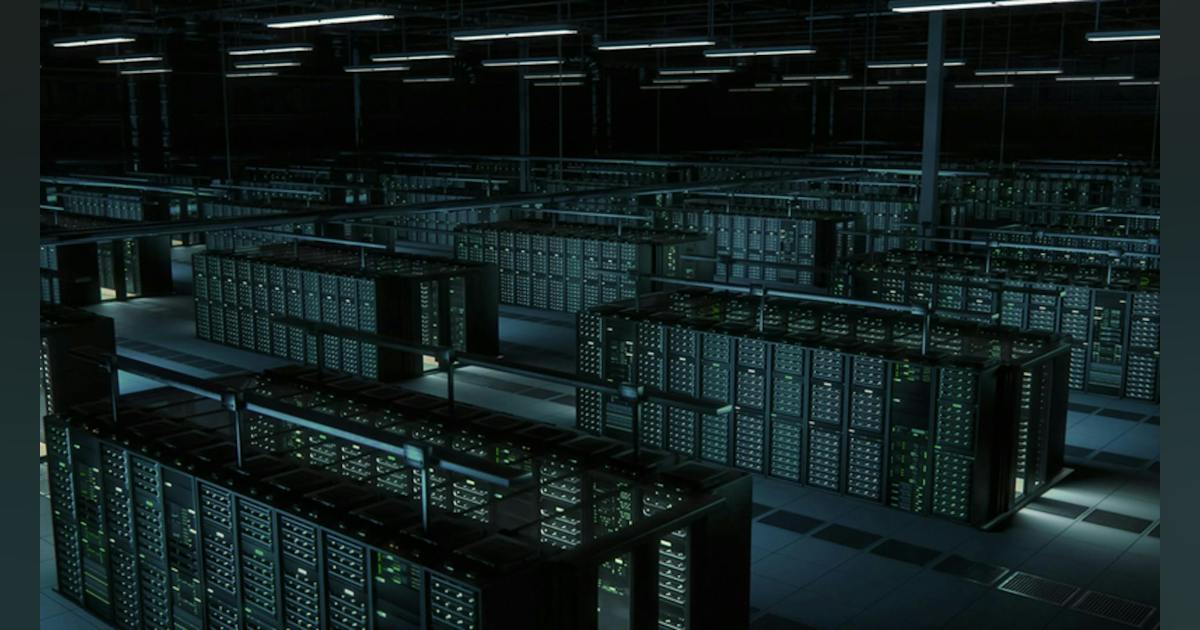
That translates to 4,032 GPUs distributed across 56 AI computing racks, supported by another 32 networking racks. The maximum AI rack power reaches 227 kW, while the documented configurations support approximately 10.4 MW to 11.4 MW of active IT load. The reference design assigns approximately 33,518 square feet to the deployment unit, divided between IT space and supporting utility infrastructure, with total peak facility power of approximately 13.25 MW.
The architecture combines prefabricated powertrains, liquid-cooling equipment, IT pods, distribution infrastructure, and management software within a standardized engineering framework. Rather than requiring developers to abandon conventional data center buildings, it allows prefabricated equipment packages to be incorporated into a broader construction program, with factory assembly proceeding alongside site development.
That distinction is telling. For developers constructing large campuses in multiple phases, the objective is not necessarily to replace every building with a modular container. It is to make the infrastructure inside those buildings easier to reproduce, coordinate, and commission as computing technologies evolve.
Power Architecture and the Redundancy Question
Reference Design 115 uses four 3.75 MW RapidScale powertrains to serve the IT environment, providing a 3+1 distributed redundant UPS architecture. Each powertrain includes a 5,000-amp QED-2 switchboard, three parallel 1,250 kW Galaxy VXL UPS units, and associated distribution infrastructure. The UPS systems provide five minutes of runtime at rated load.
Electricity is delivered through remote power panels serving the AI racks and distribution equipment supporting the networking systems. Schneider’s NetShelter Open Architecture MGX 1.2 configuration accommodates the high-density AI racks through multiple power feeds and redundant power shelves. Separate 2.5 MW powertrains provide 2N electrical infrastructure for the mechanical systems, with UPS support for critical coolant distribution units and pumps.
An important characteristic is the continued use of 480V AC distribution for AI racks, with 415V distribution for networking equipment. Schneider is developing higher-voltage DC technologies for future AI infrastructure, but Reference Design 115 does not depend on an 800V DC electrical architecture.
The more significant operational question concerns how operators allocate power between computing performance and redundancy.
Schneider’s documentation describes multiple operating states for the Vera Rubin racks. At the Max-P operating point, each AI rack draws approximately 227 kW, emphasizing maximum rack-level computing performance. At Max-Q, power consumption falls to approximately 188 kW per rack, with the objective of improving the number of tokens produced per watt.
In the design’s tabulated Max-P configuration, 42 AI racks operate with approximately 10.4 MW of total IT demand, including networking equipment. The Max-Q configuration supports all 56 AI racks, with approximately 11.4 MW of aggregate IT demand.
The documented Max-P configuration operates with three of the four IT electrical powertrains, while the full 56-rack Max-Q configuration uses all four. That distinction illustrates the trade-off between maximizing installed computing capacity and preserving electrical headroom for maintenance or equipment failures. Operators would need to account for those conditions when selecting operating configurations.
Schneider also describes the possibility of operating more Max-P racks when additional electrical capacity is made available, along with reduced-rack configurations for maintenance or equipment failure.
The design suggests that maximizing the productive use of power infrastructure may become as important as maximizing individual rack performance. However, actual token-output benefits will depend on workload characteristics, operational controls, and the ability to manage the resulting infrastructure constraints.
Liquid Cooling Moves Into the Standardized Design
The thermal architecture illustrates why factory integration is becoming increasingly attractive as AI rack densities rise. Schneider’s design assumes that liquid cooling removes approximately 96% of the heat generated by the liquid-cooled racks, with the balance handled by air-cooling infrastructure.
Motivair liquid-to-liquid coolant distribution units connect the computing equipment to a high-temperature technology cooling loop designed for approximately 108°F supply and 126°F return temperatures. A separate chilled-water system supplies 64°F water to Uniflair fan walls, which manage residual rack heat and other air-cooled equipment.
The higher-temperature liquid-cooling system permits the use of dry coolers for substantial portions of the heat-rejection requirement, with adiabatic assistance when outdoor conditions demand it. Such an approach can reduce dependence on mechanical chilling, although its water requirements will vary with climate and operating conditions.
Schneider models annualized power usage effectiveness (PUE) at approximately 1.1 under the San Francisco and Dallas conditions examined in the reference design. These are engineering projections rather than measured operating results, and actual performance will depend on climate, equipment configuration, and workload.
The design therefore presents a trade-off familiar to operators planning liquid-cooled AI environments: higher-temperature cooling creates opportunities to improve energy efficiency, but water availability, heat-rejection requirements, maintenance, and redundancy remain site-specific considerations.
What Compass’s Installation Study Actually Demonstrates
Where Reference Design 115 describes a proposed infrastructure architecture, Schneider’s work with Compass Datacenters offers evidence from actual prefabricated installations.
The companies first announced their jointly engineered EcoStruxure white-space module in September 2025. Their October 2026 White Paper 238, Prefabricated White Space Module Time Study, examines the installation sequence for integrated IT pods at a Compass hyperscale campus, comparing observed prefabricated installation durations with a functionally equivalent traditional construction sequence.
The module incorporates containment, technology cooling system piping, electrical busway, cable-support infrastructure, and structural components within a prefabricated assembly. In the configuration studied, an approximately 1,000-square-foot pod accommodates up to 42 rack positions with a maximum electrical capacity of 1.2 MW.
That configuration is distinct from the much higher-density Vera Rubin architecture described in Reference Design 115. Its relevance is the installation methodology rather than its ability to accommodate the same computing equipment.
The study reports that selected onsite activities required 15 hours for the prefabricated pod, compared with 75.5 hours for the conventional approach, an approximately 80% reduction in the installation duration being compared. The traditional calculation includes estimated durations for several field installation activities, while the prefabricated installation results were observed at the Compass campus.
The largest savings result from eliminating separate onsite installation phases for technology cooling piping, busway, and cable shelving. Those systems are incorporated into the prefabricated assembly rather than delivered and installed independently by multiple trades.
Compass also documented improvement through repetition, with one earlier installation requiring 18 hours compared with 15 hours for the later deployment examined in the study.
Importantly, the comparison excludes offsite manufacturing activities and does not measure total data center construction or commissioning time. It also excludes certain conventional overhead-support installation work. The results nevertheless provide a useful indication of how moving complex infrastructure integration into the factory can reduce construction-site coordination and simplify installation.
From Factory-Built Power to Digital Infrastructure
The broader significance of Schneider’s approach becomes clearer alongside its other recent developments.
In September, UL Solutions announced that Schneider had achieved the first certification under its UL 2140 program for specified prefabricated power distribution assemblies. The certification evaluates integrated systems that may combine switchboards, UPS units, batteries, and distribution equipment on common skids, introducing a third-party assessment pathway for equipment assembled and interconnected before delivery.
That does not certify the entire RapidScale architecture, but it addresses an important concern for developers adopting factory-integrated electrical infrastructure: how to verify complete assemblies rather than relying exclusively on certifications for individual components.
Schneider is also working to coordinate infrastructure beyond the data hall. Its September collaboration with Wärtsilä and Stanley Consultants proposes a generator-to-chip approach that brings onsite power generation, electrical distribution, automation, and engineering into a more integrated development process. Separately, the company’s software-defined medium-voltage switchgear initiatives are intended to make electrical systems easier to configure and adapt as facilities expand.
Software is becoming another important part of this strategy. In October, Schneider, AVEVA, ETAP, Nscale, and Start Campus disclosed an Immersive Twin pilot using the NVIDIA Omniverse DSX Blueprint at the SINES Data Campus in Portugal. The project connects computing requirements with electrical, cooling, and operational models, allowing proposed changes to be evaluated through simulation before implementation.
The digital-twin pilot is separate from the RapidScale reference design, but it illustrates the company’s broader direction. Standardized infrastructure becomes more useful when its performance can also be modeled, validated, and managed across the facility lifecycle.
Industrializing the Data Center Has Its Own Constraints
For developers, the potential advantages of this approach are substantial. Repeatable engineering can reduce design variation, factory integration can move complicated work away from crowded construction sites, and earlier testing may help identify problems before equipment arrives. The value increases when infrastructure configurations can be reproduced across multiple buildings or campuses.
Schneider says its prefabricated manufacturing capacity has expanded fourfold since 2025, with eight primary manufacturing facilities totaling approximately 1.35 million square feet, supplemented by additional company and partner sites. RapidScale incorporates approximately 90% internally manufactured equipment, giving Schneider greater direct involvement in the supply chain surrounding its modular infrastructure offerings.
Those figures suggest a growing industrial commitment, but manufacturing capacity alone does not establish shorter project delivery schedules. Factory throughput, component availability, transportation logistics, commissioning requirements, and the readiness of electrical and cooling connections still determine how quickly equipment can be brought into service.
Nor has Schneider published a comprehensive project-level capital-cost comparison for Reference Design 115. Developers will need to evaluate the financial benefits of repeatable construction alongside transportation, integration, maintenance, supplier-dependence, and site-specific engineering requirements.
The central development is a changing division of labor in data center construction. As AI infrastructure grows more complex, equipment suppliers are moving toward responsibility for larger portions of the integrated system, while developers and contractors increasingly manage the interfaces between manufactured infrastructure and the physical campus.
Schneider’s latest engineering and manufacturing initiatives illustrate both the opportunity and the unfinished work. The industry has evidence that prefabrication can substantially reduce selected installation activities, along with increasingly detailed architectures for the next generation of AI computing. The larger test will be whether those improvements translate into repeatable, economical, and reliable deployments at the scale now being contemplated for AI infrastructure.