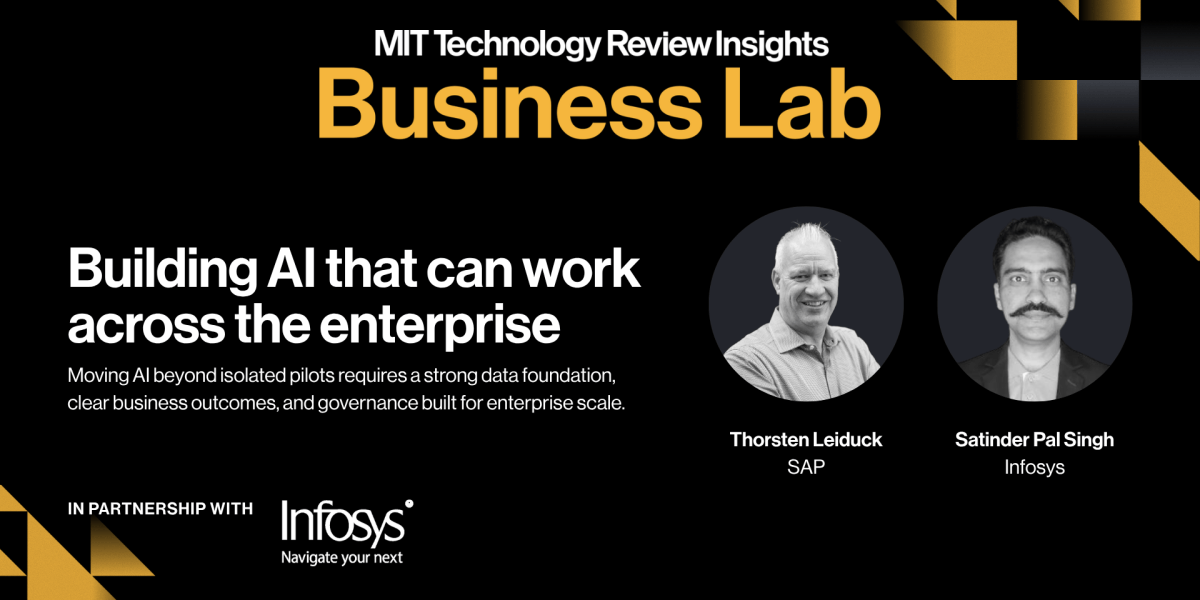
In partnership withInfosys
For years, enterprises have approached AI as a series of discrete experiments. Now, as AI agents begin to move into the workflows that run the business, that model is starting to look inadequate. Organizations moving from isolated pilots toward AI agents and autonomous workflows are confronting a deeper challenge: rethinking how data, business processes, governance, and people fit together, turning AI from a collection of tools into part of the enterprise operating model.
For Thorsten Leiduck, SVP and global head of SAP Business AI Platform Ecosystem, that shift begins with treating AI as an enterprise platform rather than a collection of disconnected projects. “AI is absolutely dependent on the data foundation,” he says, arguing that companies need a connected, semantically rich layer that reflects their business before they can reliably deploy AI across processes. The stakes also change as AI moves into mission-critical workflows. For some everyday applications, “80% might be good enough,” he says, but in areas such as supply chains or financial close, that level of accuracy is “a very terrible result.”
That foundation also determines which AI applications are worth pursuing. Satinder Pal Singh, associate VP North America for SAP BAIP and SAP AI Strategy at Infosys, frames AI agents as “digital coworkers” and recommends evaluating potential use cases through three lenses: impact, feasibility, and scalability. Companies should identify where an agent can move meaningful business metrics, determine whether their data and talent can support the use case, and then establish whether successful applications can be replicated. “A pilot that can’t scale is just an experiment,” he says.
Scaling also brings governance into sharper focus. Clear policies, access controls, monitoring, and oversight are necessary to ensure agents remain trustworthy and aligned with business requirements. “The absence of governance doesn’t speed up AI adoption,” Singh says. “It creates a risk backlog” that can ultimately force a more disruptive stop and audit.
Those considerations will become more important as AI agents take on more responsibilities as digital coworkers. Both executives see a future in which agentic systems coordinate work across applications, while customer-specific knowledge graphs and governed data become critical enterprise assets. For Singh, the longer-term opportunity is a shift from AI as a productivity tool to “AI as a decision-making partner,” helping leaders understand what is happening, anticipate what comes next, and determine how to respond.
This episode of Business Lab is produced in partnership with Infosys.
Full Transcript
Megan Tatum: From MIT Technology Review, I’m Megan Tatum, and this is Business Lab, the show that helps business leaders make sense of new technologies coming out of the lab and into the marketplace.
This episode is produced in partnership with Infosys.
Now, the development and democratization of AI tools has the potential to reconfigure how enterprises operate. But, at a time when applications are being scaled up from that initial phase of experimentation, we’re still seeing senior leaders grapple with questions around AI’s value, risk, and the complexity it adds. It’s becoming clear that, unlike past ways of automation, AI requires a real mindset shift. Put simply, the technology can’t simply be added into an enterprise’s existing toolkit. It requires a complete reconfiguration of what’s inside and how it’s used.
Two words for you: conscious configuration.
My guests today are Thorsten Leiduck, SVP and global head of SAP Business AI Platform Ecosystem, and Satinder Pal Singh, Associate VP for North America, SAP Business AI Platform and SAP AI Strategy.
Welcome, Thorsten and Satinder.
Thorsten Leiduck: Yeah, thank you for having us. Really a pleasure to be here with our valued partner, Infosys. Looking forward to the conversation.
Satinder Pal Singh: Hi, Megan. Thanks for inviting for the conversation today. Looking forward to the discussion.
Megan: Me too. Thank you both so much for being here. Thorsten, if I could start with you. We know that many senior leaders understand the transformative potential in AI, but they continue to struggle with aspects of its implementation. Many projects remain stuck at a pilot phase, for example. When you speak to clients, what are the biggest obstacles they face when it comes to integrating AI into their tech stack?
Thorsten: Yeah. Megan, as you mentioned, AI is on the agenda of every client conversation today, but many customers are really struggling how to convert that interest into an operationalized model and to unlock the value of AI across the enterprise. And the reason is that too many programs start as isolated POCs on different AI technologies and in an inconsistent fragmented data foundation.
This creates a lot of duplication, inconsistent performance, and no clear path to scale. At the same time, leaders are highly concerned about security, observability, reliability of agents, and some ethical implications when those get deployed. This is also shown in some studies. For example, BCG has launched a report, which shows that 74% of the organizations are stuck in pilot mode with no plan to scale. And in an Anthropic survey, data said that 42% are really struggling with getting access to the data and the quality to really, basically, scale the entire AI capabilities across the organization.
The path forward is really to treat AI not just as a project, but more holistically, as an enterprise platform, one that really consistently connects an unified data layer with the process context of the applications, and then embed AI capabilities governed across the entire life cycle. And to make this real, we in SAP launched the SAP autonomous enterprise framework, so organizations can move from pilots to scaled outcomes.
Megan: Yeah, really, to provide that support. And, Satinder, would you agree, why is it that we’re seeing enterprises get a touch of almost AI paralysis here? What’s the mindset shift that needs to happen and, perhaps, why is this something organizations need to be thinking about now, as well?
Satinder: Absolutely, Megan. And, if anything, the picture sharpens when you look at, specifically, at agentic AI. Infosys and HFS research surveyed over 500 global 2,000 enterprises and found only 14% have successfully scaled AI. Eighty-six percent remain in early exploration, proof of concept, or fragmented pilot phases. For a technology at the top of every boardroom agenda for two years, that’s a striking failure rate. And at the core of that 86% is what I would describe as AI as a department trap.
What happens is that an organization creates an AI team or a center of excellence and walls it off from business. That team builds technically excellent pilots the business doesn’t recognize itself in, and you end up with AI solutions searching for problems, rather than the other way around. Mindset shift is clear. Move from treating AI as a technology initiative to treating it as an operating model transformation. AI stops being something IT does for business and starts being something the whole organization does together. Every function, every workflow, embedded from the start.
And what makes this a now problem? Early movers are building an advantage. You cannot close by buying the same platform later. Eighteen months of agent behavior data, calibrated knowledge graph, workforce that has genuinely internalized AI, that is a structural advantage that compounds. Infosys Knowledge Institute AI Maturity Index shows that only 8% of the companies qualify as AI native today, yet they achieve four times the revenue contribution from the AI versus laggards. If you’re not building AI today, you’re not standing still, you’re falling behind at an accelerating rate.
Megan: Right. There’s a real polarization there, isn’t there, between the front-runners and the laggards, as you say. As we shift from pilot to scaled-up applications, perhaps the first step is evaluating when AI is the right tool. AI has quickly become the default solution within many enterprises. Is there a tendency to use it as a bit of a blunt instrument, nowadays, Thorsten? At the outset, how can senior leaders better evaluate what use cases are worthy of their time and investment, in order to strip out some of that later complexity?
Thorsten: Yeah, I think, Megan, what everybody needs to be aware is adopting and rolling out AI across an organization is as much a change management journey as it’s a technology rollout.
Now, when you have this in mind, it makes absolutely sense to put AI in front as many teams as possible, because you want to build formality, and spark ideas, and also people should see the benefit of AI in an organization. When you think about travel assistance, meeting summaries via Copilot, or AI-enabled workflows, increase the productivity, everybody feels this in their real job, in their real daily business. And, obviously, this creates creativity and also provides the organization from a bottom-up perspective with some innovation scale.
Now, however, as majority grows, the conversation, and this is also what we discuss with many of the leaders, and our clients, shifts more to economics and governance. Things like token costs, model performance, security, and accountability become much more relevant. And when you then take the approach and think about AI agents as digital workers that execute specific tasks within a business process, then this means, from an AI perspective, not every task justifies nation.
In some cases, human effort remains more economical or effective. The smart approach, and that’s what we really recommend to our clients, is to start with a defined, maybe small set of high-value use cases with defined success metrics upfront. So, for example, such as cycle time reduction, accuracy gains, or cost of per transaction, or top line improvement, and then scale what works. Those use cases can be tied to a line of business domains or industry scenarios.
And then, what we are doing from an SAP perspective, together with Infosys, we really help customers to be successful. We provide, as part of our autonomous suite, the according domain assistance, which really run business processes end-to-end and which deliver find ROIs for single end-to-end business process steps.
And then, last but not least, in many scenarios, I think, which has been very common pattern in particular around large industry AI use cases, is a joint approach, and we do this with partners like Infosys, but also customers around forward deployed engineering, so that you really define very closely the AI-specific use case with the defined outcomes together with the customer, and deliver this as the initial projects. And then, ideally, scale this to other customers and take it back like a best practice, which can be rolled out to other organizations, as well.
Megan: Right. It’s been really clear, isn’t it, on what you’re looking to achieve and what’s worth your time, as I say. And what would your advice, Satinder, be here, on refining an AI strategy to ensure organizations can focus on those areas, where AI can deliver the highest returns?
Satinder: Sure, Megan. I think Thorsten’s framing of AI agents as digital coworkers forces a precision that agentic AI strategy language often lacks. When you ask which digital coworkers do we need and where do they deliver the most value, the answer starts to become clearer right from the first step. At Infosys, through our Topaz AI-first framework, we push clients through the three lenses simultaneously.
The first one is impact. Where does deploying an agent move the numbers that matter? Revenue, cost, working capital risk. We have built a library of over 300 enterprise use cases across industries, so we never begin from a blank page. The second is feasibility. Given your data foundation platform and talent today, which high-impact use cases can you actually execute? Feasibility determines your sequence. The high-impact use case on a broken data foundation is not viable. When the foundation is right, the results are dramatic. One Infosys engagement cut complex SAP-specification documents from 86 person hours to 6, a 92% reduction.
Third is scalability. Once you have proven a use case with clear ROI metrics, cycle time reduction, accuracy gains, cost per transaction, what’s the architecture that lets you replicate it? A pilot that can’t scale is just an experiment. My practical advice: treat your AI portfolio like an investment portfolio, quick wins that fund the program, medium-term bets, one or two bold, long-term positions that balance keep stakeholders engaged at every stage and not just in year three.
Megan: That’s such a useful framework for people to use there. And given the urgency here, Thorsten, how can organizations approach and manage AI in a more structured, efficient way? To start with, what are the fundamentals that some organizations perhaps miss at the moment? I know Infosys and SAP talk about platform and data, then AI, for example.
Thorsten: Yeah, Megan, I think the fundamental, which many organizations are overlooking, is data and the data is a foundation for AI. Because, at the end, without the data structures and the ability to access the right information at the right time and basically bringing different kind of structured, unstructured data sources together, in a meaningful governed and semantic way, there will be no successful AI. AI is absolutely dependent on the data foundation. And I think this is often overlooked, and that’s why I said when you start POCs in different organization, or different parts of the organization with different technologies, it’s very hard to establish an end-to-end consistent model on the data side, as well as on the AI side.
One of the key goals companies need to achieve is, and that’s why we really talk about you need to start with data first and the platform first, is to establish and semantically-rich connected data layer that really reflects your business, so that the agents are really grounded in the company’s reality and not just in generic patterns.
And then, I think, the second element that’s important is accuracy. In the enterprise context, it really matters. For example, what might pass in a consumer setting, where you have 80% accuracy, and even in a workforce environment where you build PowerPoints or you do email drafts, which you then, with a human in the loop, optimize, 80% might be good enough. But, when you really think about mission-critical or business-critical processes in the supply chain, or closing the books, 80% is a very terrible result.
The stakes are much too high and you need to have much more accuracy. And that’s why it’s important that you have business process logic and industry context embedded into the data and the models which build the foundation, if you will, the backbone for every AI and, obviously, for the data in the ERP and the line of business system.
And then, last but not least, the other critical element, and you see this obviously in the news with all the agents going rogue, are governance, compliance, and security. Very critical in an enterprise context. You need to set clear policies, access controls. You need to have monitoring ability, capabilities, to really make sure that what then the AI agenda capabilities or agents are executing is fully aligned, is trustworthy, and scalable.
Megan: Right. Which is quite a lot of things for organizations to be thinking about. Satinder, how do SAP and Infosys work with organizations to streamline some of these processes, perhaps and make unlocking AI’s capability a little bit easier?
Satinder: Megan, I think at the onset, I want to acknowledge that, at Infosys, we are uniquely positioned for our relationship with SAP, because we are a customer to SAP, as well as one of their key global suppliers. And the way SAP and Infosys work together is designed around the architecture Thorsten described, that defines a coherent partnership.
SAP brings the platform foundation, business data cloud for the semantically-rich enterprise, generative AI hub for governed LLMXs, and agent hub for the lifecycle governance, enterprise grade from day one. Infosys brings implementation depth, industry context, and use case accelerators. Through Infosys Topaz, we have built over 50 pre-configured AI use cases on Business AI Platform, production-ready configurations deployable without building from scratch. We co-develop use cases within SAP’s industry AI engagement with clear customer-specific FTE metrics. That shared accountability for results is different from a typical implementation engagement.
In practice, one global S/4HANA transformation program used AI-assisted delivery tooling to complete over 480 RICEF objects in five months, a pace conventional delivery would not sustain. In another account, an AI-powered platform auto-classifies over 120,000 SAP incidents monthly, with zero analyst charge. The combined effect time to value drops from 12 to 18 months, down to four to six months.
What I would emphasize is change management damage. Technology is increasingly deployable, and Thorsten also spoke about it earlier. What’s hard is helping an organization internalize that their agents are digital coworkers, not automations. That mindset shift is 70% of the implementation challenge that platform cannot solve alone, and Infosys and SAP run joint adoption programs addressing both the dimensions in parallel.
Megan: Fantastic. Some great real-world examples there, as well. Thorsten, can you tell us a little bit more about SAP’s Business AI Platform, or BAIP, in particular? How does that work and what sets it apart from other platforms?
Thorsten: Yeah, so SAP Business AI Platform, if you will, is the foundation for our SAP autonomous enterprise framework, which really consists of a unified user interface and is enabled as an agentic orchestration layer, which we call Joule. And you have the autonomous read with all the applications, and then you have the Business AI Platform, which powers the other capabilities, and is closely connected, and is basically organized around three core pillars.
The first one is, really, what we call build. What it means is you provide the respective intent-based development tools, so that customer, or partners like Infosys, can really create and development agents, applications and workflows using best-in-class tools and model to extend SAP’s own assistant, or customizing those, or really building own agents as needed.
Complimenting what Satinder said, it’s really critical for us that we have a thriving ecosystem, who is innovative, and is building innovations, and is complementing our own SAP agentic portfolio. We are focusing on specific areas on the domains, from a line of business industry perspective, where we deliver assistance as part of our organization, but to really then customize them from a last mile execution from really complimenting areas which we don’t cover and really driving the innovation towards the customer, our ecosystem is the multiplier force and Infosys is really playing a leading role here with us, together.
Second is, and we talked about this, is what we call the contextualize and reason pillar, which is literally as a foundation data, we address with SAP Data Cloud and comprehensive data strategy, where we establish an end-to-end data fabric across partner provider platforms, like Databricks, Snowflakes, where we promote and zero copy access to data. For the customer, this is very important. So, we allow, basically, promote to customers if you have made investments in any of those platforms, reserve those investments and just leverage BDC to connect without moving data around your, for example, Databricks, Snowflake environment to BDC.
With this approach, we establish and harmonize semantic data layer, which can then be used for any AI scenario across the entire enterprise, combining different data sources without any disruption. The other key element that’s part of this is the generative AI hub. We have aggregated more than 50 models, language models, including some of our own models into it, in single cockpit, so that customers can access and choose any of those 50 models as part of the generative-AI hub, which is part of the platform.
And then, as a key differentiator, we really moved a lot of business semantic and context into the knowledge graph, which then helps to navigate the agents and acts like a nerve, or navigation system, in the company to really provide business-relevant, customer-specific information for the decision making and the execution to any agentic execution framework.
And then, we talked about governance, last but not least. This is the third pillar, which is very critical and this is built-in. So, we have, as the third pillar, the SAP agent hub, which is kind of a command center for enterprise-wide AI and agent governments. You can govern SAP agents, you can also govern non-SAP agents, as long as they’re integrating to SAP via A2A. So, the team can really manage, on the customer side, an end-to-end life cycle of agents and features from hire to retire.
Megan: Fantastic. That’s a really comprehensive overview. Thank you ever so much. And, Satinder, can you share any examples, perhaps, of how organizations have used SAP Business AI Platform in practice, to improve the ways they’ve used AI? Perhaps, what was the challenge they faced, what did the process look like, and what benefits did they unlock?
Satinder: Sure, Megan. I think Thorsten just explained how powerful a platform Business AI Platform is. And this is decades in working. We also have been using that, and I’ll share two examples from live Infosys engagements, both showing what BIP’s three pillar look like in production.
The first is global diversified manufacturer with a large SAP estate. The challenge was month-end close, 80-plus SAP transaction codes, period closed teams working nights and weekends, L1 support absorbing over 300 incidents per month, from close cycle alone. On Business AI Platform, we deployed Topaz Fabric, Infosys’ agentic orchestration platform, with a master agent coordinating five specialist child agents, WBS accrual, revenue recognition, intercompany settlement, master data reconciliation, and SOX audit trail generation. Agents run autonomously, escalating to humans only for genuine exceptions. The result, entire L1.5 support tier eliminated, over 300 monthly incidents handled with zero human touch. The close team redeployed from reactive firefighting to forward-looking financial analysis. Annual savings pipeline exceed $1 million.
The second is North American Utility in a S/4HANA transformation. Their challenge was development velocity, complex SAP functional specification documents routinely requiring 80 or more personnel each, a bottleneck throttling the entire program. Using AI native development environment on Business AI Platform with a Claude-powered retrieval system, we reduced those specifications from 86 hours to six, a 92% reduction, validated across 51 SAP task types at 95% accuracy. The architecture is now being replicated across accounts. In both cases, the pattern matches what Thorsten described, governed data foundation, SAP business process context, full agent observability through SAP Agent Hub. That’s the autonomous enterprise running as daily operations, not as a concept.
Megan: And those are some really compelling concrete results I think would be really helpful for people to hear. Also, of course, responsible AI, or clear governance frameworks, are a critical component of AI integration, too. And we know that tools like LLMs are rarely developed with compliance built-in. I wonder what’s your advice there, Thorsten, on how to ensure that property governance is embedded into an ERP?
Thorsten: Yeah, I mean, Megan, you’re absolutely right. Governance compliance and security are really mission-critical to delivering relevant, reliable, and trustworthy AI at enterprise scale. I mean, it’s important to understand how in public LLM service really works. Many of those services are trained on internet scale data, which means they’re public models. Depending on the provider’s policies and setting, they may retain easier inputs for model improvement, which means if a company provides data back to the model, this company data is in the public domain. For example, pipeline information or forecast information, which is becoming very, very critical, because this exposes your organization, really, at significant risk.
So, while then LLMs X are really great, imposes in large volumes of text and other unstructured data, they are less effective with structured tables like in EOP systems, or in business applications, in general, and then they’re lacking, usually, the nuance of business process and logic and context. That’s why a robust governance framework is essential. We talked about the generative AI, how we aggregate those models in a single cockpit.
And then, the other element, which we previously touched based on and Satinder mentioned, is always a part of the custom examples is SAP agent hub or, in general, when we talk about the capabilities just in AI lifecycle governance, which really includes agent registry, LMN registries, MCP registry, so a single source of tool for every AI artifact that you can manage identity and access control, so that agents are really variable and that you can really provide the right permissions, in terms of which agents allowed to use access which data, and then agent observability, agent minus, and then also map the agent skills to the organization is very critical.
As all of part of this, as I mentioned before, we provide those capabilities really fully embedded into the Business AI Platform to really provide this governance framework out of the box and fully embedded into everything what you do at SAP.
Megan: Which is so important, because when organizations are experimenting with, or scaling up multiple AI programs and tools, in some cases, it adds real complexity. I wonder, Satinder, would you add anything on how organizations can have that robust layer of governance built in, even with a pretty complex tech stack?
Satinder: We, at Infosys, have our Infosys Knowledge Institute, they run this annual magazine generative AI radar, and it found that 48% of companies had deployed generative AI without a formal governance policy. Nearly half of the enterprises were running AI with no documented framework or oversight, accountability, or compliance. That’s the gap that Thorsten is describing, and it has to be closed proactively before an incident forces a reactive stop or audit far more disruptive than building a governance upfront.
What Thorsten has just described in SAP Agent Hub is exactly the platform layer that makes enterprise-wide governance possible and is worth making the overall architecture explicit, because without it, governance is theoretical.
The framework I use with clients has three layers that have to work together. The first one is policy, a clear organization-wide AI use policy, what agents can and cannot do autonomously, how data can be used for AI training, disclosure obligations, and accountability for outcomes. This needs legal, compliance, technology teams together with a board level sponsorship. Without that foundation, every deployment becomes an ad hoc governance debate. Second layer is platform. This is where SAP Business AI Platform and, specifically, SAP Agent Hub becomes enterprise control tower.
The capabilities Thorsten described, agent LLM, MCP registry as a single source of truth, verifiable agent identities with scoped access trails, agent observability, agent mining for drift detection, these aren’t just governance features. They give leaders real-time visibility across a complex multi-agent landscape. You can see what’s running, what it’s consuming, and whether it’s performing as expected. That’s what turns a complex tech stack from a governance liability to a governance asset.
And the last layer is process, the recurring governance rituals, quarterly AI risk reviews, bias audit cycles, model performance reviews against the business KPIs, these structured conversations that keep humans accountable for the agent behavior over time. What organizations consistently discover is that this three-layer structure actually accelerates the deployment. Every new use case has a clear path through approval and a governance architecture to plug into. The absence of governance doesn’t speed up AI adoption. It creates a risk backlog that eventually forces a stop and audit movement far more disruptive than building the governance muscle.
Megan: That’s such an interesting point. Thank you so much for that. And we’ve covered a lot of ground, so to close with a future forward look, we’ve spoken today about the proliferation of AI tools that are now on the market, many designed to transform enterprise-level operations. I wonder, what do you see on the horizon, Thorsten, that you think could be a real game-changer?
Thorsten: I think what we will see very soon, and we talked about this briefly, is that we are heading into a period of sustained, rapid AI adoption, where assistance and agents will operate as digital coworkers. They will be embedded in our organizations like employees today, and they will be embedded into processes as people perform tasks, as we speak.
Now, as this happens, the Center of Gravity will shift more and more from a monolithic application layer to an agentic value layer that orchestrates work across systems and across different landscapes, which need to be orchestrated very well. I think what we also will see, and this will be likely, at least in terms of scale, I believe a game-changer, is that the delivery will become industrialized. When you think about agent factories and church services that really design, test, and govern agents at scale, or you can say agentic frameworks at scale, and I think we will see an evolution of commercial models, which are today more consumption-based towards really value and outcome-based agreements, which are then tied to clear business KPIs.
On the technology front, I think there’s still so much movement on the LLM landscape, new architectures, training methods. I think we’ll bring down, significantly, the total cost of ownership, while also control and the viability will be improved. I think there’s an awareness which the recent examples in the market show, and then I think the innovation will be playable.
And I think the big question is, from that perspective, which role is China going to play in a global context, and also how those models are really embedded. Last but not least, most importantly, even I think ontology and customer-specific knowledge graphs will become first-class assets, and I think this will be the key differentiation in the future, because they will lead in code process, semantics, policies, what Satinder talked about, and data relationships. And they are the blueprint for secure high-performing enterprise agent architectures in the future.
Megan: Which is, of course, what we’re aiming for. And how about you, Satinder? What would you flag as a really exciting area of development?
Satinder: Sure, Megan. I think what excites me most is the shift from AI as productivity tool to AI as a decision-making partner. The most important evolution Thorsten’s architecture makes possible. For decades, enterprise systems have told us what happened. The next generation helps leader understand what is happening now, what will happen next, what actions to take.
The scenario I keep coming back to, a CFO starting a day with an agent that continuously analyzes signals across finance, supply chain, procurement, workforce data, proactively surfacing the three issues that are most likely to impact the quarter, with recommended actions, financial impact quantified. That’s not a dashboard. That’s a fundamentally different decision model. Through Infosys Topaz, we are helping clients move forward an AI-first enterprise, one that can sense, learn, decide, adapt continuously across the different domains.
What also excites me is the pace of AI evolution. In past technology waves, constraints were stable. You identify a limitation and architect around it for years. AI is different. Use cases that appear constrained at program start are often resolved before go live. SAP’s prior model transformed structured data reasoning once a clear LLM gap. Decision intelligence is arriving faster than most organization are planning for.
The winning strategy is to design for where AI will be 18 months from now, flexible architecture, trusted data foundation, governance that absorbs innovation as it arrives. Organizations that do this compound value at each new generation of capabilities becomes available.
So, the next frontier isn’t that AI can do more work. It’s that AI that understands your business well enough to help you make better decision. And that’s where the greatest opportunity for SAP, Infosys, and our clients lies, convergence of systems of record with systems of intelligence.
Megan: Fantastic. Certainly, lots on the horizon to look forward to. Thank you both so much for joining us today.
That was Thorsten Leiduck, SVP and global head of SAP Business AI Platform Ecosystem and Satinder Pal Singh, Associate VP for North America at SAP Business AI Platform and SAP AI Strategy, whom I spoke with from Brighton in England.
That’s it for this episode of Business Lab. I’m your host, Megan Tatum. I’m a contributing editor and host for Insights, the custom publishing division of MIT Technology Review. We were founded in 1899 at the Massachusetts Institute of Technology, and you can find us in print, on the web, and at events each year around the world. For more information about us and the show, please check out our website, thetechnologyreview.com.
This show is available wherever you get your podcasts. And if you enjoyed this episode, we hope you’ll take a moment to rate and review us. Business Lab is a production of MIT Technology Review, and this episode was produced by Giro Studios. Thank you so much for listening. Goodbye.
This content was produced by Insights, MIT Technology Review’s custom content arm, not its editorial staff. It was researched and written by humans, with any AI tools that may have been used limited to production processes under human oversight.