Stay Ahead, Stay ONMINE

From alerts to autonomy: How leading SOCs use AI copilots to fight signal overload and staffing shortfalls

Join our daily and weekly newsletters for the latest updates and exclusive content on industry-leading AI coverage. Learn More Thanks to the rapid advances in AI-powered security copilots, security operations centers (SOCs) are seeing false positive rates drop by up to 70% while saving over 40 hours a week of manual triage. The latest generation of copilots has […]

Join our daily and weekly newsletters for the latest updates and exclusive content on industry-leading AI coverage. Learn More


Thanks to the rapid advances in AI-powered security copilots, security operations centers (SOCs) are seeing false positive rates drop by up to 70% while saving over 40 hours a week of manual triage.

The latest generation of copilots has moved far beyond chat interfaces. These agentic AI systems are capable of real-time remediation, automated policy enforcement and integrated triage across cloud, endpoint and network domains. Purpose-built to integrate within SIEM, SOAR and XDR pipelines, they’re making solid contributions to improving SOC accuracy, efficiency and speed of response.

Microsoft launched six new Security Copilot agents today—including ones for phishing triage, insider risk, conditional access, vulnerability remediation, and threat intelligence—alongside five partner-built agents, as detailed in Vasu Jakkal’s blog post.

Quantifiable gains in SOC performance are growing. Mean-time-to-restore is improving by 20% or more, and threat detection times have dropped by at least 30% in SOCs deploying these technologies. When copilots are used, KPMG reports a 43% boost in triage accuracy among junior analysts.

SOC analysts tell VentureBeat on condition of anonymity how frustrating their jobs are when they have to interpret multiple systems’ alerts and manually triage every intrusion alert.

Swivel chair integration is alive and well in many SOCs today, and while it saves on software costs, it burns out the best analysts and leaders. Burnout should not be dismissed as an isolated issue that only happens in SOCs that have analysts doing back-to-back shifts because they’re short-handed. It’s far more pervasive than security leaders realize.  

More than 70% of SOC analysts say they’re burned out, with 66% reporting that half their work is repetitive enough to be automated. Additionally, nearly two-thirds are planning to switch roles by 2025 and the need to make the most of AI’s rapid gains in automating SOCs becomes unavoidable.

AI security copilots are gaining traction as more organizations confront the challenges of keeping their SOCs efficient and staffed well enough to contain threats. The latest generation of AI security copilots don’t just accelerate response, they’re proving indispensable in training and retaining staff eliminating rote, routine work while opening new opportunities for SOC analysts to learn and earn more.

“I do get asked a lot well does that mean you know what SOC analysts are gonna be out of business? No. You know what it means? It means that you can take tier one analysts and turn them into tier three, you can take the eight hours of mundane work and turn it into 10 minutes,” George Kurtz, founder and CEO of CrowdStrike said at the company’s Fal.Con event last year.

“The way forward is not to eliminate the human element, but to empower humans with AI assistants,” says Ivanti CIO Robert Grazioli, emphasizing how AI copilots reduce repetitive tasks and free analysts to focus on complex threats. Grazioli added, “analyst burnout is driven by repetitive tasks and a continuous flood of low-fidelity alerts. AI copilots cut through this noise, letting experts tackle the toughest issues.” Ivanti’s research finds that organizations embracing AI triage can reduce false positives by up to 70%.

Vineet Arora, CTO for WinWire agrees, telling VentureBeat that, “the ideal approach is typically to use AI as a force multiplier for human analysts rather than a replacement. For example, AI can handle initial alert triage and routine responses to security issues, allowing analysts to focus their expertise on sophisticated threats and strategic work. The human team should maintain oversight of AI systems while leveraging them to reduce mundane workload.”

Ivanti’s 2025 State of Cybersecurity Report found that despite 89% of boards calling security a priority, their latest research reveals gaps in organizations’ ability to defend against high-risk threats. About half of the security executives interviewed, 54%, say generative ATI (gen AI) security is their top budget priority for this year.

The goal: turn massive amounts of real-time, raw telemetry into insights

By their nature, SOCs are continually flooded with data comprised mainly of endpoint logs, firewall events logs, identity change notices and logs and, for many, new behavioral analytics reports.

AI security copilots are proving effective in separating the signals that matter from noise. Controlling the signal-to-noise ratio increases a SOC team’s accuracy, insights and speed of response.

Instead of drowning in alerts, SOC teams are responding to prioritized, high-fidelity incidents that can be triaged automatically.

CrowdStrike’s Charlotte AI processes over 1 trillion high-fidelity signals daily from the Falcon platform and is trained on millions of real-world analyst decisions. It autonomously triages endpoint detections with over 98% agreement with human experts, saving teams an average of 40+ hours of manual work per week.

Microsoft Security Copilot customers are reporting that they’re saving up to 40% of their security analysts’ time on foundational tasks including investigation and response, threat hunting and threat intelligence assessments. On more mundane tasks such as preparing reports or troubleshooting minor issues, Security Copilot delivered gains in efficiency up to and above 60%.

In the following diagram, Gartner defines how Microsoft Copilot for Security manages user prompts, built-in and third-party security plugins, in addition to large language model (LLM) processing within a responsible AI framework.
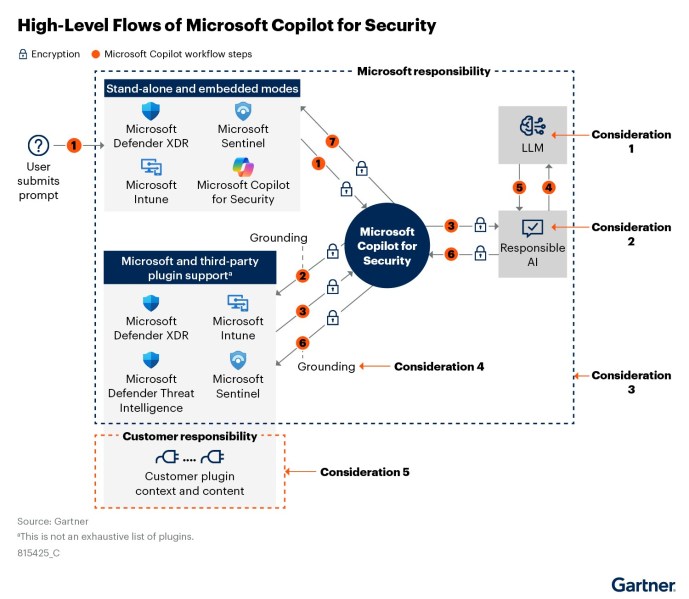
High-level workflow of Microsoft Copilot for Security, highlighting encryption, grounding, plugin support, and responsible AI considerations. Source:Gartner, Microsoft Copilot for Security Adoption Considerations, Oct.2023

Like CrowdStrike, nearly every AI security copilot provider emphasizes using AI to augment and strengthen the SOC team’s skills rather than replacing people with copilots.

Nir Zuk, founder and CTO of Palo Alto Networks told VentureBeat recently that “our AI-powered platforms don’t aim to remove analysts from the loop; they unify the SOC workflow so analysts can do their jobs more strategically.” Similarly, Jeetu Patel, Cisco’s EVP and GM of security and collaboration, said, “AI’s real value is how it narrows the talent gap in cybersecurity—not by automating analysts out of the picture, but by making them exponentially more effective.”

Charting the rapid rise of AI security copilots

AI security copilots are rapidly reshaping how mid-sized enterprises detect, investigate and neutralize threats. VentureBeat tracks this expanding ecosystem, where each solution advances automated triage, cloud-native coverage and predictive threat intelligence.

Below is a snapshot of today’s top copilots, highlighting their differentiators, telemetry focus and real-world gains. VentureBeat’s Security Copilot Guide (Google Sheet) provides a complete matrix with 16 vendors’ AI security copilots.
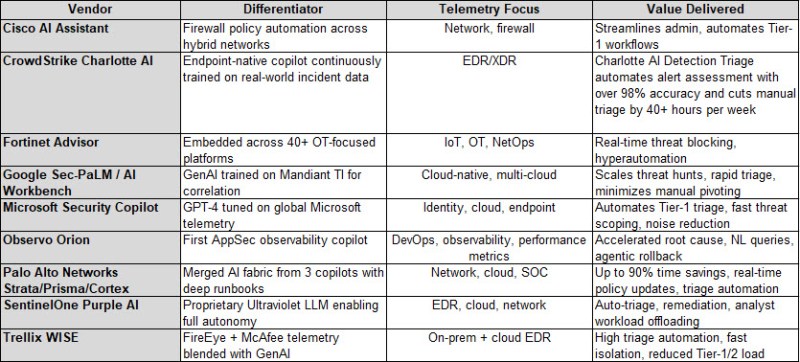
Source: VentureBeat Analysis

CrowdStrike Charlotte, SentinelOne’s Purple AI and Trellix WISE are already triaging, isolating and remediating threats without human intervention. Google and Microsoft are embedding risk scoring, auto-mitigation and cross-cloud attack surface mapping into their copilots.

 Google’s recent acquisition of Wiz will significantly impact AI security copilot adoption as part of a broader CNAPP strategy in many organizations.

Platforms such as Observo Orion illustrate what’s next: agentic copilots unifying DevOps, observability, and security data to deliver proactive, automated defenses. Rather than just detecting threats, they orchestrate complex workflows, including code rollbacks or node isolation, bridging security, development and operations in the process.

The endgame isn’t just about smart, prompt-driven personal programming assistants; it’s about integrating AI-driven decision-making across SOC workflows.

AI security copilots’ leading use cases today   

The better a given use case can integrate into SOC analysts’ workflows, the greater its potential to scale and deliver strong value. Core to the scale of an AI security copilot’s architecture is the ability to ingest data from heterogeneous telemetry sources and identify decisions early in the process, keeping them in context.

Here’s where adoption is scaling the fastest:

Accelerating triage: Tier-1 analysts using copilots, including Microsoft Security Copilot and Charlotte AI, can reduce triage to minutes instead of many hours. This is possible due to pre-trained models that flag known tactics, techniques and procedures (TTPs), cross-reference threat intel and summarize findings with confidence scores.

Alert de-duplication and noise suppression: Observo Orion and Trellix WISE use contextual filtering to correlate multi-source telemetry, eliminating low-priority noise. This reduces alert fatigue by as much as 70%, freeing teams to focus on high-fidelity signals. Sophos XDR AI Assistant achieves similar results for mid-sized SOCs with smaller teams.

Policy enforcement and firewall tuning: Cisco AI Assistant and Palo Alto’s Cortex copilots dynamically suggest and auto-implement policy changes based on telemetry thresholds and anomaly detection. This is critical for SOCs with complex, distributed firewall topologies and zero-trust mandates.

Cross-domain correlation: Security Copilot (Microsoft) and SentinelOne Purple AI integrate identity telemetry, SIEM logs and endpoint data to detect lateral movement, privilege escalation, or suspicious multi-hop activity. Analysts receive contextual playbooks that reduce root cause analysis by over 40%.

Exposure validation and breach simulation: Cymulate AI Copilot emulates red-team logic and tests exposure against new CVEs, enabling SOCs to validate controls proactively. This replaces manual validation steps with automated posture testing integrated into SOAR workflows.

Natural language SIEM interaction: Exabeam Copilot and Splunk AI Assistant allow analysts to convert natural language queries into executable SIEM commands. This democratizes investigation capabilities, especially for less technical staff, and reduces dependency on deep query language knowledge.

Identity risk reduction: Oleria Copilot continuously scans for dormant accounts, excessive access rights, and unlinked entitlements. These copilots auto-generate cleanup plans and enforce least-privilege policies, helping reduce insider threat surface in hybrid environments.

Bottom Line: Copilots don’t replace analysts, they amplify and scale their experience and strengths

By integrating identity, endpoint and network telemetry, copilots reduce the time it takes to identify lateral movement and privilege escalation, two of the most dangerous phases in an attack chain. As Elia Zaitsev, CTO of CrowdStrike, explained to VentureBeat in an earlier conversation: it’s less about substituting human roles, and more about supporting and augmenting them.

AI-powered tools should be viewed as collaborative partners for people — a concept that is especially crucial in cybersecurity.  Zaitsev cautioned that focusing on completely replacing human professionals rather than working alongside them is a misguided strategy.

Shape
Shape
Stay Ahead

Explore More Insights

Stay ahead with more perspectives on cutting-edge power, infrastructure, energy,  bitcoin and AI solutions. Explore these articles to uncover strategies and insights shaping the future of industries.

Shape

Netscout doubles DDoS defense capacity to counter AI-driven botnets

Distributed denial of service (DDoS) attacks are changing shape. Attackers now use AI throughout the attack lifecycle, from reconnaissance to exploitation to hardening compromised devices against takeover by rival botnet operators. The result is larger, more coordinated botnets capable of direct, stateful attacks rather than the reflection and amplification techniques

Read More »

Nuclear Lifecycle Innovation Campuses Contenders Announced

WASHINGTON—The U.S. Department of Energy (DOE) today announced the selection of Utah, Tennessee, Oklahoma, Louisiana, and Idaho as potential host states for Nuclear Lifecycle Innovation Campuses, a new effort to strengthen and modernize the nation’s full nuclear fuel cycle. The campuses will attract significant investment, expand domestic manufacturing, and create thousands of new high-paying jobs in their respective regions. Following record levels of interest in the application process, U.S. Secretary of Energy Chris Wright signed Memorandums of Understanding with the five states to continue exploring opportunities to host Innovation Campuses and support President Trump’s bold vision for American energy dominance and national energy security. “I’m pleased to announce that after reviewing 28 applications from 26 states, the Energy Department has selected five initial contenders to further explore building Nuclear Lifecycle Innovation Campuses,” Secretary Wright said. “These campuses will be massive generators of economic growth, create thousands of high-paying jobs, and be crucial to unleashing America’s nuclear renaissance. The innovative concept is a direct result of President Trump’s leadership and ambitious directives to restore the domestic nuclear fuel cycle and get America’s nuclear industry growing again.”  “Utah welcomes the chance to help America reclaim its leadership in civil nuclear energy,” said Utah Governor Spencer J. Cox. “We’re building the advanced technologies that will drive affordable, abundant power across our country. Through Operation Gigawatt, Utah is developing the entire nuclear lifecycle, from fuel production to advanced reactor deployment—strengthening our national security while helping secure America’s energy independence. This campus will accelerate that work.” “As the global epicenter of nuclear energy, Tennessee is honored to be selected as a potential host for a Nuclear Lifecycle Innovation Campus,” said Tennessee Governor Bill Lee. “As our state answered the call during the Manhattan Project and helped shape the course of history, Tennessee stands ready once again

Read More »

Energy Secretary Secures Grid Across 17 States Amid Period of Hot Weather

WASHINGTON—The U.S. Department of Energy (DOE) issued an emergency order to keep Americans across 17 states powered during the region’s energy emergency brought on by hot weather conditions. The order directs the Southwest Power Pool, Inc. (SPP) to dispatch specified generation units and to order their operation as needed to maintain reliability. The order also authorizes SPP to direct backup generation resources to operate as a last resort before declaring an Energy Emergency Alert (EEA) 3 or during an EEA 3. The order was issued pursuant to a request from SPP. “The Trump Administration is tapping into an abundant supply of unused backup generation to maintain affordable, reliable, and secure power for hardworking American families and businesses,” said U.S. Secretary of Energy Chris Wright. “The previous administration’s energy subtraction policies weakened the grid, leaving Americans more vulnerable during emergency events. Thanks to President Trump’s leadership, we are reversing those failures and using every available tool to ensure Americans have continued access to affordable, reliable, and secure energy to power and cool their homes.” DOE estimates more than 35 gigawatts (GW) of unused backup generation remain available nationwide. On day one of his second term, President Trump declared a national energy emergency after the Biden administration’s energy subtraction agenda left behind a grid increasingly vulnerable to blackouts. Power outages cost the American people $44 billion per year, according to data from DOE’s National Laboratories. This order mitigates the possibility of power outages in the region and highlights the commonsense policies of the Trump Administration to ensure Americans have access to affordable, reliable, and secure electricity. The order is effective on July 26, 2026, and shall expire at 11:59 PM CDT on August 3, 2026.                                   

Read More »

Magnolia expands Giddings position with $4-billion WildFire Energy acquisition

In the filing, Magnolia said WildFire’s second-quarter 2025 production is expected to average 53,000 boe/d, about 70% oil, primarily from the Eagle Ford, Austin Chalk, and Woodbine formations. Magnolia said the acquisition would strengthen its position in the Eagle Ford/Austin Chalk trend by expanding its inventory of high-return drilling locations, adding development flexibility and longer laterals, and leveraging its technical expertise to improve well performance and lower costs. “WildFire has a large, low-decline oily PDP base with historic development centered on the Eagle Ford. While there are significant future Eagle Ford development opportunities, our technical teams see extensive future potential in the Austin Chalk with further upside in the Woodbine as well as other appraisal opportunities that should expand on our success in Giddings since 2018,” said Chris Stavros, Magnolia’s chairman, president, and chief executive officer. The deal is expected to result in a pro forma position in Giddings of more than 1.25 million net acres, add more than 500 miles of gas-gathering pipelines, and offer various cost savings, the company said. “Magnolia is guiding to $100 million in run rate synergies by the end of 2027, with savings coming from the chance to deploy long laterals, shared facilities and infrastructure and additional sand sourcing for operations from WildFire’s in-basin mine. As always, successful execution will be key for the longer-term success of the deal,” Enverus’ Dittmar said. Total consideration consists of $2.65 billion in cash, 32.2 million shares of Magnolia Class A common stock, and the assumption of $600 million of outstanding debt.

Read More »

Vår Energi inks deal to acquire BlueNord

Vår Energi ASA has agreed to buy BlueNord ASA as part of a proposed merger that, if completed, will expand Vår Energi’s presence beyond the Norwegian Continental Shelf (NCS), positioning the operator as Europe’s largest independent oil and gas producer. Acqusition of BlueNord would add producing assets on the Danish Continental Shelf (DCS) to Vår Energi’s current holdings, with the combined post-merger portfolio anticipated to lift long-term production to about 450,000 boe/d, with about 2.4 billion boe of reserves and resources and an estimated reserve and resource life of about 15 years. BlueNord’s portfolio includes interests in the Tyra, Halfdan, Dan, and Gorm hub areas, which are part of the Danish Underground Consortium operated by TotalEnergies SE. The assets are expected to contribute about 45,000 boe/d of net production beginning in 2026 and include about 195 million boe of net 2P reserves and 2C contingent resources, extending production beyond 2040. “The transaction marks a significant milestone in Vår Energi’s growth journey, creating the largest independent producer of oil and gas in Europe with a long-term production target of [about 450,000 b/d] and reinforcing our role as a reliable and secure supplier of energy to Europe,” said Nick Walker, Vår Energi’s chief executive officer. Vår Energi said the DCS assets complement its existing North Sea operations because of their geological, operational, and fiscal similarities to the NCS. The combination also expands the company’s exposure to European natural gas markets through access to the Nybro and Den Helder gas delivery points. The combined portfolio would maintain a production mix of about 65% oil and 35% natural gas, with operating costs projected to remain at $10-11/boe. The proposed merger remains subject to approval by BlueNord shareholders, regulatory and governmental approvals, license and partner consent, and other customary conditions. If approved, the companies said

Read More »

Bahrain’s GPIC enlists Fluor for new unit at Sitra complex

Gulf Petrochemical Industries Co. (GPIC) has awarded Fluor Corp. a contract to execute front-end engineering and design (FEED) for a proposed aromatics plant to be built at GPIC’s petrochemicals complex located across 60 hectares of reclaimed land in Sitra, Bahrain. As part of the contract, Fluor will deliver a FEED study based on commercially proven process technologies for the plant’s targeted production of 1.2 million tonnes/year (tpy) of paraxylene and 500,000 tpy of benzene, the service provider said on July 21. Critical building blocks for plastics, polyester fibers, and packaging materials, paraxylene and benzene production from the plant would help meet global demand for high‑performance consumer and industrial products, as well as expand capabilities of GPIC’s current operations at Sitra, Fluor said. GPIC’s existing complex currently uses a feedstock of natural gas domestically produced in Bahrain to produce about 1.2 million tonnes/day of ammonia, 1.2 million tonnes/day of methanol, and 1.7 million tonnes/day of urea. Neither Fluor nor GPIC revealed details regarding a timeline for completion of the proposed aromatics plant. GPIC is a joint venture of Bahrain Petroleum Co. (33.3%), SABIC Agri-Nutrients Investment Co. (33.3%), and Kuwait’s Petrochemical Industries Co. (PIC; 33.3%).

Read More »

Oil prices surge as Hormuz, Bab el-Mandeb risks escalate amid renewed US–Iran tensions

Oil prices jumped on Wednesday, July 22, with escalating geopolitical tensions and mounting risks to key maritime chokepoints driving the rally. International Brent crude rose nearly 5% to above $95/bbl, its highest level in almost 6 weeks, while US crude climbed more than 4% to above $88/bbl. The gains extend a strong upward trend, with prices up about 30% since the start of the month and more than 55% year to date, reversing declines seen after a mid-June memorandum of understanding (MOU) between the US and Iran. Stay updated on oil price volatility, shipping disruptions, LNG market analysis, and production output through OGJ’s Iran war content hub. The earlier agreement, aimed at de-escalating conflict and reopening the Strait of Hormuz, was declared “over” on July 8 by President Donald Trump. Since then, hostilities have intensified, with US forces carrying out an 11th consecutive night of strikes on Iran. Comments from US Secretary of State Marco Rubio further dampened expectations for near-term diplomacy, noting that while Washington remains open to talks, Iran does not appear to be engaging seriously. At the same time, security risks to global shipping have increased. The UK Maritime Trade Operations (UKMTO)  has reported multiple recent attacks on vessels in the region, including incidents that forced crews to abandon ships. As a result, traffic through the Strait of Hormuz has fallen sharply, with just 13 vessels transiting Monday and 9 on Tuesday, according to MarineTraffic data. Concerns are also growing at the Bab el-Mandeb Strait, another critical oil transit route linking the Red Sea to the Gulf of Aden. Iranian-backed Houthi forces in Yemen have threatened a maritime blockade targeting Saudi Arabia, raising fears of broader supply disruptions. While vessel traffic through Bab el-Mandeb remains relatively steady—73 ships transited Tuesday—it has edged lower and signs of hesitation among

Read More »

Why KVM-over-IP is becoming the backbone of modern infrastructure management

IT teams responsible for data centers, colocation facilities, and test labs face a persistent challenge when it comes to providing affordable, timely maintenance and troubleshooting for their organizations’ IT infrastructure. Facilities aren’t often staffed around the clock, and sending someone on-site to address every hardware failure or issue is slow and expensive, especially for colocation customers that already pay for local staff support. Additionally, when critical infrastructure goes down, organizations can’t afford to endure an outage during the time it takes to get a technician on-site. IT teams typically employ tools to enable remote access, but the most common have significant limitations and drawbacks. Remote desktop protocol (RDP), for instance, provides access, but only while the operating system is running. If the OS crashes or fails to boot, or if a firmware change ends the session, RDP is useless, and IT will need to send a technician for an on-site visit. There are also security concerns, as open software ports make RDP vulnerable to attack. Another tool, physical intelligent platform management interface (IPMI), sits below the OS layer, so it can be used regardless of the state of the OS. However, legacy IPMI implementations have historically been associated with security concerns, particularly when exposed to public or poorly secured networks. Many organizations now restrict IPMI access or supplement it with additional security controls. Some organizations have moved to Distributed Management Task Force (DMTF) Redfish because it provides stronger security. But its security behaviors, such as session timeouts, rate limiting, and lockout policies, are undefined and left to the implementer, so improper implementation poses a significant risk. KVM (keyboard, video, and mouse)-over-IP addresses both the reliability and security concerns of RDP, IPMI, and DMTF Redfish. KVM connects directly to hardware, which gives administrators remote BIOS-level access and full control of a

Read More »

AI data centers in the US may face power cuts under PJM reliability proposal

High risk for new builds While PJM coordinates the wholesale electricity grid across 13 states, including Delaware, Illinois, Indiana, Kentucky, Maryland, etc., and the District of Columbia, not every data center will be affected by this development. The proposal is expected to primarily impact new facilities that will fail to secure dedicated or contracted power supplies. “The data centers most at risk are new ones being built that haven’t signed contracts for their own power source yet, especially smaller or newer companies without deep pockets. Giant companies like Amazon, Google, or Microsoft can more easily afford to build their own backup power, so they’re safer. The riskiest locations are places already packed with data centers, like Northern Virginia and growing areas in Ohio, Pennsylvania, and Maryland, where the local power grid is already stretched thin,” noted Jain.

Read More »

A 13-year-old flaw is exposing tens of thousands of data center management systems

Why this attack method is dangerous BMCs sit a layer below that which many security products monitor, on shared out-of-band management networks where administrative credentials are often reused. Thus, malicious changes made to BMCs or other platform hardware are able to survive OS reinstalls, disk replacements, and standard incident response procedures, Katchinskiy noted. The risk is “especially pronounced” in neocloud and GPU cloud environments, he said. AI infrastructure can span thousands of GPUs on shared management networks, with joint storage, high-speed interconnects, and multi-tenant tooling. He pointed out that, while a customer may rent their own dedicated servers, they are still connected to shared, provider-managed, out-of-band networks where orchestration and provisioning services, credential stores, and admin tools span infrastructure used by numerous joint customers.

Read More »

Fortinet’s new FortiGate platform converges firewall, SASE technologies

When configured as a FortiSASE Outpost, the 1200G can be deployed as a local SASE point of presence (POP), extending SASE enforcement closer to users and applications in customer-controlled locations, such as on-premises sites, private data centers, or colocation facilities, while maintaining centralized cloud management, according to Fortinet. Users can maintain local enforcement where needed without building separate stacks, the vendor stated. The FortiSASE interface centrally manages configuration, policy, monitoring, lifecycle operations, and upgrades across both deployment models, maintaining consistent zero-trust policies, visibility and protection without treating the on-site POP as a separate security environment. In addition customers can keep designated traffic, logs, and processing within defined geographic or private infrastructure boundaries to meet regulatory requirements and reduce connectivity costs without changing the end-user experience, Fortinet stated. “As AI adoption, encrypted traffic, and hybrid infrastructure reshape enterprise networks, organizations need to inspect growing traffic volumes without introducing performance bottlenecks,” Fortinet stated. “They also need the flexibility to determine where security enforcement occurs based on application performance, data sovereignty, compliance, and operational requirements.”

Read More »

Up to 50% of data center capacity slated for 2026 could be delayed

A primary obstacle is electricity. After a number of instances where local citizens saw their electric bill skyrocket after a data center opened up shop in their neighborhood, there has been tremendous pushback from cities and states on large scale data centers. In some instances, operators are being required to provide their own power rather than get power from the public grid, according to Currence. Although projects powered entirely by on-site generation or hybrid systems account for fewer than 10% of announced facilities, they represent nearly half of the total announced capacity, according to the report. Mindful of their public image, hyperscalers are responding quickly to these demands. Google has expanded its strategy by acquiring a large renewable energy development pipeline, while Amazon has increased direct investments in solar generation and battery storage.

Read More »

When Buildability Breaks: What Prince William and New York Signal for Data Center Development

For several years, the Prince William Digital Gateway represented data center ambition at its largest scale: a proposed 2,100-acre technology corridor near Gainesville, Virginia, capable of accommodating tens of millions of square feet of digital infrastructure. Its location also made it uniquely contentious. The corridor bordered Manassas National Battlefield Park and other historic, environmental and residential resources, drawing the data center development debate beyond its usual industry and land-use constituencies. Opposition increasingly centered not only on the project’s scale, but on whether development of that magnitude belonged alongside one of the country’s most significant Civil War landscapes. In July 2026, that vision effectively ended. QTS Data Centers terminated its participation in the Digital Gateway and withdrew its remaining petitions before the Supreme Court of Virginia. The decision followed Compass Datacenters’ withdrawal in April, leaving neither of the project’s original developers pursuing the corridor. QTS said it reached the decision after “careful consideration,” while emphasizing that Virginia remains an important market for the company. From Proposed Capacity to Executable Capacity The collapse of the Digital Gateway is more than the cancellation of one unusually large development. It comes as the data center industry confronts a widening gap between announced capacity and executable capacity. Power remains the most visible constraint. But permitting discipline, environmental review, community acceptance and the durability of political support are increasingly determining whether a project can progress from land control and conceptual capacity to construction and operation. A separate development in New York underscored that shift less than two weeks after QTS withdrew. On July 14, Gov. Kathy Hochul issued Executive Order 62, establishing what the state describes as the nation’s first statewide moratorium on new hyperscale data centers. The order temporarily holds in abeyance certain incomplete state environmental permit applications for data centers capable of drawing at

Read More »

Microsoft will invest $80B in AI data centers in fiscal 2025

And Microsoft isn’t the only one that is ramping up its investments into AI-enabled data centers. Rival cloud service providers are all investing in either upgrading or opening new data centers to capture a larger chunk of business from developers and users of large language models (LLMs).  In a report published in October 2024, Bloomberg Intelligence estimated that demand for generative AI would push Microsoft, AWS, Google, Oracle, Meta, and Apple would between them devote $200 billion to capex in 2025, up from $110 billion in 2023. Microsoft is one of the biggest spenders, followed closely by Google and AWS, Bloomberg Intelligence said. Its estimate of Microsoft’s capital spending on AI, at $62.4 billion for calendar 2025, is lower than Smith’s claim that the company will invest $80 billion in the fiscal year to June 30, 2025. Both figures, though, are way higher than Microsoft’s 2020 capital expenditure of “just” $17.6 billion. The majority of the increased spending is tied to cloud services and the expansion of AI infrastructure needed to provide compute capacity for OpenAI workloads. Separately, last October Amazon CEO Andy Jassy said his company planned total capex spend of $75 billion in 2024 and even more in 2025, with much of it going to AWS, its cloud computing division.

Read More »

John Deere unveils more autonomous farm machines to address skill labor shortage

Join our daily and weekly newsletters for the latest updates and exclusive content on industry-leading AI coverage. Learn More Self-driving tractors might be the path to self-driving cars. John Deere has revealed a new line of autonomous machines and tech across agriculture, construction and commercial landscaping. The Moline, Illinois-based John Deere has been in business for 187 years, yet it’s been a regular as a non-tech company showing off technology at the big tech trade show in Las Vegas and is back at CES 2025 with more autonomous tractors and other vehicles. This is not something we usually cover, but John Deere has a lot of data that is interesting in the big picture of tech. The message from the company is that there aren’t enough skilled farm laborers to do the work that its customers need. It’s been a challenge for most of the last two decades, said Jahmy Hindman, CTO at John Deere, in a briefing. Much of the tech will come this fall and after that. He noted that the average farmer in the U.S. is over 58 and works 12 to 18 hours a day to grow food for us. And he said the American Farm Bureau Federation estimates there are roughly 2.4 million farm jobs that need to be filled annually; and the agricultural work force continues to shrink. (This is my hint to the anti-immigration crowd). John Deere’s autonomous 9RX Tractor. Farmers can oversee it using an app. While each of these industries experiences their own set of challenges, a commonality across all is skilled labor availability. In construction, about 80% percent of contractors struggle to find skilled labor. And in commercial landscaping, 86% of landscaping business owners can’t find labor to fill open positions, he said. “They have to figure out how to do

Read More »

2025 playbook for enterprise AI success, from agents to evals

Join our daily and weekly newsletters for the latest updates and exclusive content on industry-leading AI coverage. Learn More 2025 is poised to be a pivotal year for enterprise AI. The past year has seen rapid innovation, and this year will see the same. This has made it more critical than ever to revisit your AI strategy to stay competitive and create value for your customers. From scaling AI agents to optimizing costs, here are the five critical areas enterprises should prioritize for their AI strategy this year. 1. Agents: the next generation of automation AI agents are no longer theoretical. In 2025, they’re indispensable tools for enterprises looking to streamline operations and enhance customer interactions. Unlike traditional software, agents powered by large language models (LLMs) can make nuanced decisions, navigate complex multi-step tasks, and integrate seamlessly with tools and APIs. At the start of 2024, agents were not ready for prime time, making frustrating mistakes like hallucinating URLs. They started getting better as frontier large language models themselves improved. “Let me put it this way,” said Sam Witteveen, cofounder of Red Dragon, a company that develops agents for companies, and that recently reviewed the 48 agents it built last year. “Interestingly, the ones that we built at the start of the year, a lot of those worked way better at the end of the year just because the models got better.” Witteveen shared this in the video podcast we filmed to discuss these five big trends in detail. Models are getting better and hallucinating less, and they’re also being trained to do agentic tasks. Another feature that the model providers are researching is a way to use the LLM as a judge, and as models get cheaper (something we’ll cover below), companies can use three or more models to

Read More »

OpenAI’s red teaming innovations define new essentials for security leaders in the AI era

Join our daily and weekly newsletters for the latest updates and exclusive content on industry-leading AI coverage. Learn More OpenAI has taken a more aggressive approach to red teaming than its AI competitors, demonstrating its security teams’ advanced capabilities in two areas: multi-step reinforcement and external red teaming. OpenAI recently released two papers that set a new competitive standard for improving the quality, reliability and safety of AI models in these two techniques and more. The first paper, “OpenAI’s Approach to External Red Teaming for AI Models and Systems,” reports that specialized teams outside the company have proven effective in uncovering vulnerabilities that might otherwise have made it into a released model because in-house testing techniques may have missed them. In the second paper, “Diverse and Effective Red Teaming with Auto-Generated Rewards and Multi-Step Reinforcement Learning,” OpenAI introduces an automated framework that relies on iterative reinforcement learning to generate a broad spectrum of novel, wide-ranging attacks. Going all-in on red teaming pays practical, competitive dividends It’s encouraging to see competitive intensity in red teaming growing among AI companies. When Anthropic released its AI red team guidelines in June of last year, it joined AI providers including Google, Microsoft, Nvidia, OpenAI, and even the U.S.’s National Institute of Standards and Technology (NIST), which all had released red teaming frameworks. Investing heavily in red teaming yields tangible benefits for security leaders in any organization. OpenAI’s paper on external red teaming provides a detailed analysis of how the company strives to create specialized external teams that include cybersecurity and subject matter experts. The goal is to see if knowledgeable external teams can defeat models’ security perimeters and find gaps in their security, biases and controls that prompt-based testing couldn’t find. What makes OpenAI’s recent papers noteworthy is how well they define using human-in-the-middle

Read More »