Google: Using AI to Engineer the AI Factory
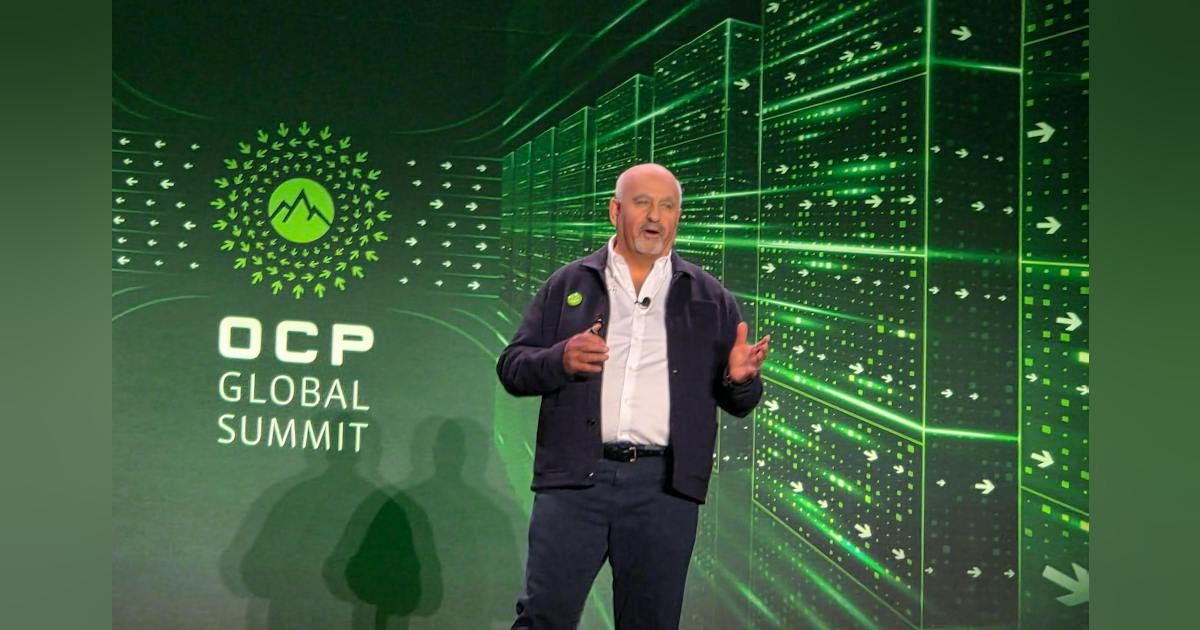
Google Vice President and Engineering Fellow Parthasarathy Ranganathan closed the keynote program by extending the discussion beyond infrastructure designed for AI toward infrastructure increasingly designed and operated with AI.
The distinction was central to his presentation.
For several years, hyperscalers have pursued progressively more sophisticated custom systems to meet the demands of artificial intelligence. Google’s own approach has included TPUs, custom CPUs, optical networking, power distribution, liquid cooling, and extensive hardware-software co-design.
But Ranganathan argued that the next opportunity involves applying AI directly to the processes of systems engineering.
Google has already been pursuing the concept of agile and fungible data centers, capable of accommodating changing generations of computing hardware without requiring fundamental redesigns of every supporting system.
Its OCP contributions include Project Deschutes, an open cooling distribution unit architecture; Project Brazos, intended to bring liquid cooling capabilities into existing air-cooled facilities; and power distribution specifications supporting higher-voltage DC architectures.
Ranganathan also highlighted collaborative work involving Google, Meta, Microsoft, and NVIDIA on specifications intended to improve coordination between AI data centers and utility systems.
Those efforts address the physical infrastructure required to support AI.
The next stage, he suggested, is to apply AI to the engineering processes themselves.
Google is exploring AI-assisted hardware architecture, automated software vulnerability detection and repair, data center climate modeling, and infrastructure capacity planning.
Among the examples Ranganathan discussed were agentic systems capable of evaluating computer architecture choices and accelerating engineering workflows, alongside AI-assisted tools for software maintenance and operational optimization.
In data center design, the company is applying AI and climate modeling to decisions involving cooling capacity, extreme weather risk, and long-term infrastructure investment.
The approach could enable more site-specific designs, reducing the need to rely on broad assumptions about operating conditions throughout a facility’s useful life.
Ranganathan also emphasized AI’s potential to improve manufacturing, supply chain management, deployment planning, and the delivery of new data center capacity.
These applications suggest an expanding role for AI within the infrastructure development cycle itself.
Rather than functioning solely as a workload consuming increasingly large amounts of computing infrastructure, AI could become a means of reducing the cost, complexity, and time required to build that infrastructure.