Stay Ahead, Stay ONMINE

EIA: US crude oil inventories down 8.6 million bbl

US crude oil inventories for the week ended Oct. 9, excluding the Strategic Petroleum Reserve, US commercial crude oil inventories decreased by 8.6 million bbl from the previous week, according to data from the US Energy Information Administration (EIA). The report was released a day later than usual due to the closure of the federal […]

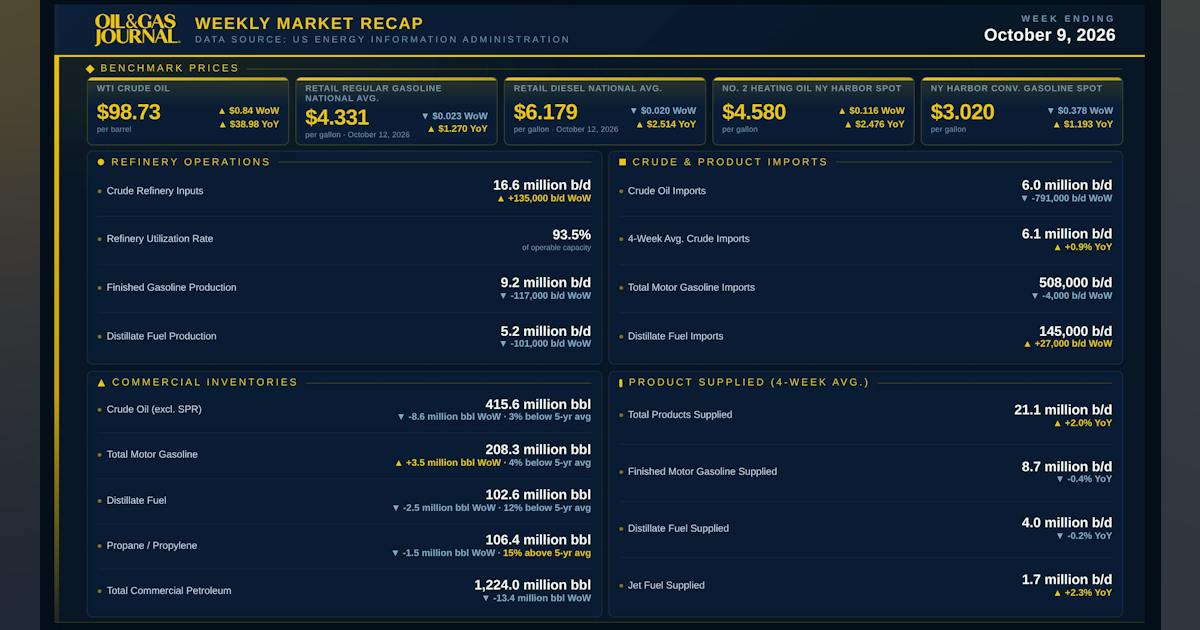
US crude oil inventories for the week ended Oct. 9, excluding the Strategic Petroleum Reserve, US commercial crude oil inventories decreased by 8.6 million bbl from the previous week, according to data from the US Energy Information Administration (EIA).

The report was released a day later than usual due to the closure of the federal government on Monday, Oct. 12. 

At 415.6 million bbl, US crude oil inventories are 3% below the 5-year average for this time of year, the EIA report indicated.

Gasoline inventories increased 3.5 million bbl, 4% below the 5-year average. Propane-propylene inventories decreased 1.5 million bbl, 15% above the 5-year average. Total commercial petroleum inventories decreased by 13.4 million bbl for the week. Distillate inventories decreased 2.5 million bbl, 12% below the 5-year average.

US crude oil refinery inputs averaged 16.6 million b/d for the week ended Oct. 9, which was 135,000 b/d more than the previous week’s average. Refineries operated at 93.5% of capacity.

Gasoline output averaged 9.2 million b/d, and distillate production decreased to 5.2 million b/d.

Crude oil imports decreased 791,000 b/d to 6.0 million b/d. The 4-week average of 6.1 million b/d is 0.9% above the year-ago level. Gasoline imports averaged 508,000 b/d; distillate imports averaged 145,000 b/d.

Over the past four weeks, total product supplied averaged 21.1 million b/d, up 2.0% year over year. The 4-week average for gasoline product supplied decreased 0.4% year over year to 8.7 million b/d, while the 4-week average for distillate product supplied decreased 0.2% to 4.0 million b/d. The 4-week average for jet fuel product supplied increased 2.3% year over year.


Shape
Shape
Stay Ahead

Explore More Insights

Stay ahead with more perspectives on cutting-edge power, infrastructure, energy,  bitcoin and AI solutions. Explore these articles to uncover strategies and insights shaping the future of industries.

Shape

SolarWinds launches Avior AI agents to automate network operations

The first Avior offering is a network engineering agent that can automate alert management, configuration automation, compliance checks, and incident remediation. “We started there because [the network is] kind of our bread and butter,” Childress explains. “Many of our customers, a large portion of our customers, are on our network

Read More »

Energy Department Invests Over $11 Million to Strengthen America’s Energy Workforce

WASHINGTON—The U.S. Department of Energy’s (DOE) Hydrocarbons and Geothermal Energy Office (HGEO) and Office of Indian Energy Policy and Programs (IE) today announced nearly $11.1 million in federal funding for eight projects selected for negotiation through the Partnerships for Academic-Industry Career Training (PACT) Initiative. The projects will create or expand hands-on training and industry-recognized credentialing programs designed around regional workforce needs, helping prepare American workers for critical jobs that support oil, natural gas, coal, and geothermal energy industries. “President Trump’s American energy dominance agenda relies on workers with the practical skills to build, operate, maintain, and modernize the systems that power our economy,” said DOE Acting Assistant Secretary for Hydrocarbons and Geothermal Energy Curt Coccodrilli. “These projects will bring industry and educators together to ensure training reflects real-world needs. By investing in job-focused training, the Department of Energy is helping develop the workforce we need to strengthen U.S. energy resilience and supplies.”  “The Tribal energy workforce is vital to unleashing America’s energy resources,” said IE Director Eric Mahroum. “Through targeted jobs and training, Tribes are growing the next generation of Tribal energy leaders. Tribal colleges and universities are essential partners in this mission, and we are proud to select two of these institutions as they prepare workers to tackle the critical energy challenges facing America.”  The selections include almost $8.8 million for six HGEO-supported projects and approximately $2.3 million for two IE-supported projects. By bringing together colleges, technical institutions, employers, and workforce partners, PACT is designed to build a stronger pipeline of skilled workers needed to advance President Trump’s commitment to expand domestic energy production to provide more affordable, reliable, and secure energy to the American people.  Learn more about the selected eight projects here.  

Read More »

Hengyi Industries taps Honeywell Technologies for Brunei complex expansion

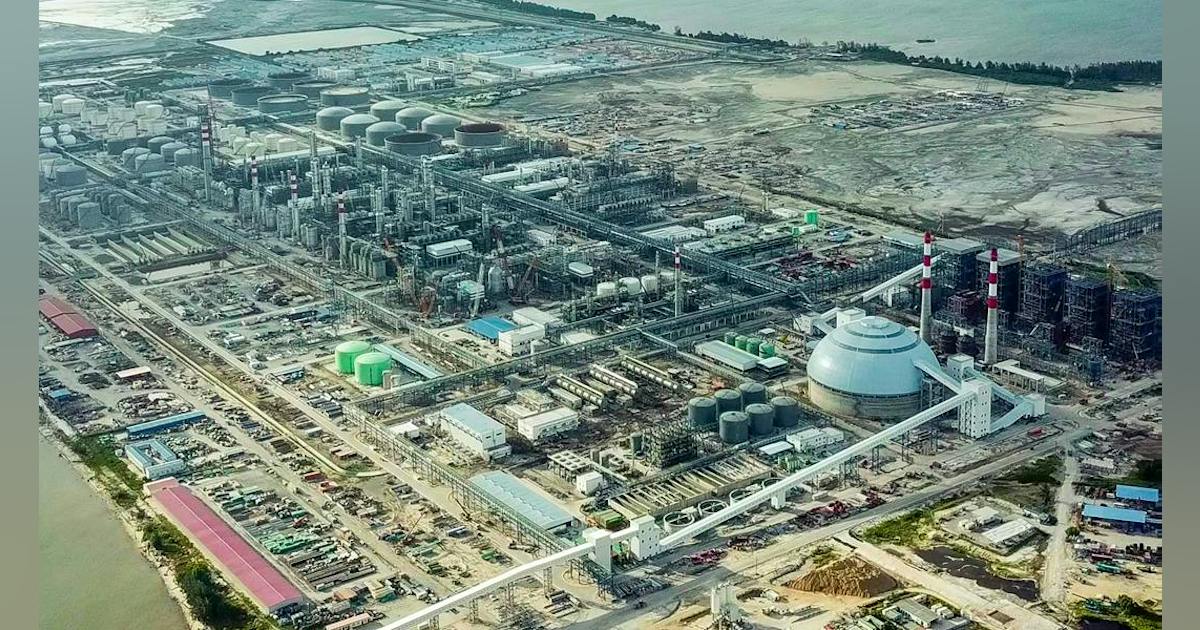
Zhejiang Hengyi Group Co. Ltd. subsidiary Hengyi Industries Sdn. Bhd. (Hengyi Industries) has awarded Honeywell Technologies a contract for delivery of proprietary process technologies and related services for Phase II of the operator’s planned expansion of its Pulau Muara Besar (PMB) refinery and petrochemical complex at Pulau Muara Besar Industrial Park in Brunei. Under the new contract, Honeywell Technologies said in a release Oct. 14 that it will provide technology licensing, engineering, proprietary equipment, catalysts, and technical support for the proposed expansion. Honeywell Technologies’ specific scope of delivery under the order includes its CCR Platforming, Unicracking, Unionfining, Butamer, and C4 Oleflex processes, as well as an aromatics complex based on the service provider’s light desorbent Parex technology. The Phase II PMB expansion project primarily aims to raise the complex’s crude-processing capacity to about 20 million tonnes/year (tpy) from current crude throughputs of between 8-9 million tpy, supporting Brunei’s efforts to create greater value from its oil and gas resources and expand the country’s downstream industries, according to information on Hengli Industries’ website and an earlier release from the operator dated Feb. 12, 2026. Alongside bolstering Hengyi Industries’ plan to increase petrochemical production at the site, Honeywell said its provision of technologies and equipment for the project also are intended to help improve the integrated complex’s efficiency and reliability while enabling greater production of higher-value petrochemicals. Mechanical completion of the Phase II expansion is targeted by yearend 2028 for anticipated startup in early 2029, according to Hengyi Industries. Once online, the project’s planned hydrocracking, aromatics, and dehydrogenation installations will be among the largest of their kind, Honeywell Technologies said. The latest award for Phase II extends work that began during Phase I, for which Honeywell Technologies supplied process technologies, engineering design, equipment, catalysts, and adsorbents, operator training, and technical services for

Read More »

EIA: US crude oil inventories down 8.6 million bbl

US crude oil inventories for the week ended Oct. 9, excluding the Strategic Petroleum Reserve, US commercial crude oil inventories decreased by 8.6 million bbl from the previous week, according to data from the US Energy Information Administration (EIA). The report was released a day later than usual due to the closure of the federal government on Monday, Oct. 12.  At 415.6 million bbl, US crude oil inventories are 3% below the 5-year average for this time of year, the EIA report indicated. Gasoline inventories increased 3.5 million bbl, 4% below the 5-year average. Propane-propylene inventories decreased 1.5 million bbl, 15% above the 5-year average. Total commercial petroleum inventories decreased by 13.4 million bbl for the week. Distillate inventories decreased 2.5 million bbl, 12% below the 5-year average. US crude oil refinery inputs averaged 16.6 million b/d for the week ended Oct. 9, which was 135,000 b/d more than the previous week’s average. Refineries operated at 93.5% of capacity. Gasoline output averaged 9.2 million b/d, and distillate production decreased to 5.2 million b/d. Crude oil imports decreased 791,000 b/d to 6.0 million b/d. The 4-week average of 6.1 million b/d is 0.9% above the year-ago level. Gasoline imports averaged 508,000 b/d; distillate imports averaged 145,000 b/d. Over the past four weeks, total product supplied averaged 21.1 million b/d, up 2.0% year over year. The 4-week average for gasoline product supplied decreased 0.4% year over year to 8.7 million b/d, while the 4-week average for distillate product supplied decreased 0.2% to 4.0 million b/d. The 4-week average for jet fuel product supplied increased 2.3% year over year.
Read More »

BW Energy finds oil in Dussafu appraisal wells, supports 2-well development

BW Energy discovered commercial oil volumes in two appraisal wells on the Dussafu license offshore Gabon, supporting development of two additional production wells with estimated recovery of 8-9 million bbl of oil (gross). The first new production well will be drilled as part of the ongoing MaBoMo Phase 2 campaign. First oil is expected in first-quarter 2027, the operator said Oct. 15. The 10P2 appraisal well encountered a 30-m oil column in the Gamba reservoir at the predicted structural level. Formation evaluation, wireline logs, and pressure data confirmed reservoir quality and indicated potential initial production rates exceeding 5,000 bo/d (gross). Incremental recovery is estimated at 6 million bbl of oil (gross). The 10P1 appraisal well encountered a 16-m oil column in a separate accumulation. Formation evaluation confirmed movable oil and supported development with an additional production well. The rig is moving to the MaBoMo production platform, where BW Energy will replace an electrical submersible pump in an existing Hibiscus well before drilling four MaBoMo Phase 2 producers and a fifth well at the 10P2 location. The company expects the new wells to produce about 5,000 bo/d (gross) each initially. MaBoMo Phase 2 is expected to add as much as 20,000 bo/d (gross) at peak production. After completing the MaBoMo campaign, BW Energy plans to drill an infill well on Tortue field and proceed with the Bourdon Phase 1 development, which is scheduled for first oil in first-quarter 2028. Additional appraisal drilling in the Bourdon area, including the Walt Whitman prospect, is planned in 2028. BW Energy holds a 73.5% operated interest in the Dussafu license, which lies within the 850-sq km Ruche Exclusive Exploitation Area. Average water depth is 116 m. Partners are Panoro Energy ASA (17.5%) and Gabon Oil Co. (9%).

Read More »

Shell, HYDRA SUBSEA sign agreement for subsea tie-in pipeline installation

@import url(‘https://fonts.googleapis.com/css2?family=Inter:wght@100..900&display=swap’); .ebm-page__main h1, .ebm-page__main h2, .ebm-page__main h3, .ebm-page__main h4, .ebm-page__main h5, .ebm-page__main h6 { font-family: Inter; } body { line-height: 150%; letter-spacing: 0.025em; } button, .ebm-button-wrapper { font-family: Inter; } .label-style { text-transform: uppercase; color: var(–color-grey); font-weight: 600; font-size: 0.75rem; } .caption-style { font-size: 0.75rem; color: color-mix(in srgb, currentColor 60%, transparent); } #onetrust-pc-sdk [id*=btn-handler], #onetrust-pc-sdk [class*=btn-handler] { background-color: #c19a06 !important; border-color: #c19a06 !important; } #onetrust-policy a, #onetrust-pc-sdk a, #ot-pc-content a { color: #c19a06 !important; } #onetrust-consent-sdk #onetrust-pc-sdk .ot-active-menu { border-color: #c19a06 !important; } #onetrust-consent-sdk #onetrust-accept-btn-handler, #onetrust-banner-sdk #onetrust-reject-all-handler, #onetrust-consent-sdk #onetrust-pc-btn-handler.cookie-setting-link { background-color: #c19a06 !important; border-color: #c19a06 !important; } #onetrust-consent-sdk .onetrust-pc-btn-handler { color: #c19a06 !important; border-color: #c19a06 !important; } Shell Offshore Inc. has signed a commercial agreement with HYDRA SUBSEA covering standardized deepwater pipeline installation for selected short-distance subsea tie-ins in the US Gulf of Mexico. The agreement sets commercial and technical terms under which the companies could advance qualifying projects, subject to separate evaluation, approval, and award, HYDRA SUBSEA said in a release Oct. 15.  <!–> –> May 23, 2019 <!–> –> July 1, 2015 Shell’s Appomattox gas lift flowline is the first proposed project, HYDRA said Oct. 15. Appomattox, about 80 miles offshore Louisiana, is operated by Shell (79%). INEOS holds the remaining 21%. HYDRA is reactivating its Subsea Legend vessel, which is expected to receive new mission equipment, a 250-ton active heave-compensated subsea crane, a new propulsion system, and an upgraded dynamic positioning system. The vessel is intended to support a standardized installation model for 6-in. and 8-in. rigid pipelines. “Smaller deepwater developments need an execution model aligned with their scale and economics,” said Trevor Davis, chief executive officer of HYDRA SUBSEA. The agreement gives Shell an additional option for selected projects where a repeatable installation approach can improve predictability, he said, adding that the model could be

Read More »

Equinor plans tieback of Grimsnes discovery to Oseberg platform in North Sea

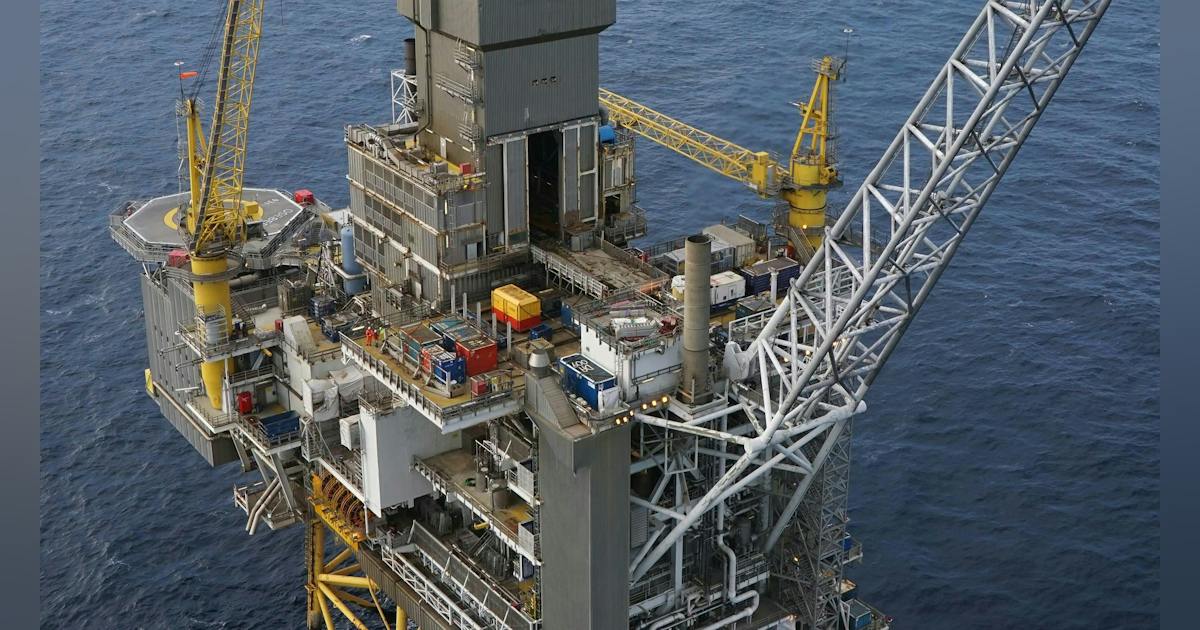
Equinor Energy AS made an oil and gas discovery in the Grimsnes prospect near Oseberg field in the North Sea about 15 km southwest of the Oseberg Sør (South) platform and 145 km west of Bergen in 96 m of water. Well 30/8-7 S, the fifth exploration well in production license (PL) 190, was drilled by the Deepsea Bergen semi-submersible drilling rig to a vertical depth of 3,752 m subsea. It was terminated in the Drake formation in the Lower Jurassic, the Norwegian Offshore Directorate reported. The primary exploration target was to prove petroleum in Middle Jurassic reservoir rocks in the Tarbert formation. The secondary target was to prove petroleum in Middle Jurassic rocks in the Ness and Etive formations. The well encountered a combined oil and gas column totaling 54 m (39-m gas column, 15-m oil column) in the Tarbert formation. The total thickness of the Tarbert formation was 264 m, 111 m of which were sandstone with moderate to good reservoir properties. In the secondary exploration target in the Ness formation, the well encountered a sandstone layer totaling 289 m with variable reservoir quality from poor to very good. The reservoir was aquiferous with a few potential hydrocarbon-filled zones. In the Etive formation, the well encountered aquiferous sandstones totaling 10 m, with moderate reservoir quality. The preliminary volume estimate of the discovery is 19-50 MMboe (3-8 million std cu m). Data has been collected and samples have been taken. The well has been permanently plugged, and the Deepsea Bergen rig will now proceed to Visund Sør field to drill a development well. Equinor plans to quickly tie the discovery back to existing subsea infrastructure and produce the volumes through the Oseberg Sør platform. Grimsnes will most likely be developed with 2-3 wells in a standard 4-slot template. The discovery

Read More »

OPC Global Summit: News spans AI-optimized hardware, cooling equipment

Arm announces methodology for evaluating CPU performance Arm released a white paper, developed with partners, that proposes a use-case-driven methodology for measuring the CPU’s contribution to agentic AI systems. It defines five representative workload types—software engineering, enterprise operations, financial and scientific research, personal assistants, and robotics—and pairs component-level benchmarking with end-to-end task measurement built on re-playable agent trajectories. Arm also highlighted independent testing by Signal65 that found its AGI CPU could deliver up to twice the rack-level performance of AMD’s Epyc Turin generation server processors across select agentic AI workloads. The comparison emphasizes completed work under rack-level constraints rather than conventional CPU benchmarks alone. In the testing, an Arm AGI CPU averaged 1.7x better performance for tooling, 2.0x for agentic workflows and orchestration, and 2.2x for reasoning and planning in modeled per-rack performance versus an AMD Epyc Turin processor. Arm’s AGI CPU reduces sandbox creation latency by up to 45% versus AMD Epyc 9965, helping agents spin up isolated execution environments faster, according to Arm. Kioxia introduces SSDs for AI Kioxia unveiled its LD4 Series enterprise solid-state drives (SSD), designed to increase flash storage density in hyperscale data centers and high density 1U servers. The drives target read-intensive workloads, including data storage applications supporting artificial intelligence infrastructure.

Read More »

Virginia’s New Data Center Bargain: Power, Permits and the Right to Build

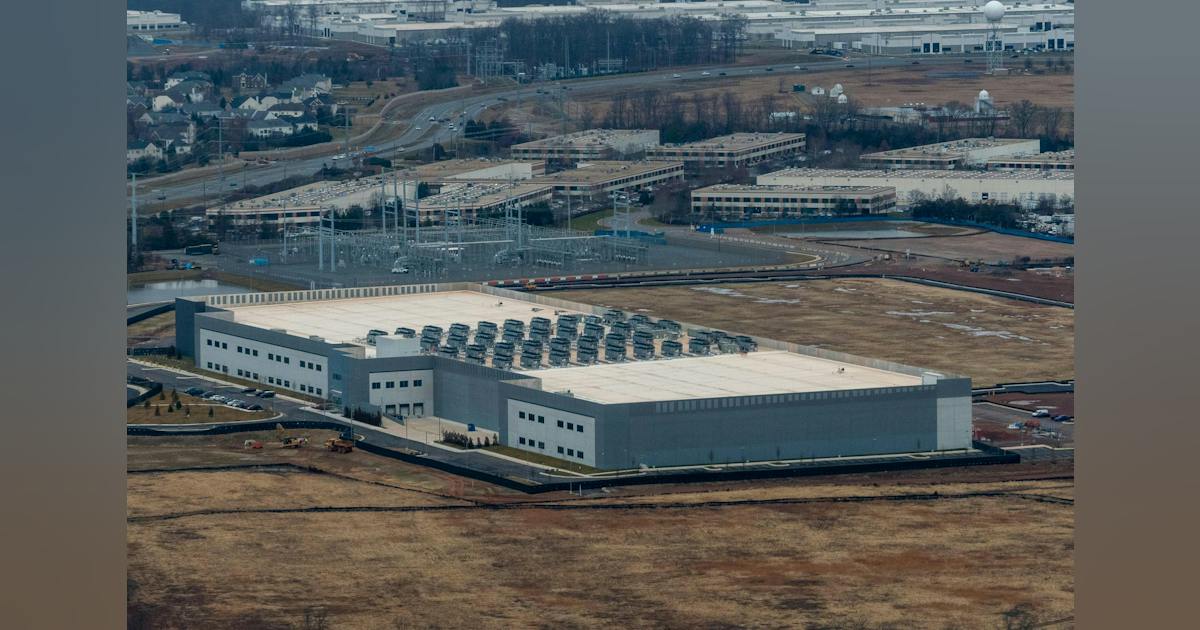
What Took Effect—and What Still Requires Legislation Spanberger laid out the administration’s rationale in announcing the framework: “In the years before I took office, data centers came to Virginia and the Commonwealth did not have a clear or coordinated plan to address their impacts on Virginians — on their electric bills, their water, their land, their air, or their quality of life. That changes today. I have said many times that Virginia should be leading the nation in setting the highest standards for this industry. And now, I believe we are doing just that.” The distinction between what Virginia has already implemented and what the administration intends to pursue is consequential. Executive Order 22 establishes immediate directives for state agencies, while significant portions of the broader Data Center Accountability Framework remain proposals for the 2027 General Assembly or future regulatory action. Among the immediate changes, executive-branch agencies are prohibited from entering into or enforcing new nondisclosure agreements that conceal material information about proposed commercial data centers, public incentives, resource demands or community impacts. Existing contractual commitments are preserved, with limited exceptions contemplated for extraordinary circumstances, including national security. The prohibition does not yet extend automatically to local governments. The order also excludes new data center projects with anticipated peak electrical demand of 25 MW or greater from the Virginia Business Ready Sites Program and similar discretionary state site-readiness and expedited-review assistance. A separate, potentially more consequential proposal would eliminate by-right development approval for data centers using more than 25 MW, requiring local approval even for projects with prior authorizations. That provision has not been enacted statewide and could introduce significant legal questions concerning established development rights. The administration is also accelerating environmental oversight. Within 120 days of the order, the Office of the Chief Energy Officer must publish an initial

Read More »

OCP 2026: Agentic AI Drives the Data Center’s Chip-to-Grid Transformation

NVIDIA Opens More of the AI Factory Architecture NVIDIA’s Ian Buck closed the opening keynote program with an extensive presentation covering Vera Rubin systems, open rack designs, networking, power delivery and AI factory software. The company announced additional contributions to OCP based on its third-generation MGX 1.2 reference architecture. The specification includes high-density liquid-cooled computing systems, improved cooling connections, standardized power interfaces and modular mechanical designs. Buck emphasized that these developments are as much about manufacturing and serviceability as they are about computational performance. He described how NVIDIA reduced the assembly time for a compute tray from approximately 90 minutes in the Grace Blackwell generation to roughly one minute for Vera Rubin through simplified mechanical construction and more automated assembly. At the scale of thousands of racks, those manufacturing improvements can materially influence deployment schedules. NVIDIA also previewed its next-generation Vera Rubin Ultra architecture, designed to interconnect 576 GPUs using an advanced NVLink fabric with co-packaged optics. Open Data Center and Grid Resilience Specifications For data center developers and operators, however, NVIDIA’s most consequential OCP contributions may lie outside the computing rack. NVIDIA, AMD, Google and Meta have published an Open Data Center Specification, currently at version 0.7, intended to establish common design principles for AI factory facilities. The specification addresses power architecture, cooling infrastructure and physical layout, helping equipment suppliers and developers coordinate around shared infrastructure requirements. That shared facilities work unfolds alongside vendor-specific programs such as NVIDIA’s DSX Ready, which establishes qualification requirements for battery energy storage and liquid cooling equipment supporting its AI factory designs. NVIDIA also joined Google, Meta and Microsoft in publishing an OCP Grid Resilience Specification addressing the behavior of large AI installations during grid disturbances. The specification establishes expectations for facilities to remain connected, respond automatically to disturbances and recover toward normal operating

Read More »

NetBox Labs adds network design templates and AI agents to streamline infrastructure operations

“This is infrastructure, and so if an agent does the wrong thing, it breaks the company,” Beevers said. NetBox Designs turns repeatable infrastructure into templates AI data centers are full of racks that are almost all identical in design. Teams do not want to lay out each one by hand. The same applies to a retail chain with small, medium, and large store formats, where the IT footprint needs to line up. NetBox Designs, now in public preview, targets that repetition. Designs work like “templatized Lego bricks for infrastructure,” Beevers said. A team defines a site, rack or IP plan once and sets its parameters. NetBox then renders the plan as many times as needed, down to the low-level components and their configuration. That includes assigning IP addresses, prefixes, and virtual LANs across a fabric. The goal is to speed design down to the component level, reduce manual error and compress time to market.

Read More »

AMD unveils Helion as agentic AI fuels demand for data center CPUs

AMD has introduced Helion, an open blueprint for data center racks that aims to give CPUs a larger role in running AI agents while allowing customers to configure GPU resources around their inference requirements. Based on Open Compute Project (OCP) specifications, the architecture supports different combinations of computing hardware. AMD cited examples including CPU-only racks for hyperscalers, powered by sixth-generation EPYC processors with up to 32,768 cores, and all-in-one enterprise racks accommodating up to 16 Instinct MI350P GPUs. AMD has listed networking bandwidth of up to 102 Tbps for Helion, although the company has not specified how that figure is calculated. The specification represents a planned rack capability rather than demonstrated performance in customer environments.

Read More »

Land & Expand: North America’s Data Center Pipeline Expands Under Pressure

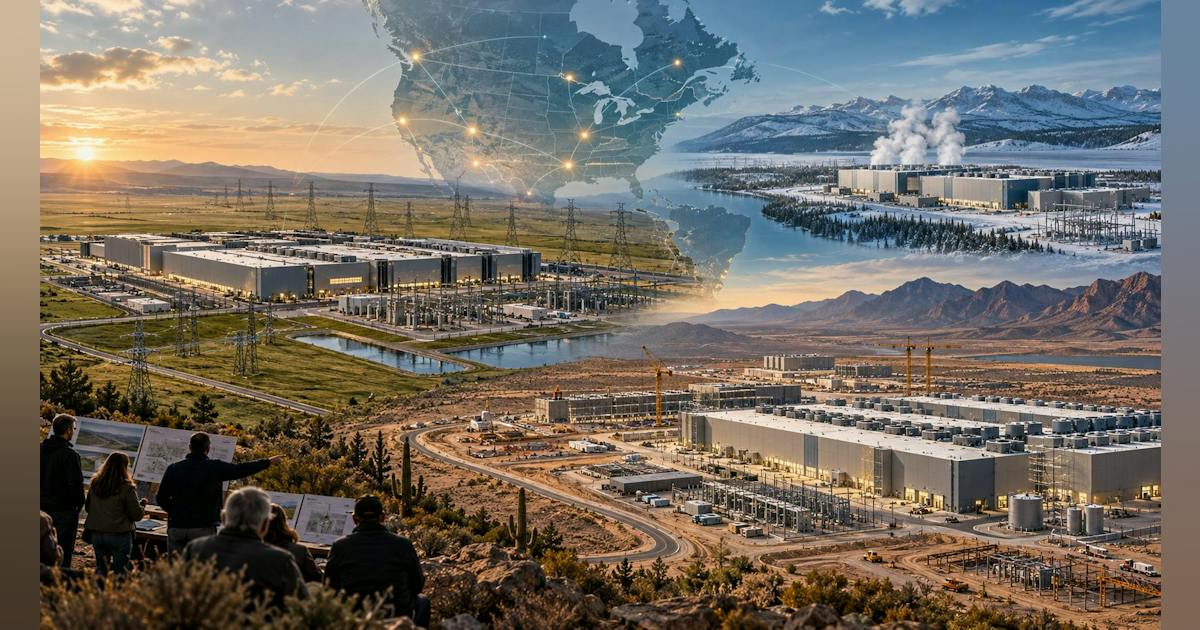
Land & Expand is Data Center Frontier’s periodic look at the latest data center development news, including new sites, land acquisitions and campus expansions across North America. This latest installment finds the development pipeline continuing to expand, even as the requirements for bringing large-scale projects online grow more complicated. Developers are securing land, planning new power infrastructure and advancing campuses measured in hundreds of megawatts or more. At the same time, local governments and residents are demanding greater clarity on electricity costs, water consumption, noise, tax incentives and the long-term effects of industrial-scale computing facilities. A succession of development disclosures and project milestones through September and early October 2026 illustrates both the geographical reach of North America’s expanding data center pipeline and the growing difficulty of measuring how much proposed capacity will ultimately be delivered. The projects range from preliminary discussions and newly secured development sites to campuses already under construction. Some are advancing through formal permitting and power studies; others remain contingent on customers, financing or local approvals. Together, they reveal an industry still expanding aggressively, but operating under increasingly complex development conditions. Fluidstack: Cameron County, Texas — Up to 1.5 GW One of the largest newly disclosed projects is Fluidstack’s AI data center development in Cameron County in the Rio Grande Valley. The project surfaced publicly September 10 when Cameron County announced that it had issued Fluidstack a worksite permit for property near Harlingen. The permit authorizes preliminary site work, including grading, utilities and related infrastructure, rather than construction of the data center buildings themselves. Fluidstack subsequently disclosed considerably more detail on September 21, saying construction had begun on a $4 billion first phase capable of supporting as much as 1.5 GW. Fluidstack expects the project to generate more than 2,500 construction jobs and several hundred permanent positions. 

Read More »

Microsoft will invest $80B in AI data centers in fiscal 2025

And Microsoft isn’t the only one that is ramping up its investments into AI-enabled data centers. Rival cloud service providers are all investing in either upgrading or opening new data centers to capture a larger chunk of business from developers and users of large language models (LLMs).  In a report published in October 2024, Bloomberg Intelligence estimated that demand for generative AI would push Microsoft, AWS, Google, Oracle, Meta, and Apple would between them devote $200 billion to capex in 2025, up from $110 billion in 2023. Microsoft is one of the biggest spenders, followed closely by Google and AWS, Bloomberg Intelligence said. Its estimate of Microsoft’s capital spending on AI, at $62.4 billion for calendar 2025, is lower than Smith’s claim that the company will invest $80 billion in the fiscal year to June 30, 2025. Both figures, though, are way higher than Microsoft’s 2020 capital expenditure of “just” $17.6 billion. The majority of the increased spending is tied to cloud services and the expansion of AI infrastructure needed to provide compute capacity for OpenAI workloads. Separately, last October Amazon CEO Andy Jassy said his company planned total capex spend of $75 billion in 2024 and even more in 2025, with much of it going to AWS, its cloud computing division.

Read More »

John Deere unveils more autonomous farm machines to address skill labor shortage

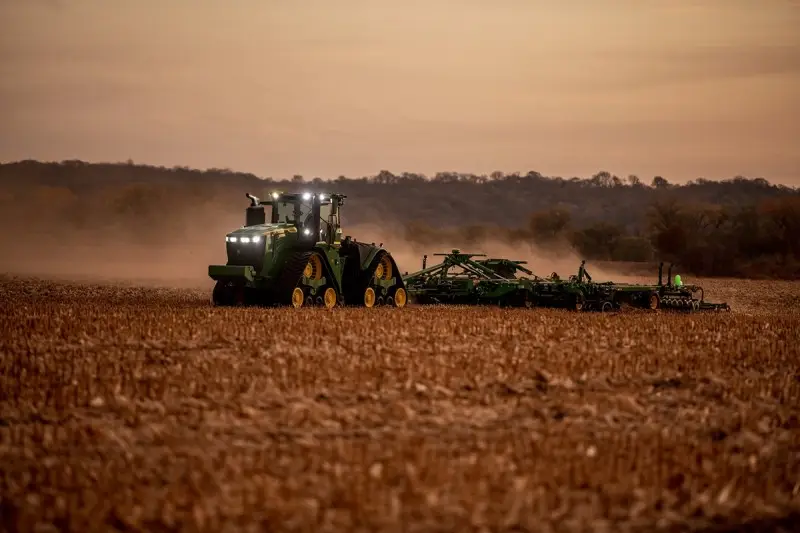
Join our daily and weekly newsletters for the latest updates and exclusive content on industry-leading AI coverage. Learn More Self-driving tractors might be the path to self-driving cars. John Deere has revealed a new line of autonomous machines and tech across agriculture, construction and commercial landscaping. The Moline, Illinois-based John Deere has been in business for 187 years, yet it’s been a regular as a non-tech company showing off technology at the big tech trade show in Las Vegas and is back at CES 2025 with more autonomous tractors and other vehicles. This is not something we usually cover, but John Deere has a lot of data that is interesting in the big picture of tech. The message from the company is that there aren’t enough skilled farm laborers to do the work that its customers need. It’s been a challenge for most of the last two decades, said Jahmy Hindman, CTO at John Deere, in a briefing. Much of the tech will come this fall and after that. He noted that the average farmer in the U.S. is over 58 and works 12 to 18 hours a day to grow food for us. And he said the American Farm Bureau Federation estimates there are roughly 2.4 million farm jobs that need to be filled annually; and the agricultural work force continues to shrink. (This is my hint to the anti-immigration crowd). John Deere’s autonomous 9RX Tractor. Farmers can oversee it using an app. While each of these industries experiences their own set of challenges, a commonality across all is skilled labor availability. In construction, about 80% percent of contractors struggle to find skilled labor. And in commercial landscaping, 86% of landscaping business owners can’t find labor to fill open positions, he said. “They have to figure out how to do

Read More »

2025 playbook for enterprise AI success, from agents to evals

Join our daily and weekly newsletters for the latest updates and exclusive content on industry-leading AI coverage. Learn More 2025 is poised to be a pivotal year for enterprise AI. The past year has seen rapid innovation, and this year will see the same. This has made it more critical than ever to revisit your AI strategy to stay competitive and create value for your customers. From scaling AI agents to optimizing costs, here are the five critical areas enterprises should prioritize for their AI strategy this year. 1. Agents: the next generation of automation AI agents are no longer theoretical. In 2025, they’re indispensable tools for enterprises looking to streamline operations and enhance customer interactions. Unlike traditional software, agents powered by large language models (LLMs) can make nuanced decisions, navigate complex multi-step tasks, and integrate seamlessly with tools and APIs. At the start of 2024, agents were not ready for prime time, making frustrating mistakes like hallucinating URLs. They started getting better as frontier large language models themselves improved. “Let me put it this way,” said Sam Witteveen, cofounder of Red Dragon, a company that develops agents for companies, and that recently reviewed the 48 agents it built last year. “Interestingly, the ones that we built at the start of the year, a lot of those worked way better at the end of the year just because the models got better.” Witteveen shared this in the video podcast we filmed to discuss these five big trends in detail. Models are getting better and hallucinating less, and they’re also being trained to do agentic tasks. Another feature that the model providers are researching is a way to use the LLM as a judge, and as models get cheaper (something we’ll cover below), companies can use three or more models to

Read More »

OpenAI’s red teaming innovations define new essentials for security leaders in the AI era

Join our daily and weekly newsletters for the latest updates and exclusive content on industry-leading AI coverage. Learn More OpenAI has taken a more aggressive approach to red teaming than its AI competitors, demonstrating its security teams’ advanced capabilities in two areas: multi-step reinforcement and external red teaming. OpenAI recently released two papers that set a new competitive standard for improving the quality, reliability and safety of AI models in these two techniques and more. The first paper, “OpenAI’s Approach to External Red Teaming for AI Models and Systems,” reports that specialized teams outside the company have proven effective in uncovering vulnerabilities that might otherwise have made it into a released model because in-house testing techniques may have missed them. In the second paper, “Diverse and Effective Red Teaming with Auto-Generated Rewards and Multi-Step Reinforcement Learning,” OpenAI introduces an automated framework that relies on iterative reinforcement learning to generate a broad spectrum of novel, wide-ranging attacks. Going all-in on red teaming pays practical, competitive dividends It’s encouraging to see competitive intensity in red teaming growing among AI companies. When Anthropic released its AI red team guidelines in June of last year, it joined AI providers including Google, Microsoft, Nvidia, OpenAI, and even the U.S.’s National Institute of Standards and Technology (NIST), which all had released red teaming frameworks. Investing heavily in red teaming yields tangible benefits for security leaders in any organization. OpenAI’s paper on external red teaming provides a detailed analysis of how the company strives to create specialized external teams that include cybersecurity and subject matter experts. The goal is to see if knowledgeable external teams can defeat models’ security perimeters and find gaps in their security, biases and controls that prompt-based testing couldn’t find. What makes OpenAI’s recent papers noteworthy is how well they define using human-in-the-middle

Read More »