Stay Ahead, Stay ONMINE

AI’s Future Must Return to the Edge: How Power Constraints and Local Politics Are Redefining AI Infrastructure

Over the past two years, AI build plans have driven a sharp escalation in projected data center power demand. One recent assessment1 found that the U.S. disclosed data center development pipeline reached roughly 241 gigawatts by the end of 2025—an increase of about 159% in a single year—illustrating the unprecedented pace at which AI infrastructure […]

Over the past two years, AI build plans have driven a sharp escalation in projected data center power demand. One recent assessment1 found that the U.S. disclosed data center development pipeline reached roughly 241 gigawatts by the end of 2025—an increase of about 159% in a single year—illustrating the unprecedented pace at which AI infrastructure demand is expanding. Forecasts from major analysts indicate that total data center power consumption could grow at least 50% by 2027 and potentially as much as 165% by 2030, with AI training and inference responsible for most of the incremental load.2 At this pace, planned AI capacity is growing faster than electric infrastructure can realistically be expanded.

In many markets, available land and fiber are not the limiting factors; dependable megawatt delivery is.3 At the facility level, AI hardware is moving standard designs into new ranges. Power densities that once centered around 10–20 kW per rack are being replaced by configurations nearer 40 kW, with dense AI racks pushing toward 85 kW today and credible roadmaps to 200–250 kW per rack by 2030, though we’ve all seen the reports of even larger. These levels do not only affect cooling and whitespace layouts; they materially change the electrical infrastructure required per room and per building, and by extension the strain on local grids.

On the powersystem side, constraints are now explicit. Transmission operators and regulators are stating that current generation, interconnection, and buildout timelines are not sufficient to accommodate another decade of large demand centers in their present form.

Analysts tracking AI data center energy demand point to electricity, grid access, and firm capacity as the primary constraints on new builds, with grid bottlenecks and transmission limitations flagged as risks for up to 20% of planned projects.4, 5  At the facility level, AI hardware is moving standard designs into new ranges. Power densities that once centered around 10–20 kW per rack are being replaced by configurations nearer 40 kW, with dense AI racks now routinely discussed in the 80–100 kW range and roadmaps toward ~200 kW per rack by the end of the decade.6,7 These levels do not only affect cooling and whitespace layouts; they materially change the electrical infrastructure required per room and per building, and by extension the strain on local grids.

Political and regulatory responses have followed the scale of this buildout. Research tracking local opposition campaigns shows that data center projects representing tens of billions of dollars in planned investment have been delayed or blocked since 2024, while organized resistance has spread across dozens of proposed developments. By spring of this year, now several dozen jurisdictions have adopted moratoriums or bans on new data centers, with a subset of those prohibitions targeted specifically at largescale facilities. 

Maine lawmakers approved what would have been the nation’s first statewide moratorium on large data centers, although the measure was subsequently vetoed by Governor Janet Mills. At the same time, policymakers at the state and federal levels are increasingly debating whether exceptionally large AI data centers warrant additional permitting scrutiny, grid-impact review, or project-specific approval requirements as electricity demand accelerates. In the past year and a half since President Trump took office and made data centers an administrative priority, proposals such as the federally introduced Artificial Intelligence Data Center Moratorium Act have brought the idea of size-based restrictions on large AI data centers into the national legislative discussion, signaling that project size itself may increasingly shape how approvals are granted, even where technical capacity exists. For developers and operators, that kind of sizebased trigger should grab our attention. It suggests that, even where grid capacity exists, approvals for singlesite deployments above that threshold may become slower, more conditional, or less predictable.

We are about to reach a structural bottleneck: the growth drivers are not going to find their solution without restructuring our approach. Capital expenditure plans for AI are assuming continued growth in very large, powerdense sites at the same time that both the grid and the policy environment are imposing tighter constraints on those forms of deployment. If our industry continues to rely primarily on hyperscale campuses as the default AI strategy, we should expect more projects to be gated by power availability, delayed by permitting, or exposed to hard caps on individual site size. A deliberate shift toward a distributed edgeandregional model, where more AI capacity is deployed in smaller increments, closer to loads and integrated with local power systems, would give operators more room to maneuver under the radar of these looming limited thresholds, relieve stress on transmission, and reduce the political visibility of each individual facility. A constraintdriven view is precisely why edge needs to move from sidestrategy to central design principle in AI infrastructure planning.

None of this suggests that hyperscale AI campuses are becoming obsolete. Frontier-model training and the largest GPU clusters will continue to depend on gigawatt-scale infrastructure for the foreseeable future. The opportunity is to rebalance the overall AI infrastructure portfolio: reserving hyperscale for the workloads that genuinely require it while expanding edge and regional deployments for inference, latency-sensitive applications, and incremental capacity that can be delivered more quickly and with fewer power and permitting constraints.

The Existing AI Buildout Model is Brittle at Best

The prevailing AI buildout model has been to add capacity in ever larger increments at a small number of hyperscale campuses. With sites now targeting tens to hundreds of megawatts per location, we still cluster in regions that can offer land, substation access, and longhaul fiber. This concentration has created a singlepointoffailure dynamic: one hostile county commission, one interconnection bottleneck, or one regional moratorium can stall megawatts to gigawatts of planned AI capacity for years, even when tenants are fully funded and equipment is sourced.

Regulatory and image risks compound that structural exposure. National narratives about data centers “sucking up land, water, and power” have shifted from isolated local disputes into coordinated campaigns that support moratoriums, referenda, and statelevel bills. The reports of projects blocked or delayed by local organized pushback show that the number of affected sites has been rising sharply over the past two years rather than stabilizing. In this regulatory environment, very large, highly visible campuses become lightning rods, not just for technical scrutiny but for broader political frustration about energy prices, land use, and AI itself.

Power availability is increasingly acting as the hard gate on capital deployment. Even where operators are ready to commit billions in AI infrastructure, utilities and grid operators are unable to build transmission and generation fast enough to support the planned timelines for large campuses. Analysts are beginning to describe power, not land or capital, as the limiting commodity in AI data center growth. That combination—load concentrated in a few very large sites, rising political resistance to those sites, and slower expansion of firm power—makes the current hyperscalefirst model brittle.

Edge Solves the Power Problem

One of the main advantages of edge infrastructure is that it breaks AI capacity into increments that power systems can absorb more easily. Instead of requiring tens or hundreds of megawatts at a single site, edge deployments often operate in the 10–500 kW range, with some metro-edge pods extending into the low single-digit megawatts. That scale gives utilities more flexibility to serve new load through existing feeders, substations, and distribution upgrades rather than forcing an immediate dependence on new high-voltage transmission buildouts.

A distributed footprint also aligns more naturally with on-site and localized energy strategies. Smaller AI nodes are easier to pair with microgrids, fuel cells, solar-plus-storage, or other distributed energy resources, which can improve resilience and reduce dependence on constrained bulk transmission systems. They can also be placed in industrial parks, telecom environments, or existing energy corridors where some combination of generation, thermal infrastructure, or interconnection capacity is already in place. In practical terms, a region that cannot permit or energize a 200 MW hyperscale campus may still be able to support 50 edge nodes at 200 kW each, tied into an upgraded distribution network and scaled over time as demand grows.

The other advantage is risk distribution. When AI capacity is spread across dozens or hundreds of smaller sites, the system becomes less exposed to a single interconnection delay, a substation failure, or a policy reversal in one jurisdiction. That logic is similar to the broader role distributed energy resources are already playing in modern grids: they do not eliminate the need for centralized infrastructure, but they reduce stress on it and create a more flexible path for incremental growth. Some operators are already making progress this way, moving ahead with smaller power requests that attract less attention, secure approvals faster, and create a clearer roadmap for adding capacity in phases rather than waiting on a single large approval event.

Edge Lowers the Political Temperature

Edge infrastructure changes not just the scale of power, but the scale of public perception and the size of the political fight. Over the past year, multiple states and counties have moved to pause or tightly condition new large data centers explicitly, while treating smaller facilities under more familiar commercial or light‑industrial rules.

By definition, distributed edge deployments sit below this highly visible threshold, and many can be absorbed into existing commercial, telecom, or light industrial environments rather than requiring a new greenfield campus. That matters politically because a sub-megawatt or low-megawatt node inside an existing building does not trigger the same visibility, land-use conflict, or symbolic reaction as a hyperscale campus arriving as a new regional power load.

The form factor also alters how projects show up in local politics. Pushback against data centers is typically organized around a cluster of concerns: high‑visibility campuses perceived as changing local character, large water draws, and the fear of higher power prices for residents and small businesses. Those arguments land most easily against single, very large sites. Smaller facilities embedded in industrial parks, logistics hubs, hospitals, or municipal infrastructure can be framed in concrete terms (supporting automation, clinical systems, traffic management, or utilities) rather than as remote “server farms” whose benefits are hard to see on the ground.

Finally, distributed deployment creates more room for case‑by‑case negotiation. When individual jurisdictions are dealing with a fraction of the overall AI load, it is simpler to set specific conditions around noise, traffic, energy sourcing, and local benefits for each site, instead of weighing a single project that represents 50–200 MW of new demand. That matches the direction of many recent state and local initiatives, which have moved toward finer‑grained oversight and explicit scrutiny of grid and environmental impacts. Edge, in that sense, is not a reputational strategy layered on top of the same buildout. It is a different pattern of growth that gives operators and governments more options for absorbing AI capacity without turning every project into a referendum on hyperscale development.

Edge Economics

A common objection to edge and regional infrastructure is that it looks more expensive on a per‑kilowatt basis than very large campuses. In many cases, that’s true on the raw unit cost. Smaller facilities often carry higher per‑kW capex than mega‑sites. But the investment profile is different. Capacity is added in smaller increments, with shorter intervals between capital outlay and revenue, and fewer points where large sums are committed before power or permits are fully secured. Smaller sites can also re‑use existing structures, utility connections, and civil works, trimming land and site‑preparation costs relative to greenfield campuses.

Time‑to‑power and time‑to‑market are part of the same equation. Since edge and regional sites are typically able to secure interconnections and local approvals faster than 100+ MW projects, this reduces the risk of stranded capital, where equipment is ordered, delivered, or even installed, but cannot be energized on the intended schedule. For AI deployments, that delay is not just operational; it is financial. Time to market is closely tied to time to revenue, and GPU infrastructure starts losing commercial leverage the longer it sits idle. Shorter deployment cycles also track more closely with AI’s hardware and model refresh rates, limiting the extent to which an operator is locked into a particular accelerator generation at one large site for years.

Political and regulatory dynamics feed directly into risk‑adjusted returns. Large AI campuses are already seeing billions of dollars in planned capex delayed or blocked because of power, permitting, and local opposition. That experience effectively raises the risk premium on hyperscale‑only strategies. A more diversified footprint of many smaller sites across multiple jurisdictions reduces exposure to any one moratorium, tax change, or policy reversal.

In parallel, the market for edge AI infrastructure is expanding quickly. Market researchers project strong long-term growth for edge AI infrastructure and related edge AI platforms, with many forecasts calling for compound annual growth rates exceeding 20% as AI inference increasingly moves closer to users, enterprises, and industrial environments.8,9

The Edge is Not Forgotten, But a Permanent Part of the AI Model

One of the clearer signals in the current buildout is that the operators furthest along in shifting to an edge strategy did not abandon edge when AI spending surged toward hyperscale campuses. They kept building small and regional sites, then used those footprints to anchor relationships with the same hyperscale tenants whose biggest workloads eventually landed in larger facilities. Micro and edge deployments became a proving ground: places where AI inference, latency‑sensitive applications, and regulated workloads could run close to users, while training clusters and bulk capacity still concentrated in a smaller number of high‑density hubs.

That pattern matters because it shows how edge and hyperscale can be integrated rather than treated as competing philosophies. Smaller sites in secondary metros, industrial zones, or repurposed facilities establish a local presence, carry early workloads, and demonstrate reliability for integrating hyperscale into edge sites. Hyperscalers are making steady use of an existing network of edge nodes to handle inference, data localization, and specialized use cases. The result is a hybrid infrastructure portfolio: a set of megawatt‑scale campuses and a mesh of smaller deployments that together carry the AI workload, instead of a single bet on very large campuses alone.

In this sense, edge is already serving as a bridge between the realities of power and politics on the ground and the scale of AI ambitions at the top, and will continue to do so. Operators that treat distributed capacity as a long‑term pillar are positioning themselves to move compute where power, permits, and local support are available, without waiting for perfect conditions at a handful of mega‑sites. This leaves all tenants (not just hyperscalers) with more available options: they can start small, grow into regional and hyperscale footprints, and still retain local, low‑latency infrastructure for the parts of their AI stack that demand it. For the industry, it is a way to keep building through the pressing constraints, using edge as a structural component of the AI era.

References:

1.       https://pv-magazine-usa.com/2026/03/19/u-s-data-center-pipeline-growth-slows-as-grid-constraints-mount/

2.       https://presenc.ai/research/ai-data-center-energy-consumption-2026

3.       https://ibuidl.org/blog/ai-energy-consumption-datacenter-2026-20260310

4.       https://www.datacenterdynamics.com/en/news/iea-data-center-energy-consumption-set-to-double-by-2030-to-945twh/

5.       https://ibuidl.org/blog/ai-energy-consumption-datacenter-2026-20260310

6.       https://ttms.com/growing-energy-demand-of-ai-data-centers-2024-2026/

7.       https://edgeconsultancykw.com/ai-data-centres-electricity-demand-2030-iea/

8.       https://www.technavio.com/report/ai-edge-infrastructure-market-industry-analysis

9.       https://www.grandviewresearch.com/horizon/statistics/edge-ai-market/component/edge-cloud-infrastructure/global

Shape
Shape
Stay Ahead

Explore More Insights

Stay ahead with more perspectives on cutting-edge power, infrastructure, energy,  bitcoin and AI solutions. Explore these articles to uncover strategies and insights shaping the future of industries.

Shape

Fortinet adds AI protections to endpoint security platform

“FortiEndpoint provides centralized visibility into AI applications and agents operating across managed endpoints. Security teams can identify sanctioned and unsanctioned tools, detect shadow AI, monitor adoption trends, and understand user activity through unified dashboards,” wrote Ankit Gupta, product and marketing leader for Fortinet, in a blog post about the enhancements.

Read More »

ISC2: AI raises accountability demands for cybersecurity teams

Artificial intelligence is changing how cybersecurity teams work, with security professionals spending more time validating AI-generated recommendations and deciding when to trust AI outputs, according to new research from ISC2. The ISC2 survey of 856 cybersecurity professionals found that 65% spent more time deciding when to trust or act on

Read More »

Governments to enterprises: Improve your router security hygiene

Actors have exploited, at the very least, CVE-2018-0171 (published in 2018) and CVE-2008-4128 (published in 2008), according to the bulletin. Both of these targeted Cisco routers, giving remote, unauthenticated attackers the ability to execute arbitrary code, take unauthorized actions, or cause a denial of service (DoS). Notable groups using this

Read More »

Routine maintenance as a failure vector in modern networks

Pre-checks should include both control-plane and data-plane evidence. Control-plane checks confirm configuration, synchronization, device health, routing tables, interface status and object availability. Data-plane checks validate real traffic movement: TCP handshakes, TLS negotiation, HTTP status codes, API responses, session persistence, source NAT behavior and return-path consistency. During the change, monitoring should

Read More »

Energy Secretary Secures Mid-Atlantic Grid Ahead of Period of Hot Weather

WASHINGTON—The U.S. Department of Energy (DOE) today issued an emergency order to mitigate blackout risks in the Mid-Atlantic ahead of the forecasted hot weather conditions and expected system load increase. The order directs PJM Interconnection, L.L.C. (PJM) to dispatch specified units and to order their operation as needed to maintain reliability. The order also authorizes PJM to direct backup generation resources to operate as a last resort before declaring an Energy Emergency Alert (EEA) 3 or during an EEA 3. PJM is authorized to call upon its Transmission Owners and Electric Distribution Companies to implement the order as needed. The order was issued pursuant to an application from PJM submitted on July 13, 2026. “Maintaining affordable, reliable, and secure power in the PJM service territory is non-negotiable,” said U.S. Secretary of Energy Chris Wright. “The previous administration’s energy subtraction policies weakened the grid, leaving Americans more vulnerable during events like this. Thanks to President Trump’s leadership, we are reversing those failures and using every available tool ensuring Americans in the Mid-Atlantic have continued access to affordable, reliable, and secure energy to power and cool their homes.” DOE estimates more than 35 GW of unused backup generation remains available nationwide. On day one, President Trump declared a national energy emergency after the Biden administration’s energy subtraction agenda left behind a grid increasingly vulnerable to risks of blackouts. According to the North American Electric Reliability Corporation’s (NERC) 2026 Summer Reliability Assessment, the peak electricity demand in PJM occurs during the summer season. NERC further notes that “if extreme high temperatures are experienced, PJM anticipates the need for demand-response resources to help reduce load.”  Power outages cost the American people $44 billion per year, according to data from DOE’s National Laboratories. This order will mitigate the possibility of power outages in the Mid-Atlantic and highlights the common sense policies of the Trump Administration to ensure Americans have access to affordable, reliable,

Read More »

DOE Alternative Fuels and Feedstocks Office Announces Intent to Advance Innovative Chemical Technologies

Proposed DOE funding will accelerate domestic chemical production WASHINGTON—The U.S. Department of Energy’s (DOE) Alternative Fuels and Feedstocks Office (AFFO) today announced its intent to fund the advancement of novel, high-impact chemical technologies. The proposed funding opportunity, Accelerating Scale-up and Pre-piloting of Emerging Chemical Technologies (ASPECT), will advance technologies for producing chemicals from alternative and waste feedstocks. In accordance with President Trump’s Executive Order Unleashing American Energy, this funding opportunity will strengthen domestic supply chains, reduce reliance on foreign imports, and accelerate American technology innovation. More than 96% of manufactured goods rely on products from the U.S. chemical sector, which directly employs more than half a million Americans. The ASPECT funding opportunity will reinforce domestic manufacturing and chemical supply chains by expanding the use of alternative feedstocks. Funding provided through ASPECT will target chemical technologies that improve performance, reduce costs, and show large market growth potential. AFFO expects to issue a notice of funding opportunity (NOFO) in August 2026, making up to $58 million available for projects that address the following topic areas: Topic Area 1: Bench ASPECT – to support the development and adoption of new technologies for producing chemicals from alternative feedstocks, moving beyond proof-of-concept to bench and pre-pilot scale. Topic Area 2: Pre-pilot ASPECT – to accelerate the development and market entry of strategically valuable, domestically produced chemicals. Following the NOFO announcement, AFFO will host an informational webinar to discuss a new, streamlined application and review process. Learn more about the topic areas, applicant eligibility and registration requirements, and the Teaming Partner List. Visit DOE eXCHANGE to view the full NOI.

Read More »

PTTEP achieves Thailand’s first wellhead platform reuse in Gulf of Thailand

PTT Exploration and Production Public Co. Ltd. (PTTEP) has completed Thailand’s first total wellhead platform reuse project by redeploying an entire decommissioned petroleum wellhead platform as a complete structure in Funan field in the Gulf of Thailand. The reuse project comes as part of PTTEP’s program to maximize value and extend utilization of wellhead platforms that remain structurally sound and safe after depleting resources at a location by redeploying the platform as a complete structure. The first implementation was carried out at the Jakrawan K wellhead platform (JKWK), in Funan field under the G1/61 Project. As part of the project, PTTEP adopted the wet-tow method to relocate the jacket, helping curb energy consumption and minimize impacts on marine life attached to the platform structure, supporting a balance between energy production and marine environmental stewardship. The topside, jacket, and selected pile sections were relocated and reinstalled for use within the same field, reducing the overall construction and installation period to only 6 months, down from about 20 months for a newly built platform.  Additionally, the approach cut construction costs by about 35–50% compared with construction of an entirely new wellhead platform. PTTEP said it expects the initiative to also reduce greenhouse gas emissions by about 3,270 tonnes of CO2e/platform by limiting the use of steel and other equipment required for construction of new platforms. PTTEP is operator of the G1/61 project (60%) with partner Mubadala Investment Co. (40%).

Read More »

Trump declares Iran ceasefire over; oil surges on renewed supply risk

US President Donald Trump said the ceasefire and memorandum of understanding (MOU) reached with Iran last month is effectively over following a fresh exchange of strikes, reigniting supply concerns and sending crude prices sharply higher. Speaking alongside NATO Secretary-General Mark Rutte at the alliance’s summit in Ankara, Pres. Trump said Washington no longer sees value in maintaining the ceasefire framework with Tehran, though he left open the possibility of continued talks. He added that further US military action against Iran remains likely after strikes overnight. Stay updated on oil price volatility, shipping disruptions, LNG market analysis, and production output at OGJ’s Iran war content hub. The escalation was triggered by alleged Iranian attacks on three commercial vessels transiting the Strait of Hormuz on July 7. US Central Command said it responded with strikes on more than 80 Iranian targets, including air defense systems, command-and-control infrastructure, anti-ship missile capabilities, and over 60 Islamic Revolutionary Guard Corps (IRGC) fast boats operating in and near the strait. US Central Command described the tanker attacks as a clear violation of the June 17 agreement. Iran’s Foreign Ministry called the US strikes a breach of the MOU and said Tehran would continue to defend its sovereignty. The IRGC said it retaliated with drone and missile strikes targeting US military facilities in Bahrain and Kuwait. Authorities in both countries reported intercepting incoming projectiles, with no material damage confirmed. Trump said on July 8 the US is considering reinstating a naval blockade targeting Iranian ports and vessels. He also raised the possibility of strikes on civilian infrastructure, including electric plants and desalination facilities, as well as a potential move to take control of Kharg Island, home to the bulk of Iran’s crude export infrastructure. He said Tuesday’s strikes had reached the island but had not targeted its

Read More »

US EIA forecasts declining oil prices as supply disruptions ease

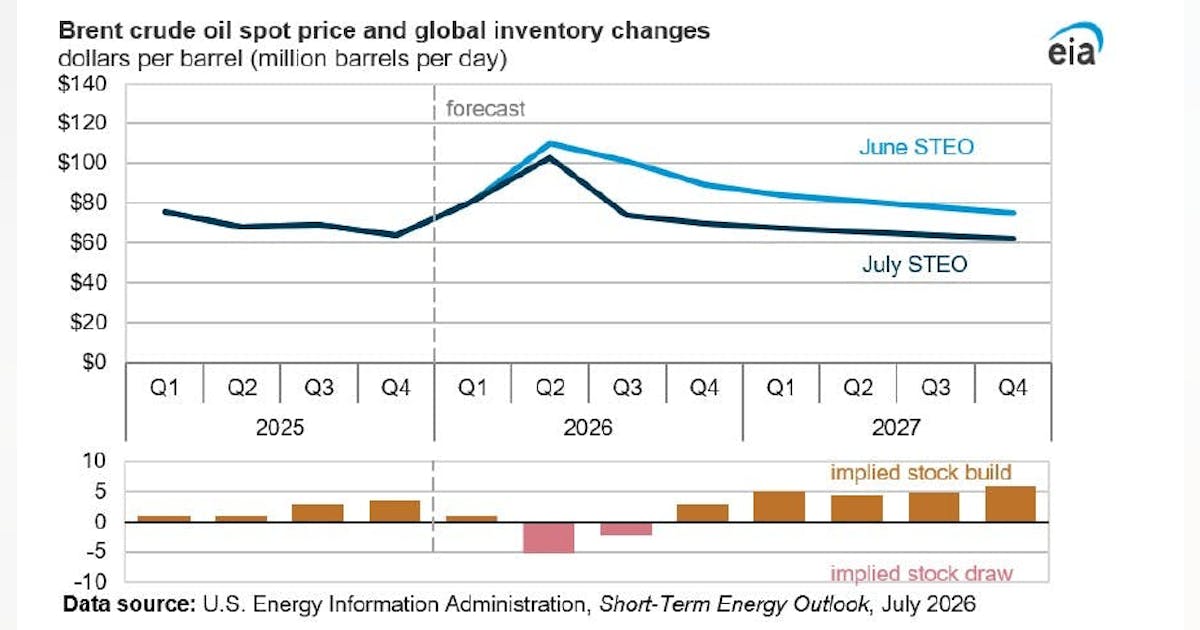
In its July 7 Short-Term Energy Outlook (STEO) report, the US Energy Information Administration (EIA) said it expects global oil prices to decline as supply disruptions linked to the Strait of Hormuz ease and production recovers.  On June 18, the US and Iran signed a memorandum of understanding to end the conflict and reopen the strait, which had been largely closed since Feb. 28. The disruption to this critical oil transit chokepoint constrained global flows, driving major price volatility. Brent crude averaged $85/bbl in June, down $22/bbl from May and $32/bbl below its April peak. Prices fell below $70/bbl on July 1 as tanker traffic through the strait increased sharply, easing supply concerns. EIA now expects most shut-in crude production to return to near pre-conflict levels by yearend, with full restoration largely to be completed by first-quarter 2027.  Despite the recovery in flows, global inventories remain significantly depleted following earlier draws. EIA estimates oil inventories declined by an average of 5.1 million b/d in second-quarter 2026 and will fall by a further 2.2 million b/d in third-quarter 2026, as much of the recent tanker movement reflects previously stranded cargoes. As a result, the market is expected to remain relatively tight through most of third-quarter 2026 before shifting back into oversupply. EIA forecasts global oil consumption will decline by 1.2 million b/d in 2026, led by a 0.8 million b/d drop in non-OECD demand, particularly in the Asia Pacific. Demand is expected to rebound in 2027 as prices ease and supply normalizes, with consumption rising by 2.0 million b/d to 104.8 million b/d.  As supply growth outpaces demand, inventories are projected to build by 2.7 million b/d in fourth-quarter 2026 and by 5.0 million b/d in 2027. This shift is expected to place sustained downward pressure on prices. EIA forecasts Brent

Read More »

Eni lets EPCI contract for Kutei North Hub field FPSO

Eni North Ganal has let an engineering, procurement, construction, and installation (EPCI) contract to a joint venture between PT Saipem Indonesia and PT Tripatra Engineers and Constructors for a floating production, storage, and offloading (FPSO) unit for the Kutei North Hub Field Development Project in Kutei basin, offshore Indonesia, about 70 km off East Kalimantan. The project execution, with an estimated duration of 48 months, includes project management, engineering, procurement of materials, fabrication, construction and installation activities, as well as commissioning and start-up of the FPSO unit. The contract is valued at about $2 billion for Saipem’s share. The Kutei FPSO project is part of the Kutei North Hub Development, which comprises a subsea development tied back to the new FPSO, a dedicated gas export pipeline to the Bontang LNG plant, and domestic gas users via the existing East Kalimantan System. Eni North Ganal is controlled by Searah Ltd., which was formed through a strategic partnership between Eni and Petronas.

Read More »

AI’s Future Must Return to the Edge: How Power Constraints and Local Politics Are Redefining AI Infrastructure

Over the past two years, AI build plans have driven a sharp escalation in projected data center power demand. One recent assessment1 found that the U.S. disclosed data center development pipeline reached roughly 241 gigawatts by the end of 2025—an increase of about 159% in a single year—illustrating the unprecedented pace at which AI infrastructure demand is expanding. Forecasts from major analysts indicate that total data center power consumption could grow at least 50% by 2027 and potentially as much as 165% by 2030, with AI training and inference responsible for most of the incremental load.2 At this pace, planned AI capacity is growing faster than electric infrastructure can realistically be expanded. In many markets, available land and fiber are not the limiting factors; dependable megawatt delivery is.3 At the facility level, AI hardware is moving standard designs into new ranges. Power densities that once centered around 10–20 kW per rack are being replaced by configurations nearer 40 kW, with dense AI racks pushing toward 85 kW today and credible roadmaps to 200–250 kW per rack by 2030, though we’ve all seen the reports of even larger. These levels do not only affect cooling and white‑space layouts; they materially change the electrical infrastructure required per room and per building, and by extension the strain on local grids. On the power‑system side, constraints are now explicit. Transmission operators and regulators are stating that current generation, interconnection, and build‑out timelines are not sufficient to accommodate another decade of large demand centers in their present form. Analysts tracking AI data center energy demand point to electricity, grid access, and firm capacity as the primary constraints on new builds, with grid bottlenecks and transmission limitations flagged as risks for up to 20% of planned projects.4, 5  At the facility level, AI hardware is moving

Read More »

Data Center Frontier Trends Summit 2026 Preview

The Hidden Constraints of Delivery If power gets the headlines, supply chain and logistics often decide the schedule. Kleyman notes that a seemingly small missing component can delay a multibillion-dollar facility. A busway, switchgear component, cooling element, or logistics failure can ripple through construction sequencing, commissioning, customer handoff, and revenue recognition. “The weakest link may not be the most expensive component,” he says. That reality receives sustained attention across the Summit agenda. Day One’s “Beyond the Dashboard: Active Exception Management for Hyperscale AI” features CargoSense CEO Rich Kilmer in a live case study examining how organizations are moving beyond passive shipment visibility toward active exception management. For hyperscale AI projects, supply chain disruption is not simply about delayed shipments. It can affect site readiness, construction sequencing, commissioning windows, and the ability to bring capacity online as planned. Day Two’s “The Hidden Constraint: Supply Chains in the Age of AI Infrastructure” continues the discussion, examining how global supply chains are becoming a defining constraint and differentiator in AI data center delivery. The execution lens sharpens again on Day Three with “The Last 90 Days: Solving the Final Infrastructure Bottlenecks Before Go-Live.” This session focuses on the phase where projects can be won or lost: generator delivery, electrical integration, controls validation, startup sequencing, fuel systems, utility coordination, commissioning, and operational readiness. Even projects that have secured power, capital, customers, and equipment can face costly delays if the final stretch is not executed with precision. In the AI infrastructure era, the last 90 days may determine whether a project becomes energized capacity—or another delayed announcement. Capital Meets Execution Reality The Summit also examines whether capital is moving in step with what can actually be built. Day Two’s investment panel, “AI Infrastructure Investment: Bubble, Breakthrough, or Both?” will assess how investors are underwriting risk

Read More »

DCF Poll: How Much of the AI Data Center Pipeline Will Actually Get Built?

Matt Vincent is Editor in Chief of Data Center Frontier, where he leads editorial strategy and coverage focused on the infrastructure powering cloud computing, artificial intelligence, and the digital economy. A veteran B2B technology journalist with more than two decades of experience, Vincent specializes in the intersection of data centers, power, cooling, and emerging AI-era infrastructure. Since assuming the EIC role in 2023, he has helped guide Data Center Frontier’s coverage of the industry’s transition into the gigawatt-scale AI era, with a focus on hyperscale development, behind-the-meter power strategies, liquid cooling architectures, and the evolving energy demands of high-density compute, while working closely with the Digital Infrastructure Group at Endeavor Business Media to expand the brand’s analytical and multimedia footprint. Vincent also hosts The Data Center Frontier Show podcast, where he interviews industry leaders across hyperscale, colocation, utilities, and the data center supply chain to examine the technologies and business models reshaping digital infrastructure. Since its inception he serves as Head of Content for the Data Center Frontier Trends Summit. Before becoming Editor in Chief, he served in multiple senior editorial roles across Endeavor Business Media’s digital infrastructure portfolio, with coverage spanning data centers and hyperscale infrastructure, structured cabling and networking, telecom and datacom, IP physical security, and wireless and Pro AV markets. He began his career in 2005 within PennWell’s Advanced Technology Division and later held senior editorial positions supporting brands such as Cabling Installation & Maintenance, Lightwave Online, Broadband Technology Report, and Smart Buildings Technology. Vincent is a frequent moderator, interviewer, and keynote speaker at industry events including the HPC Forum, where he delivers forward-looking analysis on how AI and high-performance computing are reshaping digital infrastructure. He graduated with honors from Indiana University Bloomington with a B.A. in English Literature and Creative Writing and lives in southern New Hampshire with

Read More »

Powering Canada’s AI Future: Electricity, Policy, and the Race for Data Center Leadership

Alberta represents the biggest point of contention in Canada’s data center strategy. The province is aggressively pursuing data center development with its Artificial Intelligence Data Center Strategy. It has abundant natural gas, large land parcels, a deregulated power market, experienced energy developers and political leaders actively courting AI infrastructure. That makes it attractive to data center operators that care most about speed to power. Alberta has also promoted “bring your own generation” models, where data center developers pair facilities with dedicated generation rather than relying entirely on the public grid. But Alberta’s electricity system is much more carbon-intensive than Québec, British Columbia, Manitoba or Ontario. The same feature that makes it attractive for development, potential  large AI build-outs powered primarily by natural gas, would undercut Canada’s claim that its data centers can run on some of the cleanest power in the world. Saskatchewan illustrates another version of the opportunity. Bell Canada’s planned 300-megawatt AI data center in the Rural Municipality of Sherwood near Regina is a major signal that large-scale AI infrastructure can move beyond the traditional Toronto-Montreal-Calgary corridor. The project combines domestic telecom infrastructure, sovereign compute ambitions, hyperscale tenants, fiber partnerships, Indigenous procurement participation and closed-loop cooling. It also shows why power availability is now the deciding factor in site selection. At 300 megawatts, a single facility becomes a grid-planning event, not merely a real estate development. British Columbia, meanwhile, is trying to prioritize power among competing industrial demands. Data centers are arriving at the same time as mining, LNG, manufacturing, forestry, hydrogen and electrification projects. The province has moved toward limiting and screening certain high-load uses, including data centers and cryptocurrency mining, so that scarce clean electricity is allocated to projects with the strongest public benefit. This seems to be a preview of the future for these industrial

Read More »

DC Byte’s Colby Cox Talks Power, Density and the AI Data Center Map

For much of the past two years, the data center industry’s central question was whether artificial intelligence demand could sustain the unprecedented scale of infrastructure being announced in its name. That is no longer the most urgent question. The more immediate concern is whether developers can assemble the power, land, cooling systems, interconnections, capital, political support and community acceptance required to convert that demand into operating capacity. “AI infrastructure has moved from being a fast-growing demand segment to becoming the organizing principle of data center development,” said Colby Cox, Managing Director for the Americas at DC Byte, during a recent appearance on the Data Center Frontier Show podcast. The phrase captures a fundamental shift. AI is no longer simply one workload category competing for space inside the conventional data center market. It is beginning to determine where facilities are built, how campuses are financed, how electrical and mechanical systems are designed, and which regions can realistically participate in the next phase of digital infrastructure growth. The market has also moved beyond incremental expansion. Campuses planned around hundreds of megawatts—and increasingly multiple gigawatts—are no longer treated strictly as outliers. They are being conceived from the beginning around GPU density, liquid cooling, accelerated deployment and enormous concentrations of electrical load. Behind that transformation lies a second, increasingly decisive reality: Demand may be abundant, but deployable power is not. Executable Power Separates Announcements From Infrastructure From DC Byte’s market-intelligence vantage point, the dividing line between announced capacity and capacity likely to reach operation is increasingly straightforward. Has the power been secured? When can it be energized? Can the grid—or an onsite alternative—support the project’s intended phasing? “The market is no longer constrained primarily by demand or capital,” Cox said. “It is constrained by executable power.” That distinction matters because a headline capacity figure

Read More »

How data centers cope with heat waves

“Heat waves are becoming increasingly intense and frequent. What used to happen once every two years now happens two, three, or four times a year,” Benito says. Speaking from his own experience, he adds: “In Spain, data centers already take these factors into account.” When it comes to redundancy, monitoring, or maintenance, these factors are already factored in. “It’s not like it’s an unforeseen event. It’s already been taken into account, and we build in a lot of redundancy—a wide safety margin,” he says. The difference compared to central or northern Europe is that some haven’t considered this possibility. Benito points out that the same thing happens with homes. “For many years, they’ve been designing with two assumptions: that they have plenty of water because their climates are humid, and that it never gets hot,” he says. And this is a problem, because their summer temperatures have risen significantly during extreme heat waves. “Temperatures in the UK have gone up by 10 or 15 degrees, and their data centers aren’t prepared for that,” he says. In fact, he shares an anecdote about “a certain hyperscaler that, a few years ago, when its data centers in the United Kingdom went down, held a global conference to figure out how this had happened and draw lessons from it.” The curious thing is that what they learned was something that was already well known in Spain. İsmail Enes Ayhan | Unsplash It was already getting hot in southern Europe, and preparations were needed. Now, temperatures are becoming a topic of conversation outside the region, and climate change has made its way into IT strategy. Benito confirms that, yes, the conversation is more visible in global settings. “For several reasons. The first is because, obviously, it affects operations. Another is the market. Customers also

Read More »

Microsoft will invest $80B in AI data centers in fiscal 2025

And Microsoft isn’t the only one that is ramping up its investments into AI-enabled data centers. Rival cloud service providers are all investing in either upgrading or opening new data centers to capture a larger chunk of business from developers and users of large language models (LLMs).  In a report published in October 2024, Bloomberg Intelligence estimated that demand for generative AI would push Microsoft, AWS, Google, Oracle, Meta, and Apple would between them devote $200 billion to capex in 2025, up from $110 billion in 2023. Microsoft is one of the biggest spenders, followed closely by Google and AWS, Bloomberg Intelligence said. Its estimate of Microsoft’s capital spending on AI, at $62.4 billion for calendar 2025, is lower than Smith’s claim that the company will invest $80 billion in the fiscal year to June 30, 2025. Both figures, though, are way higher than Microsoft’s 2020 capital expenditure of “just” $17.6 billion. The majority of the increased spending is tied to cloud services and the expansion of AI infrastructure needed to provide compute capacity for OpenAI workloads. Separately, last October Amazon CEO Andy Jassy said his company planned total capex spend of $75 billion in 2024 and even more in 2025, with much of it going to AWS, its cloud computing division.

Read More »

John Deere unveils more autonomous farm machines to address skill labor shortage

Join our daily and weekly newsletters for the latest updates and exclusive content on industry-leading AI coverage. Learn More Self-driving tractors might be the path to self-driving cars. John Deere has revealed a new line of autonomous machines and tech across agriculture, construction and commercial landscaping. The Moline, Illinois-based John Deere has been in business for 187 years, yet it’s been a regular as a non-tech company showing off technology at the big tech trade show in Las Vegas and is back at CES 2025 with more autonomous tractors and other vehicles. This is not something we usually cover, but John Deere has a lot of data that is interesting in the big picture of tech. The message from the company is that there aren’t enough skilled farm laborers to do the work that its customers need. It’s been a challenge for most of the last two decades, said Jahmy Hindman, CTO at John Deere, in a briefing. Much of the tech will come this fall and after that. He noted that the average farmer in the U.S. is over 58 and works 12 to 18 hours a day to grow food for us. And he said the American Farm Bureau Federation estimates there are roughly 2.4 million farm jobs that need to be filled annually; and the agricultural work force continues to shrink. (This is my hint to the anti-immigration crowd). John Deere’s autonomous 9RX Tractor. Farmers can oversee it using an app. While each of these industries experiences their own set of challenges, a commonality across all is skilled labor availability. In construction, about 80% percent of contractors struggle to find skilled labor. And in commercial landscaping, 86% of landscaping business owners can’t find labor to fill open positions, he said. “They have to figure out how to do

Read More »

2025 playbook for enterprise AI success, from agents to evals

Join our daily and weekly newsletters for the latest updates and exclusive content on industry-leading AI coverage. Learn More 2025 is poised to be a pivotal year for enterprise AI. The past year has seen rapid innovation, and this year will see the same. This has made it more critical than ever to revisit your AI strategy to stay competitive and create value for your customers. From scaling AI agents to optimizing costs, here are the five critical areas enterprises should prioritize for their AI strategy this year. 1. Agents: the next generation of automation AI agents are no longer theoretical. In 2025, they’re indispensable tools for enterprises looking to streamline operations and enhance customer interactions. Unlike traditional software, agents powered by large language models (LLMs) can make nuanced decisions, navigate complex multi-step tasks, and integrate seamlessly with tools and APIs. At the start of 2024, agents were not ready for prime time, making frustrating mistakes like hallucinating URLs. They started getting better as frontier large language models themselves improved. “Let me put it this way,” said Sam Witteveen, cofounder of Red Dragon, a company that develops agents for companies, and that recently reviewed the 48 agents it built last year. “Interestingly, the ones that we built at the start of the year, a lot of those worked way better at the end of the year just because the models got better.” Witteveen shared this in the video podcast we filmed to discuss these five big trends in detail. Models are getting better and hallucinating less, and they’re also being trained to do agentic tasks. Another feature that the model providers are researching is a way to use the LLM as a judge, and as models get cheaper (something we’ll cover below), companies can use three or more models to

Read More »

OpenAI’s red teaming innovations define new essentials for security leaders in the AI era

Join our daily and weekly newsletters for the latest updates and exclusive content on industry-leading AI coverage. Learn More OpenAI has taken a more aggressive approach to red teaming than its AI competitors, demonstrating its security teams’ advanced capabilities in two areas: multi-step reinforcement and external red teaming. OpenAI recently released two papers that set a new competitive standard for improving the quality, reliability and safety of AI models in these two techniques and more. The first paper, “OpenAI’s Approach to External Red Teaming for AI Models and Systems,” reports that specialized teams outside the company have proven effective in uncovering vulnerabilities that might otherwise have made it into a released model because in-house testing techniques may have missed them. In the second paper, “Diverse and Effective Red Teaming with Auto-Generated Rewards and Multi-Step Reinforcement Learning,” OpenAI introduces an automated framework that relies on iterative reinforcement learning to generate a broad spectrum of novel, wide-ranging attacks. Going all-in on red teaming pays practical, competitive dividends It’s encouraging to see competitive intensity in red teaming growing among AI companies. When Anthropic released its AI red team guidelines in June of last year, it joined AI providers including Google, Microsoft, Nvidia, OpenAI, and even the U.S.’s National Institute of Standards and Technology (NIST), which all had released red teaming frameworks. Investing heavily in red teaming yields tangible benefits for security leaders in any organization. OpenAI’s paper on external red teaming provides a detailed analysis of how the company strives to create specialized external teams that include cybersecurity and subject matter experts. The goal is to see if knowledgeable external teams can defeat models’ security perimeters and find gaps in their security, biases and controls that prompt-based testing couldn’t find. What makes OpenAI’s recent papers noteworthy is how well they define using human-in-the-middle

Read More »