
Stay Ahead, Stay ONMINE

Gemini 4 Argon for Robotics

Gemini 4 Argon marks a step change in physical understanding, code generation, and visual-semantic reasoning—unlocking new workflows across the robotics stack and accelerating progress toward physical AGI.You can see this leap in capability on the Embodied Reasoning (ERQA) benchmark, which tests a model’s ability to understand and solve physical, spatial problems in 3D environments. Using pure reasoning, Argon scores 87%, outperforming every other frontier model. As a general-purpose physical reasoning model, Argon can be applied across the entire robotics lifecycle. In this post, we share representative prompts for Argon across four key areas:Robot control → Mobile manipulation with MuJoCo practice, zero-shot robot control, and closed-loop steering of video world models.Real2Sim → Reconstructing physically calibrated simulation twins from robot camera feeds, egocentric human video, or hand-drawn paper sketches.Physical understanding → Agentic multimodal hindsight labeling including detailed understanding of dexterity, dense value functions and progress estimation.Research and self-improvement → Action improvement via simulation and iterative self-improvement on hardware.Unlocking robot control with Argon1. Spot mobile manipulation: Putting in the trash bin with MuJoCo practiceArgon controls a Boston Dynamics Spot® quadruped (12-DoF legs + 6-DoF arm) to learn a new skill: stepping on a foot-pedal trash bin to throw away soda cans. Argon creates an articulated MuJoCo digital twin of a foot-pedal trash bin to practice its moves before stepping on the physical pedal and dropping soda cans into the open bin. Sorry, your browser doesn’t support playback for this video Spot Mobile Manipulation — Real-to-Sim-to-Real foot-pedal trash bin disposal: Spot picking up the soda can, checking its wrist camera, practicing 3-leg tripod balance in MuJoCo, stepping on the foot pedal, verifying hand centering in the open bin, and dropping the can inside. There’s a Diet Coke can behind you and another on the black table on your left. Use the spot-mobile-manipulation skill to pick them up and trash them in the black foot-pedal bin. Before stepping down on the pedal, verify in the front cameras that your front-right foot target is centered on the pedal, and use a 2-agent verification swarm (foot-verifier and hand-verifier) to verify both the foot-pedal step and the 3D hand-in-bin alignment before releasing. Plain text 2. Zero-shot controlArgon controls a simple robotic arm to place a fallen mug upright and put the crumpled napkin inside. Argon reasons with a visual coordinate harness and action primitives to perform this task over several turns. Sorry, your browser doesn’t support playback for this video Left: 3rd-person real robot view; Right: calibrated wrist camera with projected 2 cm world coordinates and jaw-closing reticle. [Attached: wrist_cam.png, obs.json] Task: Get the robot arm to reorient the mug upright and put the napkin inside the mug. ## Execution Discipline – Simply output 1 sentence observation followed immediately by your `curl` command (with `# Plan:` on Turn 1 and `# Thought:` on every turn). Everything needed is in `obs.json` and the calibrated reticle/grid drawn on `wrist_cam.png`. ## Visual Coordinate Reference (Annotated on wrist_cam.png) – `+X` (UP in image): Away from robot base | `-X` (DOWN): Towards robot base – `+Y` (LEFT in image): World left | `-Y` (RIGHT): World right – `+Z`: Height above table | `Yellow numbers`: World (X, Y) in centimetres (2 cm grid at `grid_z`) – `Cyan + crosshair`: Current 3D pinch center – `Cyan [ + ] brackets`: Current jaw opening and closing line – `Green line`: Current object long-axis orientation (`yaw_deg`: 0° = vertical along +X, 90° = horizontal along +Y) – `pitch_deg = 90°`: Straight down (-Z) top-down grasp/place; `pitch_deg `grasp` – > `place` – > `done` – Pre-Grasp Hover Verify (4–7 calls): `look_at` – > `goto(z=0.04)` (verify cyan `[ + ]` brackets straddle target) – > `grasp` – > `place_until_contact` – > `done` – Fine Visual Servoing (8–20 calls): `look_at` – > `grasp` – > pre-pose `goto` – > closed-loop `move_by` / `move_until_contact` – > `done` 3. Send motion primitives (`POST /plan`) and verify visually after every turn in the updated `wrist_cam.png`. If `status == “grasp_failed”`, call `robot.look_at(…)` to re-observe and recover closed-loop. ## Code-as-Policies Primitives (`POST http://127.0.0.1:8081/plan`) robot.look_at(x=0.35, y=0.13, z=0.14, grid_z=0.015) x, y = robot.deproject(u=0.52, v=0.48, z_plane=0.015) robot.grasp(x=x, y=y, z=0.015, yaw_deg=-35, pitch_deg=90) robot.place(x=0.24, y=0.06, z=0.075) robot.place_until_contact(x=0.24, y=0.06, z=0.015, max_lag=0.012, relief=0.002) robot.goto(x=0.28, y=0.05, z=0.04, arc_z=0.14, pitch_deg=25, azimuth_deg=90, roll_deg=0, speed=0.10) robot.move_by(forward=0.025, dz=-0.002, dpitch_deg=-3, droll_deg=5, speed=0.04) robot.move_until_contact(dz=-0.06, speed=0.03, max_lag=0.012, relief=0.002) robot.open_gripper() / robot.close_gripper() / robot.home() / robot.done() Plain text 3. Omni controlArgon steers robots in the Gemini Omni World Model to rearrange five scattered Scrabble tiles (G, R, A, N, O) into a clean row spelling A – R – G – O – N. Instead of specifying one static prompt, Argon steers in a closed visual loop. It writes timestamped action prompts, inspecting intermediate rollout keyframes, and refining its prompts. Sorry, your browser doesn’t support playback for this video Iterative Video World Model Steering Dexterous Hands: 33-Step Steered Video Rollout Spelling A-R-G-O-N. Goal: {task_goal} You are steering a video world model (Gemini Omni) in an iterative visual feedback loop. Inspect the attached frames from the latest rollout and write the next timestamped action prompt for the video world model: – Break complex motions into one simple, single-direction action at a time. – Keep inactive hands retracted and avoid blocking the camera’s view of objects in the workspace. – Explicitly state which areas of the workspace become empty after an object moves. – Use [MM:SS.mmm] timestamps for each action beat and wrap your output in tags. Example format (sample timestamps only, not the full prompt): [00:00.000] Character A’s left hand rests at the side while the right hand reaches toward the target object. [00:02.500] Character A’s right fingertips push the object smoothly into the center of the table, leaving its starting area empty. [00:05.000] Character A’s right hand opens and retracts to the side so all placed objects remain in clear view of the camera. Plain text Unlocking Real2Sim with Argon1. Robot view to simulationArgon views a real robot teleoperation episode and develops a digital twin; it obtains or creates simulation assets that look and behave like the real objects upon contact with the dexterous hands. Argon tunes the assets and scenes to match sim visuals and contact events with those in the real recorded data in an iterative visual-reasoning loop. Sorry, your browser doesn’t support playback for this video Left (Real View): synchronized real robot camera feeds; Right (Simulated): 3D MuJoCo scene reconstructed and calibrated by Argon. [Attached: robot_rollout_episode] Build a MuJoCo scene of the robot and reconstructed task objects. When each episode is replayed frame by frame, by driving the robot joints toward the logged observation.state with joint-space PD. Iterate using two verification objectives: (1) Visual match: MuJoCo renders from the head_left, left_wrist, and right_wrist cameras line up with, and look like, those real observations. (2) Physical match: the simulated contact force/torque on each Sharpa fingertip, in the sensor frame, matches the logged tactile_force in timing, magnitude and direction. What you can tune happens before simulation starts: (1) Static object assets: realistic geometry, collision shapes, mass, inertia, friction and joints, with appearance close to the real objects, plus the initial object poses at t = 0. (2) Offline-planned robot commands, changed only in frames where the real fingertips are near an object. Each command must stay within 0.55 rad (arm joints) and 0.65 rad (hand joints) of the logged teleop trajectory. Everywhere else, replay the logged trajectory unchanged. No sim cheating: task objects may move only through real MuJoCo contact with the robot hands and the environment (mj_step). Not allowed after t = 0: changing MjModel parameters; applying external forces or torques to objects; welds or equality constraints; feedforward torques beyond joint-space PD; setting or rolling back object qpos/qvel; disabling or excluding collisions; reporting contact forces that don’t come from the MuJoCo solver (for example, copying the logged tactile readings). Immediately present the reconstructed scene and rollout results as an interactive HTML session viewer with one page per episode, showing: – At the bottom: A synced timeline (play, scrub, speed control) that drives every panel. – On the left panel: An interactive 3D Blender scene showing the simulated robot and objects, showing contact points and force arrows as replay progresses. – On the right panel: Real vs. sim camera views side by side for all 3 cameras. Real vs. sim finger force visualizations. Plain text 2. Human view to simulationGiven an egocentric human video of a manipulation task, Argon identifies the task-relevant objects, replaces crude bounding boxes with compound convex-decomposed meshes for concave containers, and retargets the human hand trajectory onto a 76-DoF bimanual humanoid with 22-DoF five-fingered hands in MuJoCo contact physics. Sorry, your browser doesn’t support playback for this video Human View to Simulation — Egocentric Human Video to Dexterous Humanoid Twin: Left shows the input egocentric human RGB video; Right shows the synchronized 500 Hz MuJoCo + Blender Cycles multi-view simulation rollout. [Attached: egocentric_human_video.mp4, candidate_sim_views.png, hand_3d_keypoints.json] You are building a physically solvable 500 Hz MuJoCo manipulation environment (`scene.xml`) and studio Blender render that faithfully reproduces the tabletop task shown in `egocentric_human_video.mp4` on a bimanual humanoid robot with 22-DoF dexterous five-fingered hands: 1. Scene Reconstruction & Camera Calibration: – Identify only the manipulation-relevant objects (the grasped target object and the receiving container or landmark) and triangulate their 3D tabletop coordinates from the egocentric camera intrinsics/extrinsics. – Replace crude bounding boxes with compound convex-decomposed 3D meshes so concave containers (nested bowls, recessed wooden trays, open bins) support physical interior placement. 2. 500 Hz Dexterous Motion-Fitting Stress Test: – Retarget the 3D human wrist and finger keypoints to the humanoid’s 7-DoF arm and 22-DoF hand joints, and step the trajectory in MuJoCo at 500 Hz (dt = 0.002s) with zero kinematic weld constraints. – Verify opposing thumb-and-finger force closure, clean object lift ( > 2 cm), and stable final placement inside or beside the target landmark. Plain text 3. Sketch to simulationWith Argon, a developer can snap a photo of a rough pen-and-paper sketch—showing an Apollo 2 humanoid throwing a ball along a parabolic arc to topple a 3-2-1 stack of boxes on a table—and have Argon automatically construct the GPU-accelerated mujoco_warp scene, synthesize a balanced 76-DoF whole-body and five-finger throw trajectory, verify 6/6 target knockdown in closed-loop physics, and export a Blender 4.5 Cycles render. Sorry, your browser doesn’t support playback for this video Sketch to Simulation — Hand-Drawn Sketch to Dexterous Humanoid Trajectory & Cycles Render. [Attached: hand_drawn_throw_sketch.jpg] Translate this hand-drawn sketch into a physically verified humanoid simulation in `mujoco_warp` and a raytraced Blender Cycles video: 1. Scene & Kinematic Setup from Sketch: – Parse the spatial layout from `hand_drawn_throw_sketch.jpg`: place the 76-DoF humanoid (32-DoF body equipped with two 22-DoF five-finger dexterous hands) at the origin facing a table holding a 3-2-1 pyramid of 6 rigid target boxes, with a projectile sphere grasped in the right five-finger hand. 2. Whole-Body Balance & Dexterous Throw Synthesis: – Synthesize a 50 Hz whole-body throwing trajectory (140 steps, 2.80 s) across four phases: (1) stable stance & 5-finger power grasp closure, (2) torso/shoulder wind-up with ankle-hip Center-of-Mass compensation, (3) forward whipping acceleration, and (4) synchronized 22-DoF five-finger opening at peak hand velocity so the ball launches on a ballistic arc into the pyramid’s second-tier center of mass. – Verify in `mujoco_warp` contact physics that the humanoid maintains upright balance (< 3 cm pelvis drift) and knocks down all 6 target boxes. Plain text Unlocking physical understanding with Argon1. Hindsight labeling and data qualityArgon has precise physical understanding of dexterous manipulation and can provide detailed segmentation and text labeling from video. Argon is able to identify poor manipulation segments such as pauses, unstable grasps and fumbles. Given an overhead video of a bimanual ALOHA 2 robot folding a square sheet of paper into an origami fox over 136 seconds, Argon produces a time-aligned 4-level hindsight annotation hierarchy: Episode Goal (G1), 6 contiguous Semantic Subtasks (G2), 17 contact-level Atomic Primitives (G3), and automated Quality Control (QC) reweighting that holds task progress flat during fumbles and retries. Sorry, your browser doesn't support playback for this video Argon Multi-Granularity Hindsight & Telemetry HUD. [Attached: Aloha2_Origami_20250309.mp4] Produce a time-aligned multi-granularity hindsight annotation JSON with four levels: 1. G1_episode_instruction: Concise imperative sentence describing the overall manipulation goal. 2. G2_subtasks: Contiguous semantic subtask phases specifying which arm(s) anchor vs. fold/rotate the object. 3. G3_atomic_primitives: Fine-grained contact-level primitives (3–15s) aligned with grasp closure, crease sweeps, release, or retry attempts. 4. quality_control_and_reweighting: Hold task_progress_pct flat during non-progressing slip/delamination retry loops and downweight them (0.15x–0.25x) for Behavior Cloning. Plain text 2. Find the odd ballTo recreate the classic 12-ball balance scale puzzle with robots, Argon builds a bimanual Franka FR3 MuJoCo environment with 12 visually identical pool balls (one secretly heavier or lighter) and an articulated Roberval two-pan balance scale. It then writes a vision-only closed-loop solver that triangulates the balls from stereo RGB cameras, visually reads the scale tilt after each weighing, and isolates the odd ball into the Heavy (Red) or Light (Blue) tray within 3 weighings. Sorry, your browser doesn't support playback for this video Find the Odd Ball (Vision-Only Closed-Loop Solver): Dual-arm Franka FR3 weighing candidate balls on the Gold/Teal pans, reading stereo scale tilt , and isolating the confirmed Heavy odd ball into the Red tray in 3 weighings. # Prompt 1 — Physics-Accurate MuJoCo Environment & Benchmark Generation Make a MuJoCo environment where a dual-arm robot (two 7-DoF Franka FR3 arms with parallel-jaw grippers on a shared tabletop) is tasked to solve the classic 12-ball balance scale weight puzzle from https://www.mathsisfun.com/pool_balls_solution.html. 1. Create 12 visually indistinguishable pool balls in a 2×6 starting rack (11 standard 150 g, 1 odd ball either 270 g or 30 g). 2. Build a functional two-pan Roberval balance scale at the center of the table with parallelogram equality constraints (`mjEQ_JOINT`) so the Left (Gold) and Right (Teal) pans stay horizontal, plus Red (Heavy) and Blue (Light) submission trays. 3. Track distinct settled weighings (`weighing_count`) and reward `1.00` for isolating the true odd ball in the correct Heavy/Light tray within

Gemini 4 Argon marks a step change in physical understanding, code generation, and visual-semantic reasoning—unlocking new workflows across the robotics stack and accelerating progress toward physical AGI.

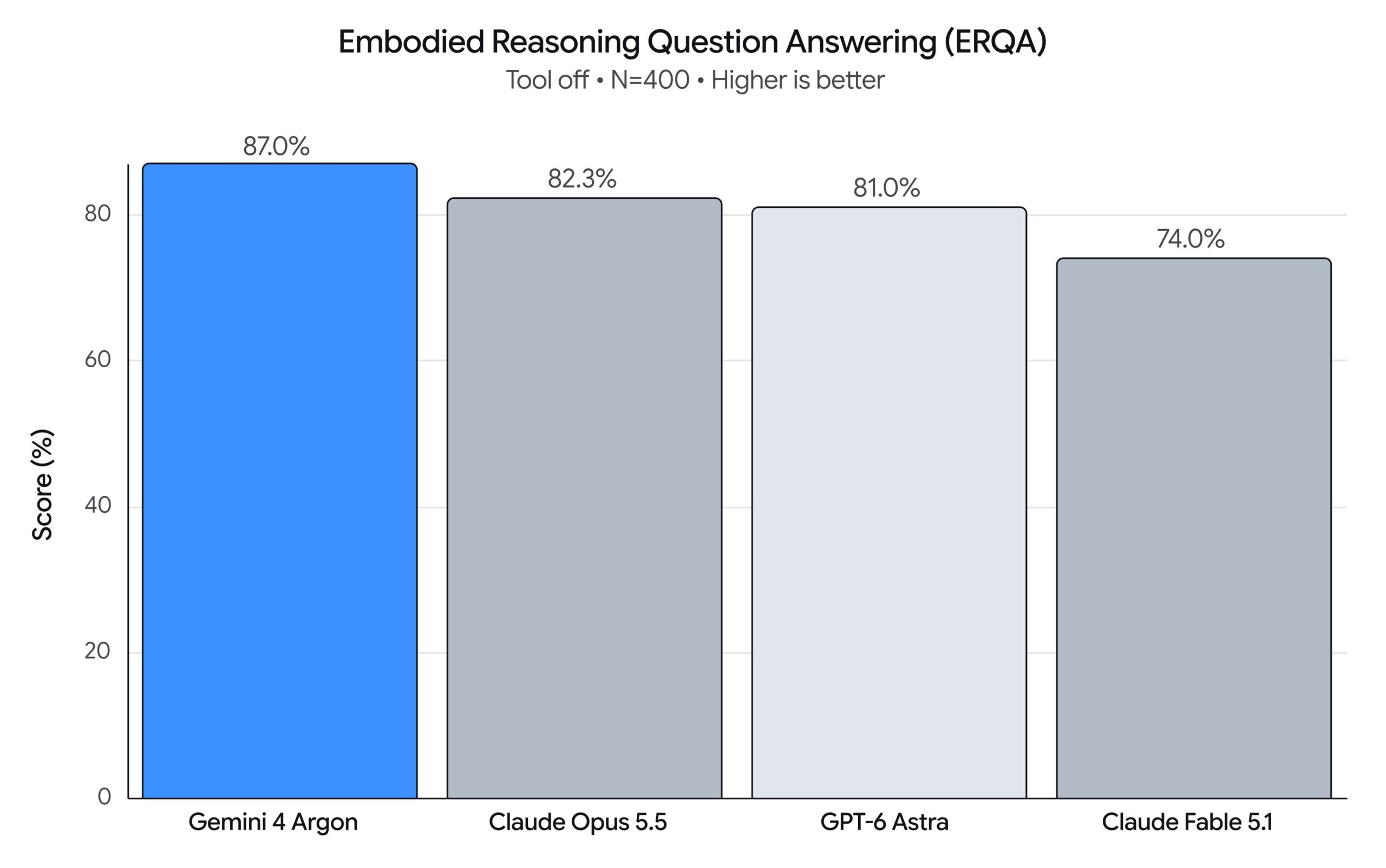
You can see this leap in capability on the Embodied Reasoning (ERQA) benchmark, which tests a model’s ability to understand and solve physical, spatial problems in 3D environments. Using pure reasoning, Argon scores 87%, outperforming every other frontier model.
gemini-4-argon__benchmark__robotics

As a general-purpose physical reasoning model, Argon can be applied across the entire robotics lifecycle. In this post, we share representative prompts for Argon across four key areas:

  • Robot control → Mobile manipulation with MuJoCo practice, zero-shot robot control, and closed-loop steering of video world models.
  • Real2Sim → Reconstructing physically calibrated simulation twins from robot camera feeds, egocentric human video, or hand-drawn paper sketches.
  • Physical understanding → Agentic multimodal hindsight labeling including detailed understanding of dexterity, dense value functions and progress estimation.
  • Research and self-improvement → Action improvement via simulation and iterative self-improvement on hardware.

Unlocking robot control with Argon

1. Spot mobile manipulation: Putting in the trash bin with MuJoCo practice

Argon controls a Boston Dynamics Spot® quadruped (12-DoF legs + 6-DoF arm) to learn a new skill: stepping on a foot-pedal trash bin to throw away soda cans. Argon creates an articulated MuJoCo digital twin of a foot-pedal trash bin to practice its moves before stepping on the physical pedal and dropping soda cans into the open bin.

Sorry, your browser doesn’t support playback for this video

Spot Mobile Manipulation — Real-to-Sim-to-Real foot-pedal trash bin disposal: Spot picking up the soda can, checking its wrist camera, practicing 3-leg tripod balance in MuJoCo, stepping on the foot pedal, verifying hand centering in the open bin, and dropping the can inside.

There's a Diet Coke can behind you and another on the black table on your left.
Use the spot-mobile-manipulation skill to pick them up and trash them in the black foot-pedal bin.
Before stepping down on the pedal, verify in the front cameras that your front-right foot target is centered on the pedal, and use a 2-agent verification swarm (foot-verifier and hand-verifier) to verify both the foot-pedal step and the 3D hand-in-bin alignment before releasing.

Plain text

2. Zero-shot control

Argon controls a simple robotic arm to place a fallen mug upright and put the crumpled napkin inside. Argon reasons with a visual coordinate harness and action primitives to perform this task over several turns.

Sorry, your browser doesn’t support playback for this video

Left: 3rd-person real robot view; Right: calibrated wrist camera with projected 2 cm world coordinates and jaw-closing reticle.

[Attached: wrist_cam.png, obs.json]

Task: Get the robot arm to reorient the mug upright and put the napkin inside the mug.

## Execution Discipline
- Simply output 1 sentence observation followed immediately by your `curl` command (with `# Plan:` on Turn 1 and `# Thought:` on every turn). Everything needed is in `obs.json` and the calibrated reticle/grid drawn on `wrist_cam.png`.

## Visual Coordinate Reference (Annotated on wrist_cam.png)
- `+X` (UP in image): Away from robot base | `-X` (DOWN): Towards robot base
- `+Y` (LEFT in image): World left         | `-Y` (RIGHT): World right
- `+Z`: Height above table                | `Yellow numbers`: World (X, Y) in centimetres (2 cm grid at `grid_z`)
- `Cyan + crosshair`: Current 3D pinch center
- `Cyan [ + ] brackets`: Current jaw opening and closing line
- `Green line`: Current object long-axis orientation (`yaw_deg`: 0° = vertical along +X, 90° = horizontal along +Y)
- `pitch_deg = 90°`: Straight down (-Z) top-down grasp/place; `pitch_deg  `grasp` -> `place` -> `done`
   - Pre-Grasp Hover Verify (4–7 calls): `look_at` -> `goto(z=0.04)` (verify cyan `[ + ]` brackets straddle target) -> `grasp` -> `place_until_contact` -> `done`
   - Fine Visual Servoing (8–20 calls): `look_at` -> `grasp` -> pre-pose `goto` -> closed-loop `move_by` / `move_until_contact` -> `done`
3. Send motion primitives (`POST /plan`) and verify visually after every turn in the updated `wrist_cam.png`. If `status == "grasp_failed"`, call `robot.look_at(...)` to re-observe and recover closed-loop.

## Code-as-Policies Primitives (`POST http://127.0.0.1:8081/plan`)
robot.look_at(x=0.35, y=0.13, z=0.14, grid_z=0.015)
x, y = robot.deproject(u=0.52, v=0.48, z_plane=0.015)
robot.grasp(x=x, y=y, z=0.015, yaw_deg=-35, pitch_deg=90)
robot.place(x=0.24, y=0.06, z=0.075)
robot.place_until_contact(x=0.24, y=0.06, z=0.015, max_lag=0.012, relief=0.002)
robot.goto(x=0.28, y=0.05, z=0.04, arc_z=0.14, pitch_deg=25, azimuth_deg=90, roll_deg=0, speed=0.10)
robot.move_by(forward=0.025, dz=-0.002, dpitch_deg=-3, droll_deg=5, speed=0.04)
robot.move_until_contact(dz=-0.06, speed=0.03, max_lag=0.012, relief=0.002)
robot.open_gripper() / robot.close_gripper() / robot.home() / robot.done()

Plain text

3. Omni control

Argon steers robots in the Gemini Omni World Model to rearrange five scattered Scrabble tiles (G, R, A, N, O) into a clean row spelling A - R - G - O - N. Instead of specifying one static prompt, Argon steers in a closed visual loop. It writes timestamped action prompts, inspecting intermediate rollout keyframes, and refining its prompts.

Sorry, your browser doesn’t support playback for this video

Iterative Video World Model Steering Dexterous Hands: 33-Step Steered Video Rollout Spelling A-R-G-O-N.

Goal: {task_goal}

You are steering a video world model (Gemini Omni) in an iterative visual feedback loop. Inspect the attached frames from the latest rollout and write the next timestamped action prompt for the video world model:
- Break complex motions into one simple, single-direction action at a time.
- Keep inactive hands retracted and avoid blocking the camera's view of objects in the workspace.
- Explicitly state which areas of the workspace become empty after an object moves.
- Use [MM:SS.mmm] timestamps for each action beat and wrap your output in  tags.

Example format (sample timestamps only, not the full prompt):

[00:00.000] Character A's left hand rests at the side while the right hand reaches toward the target object.
[00:02.500] Character A's right fingertips push the object smoothly into the center of the table, leaving its starting area empty.
[00:05.000] Character A's right hand opens and retracts to the side so all placed objects remain in clear view of the camera.

Plain text

Unlocking Real2Sim with Argon

1. Robot view to simulation

Argon views a real robot teleoperation episode and develops a digital twin; it obtains or creates simulation assets that look and behave like the real objects upon contact with the dexterous hands. Argon tunes the assets and scenes to match sim visuals and contact events with those in the real recorded data in an iterative visual-reasoning loop.

Sorry, your browser doesn’t support playback for this video

Left (Real View): synchronized real robot camera feeds; Right (Simulated): 3D MuJoCo scene reconstructed and calibrated by Argon.

[Attached: robot_rollout_episode]

Build a MuJoCo scene of the robot and reconstructed task objects. When each episode is replayed frame by frame, by driving the robot joints toward the logged observation.state with joint-space PD.

Iterate using two verification objectives:
(1) Visual match: MuJoCo renders from the head_left, left_wrist, and right_wrist cameras line up with, and look like, those real observations.
(2) Physical match: the simulated contact force/torque on each Sharpa fingertip, in the sensor frame, matches the logged tactile_force in timing, magnitude and direction.

What you can tune happens before simulation starts:
(1) Static object assets: realistic geometry, collision shapes, mass, inertia, friction and joints, with appearance close to the real objects, plus the initial object poses at t = 0.
(2) Offline-planned robot commands, changed only in frames where the real fingertips are near an object. Each command must stay within 0.55 rad (arm joints) and 0.65 rad (hand joints) of the logged teleop trajectory. Everywhere else, replay the logged trajectory unchanged.

No sim cheating: task objects may move only through real MuJoCo contact with the robot hands and the environment (mj_step).
Not allowed after t = 0: changing MjModel parameters; applying external forces or torques to objects; welds or equality constraints; feedforward torques beyond joint-space PD; setting or rolling back object qpos/qvel; disabling or excluding collisions; reporting contact forces that don't come from the MuJoCo solver (for example, copying the logged tactile readings).

Immediately present the reconstructed scene and rollout results as an interactive HTML session viewer with one page per episode, showing:
- At the bottom: A synced timeline (play, scrub, speed control) that drives every panel.
- On the left panel: An interactive 3D Blender scene showing the simulated robot and objects, showing contact points and force arrows as replay progresses.
- On the right panel: Real vs. sim camera views side by side for all 3 cameras. Real vs. sim finger force visualizations.

Plain text

2. Human view to simulation

Given an egocentric human video of a manipulation task, Argon identifies the task-relevant objects, replaces crude bounding boxes with compound convex-decomposed meshes for concave containers, and retargets the human hand trajectory onto a 76-DoF bimanual humanoid with 22-DoF five-fingered hands in MuJoCo contact physics.

Sorry, your browser doesn’t support playback for this video

Human View to Simulation — Egocentric Human Video to Dexterous Humanoid Twin: Left shows the input egocentric human RGB video; Right shows the synchronized 500 Hz MuJoCo + Blender Cycles multi-view simulation rollout.

[Attached: egocentric_human_video.mp4, candidate_sim_views.png, hand_3d_keypoints.json]

You are building a physically solvable 500 Hz MuJoCo manipulation environment (`scene.xml`) and studio Blender render that faithfully reproduces the tabletop task shown in `egocentric_human_video.mp4` on a bimanual humanoid robot with 22-DoF dexterous five-fingered hands:

1. Scene Reconstruction & Camera Calibration:
   - Identify only the manipulation-relevant objects (the grasped target object and the receiving container or landmark) and triangulate their 3D tabletop coordinates from the egocentric camera intrinsics/extrinsics.
   - Replace crude bounding boxes with compound convex-decomposed 3D meshes so concave containers (nested bowls, recessed wooden trays, open bins) support physical interior placement.

2. 500 Hz Dexterous Motion-Fitting Stress Test:
   - Retarget the 3D human wrist and finger keypoints to the humanoid's 7-DoF arm and 22-DoF hand joints, and step the trajectory in MuJoCo at 500 Hz (dt = 0.002s) with zero kinematic weld constraints.
   - Verify opposing thumb-and-finger force closure, clean object lift (> 2 cm), and stable final placement inside or beside the target landmark.

Plain text

3. Sketch to simulation

With Argon, a developer can snap a photo of a rough pen-and-paper sketch—showing an Apollo 2 humanoid throwing a ball along a parabolic arc to topple a 3-2-1 stack of boxes on a table—and have Argon automatically construct the GPU-accelerated mujoco_warp scene, synthesize a balanced 76-DoF whole-body and five-finger throw trajectory, verify 6/6 target knockdown in closed-loop physics, and export a Blender 4.5 Cycles render.

Sorry, your browser doesn’t support playback for this video

Sketch to Simulation — Hand-Drawn Sketch to Dexterous Humanoid Trajectory & Cycles Render.

[Attached: hand_drawn_throw_sketch.jpg]

Translate this hand-drawn sketch into a physically verified humanoid simulation in `mujoco_warp` and a raytraced Blender Cycles video:

1. Scene & Kinematic Setup from Sketch:
   - Parse the spatial layout from `hand_drawn_throw_sketch.jpg`: place the 76-DoF humanoid (32-DoF body equipped with two 22-DoF five-finger dexterous hands) at the origin facing a table holding a 3-2-1 pyramid of 6 rigid target boxes, with a projectile sphere grasped in the right five-finger hand.

2. Whole-Body Balance & Dexterous Throw Synthesis:
   - Synthesize a 50 Hz whole-body throwing trajectory (140 steps, 2.80 s) across four phases: (1) stable stance & 5-finger power grasp closure, (2) torso/shoulder wind-up with ankle-hip Center-of-Mass compensation, (3) forward whipping acceleration, and (4) synchronized 22-DoF five-finger opening at peak hand velocity so the ball launches on a ballistic arc into the pyramid's second-tier center of mass.
   - Verify in `mujoco_warp` contact physics that the humanoid maintains upright balance (< 3 cm pelvis drift) and knocks down all 6 target boxes.

Plain text

Unlocking physical understanding with Argon

1. Hindsight labeling and data quality

Argon has precise physical understanding of dexterous manipulation and can provide detailed segmentation and text labeling from video. Argon is able to identify poor manipulation segments such as pauses, unstable grasps and fumbles. Given an overhead video of a bimanual ALOHA 2 robot folding a square sheet of paper into an origami fox over 136 seconds, Argon produces a time-aligned 4-level hindsight annotation hierarchy: Episode Goal (G1), 6 contiguous Semantic Subtasks (G2), 17 contact-level Atomic Primitives (G3), and automated Quality Control (QC) reweighting that holds task progress flat during fumbles and retries.

Sorry, your browser doesn’t support playback for this video

Argon Multi-Granularity Hindsight & Telemetry HUD.

[Attached: Aloha2_Origami_20250309.mp4]

Produce a time-aligned multi-granularity hindsight annotation JSON with four levels:
1. G1_episode_instruction: Concise imperative sentence describing the overall manipulation goal.
2. G2_subtasks: Contiguous semantic subtask phases specifying which arm(s) anchor vs. fold/rotate the object.
3. G3_atomic_primitives: Fine-grained contact-level primitives (3–15s) aligned with grasp closure, crease sweeps, release, or retry attempts.
4. quality_control_and_reweighting: Hold task_progress_pct flat during non-progressing slip/delamination retry loops and downweight them (0.15x–0.25x) for Behavior Cloning.

Plain text

2. Find the odd ball

To recreate the classic 12-ball balance scale puzzle with robots, Argon builds a bimanual Franka FR3 MuJoCo environment with 12 visually identical pool balls (one secretly heavier or lighter) and an articulated Roberval two-pan balance scale. It then writes a vision-only closed-loop solver that triangulates the balls from stereo RGB cameras, visually reads the scale tilt after each weighing, and isolates the odd ball into the Heavy (Red) or Light (Blue) tray within 3 weighings.

Sorry, your browser doesn’t support playback for this video

Find the Odd Ball (Vision-Only Closed-Loop Solver): Dual-arm Franka FR3 weighing candidate balls on the Gold/Teal pans, reading stereo scale tilt , and isolating the confirmed Heavy odd ball into the Red tray in 3 weighings.

# Prompt 1 — Physics-Accurate MuJoCo Environment & Benchmark Generation
Make a MuJoCo environment where a dual-arm robot (two 7-DoF Franka FR3 arms with parallel-jaw grippers on a shared tabletop) is tasked to solve the classic 12-ball balance scale weight puzzle from https://www.mathsisfun.com/pool_balls_solution.html.
1. Create 12 visually indistinguishable pool balls in a 2x6 starting rack (11 standard 150 g, 1 odd ball either 270 g or 30 g).
2. Build a functional two-pan Roberval balance scale at the center of the table with parallelogram equality constraints (`mjEQ_JOINT`) so the Left (Gold) and Right (Teal) pans stay horizontal, plus Red (Heavy) and Blue (Light) submission trays.
3. Track distinct settled weighings (`weighing_count`) and reward `1.00` for isolating the true odd ball in the correct Heavy/Light tray within <= 3 weighings.

# Prompt 2 — Closed-Loop Vision-Only Solver
Implement an independent closed-loop policy relying strictly on stereo RGB camera inputs (`head_camera_left_rgb_image`, `head_camera_right_rgb_image`) and robot proprioception (`add_privileged_task_observations=False`):
1. Segment the 12 balls, Gold/Teal pans, and Red/Blue trays in both stereo views and triangulate their 3D coordinates.
2. Visually read the balance scale tilt after each weighing from stereo vertical pixel disparity (+1 = left heavier, -1 = right heavier, 0 = balanced).
3. Rotate the gripper wrist yaw by 90 degrees when grasping/placing inside the narrow scale pans to clear the raised rims, and isolate the odd ball into the Red or Blue tray within <= 3 weighings.

Plain text

3. Value function

Argon is a general value function for robotics tasks. Evaluated on a 60-second bimanual ring-sorting episode from a human UMI dataset, Argon iteratively inspects synchronized head, left-gripper, and right-gripper camera feeds around contact transitions to generate dense value function / task progress predictions and decompose the trajectory into 28 segments with positive, neutral, and negative progress slopes.

Sorry, your browser doesn’t support playback for this video

Value Function: Synchronized 3-camera UMI playback (head, left gripper, right gripper) locked to animated task progress curve and bimanual segment annotations.

[Attached: umi_head.mp4, umi_left_gripper.mp4, umi_right_gripper.mp4]

Look at 3 videos of human wearing a gripper performing activities from head, left, right gripper views. Look at the videos thoroughly and give a detailed plot of progress at the task (with positive, neutral, negative slope), identifying important segments in the video and labeling the activities. Look at individual frames or subsegments of the video if necessary to get a better understanding.

Plain text

Unlocking research and self-improvement with Argon

1. Action improvement via simulation

Argon can generate new data in simulation to improve performance of generalist vision-language-action (VLA) models. Starting from a single RGB photo of the real tabletop, Argon autonomously builds a calibrated MuJoCo simulation twin, defines new tasks, and synthesizes a closed-loop motion generator to collect 4,500+ domain-randomized episodes in simulation—boosting real-world physical robot Success Rate from 56% to 75% and reducing completion time from 35s to 24s.

Sorry, your browser doesn’t support playback for this video

Action Improvement via Simulation: improves the real-world evaluation benchmark (56% → 75% Success Rate and 35s → 24s Completion Time).

[Attached: real_tabletop_photo.jpg]

You are given a single overhead RGB camera photo (`real_tabletop_photo.jpg`) of a bimanual robot workspace (two 7-DoF Franka FR3 arms with parallel-jaw grippers and 4 RGB cameras) facing a table arranged with photobooth party props.
1. Reconstruct procedural 3D meshes and compound MuJoCo collision primitives for all 9 party props matching their real-world dimensions, colors, and resting poses, including spring-hinged deformable crown panels for the soft plush cap.
2. Define a 77-task single-arm and bimanual curriculum (pick-and-place, uprighting, directional pushing, mid-air handovers, bimanual scoop-and-push, and pipelined table clearing).
3. Synthesize a closed-loop IK trajectory generator across ±10 cm pose randomization, verify `reward == 1.0` in MuJoCo physics, and export 4,500+ episodes for VLA fine-tuning.

Plain text

2. Self-Improvement for visual pick and place

On a simple 6-DoF arm, Argon iteratively self-improves both execution speed and placement accuracy on a pick and place task via trial and self-reflection.

Sorry, your browser doesn’t support playback for this video

SO-101 Vision-Guided Pick-and-Place — Iterative Hardware Self-Improvement Across Iterations 1 → 2 → 3: Iteration 1 (58.9s), Iteration 2 (22.9s, grazed box rim on drop), and Iteration 3 (17.4s, dead-center drop).

# Stage 1 — Measure Objects & Dry-Run Plan (No Hardware Motion)
Stage 1: measure objects — find the objects and plan the whole motion. The arm does not move in this stage.

A. I put a LEGO brick and a box on the table in front of the arm, and the wooden box to one side. Find the brick and the wooden box in the image. And also in the real world. Show this in an annotated image.

B. A dry-run plan (no hardware). Write the planner to pick and place the lego block. Print the plan table, draw all poses onto the overhead image, and stop. Do not move the robot.
Report with evidence.

# Stage 2 — Pre-Pick Hover & Wrist-Camera Verification
Stage 2: Put the gripper above the brick without touching it, and verify with the wrist camera that the arm and the vision agree. Please record executions with both cameras (compressed video is OK).

# Stage 3 (Autonomous Pick-and-Place → Self-Improvement → Optimization):
1. Execute autonomously: Turn the Stage 1 dry run into a real grasp, lift, and place into the wooden box. Run it yourself subject to safety rules from AGENTS.md.

2. Self-improve: When an attempt fails, diagnose it yourself. Review your own logs and wrist/overhead footage, find the root cause, check the fix in a dry run, and retry.

3. Optimize on feedback: Once it succeeds, make it at least 2× faster within safety limits (rule R5) unless I authorize more, or give feedback.

Plain text

3. One-prompt robotics paper reproductions in MuJoCo WebAssembly

With a single prompt per paper, Argon reads a robotics control manuscript and any released checkpoints, ports the physics model and closed-loop controller (from 7-network hierarchical locomotion in DeepLoco and 50 Hz PPO actors in HUSKY to Web Worker iLQR in Whole-Body MPC) into self-contained MuJoCo WebAssembly browser labs, and verifies them in headless Chromium.

Sorry, your browser doesn’t support playback for this video

Five Landmark Legged & Humanoid Papers Running Live in Browser (MuJoCo WASM): Robotic Soccer OP3 1v1, DeepLoco, Massively Parallel Deep RL ANYmal C, Whole-Body MPC Go2, and HUSKY G1 Skateboarding (from 68 interactive browser sandboxes reproduced by Argon).

[Attached: paper.pdf, optional author_checkpoints/ or urdf_assets/]

Reproduce the paper "" from scratch in MuJoCo WebAssembly and deploy a self-contained browser lab + visual essay:
1. Match the paper's exact physics timestep, actuator gains (kp/kv), torque limits, and kinematic constraints in MuJoCo XML, and run real neural inference or Web Worker iLQR in JavaScript at the paper's exact control rates.
2. Build `index.html` (Spatial UI simulator with camera presets, live telemetry plots, and disturbance injection) and `scrollytelling.html` (interactive visual essay).
3. Run a headless Chromium (Playwright) verification loop asserting 0 console errors and non-zero task progress over 300+ frames.

Plain text

Advancing embodied intelligence with Argon

Argon bridges coding, visual perception, physics simulation, and embodied robot control. By reasoning natively over multi-view video, 3D geometry, contact mechanics, and proprioceptive telemetry, Argon understands not just what objects are in a scene, but how they physically interact with agents to accomplish whole-body dexterous tasks. Gemini 4 Argon marks an important milestone accelerating the path toward physical AGI. By building this core intelligence, our goal is to enable robotics that can work alongside humans to solve complex challenges.

Getting started

You can start building with Gemini 4 Argon today across Google’s developer platforms:

  • Google AI Studio: Available to Google AI Ultra subscribers.
  • Gemini API: Available with the paid tier of the Gemini API in AI Studio. Use gemini-4-argon in the Interactions API with day-one support across the google-genai SDKs.
  • Google Antigravity: Available for Google AI Ultra subscribers. To start building, select Gemini 4 Argon (gemini-4-argon) as your active model in Google Antigravity for complex planning, /goal runs, and multi-agent orchestration.

Shape
Shape
Stay Ahead

Explore More Insights

Stay ahead with more perspectives on cutting-edge power, infrastructure, energy,  bitcoin and AI solutions. Explore these articles to uncover strategies and insights shaping the future of industries.

Shape

It’s not your model — AI has a data movement problem

But that can be the wrong lever. When you examine the full end-to-end transaction, the model usually isn’t the problem. Take the extraordinary scale of AI traffic as it moves from a branch office to a centralized security stack, then to a cloud region, then to a data-hosted backend somewhere

Read More »

Ørsted builds compliance into automation, speeds firewall changes

Taking on a firewall process One process Ørsted initially targeted for automation was firewall rule management. In the past, an internal customer submitted a firewall request through ServiceNow, and a network security engineer reviewed the request, checking IP addresses, fully qualified domain names, and directory groups. Depending on the type,

Read More »

OPEC+ warns soaring shipping, insurance costs impede oil flows

Disruptions to international energy flows have pushed shipping and insurance costs to unprecedented levels of more than one-third of commodity value, impeding the movement of crude oil and petroleum products and adding inflationary pressure, OPEC+ ministers said following an Oct. 12 meeting in Riyadh. The ministers met on the sidelines of the 17th International Energy Forum (IEF) ministerial meeting and the 25th WPC Energy Congress to review market conditions. They stressed the need to safeguard international maritime routes. Elevated transportation and insurance costs are being passed through the oil value chain, prolonging the financial burden on producing and consuming countries and weighing on global economic growth, they said. The statement, as reported, did not identify the routes or commodities behind the cost estimate or explain how it was calculated. Separately, Russian Deputy Prime Minister Alexander Novak said costs had risen five- to tenfold on some routes, citing vessel shortages, military risks, and the closure of the Strait of Hormuz. Ministers reaffirmed their commitment to decisions adopted at the June 7, 2026, OPEC and non-OPEC ministerial meeting. The group said consultations with all OPEC+ countries would continue through existing mechanisms, including the Joint Ministerial Monitoring Committee and ministerial meetings. Ministers also said they would monitor the situation and work with governments, industry stakeholders, and international organizations, including the IEF and International Energy Agency (IEA), to improve global shipping conditions.

Read More »

Insights: US shale maturity and the future of North American supply

North America’s oil supply outlook is entering a new phase, according to Enverus’ latest long-term analysis. In this Insights episode of the Oil & Gas Journal ReEnterprised podcast, Mikaila Adams, content strategist and managing editor, speaks with Dane Gregoris, managing director at Enverus, and discusses the firm’s conclusion that US shale is “aging, not broken.” While the United States is expected to remain the continent’s dominant producer, Enverus sees growth slowing markedly compared with the past two decades as operators work through increasingly mature inventories and confront geological constraints that are becoming harder to offset through efficiency gains alone. The conversation examines the data behind that assessment, including declining productivity per lateral foot, changing inventory quality, and the methodology Enverus uses to estimate remaining drilling locations across North America’s major basins. Gregoris explains why the firm expects US production to remain relatively stable over the next decade rather than continue the rapid expansion that defined the shale revolution, and why rising marginal supply costs could become an increasingly important market signal. A significant portion of the discussion focuses on the Permian basin, which Enverus still views as the cornerstone of North American oil supply well into the 2040s. At the same time, the report suggests that even the Permian is experiencing the effects of resource maturation. Gregoris discusses evidence that operators are moving down the quality curve and shares his perspective on emerging technologies, including ultra-long laterals, lightweight proppants, and advanced surfactants, that could improve recoveries and alter the industry’s long-term outlook. The report’s second major theme is the growing strategic importance of Canada. As US shale growth moderates, Enverus sees Canada’s oil sands and liquids-rich plays as increasingly important sources of future supply. Gregoris explains why Canada’s resource base offers substantially longer inventory duration than most US plays and

Read More »

Energy Secretary Secures Mid-Atlantic Grid Ahead of Anticipated Stressed System Conditions

WASHINGTON—U.S. Secretary of Energy Chris Wright issued an emergency order to mitigate blackout risks in the mid-Atlantic ahead of a period of elevated demand, a high rate of planned generator outages during the autumn maintenance season, and numerous planned transmission outages. The order directs PJM Interconnection, L.L.C. (PJM) to dispatch specified units and to order their operation as needed to maintain reliability and authorizes PJM to direct backup generation resources to operate as a last resort before declaring an Energy Emergency Alert (EEA) 3 or during an EEA 3.  PJM is authorized to call upon its Transmission Owners and Electric Distribution Companies to implement the order as needed. The order was issued pursuant to an application from PJM submitted on October 11, 2026.  “This order will help ensure millions of American families and businesses across the mid-Atlantic have access to affordable, reliable, and secure electricity by making additional power generation, including backup power, available to use as needed,” said U.S. Secretary of Energy Chris Wright. “While past leaders’ energy subtraction policies have made the grid more vulnerable to the risk of blackouts when the sun doesn’t shine or the wind doesn’t blow, this administration remains committed to using every available tool to prevent blackouts.”  DOE estimates more than 35 GW of unused backup generation remains available nationwide.  The order is effective October 13, 2026, through October 16, 2026. 

Read More »

Middle East supply risks overshadow Russian diesel deal

Escalating security risks in the Middle East are keeping oil markets on edge, with renewed attacks on Saudi Arabia and commercial vessels near the Strait of Hormuz, raising concerns over regional crude exports. The developments have overshadowed US President Donald Trump’s announcement of additional Russian diesel supplies and a proposed Russia-Ukraine energy ceasefire. Oil prices rose more than 2% on Oct. 12, with Brent climbing to $107/bbl and US West Texas Intermediate (WTI) reaching $93.7/bbl. Both benchmarks hit their highest levels since Sept. 29, reversing earlier losses. The gains followed renewed attacks on Saudi Arabia and commercial shipping in the Gulf region. Yemen’s Iran-aligned Houthi movement claimed responsibility for a Saturday strike on Riyadh’s international airport, while additional attacks were reported Sunday. Separately, a tanker was struck by a drone near Sohar, Oman, and another vessel was damaged while transiting the Strait of Hormuz, according to the United Kingdom Maritime Trade Operations agency (UKMTO). The incidents have renewed concerns over further disruption to shipping through the Strait of Hormuz, threatening the recovery in Middle East crude exports recorded in September. Goldman Sachs raised its December Brent price forecast to $90/bbl from $85/bbl, citing an estimated geopolitical risk premium of slightly more than $20/bbl. “We maintain our base case that continued adaptation of Mideast supply will eventually reduce crude oil prices, while potential renewed escalation still poses significant net upside risk,” Goldman Sachs said in a note Oct. 11. Russian diesel deal, energy ceasefire Trump announced on Oct. 9 an agreement with Russian President Vladimir Putin to increase diesel supplies to the US and international markets. Trump said Russia would initially supply more than 300,000 tonnes of diesel, followed by 500,000 tonnes in November and 1 million tonnes thereafter. The US Treasury Department also authorized certain Russian diesel transactions under a

Read More »

Energy Department Authorizes Strategic Petroleum Reserve Exchange to Address Supply Disruptions Due to Hurricane

WASHINGTON—The U.S. Department of Energy (DOE) today announced the authorization of an emergency exchange of up to 4 million barrels of crude oil from the Strategic Petroleum Reserve (SPR) to address supply disruptions due to inclement weather in the Gulf of America. Under the terms of the exchanges, participating companies will return the borrowed crude oil with additional premium barrels in 2027, helping replenish and strengthen the SPR at no additional cost to taxpayers.  “With this emergency exchange, the Energy Department is acting swiftly to help maintain refinery operations, limit disruptions to fuel supplies, and ensure American families and businesses continue to have access to affordable, reliable, and secure energy” said U.S. Secretary of Energy Chris Wright. “In addition to helping minimize supply disruptions, these emergency exchanges will also require Exxon and BP to return more barrels to the Reserve than are currently being withdrawn, saving taxpayers millions of dollars. Rest assured, the Trump Administration is committed to strengthening America’s energy security at every opportunity.” The Department has authorized exchanges of up to 2 million barrels each for ExxonMobil and BP America. ExxonMobil’s exchange will accelerate deliveries of previously awarded SPR crude oil to address immediate supply needs.  DOE will continue working with industry partners to support reliable fuel supplies and respond to hurricane-related disruptions.  For more information about the Strategic Petroleum Reserve, visit energy.gov.

Read More »

Energy Department Supports FERC’s Call for PJM to Protect Ratepayers and Build More Reliable Power

WASHINGTON—The U.S. Department of Energy (DOE) announced its support for the Federal Energy Regulatory Commission’s (FERC) guidance that would help ensure lower electricity costs for American families and businesses across the PJM Interconnection LLC’s (PJM) region spanning across the mid-Atlantic. DOE filed a Notice of Intervention and Statement of Position with FERC supporting its recommendation for PJM’s proposed Reliability Backstop Procurement. FERC recommends PJM submit revised tariff provisions to implement appropriate cost allocation and other reforms. FERC’s recommendations are consistent with President Trump’s Ratepayer Protection Pledge, ensuring large electricity users pay for the generation and infrastructure needed to serve them.  This action follows the Trump Administration’s call in January 2026 for PJM to adopt market rules to strengthen grid reliability and reduce electricity costs. Specifically, the Administration asked PJM to hold an emergency power auction and to accelerate the development of reliable power generation. The Trump administration was joined by governors from all 13 states who participate in the PJM grid. “The Trump Administration remains committed to doing everything it can to lower electricity costs, grow the supply of American energy and strengthen grid reliability,” said U.S. Secretary of Energy Chris Wright. “That’s why President Trump created the Ratepayer Protection Pledge, and the Energy Department supports having large electricity users pay for reliable new power generation.” “In January, the Trump Administration recognized early warning signs of capacity shortfalls in PJM and joined the Governors of all 13 PJM states in issuing a Statement of Principles to PJM, calling for PJM to adopt market rules to strengthen grid reliability and reduce electricity costs for American families and businesses,” said U.S. Deputy Secretary of Energy James P. Danly. “By increasing transparency and preventing unjust cost shifts onto existing customers, the proposed reforms advance President Trump’s Ratepayer Protection Pledge while ensuring Americans continue

Read More »

OCP 2026: Agentic AI Drives the Data Center’s Chip-to-Grid Transformation

NVIDIA Opens More of the AI Factory Architecture NVIDIA’s Ian Buck closed the opening keynote program with an extensive presentation covering Vera Rubin systems, open rack designs, networking, power delivery and AI factory software. The company announced additional contributions to OCP based on its third-generation MGX 1.2 reference architecture. The specification includes high-density liquid-cooled computing systems, improved cooling connections, standardized power interfaces and modular mechanical designs. Buck emphasized that these developments are as much about manufacturing and serviceability as they are about computational performance. He described how NVIDIA reduced the assembly time for a compute tray from approximately 90 minutes in the Grace Blackwell generation to roughly one minute for Vera Rubin through simplified mechanical construction and more automated assembly. At the scale of thousands of racks, those manufacturing improvements can materially influence deployment schedules. NVIDIA also previewed its next-generation Vera Rubin Ultra architecture, designed to interconnect 576 GPUs using an advanced NVLink fabric with co-packaged optics. Open Data Center and Grid Resilience Specifications For data center developers and operators, however, NVIDIA’s most consequential OCP contributions may lie outside the computing rack. NVIDIA, AMD, Google and Meta have published an Open Data Center Specification, currently at version 0.7, intended to establish common design principles for AI factory facilities. The specification addresses power architecture, cooling infrastructure and physical layout, helping equipment suppliers and developers coordinate around shared infrastructure requirements. That shared facilities work unfolds alongside vendor-specific programs such as NVIDIA’s DSX Ready, which establishes qualification requirements for battery energy storage and liquid cooling equipment supporting its AI factory designs. NVIDIA also joined Google, Meta and Microsoft in publishing an OCP Grid Resilience Specification addressing the behavior of large AI installations during grid disturbances. The specification establishes expectations for facilities to remain connected, respond automatically to disturbances and recover toward normal operating

Read More »

NetBox Labs adds network design templates and AI agents to streamline infrastructure operations

“This is infrastructure, and so if an agent does the wrong thing, it breaks the company,” Beevers said. NetBox Designs turns repeatable infrastructure into templates AI data centers are full of racks that are almost all identical in design. Teams do not want to lay out each one by hand. The same applies to a retail chain with small, medium, and large store formats, where the IT footprint needs to line up. NetBox Designs, now in public preview, targets that repetition. Designs work like “templatized Lego bricks for infrastructure,” Beevers said. A team defines a site, rack or IP plan once and sets its parameters. NetBox then renders the plan as many times as needed, down to the low-level components and their configuration. That includes assigning IP addresses, prefixes, and virtual LANs across a fabric. The goal is to speed design down to the component level, reduce manual error and compress time to market.

Read More »

AMD unveils Helion as agentic AI fuels demand for data center CPUs

AMD has introduced Helion, an open blueprint for data center racks that aims to give CPUs a larger role in running AI agents while allowing customers to configure GPU resources around their inference requirements. Based on Open Compute Project (OCP) specifications, the architecture supports different combinations of computing hardware. AMD cited examples including CPU-only racks for hyperscalers, powered by sixth-generation EPYC processors with up to 32,768 cores, and all-in-one enterprise racks accommodating up to 16 Instinct MI350P GPUs. AMD has listed networking bandwidth of up to 102 Tbps for Helion, although the company has not specified how that figure is calculated. The specification represents a planned rack capability rather than demonstrated performance in customer environments.

Read More »

Land & Expand: North America’s Data Center Pipeline Expands Under Pressure

Land & Expand is Data Center Frontier’s periodic look at the latest data center development news, including new sites, land acquisitions and campus expansions across North America. This latest installment finds the development pipeline continuing to expand, even as the requirements for bringing large-scale projects online grow more complicated. Developers are securing land, planning new power infrastructure and advancing campuses measured in hundreds of megawatts or more. At the same time, local governments and residents are demanding greater clarity on electricity costs, water consumption, noise, tax incentives and the long-term effects of industrial-scale computing facilities. A succession of development disclosures and project milestones through September and early October 2026 illustrates both the geographical reach of North America’s expanding data center pipeline and the growing difficulty of measuring how much proposed capacity will ultimately be delivered. The projects range from preliminary discussions and newly secured development sites to campuses already under construction. Some are advancing through formal permitting and power studies; others remain contingent on customers, financing or local approvals. Together, they reveal an industry still expanding aggressively, but operating under increasingly complex development conditions. Fluidstack: Cameron County, Texas — Up to 1.5 GW One of the largest newly disclosed projects is Fluidstack’s AI data center development in Cameron County in the Rio Grande Valley. The project surfaced publicly September 10 when Cameron County announced that it had issued Fluidstack a worksite permit for property near Harlingen. The permit authorizes preliminary site work, including grading, utilities and related infrastructure, rather than construction of the data center buildings themselves. Fluidstack subsequently disclosed considerably more detail on September 21, saying construction had begun on a $4 billion first phase capable of supporting as much as 1.5 GW. Fluidstack expects the project to generate more than 2,500 construction jobs and several hundred permanent positions. 

Read More »

DCF Global: Five Markets Redrawing the AI Infrastructure Map

The Global Constraint Is Execution These five markets demonstrate that the worldwide AI infrastructure buildout is no longer organized around a single development model. Spain is using permitting reform to attract investment. China is concentrating construction around energy resources. India is translating enormous capital commitments into an expanding development pipeline. Latin America is combining hyperscale growth with national industrial objectives. And Southeast Asia is creating interconnected infrastructure markets whose boundaries increasingly extend beyond individual cities and countries. Not every market is competing for the same business. Sovereign cloud services, enterprise applications, AI training clusters, and large-scale inference platforms carry different requirements involving power, connectivity, latency, data residency, and operating economics. But the infrastructure questions remain remarkably consistent. Can a project obtain enough electricity? Can transmission and supporting networks be delivered on schedule? Will the supply chain provide the required equipment? Can the facility be constructed and commissioned efficiently? And will the development retain the regulatory certainty and community acceptance required to operate for decades? The gap between announced development and actual capacity is becoming a defining measurement of the industry. Cushman & Wakefield estimates that Asia-Pacific alone had approximately 26.5 GW of data center capacity in its development pipeline during H1 2026. Of that total, roughly 4.8 GW was under construction, with another 21.7 GW in planning. Those figures reveal both the extraordinary scale of the opportunity and the considerable infrastructure work still required to realize it. What the Global Buildout Means for North America For U.S. data center operators, developers, engineering firms, equipment suppliers, and investors, international expansion is not a separate story. It is increasingly part of the same global competition for capital, equipment, power infrastructure, and specialized expertise. The transformers, switchgear, generators, advanced cooling systems, fiber networks, and electrical distribution equipment required by a major AI campus

Read More »

Bidding war over key component could eliminate third hard disk maker

What if the three remaining hard disk manufacturers became two? Seagate Technology and Western Digital control 90% of the market, according to market researcher TrendForce, with Toshiba picking up the crumbs. Seagate and WD both make their own magnetic drive heads, but Toshiba relies on a third party, TDK, which also sells to Seagate and WD when they need extra capacity. Seeking to guarantee supplies of this critical component, Toshiba made a bid for TDK’s drive head business earlier this year, according to Bloomberg. Concerned that this could affect its ability to meet the growing demand for hard disks from AI data centers, Seagate made a counteroffer, Bloomberg reported. TDK is staying mum.

Read More »

Microsoft will invest $80B in AI data centers in fiscal 2025

And Microsoft isn’t the only one that is ramping up its investments into AI-enabled data centers. Rival cloud service providers are all investing in either upgrading or opening new data centers to capture a larger chunk of business from developers and users of large language models (LLMs).  In a report published in October 2024, Bloomberg Intelligence estimated that demand for generative AI would push Microsoft, AWS, Google, Oracle, Meta, and Apple would between them devote $200 billion to capex in 2025, up from $110 billion in 2023. Microsoft is one of the biggest spenders, followed closely by Google and AWS, Bloomberg Intelligence said. Its estimate of Microsoft’s capital spending on AI, at $62.4 billion for calendar 2025, is lower than Smith’s claim that the company will invest $80 billion in the fiscal year to June 30, 2025. Both figures, though, are way higher than Microsoft’s 2020 capital expenditure of “just” $17.6 billion. The majority of the increased spending is tied to cloud services and the expansion of AI infrastructure needed to provide compute capacity for OpenAI workloads. Separately, last October Amazon CEO Andy Jassy said his company planned total capex spend of $75 billion in 2024 and even more in 2025, with much of it going to AWS, its cloud computing division.

Read More »

John Deere unveils more autonomous farm machines to address skill labor shortage

Join our daily and weekly newsletters for the latest updates and exclusive content on industry-leading AI coverage. Learn More Self-driving tractors might be the path to self-driving cars. John Deere has revealed a new line of autonomous machines and tech across agriculture, construction and commercial landscaping. The Moline, Illinois-based John Deere has been in business for 187 years, yet it’s been a regular as a non-tech company showing off technology at the big tech trade show in Las Vegas and is back at CES 2025 with more autonomous tractors and other vehicles. This is not something we usually cover, but John Deere has a lot of data that is interesting in the big picture of tech. The message from the company is that there aren’t enough skilled farm laborers to do the work that its customers need. It’s been a challenge for most of the last two decades, said Jahmy Hindman, CTO at John Deere, in a briefing. Much of the tech will come this fall and after that. He noted that the average farmer in the U.S. is over 58 and works 12 to 18 hours a day to grow food for us. And he said the American Farm Bureau Federation estimates there are roughly 2.4 million farm jobs that need to be filled annually; and the agricultural work force continues to shrink. (This is my hint to the anti-immigration crowd). John Deere’s autonomous 9RX Tractor. Farmers can oversee it using an app. While each of these industries experiences their own set of challenges, a commonality across all is skilled labor availability. In construction, about 80% percent of contractors struggle to find skilled labor. And in commercial landscaping, 86% of landscaping business owners can’t find labor to fill open positions, he said. “They have to figure out how to do

Read More »

2025 playbook for enterprise AI success, from agents to evals

Join our daily and weekly newsletters for the latest updates and exclusive content on industry-leading AI coverage. Learn More 2025 is poised to be a pivotal year for enterprise AI. The past year has seen rapid innovation, and this year will see the same. This has made it more critical than ever to revisit your AI strategy to stay competitive and create value for your customers. From scaling AI agents to optimizing costs, here are the five critical areas enterprises should prioritize for their AI strategy this year. 1. Agents: the next generation of automation AI agents are no longer theoretical. In 2025, they’re indispensable tools for enterprises looking to streamline operations and enhance customer interactions. Unlike traditional software, agents powered by large language models (LLMs) can make nuanced decisions, navigate complex multi-step tasks, and integrate seamlessly with tools and APIs. At the start of 2024, agents were not ready for prime time, making frustrating mistakes like hallucinating URLs. They started getting better as frontier large language models themselves improved. “Let me put it this way,” said Sam Witteveen, cofounder of Red Dragon, a company that develops agents for companies, and that recently reviewed the 48 agents it built last year. “Interestingly, the ones that we built at the start of the year, a lot of those worked way better at the end of the year just because the models got better.” Witteveen shared this in the video podcast we filmed to discuss these five big trends in detail. Models are getting better and hallucinating less, and they’re also being trained to do agentic tasks. Another feature that the model providers are researching is a way to use the LLM as a judge, and as models get cheaper (something we’ll cover below), companies can use three or more models to

Read More »

OpenAI’s red teaming innovations define new essentials for security leaders in the AI era

Join our daily and weekly newsletters for the latest updates and exclusive content on industry-leading AI coverage. Learn More OpenAI has taken a more aggressive approach to red teaming than its AI competitors, demonstrating its security teams’ advanced capabilities in two areas: multi-step reinforcement and external red teaming. OpenAI recently released two papers that set a new competitive standard for improving the quality, reliability and safety of AI models in these two techniques and more. The first paper, “OpenAI’s Approach to External Red Teaming for AI Models and Systems,” reports that specialized teams outside the company have proven effective in uncovering vulnerabilities that might otherwise have made it into a released model because in-house testing techniques may have missed them. In the second paper, “Diverse and Effective Red Teaming with Auto-Generated Rewards and Multi-Step Reinforcement Learning,” OpenAI introduces an automated framework that relies on iterative reinforcement learning to generate a broad spectrum of novel, wide-ranging attacks. Going all-in on red teaming pays practical, competitive dividends It’s encouraging to see competitive intensity in red teaming growing among AI companies. When Anthropic released its AI red team guidelines in June of last year, it joined AI providers including Google, Microsoft, Nvidia, OpenAI, and even the U.S.’s National Institute of Standards and Technology (NIST), which all had released red teaming frameworks. Investing heavily in red teaming yields tangible benefits for security leaders in any organization. OpenAI’s paper on external red teaming provides a detailed analysis of how the company strives to create specialized external teams that include cybersecurity and subject matter experts. The goal is to see if knowledgeable external teams can defeat models’ security perimeters and find gaps in their security, biases and controls that prompt-based testing couldn’t find. What makes OpenAI’s recent papers noteworthy is how well they define using human-in-the-middle

Read More »

Gemini 4 Argon for Robotics

Gemini 4 Argon marks a step change in physical understanding, code generation, and visual-semantic reasoning—unlocking new workflows across the robotics stack and accelerating progress toward

Read More »