Stay Ahead, Stay ONMINE

VMware (quietly) brings back its free ESXi hypervisor

By many accounts, Broadcom’s handling of the VMware acquisition was clumsy and caused many enterprises to reevaluate their relationship with the vendor The move to subscription models was tilted in favor of larger customers and longer, three-year licenses. Because the string of bad publicity and VMware’s competitors pounced, offering migration deals and packages. However, replacing […]

By many accounts, Broadcom’s handling of the VMware acquisition was clumsy and caused many enterprises to reevaluate their relationship with the vendor The move to subscription models was tilted in favor of larger customers and longer, three-year licenses. Because the string of bad publicity and VMware’s competitors pounced, offering migration deals and packages.

However, replacing a virtualization environment is neither trivial nor easy. That said, Broadcom must have been feeling some heat to bring back the free hypervisor. But it’s more than just Broadcom’s approach that is a threat to VMware’s dominance. It is the shifting sands of computing in the AI era.

“VMware is still highly relevant for managing the overall IT infrastructure that supports AI initiatives,” said Rob Enderle, president of the Enderle Group. “However, for the core task of large-scale AI model training and inference, the gravity has shifted significantly towards bare-metal clusters, container orchestration (Kubernetes), and specialized public cloud services, making VMware’s traditional hypervisor-centric approach less central than it is for general enterprise workloads.”

Broadcom is adapting to this brave new world, but the ecosystem’s center for massive AI lies increasingly outside the traditional VM management sphere. “And right now much of the focus is on this AI training making VMware less relevant,” he said, adding that the Broadcom acquisition has had customers fleeing the platform because a lot of customers don’t like Broadcom’s licensing models.

Shape
Shape
Stay Ahead

Explore More Insights

Stay ahead with more perspectives on cutting-edge power, infrastructure, energy,  bitcoin and AI solutions. Explore these articles to uncover strategies and insights shaping the future of industries.

Shape

HPE product barrage targets AI networks, agents, management

HPE Mist integration Continuing that integration theme, HPE said it will integrate Juniper’s natural language Mist AI into HPE Aruba Central and vice versa, all fed by its core AIOps Marvis AI engine. Marvis collects telemetry and user state data from Juniper’s routers, switches, access points, firewalls, and applications to detect and

Read More »

APA inks $70-million Alaska acquisition

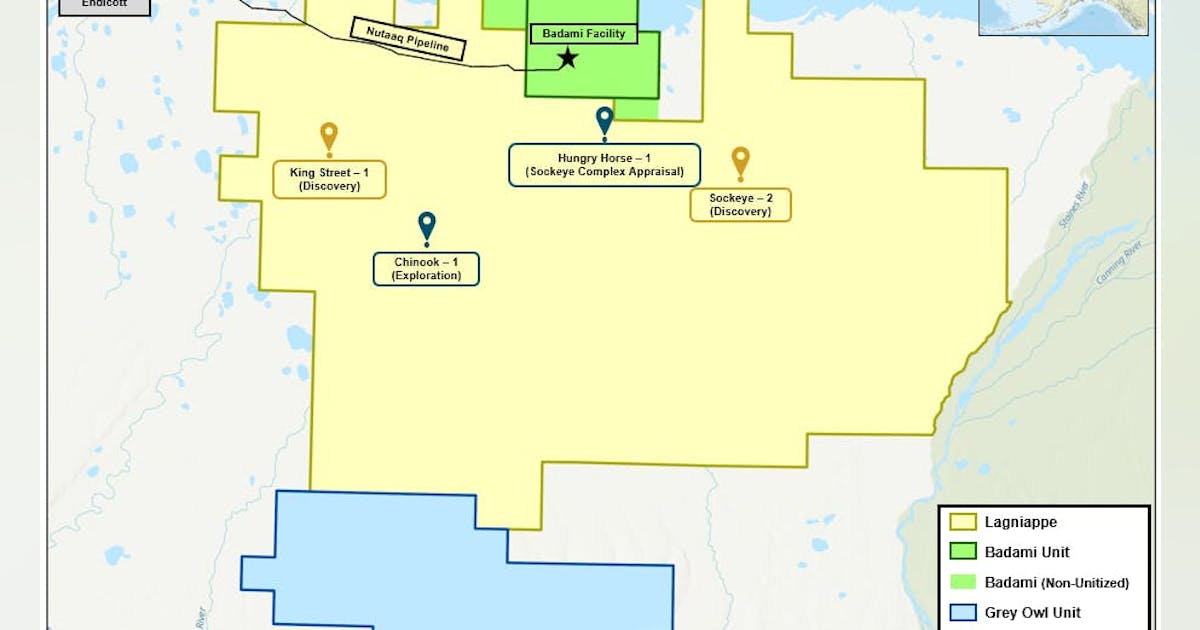
“As we continue to appraise and de-risk our resource base, ownership of this infrastructure provides greater flexibility and optionality in future development planning and represents a key step toward unlocking the potential of our position in Alaska,” John Christmann IV, chief executive officer of APA, said in a statement. Word

Read More »

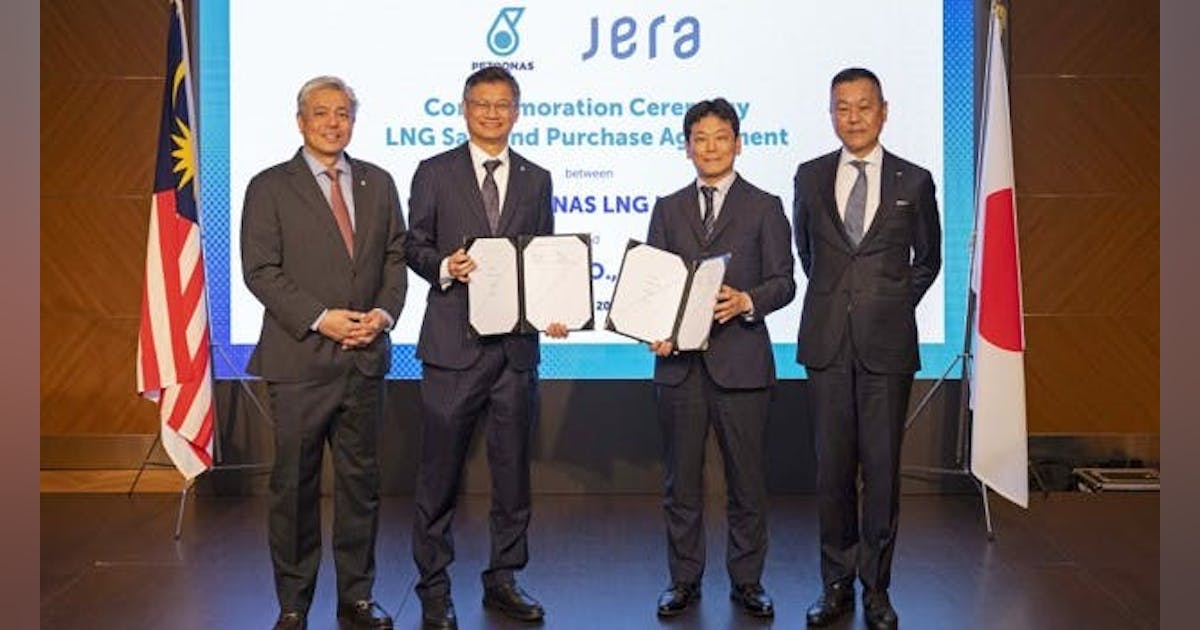
Petronas, JERA sign 20-year LNG supply deal

@import url(‘https://fonts.googleapis.com/css2?family=Inter:[email protected]&display=swap’); .ebm-page__main h1, .ebm-page__main h2, .ebm-page__main h3, .ebm-page__main h4, .ebm-page__main h5, .ebm-page__main h6 { font-family: Inter; } body { line-height: 150%; letter-spacing: 0.025em; } button, .ebm-button-wrapper { font-family: Inter; } .label-style { text-transform: uppercase; color: var(–color-grey); font-weight: 600; font-size: 0.75rem; } .caption-style { font-size: 0.75rem; opacity: .6; } #onetrust-pc-sdk

Read More »

Cloud strategies have become more complicated than ever

CIOs need to ask themselves whether they have the expertise to handle that infrastructure, he adds. Ultimately, “you have to make the best of what you’ve got,” he says. Stay focused on fundamentals Organizations may want to chase the shiny object, which is agentic AI right now, but IT leaders

Read More »

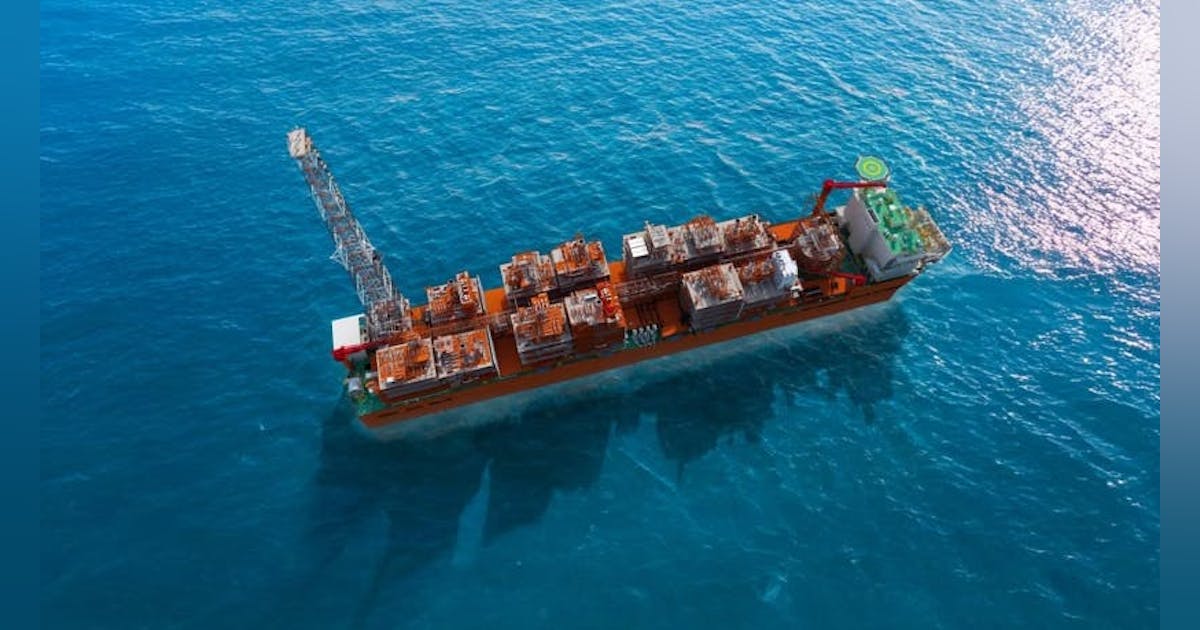
MRV lets EPCIC contract for Coral North FLNG project

Mozambique Rovuma Venture (MRV) SpA  has let an engineering, procurement, construction, installation, and commissioning (EPCIC) contract to Technip Energies, in partnership with JGC and Samsung Heavy Industries, for the Coral North FLNG project offshore Mozambique. Under the contract, JGC France and Technip Energies, through their joint venture, will be primarily responsible for the engineering and procurement of the FLNG topside infrastructure as well as overall project management. Samsung Heavy Industries will undertake the engineering, procurement, and construction of the FLNG hull and the fabrication of the topside modules. The Coral North project includes construction of a new FLNG vessel with a production capacity of about 3.6 million tonnes/year (tpy). The vessel will be installed in Coral gas field, about 50 km offshore northern Mozambique. Coral North is designed as an enhanced replica of Coral Sul, the first development in Mozambique’s Area 4 offshore gas block, and is expected to double Coral hub’s capacity to 7 million tpy.  Coral FLNG SA is a special-purpose entity incorporated by Area 4 partners Eni SPA (operator), China National Petroleum Corp. (CNPC), Empresa Nacional de Hidrocarbonetos (ENH), Galp Energia SGPS SA, and Korea Gas Corp. (KOGAS).

Read More »

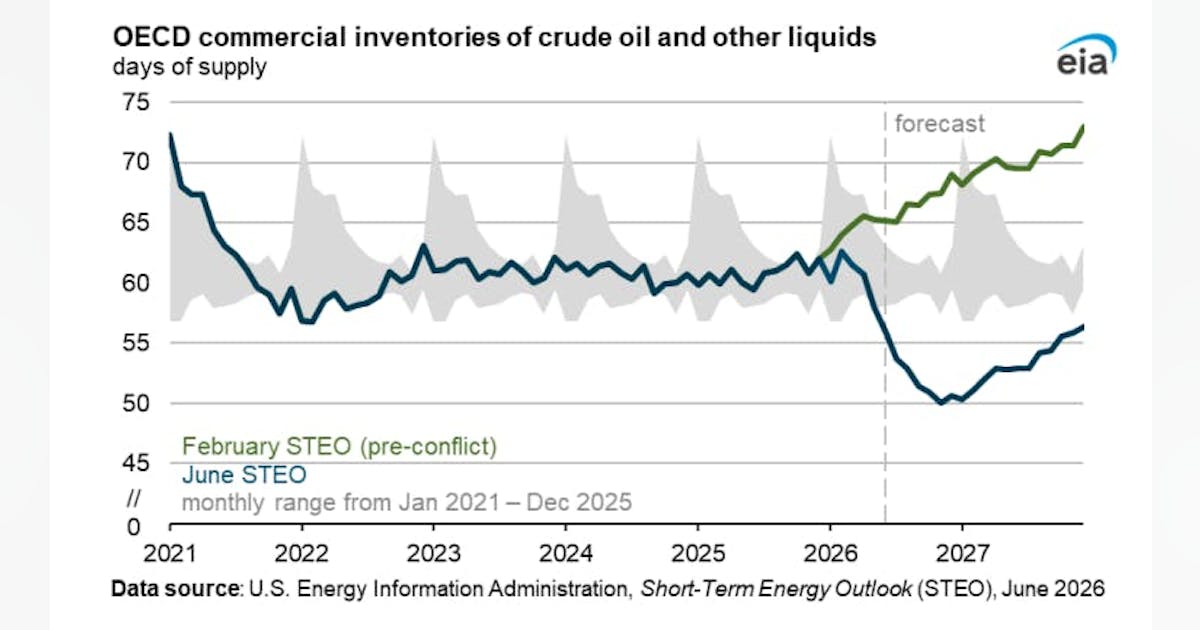
EIA forecasts prolonged oil market tightening amid Hormuz shipping disruptions

In its June 2026 Short-Term Energy Outlook (STEO), the US Energy Information Administration (EIA) assumes the Strait of Hormuz will remain effectively closed in the near term, with oil shipments resuming in third–quarter 2026. The agency expects it will take until early 2027 for traffic through the waterway to return to pre-conflict levels. Some Middle East oil production is expected to remain disrupted beyond the forecast period. Global oil producers in the Middle East reduced crude oil production by more than 11 million b/d in May compared with pre-conflict levels because of limited shipping traffic through the strait. EIA estimates production shut-ins averaged 11.3 million b/d in May and forecasts disruptions of 11.34 million b/d in June before easing to 10.11 million b/d in the third quarter and 5.70 million b/d in the fourth quarter. Stay updated on oil price volatility, shipping disruptions, LNG market analysis, and production output at OGJ’s Iran war content hub. As a result, EIA expects global oil inventories to fall by an average of 6.3 million b/d in second-quarter 2026 and 7.6 million b/d in third-quarter 2026. OECD commercial inventories are forecast to fall to just under 2.3 billion bbl by December 2026, the lowest level since 2003. On a days-of-supply basis, OECD inventories are expected to fall to 50 days by yearend 2026. Brent crude oil averaged $107/bbl in May, down $10/bbl from April. EIA forecasts Brent prices will average about $105/bbl in June and July before declining to an average of $89/bbl in fourth-quarter 2026 as oil flows gradually resume. Brent is forecast to average $95/bbl in 2026 and $79/bbl in 2027. High fuel prices, reduced fuel availability, and government initiatives have lowered oil demand, EIA said. The agency now forecasts global oil demand will decline by 1.1 million b/d in 2026 compared

Read More »

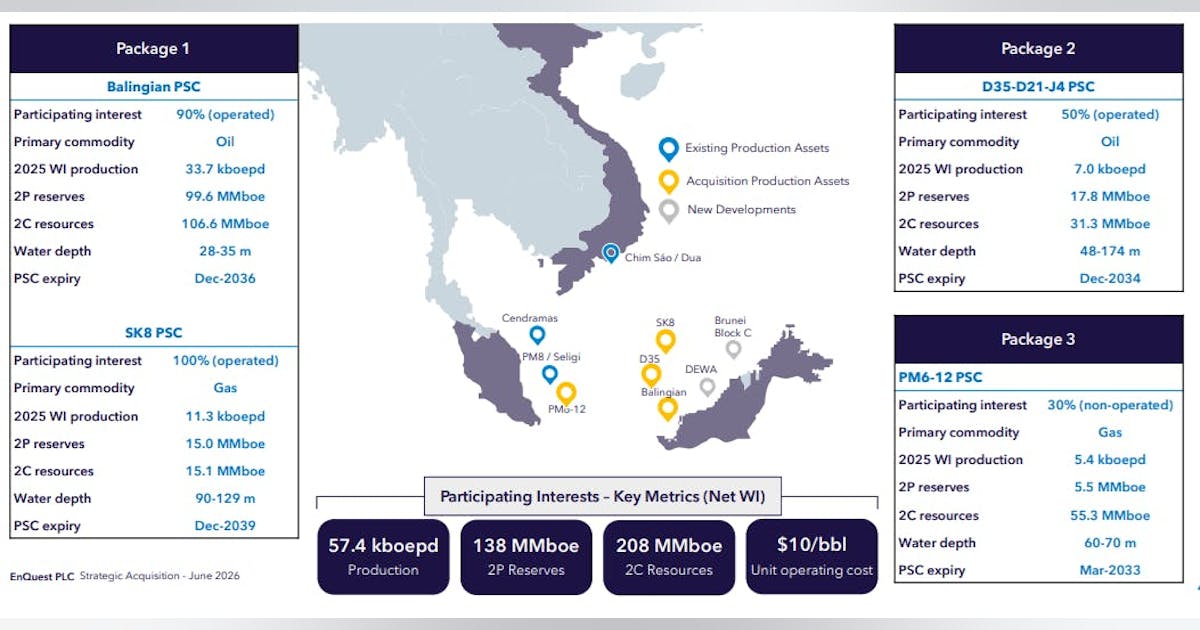
EnQuest looks to boost production by over 130% with Malaysian asset deals

EnQuest PLC subsidiary EnQuest Petroleum Production Malaysia Ltd. has agreed to acquire interests in producing upstream assets in Peninsular Malaysia and Sarawak. The company expects to leverage its integrated technical capabilities and experience in managing brownfield and late-life assets to support continued operations and redevelopment. Under three separate transaction packages with Petronas Carigali Sdn. Bhd. and E&P Malaysia Venture Sdn. Bhd., EnQuest will acquire interests in four offshore production sharing contracts (PSCs) for a maximum total consideration of up to $833 million. As part of the agreements, EnQuest Petroleum Production Malaysia will assume operatorship and participating interests in the Balingian PSC (Package 1, 90% participating interest), SK8 PSC (Package 1, 100% interest), and D35 PSC (Package 2, 50% interest), and will hold a nonoperated participating interest in the PM6/12 PSC (Package 3, 30% interest). The transaction also includes participation by Terengganu-based TI Exploration & Production Sdn. Bhd. (TI EP), which will hold a nonoperated interest in the PM6/12 PSC. TI EP is a joint venture between TI Petroleum Sdn. Bhd., a subsidiary of state-owned Terengganu Inc., and Ping Petroleum Ltd., an independent upstream company. On a 2025 net participating interest basis, the acquired interests are expected to add about 57,400 boe/d of production (47% liquids, 53% gas). This would increase EnQuest’s group production to more than 100,000 boe/d, representing a 134% increase compared with its 2025 production. The assets are expected to support production at around 100,000 boe/d through the end of the decade, the company said. EnQuest would also add 138 MMboe of 2P reserves and 208 MMboe of 2C resources (net WI). The acquisitions are expected to close by yearend, subject to customary conditions, including the waiver or expiry of applicable pre-emption rights associated with Package 2.  Package 1, Package 2, and Package 3 are subject to separate acquisition

Read More »

EIA: US crude inventories down 7.2 million bbl

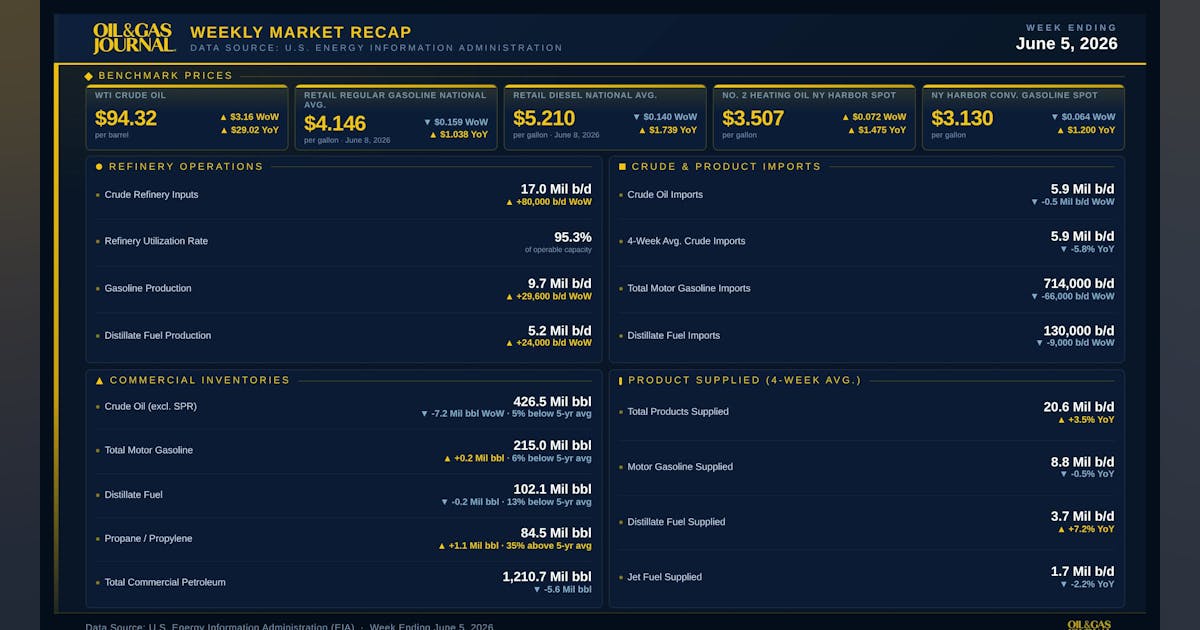
US crude oil inventories for the week ended June 5, excluding the Strategic Petroleum Reserve, decreased by 7.2 million bbl from the previous week, according to data from the US Energy Information Administration (EIA). At 426.5 million bbl, US crude oil inventories are about 5% below the 5-year average for this time of year, the EIA report indicated. EIA said total motor gasoline inventories increased by 200,000 bbl from last week and are about 6% below the 5-year average for this time of year. Finished gasoline inventories increased while blending components inventories decreased last week. Distillate fuel inventories decreased by 200,000 bbl last week and are about 13% below the 5-year average for this time of year. Propane-propylene inventories increased by 1.1 million bbl from last week and are about 35% above the 5-year average for this time of year, EIA said. US crude oil refinery inputs averaged 17.0 million b/d for the week ended June 5, which was 80,000 b/d more than the previous week’s average. Refineries operated at 95.3% of capacity. Gasoline production increased, averaging 9.7 million b/d. Distillate fuel production increased, averaging 5.2 million b/d. US crude oil imports averaged 5.9 million b/d, down 500,000 b/d from the previous week. Over the last 4 weeks, crude oil imports averaged about 5.9 million b/d, 5.8% less than the same 4-week period last year. Total motor gasoline imports averaged 714,000 b/d. Distillate fuel imports averaged 130,000 b/d.

Read More »

Shell discovers oil in Namibia’s Orange basin

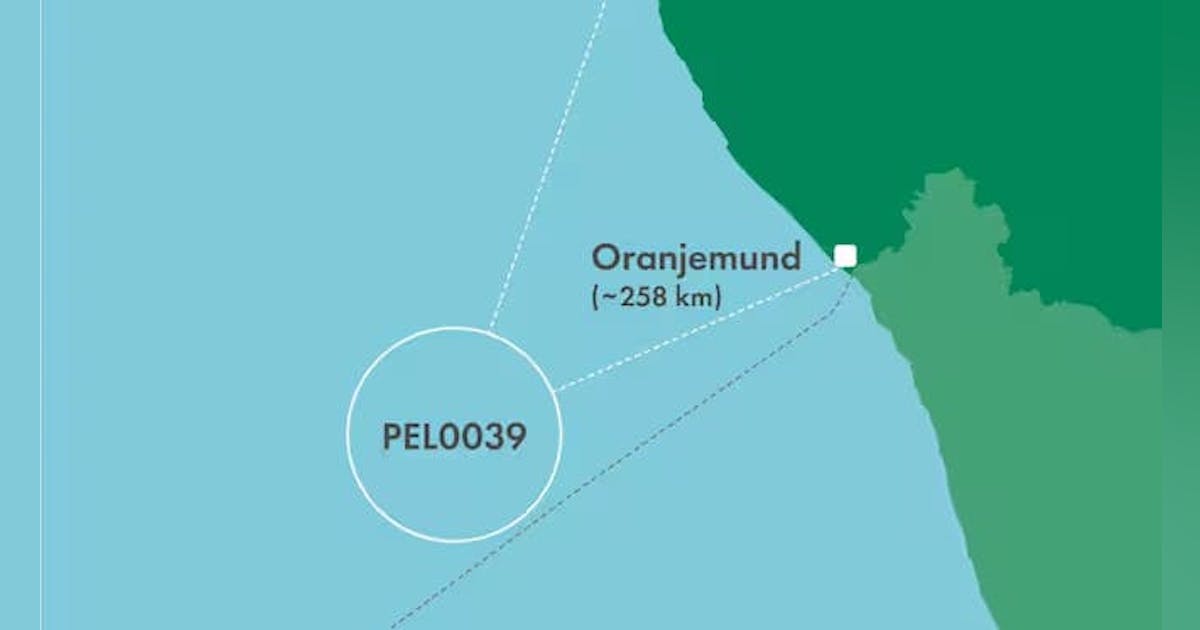
Shell discovered oil at the Merlin-1X exploration well in Orange basin 250 km off the southern coast of Namibia. Merlin-1X, spudded on Apr. 8, 2026, is the tenth well drilled in Petroleum Exploration License 39 (PEL 0039). The well penetrated the Coniacian play and has delivered the most promising subsurface results to date in PEL 0039, indicating good reservoir quality with light oil and limited associated gas, the operator said in a release June 9. Shell said additional drilling late this year is under consideration as part of a broader exploratory appraisal program. PEL 0039 covers 12,000 sq km. Over the last 4 years, 10 wells have been drilled in the license: Graff-1X, La Rona-1X, Jonker-1X, Graff-1A, Lesedi-1X, Cullinan-1X, Jonker-1A, Jonker-2A, Enigma-1X, and Merlin-1X. Shell is operator of PEL 0039 with 45% working interest. Partners are QatarEnergy (45%) and the National Petroleum Corp. of Namibia (NAMCOR) (10%).

Read More »

Equinor to farm out 50% stake in Itaimbezinho block offshore Brazil

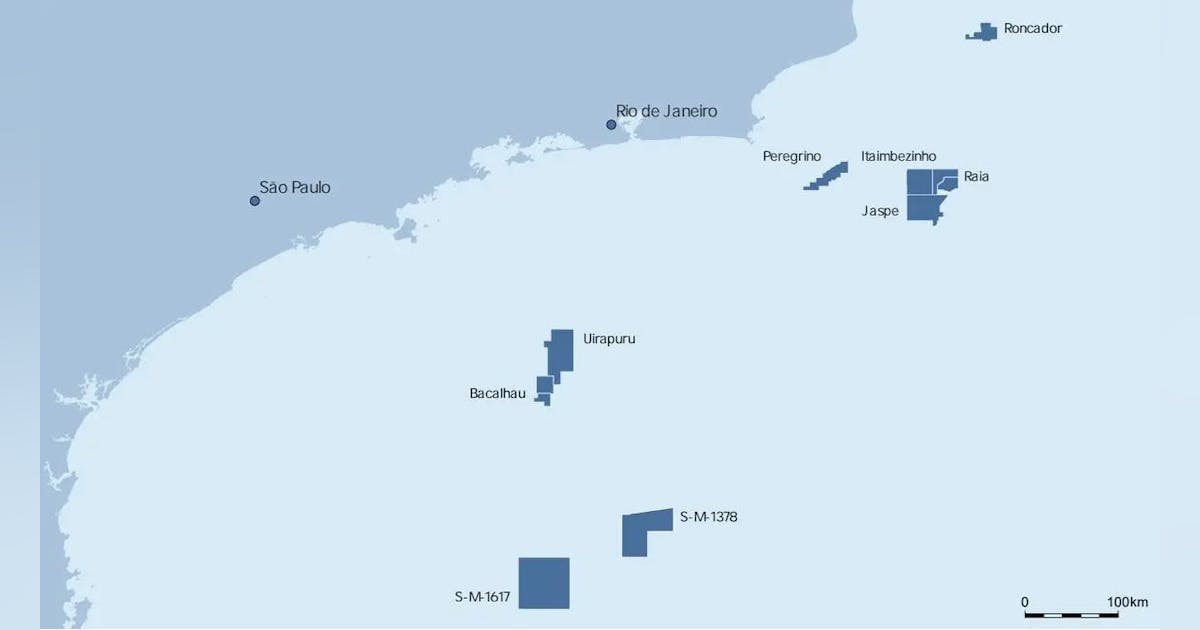
@import url(‘https://fonts.googleapis.com/css2?family=Inter:[email protected]&display=swap’); .ebm-page__main h1, .ebm-page__main h2, .ebm-page__main h3, .ebm-page__main h4, .ebm-page__main h5, .ebm-page__main h6 { font-family: Inter; } body { line-height: 150%; letter-spacing: 0.025em; } button, .ebm-button-wrapper { font-family: Inter; } .label-style { text-transform: uppercase; color: var(–color-grey); font-weight: 600; font-size: 0.75rem; } .caption-style { font-size: 0.75rem; opacity: .6; } #onetrust-pc-sdk [id*=btn-handler], #onetrust-pc-sdk [class*=btn-handler] { background-color: #c19a06 !important; border-color: #c19a06 !important; } #onetrust-policy a, #onetrust-pc-sdk a, #ot-pc-content a { color: #c19a06 !important; } #onetrust-consent-sdk #onetrust-pc-sdk .ot-active-menu { border-color: #c19a06 !important; } #onetrust-consent-sdk #onetrust-accept-btn-handler, #onetrust-banner-sdk #onetrust-reject-all-handler, #onetrust-consent-sdk #onetrust-pc-btn-handler.cookie-setting-link { background-color: #c19a06 !important; border-color: #c19a06 !important; } #onetrust-consent-sdk .onetrust-pc-btn-handler { color: #c19a06 !important; border-color: #c19a06 !important; } Equinor Brasil Energia Ltda. has agreed to farm out a 50% interest in the Itaimbezinho exploration block in Brazil’s offshore Campos basin to Petróleo Brasileiro SA (Petrobras). Equinor was awarded a 100% stake in the block during Brazil’s National Agency of Petroleum, Natural Gas and Biofuels (ANP) 3rd Cycle pre-salt bidding round in 2025. Upon completion of the deal with Petrobras, Equinor will retain a 50% interest and remain operator, while Pré-Sal Petróleo SA (PPSA) will continue as manager of the production-sharing contract. The agreement builds on Equinor and Petrobras’ broader partnership in the basin. The companies jointly acquired the Jaspe exploration block in the same bidding round, with Petrobras as operator (60%) and Equinor holding 40%. The companies also partner on the Raia natural gas project, where Equinor, as operator, began a 6-well drilling campaign in March.   Completion of the transaction remains subject to customary regulatory and governmental approvals.

Read More »

MSI’s Strategic Shift: From Server Vendor to Full-Spectrum AI Infrastructure Provider

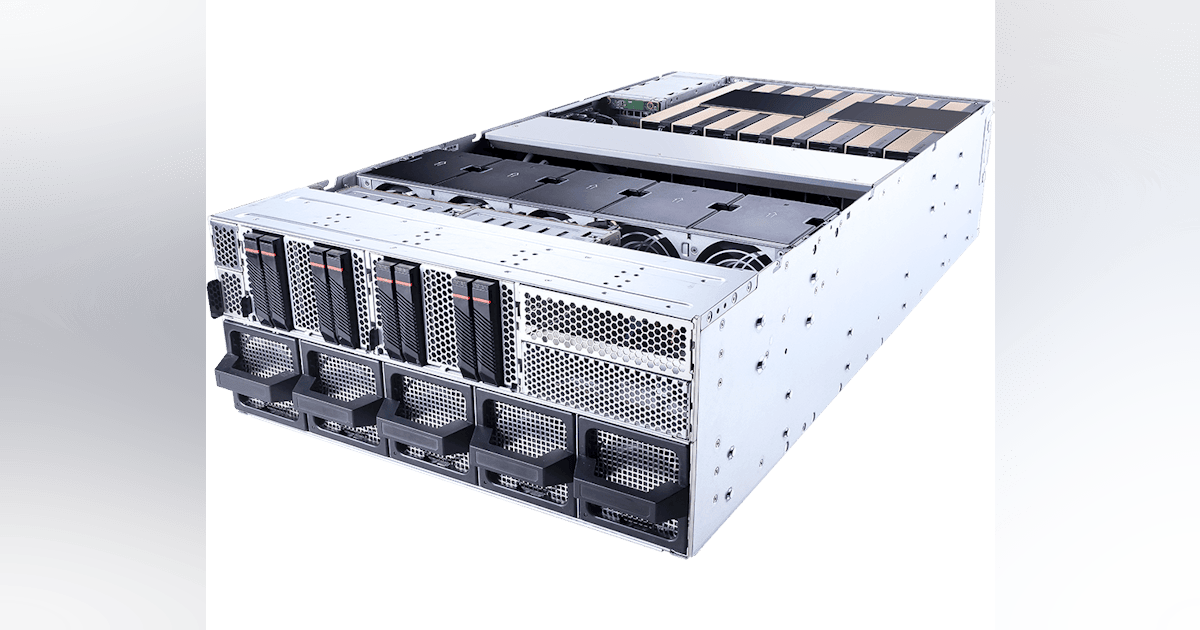
The 100 kW rack figure places MSI’s offering squarely in the world of AI-era rack densities, where conventional air cooling becomes increasingly difficult or inefficient. The announcement also suggests that MSI is aligning with hyperscale and large cloud design principles, particularly through ORv3 and 48V power distribution. The company is moving from the “we have servers that can be liquid cooled” message, to “we can participate in rack-level AI infrastructure design.” The EIA air-cooled architecture, by contrast, is designed for more conventional data center environments. MSI says its 19-inch, 48RU EIA air-cooled rack supports standard deployments and can be configured with 16 2U2N multi-node systems, with AMD EPYC 9005 and Intel Xeon 6 platform options. That split matters because the AI infrastructure market is not moving in one uniform direction. Hyperscalers, neoclouds, and AI factories may move aggressively into ORv3, liquid cooling, busbar power, and rack-scale designs. Enterprise data centers, managed service providers, and colocation customers often need to work within existing 19-inch rack footprints and existing facility constraints. MSI wants to supply both markets. The CG681-S6093: MSI’s Flagship Liquid-Cooled AI Server The centerpiece of MSI’s NVIDIA-based AI server announcement is the CG681-S6093, a 6U liquid-cooled AI server based on NVIDIA MGX architecture. MSI says the system supports dual AMD EPYC processors and up to eight NVIDIA RTX PRO 6000 Blackwell Server Edition Liquid Cooled GPUs. It also supports 32 DDR5 DIMMs and NVIDIA ConnectX-8 SuperNICs with up to 8×400Gbps networking. This system is a direct entry into high-density AI inference, HPC, simulation, graphics, video, and physical AI workloads. The server is not positioned only for frontier model training. Instead, MSI appears to be aiming at the expanding middle of the AI infrastructure market: large inference clusters, visual computing, simulation, industrial AI, scientific computing, and agentic AI workloads. The next

Read More »

Cooling at AI Scale: Inside Motivair’s Blueprint for the Liquid-Cooled Data Center

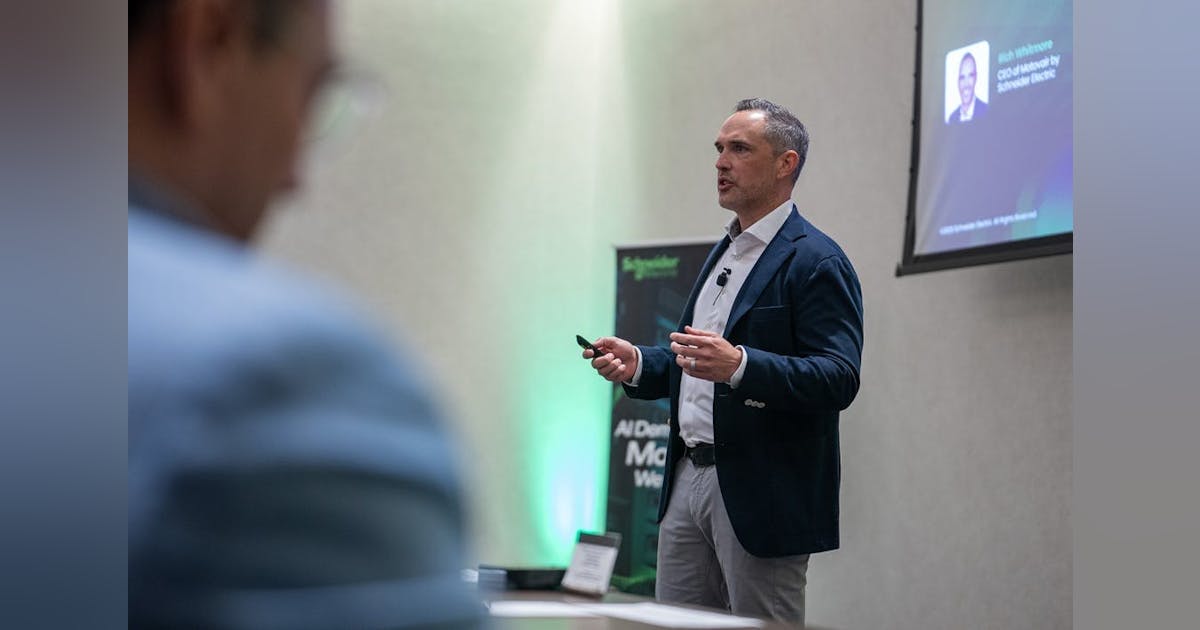
BUFFALO, N.Y. — In the race to build AI infrastructure, the industry often focuses on GPUs, power availability, and the massive capital investments reshaping the digital infrastructure landscape. But a walk through Motivair’s manufacturing facility in Buffalo, as provided on the eve of the Motivair-Schneider Electric Global Press Event’s tour of the nearby Terawulf Lake Mariner AI campus, offers a reminder that another critical component of the AI boom is being built one coolant distribution unit at a time. During a recent Data Center Frontier Show podcast recorded at Motivair’s Buffalo headquarters, CEO Rich Whitmore described a reality that is becoming bedrock across the industry: Liquid cooling is now very far from being an emerging technology. It is now a prerequisite for deploying the most advanced AI systems. “You cannot deploy AI servers—at least the cutting-edge AI servers—without liquid cooling,” Whitmore said. That observation may be obvious to infrastructure veterans. Yet it points to a larger shift now underway across the data center ecosystem. As AI workloads drive rack densities beyond the practical limits of air cooling, thermal infrastructure has moved from a supporting role to a primary design consideration. For Whitmore and Motivair, that transition did not begin with ChatGPT. From Supercomputing to Commercial AI Long before AI became the defining growth story of the data center sector, Motivair was developing liquid cooling systems for high-performance computing and supercomputing environments. Whitmore describes today’s AI market as less of a technological revolution than a commercialization of capabilities that have existed for years inside elite computing environments. “We cut our teeth in high-performance computing and supercomputing,” Whitmore explained. “What we’re seeing today as we go into the AI era is really a commercialization of traditional supercomputing.” That experience has positioned Motivair differently than many newer entrants rushing into the liquid cooling

Read More »

From Components to AI Factories: Peter Panfil Says the Future of Data Centers Is All About Integration at Scale

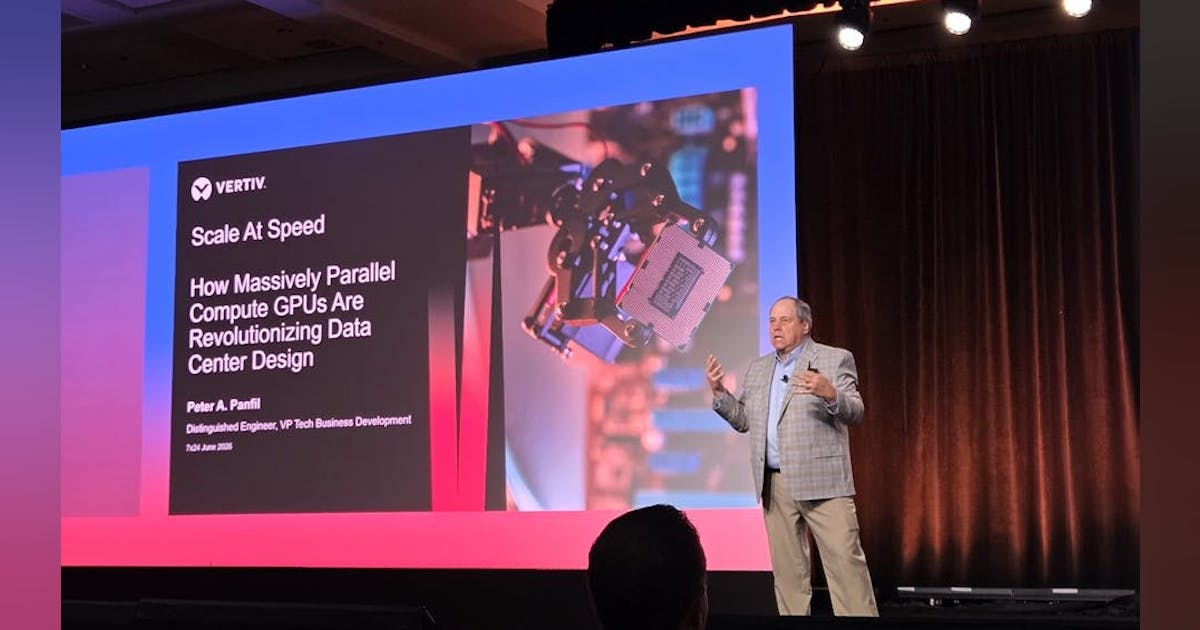
ORLANDO, Fla. — For years, the data center industry optimized individual systems: power distribution, cooling, racks, UPS equipment, and mechanical infrastructure. In the AI era, according to Vertiv Distinguished Engineer and Vice President of Technical Business Development Peter Panfil, that approach is no longer sufficient. Speaking during Wednesday morning’s keynote at the 2026 7×24 Exchange Spring Conference, Panfil presented a vision in which the data center itself becomes a single, tightly orchestrated computing appliance—truly an “AI factory” whose success depends less on standalone components than on the seamless interaction between them. Throughout his presentation, titled “Scale at Speed: How Massively Parallel Compute GPUs Are Revolutionizing Data Center Design,” Panfil repeatedly returned to a single imperative: the AI infrastructure race is increasingly defined by execution velocity. “If you think you’re going big enough, go bigger,” he told attendees. “If you think you’re going fast enough, you’re going to have to go faster.” For an industry gathered under the conference’s overarching theme of future-proofing AI infrastructure, Panfil’s message suggested something subtly different. Rather than trying to predict the future, operators should build systems capable of adapting to it. “I would much rather be future ready,” he said, “than future proof.” Speed Becomes the New Competitive Metric One of the keynote’s recurring themes was that deployment speed has become an economic variable in its own right. Panfil argued that hyperscalers and AI providers increasingly view time-to-capacity as directly tied to business value, making delays in construction or commissioning far more expensive than traditional infrastructure inefficiencies. “The cost of speeding up has real benefits right now,” he observed. That urgency is changing the way facilities are assembled. Rather than coordinating numerous independent contractors and subsystem vendors on-site, Panfil described an emerging model built around highly standardized, factory-produced HAC [hot aisle containment] modules—or “hacks”—that arrive

Read More »

Beyond the GPU: Cisco Says AI’s Biggest Challenge May Be the Network That Connects It All

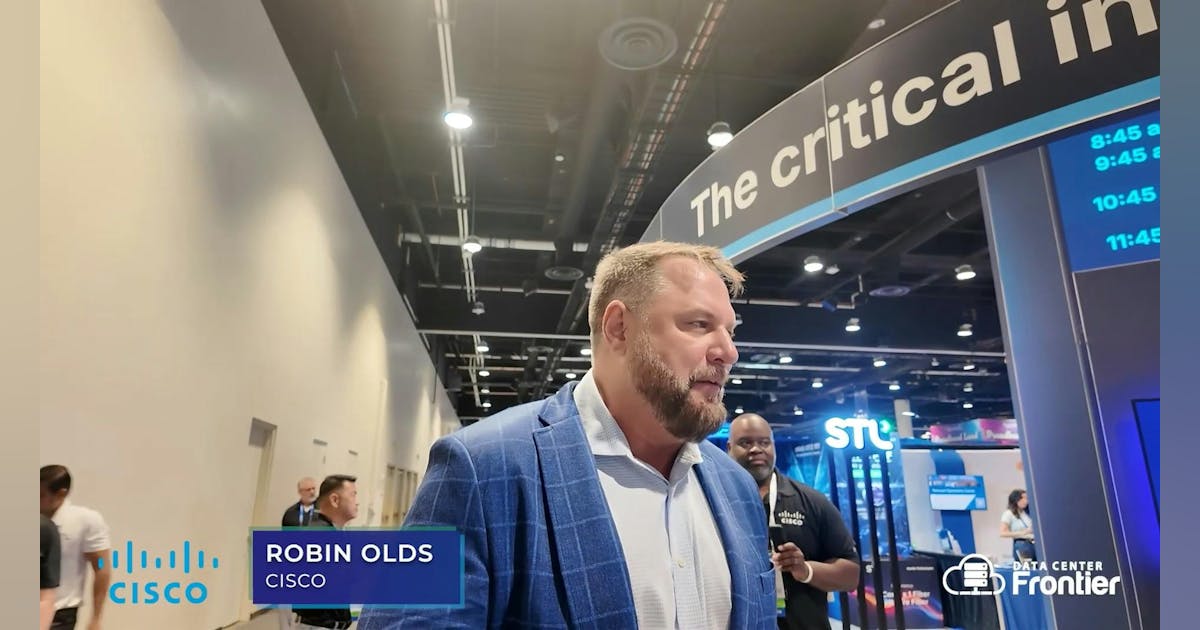
For much of the AI boom, the industry’s attention has centered on GPUs, power availability, and liquid cooling. But according to Cisco Senior Business Development Manager Robin Olds, another critical constraint is rapidly moving to the forefront: the network itself. Speaking with Data Center Frontier on the show floor at Fiber Connect 2026, Olds argued that AI represents a once-in-a-generation shift comparable to the birth of the commercial internet, fundamentally changing traffic patterns and forcing service providers, data center operators, hyperscalers, and emerging neoclouds to rethink infrastructure design. “It’s really like the internet when it was created,” Olds said. “We’re at another intersection in time where we could really see things happening.” AI Is Rewriting the Bandwidth Equation The most significant change may not be compute density alone but the sustained demand AI places on transport networks. According to Olds, service providers are already seeing AI traffic account for roughly 30% of utilization on backbone infrastructure; a dramatic increase from less than 1% only two years ago. As AI workloads continue to proliferate, those utilization levels are expected to rise further. The next wave of agentic AI could amplify that trend. Unlike consumer chatbots, which generate bursty request patterns, autonomous AI agents continuously interact with applications and external services, creating more persistent traffic flows. “Everything’s about chatbots,” Olds observed. “It’s very spiky—up, down. Agentic AI is going to maintain utilization because now I have agents working on my behalf.” For data center developers, network operators, and cloud providers alike, that implies planning not just for peak demand but for elevated baseline utilization across metro and long-haul infrastructure. Compressing the Network Stack Cisco’s response centers on architectural simplification. Olds highlighted the company’s Agile Services Networking framework, which combines router and optical networking technologies with coherent optics to converge functions that historically

Read More »

Emerging Power Strategies Transforming AI Data Center Development

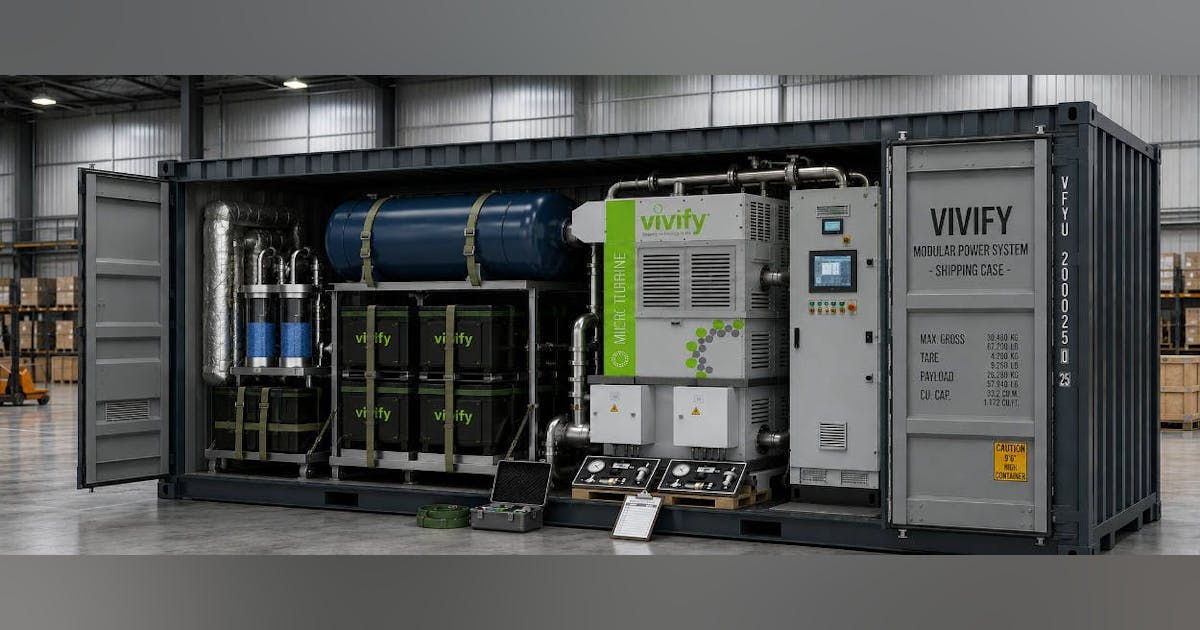
This deal follows the industry trend shown in the Flex/EP² acquisition. One transaction targets engineered control and protection systems; the other targets high-power conductive components and value-added services around them. The clarity here is that data center growth is creating investable demand not just for chips and campuses, but for the industrial companies that make the electrical buildout possible. AZIO AI and EVTV: EV maker to AI infrastructure After multiple announcements of deals between the two companies, and the end of May, they decided a corporate merger was in order. The AZIO AI–EVTV merger turns Envirotech Vehicles Inc., from an electric-vehicle company into a prospective power-backed AI infrastructure and data center platform. The core impact is not just an increase in AI servers; it is the combination of compute hardware, controlled land, behind-the-meter power, fiber, modular deployment, and cooling validation building on the AI data center growth story. AZIO describes the deal as part of EVTV’s strategic transformation into an AI infrastructure and compute platform focused on domestic AI deployment, data center operations, and long-term compute capacity expansion. For data center ambitions, the most important element is power access. AZIO and EVTV say about 11 MW of power capacity has been identified at EVTV’s existing site, with hardware orders placed for an initial 6 MW deployment. They are also discussing long-term rights tied to as much as 500 MW of additional same-site capacity. That matters because AI data center development is increasingly constrained by power availability rather than just real estate or server supply. And with the modular infrastructure the company develops, having that power availability is the key to future site growth. EVTV later said it had expanded its controlled development footprint to more than 548 acres, secured dedicated fiber for current and future operations, and was advancing natural

Read More »

Amazon claims its data centers are 7x more water-efficient than the industry average

“Amazon is on the leading edge, but it’s not a secret recipe,” he said. What sets the company apart is scale, execution, facility design, geographic mix, and its aggressive pursuit of energy goals. Others are doing the similar things, if through different avenues: Microsoft is investing in closed-loop cooling systems that dramatically reduce evaporative water loss. Google is heavily focused on reclaimed water and using AI to optimize data centers. Meta has long relied on outside-air cooling. And overall, the industry is moving toward liquid cooling for dense AI deployments, “which changes the water equation again,” said Kimball. One of the big variables is location: Climate influences water efficiency, so where a company builds its infrastructure is as important as its cooling methods. Further, power-consumptive AI changes the discussion, he emphasized; traditional enterprise workloads and dense AI training clusters create very different thermal profiles.

Read More »

Microsoft will invest $80B in AI data centers in fiscal 2025

And Microsoft isn’t the only one that is ramping up its investments into AI-enabled data centers. Rival cloud service providers are all investing in either upgrading or opening new data centers to capture a larger chunk of business from developers and users of large language models (LLMs).  In a report published in October 2024, Bloomberg Intelligence estimated that demand for generative AI would push Microsoft, AWS, Google, Oracle, Meta, and Apple would between them devote $200 billion to capex in 2025, up from $110 billion in 2023. Microsoft is one of the biggest spenders, followed closely by Google and AWS, Bloomberg Intelligence said. Its estimate of Microsoft’s capital spending on AI, at $62.4 billion for calendar 2025, is lower than Smith’s claim that the company will invest $80 billion in the fiscal year to June 30, 2025. Both figures, though, are way higher than Microsoft’s 2020 capital expenditure of “just” $17.6 billion. The majority of the increased spending is tied to cloud services and the expansion of AI infrastructure needed to provide compute capacity for OpenAI workloads. Separately, last October Amazon CEO Andy Jassy said his company planned total capex spend of $75 billion in 2024 and even more in 2025, with much of it going to AWS, its cloud computing division.

Read More »

John Deere unveils more autonomous farm machines to address skill labor shortage

Join our daily and weekly newsletters for the latest updates and exclusive content on industry-leading AI coverage. Learn More Self-driving tractors might be the path to self-driving cars. John Deere has revealed a new line of autonomous machines and tech across agriculture, construction and commercial landscaping. The Moline, Illinois-based John Deere has been in business for 187 years, yet it’s been a regular as a non-tech company showing off technology at the big tech trade show in Las Vegas and is back at CES 2025 with more autonomous tractors and other vehicles. This is not something we usually cover, but John Deere has a lot of data that is interesting in the big picture of tech. The message from the company is that there aren’t enough skilled farm laborers to do the work that its customers need. It’s been a challenge for most of the last two decades, said Jahmy Hindman, CTO at John Deere, in a briefing. Much of the tech will come this fall and after that. He noted that the average farmer in the U.S. is over 58 and works 12 to 18 hours a day to grow food for us. And he said the American Farm Bureau Federation estimates there are roughly 2.4 million farm jobs that need to be filled annually; and the agricultural work force continues to shrink. (This is my hint to the anti-immigration crowd). John Deere’s autonomous 9RX Tractor. Farmers can oversee it using an app. While each of these industries experiences their own set of challenges, a commonality across all is skilled labor availability. In construction, about 80% percent of contractors struggle to find skilled labor. And in commercial landscaping, 86% of landscaping business owners can’t find labor to fill open positions, he said. “They have to figure out how to do

Read More »

2025 playbook for enterprise AI success, from agents to evals

Join our daily and weekly newsletters for the latest updates and exclusive content on industry-leading AI coverage. Learn More 2025 is poised to be a pivotal year for enterprise AI. The past year has seen rapid innovation, and this year will see the same. This has made it more critical than ever to revisit your AI strategy to stay competitive and create value for your customers. From scaling AI agents to optimizing costs, here are the five critical areas enterprises should prioritize for their AI strategy this year. 1. Agents: the next generation of automation AI agents are no longer theoretical. In 2025, they’re indispensable tools for enterprises looking to streamline operations and enhance customer interactions. Unlike traditional software, agents powered by large language models (LLMs) can make nuanced decisions, navigate complex multi-step tasks, and integrate seamlessly with tools and APIs. At the start of 2024, agents were not ready for prime time, making frustrating mistakes like hallucinating URLs. They started getting better as frontier large language models themselves improved. “Let me put it this way,” said Sam Witteveen, cofounder of Red Dragon, a company that develops agents for companies, and that recently reviewed the 48 agents it built last year. “Interestingly, the ones that we built at the start of the year, a lot of those worked way better at the end of the year just because the models got better.” Witteveen shared this in the video podcast we filmed to discuss these five big trends in detail. Models are getting better and hallucinating less, and they’re also being trained to do agentic tasks. Another feature that the model providers are researching is a way to use the LLM as a judge, and as models get cheaper (something we’ll cover below), companies can use three or more models to

Read More »

OpenAI’s red teaming innovations define new essentials for security leaders in the AI era

Join our daily and weekly newsletters for the latest updates and exclusive content on industry-leading AI coverage. Learn More OpenAI has taken a more aggressive approach to red teaming than its AI competitors, demonstrating its security teams’ advanced capabilities in two areas: multi-step reinforcement and external red teaming. OpenAI recently released two papers that set a new competitive standard for improving the quality, reliability and safety of AI models in these two techniques and more. The first paper, “OpenAI’s Approach to External Red Teaming for AI Models and Systems,” reports that specialized teams outside the company have proven effective in uncovering vulnerabilities that might otherwise have made it into a released model because in-house testing techniques may have missed them. In the second paper, “Diverse and Effective Red Teaming with Auto-Generated Rewards and Multi-Step Reinforcement Learning,” OpenAI introduces an automated framework that relies on iterative reinforcement learning to generate a broad spectrum of novel, wide-ranging attacks. Going all-in on red teaming pays practical, competitive dividends It’s encouraging to see competitive intensity in red teaming growing among AI companies. When Anthropic released its AI red team guidelines in June of last year, it joined AI providers including Google, Microsoft, Nvidia, OpenAI, and even the U.S.’s National Institute of Standards and Technology (NIST), which all had released red teaming frameworks. Investing heavily in red teaming yields tangible benefits for security leaders in any organization. OpenAI’s paper on external red teaming provides a detailed analysis of how the company strives to create specialized external teams that include cybersecurity and subject matter experts. The goal is to see if knowledgeable external teams can defeat models’ security perimeters and find gaps in their security, biases and controls that prompt-based testing couldn’t find. What makes OpenAI’s recent papers noteworthy is how well they define using human-in-the-middle

Read More »