Stay Ahead, Stay ONMINE

Batteries included: A practical checklist for storage owners, operators to boost reliability

Listen to the article 8 min This audio is auto-generated. Please let us know if you have feedback. Brian Fellon is senior vice president at Xpansiv, a market platform for energy and environmental commodities. Winter Storm Fern hit Texas in January 2026 with extreme cold and hazardous precipitation. But unlike Winter Storm Uri in 2021, […]

Brian Fellon is senior vice president at Xpansiv, a market platform for energy and environmental commodities.

Winter Storm Fern hit Texas in January 2026 with extreme cold and hazardous precipitation. But unlike Winter Storm Uri in 2021, the lights stayed on. The Electric Reliability Council of Texas’ post-event report captured how the grid remained intact without Energy Emergency Alerts, public conservation calls or systemwide outages.

Brian Fellon is senior vice president at Xpansiv, a market platform for energy and environmental commodities.

Brian Fellon

During Fern, ERCOT’s battery energy storage resources were indispensable for covering peak-demand reserves, while all resource types contributed to meeting broader system demand. The critical lesson is that grid performance is highly dependent on coordinating nascent technologies and real-time operations with legacy generation assets. That lesson is now being tested at scale across the country.

The U.S. electricity sector is undergoing its most abrupt transformation since deregulation. After nearly two decades of flat demand, load growth is accelerating from data centers, transportation and industrial electrification.

The forward demand curve has never been this steep, and ERCOT’s long-range planning assumptions contemplate peak load reaching more than four times today’s record levels. Across the PJM Interconnection footprint, forecasted load growth is raising expectations that tens of gigawatts of new supply may be needed over the coming decade to maintain system reliability.

This demand jump is colliding with aging grid infrastructure, constrained transmission, record-long interconnection queues and a shifting policy landscape. These factors are reconfiguring wholesale power markets and revaluing baseload and dispatchable generation, while establishing battery storage as essential grid infrastructure.

Batteries are often described as a foundational solution because they respond instantly, start and stop without thermal plants’ mechanical constraints, and uniquely shift energy from off-peak to on-peak periods. In practice, the grid does not simply benefit from batteries as fixed capacity in the conventional sense. It benefits from dynamic, flexible battery storage systems that are specifically configured to accelerate responsiveness, along with the telemetry, data feeds, market interfaces and 24/7 readiness required to perform under normal and stressed conditions alike.

That distinction matters as storage scales, owners compete for arbitrage opportunities and electricity markets evolve.

In organized wholesale markets, dispatch is not a single daily event. It’s a sequence of day-ahead scheduling, intraday adjustments and real-time dispatch, translated into 5-minute price intervals. For chemically-constrained assets like batteries, timelines are crucial because spot market decisions are inseparable from current and future state-of-charge, known as SoC. Every megawatt discharged at a given time affects what can be delivered later.

Fortunately, policy and market design are adapting to support this reality. FERC’s Order No. 841 requires ISOs/RTOs to remove barriers to storage participation and adopt participation models that recognize storage’s physical and operational characteristics. That mandate expanded the range of products storage can provide, with more options for revenue production.

Although not governed by FERC, ERCOT went even further than Order 841. In December 2025, ERCOT implemented Real-Time Co-optimization Plus Batteries (RTC+B), which co-optimizes energy and reserves in real time while accounting for what battery resources can actually deliver. One month later, during Winter Storm Fern, ERCOT credited RTC+B with helping redistribute ancillary services across the system during a localized transmission emergency. The same change that helped ERCOT lean on batteries during Fern also changed how those batteries earn revenue. As these rules open new ways for storage to participate, the mix of market products that pay off keeps shifting.

The new paradigm, and what’s needed

Market participants and grid operators need timely, accurate information about what a battery can deliver under variable constraints. Unreliable data or inconsistent operations aren’t theoretical problems, because they show up directly in project economics after commercial operations begin.

Similarly, optimization only creates value if it’s converted into timely, accurate and compliant market submissions. There has never been a greater need for validated bid and offer workflows, automated checks against asset constraints and market rules, reliable ISO/RTO connectivity, clear audit trails, and the ability to rapidly adjust trades as forecasts, prices, outages and SoC conditions change.

The same need for accuracy and coordination extends into real-time operations. Wholesale markets and grid conditions don’t simply pause at 5 p.m. when the workday ends for most electricity consumers. Scarcity pricing, forced outages and weather disruptions often happen during off-hours. Sophisticated storage operators utilize defined escalation pathways, telemetry monitoring and situational awareness tools to coordinate instantly when grid conditions require immediate support. A practical checklist for battery owners and operators includes:

  • Treat data and telemetry as mission-critical infrastructure. Validate data quality and latency end-to-end, not just at the device level.
  • Run multi-market playbooks, not single-product strategies. Markets change; build the adaptive capability to shift with them.
  • Treat market submission as a core operating capability. Whether built in-house or outsourced, deploy resilient controls, versioned workflows and exception handling.
  • Operationalize SoC discipline. Establish SoC guardrails tied to existing obligations, revenue targets and forecast uncertainty. Review after-action performance during unforeseen events.

ERCOT has shown what adaptive market design can deliver. Other markets should follow.

Operators can only do so much on their own. Market rules decide how much value flexible resources can actually deliver, and those rules are only as good as a market’s culture and willingness to keep improving them.

ERCOT treats market design as ongoing work. When storage grew from a niche resource to a core part of the fleet, the rules were changed to match it. When large-load requests began reshaping the interconnection picture, regulators moved promptly to change how those loads are studied, prioritized and approved. Not every change has been perfect, and some have been contentious. But the gap between identifying a problem and putting a fix in place has been relatively short.

Other grid regulators could benefit by adapting this model to their regions, while avoiding preconceptions that this can only work in Texas. Much of the country runs on a slower cycle, where reforms move through multi-year stakeholder processes, compliance filings and phased implementations.

Implementation has also diverged enough that an operator running assets in three markets is effectively running three separate businesses. Closer alignment on state-of-charge accounting, telemetry requirements and bid formats would lower the cost of entry for smaller operators and reduce operational congestion for everyone.

ERCOT’s design doesn’t need to be copied everywhere, but its pace of innovation should be. Regions that move from a problem to a fix in months (not years) will attract investment and maintain the reliability that others will eventually fight for.

The era of static demand is over; as the grid is being rewired, success will favor those who are prepared to execute in real time.


Shape
Shape
Stay Ahead

Explore More Insights

Stay ahead with more perspectives on cutting-edge power, infrastructure, energy,  bitcoin and AI solutions. Explore these articles to uncover strategies and insights shaping the future of industries.

Shape

Microsoft outage: A cascading failure that started with an undetected bug

“If your testing doesn’t adequately reproduce the hardware characteristics, concurrency, traffic patterns, and operational conditions of production, you have inherently accepted the risk that significant defects will escape detection,” Fisher said. “The particularly troubling aspect here is that Microsoft’s production hardware was more capable than its testing hardware, yet that

Read More »

Cloud overspend is an accountability problem not a tooling gap

He added that neither self-service nor automation fixes the issues. “Without redesign, you get responsibility without leverage,” he said. “So, governance, cost management, and security practices, if they remain rooted in sort of pre-cloud thinking, that’s going to create tension between the control mechanisms that we have in place and the

Read More »

EOG Resources to double Delaware basin gas processing capacity

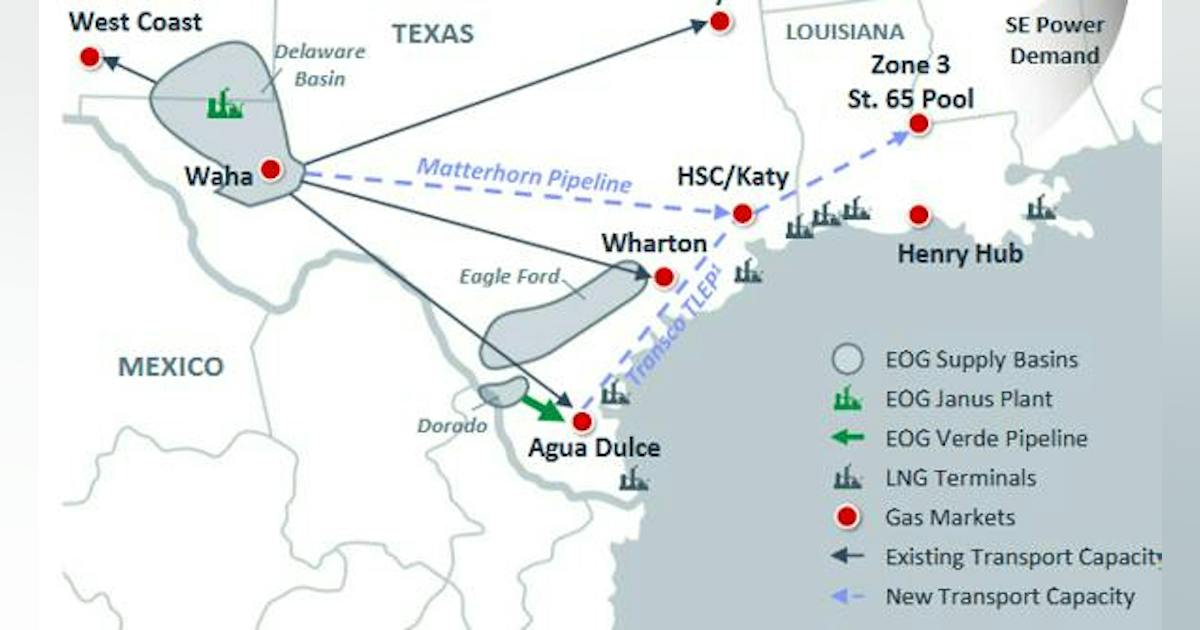
EOG Resources Inc., Houston, has taken final investment decision to proceed with an expansion of its 300-MMcfd Janus natural gas processing plant in the Permian’s Delaware basin. Budgeted at a total cost of $300 million approved during third-quarter 2026, the project will involve installing another 300 MMcfd of processing capability at the plant to bring the site’s overall processing capacity to 600 MMcfd, the company said in its latest quarterly earnings call with investors. “This project will enhance our operational control and diversify our processing options at a time when [gas] processing capacity is tightening as more natural gas production comes online due to improved pipeline takeaway capacity,” said Jeffrey R. Leitzell, EOG Resources’ chief operating officer. “Given the proven performance of the existing [plant], we believe this attractive, high-return investment represents a compelling opportunity to extend the value created by Janus for years to come,” Leitzell said. With current plans to complete the expansion in second-half 2028, Leitzell said EOG Resources expects to spend two-thirds of the dedicated budget—or about $200 million—in 2027 on the project. Commissioned in 2025 and delivering gas to multiple premium US Gulf Coast markets via Matterhorn pipeline, the Janus gas processing plant has operated at a current utilization rate of more than 99% year-to-date, according to EOG Resources’ presentation dated Nov. 6.

Read More »

Batteries included: A practical checklist for storage owners, operators to boost reliability

Listen to the article 8 min This audio is auto-generated. Please let us know if you have feedback. Brian Fellon is senior vice president at Xpansiv, a market platform for energy and environmental commodities. Winter Storm Fern hit Texas in January 2026 with extreme cold and hazardous precipitation. But unlike Winter Storm Uri in 2021, the lights stayed on. The Electric Reliability Council of Texas’ post-event report captured how the grid remained intact without Energy Emergency Alerts, public conservation calls or systemwide outages. Brian Fellon During Fern, ERCOT’s battery energy storage resources were indispensable for covering peak-demand reserves, while all resource types contributed to meeting broader system demand. The critical lesson is that grid performance is highly dependent on coordinating nascent technologies and real-time operations with legacy generation assets. That lesson is now being tested at scale across the country. The U.S. electricity sector is undergoing its most abrupt transformation since deregulation. After nearly two decades of flat demand, load growth is accelerating from data centers, transportation and industrial electrification. The forward demand curve has never been this steep, and ERCOT’s long-range planning assumptions contemplate peak load reaching more than four times today’s record levels. Across the PJM Interconnection footprint, forecasted load growth is raising expectations that tens of gigawatts of new supply may be needed over the coming decade to maintain system reliability. This demand jump is colliding with aging grid infrastructure, constrained transmission, record-long interconnection queues and a shifting policy landscape. These factors are reconfiguring wholesale power markets and revaluing baseload and dispatchable generation, while establishing battery storage as essential grid infrastructure. Batteries are often described as a foundational solution because they respond instantly, start and stop without thermal plants’ mechanical constraints, and uniquely shift energy from off-peak to on-peak periods. In practice, the grid does not simply benefit

Read More »

bp names Lewis to lead downstream business

bp plc has appointed Emma Lewis executive vice-president (EVP), downstream, and a member of the company’s leadership team, effective January 2027. The downstream segment includes refining, terminals and pipelines, mobility and convenience, aviation, and bioenergy. Lewis, a chemical engineer, has more than 25 years’ experience in chemicals, refining, manufacturing, commercial operations, supply chains, and strategy. Most recently, she served as EVP, chemicals, at Shell plc, where she led the company’s global chemicals business, including operating assets, commercial activities, polymers interests, and joint ventures. Before joining Shell, she held a series of operational, manufacturing, commercial, product management, and supply chain roles at ExxonMobil Corp. Richard Harding will continue as interim EVP, downstream, until Lewis joins bp. Harding was appointed to the interim position in July 2026 as part of the restructuring of bp into two business segments, upstream and downstream, replacing a previous three-segment structure.

Read More »

How an outdated oil benchmark erodes U.S. pricing power

The United States is the world’s largest oil producer backed by the deepest capital markets. Yet the financial system still voluntarily prices American crude off a landlocked benchmark that doesn’t fully account for where the oil is produced or who buys it. This carries structural consequences far beyond the energy sector that threaten U.S. borrowing costs, weaken sanctions power, and chip away at the dollar’s status as the world’s reserve currency. The greenback’s share of global reserves has already slid from over 70% in 2000 to around 58%. While this has been driven by many macro factors, the trend accelerates as more oil producers bypass the dollar system and non-dollar payment channels develop. The NYMEX WTI futures contract reflects an era when the U.S. was the world’s largest crude importer. The shale boom reversed that dynamic, routing Permian Basin production straight to Gulf Coast export terminals. Today, the interplay between global crude demand and Permian Basin production is captured by the ICE Midland WTI futures contract (HOU), a price marker guaranteeing on-spec Midland WTI crude delivered straight to Houston. Meanwhile, NYMEX WTI’s market share of global crude oil futures benchmark volume has dropped from 62% in 2017 to 40% today as Cushing is supported by institutional inertia via long-term contract pricing, commodity index inclusion, and price-reporting agencies being resistant to change. When NYMEX WTI diverges from Midland WTI on the Gulf Coast (priced via HOU) it distorts the price signal for U.S. exports and forces international buyers to absorb hedging inefficiencies. The physical market has been moving away from Cushing for years, pricing Gulf Coast exports against Brent or using multi-instrument trades. Using these workarounds introduces unnecessary basis risk and execution costs, risking America’s reputation as standard for transparent energy price discovery. This inertia is arguably more damaging than external

Read More »

Diamondback to acquire remaining Double Eagle Midland basin interest in multibillion cash, stock deal

The deal continues Diamondback’s long-running consolidation strategy in the basin. Andrew Dittmar, principal analyst at Enverus Intelligence Research (EIR), said the company has emerged as “the most consistent consolidator in the Midland basin” through a series of deals that have expanded its inventory position, noting Diamondback has spent more than $40 billion on acquisitions since 2020 and now trails only ExxonMobil in ownership of Midland basin inventory and owns more than two times the locations of the third-place exploration and production company.  Dittmar said the latest deal strengthens Diamondback’s exposure to the Barnett-Woodford, which he described as “the largest undeveloped oil expansion opportunity in US shale.” Along with news of the acquisition, Van’t Hof reported early results from the operator’s first full-section Barnett development in the Spanish Trail area of Midland County. The project consists of four 10,000-ft lateral wells that at peak produced about 7,500 b/d of oil and 37 MMcfd of natural gas, exceeding internal expectations and supporting plans for broader Barnett development beginning in 2027, he said.  Diamondback expects the transaction to close Dec. 21, 2026, subject to customary closing conditions.

Read More »

ExxonMobil Guyana starts production at Uaru

@import url(‘https://fonts.googleapis.com/css2?family=Inter:wght@100..900&display=swap’); .ebm-page__main h1, .ebm-page__main h2, .ebm-page__main h3, .ebm-page__main h4, .ebm-page__main h5, .ebm-page__main h6 { font-family: Inter; } body { line-height: 150%; letter-spacing: 0.025em; } button, .ebm-button-wrapper { font-family: Inter; } .label-style { text-transform: uppercase; color: var(–color-grey); font-weight: 600; font-size: 0.75rem; } .caption-style { font-size: 0.75rem; color: color-mix(in srgb, currentColor 60%, transparent); } ExxonMobil Guyana Ltd. started production at Uaru, raising Guyana’s installed crude oil production capacity to 1.1 million b/d. With production now underway, the Errea Wittu FPSO is slated to achieve its initial production capacity of 250,000 b/d in first-quarter 2027. Equipped with a storage capacity of 2 million bbl, Errea Wittu becomes the fifth FPSO operating in Stabroek block. ExxonMobil Guyana operates Stabroek block (45%) on behalf of partners Hess Guyana Exploration Ltd. (30%), and CNOOC Petroleum Guyana Ltd. (25%).

Read More »

You’ve decided to repatriate cloud workloads. Now what?

Advice for IT Pros Repatriation is the market correcting a decade of poor placement decisions. That’s healthy, but the burden of getting it right falls on network, I&O, and data center teams. If you’re facing a repatriation project, here’s where I would focus. Lock down capacity first. The single biggest mistake I see is treating space and power as a procurement detail to be sorted out after the business case is approved. With vacancy at historic lows in the major markets and most new construction spoken for before it’s finished, that order of operations no longer works. Engage colocation providers and your own facilities team as early as possible, and be prepared to consider secondary markets, smaller footprints spread across multiple sites, or upgrading an existing owned facility. Get firm answers on power per rack, cooling options, cross-connect availability, and delivery dates before committing to a migration timeline. In many markets, the lead time for space and power can be longer than the migration itself. Design the network for a hybrid end state. Repatriation doesn’t end with a clean break from the cloud; it ends with more locations that must work as one. Treat interconnects, cloud on-ramps, WAN, data center fabric, segmentation, and security policy as a single architecture spanning on-prem, colo, and multiple clouds. That means sizing interconnect bandwidth for actual data flows rather than estimates, enforcing consistent policy regardless of where a workload runs, and building in visibility to troubleshoot an application path that spans three environments. If the network is designed as an afterthought, latency and integration problems that already plague many organizations will worsen. Plan AI infrastructure explicitly. If AI inference or fine-tuning is part of the repatriation plan, treat it as a separate project. GPU clusters introduce power density, cooling, and networking requirements that are

Read More »

Data center boom faces challenges beyond water and power

According to a report published by BBC Science Focus, the United States had more than 4,000 data centers by the end of 2025, representing approximately 50 gigawatts of capacity. Meanwhile, U.S. data centers consumed approximately 66 billion liters of water in 2023, highlighting the substantial environmental footprint of the industry. These resource requirements have driven considerable opposition to new developments. A recent NBC News poll cited by the publication found that 69% of respondents would oppose construction of an AI data center in their neighborhoods. This is reflected in the recent elections, where pro-data center candidates lost badly while those who publicly opposed for the construction of data centers did well at the ballot box. Data centers can provide economic benefits to the communities where they operate, including increased property tax revenues, permanent employment and infrastructure improvements. Developers sometimes finance upgrades to electrical substations, roads and emergency services to accommodate their facilities.

Read More »

How TI’s ADC34DSO75 Catches the Nanosecond Power Glitches Behind AI Data Center Downtime

Today’s advanced AI data center can be viewed as a vast, complex and interdependent digital organism in which a virtually infinite number of components must be tracked all the time, in real time. It’s a monitoring job of staggering proportions. At stake is the operation of highly critical workloads and the maintenance of return on investment for high-cost compute equipment. At risk is sub-optimal performance or, in worst-case scenarios, the nightmare of data center downtime. Sponsored Resources: Why traditional telemetry misses nanosecond power-rail events Telemetry has long been relied upon to monitor data center servers, test and measurement equipment, wireless infrastructure and other systems for real-time information about voltage, current, power, temperature and overall system health. But most systems operate at millisecond-level intervals or slower, which is six orders of magnitude longer than the transient events that now occur at the processor power rails and the tools meant to observe them. The requirements and high stakes of today’s AI data centers and workloads have called for a new generation of advanced, nanosecond-level telemetry gear. Texas Instruments has established a leadership position in this sector. The company has developed the first analog-to-digital converter (ADC) to enable 24/7, low-power, event-based remote monitoring at nanosecond resolution. Let’s unpack this statement and examine why TI’s new monitoring technology is so important for the data center industry. What is the TI ADC34DSO75?    We’re talking specifically about TI’s ADC34DSO75, the industry’s highest-performance, 3 gigasamples per second (GSPS) ADC, delivering thousands of times faster performance than current offerings. Launched at the Open Compute Project Global Summit conference in October, the ADC34DSO75 addresses the shortcomings of existing monitoring solutions that can’t detect the nanosecond-level power-rail glitches that cause costly data center downtime. The ADC34DSO75 combines ultra-high-speed sampling with advanced on-chip digital signal processing in a small form factor,

Read More »

Schneider Electric’s AI Factory Strategy Moves Beyond the Modular Data Hall

The race to industrialize AI data center construction is moving beyond prefabricated electrical rooms and modular building components. Increasingly, major infrastructure suppliers are attempting to standardize the power, cooling, controls, and engineering systems surrounding the computing equipment itself, with the goal of delivering highly integrated infrastructure through repeatable manufacturing processes rather than site-specific construction. Schneider Electric’s recent activities provide a revealing example of that transition. Its RapidScale Modular Data Center Reference Design 115, introduced October 21 at NVIDIA GTC Berlin, outlines a modular AI factory architecture engineered for the NVIDIA Vera Rubin platform. Separately, a study conducted with Compass Datacenters documents substantial reductions in selected onsite installation activities through prefabricated white-space modules. Related developments involving power-system certification, onsite generation, and digital-twin technology show how the company is extending its reach across the data center development process. As DCF previously reported in its examination of NVIDIA’s DSX POD initiative, the broader industry is working toward factory-integrated computing environments that can be assembled, tested, and delivered with less dependence on conventional field construction. Schneider’s contribution is particularly interesting because its latest engineering documentation provides a detailed view of how electrical and thermal infrastructure might accommodate a new generation of exceptionally power-dense AI systems. A 227-kW Building Block for Vera Rubin Schneider describes Reference Design 115 as a 10–20 MW, Tier III-targeted modular AI factory architecture developed to ANSI standards. The published example concentrates on one deployment unit containing four scalable units, designed around four NVIDIA Vera Rubin clusters with 1,008 GPUs each. That translates to 4,032 GPUs distributed across 56 AI computing racks, supported by another 32 networking racks. The maximum AI rack power reaches 227 kW, while the documented configurations support approximately 10.4 MW to 11.4 MW of active IT load. The reference design assigns approximately 33,518 square feet to the

Read More »

Cisco forecasts $9 billion in AI infrastructure revenue in FY27

Cisco continues to benefit from a “networking supercycle,” reporting record revenue—driven by demand for AI infrastructure, security, and campus refreshes from hyperscalers and enterprise customers—for its fiscal first quarter ended October 24. “In Q1, we delivered record quarterly revenue of $18.5 billion, up 24% year over year, and record non-GAAP earnings per share of $1.40, up 40% year over year. These are our strongest top andbottom-line growth rates in over 15 years,” Cisco CEO Chuck Robbins said on the vendor’s quarterly financial call. “Networking product orders grew 28% in Q1, delivering our ninth consecutive quarter of double-digit growth. In fact, we saw double-digit growth across every product family: service provider routing, compute, enterprise routing, wireless, data center switching and campus switching,” Robbins said. “These broad-based results support our view that we are in the early stages of a multiyear, multibillion-dollar networking supercycle.”

Read More »

How TI’s ADC34DSO75 Catches the Nanosecond Power Glitches Behind AI Data Center Downtime

Today’s advanced AI data center can be viewed as a vast, complex and interdependent digital organism in which a virtually infinite number of components must be tracked all the time, in real time. It’s a monitoring job of staggering proportions. At stake is the operation of highly critical workloads and the maintenance of return on investment for high-cost compute equipment. At risk is sub-optimal performance or, in worst-case scenarios, the nightmare of data center downtime. Sponsored Resources: Why traditional telemetry misses nanosecond power-rail events Telemetry has long been relied upon to monitor data center servers, test and measurement equipment, wireless infrastructure and other systems for real-time information about voltage, current, power, temperature and overall system health. But most systems operate at millisecond-level intervals or slower, which is six orders of magnitude longer than the transient events that now occur at the processor power rails and the tools meant to observe them. The requirements and high stakes of today’s AI data centers and workloads have called for a new generation of advanced, nanosecond-level telemetry gear. Texas Instruments has established a leadership position in this sector. The company has developed the first analog-to-digital converter (ADC) to enable 24/7, low-power, event-based remote monitoring at nanosecond resolution. Let’s unpack this statement and examine why TI’s new monitoring technology is so important for the data center industry. What is the TI ADC34DSO75?    We’re talking specifically about TI’s ADC34DSO75, the industry’s highest-performance, 3 gigasamples per second (GSPS) ADC, delivering thousands of times faster performance than current offerings. Launched at the Open Compute Project Global Summit conference in October, the ADC34DSO75 addresses the shortcomings of existing monitoring solutions that can’t detect the nanosecond-level power-rail glitches that cause costly data center downtime. The ADC34DSO75 combines ultra-high-speed sampling with advanced on-chip digital signal processing in a small form factor,

Read More »

Microsoft will invest $80B in AI data centers in fiscal 2025

And Microsoft isn’t the only one that is ramping up its investments into AI-enabled data centers. Rival cloud service providers are all investing in either upgrading or opening new data centers to capture a larger chunk of business from developers and users of large language models (LLMs).  In a report published in October 2024, Bloomberg Intelligence estimated that demand for generative AI would push Microsoft, AWS, Google, Oracle, Meta, and Apple would between them devote $200 billion to capex in 2025, up from $110 billion in 2023. Microsoft is one of the biggest spenders, followed closely by Google and AWS, Bloomberg Intelligence said. Its estimate of Microsoft’s capital spending on AI, at $62.4 billion for calendar 2025, is lower than Smith’s claim that the company will invest $80 billion in the fiscal year to June 30, 2025. Both figures, though, are way higher than Microsoft’s 2020 capital expenditure of “just” $17.6 billion. The majority of the increased spending is tied to cloud services and the expansion of AI infrastructure needed to provide compute capacity for OpenAI workloads. Separately, last October Amazon CEO Andy Jassy said his company planned total capex spend of $75 billion in 2024 and even more in 2025, with much of it going to AWS, its cloud computing division.

Read More »

John Deere unveils more autonomous farm machines to address skill labor shortage

Join our daily and weekly newsletters for the latest updates and exclusive content on industry-leading AI coverage. Learn More Self-driving tractors might be the path to self-driving cars. John Deere has revealed a new line of autonomous machines and tech across agriculture, construction and commercial landscaping. The Moline, Illinois-based John Deere has been in business for 187 years, yet it’s been a regular as a non-tech company showing off technology at the big tech trade show in Las Vegas and is back at CES 2025 with more autonomous tractors and other vehicles. This is not something we usually cover, but John Deere has a lot of data that is interesting in the big picture of tech. The message from the company is that there aren’t enough skilled farm laborers to do the work that its customers need. It’s been a challenge for most of the last two decades, said Jahmy Hindman, CTO at John Deere, in a briefing. Much of the tech will come this fall and after that. He noted that the average farmer in the U.S. is over 58 and works 12 to 18 hours a day to grow food for us. And he said the American Farm Bureau Federation estimates there are roughly 2.4 million farm jobs that need to be filled annually; and the agricultural work force continues to shrink. (This is my hint to the anti-immigration crowd). John Deere’s autonomous 9RX Tractor. Farmers can oversee it using an app. While each of these industries experiences their own set of challenges, a commonality across all is skilled labor availability. In construction, about 80% percent of contractors struggle to find skilled labor. And in commercial landscaping, 86% of landscaping business owners can’t find labor to fill open positions, he said. “They have to figure out how to do

Read More »

2025 playbook for enterprise AI success, from agents to evals

Join our daily and weekly newsletters for the latest updates and exclusive content on industry-leading AI coverage. Learn More 2025 is poised to be a pivotal year for enterprise AI. The past year has seen rapid innovation, and this year will see the same. This has made it more critical than ever to revisit your AI strategy to stay competitive and create value for your customers. From scaling AI agents to optimizing costs, here are the five critical areas enterprises should prioritize for their AI strategy this year. 1. Agents: the next generation of automation AI agents are no longer theoretical. In 2025, they’re indispensable tools for enterprises looking to streamline operations and enhance customer interactions. Unlike traditional software, agents powered by large language models (LLMs) can make nuanced decisions, navigate complex multi-step tasks, and integrate seamlessly with tools and APIs. At the start of 2024, agents were not ready for prime time, making frustrating mistakes like hallucinating URLs. They started getting better as frontier large language models themselves improved. “Let me put it this way,” said Sam Witteveen, cofounder of Red Dragon, a company that develops agents for companies, and that recently reviewed the 48 agents it built last year. “Interestingly, the ones that we built at the start of the year, a lot of those worked way better at the end of the year just because the models got better.” Witteveen shared this in the video podcast we filmed to discuss these five big trends in detail. Models are getting better and hallucinating less, and they’re also being trained to do agentic tasks. Another feature that the model providers are researching is a way to use the LLM as a judge, and as models get cheaper (something we’ll cover below), companies can use three or more models to

Read More »

OpenAI’s red teaming innovations define new essentials for security leaders in the AI era

Join our daily and weekly newsletters for the latest updates and exclusive content on industry-leading AI coverage. Learn More OpenAI has taken a more aggressive approach to red teaming than its AI competitors, demonstrating its security teams’ advanced capabilities in two areas: multi-step reinforcement and external red teaming. OpenAI recently released two papers that set a new competitive standard for improving the quality, reliability and safety of AI models in these two techniques and more. The first paper, “OpenAI’s Approach to External Red Teaming for AI Models and Systems,” reports that specialized teams outside the company have proven effective in uncovering vulnerabilities that might otherwise have made it into a released model because in-house testing techniques may have missed them. In the second paper, “Diverse and Effective Red Teaming with Auto-Generated Rewards and Multi-Step Reinforcement Learning,” OpenAI introduces an automated framework that relies on iterative reinforcement learning to generate a broad spectrum of novel, wide-ranging attacks. Going all-in on red teaming pays practical, competitive dividends It’s encouraging to see competitive intensity in red teaming growing among AI companies. When Anthropic released its AI red team guidelines in June of last year, it joined AI providers including Google, Microsoft, Nvidia, OpenAI, and even the U.S.’s National Institute of Standards and Technology (NIST), which all had released red teaming frameworks. Investing heavily in red teaming yields tangible benefits for security leaders in any organization. OpenAI’s paper on external red teaming provides a detailed analysis of how the company strives to create specialized external teams that include cybersecurity and subject matter experts. The goal is to see if knowledgeable external teams can defeat models’ security perimeters and find gaps in their security, biases and controls that prompt-based testing couldn’t find. What makes OpenAI’s recent papers noteworthy is how well they define using human-in-the-middle

Read More »