Stay Ahead, Stay ONMINE

Building a safer path to autonomous industrial AI

In partnership withAVEVA Industrial AI is entering a new phase. After decades of predictive analytics and other specialized applications, advances in foundation models, physical AI, and agentic AI are making it possible to automate more complex tasks across industrial environments. But unlike AI that operates purely in the digital world, industrial AI can interact directly with physical systems, where an unexpected decision can have consequences for safety, reliability, and critical infrastructure. That makes responsible deployment central to the next wave of industrial automation. “How do we leverage these technologies while maintaining safety, while maintaining reliable operations, while still being able to deliver on the promises of the new capabilities?” asks Arti Garg, chief technologist at AVEVA. The challenge is particularly acute as newer AI systems become more capable but also harder to predict and explain. One foundation for making that transition work is data. Industrial systems often contain information across telemetry, service logs, engineering documents, and other disparate sources. Newer technologies can help connect and correlate that information more quickly, giving operators real-time support when diagnosing problems. AI-powered robots could take that a step further by gathering information in hazardous environments without requiring workers to enter them. But greater autonomy also requires new approaches to governance. AVEVA’s framework for responsible AI emphasizes security, efficiency, and human safety and oversight. Garg argues that AI should augment rather than replace people in critical decision loops, with guardrails determining where automated systems can act and where human supervisors remain responsible. Sustainability is another part of that equation. AI can help manage complex power systems as renewable generation grows, while organizations also need better ways to understand AI’s own environmental footprint. Garg is involved in an IEEE working group developing a standard methodology for measuring that impact across electricity, energy, resources, water, and carbon. The next phase could bring industrial AI further into the physical world, from autonomous robots and drones to AI-assisted coding that allows domain experts to build new applications. But realizing that potential will require more than deploying new technology, says Garg. Organizations will need to rethink business processes, establish appropriate safeguards, and give experienced workers new ways to apply their expertise, creating a model of automation that is not only more autonomous, but safer, more efficient, and more sustainable. “Autonomous systems, whether they’re robots or drones, are really going to change the way that we work in plants, in power systems, on mining sites,” says Garg. “In a way, that will make these types of operations more efficient, much safer for the human beings involved and more productive.” This episode of Business Lab is produced in partnership with AVEVA. Full Transcript Megan Tatum: From MIT Technology Review, I’m Megan Tatum, and this is Business Lab, the show that helps business leaders make sense of new technologies coming out of the lab and into the marketplace. Industrial AI may not be new, but it is developing at a breakneck pace. From modern predictive analytics that can preempt equipment failures, to autonomous robots tasked with inspecting high risk machinery, emerging applications have the potential to transform operational efficiencies. But often used in high consequence environments with minimal margin for error, industrial AI deployed without clarity, security, or accountability could also have catastrophic consequences for critical infrastructure over time. As industries rush to embrace the latest technologies, the goal should always be responsible AI designed to support, rather than replace that all important human judgment.Two words for you: sustainable automation. My guest today is Arti Garg, chief technologist at AVEVA. This podcast is produced in partnership with AVEVA. Welcome, Arti. Arti Garg: Thank you, Megan. It’s great to be here. Megan: Thank you so much for joining us. And just to start, if we could set some context for our discussion, can you share a bit about the current state of industrial AI and what AVEVA is working on at the moment as well? Arti: Yeah, more than happy to. And I want to go back to what you already stated, which is that in some ways, industrial AI is not new. It’s something that, even here at AVEVA, we’ve been working on for more than 20 years, really thinking about how AI can enhance applications in the industrial sector. But what has changed quite substantially in maybe the last few years is the type of AI. We’ve really moved to these general purpose foundation models, which enable a lot more people to leverage advanced AI technologies. In addition to that, in just the last couple of years, there’s been an explosion in what’s known as physical AI and the types of AI that can really accelerate the capabilities of robotics and autonomous systems. And also agentic AI, which also allows for automation at more of the software level. And what we’re seeing is that while in the past there has been some hesitancy to adopt models that don’t totally have predictable outcomes, there’s been a rapid acceleration in adoption of AI even in the industrial sector. One study suggests maybe that’s almost a 78% increase over the past just two years within the industrial sector. So yes, that’s an inflection point, but it’s almost like a step function if you think about it with respect to AI adoption. And what we’re really thinking about now at AVEVA is, how do we think about this? How do we think about incorporating these new and very powerful AI technologies in environments where customers have mission-critical operations, human safety is a significant factor? Those are some of the primary concerns that our customers have when they think about adopting any new technology. We’re doing that in narrow where these newer types of AI aren’t necessarily predictable, in terms of how they behave. That’s one of the areas we’re really thinking about is, how do we leverage these technologies while maintaining safety, while maintaining reliable operations, while still being able to deliver on the promises of the new capabilities? Megan: There’s so many things to consider at once, isn’t it? And you outlined there some of the huge developments we’ve seen in this space in recent years. What makes this such a pivotal moment for industrial AI specifically? What has changed to make some of those perhaps more out there hypotheticals much more plausible? Arti: Well, I think one of the big things, one of the big challenges within industrial AI, and this is something that as AVEVA, it’s in our blood, it’s in our core DNA, is that to really leverage any kind of digital technology in the industrial space, one of the first important things you often need to do is gather and correlate data from disparate systems, so that maybe I have telemetry coming off of a pump or a mixer, and I want to be able to correlate that with service logs so I know maybe the last time that someone had done some maintenance on that pump or mixer. And maybe I also want to be able to correlate that with the original design documentation and some of the original documentation on how to maintain that, so that if something is happening, I can do a better job diagnosing what’s going wrong and how to address it. This has always been a core challenge in the industrial space. I think that what’s happening now is that with newer technologies, even things like graph databases and being able to leverage AI to really match disparate data sets much faster, we’re able to get to the point where if something goes wrong, instead of an operator maybe needing to spend a little bit of time doing this research to really understand how do these different components fit together of information, they may have just an iPad with an AI that can very quickly go and fetch that information, correlate it and help in real time, almost, diagnose what is happening. Even a little bit more out there, but not as out there as you might think is, I still describe this with a human operator with potentially a mobile tablet, but imagine now I can also have a robot moving through that environment also gathering data and either with onboard computation or a quick connection to an operator who doesn’t necessarily now have to go out into a dangerous, potentially somewhat hazardous space, be able to gather data and enable that very quick diagnostic as well. And I think that’s really what’s exciting right now and what all of these new technologies that I’ve talked about are helping to enable. And I think then from our perspective, trying to really leverage all of those means that we have to think a lot now about our governance approach to this. How do we leverage AI in a way that keeps it contained, if you will? Megan: Yeah, absolutely. And on that governance point, how does AVEVA define responsible AI and what do you see as the primary benefits? Arti: Yeah, so I think for us, we think about a triple mandate around responsible AI, and that means that it’s secure, it’s efficient, and that includes environmentally efficient, and then it really preserves human safety and human oversight above all. And for us, that’s what some of our core pillars of responsible AI include. And for us, that means we think about internally as we build tools, a multi-layered governance approach where we’ve got both for how we use AI as a company and then how we deploy AI into our products. We’ve got a similar framework that we leverage across both, a kind of joint governance model, both around how we’re leveraging AI and also how we’re infusing AI into our products to allow our customers to leverage AI in their operations. But I would say one of the core foundational principles underneath all of these is that human beings still remain centered in how we think about how AI is leveraged. And so human judgment, human responsibility, human ethics are still core to how we think about where AI can add benefits, and we think about it more as augmenting rather than replacing human beings in critical decision loops, if you will. Megan: Right, which is such an important distinction, isn’t it? And in terms of the next phase of development, there’s growing sentiment that agentic AI will soon allow these industrial systems to operate much more autonomously. I wonder, what makes the risks in industrial settings different from AI risk in a purely digital context? And I suppose on the flip side, what are the benefits and opportunities of that same software defined automation? Arti: I think we can start with the risks and then go to the benefits. I think ultimately, I would say the biggest risk in the industrial setting is that we are interacting with real physical systems, often physical systems that are very capable of delivering important outcomes that keep our world running, whether that’s delivering power, whether that’s mining for natural resources. But usually. Those physical systems are also operating in hazardous environments, the equipment itself is capable of also having human safety implications. Anytime you’re interfacing software with a physical system that can have real world consequences, you have to be extra careful. And we’ve always had that, again, we’ve had that in our DNA at AVEVA from the beginning, being mindful of that end user and that end application, which is not just something on a computer screen. Even as we’ve deployed AI over the past few decades into our systems, we’ve typically leaned toward really trying to pick the best fit model, really understand that model’s behavior if we’re going to use, for example, we have a proprietary anomaly detection model that works in a lot of operational environments. Now, as we’re thinking about some of these newer AI capabilities, which by design are hard to understand how they behave, they’re not fundamentally explainable in the way we’ve thought about even AI or statistical models in the past, and actually their behavior can change over time as they learn and get tuned to new capabilities. That’s really the potential risk of automating a physical system based on capabilities that can evolve over time is one of the things that we have to be really mindful of and really thoughtful around, where are we willing to put some of that increased automation into practice? But at the same time, I think there’s a real opportunity there, because I glossed over this idea that, okay, well, models evolve, but so do human beings, and sometimes that’s a good thing. We talk about humans having expertise and they gain understanding over their careers of how a system works. If we can actually leverage the ability of some of these newer AI capabilities, these sort of reasoning models often have underlying agentic capabilities, to learn and gather experience faster, and potentially even more importantly or more valuably, take experience that’s learned at one site and apply it to another site, then that’s a real opportunity to take what we already know works for human beings, which is that sometimes you just have to learn by doing and be able to apply that and scale that through AI. That’s where I see potentially a real opportunity in this space. One of the things that we’re really aware of in the industrial sector is just the way that our workforce is changing. I think that almost half, not quite half, of the industrial workforce is set to retire in the next five years, and that’s a lot of expertise and experience that means that we’re going to lose in the sector. If there’s ways to make sure that we can capture that in ways that are actionable, in ways that can also help a newer generation of workers that are used to experience things in a different way, apply that expertise, apply that knowledge, then I think that’s a huge opportunity within the industrial space. Megan: Yeah, absolutely. Clearly, some huge opportunities there particularly against the backdrop of other market and workforce changes as you’ve outlined there. I suppose building on that, what is the potential for these autonomous industrial AI systems when built and deployed responsibly to facilitate even faster, more sustainable industrial processes? Arti: I think there’s a couple different ways to think about this. One is, what are the demands of potentially more environmentally sustainable processes? I’ll use one example of something that my team has been working on in partnership with Idaho National Laboratory here in the U.S. as part of their testing for AI grid resilience project. One of the challenges in the electric grid as we’re moving toward a future where we have a lot more intermittent renewable power generation sources, often distributed rooftop solar for example, is it’s becoming much more challenging to manage the grid both from really understanding where electric capacity is coming in, electric load is pulling off of the grid. In addition to that, being able to maintain just power quality because instead of having one spinning asset delivering the frequency of electricity that’s going across the grid, you’ve got a lot of smaller systems. AI is actually quite critical for being able to manage that grid of the future. And this is one of the things that we’ve been working in partnership is, how can we do that? How can we help grid operators better understand what’s happening across their system, identify where things might be behaving anomalously so they can detect that early and then remediate for it? At the same time though, I always talk about that’s an example of where AI can potentially help us accelerate the transition to a lower carbon energy future. At the same time, I think there’s a lot of conversation around the sustainability of AI itself. What are the power requirements? What are the resource requirements needed to run AI? And before I get into how do we think about that at AVEVA, because it is definitely something we think about and I think a lot of actors in the space are thinking about, I want to point out, is one of the challenges is that there’s really no agreed upon method to measure the environmental impact of AI. You see a lot of these stories, like one query on some kind of chat interface is X amount of gallons of water or this amount of electricity use. But the truth is that community-wide, there’s no agreed upon standard. One of the things that I’m involved with is a standards working group that was launched by the IEEE two years ago, a little over two years ago. I’m the chair of that working group, it’s called the P7100 Standards Working Group on measuring the environmental impact of AI. And one of the things we’re trying to do is really identify all the different areas over which we want to think about environmental sustainability associated with AI, and then having one standard methodology that works and that can be adopted both from a reporting perspective and potentially also from an oversight or regulatory perspective. That becomes really important for any sort of real understanding of how AI impacts the environment is just we have to know, what does it use? We want to look holistically at that. Our standards cover electricity and energy consumption, it covers resource usage, it covers water consumption, and it also covers carbon. But all of that said, I think it’s important for us to understand the footprint of AI, but I think it’s also important for us to simultaneously recognize that a bigger model uses more compute and more compute probably leverages more resources. The more that we can be intentional and pick the right size model for the right application, the more we can already start down that path of being more environmentally efficient in the AI that we run. One of the potentially nice side effects of that is the more purpose-built a model, the less likely it is to misbehave in unpredictable ways, if you choose correctly your architecture. There’s some sort of ancillary benefits that go beyond environmental sustainability. Megan: Fascinating. It’s really, really interesting to hear some of the work going on behind the scenes there, because I think we’ll all have heard some of the statistics around the environmental impact, as you say. So, it’s great to understand some of the work going on there to really clarify that. And we’ve talked a little bit about AI augmenting humans earlier. As systems gain greater autonomy, how should organizations think about that balance between closed loop automation, human in the loop accountability? What guardrails need to be in place? And how are governments and cross-border actors approaching those concerns as well? Arti: There’s a lot packed into that question, so I’ll try to answer it somewhat one by one. First, starting with that sort of balance between closed loop and human in the loop, automation and accountability. One of the things that we talk about in the industrial sector is from human operator to human supervisor of systems, of industrial systems. And if I’m honest about that, we’re still trying to figure that out. When a human’s in a loop in an automated system, you’re really thinking about a system may process all the data and then make a recommendation. We’ve got a solution that we’ve been working on more jointly with a few different customers where we’re able to take in a lot of their operational data, also some simulations of how their systems work, and be able to provide, say, recommendations around, you should now operate at this set point instead of that set point based on some of the other conditions that are changing in your plant. There’s a lot of interest in moving from having that be a recommended set point to have an automation that can automatically adjust the set point. And we’ve actually had some successful real-world pilots around that as well. But when you get into that, obviously it makes people very nervous if you’re changing set points on industrial equipment. That’s where you maybe continue to have some guardrails around like, you can’t go outside of a certain band, for example, of operations, or we only allow the automation in certain areas. That’s where the human supervisor, the same way a human supervisor might give employees a lot of bandwidth or a lot of flexibility to make decisions around certain things, around other things, they’re hard and fast, like this is the deadline or this is the sort of production target. It’s like that. So thinking about, how do you put the appropriate guardrails? The challenge is, AIs are not human beings, and so the guardrails look different, and I think that’s one of the things that there’s still to think about. That question of, what guardrails should be put in place? I think that it’s going to be probably dependent a little bit on the application, but over time I think we’re all going to learn, and so being really upfront and thoughtful about how we do this I think is important. But the opportunity though, potentially, is really great. I’ve already mentioned that AI can be very useful in synthesizing a lot of information and bringing to the forefront, this is what matters. That’s something that we do want to create some space to experiment around, but what’s then important is making sure that a human being understands the risk. I’ll give a little bit of a personal story because it might be illustrative. This weekend, I bought a little toy robot and decided I wanted to program it to do some stuff, and I found AI very, very helpful to get me started to read all the documentation. Putting the robot together was straightforward, they had nice instructions, but there’s a pretty heavy software developer kit that’s already there, but going through and reading all that documentation can take a while. AI was super helpful to help me surface, this is the function that does this, to help me get started. But occasionally, it made really bad recommendations on the best way to troubleshoot something. That’s where I think having the human being in the loop, being able to say, “I know that it’s not going to be the best software architect or the best troubleshooter,” is really helpful because I had the opportunity to leverage AI for what it’s good for, synthesizing and surfacing a lot of information, but being able to say, “I don’t think that’s the most efficient first step. Let’s try something else.” That’s where it’s a really different way of working, but it’s something that I think as humans get more comfortable with the power and limitations of AI, you can start to teach people how to work with it, and it’s very different from how you would work with other digital tools. One of the things that is important when it comes to AI is recognizing just the breadth of things that it touches and the breadth of impacts that it’s going to have, whether it’s on the environment, as we’ve discussed, whether it’s on productivity as sort of implicit in this entire discussion, whether it’s on labor force, whether it’s on just how economies work. From my eye, and I’m by no means a policy expert in this area, but from my eye, what I’m seeing is that different governments are prioritizing different aspects of that from how they’re thinking about regulatory and other kind of governance approaches. Megan: We’re absolutely seeing some really vastly different approaches to this, aren’t we, around the world? I wondered to illustrate some of this, if you could share perhaps some case studies you’ve seen, maybe talking us through what lessons they could hold for other organizations perhaps a little earlier in their own AI journeys. Arti: I think a lot of the key areas where we’re seeing very clear benefits of adopting AI in the industrial sector, the core to all of them is actually getting the data right and getting the right foundation of data so that you can build AI on top of it. One of our customers, SCG Chemicals, which is a petrochemical company in Thailand, they had this vision of producing a reliability platform for their operations that was as AI-driven as possible. But a core part of that was actually getting the data right, being able to have all of their information in the right place, leveraging some of AVEVA’s tools to do that. Bringing together operational data and also engineering data. And then putting on top of that AI capabilities, in this case, one of our capabilities called AVEVA Predictive Analytics that deploys some proprietary models to do things like detect anomalies, so that they could really much earlier identify potential operational risks. And instead of having unplanned downtime, translate that to planned downtime. When you translate unplanned downtime to planned downtime, you can get a huge improvement in plant reliability. At this point they’re targeting something like 99% plant reliability and a very, very high return on investment from the platform that they put in place. Again, in early pilot days, it was almost a 9x ROI, and so that’s really quite impressive. But what I want to emphasize is that it’s kind of a multi-layered problem to get it right. Megan: Those are some really striking results, though. I mean, for industrial leaders who perhaps are still hesitant to explore AI, I wonder, what do you think is the cost of taking a more wait and see approach? Arti: I think, again, this is an area where the industrial sector has a little bit of a different calculus to apply to this type of problem. In general, I think you would hear most business experts say that you can’t afford to take a wait and see approach to AI because it is so transformative across every sector of society and economy, and certainly in the industrial space, we’re not immune to that. But I do think that some of the challenges that I’ve outlined today also puts leaders in the industrial space into a mindset of sometimes potentially being a fast follower rather than the first adopter of newer technologies, just because the risk is so high. But that being said, I think one of the challenges is that the risks that we’ve covered today around infusing systems that don’t always behave predictably with physical systems is that I don’t know that there’s a lot of other sectors that are going to be solving those problems. That’s where what I’m seeing is actually a lot of interest and excitement in trying new things and willingness to do that because there’s a recognition that applied correctly and applied with the right guardrails and safeguards in place, these technologies really have truly transformative potential from a resource usage standpoint, from a human safety standpoint, from a productivity standpoint. I think the calculus has shifted a little bit in the sector to we want to actually try these things out. But then it becomes more, how do we try these things out in environments that we can make a little bit more sandboxed or safe to test out what some of the unique challenges we’re going to face in the industrial sector are? Megan: Yeah, absolutely. It’s just hard to ignore the potential nowadays, isn’t it? And just to close with a slightly future forward look, I suppose, what are you most enthusiastic about in terms of the long-term potential of responsible autonomous industrial AI systems? Arti: Yeah. Well, I think that there’s a couple of different trajectories. One of the things that I think within the next 18 months for sure, we’re going to see an increase of people with deep domain expertise who maybe didn’t grow up with a software background, be able to adopt AI assisted coding techniques to really be able to build the things that they weren’t able to build before.That’s really exciting in my career, which way back when I was actually an industrial data scientist, I would say I always felt the most energized and that I learned the most talking to the people that were on the front lines of operations, having to monitor a lot of different equipment and understanding how it all worked together. They really have a lot of expertise, and being able to put in their hands the ability to very quickly develop new applications is I think going to really lead to a lot of new ideas that many of us in the industrial software space maybe wouldn’t even have thought about and really understood how to put. I think that’s really exciting. I think then looking beyond that, I was a little bit of a, not to say a robotic skeptic, because clearly robotics and autonomous systems are going to be important, especially given the types of environments, whether they’re hazardous or remote, that industrial equipment operates in. But I just actually think things are moving a lot faster than I had anticipated. I’m really interested to see how these physical embodiments of AI systems start to really transform, again, how we think about operations. One of the things about any new technology in any environment is that to really gain value from it, you have to change the way you do things. I would say for close to 10 years now, I’ve been giving talks on AI adoption and I always say the biggest barrier to AI adoption is not anything to do with the technology. It’s not even to do with the data, although data are often the biggest sticking point, it’s really to do with, are you going to change your business processes to be able to work with the way this technology is good or not good at things? Autonomous systems, whether they’re robots or drones, are really going to change the way that we work in plants, in power systems, on mining sites. And I think that will make these types of operations more efficient, much safer for the human beings involved and more productive. So, I’m quite excited about that. I don’t know entirely what direction it will go, but one of the things that I think about a lot is that if you go back to I, Robot and Isaac Asimov’s book, the premise of those was that robotics would be the first broadly adopted AI, not computer-based systems. We went in the other direction and I think it’s really interesting to now see all of this converging. Megan: Yeah, absolutely. See robotics catches up a bit. So many exciting things on the horizon, that’s for sure. Thank you so much, for your time. That was Arti Garg, chief technologist at AVEVA, whom I spoke with from Brighton in England. That’s it for this episode of Business Lab. I’m your host, Megan Tatum. I’m a contributing editor at Insights, the custom publishing division of MIT Technology Review. We were founded in 1899 at the Massachusetts Institute of Technology, and you can find us in print, on the web, and at events each year around the world. For more information about us and the show, please check out our website at technologyreview.com. This show is available wherever you get your podcasts. And if you enjoyed us, we hope you’ll take a moment to rate and review us. Business Lab is a production of MIT Technology Review, and this episode was produced by Giro Studios. Thank you so much for listening. Goodbye. Learn more at aveva.com. This content was produced by Insights, MIT Technology Review’s custom content arm, not its editorial staff. It was researched and written by humans, with any AI tools that may have been used limited to production processes under human oversight.


In partnership withAVEVA

Industrial AI is entering a new phase. After decades of predictive analytics and other specialized applications, advances in foundation models, physical AI, and agentic AI are making it possible to automate more complex tasks across industrial environments. But unlike AI that operates purely in the digital world, industrial AI can interact directly with physical systems, where an unexpected decision can have consequences for safety, reliability, and critical infrastructure.

That makes responsible deployment central to the next wave of industrial automation. “How do we leverage these technologies while maintaining safety, while maintaining reliable operations, while still being able to deliver on the promises of the new capabilities?” asks Arti Garg, chief technologist at AVEVA. The challenge is particularly acute as newer AI systems become more capable but also harder to predict and explain.

One foundation for making that transition work is data. Industrial systems often contain information across telemetry, service logs, engineering documents, and other disparate sources. Newer technologies can help connect and correlate that information more quickly, giving operators real-time support when diagnosing problems. AI-powered robots could take that a step further by gathering information in hazardous environments without requiring workers to enter them.

But greater autonomy also requires new approaches to governance. AVEVA’s framework for responsible AI emphasizes security, efficiency, and human safety and oversight. Garg argues that AI should augment rather than replace people in critical decision loops, with guardrails determining where automated systems can act and where human supervisors remain responsible.

Sustainability is another part of that equation. AI can help manage complex power systems as renewable generation grows, while organizations also need better ways to understand AI’s own environmental footprint. Garg is involved in an IEEE working group developing a standard methodology for measuring that impact across electricity, energy, resources, water, and carbon.

The next phase could bring industrial AI further into the physical world, from autonomous robots and drones to AI-assisted coding that allows domain experts to build new applications. But realizing that potential will require more than deploying new technology, says Garg. Organizations will need to rethink business processes, establish appropriate safeguards, and give experienced workers new ways to apply their expertise, creating a model of automation that is not only more autonomous, but safer, more efficient, and more sustainable.

“Autonomous systems, whether they’re robots or drones, are really going to change the way that we work in plants, in power systems, on mining sites,” says Garg. “In a way, that will make these types of operations more efficient, much safer for the human beings involved and more productive.”

This episode of Business Lab is produced in partnership with AVEVA.

Full Transcript

Megan Tatum: From MIT Technology Review, I’m Megan Tatum, and this is Business Lab, the show that helps business leaders make sense of new technologies coming out of the lab and into the marketplace.

Industrial AI may not be new, but it is developing at a breakneck pace. From modern predictive analytics that can preempt equipment failures, to autonomous robots tasked with inspecting high risk machinery, emerging applications have the potential to transform operational efficiencies. But often used in high consequence environments with minimal margin for error, industrial AI deployed without clarity, security, or accountability could also have catastrophic consequences for critical infrastructure over time. As industries rush to embrace the latest technologies, the goal should always be responsible AI designed to support, rather than replace that all important human judgment.

Two words for you: sustainable automation.

My guest today is Arti Garg, chief technologist at AVEVA.

This podcast is produced in partnership with AVEVA.

Welcome, Arti.

Arti Garg: Thank you, Megan. It’s great to be here.

Megan: Thank you so much for joining us. And just to start, if we could set some context for our discussion, can you share a bit about the current state of industrial AI and what AVEVA is working on at the moment as well?

Arti: Yeah, more than happy to. And I want to go back to what you already stated, which is that in some ways, industrial AI is not new. It’s something that, even here at AVEVA, we’ve been working on for more than 20 years, really thinking about how AI can enhance applications in the industrial sector.

But what has changed quite substantially in maybe the last few years is the type of AI. We’ve really moved to these general purpose foundation models, which enable a lot more people to leverage advanced AI technologies. In addition to that, in just the last couple of years, there’s been an explosion in what’s known as physical AI and the types of AI that can really accelerate the capabilities of robotics and autonomous systems. And also agentic AI, which also allows for automation at more of the software level.

And what we’re seeing is that while in the past there has been some hesitancy to adopt models that don’t totally have predictable outcomes, there’s been a rapid acceleration in adoption of AI even in the industrial sector. One study suggests maybe that’s almost a 78% increase over the past just two years within the industrial sector. So yes, that’s an inflection point, but it’s almost like a step function if you think about it with respect to AI adoption.

And what we’re really thinking about now at AVEVA is, how do we think about this? How do we think about incorporating these new and very powerful AI technologies in environments where customers have mission-critical operations, human safety is a significant factor? Those are some of the primary concerns that our customers have when they think about adopting any new technology. We’re doing that in narrow where these newer types of AI aren’t necessarily predictable, in terms of how they behave. That’s one of the areas we’re really thinking about is, how do we leverage these technologies while maintaining safety, while maintaining reliable operations, while still being able to deliver on the promises of the new capabilities?

Megan: There’s so many things to consider at once, isn’t it? And you outlined there some of the huge developments we’ve seen in this space in recent years. What makes this such a pivotal moment for industrial AI specifically? What has changed to make some of those perhaps more out there hypotheticals much more plausible?

Arti: Well, I think one of the big things, one of the big challenges within industrial AI, and this is something that as AVEVA, it’s in our blood, it’s in our core DNA, is that to really leverage any kind of digital technology in the industrial space, one of the first important things you often need to do is gather and correlate data from disparate systems, so that maybe I have telemetry coming off of a pump or a mixer, and I want to be able to correlate that with service logs so I know maybe the last time that someone had done some maintenance on that pump or mixer. And maybe I also want to be able to correlate that with the original design documentation and some of the original documentation on how to maintain that, so that if something is happening, I can do a better job diagnosing what’s going wrong and how to address it. This has always been a core challenge in the industrial space.

I think that what’s happening now is that with newer technologies, even things like graph databases and being able to leverage AI to really match disparate data sets much faster, we’re able to get to the point where if something goes wrong, instead of an operator maybe needing to spend a little bit of time doing this research to really understand how do these different components fit together of information, they may have just an iPad with an AI that can very quickly go and fetch that information, correlate it and help in real time, almost, diagnose what is happening.

Even a little bit more out there, but not as out there as you might think is, I still describe this with a human operator with potentially a mobile tablet, but imagine now I can also have a robot moving through that environment also gathering data and either with onboard computation or a quick connection to an operator who doesn’t necessarily now have to go out into a dangerous, potentially somewhat hazardous space, be able to gather data and enable that very quick diagnostic as well. And I think that’s really what’s exciting right now and what all of these new technologies that I’ve talked about are helping to enable.

And I think then from our perspective, trying to really leverage all of those means that we have to think a lot now about our governance approach to this. How do we leverage AI in a way that keeps it contained, if you will?

Megan: Yeah, absolutely. And on that governance point, how does AVEVA define responsible AI and what do you see as the primary benefits?

Arti: Yeah, so I think for us, we think about a triple mandate around responsible AI, and that means that it’s secure, it’s efficient, and that includes environmentally efficient, and then it really preserves human safety and human oversight above all. And for us, that’s what some of our core pillars of responsible AI include. And for us, that means we think about internally as we build tools, a multi-layered governance approach where we’ve got both for how we use AI as a company and then how we deploy AI into our products. We’ve got a similar framework that we leverage across both, a kind of joint governance model, both around how we’re leveraging AI and also how we’re infusing AI into our products to allow our customers to leverage AI in their operations.

But I would say one of the core foundational principles underneath all of these is that human beings still remain centered in how we think about how AI is leveraged. And so human judgment, human responsibility, human ethics are still core to how we think about where AI can add benefits, and we think about it more as augmenting rather than replacing human beings in critical decision loops, if you will.

Megan: Right, which is such an important distinction, isn’t it? And in terms of the next phase of development, there’s growing sentiment that agentic AI will soon allow these industrial systems to operate much more autonomously. I wonder, what makes the risks in industrial settings different from AI risk in a purely digital context? And I suppose on the flip side, what are the benefits and opportunities of that same software defined automation?

Arti: I think we can start with the risks and then go to the benefits. I think ultimately, I would say the biggest risk in the industrial setting is that we are interacting with real physical systems, often physical systems that are very capable of delivering important outcomes that keep our world running, whether that’s delivering power, whether that’s mining for natural resources. But usually. Those physical systems are also operating in hazardous environments, the equipment itself is capable of also having human safety implications. Anytime you’re interfacing software with a physical system that can have real world consequences, you have to be extra careful. And we’ve always had that, again, we’ve had that in our DNA at AVEVA from the beginning, being mindful of that end user and that end application, which is not just something on a computer screen.

Even as we’ve deployed AI over the past few decades into our systems, we’ve typically leaned toward really trying to pick the best fit model, really understand that model’s behavior if we’re going to use, for example, we have a proprietary anomaly detection model that works in a lot of operational environments. Now, as we’re thinking about some of these newer AI capabilities, which by design are hard to understand how they behave, they’re not fundamentally explainable in the way we’ve thought about even AI or statistical models in the past, and actually their behavior can change over time as they learn and get tuned to new capabilities. That’s really the potential risk of automating a physical system based on capabilities that can evolve over time is one of the things that we have to be really mindful of and really thoughtful around, where are we willing to put some of that increased automation into practice?

But at the same time, I think there’s a real opportunity there, because I glossed over this idea that, okay, well, models evolve, but so do human beings, and sometimes that’s a good thing. We talk about humans having expertise and they gain understanding over their careers of how a system works. If we can actually leverage the ability of some of these newer AI capabilities, these sort of reasoning models often have underlying agentic capabilities, to learn and gather experience faster, and potentially even more importantly or more valuably, take experience that’s learned at one site and apply it to another site, then that’s a real opportunity to take what we already know works for human beings, which is that sometimes you just have to learn by doing and be able to apply that and scale that through AI. That’s where I see potentially a real opportunity in this space.

One of the things that we’re really aware of in the industrial sector is just the way that our workforce is changing. I think that almost half, not quite half, of the industrial workforce is set to retire in the next five years, and that’s a lot of expertise and experience that means that we’re going to lose in the sector. If there’s ways to make sure that we can capture that in ways that are actionable, in ways that can also help a newer generation of workers that are used to experience things in a different way, apply that expertise, apply that knowledge, then I think that’s a huge opportunity within the industrial space.

Megan: Yeah, absolutely. Clearly, some huge opportunities there particularly against the backdrop of other market and workforce changes as you’ve outlined there. I suppose building on that, what is the potential for these autonomous industrial AI systems when built and deployed responsibly to facilitate even faster, more sustainable industrial processes?

Arti: I think there’s a couple different ways to think about this. One is, what are the demands of potentially more environmentally sustainable processes? I’ll use one example of something that my team has been working on in partnership with Idaho National Laboratory here in the U.S. as part of their testing for AI grid resilience project.

One of the challenges in the electric grid as we’re moving toward a future where we have a lot more intermittent renewable power generation sources, often distributed rooftop solar for example, is it’s becoming much more challenging to manage the grid both from really understanding where electric capacity is coming in, electric load is pulling off of the grid. In addition to that, being able to maintain just power quality because instead of having one spinning asset delivering the frequency of electricity that’s going across the grid, you’ve got a lot of smaller systems. AI is actually quite critical for being able to manage that grid of the future. And this is one of the things that we’ve been working in partnership is, how can we do that? How can we help grid operators better understand what’s happening across their system, identify where things might be behaving anomalously so they can detect that early and then remediate for it?

At the same time though, I always talk about that’s an example of where AI can potentially help us accelerate the transition to a lower carbon energy future. At the same time, I think there’s a lot of conversation around the sustainability of AI itself. What are the power requirements? What are the resource requirements needed to run AI? And before I get into how do we think about that at AVEVA, because it is definitely something we think about and I think a lot of actors in the space are thinking about, I want to point out, is one of the challenges is that there’s really no agreed upon method to measure the environmental impact of AI. You see a lot of these stories, like one query on some kind of chat interface is X amount of gallons of water or this amount of electricity use. But the truth is that community-wide, there’s no agreed upon standard.

One of the things that I’m involved with is a standards working group that was launched by the IEEE two years ago, a little over two years ago. I’m the chair of that working group, it’s called the P7100 Standards Working Group on measuring the environmental impact of AI. And one of the things we’re trying to do is really identify all the different areas over which we want to think about environmental sustainability associated with AI, and then having one standard methodology that works and that can be adopted both from a reporting perspective and potentially also from an oversight or regulatory perspective. That becomes really important for any sort of real understanding of how AI impacts the environment is just we have to know, what does it use? We want to look holistically at that. Our standards cover electricity and energy consumption, it covers resource usage, it covers water consumption, and it also covers carbon.

But all of that said, I think it’s important for us to understand the footprint of AI, but I think it’s also important for us to simultaneously recognize that a bigger model uses more compute and more compute probably leverages more resources. The more that we can be intentional and pick the right size model for the right application, the more we can already start down that path of being more environmentally efficient in the AI that we run. One of the potentially nice side effects of that is the more purpose-built a model, the less likely it is to misbehave in unpredictable ways, if you choose correctly your architecture. There’s some sort of ancillary benefits that go beyond environmental sustainability.

Megan: Fascinating. It’s really, really interesting to hear some of the work going on behind the scenes there, because I think we’ll all have heard some of the statistics around the environmental impact, as you say. So, it’s great to understand some of the work going on there to really clarify that.

And we’ve talked a little bit about AI augmenting humans earlier. As systems gain greater autonomy, how should organizations think about that balance between closed loop automation, human in the loop accountability? What guardrails need to be in place? And how are governments and cross-border actors approaching those concerns as well?

Arti: There’s a lot packed into that question, so I’ll try to answer it somewhat one by one. First, starting with that sort of balance between closed loop and human in the loop, automation and accountability. One of the things that we talk about in the industrial sector is from human operator to human supervisor of systems, of industrial systems. And if I’m honest about that, we’re still trying to figure that out. When a human’s in a loop in an automated system, you’re really thinking about a system may process all the data and then make a recommendation.

We’ve got a solution that we’ve been working on more jointly with a few different customers where we’re able to take in a lot of their operational data, also some simulations of how their systems work, and be able to provide, say, recommendations around, you should now operate at this set point instead of that set point based on some of the other conditions that are changing in your plant. There’s a lot of interest in moving from having that be a recommended set point to have an automation that can automatically adjust the set point. And we’ve actually had some successful real-world pilots around that as well.

But when you get into that, obviously it makes people very nervous if you’re changing set points on industrial equipment. That’s where you maybe continue to have some guardrails around like, you can’t go outside of a certain band, for example, of operations, or we only allow the automation in certain areas. That’s where the human supervisor, the same way a human supervisor might give employees a lot of bandwidth or a lot of flexibility to make decisions around certain things, around other things, they’re hard and fast, like this is the deadline or this is the sort of production target. It’s like that. So thinking about, how do you put the appropriate guardrails?

The challenge is, AIs are not human beings, and so the guardrails look different, and I think that’s one of the things that there’s still to think about. That question of, what guardrails should be put in place? I think that it’s going to be probably dependent a little bit on the application, but over time I think we’re all going to learn, and so being really upfront and thoughtful about how we do this I think is important.

But the opportunity though, potentially, is really great. I’ve already mentioned that AI can be very useful in synthesizing a lot of information and bringing to the forefront, this is what matters. That’s something that we do want to create some space to experiment around, but what’s then important is making sure that a human being understands the risk.

I’ll give a little bit of a personal story because it might be illustrative. This weekend, I bought a little toy robot and decided I wanted to program it to do some stuff, and I found AI very, very helpful to get me started to read all the documentation. Putting the robot together was straightforward, they had nice instructions, but there’s a pretty heavy software developer kit that’s already there, but going through and reading all that documentation can take a while. AI was super helpful to help me surface, this is the function that does this, to help me get started. But occasionally, it made really bad recommendations on the best way to troubleshoot something.

That’s where I think having the human being in the loop, being able to say, “I know that it’s not going to be the best software architect or the best troubleshooter,” is really helpful because I had the opportunity to leverage AI for what it’s good for, synthesizing and surfacing a lot of information, but being able to say, “I don’t think that’s the most efficient first step. Let’s try something else.” That’s where it’s a really different way of working, but it’s something that I think as humans get more comfortable with the power and limitations of AI, you can start to teach people how to work with it, and it’s very different from how you would work with other digital tools.

One of the things that is important when it comes to AI is recognizing just the breadth of things that it touches and the breadth of impacts that it’s going to have, whether it’s on the environment, as we’ve discussed, whether it’s on productivity as sort of implicit in this entire discussion, whether it’s on labor force, whether it’s on just how economies work. From my eye, and I’m by no means a policy expert in this area, but from my eye, what I’m seeing is that different governments are prioritizing different aspects of that from how they’re thinking about regulatory and other kind of governance approaches.

Megan: We’re absolutely seeing some really vastly different approaches to this, aren’t we, around the world? I wondered to illustrate some of this, if you could share perhaps some case studies you’ve seen, maybe talking us through what lessons they could hold for other organizations perhaps a little earlier in their own AI journeys.

Arti: I think a lot of the key areas where we’re seeing very clear benefits of adopting AI in the industrial sector, the core to all of them is actually getting the data right and getting the right foundation of data so that you can build AI on top of it.

One of our customers, SCG Chemicals, which is a petrochemical company in Thailand, they had this vision of producing a reliability platform for their operations that was as AI-driven as possible. But a core part of that was actually getting the data right, being able to have all of their information in the right place, leveraging some of AVEVA’s tools to do that. Bringing together operational data and also engineering data. And then putting on top of that AI capabilities, in this case, one of our capabilities called AVEVA Predictive Analytics that deploys some proprietary models to do things like detect anomalies, so that they could really much earlier identify potential operational risks. And instead of having unplanned downtime, translate that to planned downtime. When you translate unplanned downtime to planned downtime, you can get a huge improvement in plant reliability.

At this point they’re targeting something like 99% plant reliability and a very, very high return on investment from the platform that they put in place. Again, in early pilot days, it was almost a 9x ROI, and so that’s really quite impressive. But what I want to emphasize is that it’s kind of a multi-layered problem to get it right.

Megan: Those are some really striking results, though. I mean, for industrial leaders who perhaps are still hesitant to explore AI, I wonder, what do you think is the cost of taking a more wait and see approach?

Arti: I think, again, this is an area where the industrial sector has a little bit of a different calculus to apply to this type of problem. In general, I think you would hear most business experts say that you can’t afford to take a wait and see approach to AI because it is so transformative across every sector of society and economy, and certainly in the industrial space, we’re not immune to that. But I do think that some of the challenges that I’ve outlined today also puts leaders in the industrial space into a mindset of sometimes potentially being a fast follower rather than the first adopter of newer technologies, just because the risk is so high.

But that being said, I think one of the challenges is that the risks that we’ve covered today around infusing systems that don’t always behave predictably with physical systems is that I don’t know that there’s a lot of other sectors that are going to be solving those problems. That’s where what I’m seeing is actually a lot of interest and excitement in trying new things and willingness to do that because there’s a recognition that applied correctly and applied with the right guardrails and safeguards in place, these technologies really have truly transformative potential from a resource usage standpoint, from a human safety standpoint, from a productivity standpoint.

I think the calculus has shifted a little bit in the sector to we want to actually try these things out. But then it becomes more, how do we try these things out in environments that we can make a little bit more sandboxed or safe to test out what some of the unique challenges we’re going to face in the industrial sector are?

Megan: Yeah, absolutely. It’s just hard to ignore the potential nowadays, isn’t it? And just to close with a slightly future forward look, I suppose, what are you most enthusiastic about in terms of the long-term potential of responsible autonomous industrial AI systems?

Arti: Yeah. Well, I think that there’s a couple of different trajectories. One of the things that I think within the next 18 months for sure, we’re going to see an increase of people with deep domain expertise who maybe didn’t grow up with a software background, be able to adopt AI assisted coding techniques to really be able to build the things that they weren’t able to build before.

That’s really exciting in my career, which way back when I was actually an industrial data scientist, I would say I always felt the most energized and that I learned the most talking to the people that were on the front lines of operations, having to monitor a lot of different equipment and understanding how it all worked together. They really have a lot of expertise, and being able to put in their hands the ability to very quickly develop new applications is I think going to really lead to a lot of new ideas that many of us in the industrial software space maybe wouldn’t even have thought about and really understood how to put. I think that’s really exciting.

I think then looking beyond that, I was a little bit of a, not to say a robotic skeptic, because clearly robotics and autonomous systems are going to be important, especially given the types of environments, whether they’re hazardous or remote, that industrial equipment operates in. But I just actually think things are moving a lot faster than I had anticipated. I’m really interested to see how these physical embodiments of AI systems start to really transform, again, how we think about operations.

One of the things about any new technology in any environment is that to really gain value from it, you have to change the way you do things. I would say for close to 10 years now, I’ve been giving talks on AI adoption and I always say the biggest barrier to AI adoption is not anything to do with the technology. It’s not even to do with the data, although data are often the biggest sticking point, it’s really to do with, are you going to change your business processes to be able to work with the way this technology is good or not good at things?

Autonomous systems, whether they’re robots or drones, are really going to change the way that we work in plants, in power systems, on mining sites. And I think that will make these types of operations more efficient, much safer for the human beings involved and more productive. So, I’m quite excited about that.

I don’t know entirely what direction it will go, but one of the things that I think about a lot is that if you go back to I, Robot and Isaac Asimov’s book, the premise of those was that robotics would be the first broadly adopted AI, not computer-based systems. We went in the other direction and I think it’s really interesting to now see all of this converging.

Megan: Yeah, absolutely. See robotics catches up a bit. So many exciting things on the horizon, that’s for sure. Thank you so much, for your time.

That was Arti Garg, chief technologist at AVEVA, whom I spoke with from Brighton in England.

That’s it for this episode of Business Lab. I’m your host, Megan Tatum. I’m a contributing editor at Insights, the custom publishing division of MIT Technology Review. We were founded in 1899 at the Massachusetts Institute of Technology, and you can find us in print, on the web, and at events each year around the world. For more information about us and the show, please check out our website at technologyreview.com.

This show is available wherever you get your podcasts. And if you enjoyed us, we hope you’ll take a moment to rate and review us. Business Lab is a production of MIT Technology Review, and this episode was produced by Giro Studios. Thank you so much for listening. Goodbye.

Learn more at aveva.com.

This content was produced by Insights, MIT Technology Review’s custom content arm, not its editorial staff. It was researched and written by humans, with any AI tools that may have been used limited to production processes under human oversight.

Shape
Shape
Stay Ahead

Explore More Insights

Stay ahead with more perspectives on cutting-edge power, infrastructure, energy,  bitcoin and AI solutions. Explore these articles to uncover strategies and insights shaping the future of industries.

Shape

Dell gives AI agents a broader view of enterprise data

The Unified Semantic Layer establishes a common business vocabulary across structured and unstructured data. Dell also plans to incorporate Nvidia’s open-source Auto-Ontology technology, which can help construct knowledge graphs from enterprise data. The Enterprise Knowledge Graph goes a step further by mapping relationships between data, including metadata, lineage, query history

Read More »

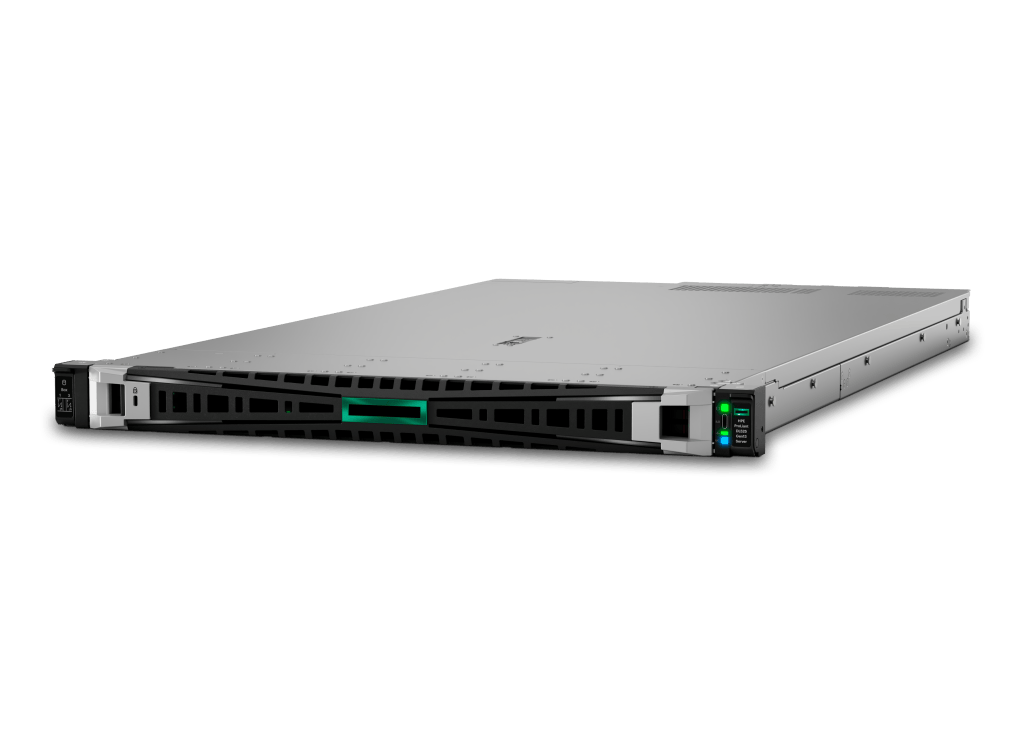
HPE supercharges ProLiant servers with AMD’s EPYC 9006 processors

One important attribute is that HPE iLO 8 delivers auto-SED (Self-Encrypting Drive) server capabilities, automatically protecting data at rest from the moment the server is first powered on, according to Aaron Lamond, product marketing manager, HPE Compute. “No external key manager, additional configuration, or manual activation is required. Encryption stops

Read More »

LNG market tightens into winter as Europe pulls US cargoes, China reopens contract talks

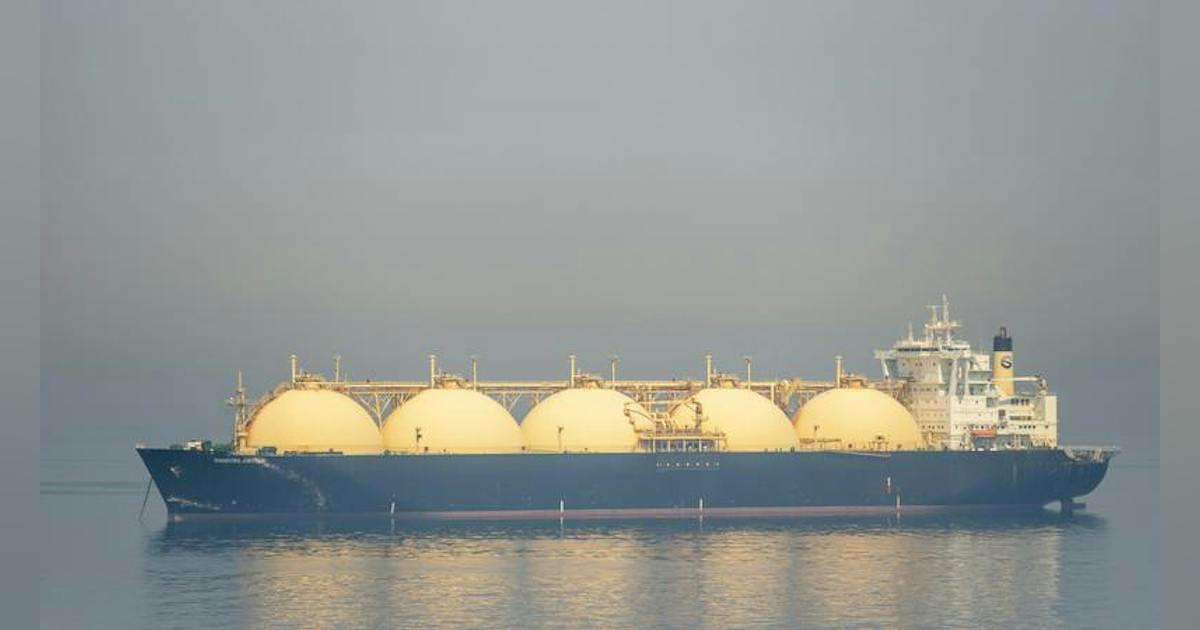
Global LNG markets are entering winter with limited supply cushion, even as a growing carrier fleet and shorter Atlantic voyages keep shipping rates subdued. Meanwhile China is showing signs of returning to long-term US contracting. New liquefaction capacity and higher utilization outside Qatar and the UAE have offset about 60% of Middle East LNG supply losses since March, according to a recent analysis from Morgan Stanley. Weaker demand outside Europe and European storage withdrawals have helped offset the remaining supply loss, but left inventories unusually low heading into winter. EU storage was about 70% full in late September, compared with 82% a year earlier and a 10-year average of 87%. Morgan Stanley raised its fourth-quarter JKM forecast to $27.50/MMbtu from $25/MMbtu, citing a slower Qatari restart and continued winter upside risk. Europe is drawing more flexible US supply. About 57% of US LNG exports were headed to Europe in September, up from 53% in August, while US feedgas rose about 6% month over month as Freeport recovered from an outage. Strong European demand is supporting vessel demand, but shorter US-Europe voyages and rapid fleet growth are more than offsetting that pressure. Atlantic spot rates for modern two-stroke LNG carriers stood at about $25,750/day on Oct. 6, while Pacific rates were about $39,000/day, according to Spark Commodities data. About 55 new LNG carriers were delivered in the first 7 months of 2026, with more expected by yearend. Morgan Stanley similarly noted that Asia LNG carrier rates had fallen about 80% from early-March highs and returned near pre-conflict levels, although route costs remain above levels immediately before the conflict. Meantime, the investment bank expects more than 30 million tpy of non-Middle East capacity to start by end-2027, before additional volumes from Qatar’s North Field expansion. China contracting returns China is adding another

Read More »

EIA: US crude oil inventories down 3.2 million bbl

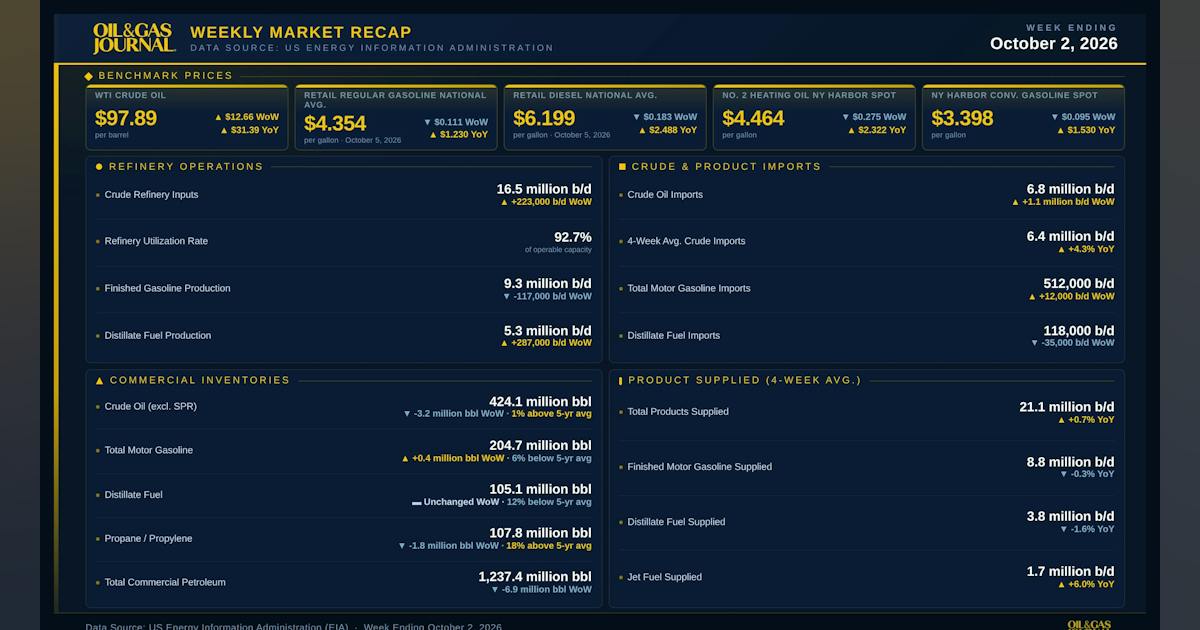
US crude oil inventories for the week ended Oct. 2, excluding the Strategic Petroleum Reserve, decreased by 3.2 million bbl from the previous week, according to data from the US Energy Information Administration (EIA). At 424.1 million bbl, US crude oil inventories are 1% above the 5-year average for this time of year, the EIA report indicated. Gasoline inventories increased 0.4 million bbl, 6% below the 5-year average. Propane-propylene inventories decreased 1.8 million bbl, 18% above the 5-year average. Total commercial petroleum inventories decreased by 6.9 million bbl for the week. Distillate inventories remained unchanged, 12% below the 5-year average. US crude oil refinery inputs averaged 16.5 million b/d for the week ended Oct. 2, which was 223,000 b/d more than the previous week’s average. Refineries operated at 92.7% of capacity. Gasoline output averaged 9.3 million b/d, and distillate production increased to 5.3 million b/d. Crude oil imports increased 1.1 million b/d to 6.8 million b/d. The 4-week average of 6.4 million b/d is 4.3% above the year-ago level. Gasoline imports averaged 512,000 b/d; distillate imports averaged 118,000 b/d. Over the past four weeks, total product supplied averaged 21.1 million b/d, up 0.7% year over year. The 4-week average for gasoline product supplied dereased 0.3% year over year to 8.8 million b/d, while the 4-week average for distillate product supplied decreased 1.6% to 3.8 million b/d. The 4-week average for jet fuel product supplied increased 6.0% year over year.

Read More »

Chevron restructures Bakken midstream agreements, transfers Hess Midstream stake

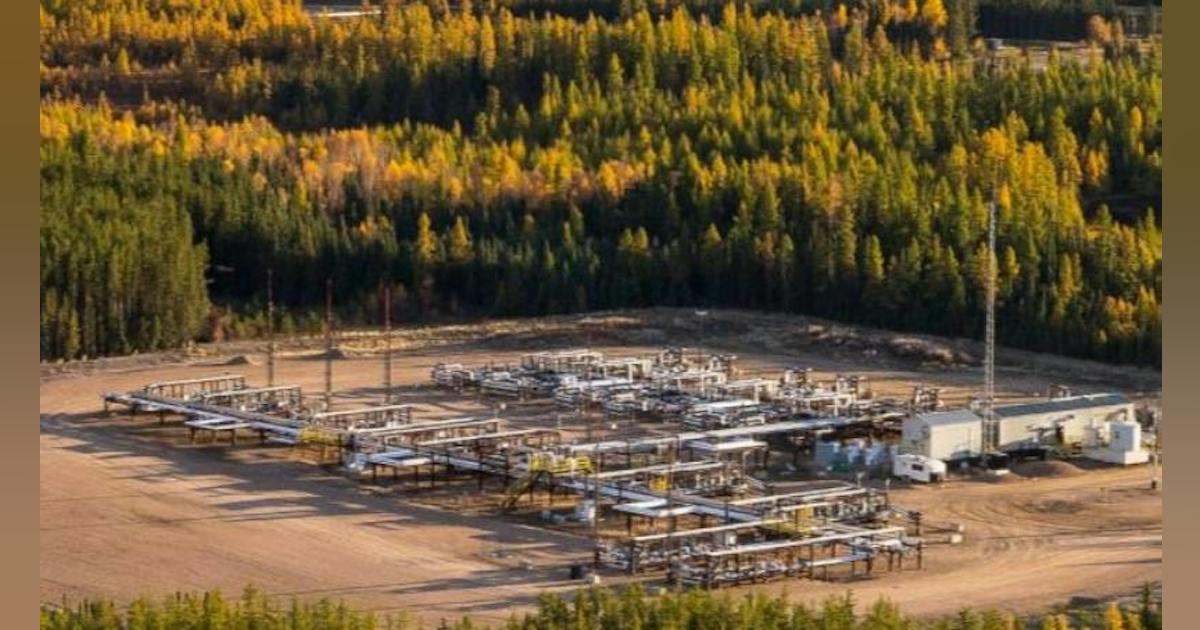
The restructuring follows Chevron’s acquisition of Hess Corp. in July 2025. Chevron inherited Hess Corp.’s 37.8% interest in Hess Midstream, which provides midstream services to Chevron’s Bakken operations. Hess Midstream subsequently adjusted its outlook after Chevron reduced its Bakken drilling program to 3 rigs from 4 in late 2025. The lower activity led Hess Midstream to suspend its planned Capa gas plant project and lower its throughput and capital-spending expectations. Chevron is now expected to reduce its Bakken drilling program to 2 rigs in December, with Hess Midstream’s minimum revenue commitments for 2027-29 based on the 2-rig program, Hess noted. Bakken agreements Hess Midstream and Chevron will reduce the tariff rates Chevron pays for crude oil and natural gas gathering and processing services in the Bakken for 2027-33 and extend the agreements through 2045. Bakken agreements currently structured on a cost-of-service basis will convert to fixed-fee arrangements with inflation escalators. The revised agreements will include a minimum revenue commitment equal to 80% of Hess Midstream’s expected Bakken revenues attributable to Chevron through 2033. The minimum revenue commitment will be established 3 years in advance and, once established for a given year, can only increase based on updated annual development plans provided by Chevron. Minimum commitments for 2027-29 have been established on the basis of a 2-rig program, Hess Midstream said in a separate release. Hess Midstream said the revised commercial arrangements are expected to support Chevron’s investment in the Bakken. Chevron expects to sustain Bakken production through continued technology deployment and operational improvements drawn from its global shale and tight-oil portfolio. Hess Midstream expects Bakken throughput volumes to decline about 5% in 2027 as a result of reduced Chevron activity and then generally plateau beginning in 2028. DJ Basin assets Hess Midstream will acquire Chevron’s crude oil and natural gas

Read More »

DNV: Energy-importing countries scaling clean energy 3x faster than exporters

OGJ: Energy security is becoming a major driver of the energy transition. The DNV outlook found that energy-importing countries are scaling clean energy three times faster than energy-exporting countries. From the perspective of an oil and gas operator, what is the most important implication of that divergence? Alvik: I think it’s important to realize that the customers of the oil and gas business are, longer term, trying to avoid being dependent on that commodity. If you’re exporting oil like the US or Norway or Canada or Brazil or Saudi, your key strategy is to meet the shortfall of Middle East oil and gas as much as possible. But for the importer, both the vulnerability of the supply chains and the price hikes, as well as the attacks on the infrastructure, are demonstrating how vulnerable you are when you are importing any sort of critical commodity to your country, like energy is. And on top of that, you have the industry. If you have a large renewable industry, you would like that to grow. China is the best example. If you have a large oil and gas industry, you would like [that] to grow. The US is a major example of that. So, there are diverging interests leading to diverging results between importers and exporters, and this is clearer than ever. OGJ: Definitely. The Strait of Hormuz is a big part of what’s put energy security back at the center of the conversation. Do you think the current disruption represents a temporary shock to energy markets, or could it fundamentally change how governments and companies think about their exposure to imported oil and gas? Alvik: I think it could fundamentally change. The same way as the Russian attack on Ukraine dramatically changed how Germany, or Poland, or other countries were looking

Read More »

Cenovus to build oil sands business via Athabasca acquisition

“These are long-life assets located in an area where Cenovus already has a deep operating experience and strong understanding of the resource,” McKenzie said on a conference call with analysts. “They also represent one of the only remaining large-scale opportunities to add meaningful thermal reserves, resource and future development inventory within the core of the oil sands.” Among Cenovus’ growth plans is accelerating production from Athabasca’s Corner project northwest of Christina Lake by consolidating two planned expansion phases. Doing so would let Corner’s output grow to 40,000 boe/d by 2032, 3 years faster than today’s forecast. Also in the cards are efficiency projects at Athabasca’s Leismer assets that would grow production by half to about 60,000 boe/d by 2032. Michael Berger, a senior analyst at Enverus Intelligence Research, said buying Athabasca “refills Cenovus’ growth pipeline” as it relates to future production growth. The deal, he added, also “represents an escalation in oil sands deal valuations” that reflects the energy sector’s changing global dynamics. “The higher price paid by Cenovus compared to historical deals reflects a rerating of Canadian oil sands producers higher as the industry’s critical position in providing long-term oil resource in a resource-constrained world grows sharper,” Berger wrote in a commentary analyzing the acquisition plan. “While U.S. plays offer up to a decade of core inventory, the oil sands hold multiple decades. Additionally, scarcity always demands a premium and logical large-scale oil sands acquisition targets have been significantly drawn down.” The planned transaction is expected to be roughly 70% funded by cash and 30% by Cenovus shares and should close by the end of this year. It also will consolidate ownership of Duvernay Energy Corp., an oil-weighted joint venture the two companies created nearly 3 years ago that today operates more than 170 locations on roughly 90,000 net

Read More »

Energy Transfer expands Delaware basin footprint with $2.625 billion deal

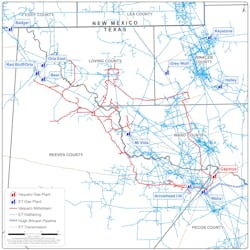
@import url(‘https://fonts.googleapis.com/css2?family=Inter:wght@100..900&display=swap’); .ebm-page__main h1, .ebm-page__main h2, .ebm-page__main h3, .ebm-page__main h4, .ebm-page__main h5, .ebm-page__main h6 { font-family: Inter; } body { line-height: 150%; letter-spacing: 0.025em; } button, .ebm-button-wrapper { font-family: Inter; } .label-style { text-transform: uppercase; color: var(–color-grey); font-weight: 600; font-size: 0.75rem; } .caption-style { font-size: 0.75rem; color: color-mix(in srgb, currentColor 60%, transparent); } #onetrust-pc-sdk [id*=btn-handler], #onetrust-pc-sdk [class*=btn-handler] { background-color: #c19a06 !important; border-color: #c19a06 !important; } #onetrust-policy a, #onetrust-pc-sdk a, #ot-pc-content a { color: #c19a06 !important; } #onetrust-consent-sdk #onetrust-pc-sdk .ot-active-menu { border-color: #c19a06 !important; } #onetrust-consent-sdk #onetrust-accept-btn-handler, #onetrust-banner-sdk #onetrust-reject-all-handler, #onetrust-consent-sdk #onetrust-pc-btn-handler.cookie-setting-link { background-color: #c19a06 !important; border-color: #c19a06 !important; } #onetrust-consent-sdk .onetrust-pc-btn-handler { color: #c19a06 !important; border-color: #c19a06 !important; } Energy Transfer LP has agreed to acquire Vaquero Midstream LLC in a $2.625-billion bolt-on deal to add natural gas gathering and processing assets in the southern Delaware basin of the Texas Permian.   Vaquero holds a 300-mile pipeline network that serves operators across the basin, including in Loving, Reeves, Ward, and Winkler Counties, Tex., and operates the Caymus processing complex in Coyanosa, Pecos County, Tex., near Waha, which includes three processing trains with 675 MMcfd capacity. The company owns acreage to support construction of two additional trains that could increase total processing capacity at the site to about 1.2 bcfd. <!–> –> <!–> April 29, 2025 ]–> <!–> The Vaquero assets are interconnected with Energy Transfer’s downstream natural gas and NGL infrastructure, which Energy Transfer said could generate incremental revenue opportunities through pipeline transportation, fractionation, terminalling, and export services. Vaquero is supported by long-term, fee-based contracts with average remaining life of 10 years, and 100,000 dedicated acres. Consideration for the deal, which is expected to close in this year’s fourth quarter subject to customary conditions, consists of $1.95 billion in cash and about 33.3 million newly issued Energy Transfer common units. ]–>

Read More »

Brookfield’s AREP Deal Extends the AI Infrastructure Stack to Powered Land

The transaction goes beyond Brookfield investing in another portfolio of buildings. It is investing in a developer whose principal product increasingly begins before the building, with land, entitlements, substations, transmission access and utility capacity. PowerHouse Has Become a Gigawatt-Scale Development Platform PowerHouse was founded with a strong Northern Virginia orientation, but its development map now stretches well beyond Data Center Alley as its current portfolio includes projects in Virginia, Texas, Pennsylvania, North Carolina, Nevada, Indiana, Illinois and Kentucky. The company lists 515 MW across its Northern VA Ashburn properties, another 900 MW at its PH 95 development in Spotsylvania, 1.35 GW in Carlisle, Pennsylvania, 1.8 GW at Joliet, Illinois, and substantial campuses across multiple Texas and Indiana locations. The various projects do a good job of illustrating how the definition of a hyperscale development site is changing. At PowerHouse Arcola in Loudoun County, Virginia, PowerHouse announced a long-term hyperscale lease earlier this year. The 37-acre campus includes two planned data center buildings totaling approximately 615,000 square feet and is designed for up to 120 MW of utility capacity. PowerHouse emphasizes not only the buildings but the campus’s on-site substation, fiber access, power security and support for high-density GPU and liquid-cooled deployments. In Texas, it might be that everything really is bigger, and PowerHouse’s Grand Prairie development covers approximately 810 acres and 8.5 million developable square feet. Its project page cites maximum utility power of 1.8 GW and a development schedule extending through 2029 and beyond. The Texas development plans also include a proposed Circle T campus in Westlake outside Fort Worth, which calls for as many as four roughly 300,000-square-foot facilities totaling approximately 300 MW. According to reporting on local filings, PowerHouse has funded a 350-MW Oncor substation intended to serve the campus and the town’s pump station. The company’s development in

Read More »

AI Is Turning Energy Storage Into Active Power Infrastructure

AI Turns the Power Problem Into a Transient Problem At the heart of the issue is the changing behavior of the IT load. In a conventional data center, DeLattre said, large numbers of independent loads create a relatively predictable electrical profile. AI clusters introduce much greater synchronization. As GPUs begin processing a common workload, large numbers of accelerators can increase their power consumption simultaneously. Instead of asking the electrical infrastructure to serve a relatively smooth load, the facility can experience fast power pulses moving through the system. Hybrid supercapacitors are intended to act as a buffer between that dynamic compute load and the infrastructure supplying it. During an upward transient, storage provides some of the incremental power demanded by the IT load. When demand falls, the storage system recharges. The objective is not to create additional energy. It is to keep every upstream component — from the UPS to generators and ultimately the utility connection — from having to respond directly to every rapid change taking place inside the AI cluster. From the perspective of the upstream power source, DeLattre said, the goal is to make a highly dynamic AI load appear significantly smoother. That distinction between energy and power is central to Musashi’s argument for hybrid supercapacitors. A conventional supercapacitor, also known as an electric double-layer capacitor, can deliver very high power almost instantly but stores relatively little energy. A lithium-ion battery can store considerably more energy, but DeLattre argues that it is less suited to being aggressively charged and discharged tens or hundreds of thousands of times. Musashi’s hybrid technology uses a capacitor architecture with a lithium-doped graphite electrode intended to increase energy density while preserving the fast response and high cycling capability associated with capacitors. DeLattre reduces the distinction to a simple formulation. “Batteries are very good

Read More »

AI Infrastructure’s Next Phase: Capital, Power and the Right to Build

Capital Is Becoming Infrastructure Samsung’s $1 billion commitment to Helix Digital Infrastructure offered one of the clearest examples yet of how the capital structure surrounding AI data centers is changing. Helix was formed by KKR as an AI infrastructure platform with more than $10 billion already committed by founding investors including KKR, the Kuwait Investment Authority, NVIDIA and Vistra. Samsung’s new commitment pushes that capital base still higher. But the composition of the partnership may be more significant than another billion dollars being added to the AI infrastructure ledger. Helix is intended to invest across hyperscale data centers, power generation and transmission, fiber and other connectivity infrastructure. Samsung, meanwhile, brings capabilities extending across advanced technology, construction, energy storage and cooling. This is not simply capital chasing data center returns. It increasingly resembles an attempt to assemble the data center, energy and technology supply chain inside a single investment ecosystem. That distinction is important, because one of the defining problems of the current buildout is that capital by itself does not produce capacity. Billions of dollars can be committed long before transformers arrive, transmission is constructed, generation is secured or a campus is commissioned. The increasingly valuable infrastructure platform is therefore the one capable of controlling more of those dependencies. Lambda demonstrated another side of that evolution last week with the closing of a $1.008 billion delayed-draw term loan supporting three committed customer deployments across multiple data centers. The financing received investment-grade ratings from Morningstar DBRS and Moody’s and carries a 6.78% fixed interest rate. More importantly, it is secured by both the GPU infrastructure being financed and contracted cash flows from two investment-grade customers. Capital is drawn as infrastructure reaches commissioning milestones rather than simply being handed to Lambda upfront. That begins to make AI compute look less like speculative

Read More »

Micro data center company rolls out stackable data center for edge and AI

Stack runs on Zella Sense, a monitoring, control, and automation layer built into every Zella DC cabinet. It tracks power, cooling, servers, and suspicious activity, while monitoring things like temperature, humidity, smoke, motion, water, and doors through sensors. The system runs over SNMP, Modbus, and a full API, with email alerting and local, LDAP, RADIUS, or TACACS+ authentication. That means an edge location can be remotely monitored without requiring local staff. It also comes with access control and fire protection. Zella Stack is an indoor-only offering. Zella DC sells Zella Outback as its standalone, ruggedized outdoor micro data center, and the company says an outdoor version of Stack is planned for the second half of 2027.

Read More »

Data Center Jobs: Engineering, Construction, Commissioning, Sales, Field Service and Facility Tech Jobs Available in Major Data Center Hotspots

Each month Data Center Frontier, in partnership with Pkaza, posts some of the hottest data center career opportunities in the market. Here’s a look at some of the latest data center jobs posted on the Data Center Frontier jobs board, powered by Pkaza Critical Facilities Recruiting. Looking for Data Center Candidates? Check out Pkaza’s Active Candidate / Featured Candidate Hotlist  Lead Mechanical Engineer – Data Center DesignNew York, NY/Remote This position is also available in: Denver, CO; Indianapolis, IN; Cedar Rapids, IA; Austin, TX; White Plains, NY; Dallas, TX; Richmond, VA; Ashburn, VA; Charlotte, NC; Atlanta, GA; Phoenix, AZ; Salt Lake City, UT; Kansas City, MO; Chicago, IL; Los Angeles, CA or San Jose, CA. Our client is a leading engineering design and commissioning company that is a subject matter expert in the data center space. They will provide design coordination and construction administration, consulting and management support for the data center / mission critical facilities space with the mindset to provide reliability, energy efficiency, and sustainable design expertise when providing these consulting services for enterprise, colocation and hyperscale companies. This career-growth minded opportunity offers exciting projects with leading-edge technology and innovation as well as competitive salaries and benefits. Electrical Commissioning Agent – Data Centers Austin, TX (limited travel) Non-Traveling CxA positions available in: Indianapolis, IN; Cedar Rapids, IA; Phoenix, AZ and Columbus, OH. Traveling CxA based near any major airport, otherwise traveling to: New York, NY; White Plains, NY; Dallas, TX; Richmond, VA; Montvale, NJ; Charlotte, NC; Salt Lake City, UT; Kansas City, MO; Chesterton, IN or Chicago, IL. ***Also looking for a Lead EE and ME CxA Agents and CxA PMs. *** This opportunity is with a leading EPC company of data center design / build / commissioning solutions. This company provides a complete life cycle of solutions that are custom-fit

Read More »

Startup doxx.net hands the network controls to AI

“The whole thing is run completely by AI, so behind the scenes, I mean, it’s a network with 31 locations around the world, and internally there’s a mesh network, and I can’t, as a human being, manage all of this by myself,” Lyon said. Lyon said the team modeled every site, down to the wire and the optic, in a virtual model before building. An infrastructure management system running the company’s own AI on its own hardware then ordered the installation. It orchestrated shipping and delivery through data center APIs. Human technicians performed the remote smart hands installations. The company also built tools for agents to work with users and with the network. An agent gateway gives an AI agent an identity in the doxx.net chat app. The user pastes a credential into the agent. The agent obtains its certificate and appears in the user’s chat. Users can create group chats with several agents. In one example, Lyon said one agent runs BGP while others handle other tasks.

Read More »

Microsoft will invest $80B in AI data centers in fiscal 2025

And Microsoft isn’t the only one that is ramping up its investments into AI-enabled data centers. Rival cloud service providers are all investing in either upgrading or opening new data centers to capture a larger chunk of business from developers and users of large language models (LLMs).  In a report published in October 2024, Bloomberg Intelligence estimated that demand for generative AI would push Microsoft, AWS, Google, Oracle, Meta, and Apple would between them devote $200 billion to capex in 2025, up from $110 billion in 2023. Microsoft is one of the biggest spenders, followed closely by Google and AWS, Bloomberg Intelligence said. Its estimate of Microsoft’s capital spending on AI, at $62.4 billion for calendar 2025, is lower than Smith’s claim that the company will invest $80 billion in the fiscal year to June 30, 2025. Both figures, though, are way higher than Microsoft’s 2020 capital expenditure of “just” $17.6 billion. The majority of the increased spending is tied to cloud services and the expansion of AI infrastructure needed to provide compute capacity for OpenAI workloads. Separately, last October Amazon CEO Andy Jassy said his company planned total capex spend of $75 billion in 2024 and even more in 2025, with much of it going to AWS, its cloud computing division.

Read More »

John Deere unveils more autonomous farm machines to address skill labor shortage

Join our daily and weekly newsletters for the latest updates and exclusive content on industry-leading AI coverage. Learn More Self-driving tractors might be the path to self-driving cars. John Deere has revealed a new line of autonomous machines and tech across agriculture, construction and commercial landscaping. The Moline, Illinois-based John Deere has been in business for 187 years, yet it’s been a regular as a non-tech company showing off technology at the big tech trade show in Las Vegas and is back at CES 2025 with more autonomous tractors and other vehicles. This is not something we usually cover, but John Deere has a lot of data that is interesting in the big picture of tech. The message from the company is that there aren’t enough skilled farm laborers to do the work that its customers need. It’s been a challenge for most of the last two decades, said Jahmy Hindman, CTO at John Deere, in a briefing. Much of the tech will come this fall and after that. He noted that the average farmer in the U.S. is over 58 and works 12 to 18 hours a day to grow food for us. And he said the American Farm Bureau Federation estimates there are roughly 2.4 million farm jobs that need to be filled annually; and the agricultural work force continues to shrink. (This is my hint to the anti-immigration crowd). John Deere’s autonomous 9RX Tractor. Farmers can oversee it using an app. While each of these industries experiences their own set of challenges, a commonality across all is skilled labor availability. In construction, about 80% percent of contractors struggle to find skilled labor. And in commercial landscaping, 86% of landscaping business owners can’t find labor to fill open positions, he said. “They have to figure out how to do

Read More »

2025 playbook for enterprise AI success, from agents to evals

Join our daily and weekly newsletters for the latest updates and exclusive content on industry-leading AI coverage. Learn More 2025 is poised to be a pivotal year for enterprise AI. The past year has seen rapid innovation, and this year will see the same. This has made it more critical than ever to revisit your AI strategy to stay competitive and create value for your customers. From scaling AI agents to optimizing costs, here are the five critical areas enterprises should prioritize for their AI strategy this year. 1. Agents: the next generation of automation AI agents are no longer theoretical. In 2025, they’re indispensable tools for enterprises looking to streamline operations and enhance customer interactions. Unlike traditional software, agents powered by large language models (LLMs) can make nuanced decisions, navigate complex multi-step tasks, and integrate seamlessly with tools and APIs. At the start of 2024, agents were not ready for prime time, making frustrating mistakes like hallucinating URLs. They started getting better as frontier large language models themselves improved. “Let me put it this way,” said Sam Witteveen, cofounder of Red Dragon, a company that develops agents for companies, and that recently reviewed the 48 agents it built last year. “Interestingly, the ones that we built at the start of the year, a lot of those worked way better at the end of the year just because the models got better.” Witteveen shared this in the video podcast we filmed to discuss these five big trends in detail. Models are getting better and hallucinating less, and they’re also being trained to do agentic tasks. Another feature that the model providers are researching is a way to use the LLM as a judge, and as models get cheaper (something we’ll cover below), companies can use three or more models to

Read More »

OpenAI’s red teaming innovations define new essentials for security leaders in the AI era

Join our daily and weekly newsletters for the latest updates and exclusive content on industry-leading AI coverage. Learn More OpenAI has taken a more aggressive approach to red teaming than its AI competitors, demonstrating its security teams’ advanced capabilities in two areas: multi-step reinforcement and external red teaming. OpenAI recently released two papers that set a new competitive standard for improving the quality, reliability and safety of AI models in these two techniques and more. The first paper, “OpenAI’s Approach to External Red Teaming for AI Models and Systems,” reports that specialized teams outside the company have proven effective in uncovering vulnerabilities that might otherwise have made it into a released model because in-house testing techniques may have missed them. In the second paper, “Diverse and Effective Red Teaming with Auto-Generated Rewards and Multi-Step Reinforcement Learning,” OpenAI introduces an automated framework that relies on iterative reinforcement learning to generate a broad spectrum of novel, wide-ranging attacks. Going all-in on red teaming pays practical, competitive dividends It’s encouraging to see competitive intensity in red teaming growing among AI companies. When Anthropic released its AI red team guidelines in June of last year, it joined AI providers including Google, Microsoft, Nvidia, OpenAI, and even the U.S.’s National Institute of Standards and Technology (NIST), which all had released red teaming frameworks. Investing heavily in red teaming yields tangible benefits for security leaders in any organization. OpenAI’s paper on external red teaming provides a detailed analysis of how the company strives to create specialized external teams that include cybersecurity and subject matter experts. The goal is to see if knowledgeable external teams can defeat models’ security perimeters and find gaps in their security, biases and controls that prompt-based testing couldn’t find. What makes OpenAI’s recent papers noteworthy is how well they define using human-in-the-middle

Read More »