Stay Ahead, Stay ONMINE

Rumi raises $4.7M to change passive media into interactive AI experiences

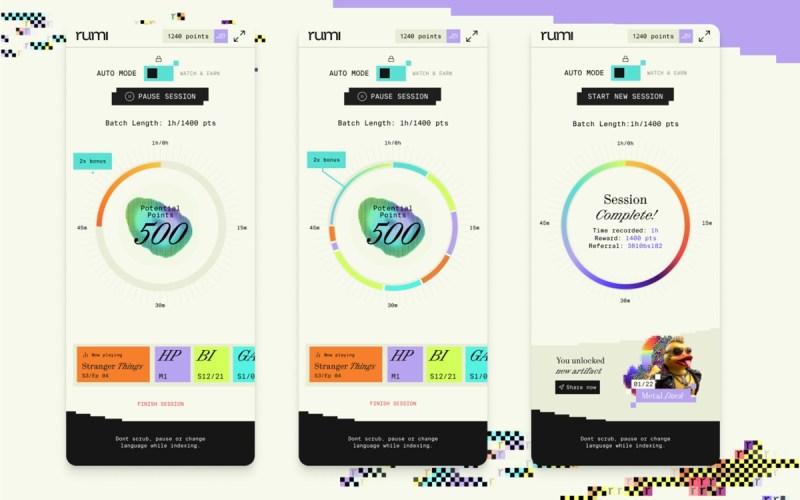
How would you like to earn money while watching TV? Rumi, an AI media company, has raised $4.7 million in a pre-seed funding round to transform passive media with rewards. Rumi is launching its invite-only beta app today and it aims to allows users to engage with media content in real time. The round, co-led by A16z crypto CSX and EV3, will support Rumi’s mission to build the first decentralized AI infrastructure for media, combining cutting-edge artificial intelligence with user-powered indexing to transform streaming into an intelligent, interactive experience. Viewers can chat with characters or pro sports athletes about what they’re doing on the screen, identify actors and outfits on screen, or receive real-time fact checks during heated political debates — all powered by AI. “Rumi sits at the cutting edge of AI agents, consumer media and decentralized infrastructure,” said Salvador Gala, cofounder of EV3, in a statement. “Their approach to indexing audio and video content through a distributed network of AI-powered nodes empowers users to directly benefit from existing behaviors.” Streaming meets earning Rumi has raised $4.7 million. With users spending more than five hours a day watching content — often while multitasking — Rumi allows them to earn passive income by contributing spare compute to build the world’s richest knowledge base on video content that in turn allows AI agents to deeply understand and augment media in ways we can’t even imagine yet, the company said.  “AI can make storytelling truly immersive — but it first needs to understand the world’s content and culture to do so,” said Niko Cunningham, CEO of Rumi, in a statement. “Rumi is building that infrastructure and giving users a way to be part of it from day one.” This decentralized indexing system helps AI agents deliver smarter insights and personalized features such as contextual overlays, real-time cultural context and interactive recommendations, while protecting user privacy and respecting content IP. Business model and partnerships Rumi is licensing infrastructure to third party AI agents, developers, and creators, providing agents brand new functionality and monetization opportunities. Those opportunities include contextual ads which, from the viewer’s perspective, can be seamlessly integrated in the conversation with AI agents, and much more value-adding. Agents can organically surface recipe cards during cooking shows or fashion links tied to what characters are wearing on the screen.  Rumi is also building a “decentralized Nielsen,” offering real-time analytics and audience insights. Early partnerships include Virtuals.io, who will integrate Rumi’s APIs to provide agents using their platform media contextual-awareness and interactivity capabilities, in addition to TVision and Story Protocol who will rely on Rumi to provide unique viewership data and content analytics.  Rumi is now welcoming early users to its watch-to-earn beta, allowing participants to help build what it calls the first intelligent, user-powered media ecosystem. Sign up at https://www.rumilabs.io. How Rumi works Infrastructure allowing AI to understand human stories and culture locked in billions of hours of video. Imagine having an entire cast and crew, commentators, shopping assistants, fact-checkers, researchers, and writers in your living room — sitting on your couch with you as you watch your favorite movies, shows, sports, news. That’s media contextually-aware AI. To enable that future, the company built a decentralized network of indexers analyzing content as they watch, and getting compensated for their work and compute. Over time, the company plans to use the money to bring to market the world’s best AI architecture for distilling the story from video: relations between actions, characters, objects; story / character arcs — mapping, understanding and AI participating in the world’s stories — not just documents and facts like today’s current LLMs. The company is building infrastructure to support Live TV / sports (vs historical content that are covering now) and to build a brand new gateway to media, D2C app — first ever AI remote and media companion. How the “watch-to-earn” model works Rumi indexes videos and offers rewards to viewers. Users get paid for their compute and data contributions. They are providing value by analyzing video content and interacting with it on their machines. That data is valuable because it empowers the next generation of AI agents that can identify and deeply understand content, providing them the ability to augment and personalize content for you, and turn passive media into interactive experience. The viewership analytics data that we’re collecting on how people interact with content at the depth never reached before, is also used to improve content and advertising quality. The company said it will help individual creators and Hollywood studios improve quality of storytelling, as Rumi is collecting the richest and most granular trove of data on what resonates with people — stories, characters, objects. Rumi said it will boost advertisers’ return-on-investment by enabling contextual, agentic ads, that are more personalized and valuable to consumer, and feel seamless, organic — embedded in the natural conversation flow… ads that don’t feel like ads. Of course, people have to agree to the privacy policies of the company. As far as the target audience goes, Rumi said anyone with a computer and access to streaming platforms can join our network today, and get rewarded for their contributions to enabling the AI-powered Media future. The company is primarily focused on Web3 users, as they’re used to the model of sharing their spare resources, such as compute power or bandwidth, in exchange for points or tokens. Rival companies There are a few decentralized networks paying people for their compute resources to train AI models or run inference, such as Bittensor, Akash, or Render. However, Rumi said it is focused on video understanding, and have built its proprietary deep learning models and architectures that allow it to distill the essence of the story from the video, which Rumi believes will be critical for AI to truly understand the stories humans care about and how they connect to our culture, building up towards more human AI. Rumi makes money by providing media contextual awareness to AI Agents, allowing them to become way more than simple bots on social media. Rumi charges them for accessing its APIs, and serve their end users contextual Ads. It’s also selling viewership data and analytics to media companies, advertisers, AI Labs, and other parties interested in understanding how consumers interact with content (on which they spend perhaps five hours a day). Content licensing and rights management policies for AI Rumi said it is never storing, rebroadcasting nor exposing any actual IP-protected content. Its decentralized network is indexing it in similar fashion that Google indexed web pages. The company said it will never train any AI models on that IP-protected content. It is building infrastructure that benefits IP owners: Rumi gives them a brand new direct channel of communication with their audiences, via which they can deepen the consumer engagement in ways unimaginable before, and access new monetization opportunities. Courts have repeatedly upheld that publishing granular transcriptions or summaries of video content qualify as fair use—as seen in Google Books (Authors Guild v. Google), where digitizing and displaying searchable snippets of entire books was ruled transformative. And the same held in TVEyes v. Fox, where indexing and repurposing broadcast content for search and review was partially upheld as fair use. Rumi’s network of indexers transcribes content, but it doesn’t publish it to the public. Rumi’s protocol only exposes APIs to allow AI Agents to interact with that transcript and content fingerprint, prompt by prompt. Rumi said this opens endless opportunities for creators to make their content more personalized and interactive, so it ultimately benefits the IP owners, as they direct channels of communication with their audiences, which they can monetize. Why now? What macro trends are converging that make Rumi viable today? Consumers want more interactive, connected, personalized and immersive entertainment. It’s clear looking at the growth of gaming, social media, and the massive second screening trend: 80% of Gen Zs report constantly scrolling through their phones while watching TV. Consumer AI agents are about to boom, but they will not start with high stakes use cases like planning and paying for your vacation. They will start in your living room, making your entertainment more immersive, connected and educational. Tech is finally ready, and anyone can analyze content on their device, contribute to more immersive and personalized future of media, and earn while doing that, Rumi said.



How would you like to earn money while watching TV? Rumi, an AI media company, has raised $4.7 million in a pre-seed funding round to transform passive media with rewards.

Rumi is launching its invite-only beta app today and it aims to allows users to engage with media content in real time.

The round, co-led by A16z crypto CSX and EV3, will support Rumi’s mission to build the first decentralized AI infrastructure for media, combining cutting-edge artificial intelligence with user-powered indexing to transform streaming into an intelligent, interactive experience.

Viewers can chat with characters or pro sports athletes about what they’re doing on the screen, identify actors and outfits on screen, or receive real-time fact checks during heated political debates — all powered by AI.

“Rumi sits at the cutting edge of AI agents, consumer media and decentralized infrastructure,” said Salvador Gala, cofounder of EV3, in a statement. “Their approach to indexing audio and video content through a distributed network of AI-powered nodes empowers users to directly benefit from existing behaviors.”

Streaming meets earning

Rumi has raised $4.7 million.

With users spending more than five hours a day watching content — often while multitasking — Rumi allows them to earn passive income by contributing spare compute to build the world’s richest knowledge base on video content that in turn allows AI agents to deeply understand and augment media in ways we can’t even imagine yet, the company said. 

“AI can make storytelling truly immersive — but it first needs to understand the world’s content and culture to do so,” said Niko Cunningham, CEO of Rumi, in a statement. “Rumi is building that infrastructure and giving users a way to be part of it from day one.”

This decentralized indexing system helps AI agents deliver smarter insights and personalized features such as contextual overlays, real-time cultural context and interactive recommendations, while protecting user privacy and respecting content IP.

Business model and partnerships

Rumi is licensing infrastructure to third party AI agents, developers, and creators, providing agents brand new functionality and monetization opportunities. Those opportunities include contextual ads which, from the viewer’s perspective, can be seamlessly integrated in the conversation with AI agents, and much more value-adding. Agents can organically surface recipe cards during cooking shows or fashion links tied to what characters are wearing on the screen. 

Rumi is also building a “decentralized Nielsen,” offering real-time analytics and audience insights. Early partnerships include Virtuals.io, who will integrate Rumi’s APIs to provide agents using their platform media contextual-awareness and interactivity capabilities, in addition to TVision and Story Protocol who will rely on Rumi to provide unique viewership data and content analytics. 

Rumi is now welcoming early users to its watch-to-earn beta, allowing participants to help build what it calls the first intelligent, user-powered media ecosystem. Sign up at https://www.rumilabs.io.

How Rumi works

Infrastructure allowing AI to understand human stories and culture locked in billions of hours of video.

Imagine having an entire cast and crew, commentators, shopping assistants, fact-checkers, researchers, and writers in your living room — sitting on your couch with you as you watch your favorite movies, shows, sports, news. That’s media contextually-aware AI. To enable that future, the company built a decentralized network of indexers analyzing content as they watch, and getting compensated for their work and compute.

Over time, the company plans to use the money to bring to market the world’s best AI architecture for distilling the story from video: relations between actions, characters, objects; story / character arcs — mapping, understanding and AI participating in the world’s stories — not just documents and facts like today’s current LLMs.

The company is building infrastructure to support Live TV / sports (vs historical content that are covering now) and to build a brand new gateway to media, D2C app — first ever AI remote and media companion.

How the “watch-to-earn” model works

Rumi indexes videos and offers rewards to viewers.

Users get paid for their compute and data contributions. They are providing value by analyzing video content and interacting with it on their machines.

That data is valuable because it empowers the next generation of AI agents that can identify and deeply understand content, providing them the ability to augment and personalize content for you, and turn passive media into interactive experience.

The viewership analytics data that we’re collecting on how people interact with content at the depth never reached before, is also used to improve content and advertising quality.

The company said it will help individual creators and Hollywood studios improve quality of storytelling, as Rumi is collecting the richest and most granular trove of data on what resonates with people — stories, characters, objects.

Rumi said it will boost advertisers’ return-on-investment by enabling contextual, agentic ads, that are more personalized and valuable to consumer, and feel seamless, organic — embedded in the natural conversation flow… ads that don’t feel like ads. Of course, people have to agree to the privacy policies of the company.

As far as the target audience goes, Rumi said anyone with a computer and access to streaming platforms can join our network today, and get rewarded for their contributions to enabling the AI-powered Media future. The company is primarily focused on Web3 users, as they’re used to the model of sharing their spare resources, such as compute power or bandwidth, in exchange for points or tokens.

Rival companies

There are a few decentralized networks paying people for their compute resources to train AI models or run inference, such as Bittensor, Akash, or Render.

However, Rumi said it is focused on video understanding, and have built its proprietary deep learning models and architectures that allow it to distill the essence of the story from the video, which Rumi believes will be critical for AI to truly understand the stories humans care about and how they connect to our culture, building up towards more human AI.

Rumi makes money by providing media contextual awareness to AI Agents, allowing them to become way more than simple bots on social media. Rumi charges them for accessing its APIs, and serve their end users contextual Ads.

It’s also selling viewership data and analytics to media companies, advertisers, AI Labs, and other parties interested in understanding how consumers interact with content (on which they spend perhaps five hours a day).

Content licensing and rights management policies for AI

Rumi said it is never storing, rebroadcasting nor exposing any actual IP-protected content. Its decentralized network is indexing it in similar fashion that Google indexed web pages.

The company said it will never train any AI models on that IP-protected content. It is building infrastructure that benefits IP owners: Rumi gives them a brand new direct channel of communication with their audiences, via which they can deepen the consumer engagement in ways unimaginable before, and access new monetization opportunities.

Courts have repeatedly upheld that publishing granular transcriptions or summaries of video content qualify as fair use—as seen in Google Books (Authors Guild v. Google), where digitizing and displaying searchable snippets of entire books was ruled transformative. And the same held in TVEyes v. Fox, where indexing and repurposing broadcast content for search and review was partially upheld as fair use.

Rumi’s network of indexers transcribes content, but it doesn’t publish it to the public. Rumi’s protocol only exposes APIs to allow AI Agents to interact with that transcript and content fingerprint, prompt by prompt.

Rumi said this opens endless opportunities for creators to make their content more personalized and interactive, so it ultimately benefits the IP owners, as they direct channels of communication with their audiences, which they can monetize.

Consumers want more interactive, connected, personalized and immersive entertainment. It’s clear looking at the growth of gaming, social media, and the massive second screening trend: 80% of Gen Zs report constantly scrolling through their phones while watching TV.

Consumer AI agents are about to boom, but they will not start with high stakes use cases like planning and paying for your vacation. They will start in your living room, making your entertainment more immersive, connected and educational. Tech is finally ready, and anyone can analyze content on their device, contribute to more immersive and personalized future of media, and earn while doing that, Rumi said.

Shape
Shape
Stay Ahead

Explore More Insights

Stay ahead with more perspectives on cutting-edge power, infrastructure, energy,  bitcoin and AI solutions. Explore these articles to uncover strategies and insights shaping the future of industries.

Shape

Fortinet adds AI protections to endpoint security platform

“FortiEndpoint provides centralized visibility into AI applications and agents operating across managed endpoints. Security teams can identify sanctioned and unsanctioned tools, detect shadow AI, monitor adoption trends, and understand user activity through unified dashboards,” wrote Ankit Gupta, product and marketing leader for Fortinet, in a blog post about the enhancements.

Read More »

ISC2: AI raises accountability demands for cybersecurity teams

Artificial intelligence is changing how cybersecurity teams work, with security professionals spending more time validating AI-generated recommendations and deciding when to trust AI outputs, according to new research from ISC2. The ISC2 survey of 856 cybersecurity professionals found that 65% spent more time deciding when to trust or act on

Read More »

Governments to enterprises: Improve your router security hygiene

Actors have exploited, at the very least, CVE-2018-0171 (published in 2018) and CVE-2008-4128 (published in 2008), according to the bulletin. Both of these targeted Cisco routers, giving remote, unauthenticated attackers the ability to execute arbitrary code, take unauthorized actions, or cause a denial of service (DoS). Notable groups using this

Read More »

Routine maintenance as a failure vector in modern networks

Pre-checks should include both control-plane and data-plane evidence. Control-plane checks confirm configuration, synchronization, device health, routing tables, interface status and object availability. Data-plane checks validate real traffic movement: TCP handshakes, TLS negotiation, HTTP status codes, API responses, session persistence, source NAT behavior and return-path consistency. During the change, monitoring should

Read More »

DOE Alternative Fuels and Feedstocks Office Announces Intent to Advance Innovative Chemical Technologies

Proposed DOE funding will accelerate domestic chemical production WASHINGTON—The U.S. Department of Energy’s (DOE) Alternative Fuels and Feedstocks Office (AFFO) today announced its intent to fund the advancement of novel, high-impact chemical technologies. The proposed funding opportunity, Accelerating Scale-up and Pre-piloting of Emerging Chemical Technologies (ASPECT), will advance technologies for producing chemicals from alternative and waste feedstocks. In accordance with President Trump’s Executive Order Unleashing American Energy, this funding opportunity will strengthen domestic supply chains, reduce reliance on foreign imports, and accelerate American technology innovation. More than 96% of manufactured goods rely on products from the U.S. chemical sector, which directly employs more than half a million Americans. The ASPECT funding opportunity will reinforce domestic manufacturing and chemical supply chains by expanding the use of alternative feedstocks. Funding provided through ASPECT will target chemical technologies that improve performance, reduce costs, and show large market growth potential. AFFO expects to issue a notice of funding opportunity (NOFO) in August 2026, making up to $58 million available for projects that address the following topic areas: Topic Area 1: Bench ASPECT – to support the development and adoption of new technologies for producing chemicals from alternative feedstocks, moving beyond proof-of-concept to bench and pre-pilot scale. Topic Area 2: Pre-pilot ASPECT – to accelerate the development and market entry of strategically valuable, domestically produced chemicals. Following the NOFO announcement, AFFO will host an informational webinar to discuss a new, streamlined application and review process. Learn more about the topic areas, applicant eligibility and registration requirements, and the Teaming Partner List. Visit DOE eXCHANGE to view the full NOI.

Read More »

PTTEP achieves Thailand’s first wellhead platform reuse in Gulf of Thailand

PTT Exploration and Production Public Co. Ltd. (PTTEP) has completed Thailand’s first total wellhead platform reuse project by redeploying an entire decommissioned petroleum wellhead platform as a complete structure in Funan field in the Gulf of Thailand. The reuse project comes as part of PTTEP’s program to maximize value and extend utilization of wellhead platforms that remain structurally sound and safe after depleting resources at a location by redeploying the platform as a complete structure. The first implementation was carried out at the Jakrawan K wellhead platform (JKWK), in Funan field under the G1/61 Project. As part of the project, PTTEP adopted the wet-tow method to relocate the jacket, helping curb energy consumption and minimize impacts on marine life attached to the platform structure, supporting a balance between energy production and marine environmental stewardship. The topside, jacket, and selected pile sections were relocated and reinstalled for use within the same field, reducing the overall construction and installation period to only 6 months, down from about 20 months for a newly built platform.  Additionally, the approach cut construction costs by about 35–50% compared with construction of an entirely new wellhead platform. PTTEP said it expects the initiative to also reduce greenhouse gas emissions by about 3,270 tonnes of CO2e/platform by limiting the use of steel and other equipment required for construction of new platforms. PTTEP is operator of the G1/61 project (60%) with partner Mubadala Investment Co. (40%).

Read More »

Trump declares Iran ceasefire over; oil surges on renewed supply risk

US President Donald Trump said the ceasefire and memorandum of understanding (MOU) reached with Iran last month is effectively over following a fresh exchange of strikes, reigniting supply concerns and sending crude prices sharply higher. Speaking alongside NATO Secretary-General Mark Rutte at the alliance’s summit in Ankara, Pres. Trump said Washington no longer sees value in maintaining the ceasefire framework with Tehran, though he left open the possibility of continued talks. He added that further US military action against Iran remains likely after strikes overnight. Stay updated on oil price volatility, shipping disruptions, LNG market analysis, and production output at OGJ’s Iran war content hub. The escalation was triggered by alleged Iranian attacks on three commercial vessels transiting the Strait of Hormuz on July 7. US Central Command said it responded with strikes on more than 80 Iranian targets, including air defense systems, command-and-control infrastructure, anti-ship missile capabilities, and over 60 Islamic Revolutionary Guard Corps (IRGC) fast boats operating in and near the strait. US Central Command described the tanker attacks as a clear violation of the June 17 agreement. Iran’s Foreign Ministry called the US strikes a breach of the MOU and said Tehran would continue to defend its sovereignty. The IRGC said it retaliated with drone and missile strikes targeting US military facilities in Bahrain and Kuwait. Authorities in both countries reported intercepting incoming projectiles, with no material damage confirmed. Trump said on July 8 the US is considering reinstating a naval blockade targeting Iranian ports and vessels. He also raised the possibility of strikes on civilian infrastructure, including electric plants and desalination facilities, as well as a potential move to take control of Kharg Island, home to the bulk of Iran’s crude export infrastructure. He said Tuesday’s strikes had reached the island but had not targeted its

Read More »

US EIA forecasts declining oil prices as supply disruptions ease

In its July 7 Short-Term Energy Outlook (STEO) report, the US Energy Information Administration (EIA) said it expects global oil prices to decline as supply disruptions linked to the Strait of Hormuz ease and production recovers.  On June 18, the US and Iran signed a memorandum of understanding to end the conflict and reopen the strait, which had been largely closed since Feb. 28. The disruption to this critical oil transit chokepoint constrained global flows, driving major price volatility. Brent crude averaged $85/bbl in June, down $22/bbl from May and $32/bbl below its April peak. Prices fell below $70/bbl on July 1 as tanker traffic through the strait increased sharply, easing supply concerns. EIA now expects most shut-in crude production to return to near pre-conflict levels by yearend, with full restoration largely to be completed by first-quarter 2027.  Despite the recovery in flows, global inventories remain significantly depleted following earlier draws. EIA estimates oil inventories declined by an average of 5.1 million b/d in second-quarter 2026 and will fall by a further 2.2 million b/d in third-quarter 2026, as much of the recent tanker movement reflects previously stranded cargoes. As a result, the market is expected to remain relatively tight through most of third-quarter 2026 before shifting back into oversupply. EIA forecasts global oil consumption will decline by 1.2 million b/d in 2026, led by a 0.8 million b/d drop in non-OECD demand, particularly in the Asia Pacific. Demand is expected to rebound in 2027 as prices ease and supply normalizes, with consumption rising by 2.0 million b/d to 104.8 million b/d.  As supply growth outpaces demand, inventories are projected to build by 2.7 million b/d in fourth-quarter 2026 and by 5.0 million b/d in 2027. This shift is expected to place sustained downward pressure on prices. EIA forecasts Brent

Read More »

Eni lets EPCI contract for Kutei North Hub field FPSO

Eni North Ganal has let an engineering, procurement, construction, and installation (EPCI) contract to a joint venture between PT Saipem Indonesia and PT Tripatra Engineers and Constructors for a floating production, storage, and offloading (FPSO) unit for the Kutei North Hub Field Development Project in Kutei basin, offshore Indonesia, about 70 km off East Kalimantan. The project execution, with an estimated duration of 48 months, includes project management, engineering, procurement of materials, fabrication, construction and installation activities, as well as commissioning and start-up of the FPSO unit. The contract is valued at about $2 billion for Saipem’s share. The Kutei FPSO project is part of the Kutei North Hub Development, which comprises a subsea development tied back to the new FPSO, a dedicated gas export pipeline to the Bontang LNG plant, and domestic gas users via the existing East Kalimantan System. Eni North Ganal is controlled by Searah Ltd., which was formed through a strategic partnership between Eni and Petronas.

Read More »

EIA: US crude inventories up 3.0 million bbl

US crude oil inventories for the week ended July 3, excluding the Strategic Petroleum Reserve, increased by 3.0 million bbl from the previous week, according to data from the US Energy Information Administration (EIA). At 411.4 million bbl, US crude oil inventories are about 6% below the 5-year average for this time of year, the EIA report indicated. EIA said total motor gasoline inventories decreased by 1.9 million bbl from last week and are about 6% below the 5-year average for this time of year. Finished gasoline inventories and blending components inventories both decreased last week. Distillate fuel inventories decreased by 5.0 million bbl last week and are about 12% below the 5-year average for this time of year. Propane-propylene inventories decreased by 800,000 bbl from last week and are 29% above the 5-year average for this time of year, EIA said. US crude oil refinery inputs averaged 17.0 million b/d for the week ended July 3, which was 173,000 b/d less than the previous week’s average. Refineries operated at 95.8% of capacity. Gasoline production decreased, averaging 9.7 million b/d. Distillate fuel production decreased, averaging 5.2 million b/d. US crude oil imports averaged 5.6 million b/d, up 351,000 b/d from the previous week. Over the last 4 weeks, crude oil imports averaged about 5.4 million b/d, 11.4% less than the same 4-week period last year. Total motor gasoline imports averaged 423,000 b/d. Distillate fuel imports averaged 87,000 b/d.

Read More »

How data centers cope with heat waves

“Heat waves are becoming increasingly intense and frequent. What used to happen once every two years now happens two, three, or four times a year,” Benito says. Speaking from his own experience, he adds: “In Spain, data centers already take these factors into account.” When it comes to redundancy, monitoring, or maintenance, these factors are already factored in. “It’s not like it’s an unforeseen event. It’s already been taken into account, and we build in a lot of redundancy—a wide safety margin,” he says. The difference compared to central or northern Europe is that some haven’t considered this possibility. Benito points out that the same thing happens with homes. “For many years, they’ve been designing with two assumptions: that they have plenty of water because their climates are humid, and that it never gets hot,” he says. And this is a problem, because their summer temperatures have risen significantly during extreme heat waves. “Temperatures in the UK have gone up by 10 or 15 degrees, and their data centers aren’t prepared for that,” he says. In fact, he shares an anecdote about “a certain hyperscaler that, a few years ago, when its data centers in the United Kingdom went down, held a global conference to figure out how this had happened and draw lessons from it.” The curious thing is that what they learned was something that was already well known in Spain. İsmail Enes Ayhan | Unsplash It was already getting hot in southern Europe, and preparations were needed. Now, temperatures are becoming a topic of conversation outside the region, and climate change has made its way into IT strategy. Benito confirms that, yes, the conversation is more visible in global settings. “For several reasons. The first is because, obviously, it affects operations. Another is the market. Customers also

Read More »

Weather grows as one of data center growth’s greatest risks

They include West Texas, Tennessee, Wisconsin and Ohio, where tornadoes, hailstorms and high winds present new hazards. Zurich says severe weather has become the largest source of losses in its U.S. builders-risk portfolio over the past three years, surpassing fire as the industry’s dominant construction threat. Weather accounts for 32% of losses in Zurich’s data center portfolio, followed by fire and equipment damage. The second issue is compressed construction schedules. Operators are increasingly beginning operating portions of a campus where construction is complete and while construction continues elsewhere. That means welding and other, heavy equipment plus incomplete fire protection coexist with active server halls containing sensitive computing equipment. Beyond construction and to absolutely no surprise, Zurich identifies energy infrastructure as one of the defining challenges facing AI expansion. The report notes that U.S. data center electricity demand increased roughly 22% in a single year and is expected to nearly triple to approximately 134 gigawatts by 2030.

Read More »

Infoblox acquires Kentik, adding network observability to its DNS and DDI platform

Infoblox announced today that it has entered into a definitive agreement to acquire Kentik, combining Infoblox’s authoritative DNS, DHCP, and IP address management (IPAM) data with Kentik’s network observability platform. Financial terms were not disclosed. Kentik was founded in 2014, originally as CloudHelix before rebranding the following year, and has raised more than $100 million in venture funding to date. The platform provides real-time visibility into network traffic and ingests flow data, routing intelligence, and device telemetry across data centers, cloud environments, WANs, and the public internet. In recent years, the company has enhanced its platform with an AI advisor that helps to accelerate investigations. Infoblox has spent more than two decades managing the DNS, DHCP, and IPAM services enterprises rely on to stay connected. In 2024, it first launched its Universal DDI SaaS platform for managing DNS, DHCP, and IP addresses from a single place, expanding in 2025 to more providers. DDI refers to the trio of core network services in IP networks: DNS, which turns domain names into IP addresses; DHCP, which assigns IP addresses to resources; and IPAM, which manages the network’s IP address infrastructure.

Read More »

Building the AI Optical Layer: Connectivity, Standards, and the Future of AI Infrastructure

As AI data centers push past the limits of traditional compute architecture, the industry’s attention is moving deeper into the physical layer. GPUs, accelerators, power systems and cooling platforms still dominate the headlines, but the network fabric that connects those systems is becoming just as critical. A wave of recent announcements points to the same conclusion: future growth will depend not only on more compute, but on faster, denser, more efficient and more scalable optical connectivity. A new multi-source agreement is bringing together major technology companies to standardize expanded beam optical connectivity for AI data centers. University of Arizona research is powering a new optical switching technology designed to reduce the energy consumed by data center networks. STL is planning to invest up to $100 million in U.S. manufacturing capacity to support AI data center and telecom customers with optical connectivity products. Those developments are now being reinforced by a broader series of moves across the optical ecosystem: Corning’s major AI infrastructure partnerships with NVIDIA and Amazon, GlobalFoundries’ push into co-packaged optics, Sivers’ laser-array collaboration with GlobalFoundries, Wiwynn’s co-packaged optics demonstration at Computex, Credo’s acquisition of DustPhotonics, and emerging near-packaged optical interconnect designs from LightSpeed Photonics. Taken together, these announcements highlight a maturing market around the optical layer of AI infrastructure. The value is not simply faster data movement. It is about reducing deployment complexity, lowering operating overhead, supporting higher-density clusters, improving energy efficiency and strengthening the domestic supply chain behind AI-ready networks. Let’s drill down into what these announcements mean. Standards for the AI Optical Layer The launch of a new coalition focused on expanded beam optical, or EBO, connectivity reflects a practical challenge facing AI deployments: as clusters grow larger and more bandwidth-intensive, physical connections become harder to deploy, maintain and scale. 3M announced that it has joined

Read More »

Data Center Jobs: Engineering, Construction, Commissioning, Sales, Field Service and Facility Tech Jobs Available in Major Data Center Hotspots

Each month Data Center Frontier, in partnership with Pkaza, posts some of the hottest data center career opportunities in the market. Here’s a look at some of the latest data center jobs posted on the Data Center Frontier jobs board, powered by Pkaza Critical Facilities Recruiting. Looking for Data Center Candidates? Check out Pkaza’s Active Candidate / Featured Candidate Hotlist CFD Engineer – Data Center Mechanical DesignNew York, NY (remote)This position is also available as a remote role anywhere in the US, in addition to key markets such as Cedar Rapids, IA; Kansas City, MO or White Plains, NY. Our client is an engineering design and commissioning company that has a national footprint and specializes in MEP critical facilities design. They provide design, commissioning, consulting and management expertise in the critical facilities space. They have a mindset to provide reliability, energy efficiency, and sustainable design expertise when providing these consulting services for enterprise, colocation and hyperscale companies. This career-growth minded opportunity offers exciting projects with leading-edge technology and innovation as well as competitive salaries and benefits. Electrical Commissioning Engineer New Albany, OH (limited travel)Non-Traveling CxA positions available in: Indianapolis, IN; Cedar Rapids, IA and Austin, TX. Traveling CxA Roles: New York, NY; White Plain, NY; Morristown, NJ; Dallas, TX; Richmond, VA; Ashburn, VA; Montvale, NJ; Charlotte, NC; Atlanta, GA; Phoenix, AZ; Salt Lake City, UT;  Kansas City, MO; Omaha, NE; Chesterton, IN or Chicago, IL. *** ALSO looking for a LEAD EE and ME CxA Agents and CxA PMs. *** Our client is an engineering design and commissioning company that has a national footprint and specializes in MEP critical facilities design. They provide design, commissioning, consulting and management expertise in the critical facilities space. They have a mindset to provide reliability, energy efficiency, sustainable design and LEED expertise when providing these consulting services

Read More »

H5 Data Centers’ 325 Hudson: A Manhattan Carrier Hotel with SoHo DNA – DCF Tours

A Carrier Hotel Reimagined for Modern Colocation H5 formally announced its expansion into 325 Hudson, a 225,000 square-foot mixed-use building comprised of office, lab and data center uses, in 2021 through a partnership with real estate investment firm DivcoWest, describing its new location as a data center and carrier hotel in one of the world’s largest communications markets. At the time, H5 founder and CEO Josh Simms framed the move as an opportunity to expand an already-established interconnection ecosystem while supporting growing demand from cloud providers, content delivery networks, and communications carriers. That vision now appears fully realized inside the building. The facility today operates as both a traditional carrier hotel and a modern enterprise colocation environment. H5’s infrastructure footprint supports high-density deployments, A/B UPS power architecture, N+1 emergency generators, N+1 CRAC systems, and energy-efficient in-row cooling with cold aisle containment. The building also reflects the physical realities of Manhattan infrastructure engineering. Operators work within vertical constraints rather than sprawling horizontal campuses. Freight access, riser strategy, structured cabling pathways, and efficient floor utilization become critical operational variables. H5 highlighted several features tailored for those realities, including 13-foot slab-to-slab heights, 150 pounds-per-square-foot floor loading capability, secure loading access, and extensive pre-built conduit infrastructure.

Read More »

Microsoft will invest $80B in AI data centers in fiscal 2025

And Microsoft isn’t the only one that is ramping up its investments into AI-enabled data centers. Rival cloud service providers are all investing in either upgrading or opening new data centers to capture a larger chunk of business from developers and users of large language models (LLMs).  In a report published in October 2024, Bloomberg Intelligence estimated that demand for generative AI would push Microsoft, AWS, Google, Oracle, Meta, and Apple would between them devote $200 billion to capex in 2025, up from $110 billion in 2023. Microsoft is one of the biggest spenders, followed closely by Google and AWS, Bloomberg Intelligence said. Its estimate of Microsoft’s capital spending on AI, at $62.4 billion for calendar 2025, is lower than Smith’s claim that the company will invest $80 billion in the fiscal year to June 30, 2025. Both figures, though, are way higher than Microsoft’s 2020 capital expenditure of “just” $17.6 billion. The majority of the increased spending is tied to cloud services and the expansion of AI infrastructure needed to provide compute capacity for OpenAI workloads. Separately, last October Amazon CEO Andy Jassy said his company planned total capex spend of $75 billion in 2024 and even more in 2025, with much of it going to AWS, its cloud computing division.

Read More »

John Deere unveils more autonomous farm machines to address skill labor shortage

Join our daily and weekly newsletters for the latest updates and exclusive content on industry-leading AI coverage. Learn More Self-driving tractors might be the path to self-driving cars. John Deere has revealed a new line of autonomous machines and tech across agriculture, construction and commercial landscaping. The Moline, Illinois-based John Deere has been in business for 187 years, yet it’s been a regular as a non-tech company showing off technology at the big tech trade show in Las Vegas and is back at CES 2025 with more autonomous tractors and other vehicles. This is not something we usually cover, but John Deere has a lot of data that is interesting in the big picture of tech. The message from the company is that there aren’t enough skilled farm laborers to do the work that its customers need. It’s been a challenge for most of the last two decades, said Jahmy Hindman, CTO at John Deere, in a briefing. Much of the tech will come this fall and after that. He noted that the average farmer in the U.S. is over 58 and works 12 to 18 hours a day to grow food for us. And he said the American Farm Bureau Federation estimates there are roughly 2.4 million farm jobs that need to be filled annually; and the agricultural work force continues to shrink. (This is my hint to the anti-immigration crowd). John Deere’s autonomous 9RX Tractor. Farmers can oversee it using an app. While each of these industries experiences their own set of challenges, a commonality across all is skilled labor availability. In construction, about 80% percent of contractors struggle to find skilled labor. And in commercial landscaping, 86% of landscaping business owners can’t find labor to fill open positions, he said. “They have to figure out how to do

Read More »

2025 playbook for enterprise AI success, from agents to evals

Join our daily and weekly newsletters for the latest updates and exclusive content on industry-leading AI coverage. Learn More 2025 is poised to be a pivotal year for enterprise AI. The past year has seen rapid innovation, and this year will see the same. This has made it more critical than ever to revisit your AI strategy to stay competitive and create value for your customers. From scaling AI agents to optimizing costs, here are the five critical areas enterprises should prioritize for their AI strategy this year. 1. Agents: the next generation of automation AI agents are no longer theoretical. In 2025, they’re indispensable tools for enterprises looking to streamline operations and enhance customer interactions. Unlike traditional software, agents powered by large language models (LLMs) can make nuanced decisions, navigate complex multi-step tasks, and integrate seamlessly with tools and APIs. At the start of 2024, agents were not ready for prime time, making frustrating mistakes like hallucinating URLs. They started getting better as frontier large language models themselves improved. “Let me put it this way,” said Sam Witteveen, cofounder of Red Dragon, a company that develops agents for companies, and that recently reviewed the 48 agents it built last year. “Interestingly, the ones that we built at the start of the year, a lot of those worked way better at the end of the year just because the models got better.” Witteveen shared this in the video podcast we filmed to discuss these five big trends in detail. Models are getting better and hallucinating less, and they’re also being trained to do agentic tasks. Another feature that the model providers are researching is a way to use the LLM as a judge, and as models get cheaper (something we’ll cover below), companies can use three or more models to

Read More »

OpenAI’s red teaming innovations define new essentials for security leaders in the AI era

Join our daily and weekly newsletters for the latest updates and exclusive content on industry-leading AI coverage. Learn More OpenAI has taken a more aggressive approach to red teaming than its AI competitors, demonstrating its security teams’ advanced capabilities in two areas: multi-step reinforcement and external red teaming. OpenAI recently released two papers that set a new competitive standard for improving the quality, reliability and safety of AI models in these two techniques and more. The first paper, “OpenAI’s Approach to External Red Teaming for AI Models and Systems,” reports that specialized teams outside the company have proven effective in uncovering vulnerabilities that might otherwise have made it into a released model because in-house testing techniques may have missed them. In the second paper, “Diverse and Effective Red Teaming with Auto-Generated Rewards and Multi-Step Reinforcement Learning,” OpenAI introduces an automated framework that relies on iterative reinforcement learning to generate a broad spectrum of novel, wide-ranging attacks. Going all-in on red teaming pays practical, competitive dividends It’s encouraging to see competitive intensity in red teaming growing among AI companies. When Anthropic released its AI red team guidelines in June of last year, it joined AI providers including Google, Microsoft, Nvidia, OpenAI, and even the U.S.’s National Institute of Standards and Technology (NIST), which all had released red teaming frameworks. Investing heavily in red teaming yields tangible benefits for security leaders in any organization. OpenAI’s paper on external red teaming provides a detailed analysis of how the company strives to create specialized external teams that include cybersecurity and subject matter experts. The goal is to see if knowledgeable external teams can defeat models’ security perimeters and find gaps in their security, biases and controls that prompt-based testing couldn’t find. What makes OpenAI’s recent papers noteworthy is how well they define using human-in-the-middle

Read More »