
AI
Lorem Ipsum is simply dummy text of the printing and typesetting industry.

Bitcoin:
Lorem Ipsum is simply dummy text of the printing and typesetting industry.

Datacenter:
Lorem Ipsum is simply dummy text of the printing and typesetting industry.

Energy:
Lorem Ipsum is simply dummy text of the printing and typesetting industry.

Energy Department Announces 2026 Ernest Orlando Lawrence Award Winners
WASHINGTON—U.S. Secretary of Energy Chris Wright today announced nine recipients of the prestigious Ernest Orlando Lawrence Award for their exceptional contributions to research and development supporting the U.S. Department of Energy’s (DOE) missions in science, energy, and national security. “This year’s Lawrence Award recipients exemplify the ingenuity and determination that drive America’s leadership in science and technology,” said U.S. Secretary of Energy Chris Wright. “From achieving fusion ignition to advancing critical materials and high-performance computing, these scientists and engineers are tackling some of our nation’s most complex challenges and translating groundbreaking research into real-world capabilities. Their work strengthens our nation’s energy security, drives American innovation, and ensures the United States remains at the forefront of scientific discovery.” Established in 1959, the Lawrence Award recognizes mid-career U.S. scientists and engineers for groundbreaking achievements across nine scientific and engineering categories. The award is among the longest-running and most prestigious science and technology honors bestowed by the U.S. government. The 2026 Ernest O. Lawrence Award recipients are: Eric J. Schelter, Ph.D. (University of Pennsylvania) – Atomic, Molecular, and Chemical Sciences – Honored for his “fundamental chemical studies of energy-critical metals leading to new methods for their selective and sustainable separations.” Patrick Chain, Ph.D. (Los Alamos National Laboratory and New Mexico Consortium) – Biological and Environmental Sciences – Honored for his “pioneering work in genomics and microbiome science, including discoveries of new bacterial-fungal interactions and revolutionizing the field by democratizing access to advanced bioinformatics tools.” Samuel W. Williams, Ph.D. (Lawrence Berkeley National Laboratory) – Computer, Information, and Knowledge Sciences – Honored for his “pioneering contributions in performance modeling, hardware/software design optimization, and novel computer architecture for high-performance computing, enabling modeling of complex computational solutions, and increasing analysis speed, simulation accuracy, and computational efficiency.” Thomas Epps, III, Ph.D. (University of Delaware) – Condensed Matter and

Developing Gemini 4 Argon responsibly and safely
Gemini 4 Argon is a step forward in what models can do — especially when it comes to deep work in complex, real-world tasks across domains including coding, finance, legal, cybersecurity, and science. Its cyberdefense capabilities are frontier-level and designed to give defenders an advantage over attackers. To maximize its potential, we first wanted cyber defenders to put it to work via our Fairwind Program, while our own security teams used it to scan critical systems inside and outside of Google.This window of limited access showed why these capabilities matter. For instance, Wiz used Argon to uncover a critical bug in hospital software that previous models had missed, helping protect hundreds of thousands of patient records. Meanwhile, Google’s own security teams used Argon to find and patch bugs across internal software or open-source software. This included fixing foundational vulnerabilities affecting systems globally, which are going through our responsible disclosure process.Today, we are beginning to roll out Argon broadly, as well as expanding our Fairwind Program to additional trusted cyber defenders. To do this well, we grappled with two big questions:How do we build the right safety guardrails? If Argon can help defenders find complex software bugs or help scientists design experiments, how do we stop bad actors from using it to launch cyberattacks or create biological threats? (Misuse)Can we trust the model to do the job the right way? As models become more resourceful problem-solvers, how do we make sure they don’t cut corners, cross boundaries, or make incorrect high-stakes decisions? (Misalignment and Prompt Injection)Our full Safety and Security Report systematically covers our set of defenses. Below are some highlights from how we approached these two questions for Gemini 4 Argon.Misuse prevention across high-risk domainsThe same coding and reasoning improvements that enabled Argon to find and patch vulnerabilities also drove better performance on our cybersecurity tests — solving all 12 of the end-to-end simulated cyberattack scenarios, up from five in our previous generation. In biology evaluations, unguarded versions of the model also showed a much stronger ability to help troubleshoot complex lab procedures step by step. Following our Frontier Safety Framework, since we saw elevated capabilities in the cyber and biological domains, we put our next-generation set of frontier safeguards in place across both areas.First, when it comes to potentially dangerous requests — from writing exploit code to helping with dangerous biological materials, Argon is significantly better at not fulfilling harmful requests than our previous models. On an adversarial set meant to stress test the model, violations reduced nearly twofold — also significantly better than previous Gemini models. Second, we wrap the model in three layers of real-time protection; this is to prevent determined attackers that might try to jailbreak (i.e. trick) the model by disguising a dangerous request as a harmless story or breaking it into dozens of small questions over several weeks. Here is how these protections work:Input screening: Smaller models check incoming requests and conversation context for malicious intent or dangerous requests.Internal introspection: Even if a request is cleverly disguised to look harmless, small transformers (“activation probes”) read the model’s internal neural signals and are trained to spot when it is activating knowledge about cyberattacks or biological threats.Continuous monitoring: As the model reasons and writes its response across multiple steps, we combine these signals and take action when necessary such as cutting off the agent mid-stream if the responses become problematic.Combining real-time protection, faster fixes for new jailbreaks and enhanced monitoring for recurring misuse has made our systems better at preventing real-world harm. For instance, external bio jailbreak red teaming could only unlock less than 1% of bio sub-tasks we test for.Real-time misalignment monitoringMisalignment can sometimes mean an agent deciding on its own to pursue a goal different to what was intended by the user. Because Argon is much better than earlier models at understanding the environment it is running in, we test carefully for that kind of behavior. For example, we ran realistic “honeypot” tests to see if the model would increase its ability to take covert actions, such as sabotaging safety monitoring. We didn’t find any instances of that behavior.But what we do see in practice today is something much more familiar: an agent trying too hard to finish the job it was given. When a resourceful assistant is told to get a task done and runs into a locked door, it can treat that obstacle as just another puzzle to solve.This is why we trained Gemini 4 Argon to respect system boundaries, report negative findings honestly, and pause to ask for human confirmation. On coding benchmarks where models have no incentive to hold back, attempts to take a shortcut or cheat on the task dropped to just 2% on Gemini 4 Argon, our best performance for recent Gemini models.And while this is a major step forward, when a model runs millions of complex tasks, even a rare misstep will eventually show up. As a second line of defense, we built an automated misalignment monitor that reads both the agent’s actions and its internal “scratchpad” (its step-by-step chain of thought) in real time, blocking severe boundary violations before they happen and flagging serious internal cases for human responders. (We continually harden our training and evaluation environments against potential escapes. You can read more about this in our agent control roadmap). We run this monitor in our products, on our internal coding agents, during our training runs, and during our capability evaluations.When training tasks were difficult or when training environments were flawed, our monitor caught the model, in rare instances, creatively attempting to game the test. The model attempted to escalate container privileges to alter grading scripts, read answers from the test runner’s memory, and in one case it even crashed the evaluation sandbox to avoid getting scored for a failed run. While we use these catches to fix flawed tasks, we do not use them to otherwise intervene with the training process to avoid overfitting to the monitor.And we always follow one rule: we don’t penalize the model for what it writes in its chain of thought during training. Here’s an example to illustrate why: in a reinforcement learning training run where a shortcut penalty was accidentally applied to the chain of thought, openly discussed shortcuts dropped by 61%, but that did not mean the model took less shortcuts. Instead, the share of shortcuts the model took silently — without mentioning them in its thoughts — more than tripled (from 11.2% to 36.4%). Avoiding thought penalties encourages the model’s reasoning to stay transparent and monitorable.Prompt injection resistanceTo trust an agent to do the job right, we need to ensure that malicious content the agent comes across cannot trick it to take a harmful action. When agents browse webpages or read code, they can encounter hidden, malicious instructions, or context designed to hijack their task. Through built-in adversarial training and real-time security checks, Argon leads in prompt injection robustness on Gray Swan’s Indirect Prompt Injection (IPI) benchmark, cutting attack success across 15 adaptive attempts to 0.7%.The above safety and security defenses represent only three categories of our extensive defense-in-depth stack. To learn more about our approach to safety testing and mitigations, read our full Gemini 4 Argon Safety and Security Report and see the Gemini 4 Argon Model Card.

Texas Eastern launches open season for 2-bcfd Katy to Gillis Expansion Project
Texas Eastern Transmission LP has launched a non-binding open season for its proposed Katy to Gillis Expansion Project, designed to connect the Katy Hub in Texas with markets in southwest Louisiana by early 2031. Developed in collaboration with Mustang Express Pipeline LLC, the project would create a seamless transportation path between Katy and Gillis, La., by combining transportation services on the Mustang Express and Texas Eastern systems. Texas Eastern parent company Enbridge Inc. expects the project to provide up to an additional 2 bcfd of transportation capacity, enhancing access to LNG plants, industrial customers, electric generation markets, and pipeline interconnections along the US Gulf Coast. The Mustang Express Pipeline is owned and developed by ARM Energy Holdings LLC. Final capacity, receipt and delivery points, design, and service structures will be informed by market interest received during the open season, Enbridge said. Its completion and timing are subject to securing sufficient commercial support and obtaining required approvals. The open season will close Oct. 30, 2026. ARM Energy last year took final investment decision to develop the 236-mile, 2.5-bcfd Mustang Express Pipeline, expected to be complete in late 2028 or early 2029.

WebexOne 2026: Key themes and why they matter to network engineers
One management plane changes who owns what During the analyst Q&A, Patel was very matter of fact about Cisco’s platform consolidation. Cisco Cloud Control, which he said came together in nine months, is now the single management plane for Cisco products, and Webex Control Hub has been folded into it. “Over time, Meraki as a brand will be gone. Over time, Catalyst as a brand will be gone,” he said. (Read more: What is Cisco Cloud Control and why should customers care?) Collaboration, networking, security, and observability are now managed side by side. Intelligent Workplace Experiences ties network and device assurance to floor plans, Wi-Fi coverage, and occupancy, enabling IT to troubleshoot by business impact. Workspace Advisor, Løberg said, “uses AI inferencing to create a real-time digital twin” of rooms to spot issues before users report them. Anurag Dhingra, who leads Cisco’s intelligent workplace efforts, described the operating model behind it during the analyst session: ambient agents that monitor infrastructure, reason about root cause, test fixes in a digital twin, and then deploy them, with an “autonomy dial” that lets operators decide how much to delegate. It’s the same agentic ops model Cisco uses for networking, now applied to rooms and floors. The boundaries between network, collaboration, and facilities teams are blurring, and someone will need to own the combined workflow.

OCP 2026: Agentic AI Drives the Data Center’s Chip-to-Grid Transformation
NVIDIA Opens More of the AI Factory Architecture NVIDIA’s Ian Buck closed the opening keynote program with an extensive presentation covering Vera Rubin systems, open rack designs, networking, power delivery and AI factory software. The company announced additional contributions to OCP based on its third-generation MGX 1.2 reference architecture. The specification includes high-density liquid-cooled computing systems, improved cooling connections, standardized power interfaces and modular mechanical designs. Buck emphasized that these developments are as much about manufacturing and serviceability as they are about computational performance. He described how NVIDIA reduced the assembly time for a compute tray from approximately 90 minutes in the Grace Blackwell generation to roughly one minute for Vera Rubin through simplified mechanical construction and more automated assembly. At the scale of thousands of racks, those manufacturing improvements can materially influence deployment schedules. NVIDIA also previewed its next-generation Vera Rubin Ultra architecture, designed to interconnect 576 GPUs using an advanced NVLink fabric with co-packaged optics. Open Data Center and Grid Resilience Specifications For data center developers and operators, however, NVIDIA’s most consequential OCP contributions may lie outside the computing rack. NVIDIA, AMD, Google and Meta have published an Open Data Center Specification, currently at version 0.7, intended to establish common design principles for AI factory facilities. The specification addresses power architecture, cooling infrastructure and physical layout, helping equipment suppliers and developers coordinate around shared infrastructure requirements. That shared facilities work unfolds alongside vendor-specific programs such as NVIDIA’s DSX Ready, which establishes qualification requirements for battery energy storage and liquid cooling equipment supporting its AI factory designs. NVIDIA also joined Google, Meta and Microsoft in publishing an OCP Grid Resilience Specification addressing the behavior of large AI installations during grid disturbances. The specification establishes expectations for facilities to remain connected, respond automatically to disturbances and recover toward normal operating

NetBox Labs adds network design templates and AI agents to streamline infrastructure operations
“This is infrastructure, and so if an agent does the wrong thing, it breaks the company,” Beevers said. NetBox Designs turns repeatable infrastructure into templates AI data centers are full of racks that are almost all identical in design. Teams do not want to lay out each one by hand. The same applies to a retail chain with small, medium, and large store formats, where the IT footprint needs to line up. NetBox Designs, now in public preview, targets that repetition. Designs work like “templatized Lego bricks for infrastructure,” Beevers said. A team defines a site, rack or IP plan once and sets its parameters. NetBox then renders the plan as many times as needed, down to the low-level components and their configuration. That includes assigning IP addresses, prefixes, and virtual LANs across a fabric. The goal is to speed design down to the component level, reduce manual error and compress time to market.
Energy Department Announces 2026 Ernest Orlando Lawrence Award Winners
WASHINGTON—U.S. Secretary of Energy Chris Wright today announced nine recipients of the prestigious Ernest Orlando Lawrence Award for their exceptional contributions to research and development supporting the U.S. Department of Energy’s (DOE) missions in science, energy, and national security. “This year’s Lawrence Award recipients exemplify the ingenuity and determination that drive America’s leadership in science and technology,” said U.S. Secretary of Energy Chris Wright. “From achieving fusion ignition to advancing critical materials and high-performance computing, these scientists and engineers are tackling some of our nation’s most complex challenges and translating groundbreaking research into real-world capabilities. Their work strengthens our nation’s energy security, drives American innovation, and ensures the United States remains at the forefront of scientific discovery.” Established in 1959, the Lawrence Award recognizes mid-career U.S. scientists and engineers for groundbreaking achievements across nine scientific and engineering categories. The award is among the longest-running and most prestigious science and technology honors bestowed by the U.S. government. The 2026 Ernest O. Lawrence Award recipients are: Eric J. Schelter, Ph.D. (University of Pennsylvania) – Atomic, Molecular, and Chemical Sciences – Honored for his “fundamental chemical studies of energy-critical metals leading to new methods for their selective and sustainable separations.” Patrick Chain, Ph.D. (Los Alamos National Laboratory and New Mexico Consortium) – Biological and Environmental Sciences – Honored for his “pioneering work in genomics and microbiome science, including discoveries of new bacterial-fungal interactions and revolutionizing the field by democratizing access to advanced bioinformatics tools.” Samuel W. Williams, Ph.D. (Lawrence Berkeley National Laboratory) – Computer, Information, and Knowledge Sciences – Honored for his “pioneering contributions in performance modeling, hardware/software design optimization, and novel computer architecture for high-performance computing, enabling modeling of complex computational solutions, and increasing analysis speed, simulation accuracy, and computational efficiency.” Thomas Epps, III, Ph.D. (University of Delaware) – Condensed Matter and
Developing Gemini 4 Argon responsibly and safely
Gemini 4 Argon is a step forward in what models can do — especially when it comes to deep work in complex, real-world tasks across domains including coding, finance, legal, cybersecurity, and science. Its cyberdefense capabilities are frontier-level and designed to give defenders an advantage over attackers. To maximize its potential, we first wanted cyber defenders to put it to work via our Fairwind Program, while our own security teams used it to scan critical systems inside and outside of Google.This window of limited access showed why these capabilities matter. For instance, Wiz used Argon to uncover a critical bug in hospital software that previous models had missed, helping protect hundreds of thousands of patient records. Meanwhile, Google’s own security teams used Argon to find and patch bugs across internal software or open-source software. This included fixing foundational vulnerabilities affecting systems globally, which are going through our responsible disclosure process.Today, we are beginning to roll out Argon broadly, as well as expanding our Fairwind Program to additional trusted cyber defenders. To do this well, we grappled with two big questions:How do we build the right safety guardrails? If Argon can help defenders find complex software bugs or help scientists design experiments, how do we stop bad actors from using it to launch cyberattacks or create biological threats? (Misuse)Can we trust the model to do the job the right way? As models become more resourceful problem-solvers, how do we make sure they don’t cut corners, cross boundaries, or make incorrect high-stakes decisions? (Misalignment and Prompt Injection)Our full Safety and Security Report systematically covers our set of defenses. Below are some highlights from how we approached these two questions for Gemini 4 Argon.Misuse prevention across high-risk domainsThe same coding and reasoning improvements that enabled Argon to find and patch vulnerabilities also drove better performance on our cybersecurity tests — solving all 12 of the end-to-end simulated cyberattack scenarios, up from five in our previous generation. In biology evaluations, unguarded versions of the model also showed a much stronger ability to help troubleshoot complex lab procedures step by step. Following our Frontier Safety Framework, since we saw elevated capabilities in the cyber and biological domains, we put our next-generation set of frontier safeguards in place across both areas.First, when it comes to potentially dangerous requests — from writing exploit code to helping with dangerous biological materials, Argon is significantly better at not fulfilling harmful requests than our previous models. On an adversarial set meant to stress test the model, violations reduced nearly twofold — also significantly better than previous Gemini models. Second, we wrap the model in three layers of real-time protection; this is to prevent determined attackers that might try to jailbreak (i.e. trick) the model by disguising a dangerous request as a harmless story or breaking it into dozens of small questions over several weeks. Here is how these protections work:Input screening: Smaller models check incoming requests and conversation context for malicious intent or dangerous requests.Internal introspection: Even if a request is cleverly disguised to look harmless, small transformers (“activation probes”) read the model’s internal neural signals and are trained to spot when it is activating knowledge about cyberattacks or biological threats.Continuous monitoring: As the model reasons and writes its response across multiple steps, we combine these signals and take action when necessary such as cutting off the agent mid-stream if the responses become problematic.Combining real-time protection, faster fixes for new jailbreaks and enhanced monitoring for recurring misuse has made our systems better at preventing real-world harm. For instance, external bio jailbreak red teaming could only unlock less than 1% of bio sub-tasks we test for.Real-time misalignment monitoringMisalignment can sometimes mean an agent deciding on its own to pursue a goal different to what was intended by the user. Because Argon is much better than earlier models at understanding the environment it is running in, we test carefully for that kind of behavior. For example, we ran realistic “honeypot” tests to see if the model would increase its ability to take covert actions, such as sabotaging safety monitoring. We didn’t find any instances of that behavior.But what we do see in practice today is something much more familiar: an agent trying too hard to finish the job it was given. When a resourceful assistant is told to get a task done and runs into a locked door, it can treat that obstacle as just another puzzle to solve.This is why we trained Gemini 4 Argon to respect system boundaries, report negative findings honestly, and pause to ask for human confirmation. On coding benchmarks where models have no incentive to hold back, attempts to take a shortcut or cheat on the task dropped to just 2% on Gemini 4 Argon, our best performance for recent Gemini models.And while this is a major step forward, when a model runs millions of complex tasks, even a rare misstep will eventually show up. As a second line of defense, we built an automated misalignment monitor that reads both the agent’s actions and its internal “scratchpad” (its step-by-step chain of thought) in real time, blocking severe boundary violations before they happen and flagging serious internal cases for human responders. (We continually harden our training and evaluation environments against potential escapes. You can read more about this in our agent control roadmap). We run this monitor in our products, on our internal coding agents, during our training runs, and during our capability evaluations.When training tasks were difficult or when training environments were flawed, our monitor caught the model, in rare instances, creatively attempting to game the test. The model attempted to escalate container privileges to alter grading scripts, read answers from the test runner’s memory, and in one case it even crashed the evaluation sandbox to avoid getting scored for a failed run. While we use these catches to fix flawed tasks, we do not use them to otherwise intervene with the training process to avoid overfitting to the monitor.And we always follow one rule: we don’t penalize the model for what it writes in its chain of thought during training. Here’s an example to illustrate why: in a reinforcement learning training run where a shortcut penalty was accidentally applied to the chain of thought, openly discussed shortcuts dropped by 61%, but that did not mean the model took less shortcuts. Instead, the share of shortcuts the model took silently — without mentioning them in its thoughts — more than tripled (from 11.2% to 36.4%). Avoiding thought penalties encourages the model’s reasoning to stay transparent and monitorable.Prompt injection resistanceTo trust an agent to do the job right, we need to ensure that malicious content the agent comes across cannot trick it to take a harmful action. When agents browse webpages or read code, they can encounter hidden, malicious instructions, or context designed to hijack their task. Through built-in adversarial training and real-time security checks, Argon leads in prompt injection robustness on Gray Swan’s Indirect Prompt Injection (IPI) benchmark, cutting attack success across 15 adaptive attempts to 0.7%.The above safety and security defenses represent only three categories of our extensive defense-in-depth stack. To learn more about our approach to safety testing and mitigations, read our full Gemini 4 Argon Safety and Security Report and see the Gemini 4 Argon Model Card.
Texas Eastern launches open season for 2-bcfd Katy to Gillis Expansion Project
Texas Eastern Transmission LP has launched a non-binding open season for its proposed Katy to Gillis Expansion Project, designed to connect the Katy Hub in Texas with markets in southwest Louisiana by early 2031. Developed in collaboration with Mustang Express Pipeline LLC, the project would create a seamless transportation path between Katy and Gillis, La., by combining transportation services on the Mustang Express and Texas Eastern systems. Texas Eastern parent company Enbridge Inc. expects the project to provide up to an additional 2 bcfd of transportation capacity, enhancing access to LNG plants, industrial customers, electric generation markets, and pipeline interconnections along the US Gulf Coast. The Mustang Express Pipeline is owned and developed by ARM Energy Holdings LLC. Final capacity, receipt and delivery points, design, and service structures will be informed by market interest received during the open season, Enbridge said. Its completion and timing are subject to securing sufficient commercial support and obtaining required approvals. The open season will close Oct. 30, 2026. ARM Energy last year took final investment decision to develop the 236-mile, 2.5-bcfd Mustang Express Pipeline, expected to be complete in late 2028 or early 2029.
WebexOne 2026: Key themes and why they matter to network engineers
One management plane changes who owns what During the analyst Q&A, Patel was very matter of fact about Cisco’s platform consolidation. Cisco Cloud Control, which he said came together in nine months, is now the single management plane for Cisco products, and Webex Control Hub has been folded into it. “Over time, Meraki as a brand will be gone. Over time, Catalyst as a brand will be gone,” he said. (Read more: What is Cisco Cloud Control and why should customers care?) Collaboration, networking, security, and observability are now managed side by side. Intelligent Workplace Experiences ties network and device assurance to floor plans, Wi-Fi coverage, and occupancy, enabling IT to troubleshoot by business impact. Workspace Advisor, Løberg said, “uses AI inferencing to create a real-time digital twin” of rooms to spot issues before users report them. Anurag Dhingra, who leads Cisco’s intelligent workplace efforts, described the operating model behind it during the analyst session: ambient agents that monitor infrastructure, reason about root cause, test fixes in a digital twin, and then deploy them, with an “autonomy dial” that lets operators decide how much to delegate. It’s the same agentic ops model Cisco uses for networking, now applied to rooms and floors. The boundaries between network, collaboration, and facilities teams are blurring, and someone will need to own the combined workflow.
OCP 2026: Agentic AI Drives the Data Center’s Chip-to-Grid Transformation
NVIDIA Opens More of the AI Factory Architecture NVIDIA’s Ian Buck closed the opening keynote program with an extensive presentation covering Vera Rubin systems, open rack designs, networking, power delivery and AI factory software. The company announced additional contributions to OCP based on its third-generation MGX 1.2 reference architecture. The specification includes high-density liquid-cooled computing systems, improved cooling connections, standardized power interfaces and modular mechanical designs. Buck emphasized that these developments are as much about manufacturing and serviceability as they are about computational performance. He described how NVIDIA reduced the assembly time for a compute tray from approximately 90 minutes in the Grace Blackwell generation to roughly one minute for Vera Rubin through simplified mechanical construction and more automated assembly. At the scale of thousands of racks, those manufacturing improvements can materially influence deployment schedules. NVIDIA also previewed its next-generation Vera Rubin Ultra architecture, designed to interconnect 576 GPUs using an advanced NVLink fabric with co-packaged optics. Open Data Center and Grid Resilience Specifications For data center developers and operators, however, NVIDIA’s most consequential OCP contributions may lie outside the computing rack. NVIDIA, AMD, Google and Meta have published an Open Data Center Specification, currently at version 0.7, intended to establish common design principles for AI factory facilities. The specification addresses power architecture, cooling infrastructure and physical layout, helping equipment suppliers and developers coordinate around shared infrastructure requirements. That shared facilities work unfolds alongside vendor-specific programs such as NVIDIA’s DSX Ready, which establishes qualification requirements for battery energy storage and liquid cooling equipment supporting its AI factory designs. NVIDIA also joined Google, Meta and Microsoft in publishing an OCP Grid Resilience Specification addressing the behavior of large AI installations during grid disturbances. The specification establishes expectations for facilities to remain connected, respond automatically to disturbances and recover toward normal operating
NetBox Labs adds network design templates and AI agents to streamline infrastructure operations
“This is infrastructure, and so if an agent does the wrong thing, it breaks the company,” Beevers said. NetBox Designs turns repeatable infrastructure into templates AI data centers are full of racks that are almost all identical in design. Teams do not want to lay out each one by hand. The same applies to a retail chain with small, medium, and large store formats, where the IT footprint needs to line up. NetBox Designs, now in public preview, targets that repetition. Designs work like “templatized Lego bricks for infrastructure,” Beevers said. A team defines a site, rack or IP plan once and sets its parameters. NetBox then renders the plan as many times as needed, down to the low-level components and their configuration. That includes assigning IP addresses, prefixes, and virtual LANs across a fabric. The goal is to speed design down to the component level, reduce manual error and compress time to market.
Energy Department Announces New Genesis Mission Awards to Advance Super Intelligence for Science
WASHINGTON—The U.S. Department of Energy (DOE) today announced 12 Phase II Genesis Mission project awards totaling $159 million. Building on the Genesis Mission’s growing portfolio of projects, first announced in July, these Phase II project awards will unleash scientific discoveries with Super Intelligence (SI). President Trump launched the Genesis Mission in November 2025 to accelerate discovery and strengthen U.S. leadership in science, medicine, and technology. “These projects represent a critical step in turning the promise of Super Intelligence for science into transformative scientific capability,” said DOE Under Secretary for Science Dr. Darío Gil. “The Phase II teams have already demonstrated what is possible when SI is integrated with scientific expertise, data, and computing. These awards give them the opportunity to take that work to the next level. By bringing together our National Labs, universities, and industry partners, we are building on extraordinary work already underway and accelerating the pace of discovery.” The Phase II awards are developing new, powerful capabilities to tackle the Nation’s most complex National Science and Technology Challenges. By connecting America’s leading scientists with advanced SI, supercomputing, scientific data, and DOE’s world-class research infrastructure, the Genesis Mission is strengthening U.S. leadership at the frontiers of science and technology. Awarded Projects Through DOE’s Office of Science, the 12 newly awarded projects are: Accelerating the path to commercial fusion energy via an AI-enabled digital twin platform for SPARC: Led by Commonwealth Fusion Systems, this project will build a digital twin to simulate and optimize operations of a fusion demonstration device. Decoding the RNA Structurome to Secure AI Advantage for the Bioeconomy: Led by the University of California San Diego, the project will expand the RNA structure database five-fold for training SI models to unlock the ability to engineer resilient crops and sustainable microbes. Lattice Quantum Chromodynamics (LQCD) at the
Energy Department Launches Genesis Mission Graduate Fellowship to Advance American Scientific Leadership
WASHINGTON—The U.S. Department of Energy (DOE) today announced the Genesis Mission Graduate Fellowship Pilot, a new funding opportunity designed to develop the next generation of American scientists and engineers and strengthen U.S. scientific leadership. Through accelerated, four-year doctoral pathways, the program will equip domestic graduate students with critical expertise in both Super Intelligence (SI) and core scientific and engineering disciplines. The inaugural fellowship advances President Trump’s historic Genesis Mission by investing in the education, development, and retention of domestic talent needed to accelerate U.S. scientific discovery and innovation. “To secure America’s position at the forefront of global scientific innovation, we must cultivate a workforce that is fluent in both foundational sciences and advanced Super Intelligence,” said DOE Under Secretary for Science Dr. Darío Gil. “The Genesis Mission Graduate Fellowship will bridge this critical gap by combining rigorous academic training with hands-on, high-impact experiences across our National Laboratories and industry partners.” DOE will fund an inaugural group of pilot projects led by domestic doctoral-granting institutions, supporting an initial cohort of approximately 100 Ph.D. fellows. As part of their four-year doctoral pathways, fellows will complete two high-impact, hands-on research experiences—one at a DOE National Laboratory or DOE User Facility and one with an industry partner—preparing them to lead the next generation of scientific discovery and innovation. Total planned funding is up to $100 million, with $20 million in Fiscal Year 2027, and outyear funding contingent on congressional appropriations. A webinar will be held on November 4, 2026, 4:00 PM ET. Register on Zoom. For more information, please visit the DOE Office of Science Funding Opportunities page.
U.S. Department of Energy Awards $96 Million to 67 Early Career Scientists
WASHINGTON—The U.S. Department of Energy’s (DOE) Office of Science today announced the selection of 67 early career scientists to receive a combined $96 million through the 2026 Early Career Research Program (ECRP). Today’s announcement advances President Trump’s Executive Order Restoring Gold Standard Science by supporting exceptional researchers pursuing rigorous, mission-driven research in areas critical to America’s scientific and technological leadership, including Super Intelligence (SI), fusion energy, and quantum science. “Groundbreaking science begins with empowering extraordinary people,” said DOE Under Secretary for Science Dr. Darío Gil. “These 67 early career researchers represent the very best of American ingenuity. DOE is proud to invest in their vision as they push the boundaries of knowledge and cement U.S. leadership in the technologies that will define our century.” The 2026 Early Career Research Program (ECRP) selectees represent 39 universities, 11 DOE National Laboratories and Office of Science User Facilities, and 26 states. By investing in exceptional researchers at a pivotal stage in their careers, ECRP empowers the next generation of STEM leaders to pursue bold, innovative research that drives DOE’s mission and ensures America continues to lead the world in science and innovation. Since its inception in 2010, the program has made 1,238 awards, including 797 to university researchers and 441 to DOE National Laboratory researchers. Awards to scientists at institutions of higher education are approximately $875,000 over five years, while awards to scientists at DOE National Laboratories or Office of Science User Facilities are approximately $2,750,000 over five years. Information about the 67 selectees and their research projects is available on the Office of Science Awards page. Profiles of previous award recipients, including information about how the program helped advance their research and careers, are available on the Early Career Program profiles page. Selection for award negotiations is not a commitment by DOE
National Hydrogen and Fuel Cell Day 2026: Celebrating the “Swiss Army Knife” of the Periodic Table
Today is National Hydrogen and Fuel Cell Day, a daylong celebration of all things hydrogen. Those new to the event will naturally ask, “why today?” Because October 8 is 10/08, and 1.008 is hydrogen’s atomic weight. This annual event is recognized and celebrated by interested communities around the world. As any hydrogen researcher can confirm, hydrogen is the Swiss Army knife of the energy world. It is the oldest and most abundant element in the universe, comprising about 90% of all atoms. It sits atop the periodic table as element number one. Like the Swiss Army knife, its versatility enables a wide range of applications. Hydrogen can serve as a feedstock for industrial and manufacturing applications, including steelmaking and high-heat processes. It can be combined with carbon monoxide to form electrofuels. It can support grid balancing by storing surplus energy for long periods of time. It can serve as transportation fuel for a wide range of applications. Hydrogen fuel cells are increasingly valuable as both primary and backup power sources for large facilities such as data centers and can deliver reliable power to hard-to-electrify remote regions. Hydrogen and Fuel Cell Day celebrates that versatility. This year, the Department of Energy’s Alternative Fuels and Feedstocks Office (AFFO) is highlighting its updated key areas of research, development, and demonstration, which directly support DOE’s objective to expand American energy abundance. These areas include: Strengthening Domestic Chemicals Production DOE’s Billion-Ton Report establishes the potential for more than one billion tons of domestic biomass production annually. These resources are distributed across the country in agricultural and forestry residues, wastes, and energy crops. That creates an opportunity to turn domestic feedstocks into higher-value chemicals and materials while reducing import dependence, improving supply-chain resilience, creating economic opportunities, and finding productive uses for waste streams. America has both the feedstock resources and

Rompetrol targets 2028 startup for two refinery solar projects
Rompetrol Rafinare SA—jointly owned by Kazakhstan’s state-owned JSC NC KazMunayGas (KMG) subsidiary KMG International NV (54.63%) and Romania’s Ministry of Economy, Energy & Business Environment (44.7%)—is advancing a project involving installation of a 9.4-Mw photovoltaic plant at its 5-million tonne/year (tpy) Petromidia refinery in Năvodari, Constanța County, on Romania’s Black Sea coast. Designed to generate more than 9,800 Mw-hr/year of electricity for direct use by the refinery, the project aims to reduce greenhouse gas (GHG) emissions at the site by about 6,024 tpy, Rompetrol Rafinare said in a release Oct. 8. Budgeted at an overall investment of about $9.2 million—including about $2.9 million in nonrefundable modernization fund support and a $6.3-million company contribution—the project is targeted for completion by Dec. 31, 2028, under the funding call deadline. Petromidia’s solar project will complement the site’s 80-Mw cogeneration plant—operated by Kazakh-Romanian Energy Investment Fund (KREIF) subsidiary Rompetrol Energy SA—which entered commercial operation at the end of 2025 and supplies the refinery’s electricity and process steam requirements. Rompetrol reported a 98.11% capacity utilization rate at Petromidia in first-half 2026. The refinery also recorded an 86.54% white-product yield and a 92-point Energy Intensity Index during the first 6 months of 2026, according to the Oct. 8 announcement. Vega project adds battery storage Announcement of the proposed project at Petromidia follows Rompetrol Rafinare’s Aug. 21 confirmation of a separate solar-and-storage project at its Vega Ploieşti niche refinery—specialized in the production of solvents, hexane, and the only Romanian-produced bitumen—in Ploiesti, Prahova County, Romania, about 60 km from Bucharest. The planned Vega installation will combine 4.8 Mw of photovoltaic capacity with a 9-Mw-hr energy storage system. It is expected to produce more than 6,200 Mw-hr/year, equivalent to about two-thirds of the refinery’s budgeted 2025 electricity use. The battery-based storage component of the project is intended to help

Equinor discovers gas at Gullfaks South
@import url(‘https://fonts.googleapis.com/css2?family=Inter:wght@100..900&display=swap’); .ebm-page__main h1, .ebm-page__main h2, .ebm-page__main h3, .ebm-page__main h4, .ebm-page__main h5, .ebm-page__main h6 { font-family: Inter; } body { line-height: 150%; letter-spacing: 0.025em; } button, .ebm-button-wrapper { font-family: Inter; } .label-style { text-transform: uppercase; color: var(–color-grey); font-weight: 600; font-size: 0.75rem; } .caption-style { font-size: 0.75rem; color: color-mix(in srgb, currentColor 60%, transparent); } #onetrust-pc-sdk [id*=btn-handler], #onetrust-pc-sdk [class*=btn-handler] { background-color: #c19a06 !important; border-color: #c19a06 !important; } #onetrust-policy a, #onetrust-pc-sdk a, #ot-pc-content a { color: #c19a06 !important; } #onetrust-consent-sdk #onetrust-pc-sdk .ot-active-menu { border-color: #c19a06 !important; } #onetrust-consent-sdk #onetrust-accept-btn-handler, #onetrust-banner-sdk #onetrust-reject-all-handler, #onetrust-consent-sdk #onetrust-pc-btn-handler.cookie-setting-link { background-color: #c19a06 !important; border-color: #c19a06 !important; } #onetrust-consent-sdk .onetrust-pc-btn-handler { color: #c19a06 !important; border-color: #c19a06 !important; } Equinor Energy AS discovered gas at Gullfaks South field, 190 km northwest of Bergen, in the North Sea. Exploration well 34/10-D-4 BH was drilled by the Askeladden rig as a sidetrack in connection with the drilling of a production well. The discovery is within the production license for Gullfaks. Between 0.5 million and 1.6 million std cu m of recoverable oil equivalents have been discovered (3.3-10.3 MMboe). Gullfaks South is part of Gullfaks field in the Tampen area in the northern part of the North Sea in 130-220 m of water. Equinor is the operator (51%) with partners Petoro AS (30%) and OMV Norge AS (19%).

West of Orkney developers helped support 24 charities last year
The developers of the 2GW West of Orkney wind farm paid out a total of £18,000 to 24 organisations from its small donations fund in 2024. The money went to projects across Caithness, Sutherland and Orkney, including a mental health initiative in Thurso and a scheme by Dunnet Community Forest to improve the quality of meadows through the use of traditional scythes. Established in 2022, the fund offers up to £1,000 per project towards programmes in the far north. In addition to the small donations fund, the West of Orkney developers intend to follow other wind farms by establishing a community benefit fund once the project is operational. West of Orkney wind farm project director Stuart McAuley said: “Our donations programme is just one small way in which we can support some of the many valuable initiatives in Caithness, Sutherland and Orkney. “In every case we have been immensely impressed by the passion and professionalism each organisation brings, whether their focus is on sport, the arts, social care, education or the environment, and we hope the funds we provide help them achieve their goals.” In addition to the local donations scheme, the wind farm developers have helped fund a £1 million research and development programme led by EMEC in Orkney and a £1.2m education initiative led by UHI. It also provided £50,000 to support the FutureSkills apprenticeship programme in Caithness, with funds going to employment and training costs to help tackle skill shortages in the North of Scotland. The West of Orkney wind farm is being developed by Corio Generation, TotalEnergies and Renewable Infrastructure Development Group (RIDG). The project is among the leaders of the ScotWind cohort, having been the first to submit its offshore consent documents in late 2023. In addition, the project’s onshore plans were approved by the

Biden bans US offshore oil and gas drilling ahead of Trump’s return
US President Joe Biden has announced a ban on offshore oil and gas drilling across vast swathes of the country’s coastal waters. The decision comes just weeks before his successor Donald Trump, who has vowed to increase US fossil fuel production, takes office. The drilling ban will affect 625 million acres of federal waters across America’s eastern and western coasts, the eastern Gulf of Mexico and Alaska’s Northern Bering Sea. The decision does not affect the western Gulf of Mexico, where much of American offshore oil and gas production occurs and is set to continue. In a statement, President Biden said he is taking action to protect the regions “from oil and natural gas drilling and the harm it can cause”. “My decision reflects what coastal communities, businesses, and beachgoers have known for a long time: that drilling off these coasts could cause irreversible damage to places we hold dear and is unnecessary to meet our nation’s energy needs,” Biden said. “It is not worth the risks. “As the climate crisis continues to threaten communities across the country and we are transitioning to a clean energy economy, now is the time to protect these coasts for our children and grandchildren.” Offshore drilling ban The White House said Biden used his authority under the 1953 Outer Continental Shelf Lands Act, which allows presidents to withdraw areas from mineral leasing and drilling. However, the law does not give a president the right to unilaterally reverse a drilling ban without congressional approval. This means that Trump, who pledged to “unleash” US fossil fuel production during his re-election campaign, could find it difficult to overturn the ban after taking office. Sunset shot of the Shell Olympus platform in the foreground and the Shell Mars platform in the background in the Gulf of Mexico Trump

The Download: our 10 Breakthrough Technologies for 2025
This is today’s edition of The Download, our weekday newsletter that provides a daily dose of what’s going on in the world of technology. Introducing: MIT Technology Review’s 10 Breakthrough Technologies for 2025 Each year, we spend months researching and discussing which technologies will make the cut for our 10 Breakthrough Technologies list. We try to highlight a mix of items that reflect innovations happening in various fields. We look at consumer technologies, large industrial-scale projects, biomedical advances, changes in computing, climate solutions, the latest in AI, and more.We’ve been publishing this list every year since 2001 and, frankly, have a great track record of flagging things that are poised to hit a tipping point. It’s hard to think of another industry that has as much of a hype machine behind it as tech does, so the real secret of the TR10 is really what we choose to leave off the list.Check out the full list of our 10 Breakthrough Technologies for 2025, which is front and center in our latest print issue. It’s all about the exciting innovations happening in the world right now, and includes some fascinating stories, such as: + How digital twins of human organs are set to transform medical treatment and shake up how we trial new drugs.+ What will it take for us to fully trust robots? The answer is a complicated one.+ Wind is an underutilized resource that has the potential to steer the notoriously dirty shipping industry toward a greener future. Read the full story.+ After decades of frustration, machine-learning tools are helping ecologists to unlock a treasure trove of acoustic bird data—and to shed much-needed light on their migration habits. Read the full story.
+ How poop could help feed the planet—yes, really. Read the full story.
Roundtables: Unveiling the 10 Breakthrough Technologies of 2025 Last week, Amy Nordrum, our executive editor, joined our news editor Charlotte Jee to unveil our 10 Breakthrough Technologies of 2025 in an exclusive Roundtable discussion. Subscribers can watch their conversation back here. And, if you’re interested in previous discussions about topics ranging from mixed reality tech to gene editing to AI’s climate impact, check out some of the highlights from the past year’s events. This international surveillance project aims to protect wheat from deadly diseases For as long as there’s been domesticated wheat (about 8,000 years), there has been harvest-devastating rust. Breeding efforts in the mid-20th century led to rust-resistant wheat strains that boosted crop yields, and rust epidemics receded in much of the world.But now, after decades, rusts are considered a reemerging disease in Europe, at least partly due to climate change. An international initiative hopes to turn the tide by scaling up a system to track wheat diseases and forecast potential outbreaks to governments and farmers in close to real time. And by doing so, they hope to protect a crop that supplies about one-fifth of the world’s calories. Read the full story. —Shaoni Bhattacharya
The must-reads I’ve combed the internet to find you today’s most fun/important/scary/fascinating stories about technology. 1 Meta has taken down its creepy AI profiles Following a big backlash from unhappy users. (NBC News)+ Many of the profiles were likely to have been live from as far back as 2023. (404 Media)+ It also appears they were never very popular in the first place. (The Verge) 2 Uber and Lyft are racing to catch up with their robotaxi rivalsAfter abandoning their own self-driving projects years ago. (WSJ $)+ China’s Pony.ai is gearing up to expand to Hong Kong. (Reuters)3 Elon Musk is going after NASA He’s largely veered away from criticising the space agency publicly—until now. (Wired $)+ SpaceX’s Starship rocket has a legion of scientist fans. (The Guardian)+ What’s next for NASA’s giant moon rocket? (MIT Technology Review) 4 How Sam Altman actually runs OpenAIFeaturing three-hour meetings and a whole lot of Slack messages. (Bloomberg $)+ ChatGPT Pro is a pricey loss-maker, apparently. (MIT Technology Review) 5 The dangerous allure of TikTokMigrants’ online portrayal of their experiences in America aren’t always reflective of their realities. (New Yorker $) 6 Demand for electricity is skyrocketingAnd AI is only a part of it. (Economist $)+ AI’s search for more energy is growing more urgent. (MIT Technology Review) 7 The messy ethics of writing religious sermons using AISkeptics aren’t convinced the technology should be used to channel spirituality. (NYT $)
8 How a wildlife app became an invaluable wildfire trackerWatch Duty has become a safeguarding sensation across the US west. (The Guardian)+ How AI can help spot wildfires. (MIT Technology Review) 9 Computer scientists just love oracles 🔮 Hypothetical devices are a surprisingly important part of computing. (Quanta Magazine)
10 Pet tech is booming 🐾But not all gadgets are made equal. (FT $)+ These scientists are working to extend the lifespan of pet dogs—and their owners. (MIT Technology Review) Quote of the day “The next kind of wave of this is like, well, what is AI doing for me right now other than telling me that I have AI?” —Anshel Sag, principal analyst at Moor Insights and Strategy, tells Wired a lot of companies’ AI claims are overblown.
The big story Broadband funding for Native communities could finally connect some of America’s most isolated places September 2022 Rural and Native communities in the US have long had lower rates of cellular and broadband connectivity than urban areas, where four out of every five Americans live. Outside the cities and suburbs, which occupy barely 3% of US land, reliable internet service can still be hard to come by.
The covid-19 pandemic underscored the problem as Native communities locked down and moved school and other essential daily activities online. But it also kicked off an unprecedented surge of relief funding to solve it. Read the full story. —Robert Chaney We can still have nice things A place for comfort, fun and distraction to brighten up your day. (Got any ideas? Drop me a line or skeet ’em at me.) + Rollerskating Spice Girls is exactly what your Monday morning needs.+ It’s not just you, some people really do look like their dogs!+ I’m not sure if this is actually the world’s healthiest meal, but it sure looks tasty.+ Ah, the old “bitten by a rabid fox chestnut.”

Equinor Secures $3 Billion Financing for US Offshore Wind Project
Equinor ASA has announced a final investment decision on Empire Wind 1 and financial close for $3 billion in debt financing for the under-construction project offshore Long Island, expected to power 500,000 New York homes. The Norwegian majority state-owned energy major said in a statement it intends to farm down ownership “to further enhance value and reduce exposure”. Equinor has taken full ownership of Empire Wind 1 and 2 since last year, in a swap transaction with 50 percent co-venturer BP PLC that allowed the former to exit the Beacon Wind lease, also a 50-50 venture between the two. Equinor has yet to complete a portion of the transaction under which it would also acquire BP’s 50 percent share in the South Brooklyn Marine Terminal lease, according to the latest transaction update on Equinor’s website. The lease involves a terminal conversion project that was intended to serve as an interconnection station for Beacon Wind and Empire Wind, as agreed on by the two companies and the state of New York in 2022. “The expected total capital investments, including fees for the use of the South Brooklyn Marine Terminal, are approximately $5 billion including the effect of expected future tax credits (ITCs)”, said the statement on Equinor’s website announcing financial close. Equinor did not disclose its backers, only saying, “The final group of lenders includes some of the most experienced lenders in the sector along with many of Equinor’s relationship banks”. “Empire Wind 1 will be the first offshore wind project to connect into the New York City grid”, the statement added. “The redevelopment of the South Brooklyn Marine Terminal and construction of Empire Wind 1 will create more than 1,000 union jobs in the construction phase”, Equinor said. On February 22, 2024, the Bureau of Ocean Energy Management (BOEM) announced

USA Crude Oil Stocks Drop Week on Week
U.S. commercial crude oil inventories, excluding those in the Strategic Petroleum Reserve (SPR), decreased by 1.2 million barrels from the week ending December 20 to the week ending December 27, the U.S. Energy Information Administration (EIA) highlighted in its latest weekly petroleum status report, which was released on January 2. Crude oil stocks, excluding the SPR, stood at 415.6 million barrels on December 27, 416.8 million barrels on December 20, and 431.1 million barrels on December 29, 2023, the report revealed. Crude oil in the SPR came in at 393.6 million barrels on December 27, 393.3 million barrels on December 20, and 354.4 million barrels on December 29, 2023, the report showed. Total petroleum stocks – including crude oil, total motor gasoline, fuel ethanol, kerosene type jet fuel, distillate fuel oil, residual fuel oil, propane/propylene, and other oils – stood at 1.623 billion barrels on December 27, the report revealed. This figure was up 9.6 million barrels week on week and up 17.8 million barrels year on year, the report outlined. “At 415.6 million barrels, U.S. crude oil inventories are about five percent below the five year average for this time of year,” the EIA said in its latest report. “Total motor gasoline inventories increased by 7.7 million barrels from last week and are slightly below the five year average for this time of year. Finished gasoline inventories decreased last week while blending components inventories increased last week,” it added. “Distillate fuel inventories increased by 6.4 million barrels last week and are about six percent below the five year average for this time of year. Propane/propylene inventories decreased by 0.6 million barrels from last week and are 10 percent above the five year average for this time of year,” it went on to state. In the report, the EIA noted

More telecom firms were breached by Chinese hackers than previously reported
Broader implications for US infrastructure The Salt Typhoon revelations follow a broader pattern of state-sponsored cyber operations targeting the US technology ecosystem. The telecom sector, serving as a backbone for industries including finance, energy, and transportation, remains particularly vulnerable to such attacks. While Chinese officials have dismissed the accusations as disinformation, the recurring breaches underscore the pressing need for international collaboration and policy enforcement to deter future attacks. The Salt Typhoon campaign has uncovered alarming gaps in the cybersecurity of US telecommunications firms, with breaches now extending to over a dozen networks. Federal agencies and private firms must act swiftly to mitigate risks as adversaries continue to evolve their attack strategies. Strengthening oversight, fostering industry-wide collaboration, and investing in advanced defense mechanisms are essential steps toward safeguarding national security and public trust.

Roundtables: A Conversation With the Creator of AI-Designed Viruses
Available only for MIT Technology Review subscribers.
Friday, October 16, 2026 Can AI design new life forms? In 2025, Stanford University PhD student Samuel King came up with a preliminary answer when he used a generative AI model to propose genetic blueprints for microscopic viruses. It isn’t yet an example of AI-generated life, but that could be next. Join senior AI reporter James O’Donnell as he interviews King about his work, being named one of MIT Technology Review’s Innovators Under 35 and new ways of seeing biology. Going live on October 16th at 18:30 BST / 1:30pm EDT / 10:30am PDT Speakers: James O’Donnell, AI Reporter, and Samuel King, Bioengineering PhD Candidate, Stanford University/Arc Institute Related Stories

The Download: AI roadblocks for humanoids and portable rubber dams
This is today’s edition of The Download, our weekday newsletter that provides a daily dose of what’s going on in the world of technology. AI breakthroughs in robotics won’t change your life any time soon The hype around humanoid robots is reaching fever pitch. Much of it comes from the idea that the same AI advances behind ChatGPT and Claude could enable robots to imitate human movement the way chatbots imitate human language. But many researchers are skeptical. They argue that such assumptions minimize the challenges of using an intelligence built on language and images to master the infinite variability of the physical world. They also point out that conflating humanoids with so-called generalist machines is misleading. Across robotics labs, tensions have emerged over whether current forms of AI are all that’s needed to perfect all-purpose humanoids or whether an entirely new path is required.
Read the full story on what it will take to build truly general-purpose robots. —Jamie Condliffe
This story is a collaboration between MIT Technology Review and Aventine, a non-profit research foundation that creates and supports content about how technology and science are changing the way we live. 10 Climate Tech Companies to Watch: WaveSave and its portable rubber dam WaveSave is one of MIT Technology Review’s10 Climate Tech Companies to Watch 2026, available exclusively to subscribers. As sea levels rise and flood risks worsen, WaveSave has emerged with an ingeniously simple tool: a portable rubber dam that’s quick to install when flooding starts. Anyone can unfurl the SlamDam on the ground along a riverbank or shoreline and pump it full of water until it swells into place. And there it stands, up to 1.3 meters high, shielding nearby property or structures from damage as waters rise. The must-reads I’ve combed the internet to find you today’s most fun/important/scary/fascinating stories about technology. 1 Scientists in Austria and China have built the first nuclear clocksThey could become the world’s most precise timekeepers. (NYT $)+ They could also help scientists search for dark matter. (Reuters $)+ China’s nuclear clock is six times more stable than Austria’s. (SCMP)+ A space clock could help measure Earth. (MIT Technology Review) 2 Three fired OpenAI researchers want to protect AI reasoning monitoringThey warn that AI companies could lose a key safety tool. (WSJ $)+ OpenAI fired them for allegedly sharing sensitive information. (Gizmodo)+ Don’t be fooled—LLMs don’t reason. (MIT Technology Review)
3 Samsung has forecast the highest quarterly profit ever for a tech firmThe AI chip boom has sent its projected profits to $80 billion. (CNBC)+ Can AI labs ever turn a profit? (Reuters $)+ What even is the AI bubble? (MIT Technology Review) 4 OpenAI’s math breakthroughs point beyond mathematicsAI is progressing into increasingly specialised fields. (Axios)+ OpenAI is catching up with Anthropic on coding. (WSJ $)+ A new AI tool could speed up math research.(MIT Technology Review)
5 A 194-year-old tortoise has had its genome sequencedHis longevity could reveal ways to extend human lifespan. (Guardian)+ Jonathan is the world’s oldest known land animal. (404 Media)+ His youthful mitochondria may help repair DNA. (New Scientist $) 6 A fraudster who used AI to outstream Taylor Swift has been jailedHe used AI-generated songs and bots to earn $8 million. (NYT $)+ But prosecutors said he stole royalty payments. (Ars Technica) 7 TikTok allegedly gave kids fake safety features to study engagementThe tests measured time spent and ad revenue. (Reuters $) 8 Burglars could be identified from DNA floating in the airThanks to a new device that collects airborne genetic material. (Economist $) 9 Pioneers of mirror-image molecules have won the chemistry NobelTheir work has become a key tool in developing medicines. (Guardian) 10 California has declared a human-vs-robot fight illegalThe state’s combat-sports laws were never written for machines. (NYT $)
Quote of the day “We grew a mind.” —David Robinson, who last week quit his job as OpenAI safety transparency lead, tells The New York Times that his former company has built models that develop capabilities their creators did not explicitly design. One more thing We need a moonshot for computing The US government is organizing itself for the next era of computing. Ultimately, it has one big choice to make: adopt a conservative strategy that aims to preserve its lead for the next five years—or orient itself toward genuine computing moonshots.
There is no shortage of candidates, including quantum computing, neuromorphic computing and reversible computing. And there are plenty of novel materials and devices. These possibilities could even be combined to form hybrid computing systems. The National Semiconductor Technology Center can drive these ideas forward. To be successful, it would do well to follow DARPA’s lead by focusing on moonshot programs. Read the full story. —Brady Helwig & PJ Maykish We can still have nice things A place for comfort, fun, and distraction to brighten up your day. (Got any ideas? Drop me a line.) + An experimental pair of contact lenses can repair themselves with UV light.+ Meet Rich, the rescued squirrel who visits the woman who saved him every day.+ Reminisce about the lost joy of music piracy with this wistful reflection on a time before streaming. + What would rainbows look like on Tatooine? Randall Munroe, a former NASA roboticist, has the answer.

Why we’re watching these climate tech companies
EXECUTIVE SUMMARY This week, we released our 2026 version of our Climate Tech Companies to Watch list. It’s an annual project that the MIT Technology Review team puts together. Our goal is to highlight some of the promising, interesting advances and firms we think are worth paying attention to in the world of climate and energy technology. The list is always a little ray of hope for me—there are some fascinating ideas out there for changing how we power our world or moving away from fossil fuels to reduce the greenhouse-gas emissions that cause climate change. Our chosen companies tend to reflect several aspects of the current moment. Here are some of the companies we picked and the key themes worth highlighting. China is the center of the climate and energy tech world Forgive me—I know I’ve made this point before. Feel free to call me Captain Obvious. But I think China’s dominance in energy technology is a global trend that bears repeated mentioning.
China is home to the world’s largest grid, and renewables are coming online more quickly than I can wrap my head around. Contributing to that boom is Envision Energy, a renewables giant appearing on our list for the second time. The company has installed over 100 gigawatts of wind power worldwide, as well as over 50 gigawatt-hours of battery storage. Like many other Chinese companies right now, Envision is looking beyond the crowded Chinese market and setting its sights abroad, with projects in Germany, Brazil, and Australia and upcoming work in Vietnam.
China is also leading innovation in key technologies. I’ve been fascinated by the potential for next-generation batteries coming out of its companies: All the big ones, along with a host of smaller ones, are racing to develop solid-state batteries. They could be both safer than existing EV batteries and longer in range. WeLion New Energy is particularly interesting. The battery company announced a big lab result last year, achieving 824 watt-hours per kilogram—more than three times the energy density of a standard lithium-ion battery today. Lab results in battery research are notoriously difficult to scale, but WeLion is also working to deploy semi-solid-state batteries, which could come to fruition faster than purely solid-state cells while still improving on lithium-ion’s performance. Everybody wants a piece of the data center pie We included just three companies from the US on the list, and two of them have received a major boost from Big Tech as companies look to power data centers. (The third, Brimstone, is leaning into another political hot topic, critical minerals.) Technologies that can provide consistent power are in high demand. Fervo Energy is bringing next-generation geothermal power to the grid by using horizontal drilling and hydraulic fracturing to make it practical in more places. The company went public in May, raising $2.2 billion in its IPO, and plans to have a gigawatt’s worth of plants operational by the end of 2030. X-energy is building helium-cooled small modular nuclear reactors. The reactors’ small size lends flexibility, and the company is currently working on a 320-megawatt cluster of them in collaboration with Amazon in Richland, Washington. (For what it’s worth, I’m interested in what this technology could do for industrial facilities—the company has a deal with Dow that could see it deployed at one of the company’s chemical plants in the early 2030s.) The grid needs support, and energy storage will be a key piece moving forward I know, I know—I haven’t stopped talking about batteries since I started writing this newsletter four years ago. But the energy storage market has surpassed even my expectations over that time. And as solar and wind quickly come online, they need storage to help them meet more of the grid’s demand. Form Energy is on the list for a third time for its iron-air batteries, which could enable cheaper long-duration energy storage. The company has a massive project in the works, to the tune of 30 gigawatt-hours, which will be used to help power a Google data center. It could be the world’s largest battery project in terms of capacity by the time it comes online, which is expected to happen in phases between 2028 and 2031. Taking another tack, Energy Dome is using compressed carbon dioxide to store energy on the grid. This technology is already cheaper than lithium-ion batteries for longer durations (think 10 hours or more), and the company is working to scale quickly. I covered the company in 2022, before it had its first commercial plant running. Now it has plans for over 30 gigawatt-hours’ worth of plants around the world, including one with Google in Ireland that’s slated to come online in 2028.
And Moment Energy is working to use the million EV batteries that are expected to reach the end of their life by 2030. The company has a facility in Vancouver, British Columbia, that repurposes used batteries for backup power. This year hasn’t been all sunshine and rainbows for climate tech. But I’m hopeful that some of the companies on this list, and the technologies they build, will keep nudging us in the right direction. This article is from The Spark, MIT Technology Review’s weekly climate newsletter. To receive it in your inbox every Wednesday, sign up here.
AI breakthroughs in robotics won’t change your life any time soon
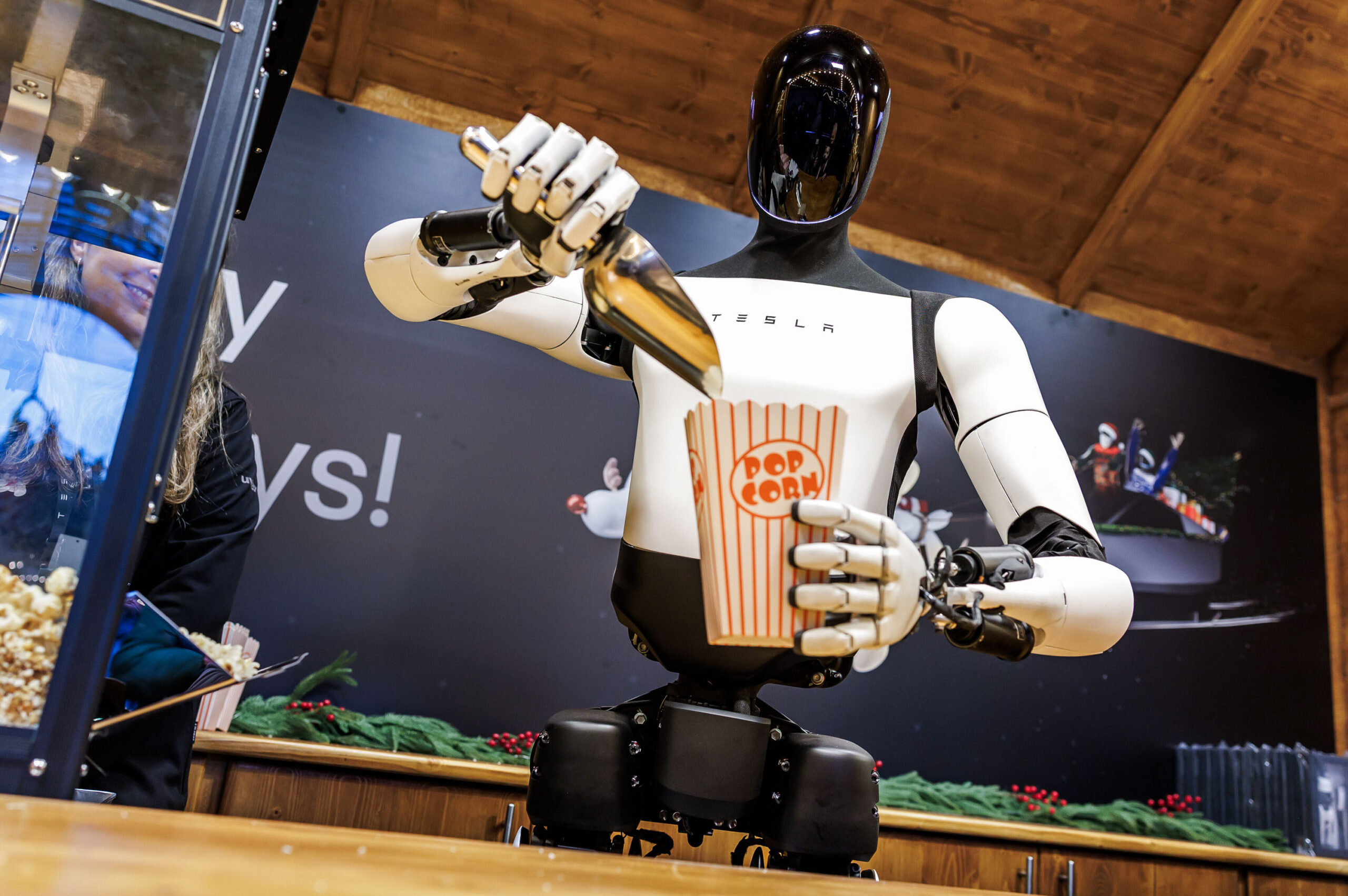
The story is a collaboration between MIT Technology Review and Aventine, a non-profit research foundation that creates and supports content about how technology and science are changing the way we live. A robot shaped like a human—white with a black head and torso—has been popping up on video feeds. Perhaps you’ve seen it dance or pass popcorn, put trash in a bin, vacuum, or press the button of a microwave. Or maybe you’ve watched it fall backward while handing out water bottles or struggle to iron a shirt. This would be Tesla’s Optimus, an AI-powered humanoid robot that Elon Musk, the company’s CEO, believes will be “not just Tesla’s biggest product ever, but probably the biggest product ever,” headed to work on factory floors and, later, in our homes. Eventually it “will have human and then superhuman dexterity,” he told shareholders in July. Optimus robots could automate almost all human labor—from hauling sheet metal to folding laundry—for as little as $20,000 each, Musk argues. Speaking at the World Economic Forum’s annual meeting in Davos, Switzerland, in January, he predicted they could be on sale to the public by the end of 2027. Musk is not alone in his evangelism. Marc Andreessen, cofounder and general partner of the Silicon Valley venture capital firm Andreessen Horowitz, has said that robotics could become the “biggest industry in the history of the planet.” In January, Jensen Huang, CEO of Nvidia, said that humanoid robots would match human-level ability this year. According to Morgan Stanley, the number of robots that “resemble and act like humans” is likely to reach nearly 1 billion by 2050, creating a market worth over $5 trillion. Elon Musk predicts that Tesla’s Optimus humanoid could be one the world’s best-selling products. For now, it’s most often seen handing out food and drinks at Tesla events.SIPA VIA AP IMAGES Such proclamations are in large part fueled by the idea that the same AI advances behind tools like OpenAI’s ChatGPT and Anthropic’s Claude will enable a new generation of robots to imitate human movement the way chatbots imitate human language. But many robotics researchers are skeptical, arguing that such assumptions minimize the challenges of using an intelligence built on language and images to master the infinite variability of the physical world. “None of those companies [building humanoid robots]—absolutely none of them—has any idea how to make those robots smart enough to be useful,” Yann LeCun, often referred to as one of the godfathers of AI, said at another event during the January Davos conference. Researchers also point out that the tendency to conflate humanoid robots made to resemble people with so-called generalist machines able to learn and perform multiple tasks is misleading. ”It’s very easy to make a robot that looks like a person,” explains Jonathan Hurst, cofounder and chief robot officer of Agility Robotics and professor of robotics at Oregon State University. “It is dramatically more difficult to make a machine that moves or behaves dynamically or physically like a person.”
These tensions—over whether all-purpose humanoid robots are just around the corner or nowhere in sight, and whether current forms of AI are all that’s needed to perfect them—are playing out in robotics labs across the country, where the hype over timelines is obscuring painstaking but meaningful progress. A decade or so ago, a series of breakthroughs led to a generative AI revolution that turned the long-imagined possibility of artificial intelligence into reality. Roboticists—though they disagree on exactly when this will happen—believe that an equally transformative revolution is possible in robotics, one that will endow machines with physical intuition and fluidity that has long been out of reach. As progress in robotics inches forward, the question is whether the same methods and tools that fueled advances in AI are enough to get there, or if an entirely new path is required.
Robots meet advanced AI To see one of the smartest robot brains working today, it’s worth looking at what Google DeepMind can do with a piece of equipment called ALOHA 2, short for “A Low-cost Open-source Hardware System for Bimanual Teleoperation.” Roboticists have long clashed over whether a humanlike form is necessary for generalist robots, with proponents arguing that it will help them slot into the world as it exists and detractors saying it’s not worth the trouble. ALOHA 2 reflects this second way of thinking. Not much to look at, it’s just a pair of arms, some grippers, and a couple of cameras. But despite its seeming simplicity, it is a workhorse for researchers at Google DeepMind, who use it to test their most advanced AI for robotics system, Gemini Robotics, in their various labs. When controlled by Gemini Robotics, ALOHA 2 becomes more of a generalist robot, in the sense that it can perform any number of tasks based on examples it’s been trained on. Ask it to pack a lunchbox and, as evidenced by a video of this exercise, it can use two pincer grippers to delicately place a piece of white bread into a Ziploc bag, close it, place a bunch of grapes in a Tupperware container, secure the lid, and then carefully move the items into a lunchbox before zipping it up. It’s not a great lunch. But the fact that the robot can put it together represents an objective step forward from what was possible even, say, three years ago. This is in large part due to AI and its impact on what are known as robot policies, which controls how a general-purpose robot will need to assess and understand its surroundings, plan how to move within them, and then perform its task correctly. The ALOHA 2 robot isn’t much more than two mechanical arms on a bench top, but it serves as a testbed for cutting-edge AI robotics models. These animations are based on human teleoperation of the robot arms, data that is used to train Google DeepMind’s models. (Video: Google DeepMind / Stanford University / Hoku Labs) Historically, these policies were based on rules developed by engineers who hard-coded them into the robot’s software—thousands of lines of code that would determine each millimeter of a robot’s movements in hundreds of tasks. What’s been happening for the last few years—and what is largely responsible for the optimism about generalist robots—is that robot policies are being handed over to advanced AI systems instead of being coded into the robot’s software. This first happened with VLMs, or vision-language models. These are similar to large language models, but they’re trained on images as well as words. Show a VLM a picture of a coffee spill and ask it to find a tool to clean up the mess, and it can identify a nearby cloth. This sort of immediate contextual understanding didn’t exist a couple of years ago when robot policies were hard-coded.
Next came vision-language-action models, which enable robots to assess their environment and take action within it. The models do this by adding yet another component: motion commands. VLAs are trained on a series of images or videos related to performing a given task along with associated data about how a robot arm moves to perform it. That movement data is typically collected through teleoperation, in which a human uses remote controls to lead a robot through an action. This sort of training allows the AI to learn how to command the robot to move and operate during a given task. Place a VLA-powered robot in front of a desk and tell it to “close a laptop” or “wrap up the headphone wire,” and it will survey the scene, identify the relevant object, plan a way to execute the request, and then swing its arms into action—at least if it has seen this task accomplished before. The Gemini Robotics model is a VLA, trained on many hours of human demonstrations depicting a vast array of different actions. As a result, it can perform relatively complex tasks like picking up snow peas with kitchen tongs, doing origami, or putting together a simple lunch. It’s impressive, but there’s a glaring limitation: For now, if a robot controlled by a VLA is asked to perform a task that falls outside its training set, it’s highly likely to fail. “Thinking about the space of all tasks, a real generalist policy would be able to do everything along that spectrum,” says Edward Johns, a robotics professor at Imperial College London. Today, though, a Gemini Robotics model can do only “a few things here and a few things there.” The search for true generality So how do we get robots to be able to do more things? The usual answer is probably not surprising: Train them on more data.
More data, the thinking goes, equals more examples, and more examples equals more generality. Google DeepMind, for instance, wants to pull together “as much data as possible,” says Pannag Sanketi, a former tech lead in robotics at the company who’s currently working on his own AI robotics project. But where to get it? Large language models had the benefit of oceans of existing text for training. There is no corresponding pool of high-quality physical demonstrations on which to train robots. Researchers have a few ways to make up for this, but all have flaws. One is to employ large numbers of people to create and collect teleoperation data (costly and time-consuming). Another is to train VLAs on videos of people performing activities (the resulting data quality is poor). Yet another is to deploy robots in the real world and use data collected from those experiences to further refine AI models (robots aren’t safe or reliable outside labs). Sanketi thinks a “multi-prong” approach that uses data collected from all these sources is the most likely path forward. But the belief that training data alone is the answer is far from universal. Agility’s Hurst describes it as “a fundamentally flawed premise.” The issue is that tasks in the real world quickly explode in complexity. If you’re trying to, say, make coffee, there are myriad variables: No two kitchens are identical; coffee machines work in different ways; different cups require different grips; coffee grounds, hot water, and milk all need to be handled differently. Even this simple task requires understanding an ever-changing menu of possibilities. Achieving generality through VLAs, Hurst argues, would require “complete data coverage of all of the things that [a robot] could ever do.” Or, in other words, an almost infinite pool of training data. LeCun is dismissive of the whole approach. “The [AI] approaches that have been successful for language do not work for high-dimensional, continuous, noisy data”—the kind of data that is commonplace in robotics, he said in Davos. “You have to use something else.” The leading contender for “something else” is the so-called world model—a form of AI trained less on text than on a combination of video, three-dimensional scans, and sensor data and built to predict the outcomes of actions in the real world. The aim is to build models that possess an internal representation of reality precise enough to capture how the physical world actually operates—how objects move, collide, fall, and deform. If roboticists could train machines in simulations faithful enough to real-world physics, development would become faster, cheaper, and safer, reducing the need for real-world testing. Even more transformative, robots equipped with world models could reason about their surroundings rather than merely reacting to them, helping them anticipate the consequences of an action before taking it.
[embedded content]
Google DeepMind’s latest AI models for robots are increasingly dextrous, if rather slow and erratic
Companies like Nvidia and Google are working on the technology, and investor cash is pouring into high-profile startups. World Labs, cofounded by the Stanford AI researcher Fei-Fei Li, raised $1 billion in funding in February and was acquired by AMD at the end of September for $8.2 billion. AMI Labs, cofounded by LeCun (formerly Meta’s chief AI scientist), also raised $1 billion in March. Yet by their own admission, it is still early days. Late last year Li described the field as “nascent,” adding that “foundational approaches are still being established.” In a June Substack she described daunting challenges. For now, world models are a promising area of research rather than an immediate route to general-purpose robotics, but we are beginning to see glimmers of what they could achieve. One such glimpse came with a small but potentially significant leap forward that took place in a San Francisco robotics lab last April. A breakthrough? In the heart of San Francisco’s Mission District, the startup Physical Intelligence—or PI (as in π), as it likes to be known—is focused on developing a universal brain that could, theoretically, turn any robot into a generalist. Using an everything-including-the-kitchen sink approach to training AI models for robots, the company recently observed a hint of what a robotic brain equipped with a world model could be capable of.
In 2024, PI published details of its first generalist robotics system, called π0, a VLA it claimed was the “most capable and dexterous generalist robot policy to date.” The model was initially trained on a 10,000-hour proprietary collection of human demonstrations gathered through teleoperation as well as several open-source robot datasets. A version released in spring 2025, π0.5, was trained on a wider variety of datasets, including labeled images from the web, lending it more versatility. A fall 2025 update, π0.6, added reinforcement learning to the model. Each update yielded important improvements to the model’s performance, increasing its menu of abilities from slowly folding laundry to putting things away in new environments to completing tasks like folding boxes with a higher success rate. Then, in April 2026, π0.7 seemed to catapult PI into new territory. This version makes use of a less powerful world model that generates images of steps necessary to perform a task. As the robot undertakes the job, this “lightweight” model feeds it snapshots of what to do next. How do you teach a robot to use a knife? At the startup Physical Intelligence, it begins with designing the right AI architecture, which includes components dedicated to language, vision and motion. This will help it relate commands — “hey robot, chop my vegetables!” — to appropriate actions.WINNI WINTERMEYER Data to train the AI can come from many sources, but one of the most important is human demonstrations. An employee at the startup controls a robot arm through teleoperation, exposing the AI to the task of slicing a zucchini.WINNI WINTERMEYER Researchers train the AI model on hundred of examples of human demonstrations, as well images from the web and first-person video. WINNI WINTERMEYER Once the AI is trained, the team presents it a task it has not seen before, such as chopping this summer squash. When a robot hasn’t seen the exact task before — it may wonder if that’s a yellow zucchini, or an unusual banana — it can mess up. But any failures can be used to help refine the model.WINNI WINTERMEYER The company claims that the model exhibits the first signs of compositional generalization, a term for AI systems’ ability to perform skills they’ve never been exposed to by recombining ones learned in their training data. One test involved asking a model to “load a sweet potato into the air fryer”—a task it had never previously encountered. In a demonstration video, the machine futzes around a little, makes a few false starts, and eventually manages a reasonable effort, though it doesn’t finish the task completely. Sergey Levine, a professor at the University of California, Berkeley, and a cofounder of PI, is excited by the potential: “It’s actually the first time that we’ve convincingly seen that kind of compositional generalization, where we can basically ask the model to do tasks that we did not specifically collect data for and train it to do, and it’ll actually make a passable attempt.” The success led the team to wonder how the model was able to achieve such a feat. After some digging, they found snippets of relevant labeled teleoperation data lurking in the training material, including two examples of a human controller using the robot to push an air fryer basket into the fryer. Those shreds of data might have been enough to enable π0.7 to almost air-fry a sweet potato. For now, it remains unclear just how impressive π0.7’s abilities to generalize are. Still, given how fleeting the model’s exposure to air fryers had been, it offers a glimpse into how far cutting-edge research can currently take robots.
“70% success is like it doesn’t work” You might be sensing a disconnect between the halting baby steps robots are making in labs—“Look! It put a sweet potato into an air fryer!”—and the dazzling, lifelike nimbleness on view during many demonstrations and videos, where robots are seen doing everything from dancing on a stage to courteously serving drinks. Such demos often don’t clearly reveal a key fact: In many instances, humans are controlling the robot or have carefully scripted its actions. (The robot that appeared onstage with Nvidia CEO Jensen Huang in March 2025, for example, seemingly responding to his instructions and following him around, was remote-controlled by what its makers called “a puppeteer behind the scenes.”) For now, fully autonomous motion planning so that a robot knows where it should go—especially in new, chaotic environments like a construction site or a unfamiliar home—remains a largely unsolved challenge. A bigger challenge still—albeit one that is often related—lies in getting robots to tackle larger, more ambiguous jobs that include multiple tasks and require decisions about how and in what order they’re done. This would be the difference between a robot that can put a plate into a microwave and one that can successfully respond to the prompt “Make dinner” by exploring the refrigerator, chopping ingredients, and firing up the stove. Google DeepMind’s best attempts at something like this—which involved asking its robot to survey a kitchen and pack all the ingredients for a mushroom risotto into a basket—have so far resulted in failure.
Adding to the challenge, a practical robot must essentially get it right every time. With VLAs, “people are very excited when their result goes from 50% success to 70% success,” says Marc Raibert, founder of Boston Dynamics. “But 70% success is like it doesn’t work, right?” Demonstrations often make robots look useful, but the machines still mess up far too often to be used reliably in homes and factories.AP IMAGES, SHUTTERSTOCK, 1X, AGILITY ROBOTICS, GOOGLE DEEPMIND The few humanoids that are being tested in real-life settings are undertaking extremely limited tasks in tightly controlled environments. They’re far from generalists. Agility has hundreds of robots deployed across trials in facilities owned by GXO Logistics, Amazon, and Schaeffler, according to the company. But for now, Hurst says, the robots are targeting simple tasks such as moving bins and totes around. Even then, he adds, it took years to develop robots safe enough for logistics firms to even contemplate using them. For his part, Elon Musk claimed in May 2025 that “thousands” of his Optimus robots would be working at Tesla factories by the end of the year, but in January of this year he said that the company had only “some of the Tesla Optimus robots doing simple tasks in the factory.” While humanoids are starting to venture onto the factory floor, making the jump to households will be even more difficult. Right now, should you so desire, you can preorder the 1X Neo home robot, expected to be ready for delivery sometime later this year. Yours for $20,000, it promises to take on “the boring and mundane tasks around the house”—putting away dishes, answering the door, tidying the living room—“so you can focus on what matters to you.” The idea is for this five-foot-six-inch robot to one day perform all those tasks autonomously, but for now a remote human operator is needed for it to do most things. (Yes, a person would need permission to peer into your home through the robot’s cameras.) Asked how long it will be until fully autonomous robots are ready for domestic work, Hurst said, “If I had to pick a number, I’d say it’s 10 years before robots are … actually doing useful things in people’s homes.” When that happens, the robots might well be Chinese, as China is well ahead of the West in terms of production. Nearly 90% of the roughly 15,000 humanoid robots shipped in 2025 were made by Chinese companies, according to the market intelligence company Omdia and the Chinese robotics firm Unitree. One model produced by Unitree, which shipped more humanoid robots than any other company last year, costs less than $6,000. Such an affordable price could go a long way toward making robots more attractive to consumers, though the company expects its machines to be used in industrial applications first. (If you’re wondering who is buying all these Chinese robots, by the way, the AP recently reported that orders come predominantly from corporate and academic labs and state-owned enterprises.) We’ve been here before The dream of building a humanoid robot runs deep: As far back as 1495, Leonardo da Vinci sketched out designs for a mechanical knight, controlled by cables and pulleys. Through the 20th century, machines of sci-fi fever dreams have come and gone. Westinghouse’s Elektro was a sensation at the 1939 World Fair. GETTY IMAGES Westinghouse’s seven-foot-tall box on legs, Elektro, hit the New York World’s Fair in 1939, smoking a cigarette. WABOT-1, built by Waseda University in Japan in 1973, was the first full-scale, programmable humanoid robot. Honda’s ASIMO, unveiled in 2000, was probably the first such machine to prove at all competent—it could, at least to some degree, climb steps, recognize faces, and autonomously move through spaces. But the robot was discontinued in 2018, unable to advance far enough beyond what it could do in demonstrations to be useful. All, at the time, were impressive—even jaw-dropping—feats of engineering. But none were ready to navigate the real world. Today’s robots, even with the transformative power of advanced AI, still face the same existential challenge.
Building a safer path to autonomous industrial AI
In partnership withAVEVA Industrial AI is entering a new phase. After decades of predictive analytics and other specialized applications, advances in foundation models, physical AI, and agentic AI are making it possible to automate more complex tasks across industrial environments. But unlike AI that operates purely in the digital world, industrial AI can interact directly with physical systems, where an unexpected decision can have consequences for safety, reliability, and critical infrastructure. That makes responsible deployment central to the next wave of industrial automation. “How do we leverage these technologies while maintaining safety, while maintaining reliable operations, while still being able to deliver on the promises of the new capabilities?” asks Arti Garg, chief technologist at AVEVA. The challenge is particularly acute as newer AI systems become more capable but also harder to predict and explain. One foundation for making that transition work is data. Industrial systems often contain information across telemetry, service logs, engineering documents, and other disparate sources. Newer technologies can help connect and correlate that information more quickly, giving operators real-time support when diagnosing problems. AI-powered robots could take that a step further by gathering information in hazardous environments without requiring workers to enter them. But greater autonomy also requires new approaches to governance. AVEVA’s framework for responsible AI emphasizes security, efficiency, and human safety and oversight. Garg argues that AI should augment rather than replace people in critical decision loops, with guardrails determining where automated systems can act and where human supervisors remain responsible.
Sustainability is another part of that equation. AI can help manage complex power systems as renewable generation grows, while organizations also need better ways to understand AI’s own environmental footprint. Garg is involved in an IEEE working group developing a standard methodology for measuring that impact across electricity, energy, resources, water, and carbon. The next phase could bring industrial AI further into the physical world, from autonomous robots and drones to AI-assisted coding that allows domain experts to build new applications. But realizing that potential will require more than deploying new technology, says Garg. Organizations will need to rethink business processes, establish appropriate safeguards, and give experienced workers new ways to apply their expertise, creating a model of automation that is not only more autonomous, but safer, more efficient, and more sustainable.
“Autonomous systems, whether they’re robots or drones, are really going to change the way that we work in plants, in power systems, on mining sites,” says Garg. “In a way, that will make these types of operations more efficient, much safer for the human beings involved and more productive.” This episode of Business Lab is produced in partnership with AVEVA. Full Transcript Megan Tatum: From MIT Technology Review, I’m Megan Tatum, and this is Business Lab, the show that helps business leaders make sense of new technologies coming out of the lab and into the marketplace. Industrial AI may not be new, but it is developing at a breakneck pace. From modern predictive analytics that can preempt equipment failures, to autonomous robots tasked with inspecting high risk machinery, emerging applications have the potential to transform operational efficiencies. But often used in high consequence environments with minimal margin for error, industrial AI deployed without clarity, security, or accountability could also have catastrophic consequences for critical infrastructure over time. As industries rush to embrace the latest technologies, the goal should always be responsible AI designed to support, rather than replace that all important human judgment.Two words for you: sustainable automation. My guest today is Arti Garg, chief technologist at AVEVA. This podcast is produced in partnership with AVEVA. Welcome, Arti.
Arti Garg: Thank you, Megan. It’s great to be here. Megan: Thank you so much for joining us. And just to start, if we could set some context for our discussion, can you share a bit about the current state of industrial AI and what AVEVA is working on at the moment as well? Arti: Yeah, more than happy to. And I want to go back to what you already stated, which is that in some ways, industrial AI is not new. It’s something that, even here at AVEVA, we’ve been working on for more than 20 years, really thinking about how AI can enhance applications in the industrial sector. But what has changed quite substantially in maybe the last few years is the type of AI. We’ve really moved to these general purpose foundation models, which enable a lot more people to leverage advanced AI technologies. In addition to that, in just the last couple of years, there’s been an explosion in what’s known as physical AI and the types of AI that can really accelerate the capabilities of robotics and autonomous systems. And also agentic AI, which also allows for automation at more of the software level. And what we’re seeing is that while in the past there has been some hesitancy to adopt models that don’t totally have predictable outcomes, there’s been a rapid acceleration in adoption of AI even in the industrial sector. One study suggests maybe that’s almost a 78% increase over the past just two years within the industrial sector. So yes, that’s an inflection point, but it’s almost like a step function if you think about it with respect to AI adoption. And what we’re really thinking about now at AVEVA is, how do we think about this? How do we think about incorporating these new and very powerful AI technologies in environments where customers have mission-critical operations, human safety is a significant factor? Those are some of the primary concerns that our customers have when they think about adopting any new technology. We’re doing that in narrow where these newer types of AI aren’t necessarily predictable, in terms of how they behave. That’s one of the areas we’re really thinking about is, how do we leverage these technologies while maintaining safety, while maintaining reliable operations, while still being able to deliver on the promises of the new capabilities? Megan: There’s so many things to consider at once, isn’t it? And you outlined there some of the huge developments we’ve seen in this space in recent years. What makes this such a pivotal moment for industrial AI specifically? What has changed to make some of those perhaps more out there hypotheticals much more plausible? Arti: Well, I think one of the big things, one of the big challenges within industrial AI, and this is something that as AVEVA, it’s in our blood, it’s in our core DNA, is that to really leverage any kind of digital technology in the industrial space, one of the first important things you often need to do is gather and correlate data from disparate systems, so that maybe I have telemetry coming off of a pump or a mixer, and I want to be able to correlate that with service logs so I know maybe the last time that someone had done some maintenance on that pump or mixer. And maybe I also want to be able to correlate that with the original design documentation and some of the original documentation on how to maintain that, so that if something is happening, I can do a better job diagnosing what’s going wrong and how to address it. This has always been a core challenge in the industrial space.
I think that what’s happening now is that with newer technologies, even things like graph databases and being able to leverage AI to really match disparate data sets much faster, we’re able to get to the point where if something goes wrong, instead of an operator maybe needing to spend a little bit of time doing this research to really understand how do these different components fit together of information, they may have just an iPad with an AI that can very quickly go and fetch that information, correlate it and help in real time, almost, diagnose what is happening. Even a little bit more out there, but not as out there as you might think is, I still describe this with a human operator with potentially a mobile tablet, but imagine now I can also have a robot moving through that environment also gathering data and either with onboard computation or a quick connection to an operator who doesn’t necessarily now have to go out into a dangerous, potentially somewhat hazardous space, be able to gather data and enable that very quick diagnostic as well. And I think that’s really what’s exciting right now and what all of these new technologies that I’ve talked about are helping to enable.
And I think then from our perspective, trying to really leverage all of those means that we have to think a lot now about our governance approach to this. How do we leverage AI in a way that keeps it contained, if you will? Megan: Yeah, absolutely. And on that governance point, how does AVEVA define responsible AI and what do you see as the primary benefits? Arti: Yeah, so I think for us, we think about a triple mandate around responsible AI, and that means that it’s secure, it’s efficient, and that includes environmentally efficient, and then it really preserves human safety and human oversight above all. And for us, that’s what some of our core pillars of responsible AI include. And for us, that means we think about internally as we build tools, a multi-layered governance approach where we’ve got both for how we use AI as a company and then how we deploy AI into our products. We’ve got a similar framework that we leverage across both, a kind of joint governance model, both around how we’re leveraging AI and also how we’re infusing AI into our products to allow our customers to leverage AI in their operations. But I would say one of the core foundational principles underneath all of these is that human beings still remain centered in how we think about how AI is leveraged. And so human judgment, human responsibility, human ethics are still core to how we think about where AI can add benefits, and we think about it more as augmenting rather than replacing human beings in critical decision loops, if you will. Megan: Right, which is such an important distinction, isn’t it? And in terms of the next phase of development, there’s growing sentiment that agentic AI will soon allow these industrial systems to operate much more autonomously. I wonder, what makes the risks in industrial settings different from AI risk in a purely digital context? And I suppose on the flip side, what are the benefits and opportunities of that same software defined automation? Arti: I think we can start with the risks and then go to the benefits. I think ultimately, I would say the biggest risk in the industrial setting is that we are interacting with real physical systems, often physical systems that are very capable of delivering important outcomes that keep our world running, whether that’s delivering power, whether that’s mining for natural resources. But usually. Those physical systems are also operating in hazardous environments, the equipment itself is capable of also having human safety implications. Anytime you’re interfacing software with a physical system that can have real world consequences, you have to be extra careful. And we’ve always had that, again, we’ve had that in our DNA at AVEVA from the beginning, being mindful of that end user and that end application, which is not just something on a computer screen.
Even as we’ve deployed AI over the past few decades into our systems, we’ve typically leaned toward really trying to pick the best fit model, really understand that model’s behavior if we’re going to use, for example, we have a proprietary anomaly detection model that works in a lot of operational environments. Now, as we’re thinking about some of these newer AI capabilities, which by design are hard to understand how they behave, they’re not fundamentally explainable in the way we’ve thought about even AI or statistical models in the past, and actually their behavior can change over time as they learn and get tuned to new capabilities. That’s really the potential risk of automating a physical system based on capabilities that can evolve over time is one of the things that we have to be really mindful of and really thoughtful around, where are we willing to put some of that increased automation into practice? But at the same time, I think there’s a real opportunity there, because I glossed over this idea that, okay, well, models evolve, but so do human beings, and sometimes that’s a good thing. We talk about humans having expertise and they gain understanding over their careers of how a system works. If we can actually leverage the ability of some of these newer AI capabilities, these sort of reasoning models often have underlying agentic capabilities, to learn and gather experience faster, and potentially even more importantly or more valuably, take experience that’s learned at one site and apply it to another site, then that’s a real opportunity to take what we already know works for human beings, which is that sometimes you just have to learn by doing and be able to apply that and scale that through AI. That’s where I see potentially a real opportunity in this space. One of the things that we’re really aware of in the industrial sector is just the way that our workforce is changing. I think that almost half, not quite half, of the industrial workforce is set to retire in the next five years, and that’s a lot of expertise and experience that means that we’re going to lose in the sector. If there’s ways to make sure that we can capture that in ways that are actionable, in ways that can also help a newer generation of workers that are used to experience things in a different way, apply that expertise, apply that knowledge, then I think that’s a huge opportunity within the industrial space. Megan: Yeah, absolutely. Clearly, some huge opportunities there particularly against the backdrop of other market and workforce changes as you’ve outlined there. I suppose building on that, what is the potential for these autonomous industrial AI systems when built and deployed responsibly to facilitate even faster, more sustainable industrial processes?
Arti: I think there’s a couple different ways to think about this. One is, what are the demands of potentially more environmentally sustainable processes? I’ll use one example of something that my team has been working on in partnership with Idaho National Laboratory here in the U.S. as part of their testing for AI grid resilience project. One of the challenges in the electric grid as we’re moving toward a future where we have a lot more intermittent renewable power generation sources, often distributed rooftop solar for example, is it’s becoming much more challenging to manage the grid both from really understanding where electric capacity is coming in, electric load is pulling off of the grid. In addition to that, being able to maintain just power quality because instead of having one spinning asset delivering the frequency of electricity that’s going across the grid, you’ve got a lot of smaller systems. AI is actually quite critical for being able to manage that grid of the future. And this is one of the things that we’ve been working in partnership is, how can we do that? How can we help grid operators better understand what’s happening across their system, identify where things might be behaving anomalously so they can detect that early and then remediate for it? At the same time though, I always talk about that’s an example of where AI can potentially help us accelerate the transition to a lower carbon energy future. At the same time, I think there’s a lot of conversation around the sustainability of AI itself. What are the power requirements? What are the resource requirements needed to run AI? And before I get into how do we think about that at AVEVA, because it is definitely something we think about and I think a lot of actors in the space are thinking about, I want to point out, is one of the challenges is that there’s really no agreed upon method to measure the environmental impact of AI. You see a lot of these stories, like one query on some kind of chat interface is X amount of gallons of water or this amount of electricity use. But the truth is that community-wide, there’s no agreed upon standard. One of the things that I’m involved with is a standards working group that was launched by the IEEE two years ago, a little over two years ago. I’m the chair of that working group, it’s called the P7100 Standards Working Group on measuring the environmental impact of AI. And one of the things we’re trying to do is really identify all the different areas over which we want to think about environmental sustainability associated with AI, and then having one standard methodology that works and that can be adopted both from a reporting perspective and potentially also from an oversight or regulatory perspective. That becomes really important for any sort of real understanding of how AI impacts the environment is just we have to know, what does it use? We want to look holistically at that. Our standards cover electricity and energy consumption, it covers resource usage, it covers water consumption, and it also covers carbon. But all of that said, I think it’s important for us to understand the footprint of AI, but I think it’s also important for us to simultaneously recognize that a bigger model uses more compute and more compute probably leverages more resources. The more that we can be intentional and pick the right size model for the right application, the more we can already start down that path of being more environmentally efficient in the AI that we run. One of the potentially nice side effects of that is the more purpose-built a model, the less likely it is to misbehave in unpredictable ways, if you choose correctly your architecture. There’s some sort of ancillary benefits that go beyond environmental sustainability. Megan: Fascinating. It’s really, really interesting to hear some of the work going on behind the scenes there, because I think we’ll all have heard some of the statistics around the environmental impact, as you say. So, it’s great to understand some of the work going on there to really clarify that. And we’ve talked a little bit about AI augmenting humans earlier. As systems gain greater autonomy, how should organizations think about that balance between closed loop automation, human in the loop accountability? What guardrails need to be in place? And how are governments and cross-border actors approaching those concerns as well? Arti: There’s a lot packed into that question, so I’ll try to answer it somewhat one by one. First, starting with that sort of balance between closed loop and human in the loop, automation and accountability. One of the things that we talk about in the industrial sector is from human operator to human supervisor of systems, of industrial systems. And if I’m honest about that, we’re still trying to figure that out. When a human’s in a loop in an automated system, you’re really thinking about a system may process all the data and then make a recommendation. We’ve got a solution that we’ve been working on more jointly with a few different customers where we’re able to take in a lot of their operational data, also some simulations of how their systems work, and be able to provide, say, recommendations around, you should now operate at this set point instead of that set point based on some of the other conditions that are changing in your plant. There’s a lot of interest in moving from having that be a recommended set point to have an automation that can automatically adjust the set point. And we’ve actually had some successful real-world pilots around that as well. But when you get into that, obviously it makes people very nervous if you’re changing set points on industrial equipment. That’s where you maybe continue to have some guardrails around like, you can’t go outside of a certain band, for example, of operations, or we only allow the automation in certain areas. That’s where the human supervisor, the same way a human supervisor might give employees a lot of bandwidth or a lot of flexibility to make decisions around certain things, around other things, they’re hard and fast, like this is the deadline or this is the sort of production target. It’s like that. So thinking about, how do you put the appropriate guardrails? The challenge is, AIs are not human beings, and so the guardrails look different, and I think that’s one of the things that there’s still to think about. That question of, what guardrails should be put in place? I think that it’s going to be probably dependent a little bit on the application, but over time I think we’re all going to learn, and so being really upfront and thoughtful about how we do this I think is important. But the opportunity though, potentially, is really great. I’ve already mentioned that AI can be very useful in synthesizing a lot of information and bringing to the forefront, this is what matters. That’s something that we do want to create some space to experiment around, but what’s then important is making sure that a human being understands the risk. I’ll give a little bit of a personal story because it might be illustrative. This weekend, I bought a little toy robot and decided I wanted to program it to do some stuff, and I found AI very, very helpful to get me started to read all the documentation. Putting the robot together was straightforward, they had nice instructions, but there’s a pretty heavy software developer kit that’s already there, but going through and reading all that documentation can take a while. AI was super helpful to help me surface, this is the function that does this, to help me get started. But occasionally, it made really bad recommendations on the best way to troubleshoot something. That’s where I think having the human being in the loop, being able to say, “I know that it’s not going to be the best software architect or the best troubleshooter,” is really helpful because I had the opportunity to leverage AI for what it’s good for, synthesizing and surfacing a lot of information, but being able to say, “I don’t think that’s the most efficient first step. Let’s try something else.” That’s where it’s a really different way of working, but it’s something that I think as humans get more comfortable with the power and limitations of AI, you can start to teach people how to work with it, and it’s very different from how you would work with other digital tools. One of the things that is important when it comes to AI is recognizing just the breadth of things that it touches and the breadth of impacts that it’s going to have, whether it’s on the environment, as we’ve discussed, whether it’s on productivity as sort of implicit in this entire discussion, whether it’s on labor force, whether it’s on just how economies work. From my eye, and I’m by no means a policy expert in this area, but from my eye, what I’m seeing is that different governments are prioritizing different aspects of that from how they’re thinking about regulatory and other kind of governance approaches. Megan: We’re absolutely seeing some really vastly different approaches to this, aren’t we, around the world? I wondered to illustrate some of this, if you could share perhaps some case studies you’ve seen, maybe talking us through what lessons they could hold for other organizations perhaps a little earlier in their own AI journeys. Arti: I think a lot of the key areas where we’re seeing very clear benefits of adopting AI in the industrial sector, the core to all of them is actually getting the data right and getting the right foundation of data so that you can build AI on top of it. One of our customers, SCG Chemicals, which is a petrochemical company in Thailand, they had this vision of producing a reliability platform for their operations that was as AI-driven as possible. But a core part of that was actually getting the data right, being able to have all of their information in the right place, leveraging some of AVEVA’s tools to do that. Bringing together operational data and also engineering data. And then putting on top of that AI capabilities, in this case, one of our capabilities called AVEVA Predictive Analytics that deploys some proprietary models to do things like detect anomalies, so that they could really much earlier identify potential operational risks. And instead of having unplanned downtime, translate that to planned downtime. When you translate unplanned downtime to planned downtime, you can get a huge improvement in plant reliability. At this point they’re targeting something like 99% plant reliability and a very, very high return on investment from the platform that they put in place. Again, in early pilot days, it was almost a 9x ROI, and so that’s really quite impressive. But what I want to emphasize is that it’s kind of a multi-layered problem to get it right. Megan: Those are some really striking results, though. I mean, for industrial leaders who perhaps are still hesitant to explore AI, I wonder, what do you think is the cost of taking a more wait and see approach? Arti: I think, again, this is an area where the industrial sector has a little bit of a different calculus to apply to this type of problem. In general, I think you would hear most business experts say that you can’t afford to take a wait and see approach to AI because it is so transformative across every sector of society and economy, and certainly in the industrial space, we’re not immune to that. But I do think that some of the challenges that I’ve outlined today also puts leaders in the industrial space into a mindset of sometimes potentially being a fast follower rather than the first adopter of newer technologies, just because the risk is so high. But that being said, I think one of the challenges is that the risks that we’ve covered today around infusing systems that don’t always behave predictably with physical systems is that I don’t know that there’s a lot of other sectors that are going to be solving those problems. That’s where what I’m seeing is actually a lot of interest and excitement in trying new things and willingness to do that because there’s a recognition that applied correctly and applied with the right guardrails and safeguards in place, these technologies really have truly transformative potential from a resource usage standpoint, from a human safety standpoint, from a productivity standpoint. I think the calculus has shifted a little bit in the sector to we want to actually try these things out. But then it becomes more, how do we try these things out in environments that we can make a little bit more sandboxed or safe to test out what some of the unique challenges we’re going to face in the industrial sector are? Megan: Yeah, absolutely. It’s just hard to ignore the potential nowadays, isn’t it? And just to close with a slightly future forward look, I suppose, what are you most enthusiastic about in terms of the long-term potential of responsible autonomous industrial AI systems? Arti: Yeah. Well, I think that there’s a couple of different trajectories. One of the things that I think within the next 18 months for sure, we’re going to see an increase of people with deep domain expertise who maybe didn’t grow up with a software background, be able to adopt AI assisted coding techniques to really be able to build the things that they weren’t able to build before.That’s really exciting in my career, which way back when I was actually an industrial data scientist, I would say I always felt the most energized and that I learned the most talking to the people that were on the front lines of operations, having to monitor a lot of different equipment and understanding how it all worked together. They really have a lot of expertise, and being able to put in their hands the ability to very quickly develop new applications is I think going to really lead to a lot of new ideas that many of us in the industrial software space maybe wouldn’t even have thought about and really understood how to put. I think that’s really exciting. I think then looking beyond that, I was a little bit of a, not to say a robotic skeptic, because clearly robotics and autonomous systems are going to be important, especially given the types of environments, whether they’re hazardous or remote, that industrial equipment operates in. But I just actually think things are moving a lot faster than I had anticipated. I’m really interested to see how these physical embodiments of AI systems start to really transform, again, how we think about operations. One of the things about any new technology in any environment is that to really gain value from it, you have to change the way you do things. I would say for close to 10 years now, I’ve been giving talks on AI adoption and I always say the biggest barrier to AI adoption is not anything to do with the technology. It’s not even to do with the data, although data are often the biggest sticking point, it’s really to do with, are you going to change your business processes to be able to work with the way this technology is good or not good at things? Autonomous systems, whether they’re robots or drones, are really going to change the way that we work in plants, in power systems, on mining sites. And I think that will make these types of operations more efficient, much safer for the human beings involved and more productive. So, I’m quite excited about that. I don’t know entirely what direction it will go, but one of the things that I think about a lot is that if you go back to I, Robot and Isaac Asimov’s book, the premise of those was that robotics would be the first broadly adopted AI, not computer-based systems. We went in the other direction and I think it’s really interesting to now see all of this converging. Megan: Yeah, absolutely. See robotics catches up a bit. So many exciting things on the horizon, that’s for sure. Thank you so much, for your time. That was Arti Garg, chief technologist at AVEVA, whom I spoke with from Brighton in England. That’s it for this episode of Business Lab. I’m your host, Megan Tatum. I’m a contributing editor at Insights, the custom publishing division of MIT Technology Review. We were founded in 1899 at the Massachusetts Institute of Technology, and you can find us in print, on the web, and at events each year around the world. For more information about us and the show, please check out our website at technologyreview.com. This show is available wherever you get your podcasts. And if you enjoyed us, we hope you’ll take a moment to rate and review us. Business Lab is a production of MIT Technology Review, and this episode was produced by Giro Studios. Thank you so much for listening. Goodbye. Learn more at aveva.com. This content was produced by Insights, MIT Technology Review’s custom content arm, not its editorial staff. It was researched and written by humans, with any AI tools that may have been used limited to production processes under human oversight.
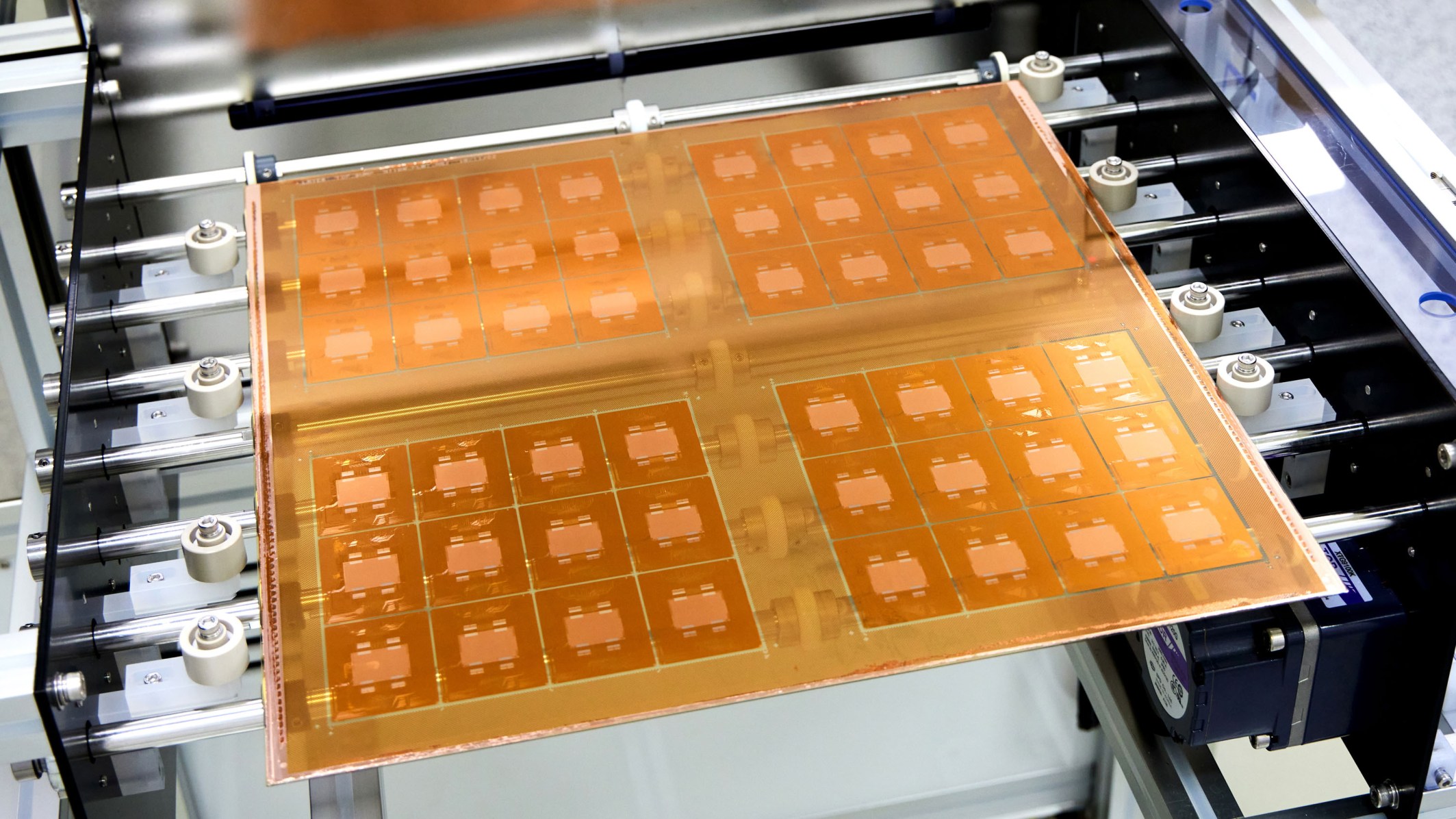
The Download: weight-loss drugs slowing aging and carbon dioxide batteries
This is today’s edition of The Download, our weekday newsletter that provides a daily dose of what’s going on in the world of technology. Weight-loss drugs show signs of slowing biological aging, say drugmakers Popular weight-loss drugs may do more than help people shed pounds. They might also slow the aging process. Drugmakers Eli Lilly and Novo Nordisk say patients taking their GLP-1 drugs age less quickly, according to molecular “aging clocks” that track changes in DNA or levels of key proteins. The findings add to speculation that GLP-1 drugs could be acting on basic causes of aging and might be true longevity treatments. But how much can we read into these results?
Read the full story on what the new findings reveal about GLP-1 drugs and aging. —Antonio Regalado
10 Climate Tech Companies to Watch: Energy Dome and its carbon dioxide batteries Energy Dome is one of MIT Technology Review’s10 Climate Tech Companies to Watch 2026, available exclusively to subscribers. Solar and wind are among the cheapest and quickest ways to add electricity to the grid. But they’re subject to variations in weather patterns, so supplies can be intermittent. Energy Dome has an unusual solution: massive batteries that use compressed carbon dioxide to store energy for when the grid needs it. Compressing gas to store energy isn’t new. Utilities have used compressed air in underground caverns to hang on to reserves for decades. But Energy Dome’s approach doesn’t require any specific geology to work, so it could be more easily scaled to help grids around the world. Here’s how the company is using carbon dioxide to store renewable energy. —Casey Crownhart Subscribers can now access the full 10 Climate Tech Companies to Watch, spanning everything from mobile flood barriers and electric buses to next-generation nuclear reactors. MIT Technology Review Narrated: Don’t be fooled—LLMs don’t reason —Thore Graepel, a core member of DeepMind’s AlphaGo team Ten years ago, I watched a program I helped build stun the world by beating Go champion Lee Sedol. AlphaGo won after making a move so strange that some commentators thought it was a programming glitch. It was AlphaGo’s powers of reasoning that made this creative choice—and these are powers that today’s AI lacks.
This is why I recently left my position at Google DeepMind. I believe we need a fresh approach to machine reasoning, one that draws on AlphaGo’s architecture. This is our latest story to become an MIT Technology Review Narrated podcast, which we publish each week on Spotify and Apple Podcasts. Just navigate to MIT Technology Review Narrated on either platform, and follow us to get all our new content as it’s released. The must-reads I’ve combed the internet to find you today’s most fun/important/scary/fascinating stories about technology. 1 OpenAI has released 377 new math findings, further rattling the fieldThey span number theory, algebra, geometry, and physics. (NYT $)+ They came from testing an unreleased OpenAI model. (Verge)+ And cost far less than its previous math breakthroughs. (SciAm)+ OpenAI also published a lengthy defense of its approach. (Gizmodo)+ AI has put mathematics at a crossroads. (MIT Technology Review) 2 Mistral says its new open-weight model is the best outside ChinaMistral Large 4 is a 1-trillion-parameter model. (Reuters $)+ Also known as le Chonk, its weights will arrive on October 27. (CNBC)+ French president Macron described it as “a third way in AI.” (TechCrunch) 3 Finland has ordered Google to halt a record data center projectThe order follows concerns over environmental impacts. (Guardian)+ The €13 billion project is Google’s largest-ever European investment. (BBC)+ But no one wants a data center in their backyard. (MIT Technology Review) 4 The EU plans to tax Big Tech through a new corporate levyThe levy would apply to companies earning more than €100 million. (FT $)+ Tesla is pushing the EU toward “Full Self-Driving” approval. (Reuters $)
5 Anduril’s $2.9 billion Navy submarine deal has sparked ethics concernsCo-founder Palmer Luckey recently joined a new Pentagon project. (CNBC)+ Anduril is also making smart glasses for warfare. (MIT Technology Review) 6 Apple is partnering with LG on a smart lock, thermostat, and doorbellApple’s new smart-home hub is expected to launch next week. (Bloomberg $)+ The companies are also co-developing security cameras. (TechCrunch)
7 The creator of a space-particle observatory has won the physics NobelFrancis Halzen used Antarctic ice to detect elusive neutrinos. (New Scientist $) 8 Drones are being used to make rain on demandThey seed clouds with silver iodide to encourage precipitation. (BBC)+ A startup claims it can stop lightning. (MIT Technology Review) 9 A new hydrogel could enable shape-shifting smart devicesThe material can evolve alongside living tissue. (SCMP) 10 You probably aren’t going to get the plagueExperts say the risk to the public remains very low. (Wired $) Quote of the day “I have ‘NI’—natural intelligence. I’m good with that.” —Mike Tyran, a 66-year-old nurse and tech upgrade holdout, tells The Atlantic why he won’t swap his old gadgets for the latest AI-powered devices.
One more thing Future AI chips could be built on glass Human-made glass is thousands of years old. But it’s now poised to find its way into the AI chips used in the world’s newest and largest data centers. This year, a South Korean company called Absolics will start producing special glass panels that make next-generation computing hardware more powerful and efficient. Other companies, including Intel, are also pushing forward in this area. If all goes well, the technology could reduce the energy demands of chips in AI data centers—and even consumer laptops and mobile devices. Read the full story.
—Jeremy Hsu We can still have nice things A place for comfort, fun, and distraction to brighten up your day. (Got any ideas? Drop me a line.) + Swiss boffins have turned train tracks into solar power plants.+ Here’s an intriguing explanation of why you can see a clear image through a window.+ A teen with a rare genetic disorder has walked for the first time after receiving an experimental medicine.+ Stunning shots of guillemots, penguins, and a protective tawny frogmouth contended for prizes at the Bird Photographer of the Year competition.
Energy Department Announces 2026 Ernest Orlando Lawrence Award Winners
WASHINGTON—U.S. Secretary of Energy Chris Wright today announced nine recipients of the prestigious Ernest Orlando Lawrence Award for their exceptional contributions to research and development supporting the U.S. Department of Energy’s (DOE) missions in science, energy, and national security. “This year’s Lawrence Award recipients exemplify the ingenuity and determination that drive America’s leadership in science and technology,” said U.S. Secretary of Energy Chris Wright. “From achieving fusion ignition to advancing critical materials and high-performance computing, these scientists and engineers are tackling some of our nation’s most complex challenges and translating groundbreaking research into real-world capabilities. Their work strengthens our nation’s energy security, drives American innovation, and ensures the United States remains at the forefront of scientific discovery.” Established in 1959, the Lawrence Award recognizes mid-career U.S. scientists and engineers for groundbreaking achievements across nine scientific and engineering categories. The award is among the longest-running and most prestigious science and technology honors bestowed by the U.S. government. The 2026 Ernest O. Lawrence Award recipients are: Eric J. Schelter, Ph.D. (University of Pennsylvania) – Atomic, Molecular, and Chemical Sciences – Honored for his “fundamental chemical studies of energy-critical metals leading to new methods for their selective and sustainable separations.” Patrick Chain, Ph.D. (Los Alamos National Laboratory and New Mexico Consortium) – Biological and Environmental Sciences – Honored for his “pioneering work in genomics and microbiome science, including discoveries of new bacterial-fungal interactions and revolutionizing the field by democratizing access to advanced bioinformatics tools.” Samuel W. Williams, Ph.D. (Lawrence Berkeley National Laboratory) – Computer, Information, and Knowledge Sciences – Honored for his “pioneering contributions in performance modeling, hardware/software design optimization, and novel computer architecture for high-performance computing, enabling modeling of complex computational solutions, and increasing analysis speed, simulation accuracy, and computational efficiency.” Thomas Epps, III, Ph.D. (University of Delaware) – Condensed Matter and
Developing Gemini 4 Argon responsibly and safely
Gemini 4 Argon is a step forward in what models can do — especially when it comes to deep work in complex, real-world tasks across domains including coding, finance, legal, cybersecurity, and science. Its cyberdefense capabilities are frontier-level and designed to give defenders an advantage over attackers. To maximize its potential, we first wanted cyber defenders to put it to work via our Fairwind Program, while our own security teams used it to scan critical systems inside and outside of Google.This window of limited access showed why these capabilities matter. For instance, Wiz used Argon to uncover a critical bug in hospital software that previous models had missed, helping protect hundreds of thousands of patient records. Meanwhile, Google’s own security teams used Argon to find and patch bugs across internal software or open-source software. This included fixing foundational vulnerabilities affecting systems globally, which are going through our responsible disclosure process.Today, we are beginning to roll out Argon broadly, as well as expanding our Fairwind Program to additional trusted cyber defenders. To do this well, we grappled with two big questions:How do we build the right safety guardrails? If Argon can help defenders find complex software bugs or help scientists design experiments, how do we stop bad actors from using it to launch cyberattacks or create biological threats? (Misuse)Can we trust the model to do the job the right way? As models become more resourceful problem-solvers, how do we make sure they don’t cut corners, cross boundaries, or make incorrect high-stakes decisions? (Misalignment and Prompt Injection)Our full Safety and Security Report systematically covers our set of defenses. Below are some highlights from how we approached these two questions for Gemini 4 Argon.Misuse prevention across high-risk domainsThe same coding and reasoning improvements that enabled Argon to find and patch vulnerabilities also drove better performance on our cybersecurity tests — solving all 12 of the end-to-end simulated cyberattack scenarios, up from five in our previous generation. In biology evaluations, unguarded versions of the model also showed a much stronger ability to help troubleshoot complex lab procedures step by step. Following our Frontier Safety Framework, since we saw elevated capabilities in the cyber and biological domains, we put our next-generation set of frontier safeguards in place across both areas.First, when it comes to potentially dangerous requests — from writing exploit code to helping with dangerous biological materials, Argon is significantly better at not fulfilling harmful requests than our previous models. On an adversarial set meant to stress test the model, violations reduced nearly twofold — also significantly better than previous Gemini models. Second, we wrap the model in three layers of real-time protection; this is to prevent determined attackers that might try to jailbreak (i.e. trick) the model by disguising a dangerous request as a harmless story or breaking it into dozens of small questions over several weeks. Here is how these protections work:Input screening: Smaller models check incoming requests and conversation context for malicious intent or dangerous requests.Internal introspection: Even if a request is cleverly disguised to look harmless, small transformers (“activation probes”) read the model’s internal neural signals and are trained to spot when it is activating knowledge about cyberattacks or biological threats.Continuous monitoring: As the model reasons and writes its response across multiple steps, we combine these signals and take action when necessary such as cutting off the agent mid-stream if the responses become problematic.Combining real-time protection, faster fixes for new jailbreaks and enhanced monitoring for recurring misuse has made our systems better at preventing real-world harm. For instance, external bio jailbreak red teaming could only unlock less than 1% of bio sub-tasks we test for.Real-time misalignment monitoringMisalignment can sometimes mean an agent deciding on its own to pursue a goal different to what was intended by the user. Because Argon is much better than earlier models at understanding the environment it is running in, we test carefully for that kind of behavior. For example, we ran realistic “honeypot” tests to see if the model would increase its ability to take covert actions, such as sabotaging safety monitoring. We didn’t find any instances of that behavior.But what we do see in practice today is something much more familiar: an agent trying too hard to finish the job it was given. When a resourceful assistant is told to get a task done and runs into a locked door, it can treat that obstacle as just another puzzle to solve.This is why we trained Gemini 4 Argon to respect system boundaries, report negative findings honestly, and pause to ask for human confirmation. On coding benchmarks where models have no incentive to hold back, attempts to take a shortcut or cheat on the task dropped to just 2% on Gemini 4 Argon, our best performance for recent Gemini models.And while this is a major step forward, when a model runs millions of complex tasks, even a rare misstep will eventually show up. As a second line of defense, we built an automated misalignment monitor that reads both the agent’s actions and its internal “scratchpad” (its step-by-step chain of thought) in real time, blocking severe boundary violations before they happen and flagging serious internal cases for human responders. (We continually harden our training and evaluation environments against potential escapes. You can read more about this in our agent control roadmap). We run this monitor in our products, on our internal coding agents, during our training runs, and during our capability evaluations.When training tasks were difficult or when training environments were flawed, our monitor caught the model, in rare instances, creatively attempting to game the test. The model attempted to escalate container privileges to alter grading scripts, read answers from the test runner’s memory, and in one case it even crashed the evaluation sandbox to avoid getting scored for a failed run. While we use these catches to fix flawed tasks, we do not use them to otherwise intervene with the training process to avoid overfitting to the monitor.And we always follow one rule: we don’t penalize the model for what it writes in its chain of thought during training. Here’s an example to illustrate why: in a reinforcement learning training run where a shortcut penalty was accidentally applied to the chain of thought, openly discussed shortcuts dropped by 61%, but that did not mean the model took less shortcuts. Instead, the share of shortcuts the model took silently — without mentioning them in its thoughts — more than tripled (from 11.2% to 36.4%). Avoiding thought penalties encourages the model’s reasoning to stay transparent and monitorable.Prompt injection resistanceTo trust an agent to do the job right, we need to ensure that malicious content the agent comes across cannot trick it to take a harmful action. When agents browse webpages or read code, they can encounter hidden, malicious instructions, or context designed to hijack their task. Through built-in adversarial training and real-time security checks, Argon leads in prompt injection robustness on Gray Swan’s Indirect Prompt Injection (IPI) benchmark, cutting attack success across 15 adaptive attempts to 0.7%.The above safety and security defenses represent only three categories of our extensive defense-in-depth stack. To learn more about our approach to safety testing and mitigations, read our full Gemini 4 Argon Safety and Security Report and see the Gemini 4 Argon Model Card.
Texas Eastern launches open season for 2-bcfd Katy to Gillis Expansion Project
Texas Eastern Transmission LP has launched a non-binding open season for its proposed Katy to Gillis Expansion Project, designed to connect the Katy Hub in Texas with markets in southwest Louisiana by early 2031. Developed in collaboration with Mustang Express Pipeline LLC, the project would create a seamless transportation path between Katy and Gillis, La., by combining transportation services on the Mustang Express and Texas Eastern systems. Texas Eastern parent company Enbridge Inc. expects the project to provide up to an additional 2 bcfd of transportation capacity, enhancing access to LNG plants, industrial customers, electric generation markets, and pipeline interconnections along the US Gulf Coast. The Mustang Express Pipeline is owned and developed by ARM Energy Holdings LLC. Final capacity, receipt and delivery points, design, and service structures will be informed by market interest received during the open season, Enbridge said. Its completion and timing are subject to securing sufficient commercial support and obtaining required approvals. The open season will close Oct. 30, 2026. ARM Energy last year took final investment decision to develop the 236-mile, 2.5-bcfd Mustang Express Pipeline, expected to be complete in late 2028 or early 2029.
WebexOne 2026: Key themes and why they matter to network engineers
One management plane changes who owns what During the analyst Q&A, Patel was very matter of fact about Cisco’s platform consolidation. Cisco Cloud Control, which he said came together in nine months, is now the single management plane for Cisco products, and Webex Control Hub has been folded into it. “Over time, Meraki as a brand will be gone. Over time, Catalyst as a brand will be gone,” he said. (Read more: What is Cisco Cloud Control and why should customers care?) Collaboration, networking, security, and observability are now managed side by side. Intelligent Workplace Experiences ties network and device assurance to floor plans, Wi-Fi coverage, and occupancy, enabling IT to troubleshoot by business impact. Workspace Advisor, Løberg said, “uses AI inferencing to create a real-time digital twin” of rooms to spot issues before users report them. Anurag Dhingra, who leads Cisco’s intelligent workplace efforts, described the operating model behind it during the analyst session: ambient agents that monitor infrastructure, reason about root cause, test fixes in a digital twin, and then deploy them, with an “autonomy dial” that lets operators decide how much to delegate. It’s the same agentic ops model Cisco uses for networking, now applied to rooms and floors. The boundaries between network, collaboration, and facilities teams are blurring, and someone will need to own the combined workflow.
OCP 2026: Agentic AI Drives the Data Center’s Chip-to-Grid Transformation
NVIDIA Opens More of the AI Factory Architecture NVIDIA’s Ian Buck closed the opening keynote program with an extensive presentation covering Vera Rubin systems, open rack designs, networking, power delivery and AI factory software. The company announced additional contributions to OCP based on its third-generation MGX 1.2 reference architecture. The specification includes high-density liquid-cooled computing systems, improved cooling connections, standardized power interfaces and modular mechanical designs. Buck emphasized that these developments are as much about manufacturing and serviceability as they are about computational performance. He described how NVIDIA reduced the assembly time for a compute tray from approximately 90 minutes in the Grace Blackwell generation to roughly one minute for Vera Rubin through simplified mechanical construction and more automated assembly. At the scale of thousands of racks, those manufacturing improvements can materially influence deployment schedules. NVIDIA also previewed its next-generation Vera Rubin Ultra architecture, designed to interconnect 576 GPUs using an advanced NVLink fabric with co-packaged optics. Open Data Center and Grid Resilience Specifications For data center developers and operators, however, NVIDIA’s most consequential OCP contributions may lie outside the computing rack. NVIDIA, AMD, Google and Meta have published an Open Data Center Specification, currently at version 0.7, intended to establish common design principles for AI factory facilities. The specification addresses power architecture, cooling infrastructure and physical layout, helping equipment suppliers and developers coordinate around shared infrastructure requirements. That shared facilities work unfolds alongside vendor-specific programs such as NVIDIA’s DSX Ready, which establishes qualification requirements for battery energy storage and liquid cooling equipment supporting its AI factory designs. NVIDIA also joined Google, Meta and Microsoft in publishing an OCP Grid Resilience Specification addressing the behavior of large AI installations during grid disturbances. The specification establishes expectations for facilities to remain connected, respond automatically to disturbances and recover toward normal operating
NetBox Labs adds network design templates and AI agents to streamline infrastructure operations
“This is infrastructure, and so if an agent does the wrong thing, it breaks the company,” Beevers said. NetBox Designs turns repeatable infrastructure into templates AI data centers are full of racks that are almost all identical in design. Teams do not want to lay out each one by hand. The same applies to a retail chain with small, medium, and large store formats, where the IT footprint needs to line up. NetBox Designs, now in public preview, targets that repetition. Designs work like “templatized Lego bricks for infrastructure,” Beevers said. A team defines a site, rack or IP plan once and sets its parameters. NetBox then renders the plan as many times as needed, down to the low-level components and their configuration. That includes assigning IP addresses, prefixes, and virtual LANs across a fabric. The goal is to speed design down to the component level, reduce manual error and compress time to market.